768
8–21.
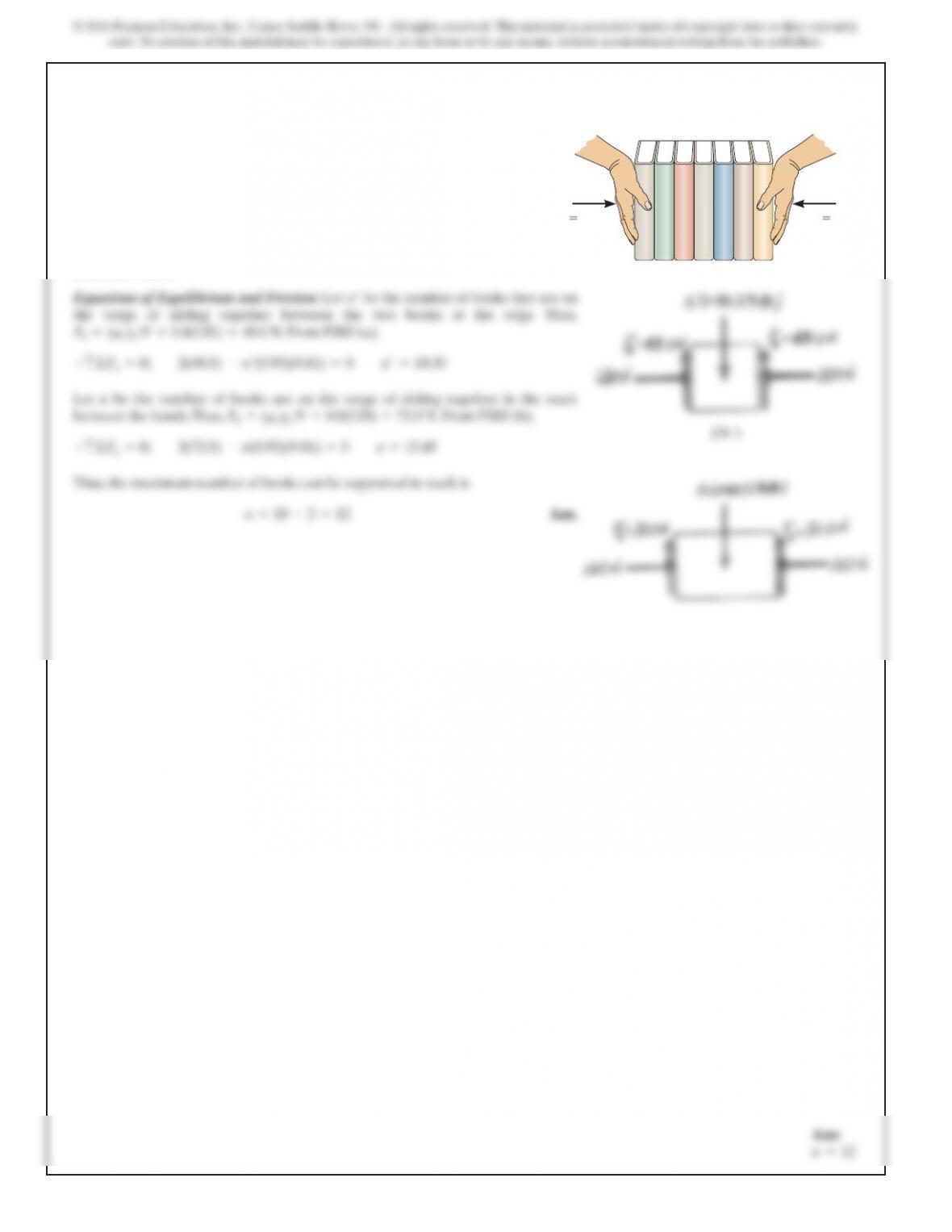
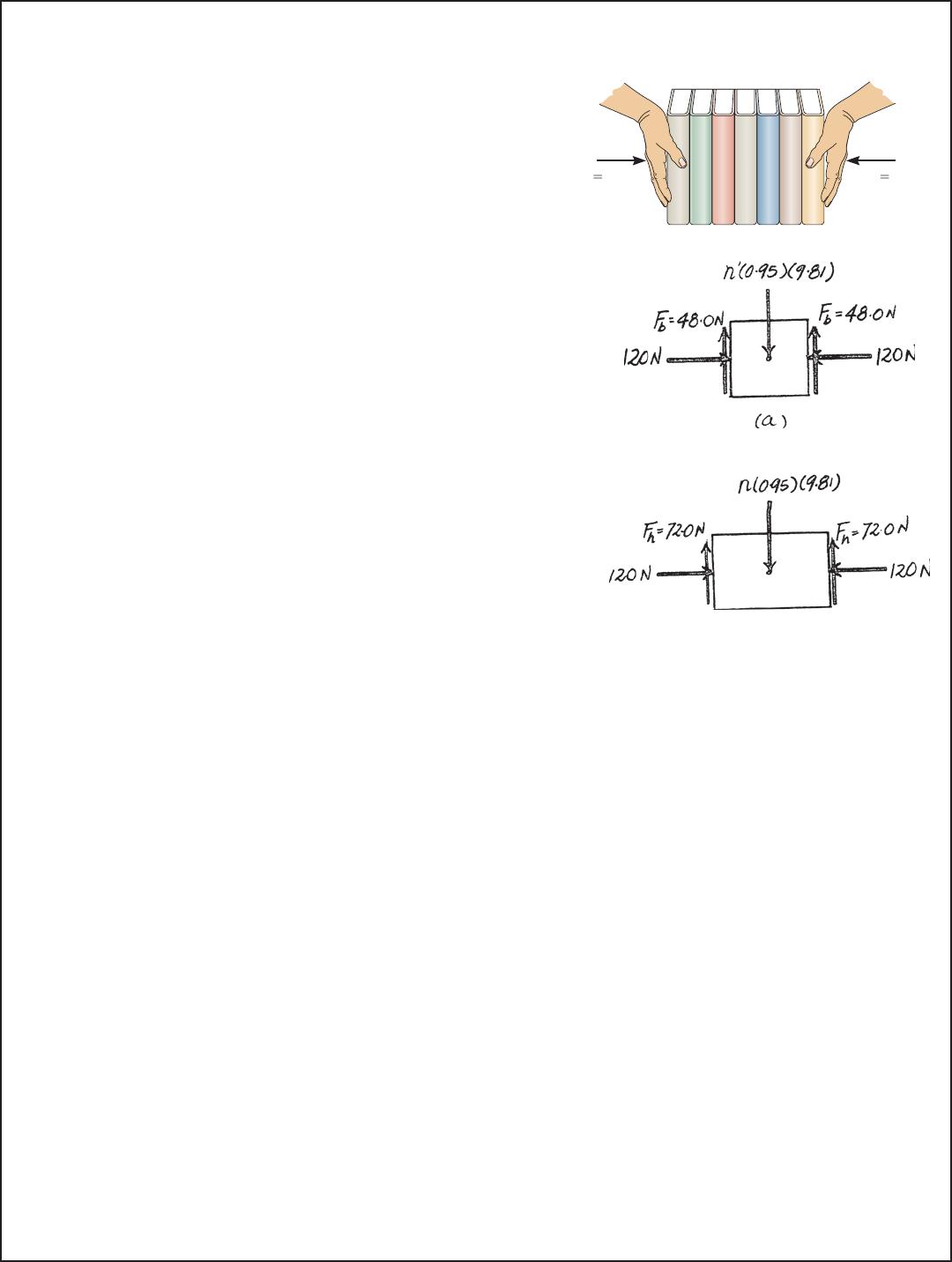
A man attempts to support a stack of books horizontally by
applying a compressive force of to the ends of
the stack with his hands. If each book has a mass of 0.95 kg,
determine the greatest number of books that can be
supported in the stack. The coefficient of static friction
between the man’s hands and a book is and
between any two books .(ms)b=0.4
(ms)h=0.6
F=120 N
SOLUTION
F12
0N
F120 N
769
8–22.
275 mm
30
500 mm
500 mm
CD
F
H
E
P
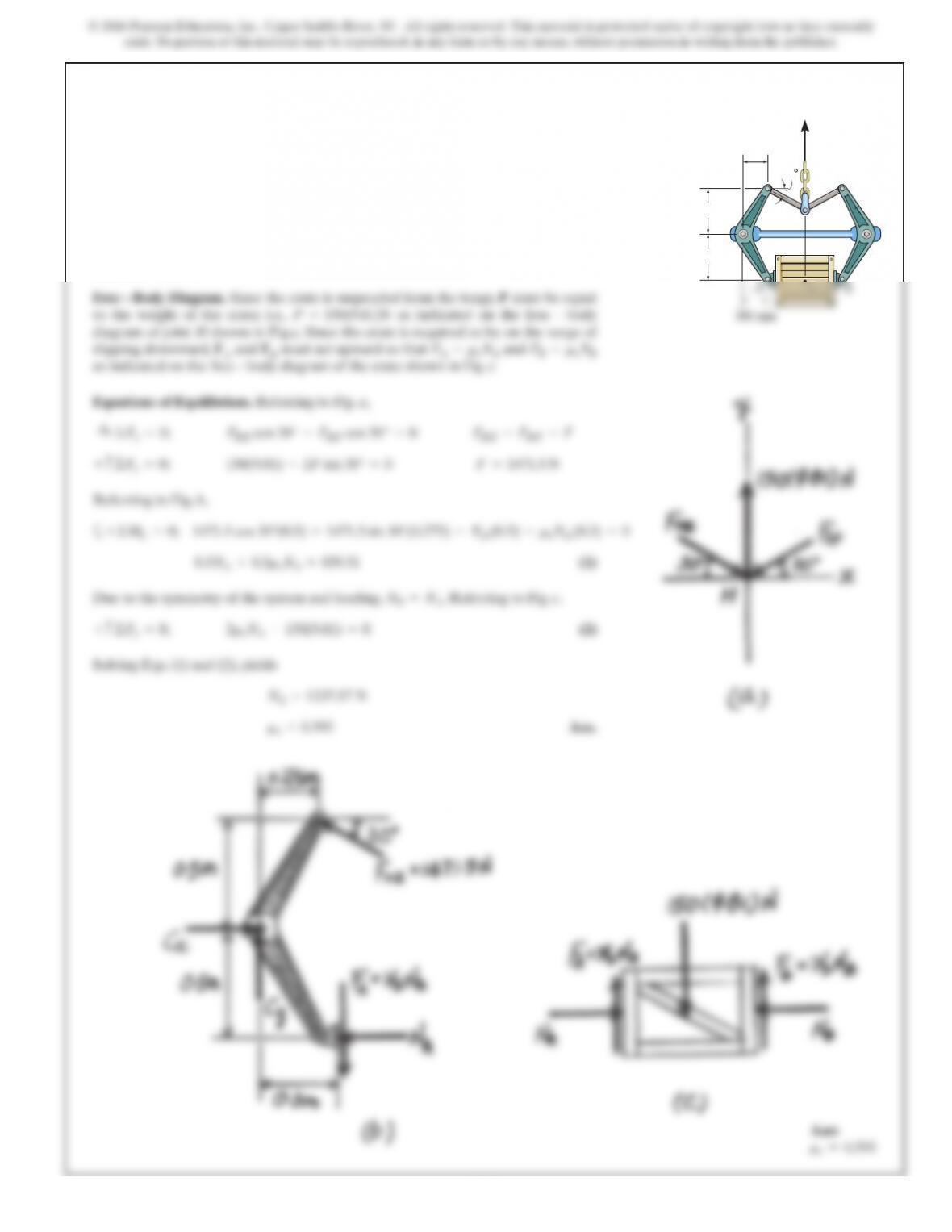
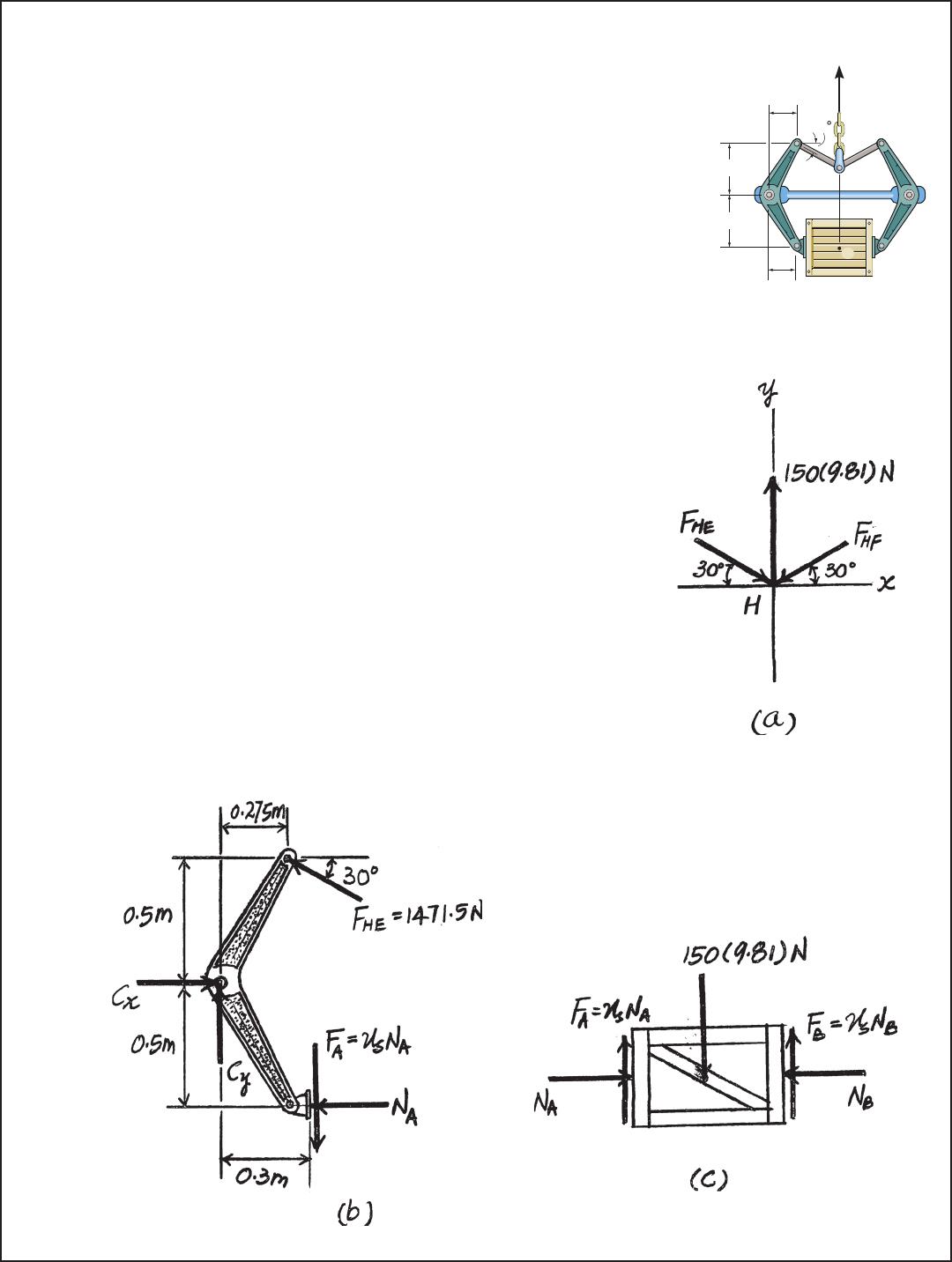
The tongs are used to lift the 150-kg crate, whose center of
mass is at G. Determine the least coefficient of static
friction at the pivot blocks so that the crate can be lifted.
SOLUTION
770
8–23.
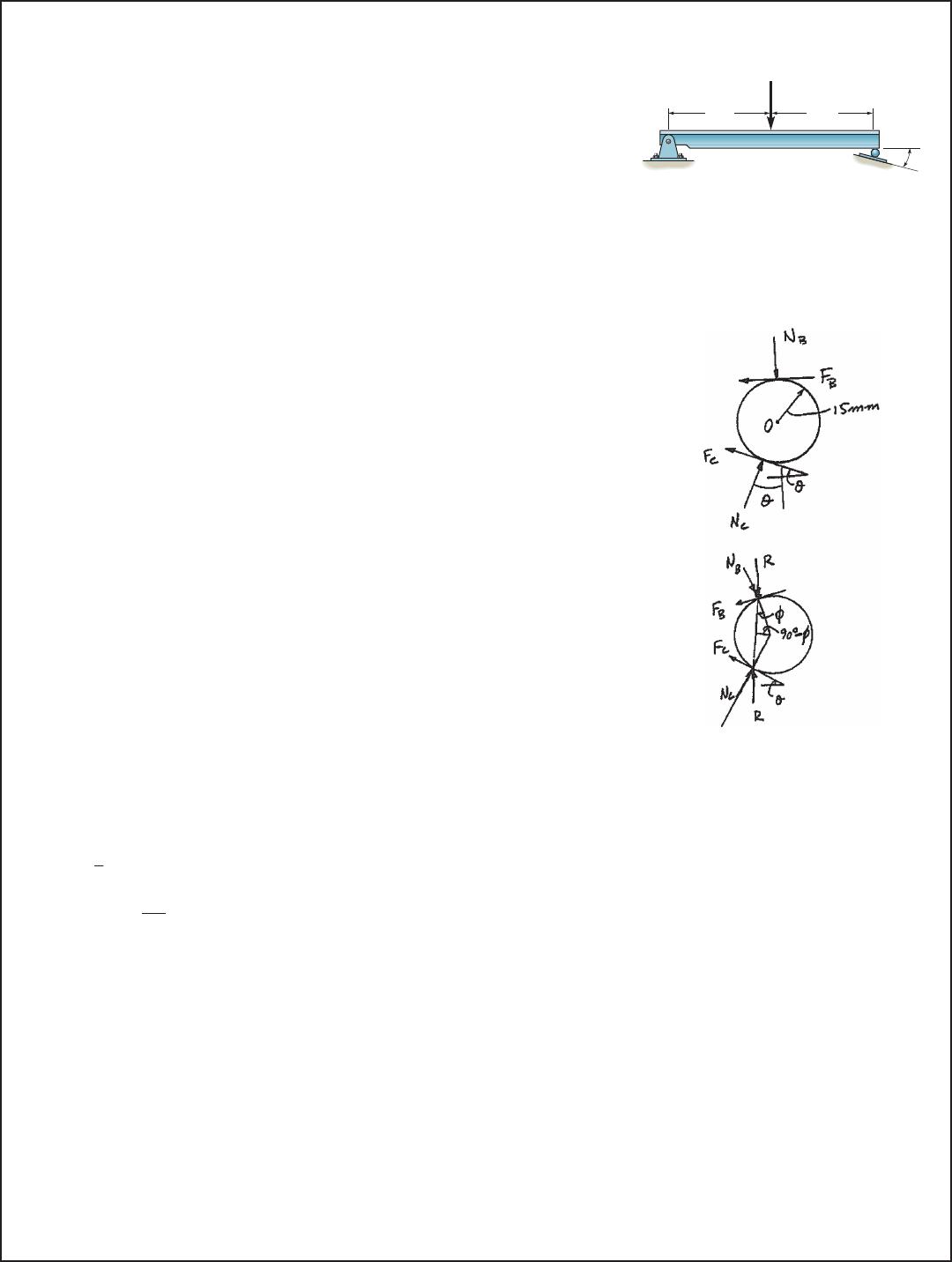
The beam is supported by a pin at A and a roller at B which
has negligible weight and a radius of 15 mm. If the coefficient
of static friction is m
B=
m
C=0.3
, determine the largest
angle
u
of the incline so that the roller does not slip for any
force P applied to the beam.
SOLUTION
A
2 m 2 m
P
B
Cu
771
exist. No portion of this material may be reproduced, in any form or by any means, without permission in writing from the publisher.
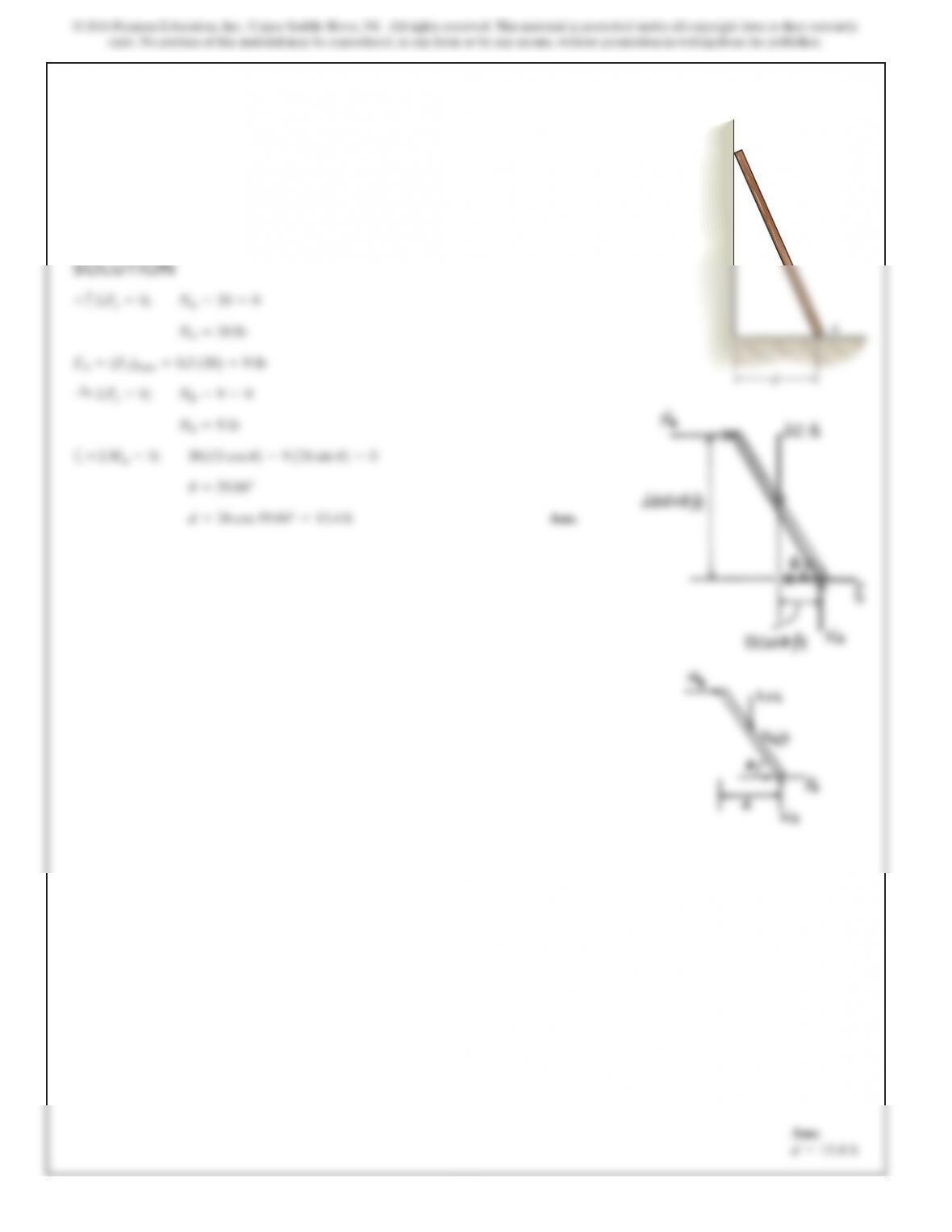
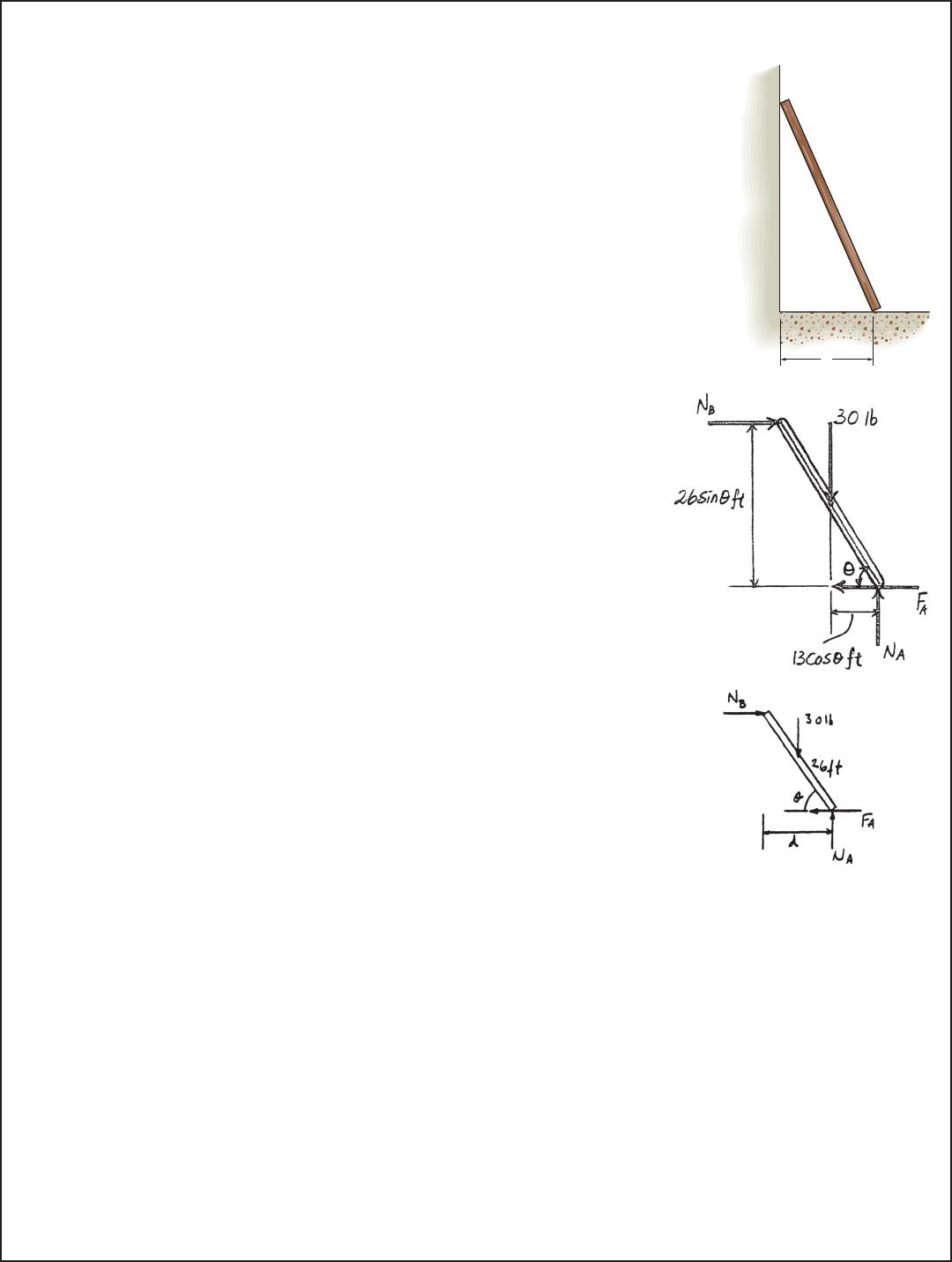
*8–24.
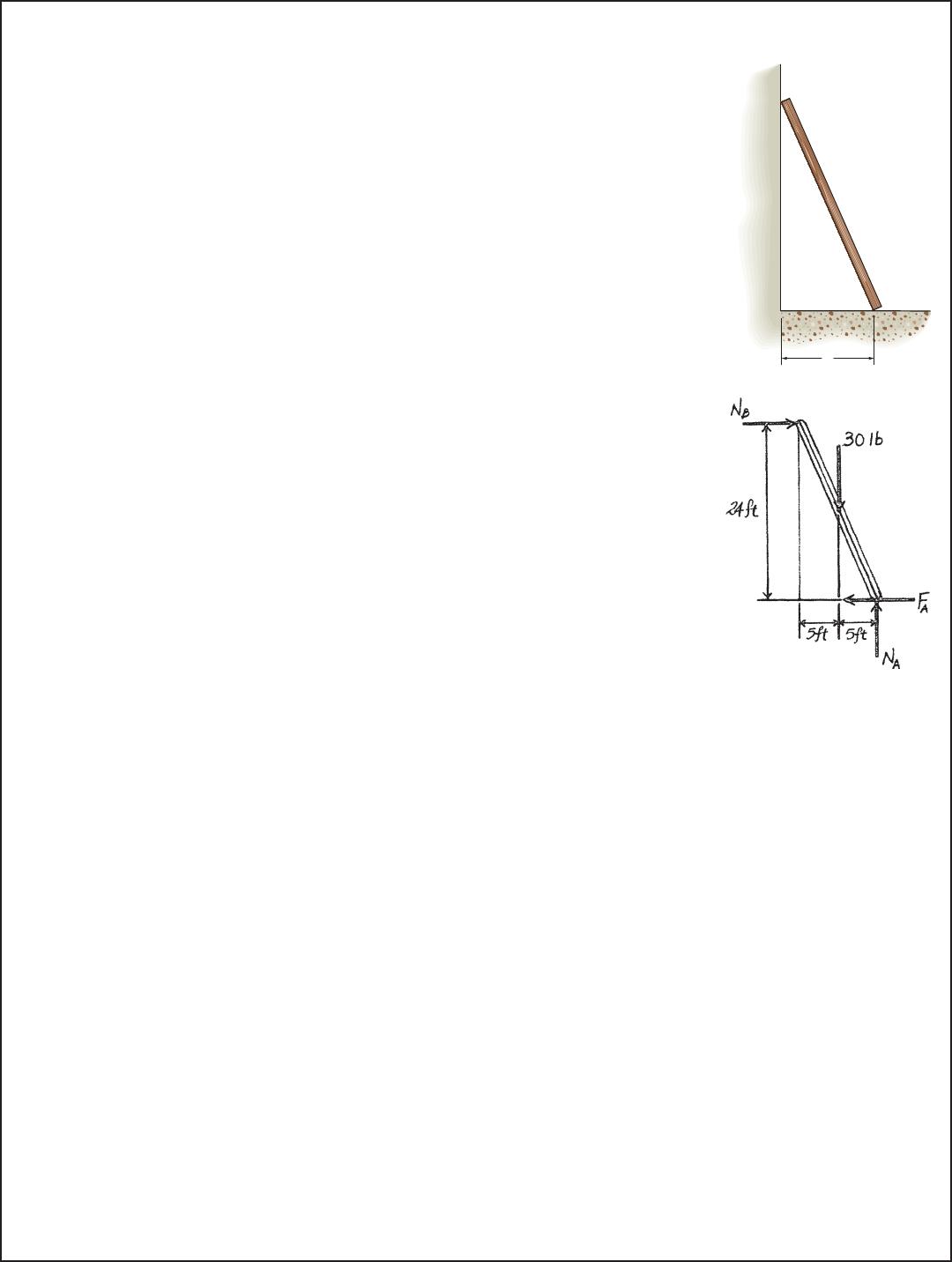
The uniform thin pole has a weight of 30 lb and a length of
26
ft. If it is placed against the smooth wall and on the rough
floor in the position
, will it remain in this position
when
it is released? The coefficient of static friction is
.
m
s=0.3
d=10 ft
B
26 ft
772
8–25.
B
26 ft
The uniform pole has a weight of 30 lb and a length of 26 ft.
Determine the maximum distance dit can be placed from
the smooth wall and not slip.The coefficient of static
friction between the floor and the pole is .ms=0.3
773
8–26.
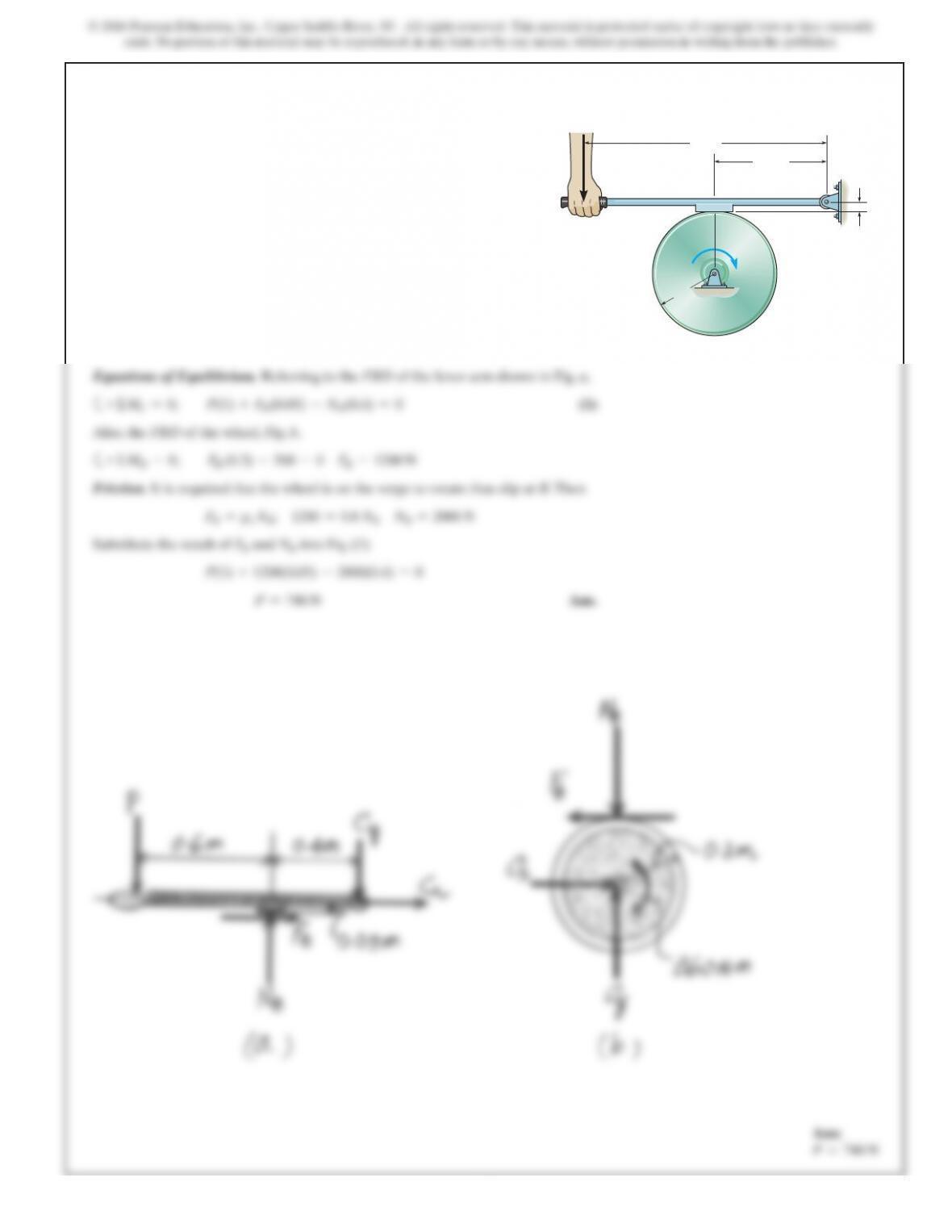
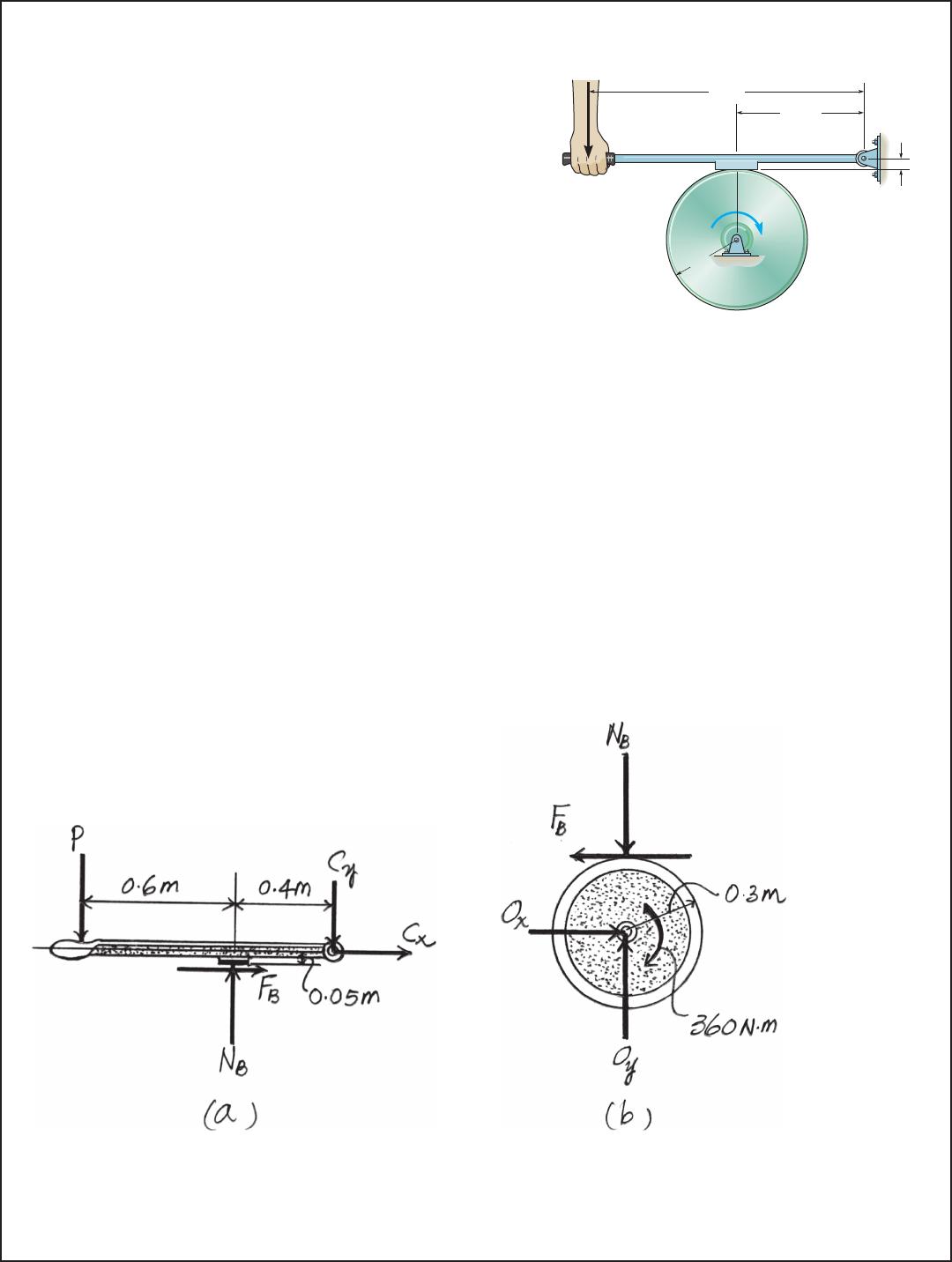
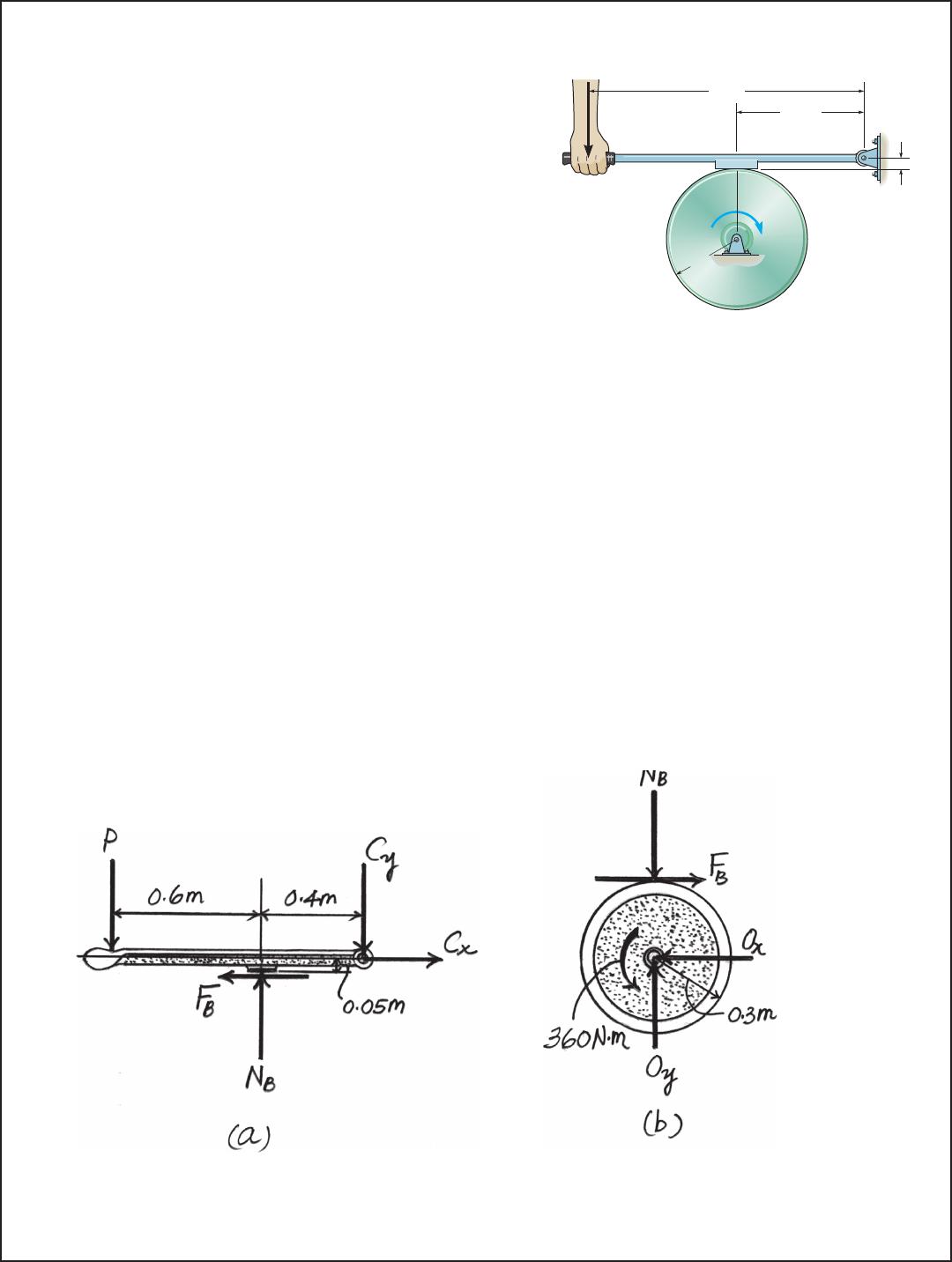
The block brake is used to stop the wheel from rotating
when the wheel is subjected to a couple moment M0
=
360 N
#
m. If the coefficient of static friction between the
wheel and the block is m
s=0.6,
determine the smallest
force P that should be applied.
SOLUTION
O
0.05 m
0.3 m
P
1 m
0.4 m
CC
M0
B
774
8–27.
Solve Prob. 8–26 if the couple moment M0 is applied
counterclockwise.
SOLUTION
Ans:
P=860 N
O
0.05
m
0.3 m
P
1 m
0.4 m
CC
M0
B
775
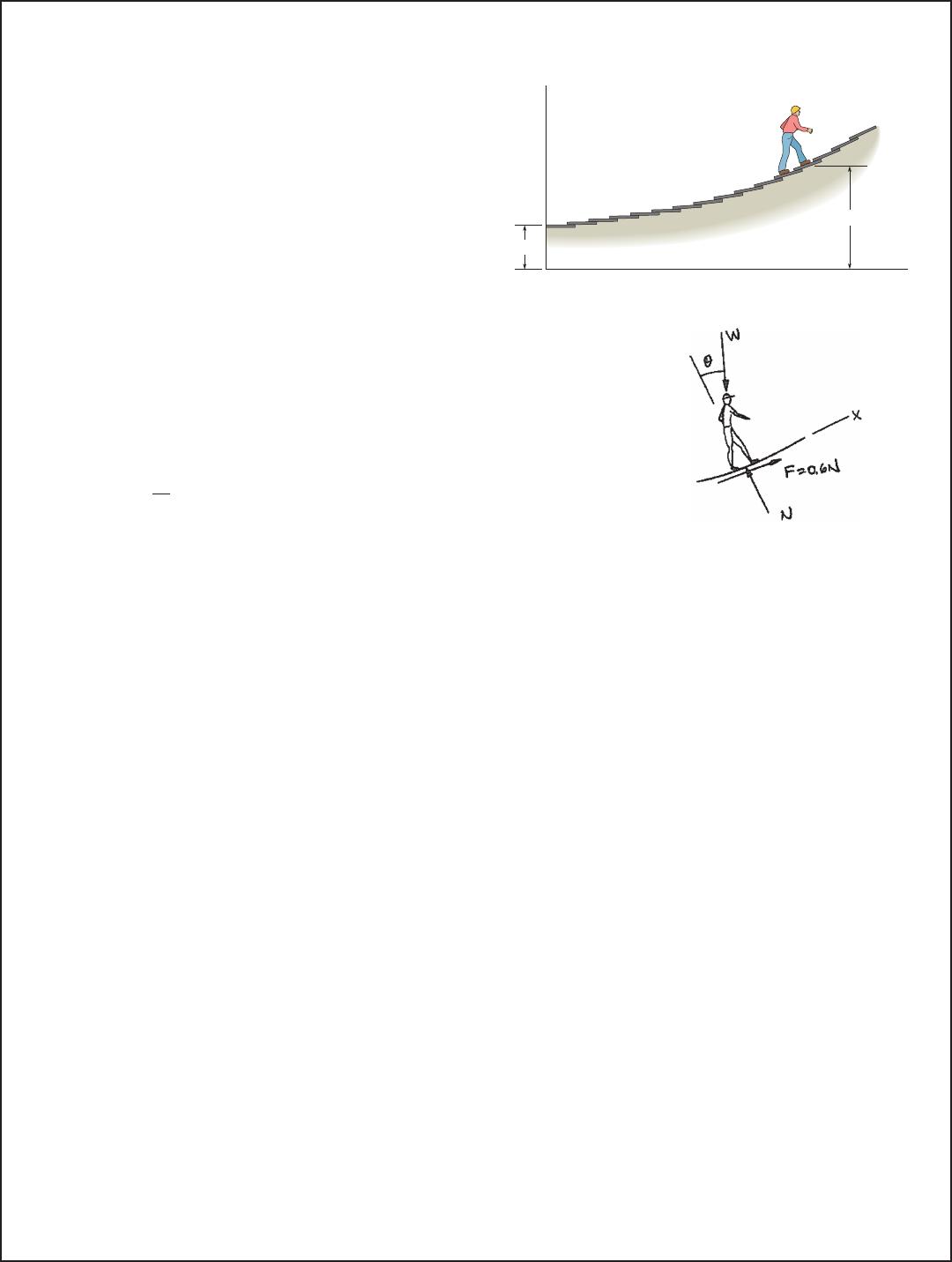
*8–28.
A worker walks up the sloped roof that is defined by the
curve y
=
(5e0.01x) ft, where x is in feet. Determine how
high h he can go without slipping. The coefficient of static
friction is m
s=0.6
.
SOLUTION
y
x
5 ft
h
776
8–29.
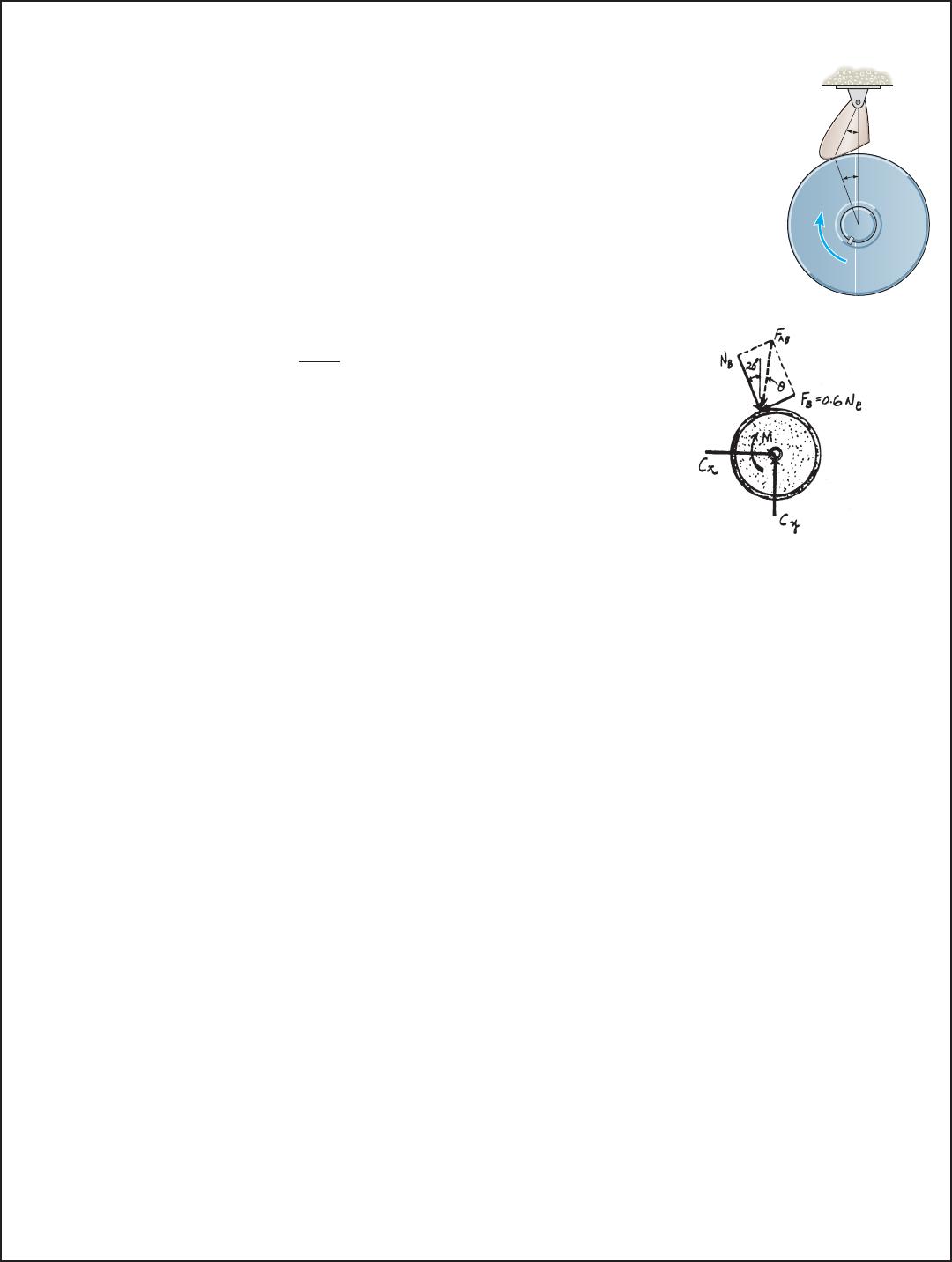
The friction pawl is pinned at Aand rests against the wheel
at B. It allows freedom of movement when the wheel is
rotating counterclockwise about C. Clockwise rotation is
prevented due to friction of the pawl which tends to bind
the wheel. If determine the design angle
which will prevent clockwise motion for any value of
applied moment M. Hint: Neglect the weight of the pawl so
that it becomes a two-force member.
u1ms2B=0.6,
SOLUTION
M
B
C
20°
A
θ
Ans:
u=11.0°
777
8–30.
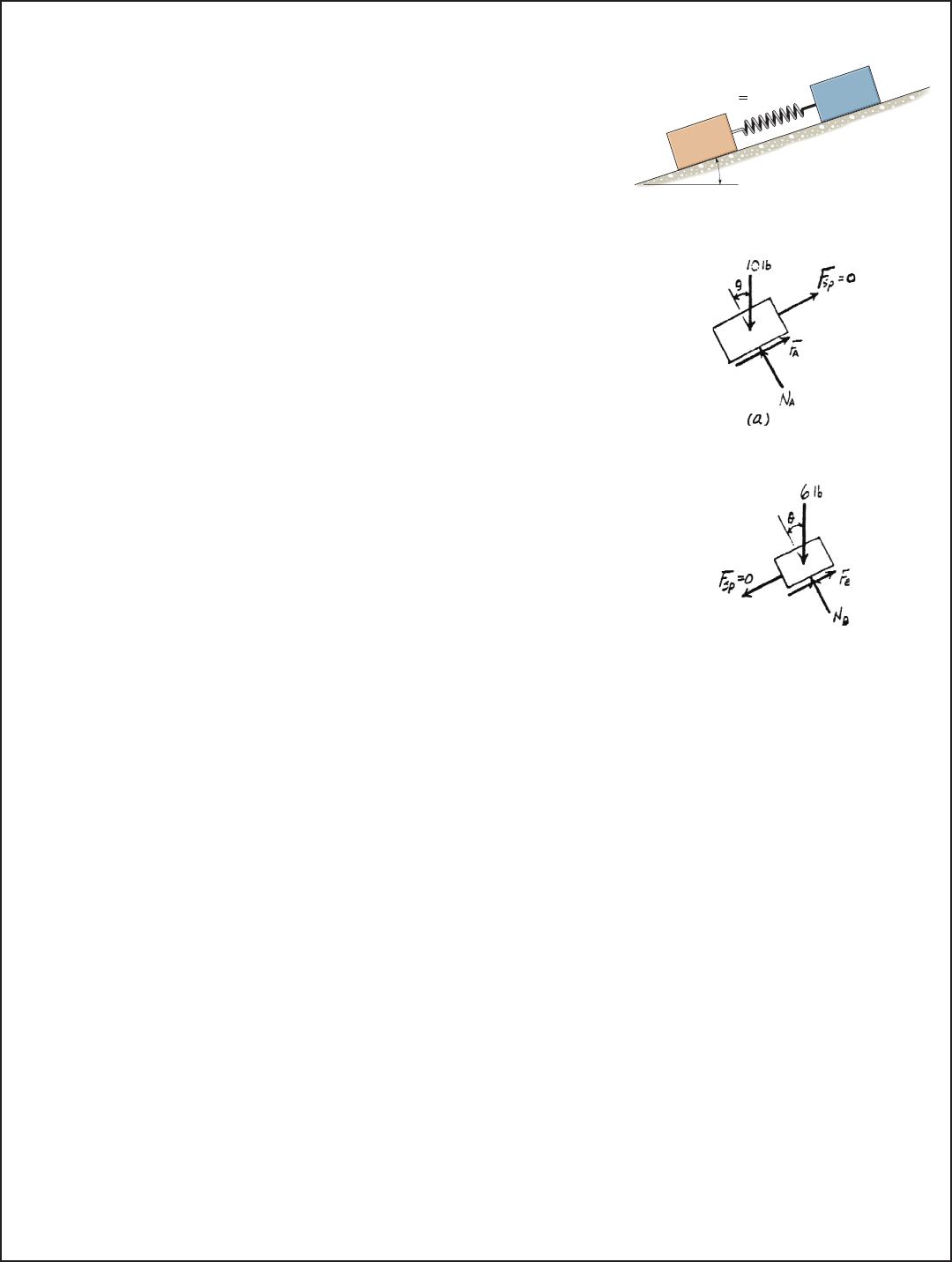
SOLUTION
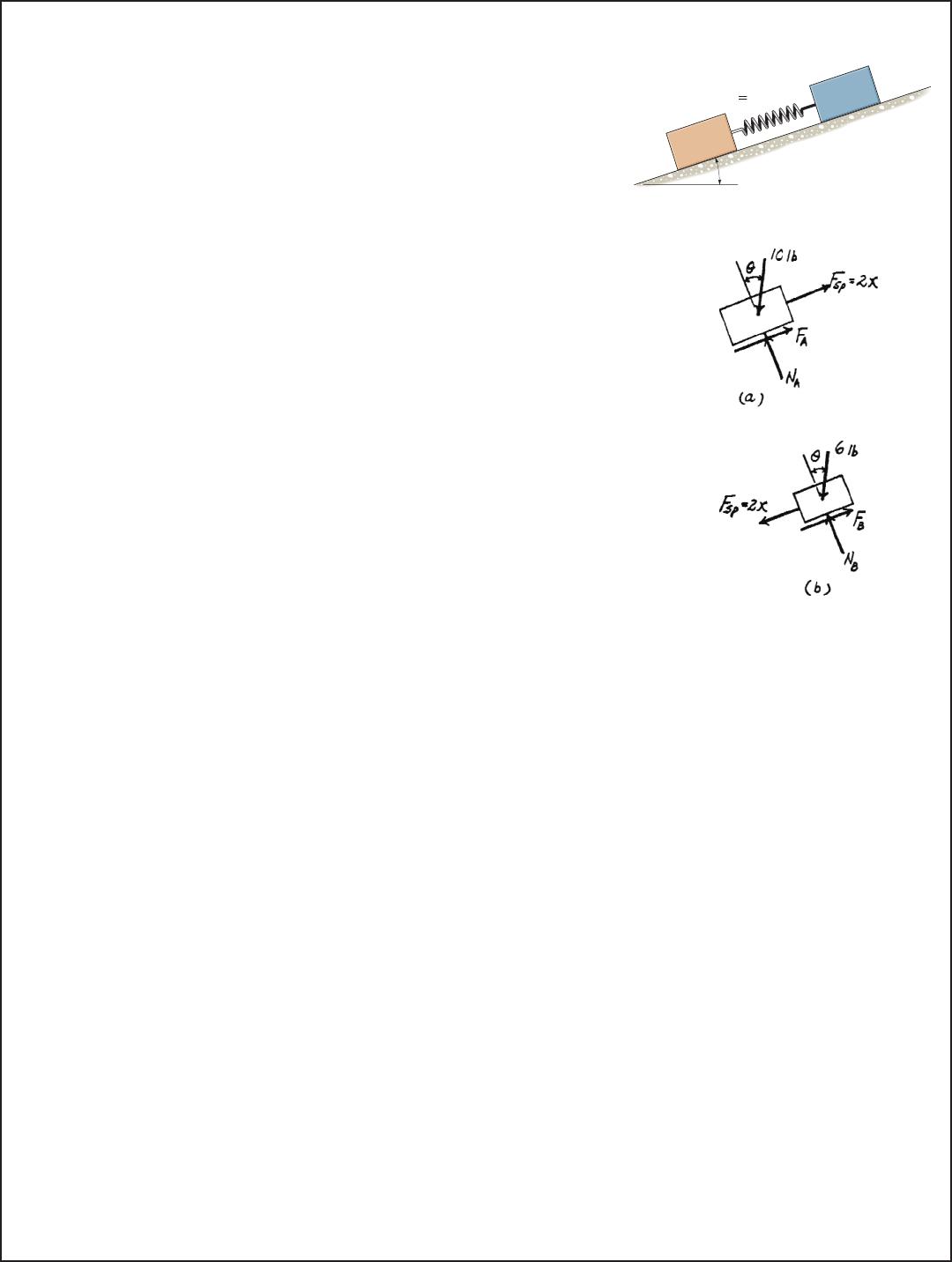
Two blocks Aand Bhave a weight of 10 lb and 6 lb,
respectively.They are resting on the incline for which the
coefficients of static friction are and .
Determine the incline angle for which both blocks begin
to slide.Also find the required stretch or compression in the
connecting spring for this to occur.The spring has a stiffness
of .k=2lb>ft
u
mB=0.25mA=0.15
A
u
B
k2lb/ft
Ans:
u=10.6°
x=0.184 ft
778
8–31.
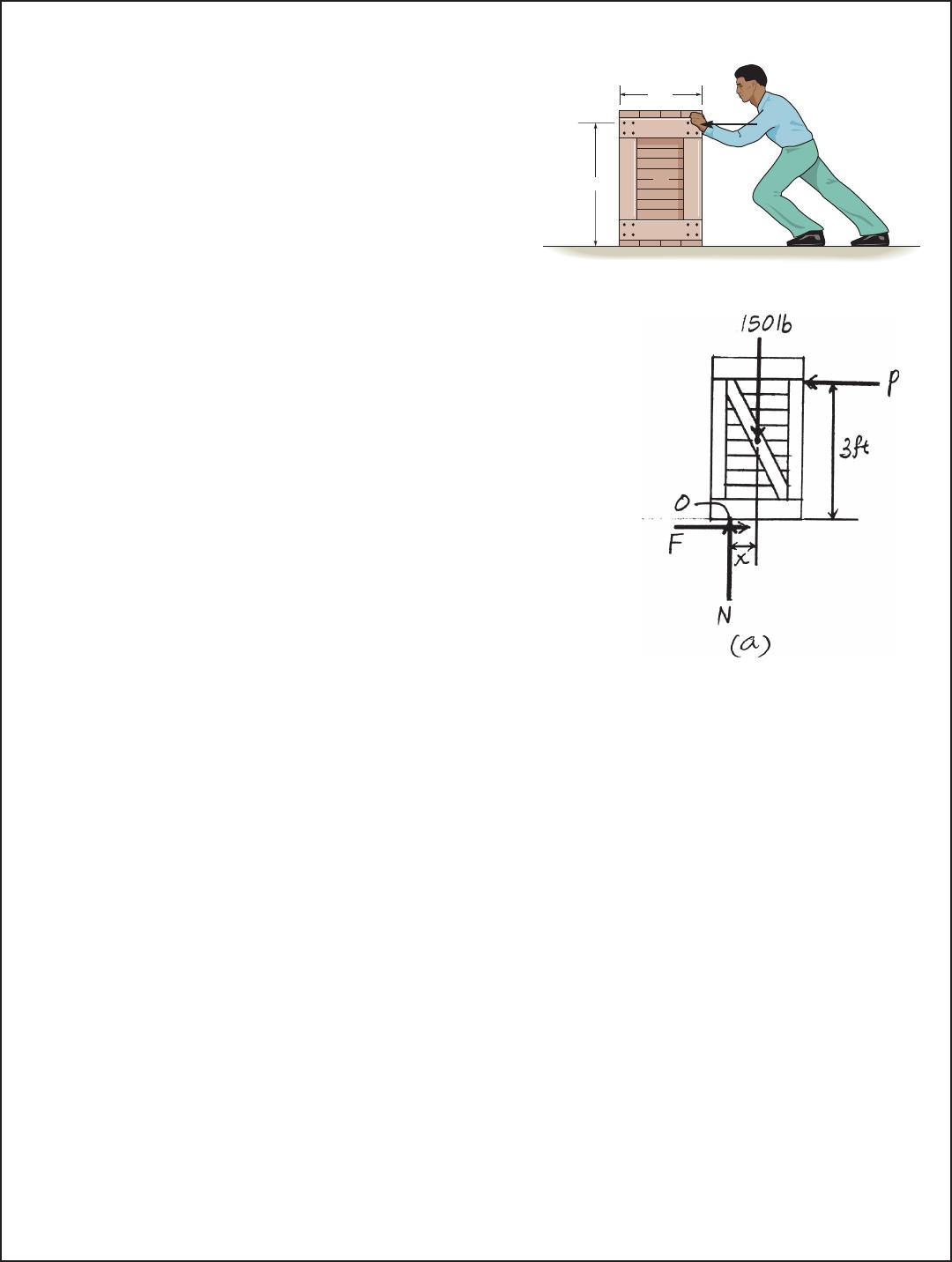
Two blocks Aand Bhave a weight of 10 lb and 6 lb,
respectively.They are resting on the incline for which the
coefficients of static friction are and .
Determine the angle which will cause motion of one of
the blocks.What is the friction force under each of the
blocks when this occurs? The spring has a stiffness of
and is originally unstretched.k=2lb>ft
u
mB=0.25mA=0.15
SOLUTION
A
u
B
k2lb/ft
Ans:
u=8.53°
FA=1.48 lb
FB=0.890 lb
779
*8–32.
Determine the smallest force P that must be applied in
order to cause the 150-lb uniform crate to move. The
coefficent of static friction between the crate and the floor
is m
s=0.5.
SOLUTION
Ans:
50 lb
3 ft
2 ft
P
780
8–33.
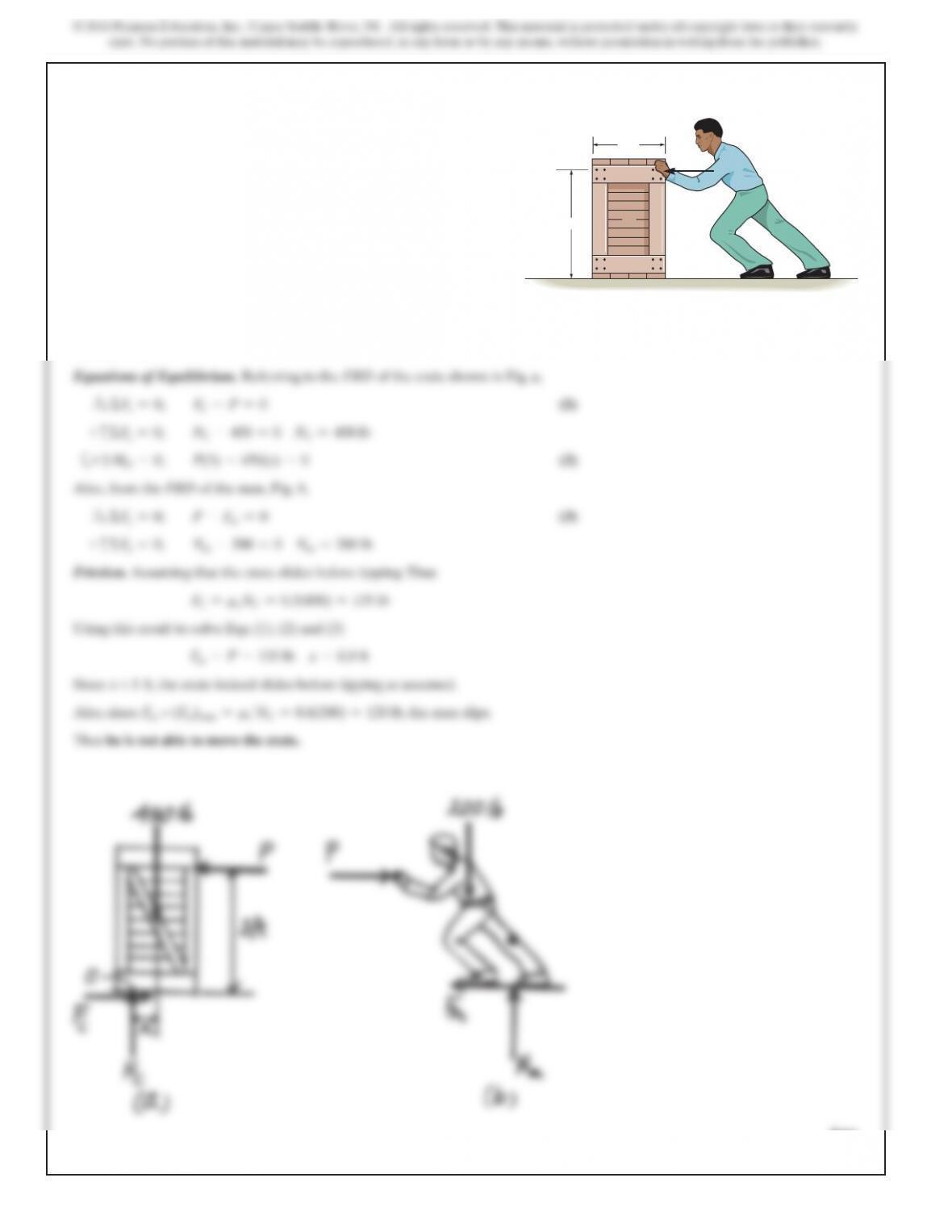
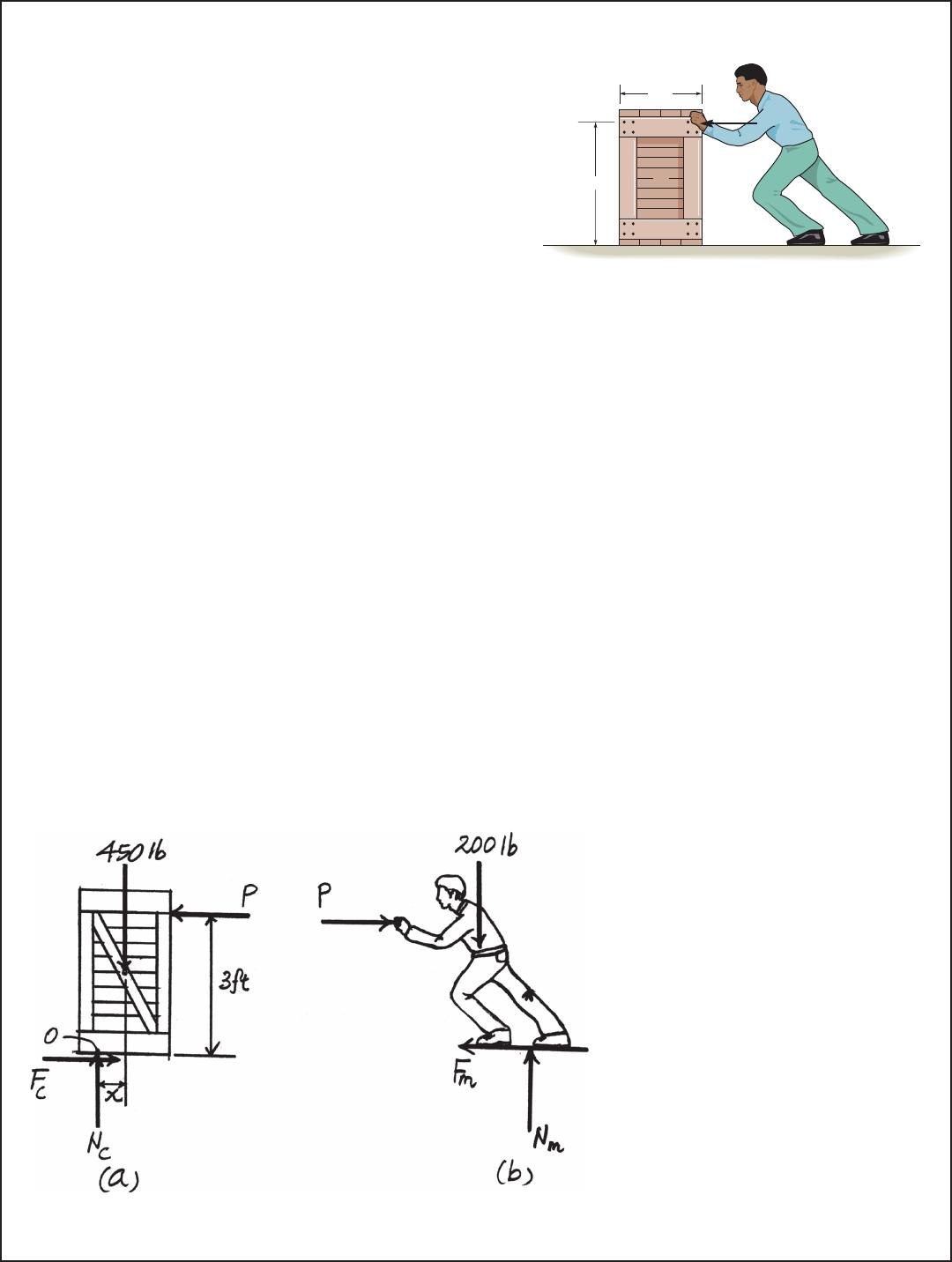
The man having a weight of 200 lb pushes horizontally on
the crate. If the coefficient of static friction between the
450-lb crate and the floor is m
s=0.3
and between his shoes
and the floor is m
′
s=0.6
, determine if he can move the
crate.
SOLUTION
3 ft
2 ft
P
Ans:
No
781
8–34.
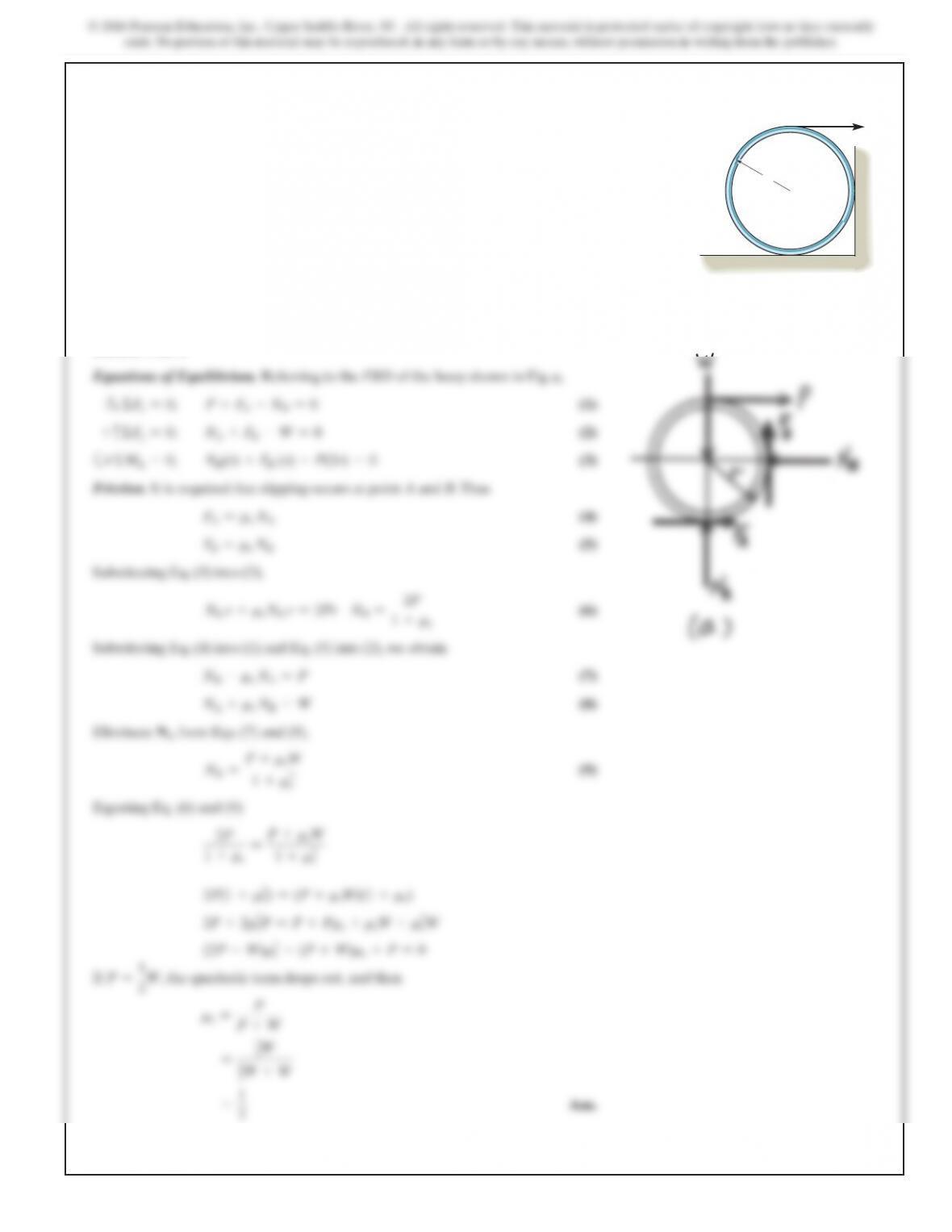
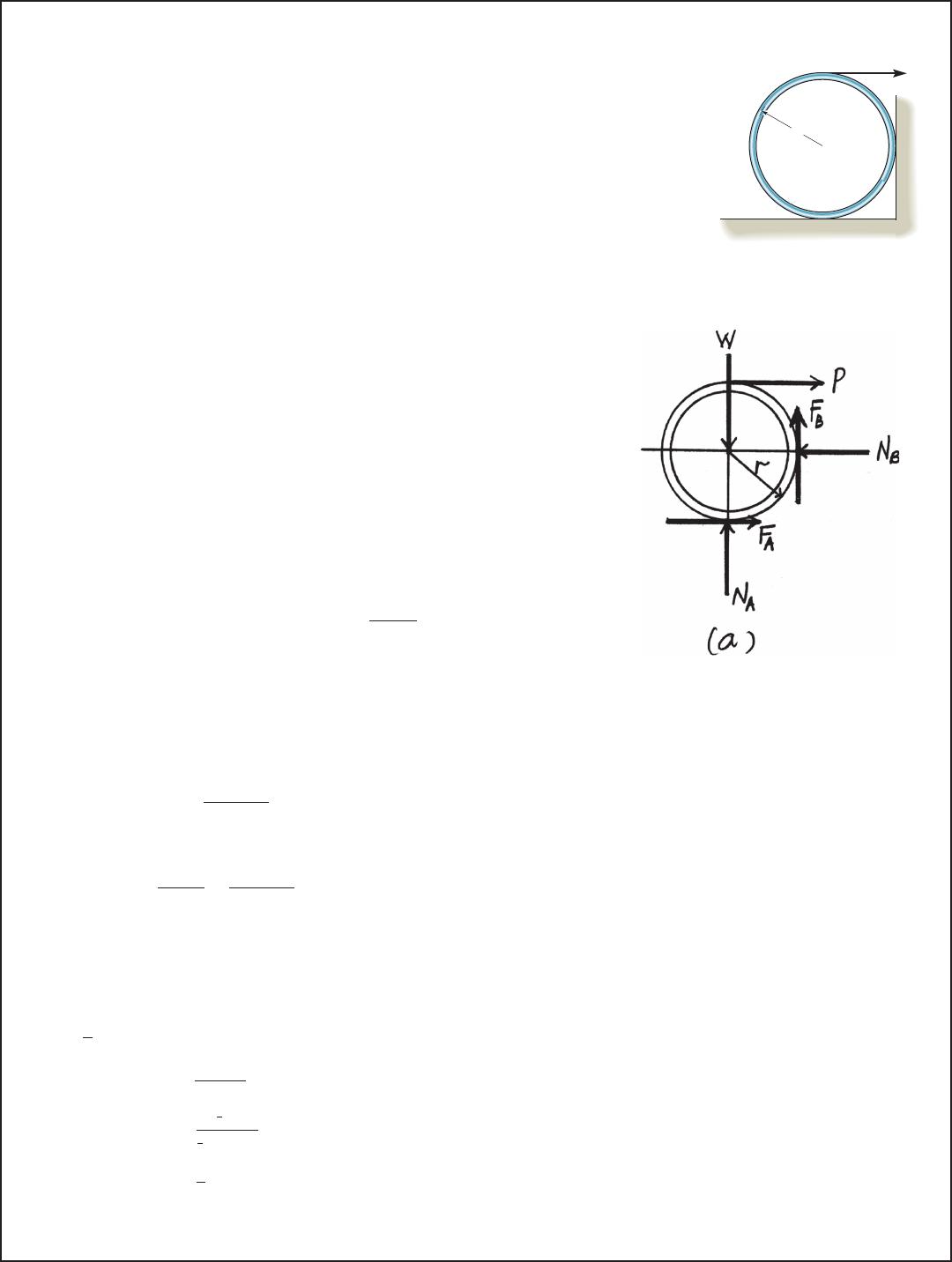
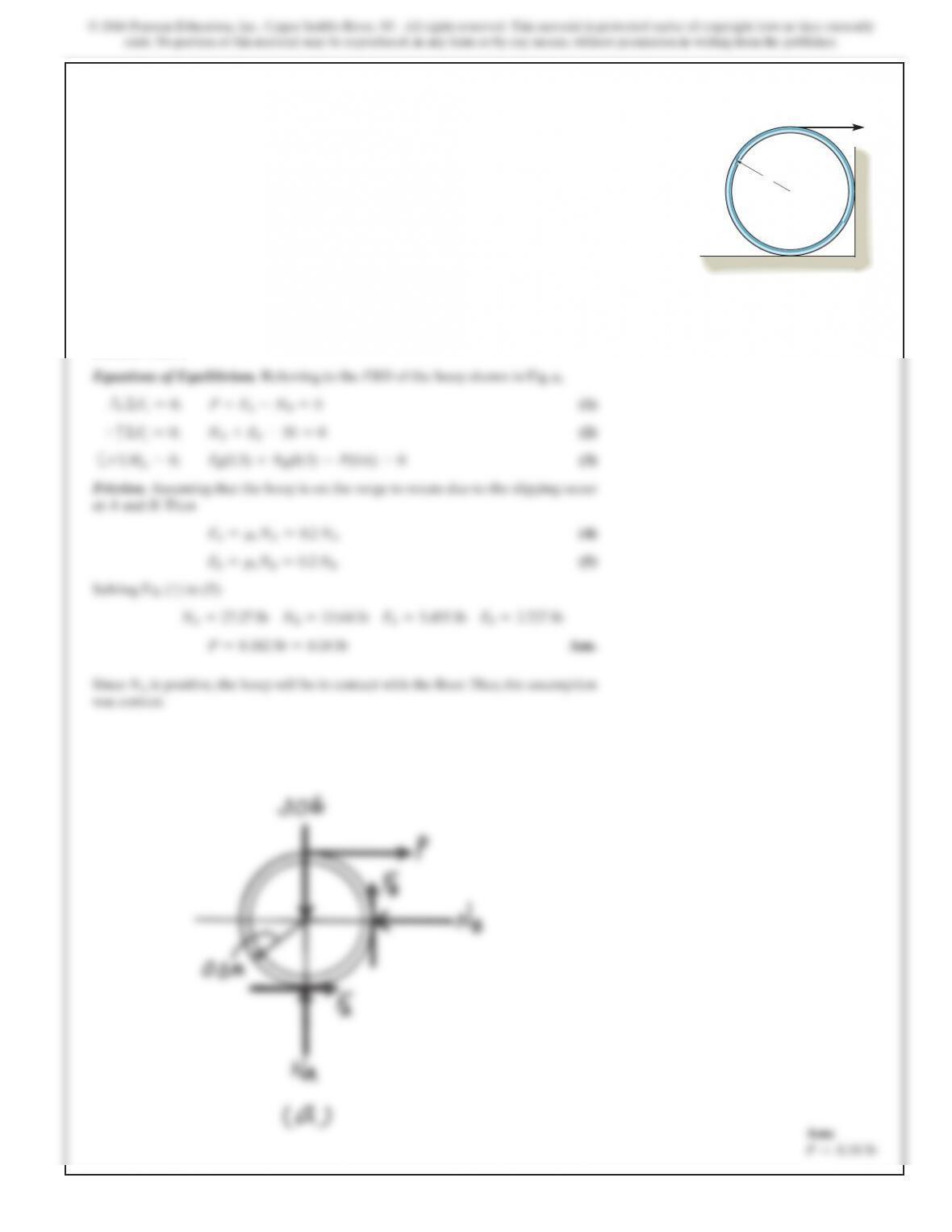
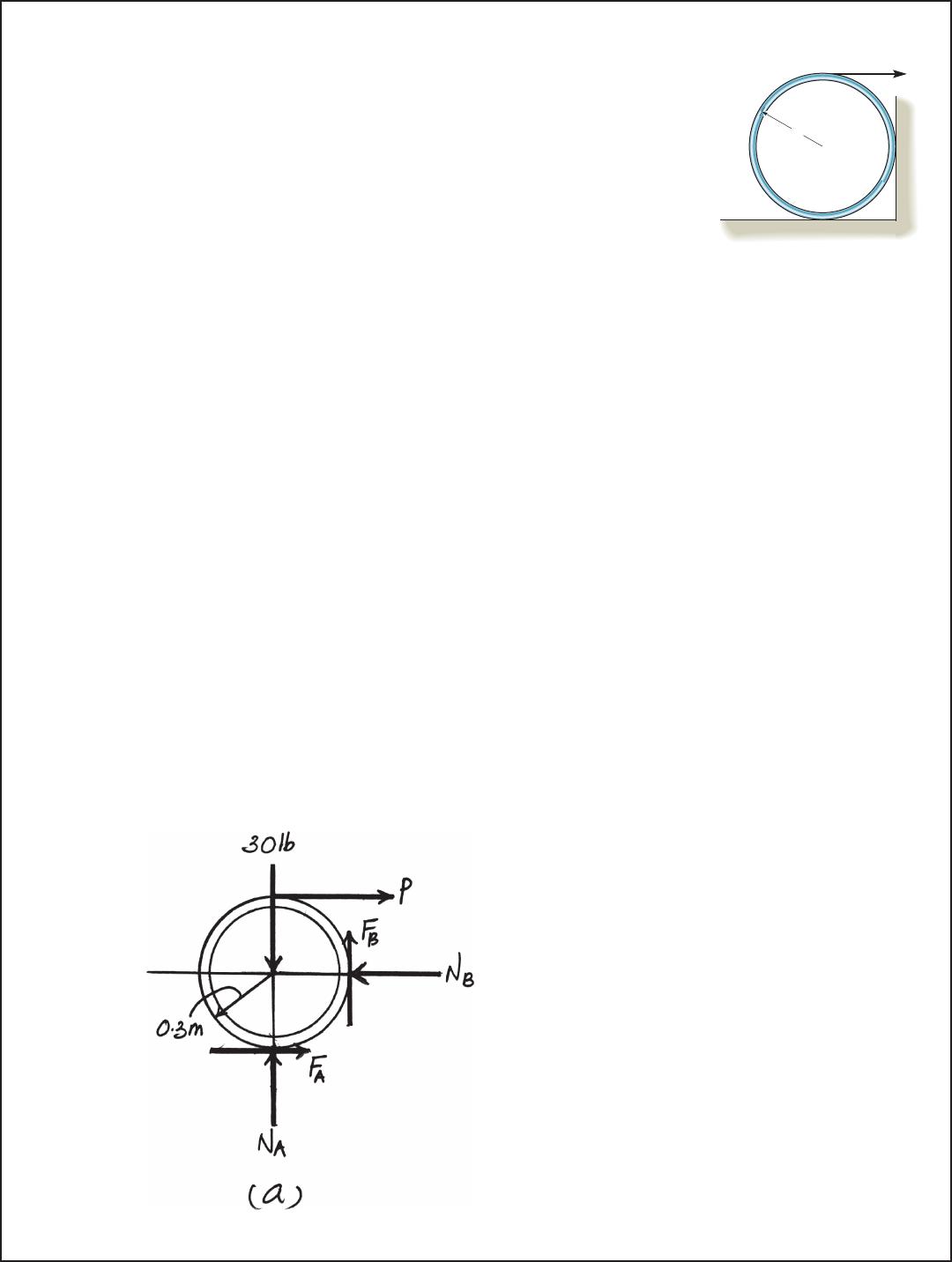
The uniform hoop of weight W is subjected to the horizontal
force P. Determine the coefficient of static friction between
the hoop and the surface of A and B if the hoop is on the
verge of rotating.
SOLUTION
r
A
B
P
B
A

782
8–34. Continued
783
8–35.
Determine the maximum horizontal force P that can be
applied to the 30-lb hoop without causing it to rotate. The
coefficient of static friction between the hoop and the
surfaces A and B is m
s=0.2.
Take r
=
300 mm.
SOLUTION
r
A
B
P
B
A
784
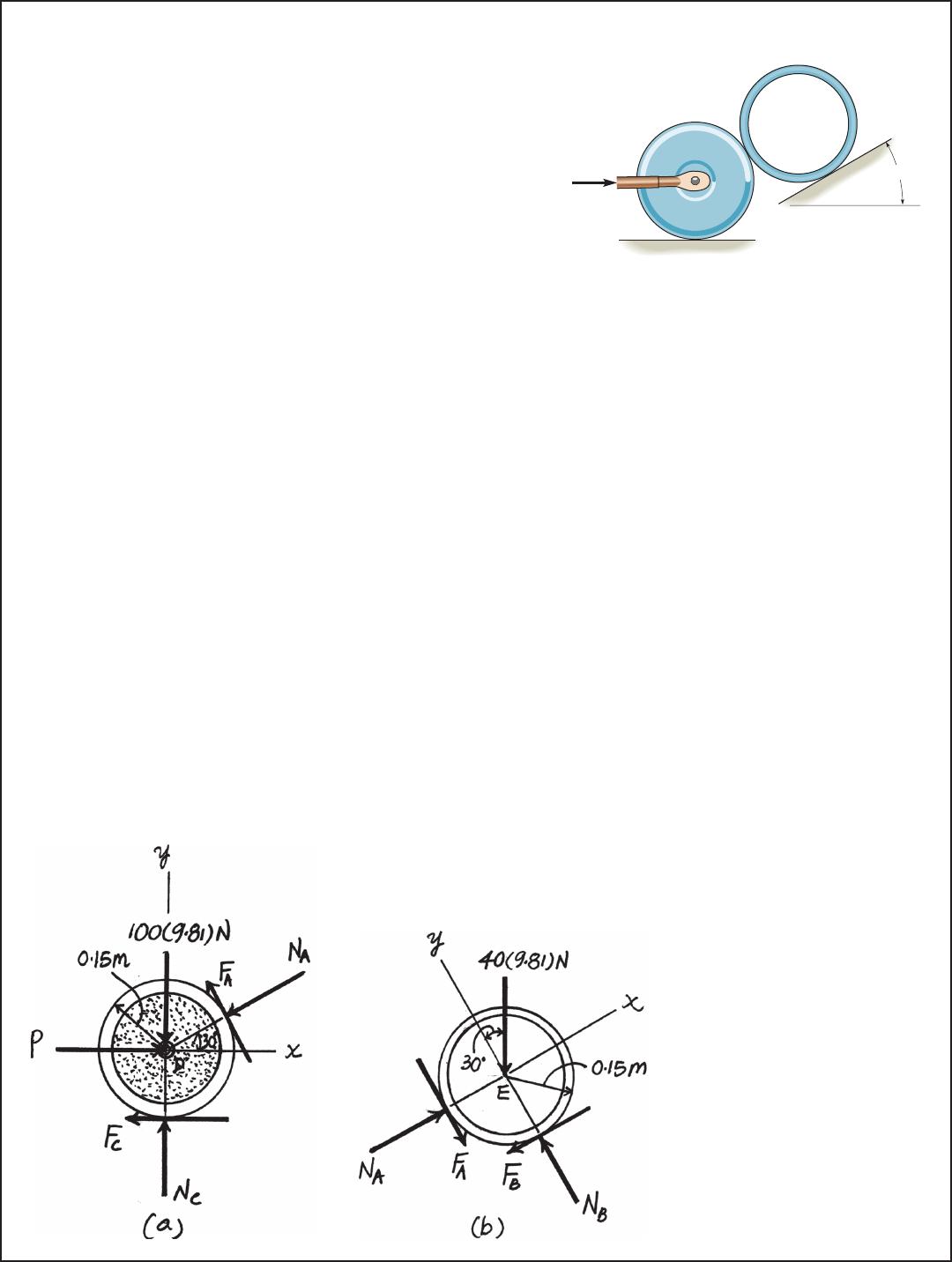
*8–36.
Determine the minimum force P needed to push the tube E
up the incline. The force acts parallel to the plane, and the
coefficients of static friction at the contacting surfaces are
m
A=0.2,
m
B=0.3,
and m
C=0.4.
The 100-kg roller and
40-kg tube each have a radius of 150 mm.
SOLUTION
A
E
B
C
30
P
785
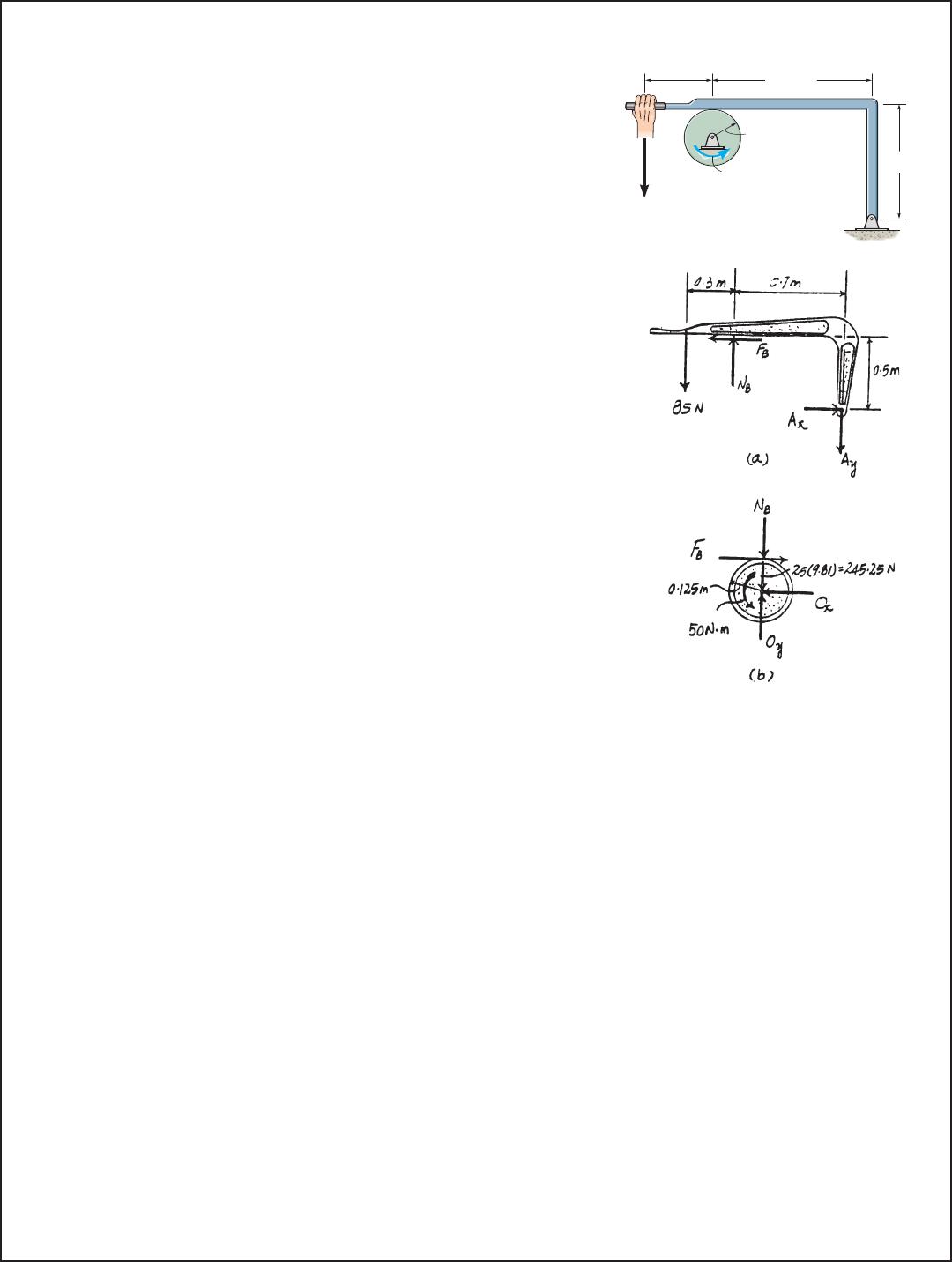
8–37.
The coefficients of static and kinetic friction between the
drum and brake bar are and ,respectively.
If and determine the horizontal
and vertical components of reaction at the pin O.Neglect
the weight and thickness of the brake.The drum has a mass
of 25 kg.
P=85 NM=50 N #m
mk=0.3ms=0.4
SOLUTION
A
M
P
B
O125 mm
700 mm
500 mm
300 mm
Ans:
O
y
=400
N
Ox=46.4
N
786
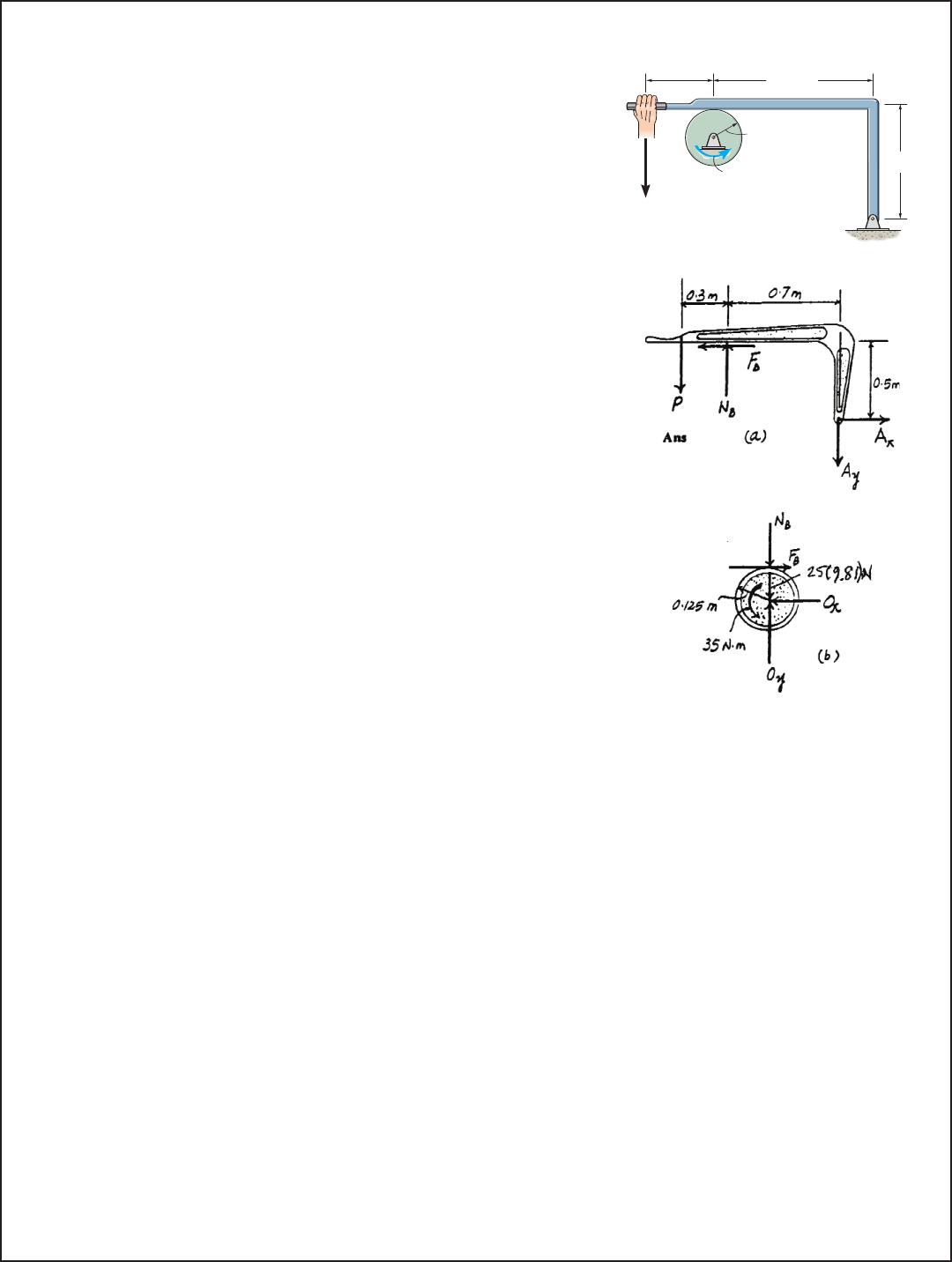
8–38.
SOLUTION
The coefficient of static friction between the drum and
brake bar is . If the moment ,
determine the smallest force Pthat needs to be applied to
the brake bar in order to prevent the drum from rotating.
Also determine the corresponding horizontal and vertical
components of reaction at pin O. Neglect the weight and
thickness of the brake bar.The drum has a mass of 25 kg.
M=35 N #mms=0.4
A
M
P
B
O125 mm
700 mm
500 mm
300 mm
Ans:
P=350
N
O
y
=945 N
Ox=280 N
787
exist. No portion of this material may be reproduced, in any form or by any means, without permission in writing from the publisher.
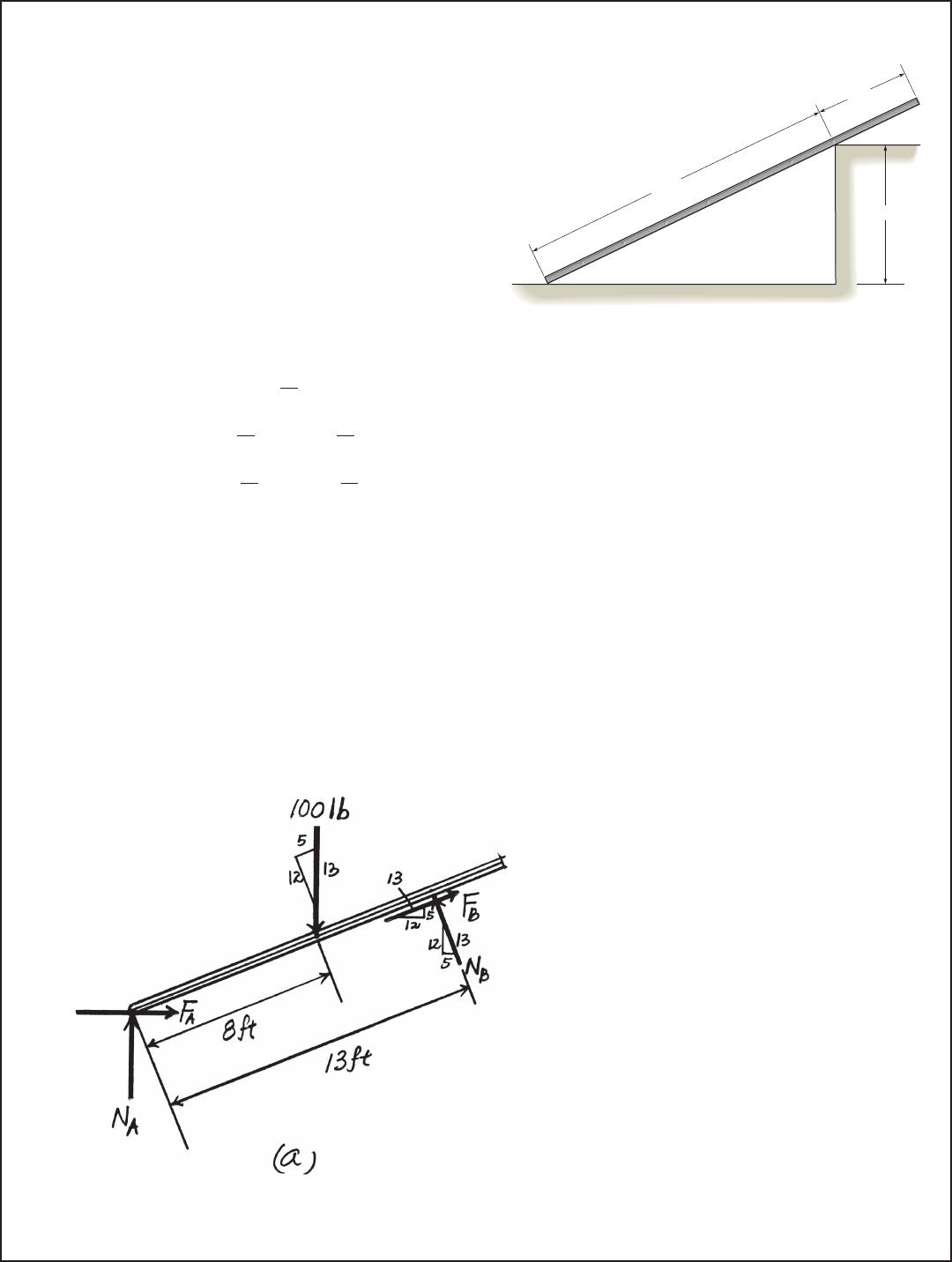
8–39.
Determine the smallest coefficient of static friction at both
A and B needed to hold the uniform 100-lb bar
in equilibrium. Neglect the thickness of the bar.
Take
mA=mB=m.
Ans:
m
s=0.230
SOLUTION
13 ft
3 ft
B
A
5 ft