17–41.
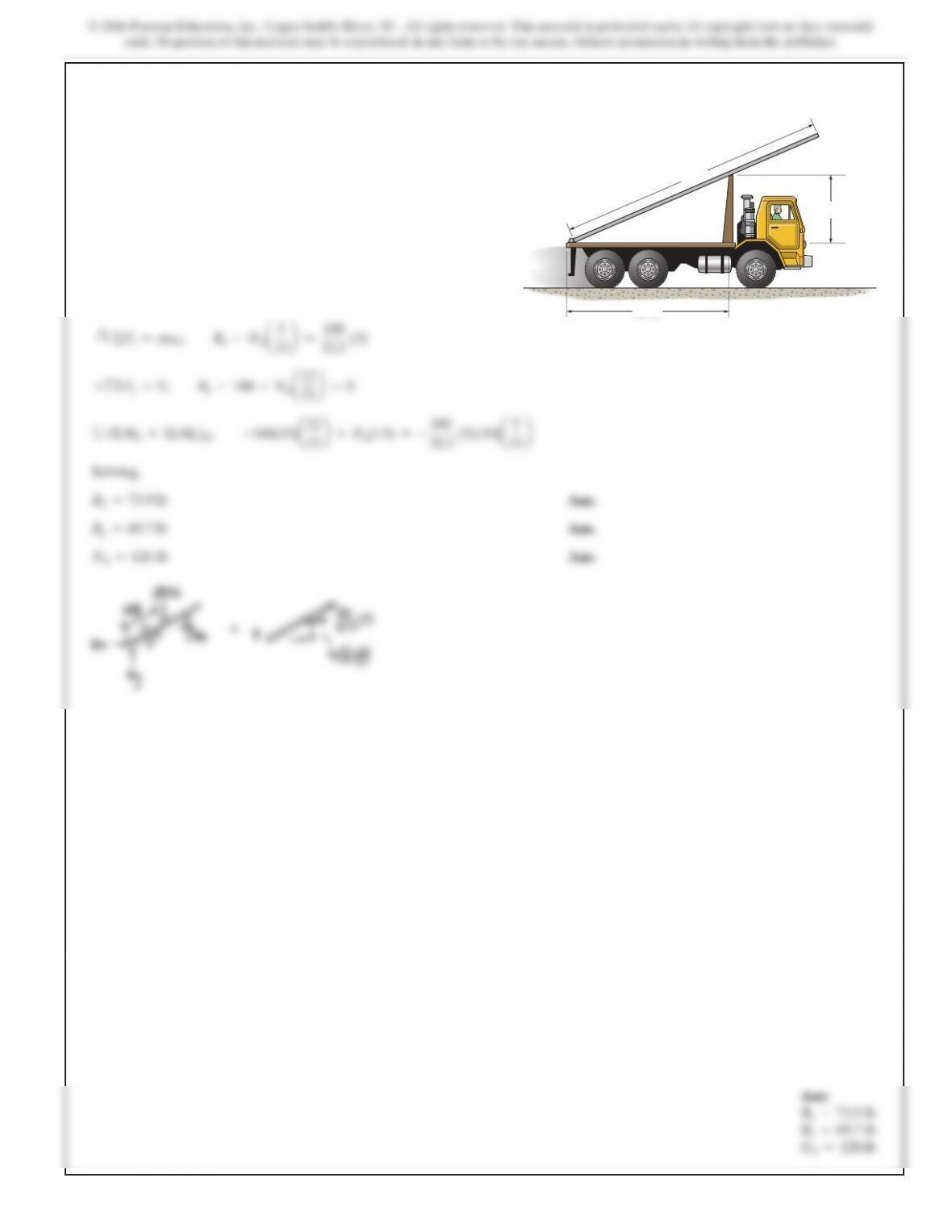
The smooth 180-lb pipe has a length of 20 ft and a negligible
diameter. It is carried on a truck as shown. If the truck
accelerates at a
=
5 ft
>
s
2
, determine the normal reaction at
A and the horizontal and vertical components of force
which the truck exerts on the pipe at B.
SOLUTION
S
+Σ
F
x=
ma
x
; Bx–NA
a5
13 b
=
180
32.2
(5)
+
c
Σ
Fy=0; By–180 +NA
a12
13 b
=0
a+
ΣMB=Σ(Mk)B
; –180(10)
a
12
13 b
+NA(13) =–
180
32.2
(5)(10)
a
5
13 b
Solving,
Bx=73.9 lb
Ans.
B
y
=69.7 lb
Ans.
NA=120 lb
Ans.
B
A
20 ft
5 ft
12 ft
Bx=73.9 lb
17–42.
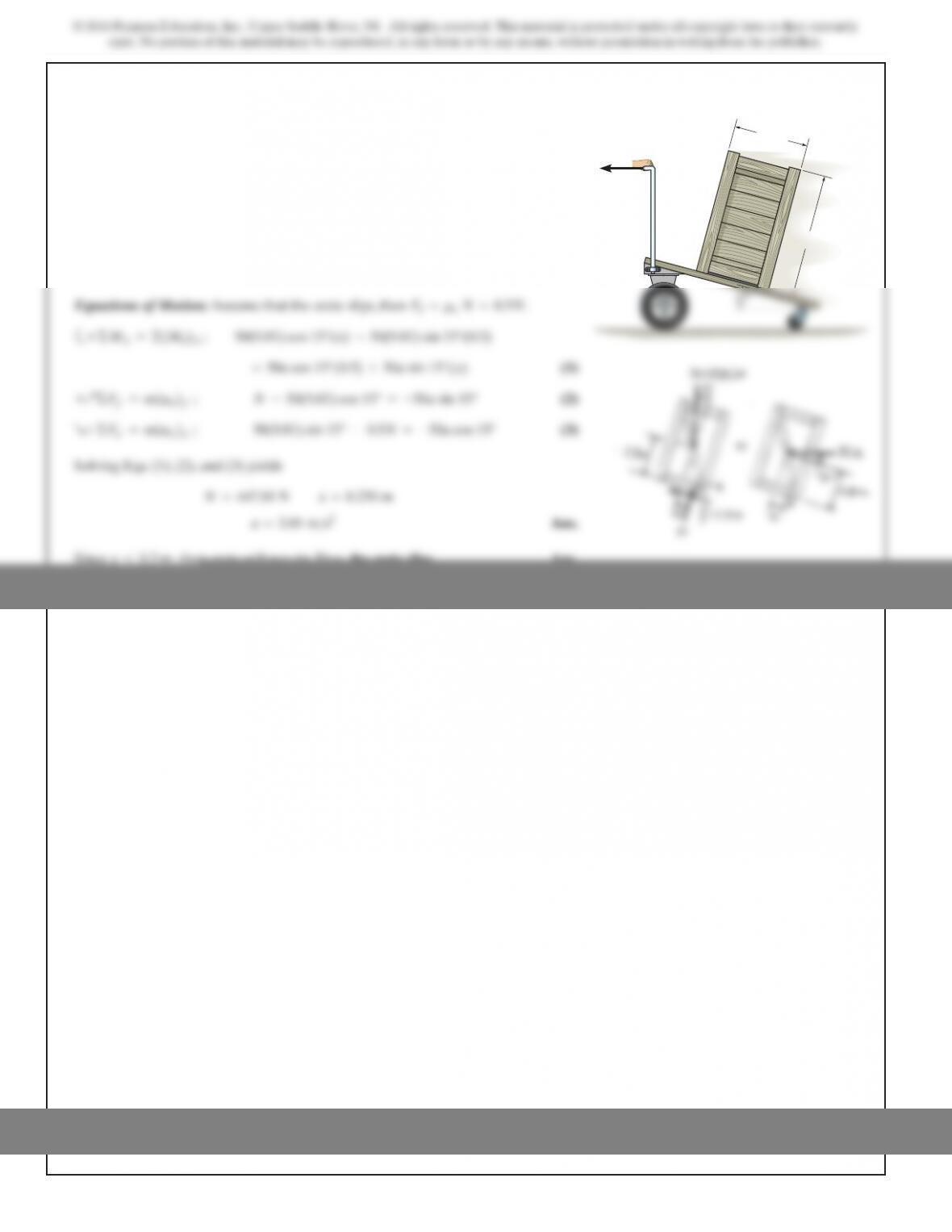
The uniform crate has a mass of 50 kg and rests on the cart
having an inclined surface. Determine the smallest
acceleration that will cause the crate either to tip or slip
relative to the cart. What is the magnitude of this
acceleration? The coefficient of static friction between the
crate and the cart is .ms=0.5
SOLUTION
a
(1)
(2)
(3)
Solving Eqs. (1), (2), and (3) yields
Ans.
Since , then crate will not tip.Thus, the crate slips.Ans.x
6
0.3 m
a=2.01 m>s2
N=447.81 N
x=0.250 m
R+©F
x¿=m(aG)x¿; 50(9.81) sin 15° –0.5N=-50acos 15°
+Q©F
y¿=m(aG)y¿;N–50(9.81) cos 15° =-50asin 15°
=50acos 15°(0.5) +50asin 15°(x)
+©MA=©(Mk)A; 50(9.81) cos 15°(x)–50(9.81) sin 15°(0.5)
1m
0.6 m
F
17–43.
1 ft 1 ft
P
4 ft
G
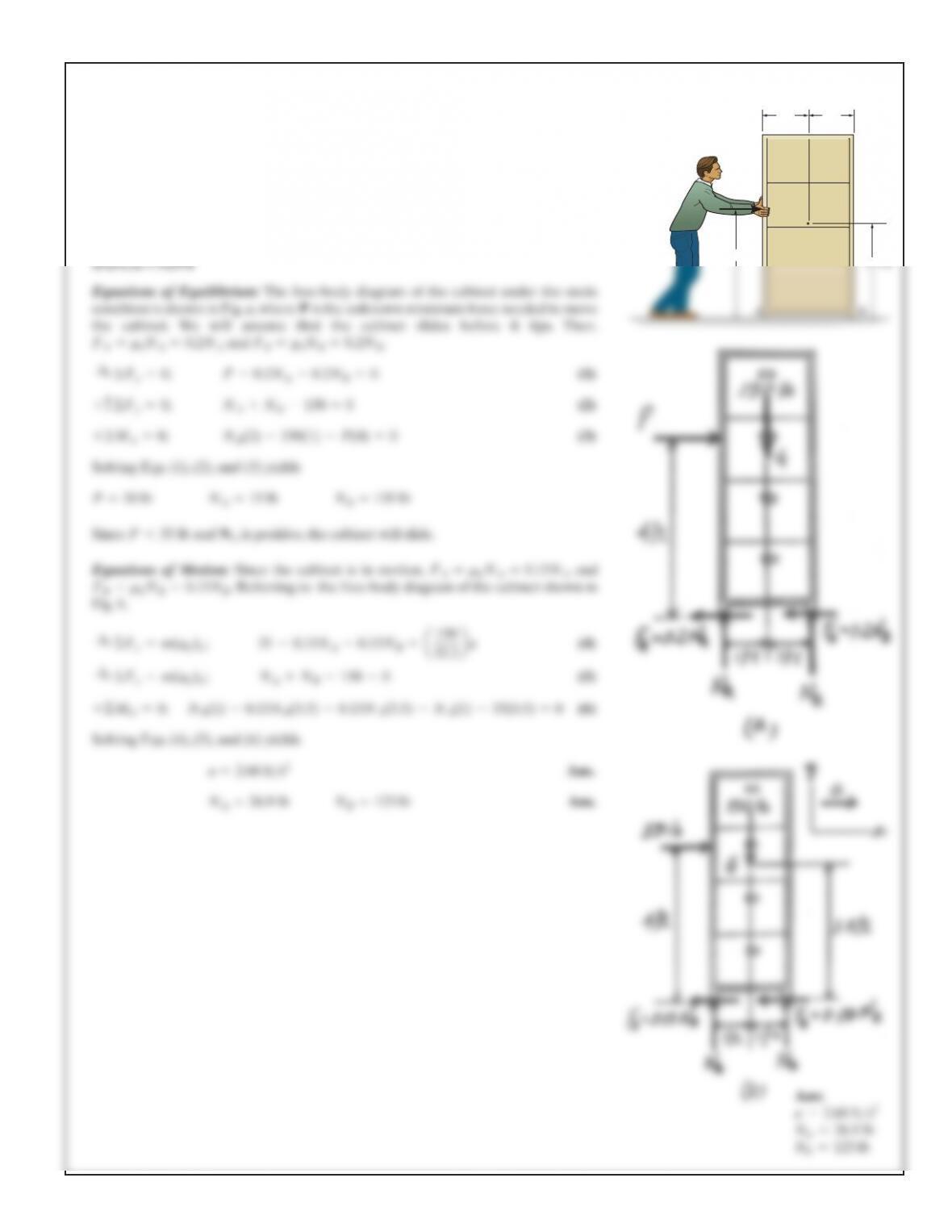
Determine the acceleration of the 150-lb cabinet and the
normal reaction under the legs Aand Bif .The
coefficients of static and kinetic friction between the
cabinet and the plane are and ,
respectively.The cabinet’s center of gravity is located at G.
mk=0.15ms=0.2
P=35 lb
*17–44.
L
A
a
u
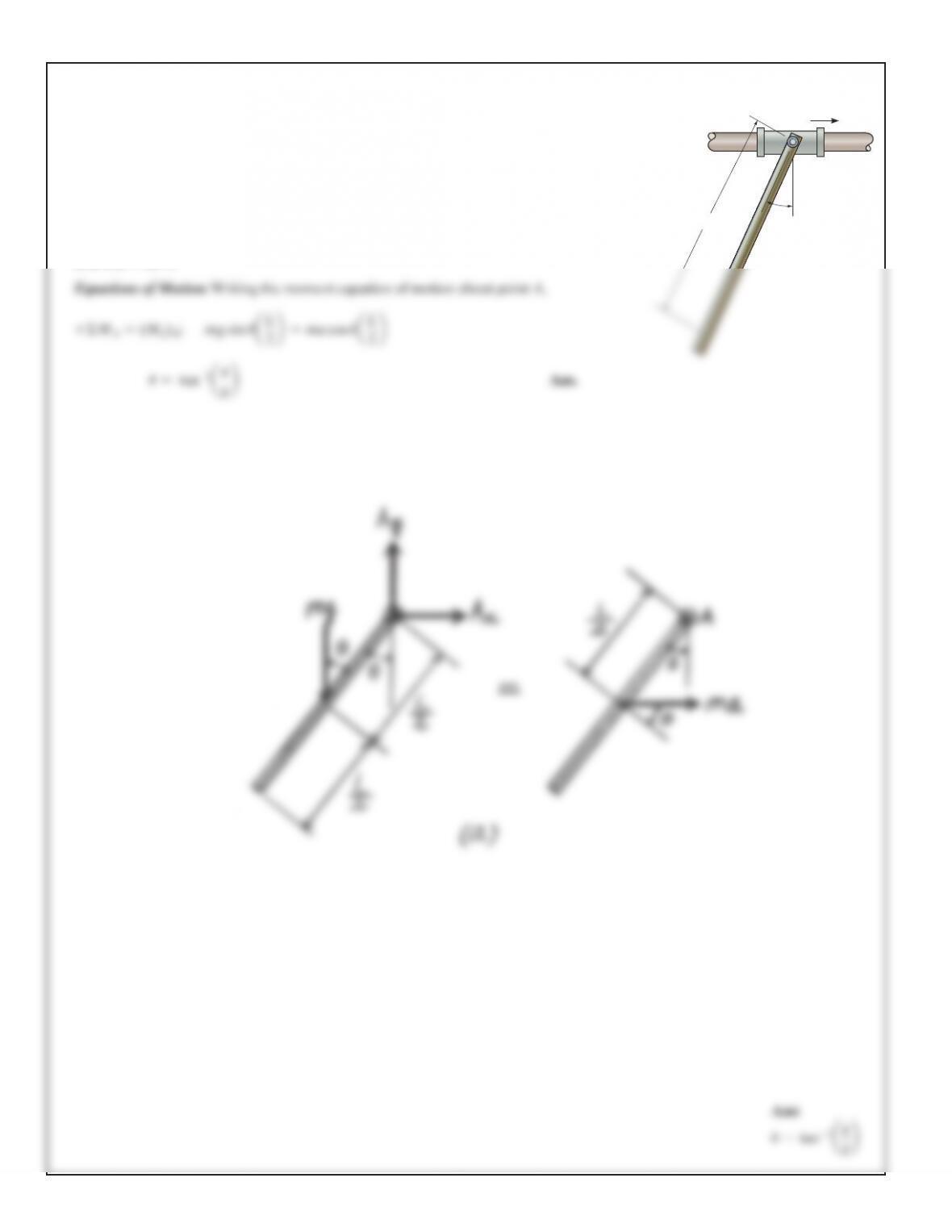
The uniform bar of mass mis pin connected to the collar,
which slides along the smooth horizontal rod. If the collar is
given a constant acceleration of a, determine the bar’s
inclination angle Neglect the collar’s mass. u.
SOLUTION
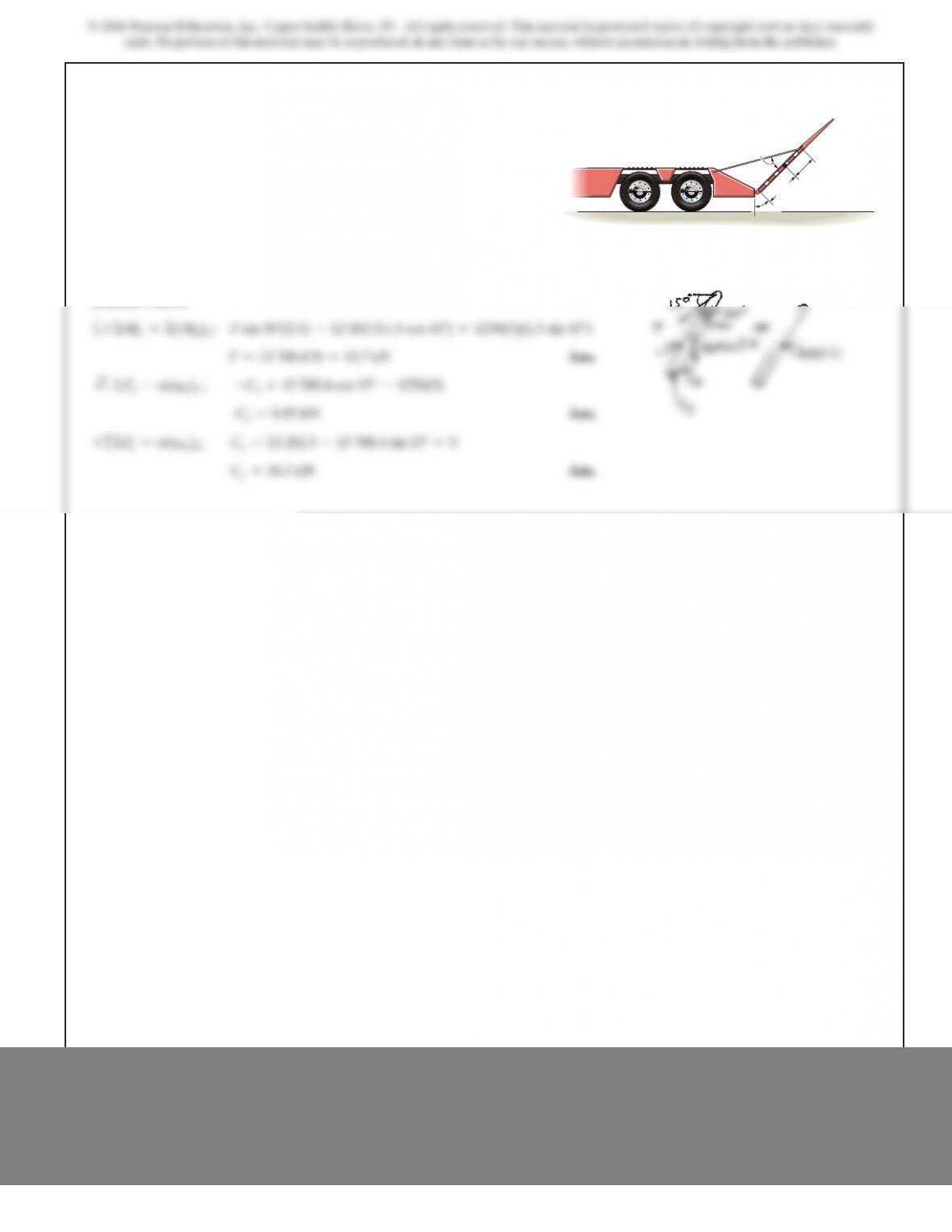
17–45.
The drop gate at the end of the trailer has a mass
of 1.25 Mg and mass center at G. If it is supported by the
cable AB and hinge at C, determine the tension in the cable
when the truck begins to accelerate at 5 m
>
s2. Also, what
are the horizontal and vertical components of reaction at
the hinge C?
B
C
$
30
1.5 m
1 m
45
G
SOLUTION
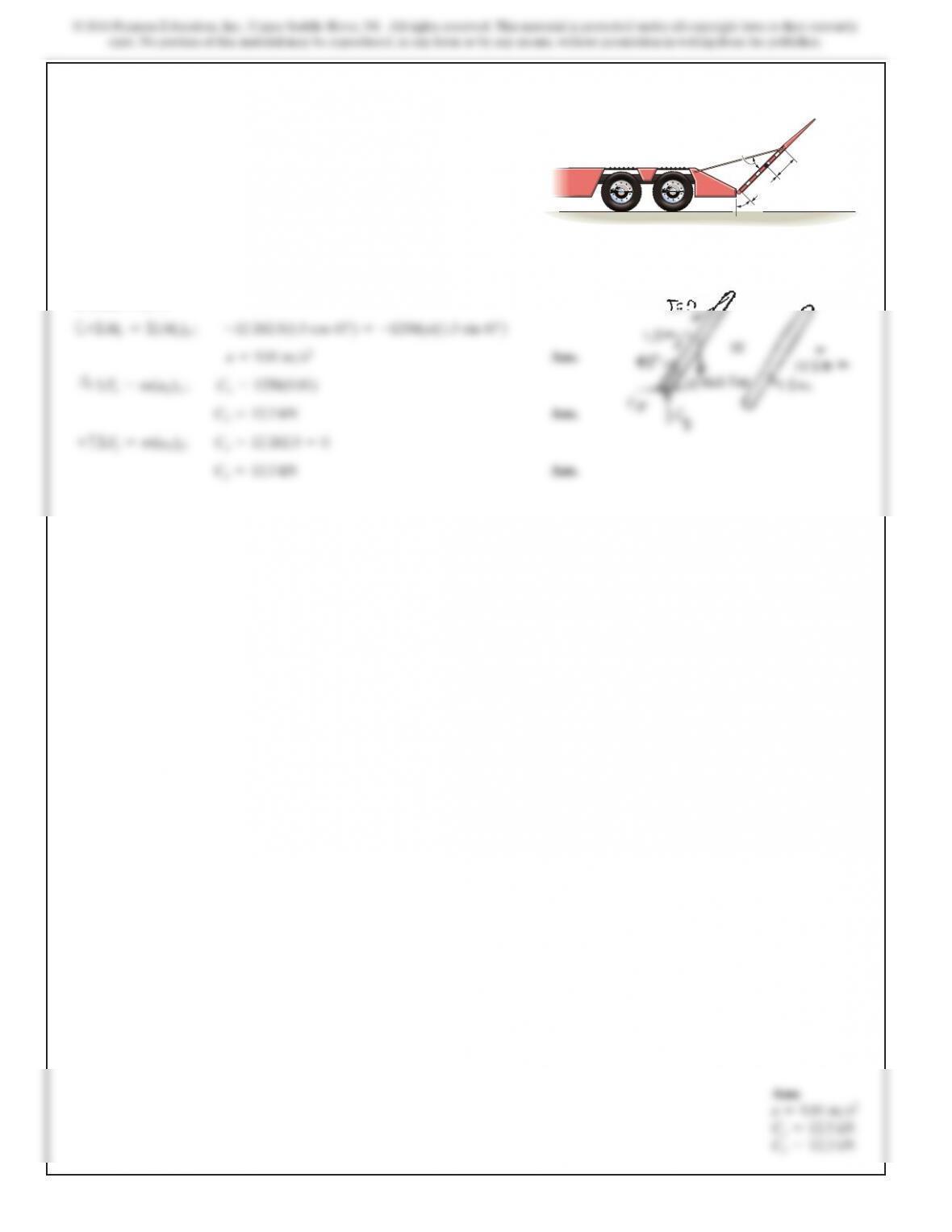
17–46.
The drop gate at the end of the trailer has a mass of 1.25 Mg
and mass center at G. If it is supported by the
cable AB and hinge at C, determine the maximum
deceleration of the truck so that the gate does not begin to
rotate forward. What are the horizontal and vertical
components of reaction at the hinge C?
SOLUTION
B
C
$
30
1.5 m
1 m
45
G
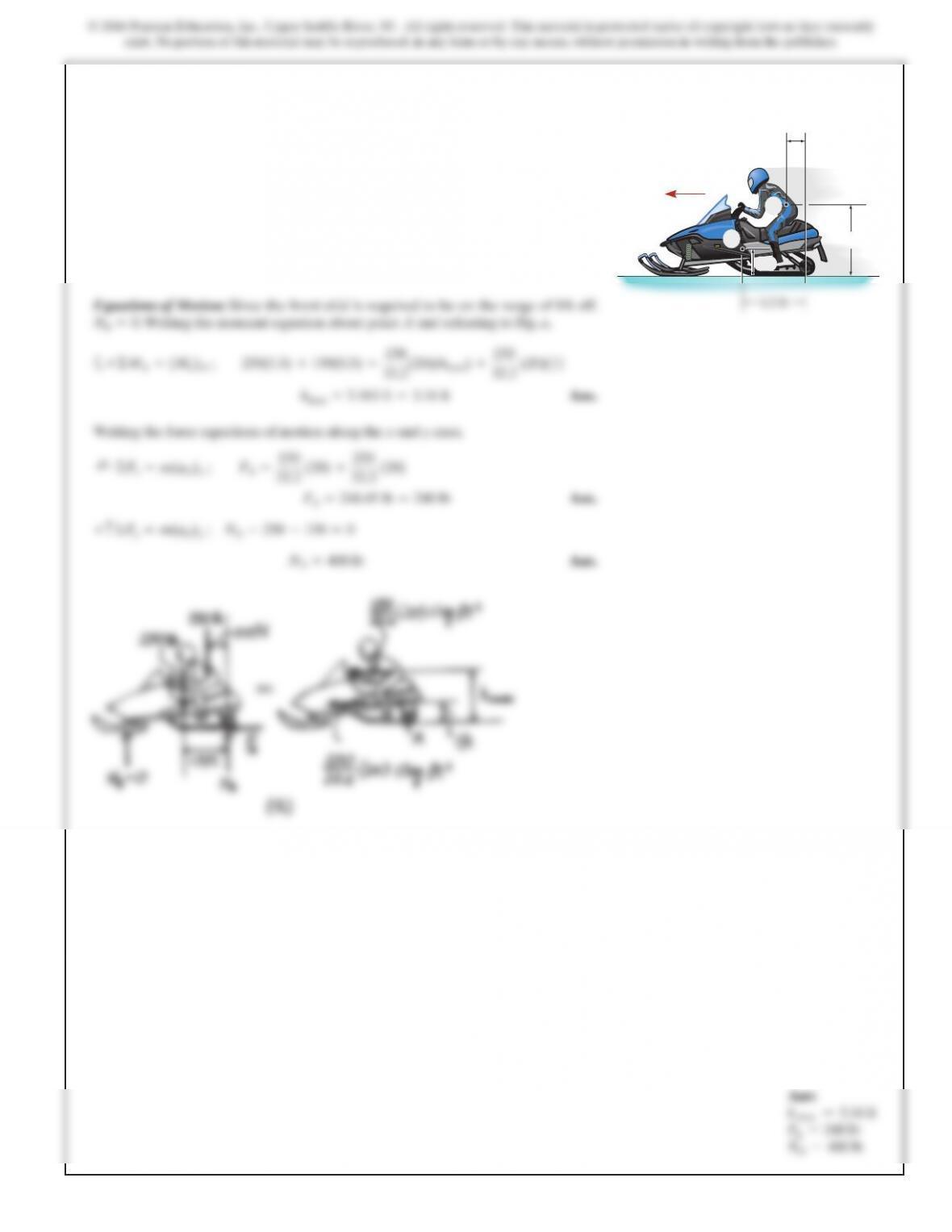
17–47.
SOLUTION
a
Ans.
Writing the force equations of motion along the xand yaxes,
Ans.
Ans.N
A=400 lb
+c©F
y=m(aG)y;N
A–250 –150 =0
F
A=248.45 lb =248 lb
;
+©F
x=m(aG)x;F
A=150
32.2 (20) +250
32.2 (20)
hmax =3.163 ft =3.16 ft
+©MA=(Mk)A; 250(1.5) +150(0.5) =150
32.2(20)(hmax)+250
32.2 (20)(1)
The snowmobile has a weight of 250 lb,centered at ,while
the rider has a weight of 150 lb,centered at .If the
acceleration is ,determine the maximum height h
of of the rider so that the snowmobile’s front skid does not
lift off the ground. Also,what are the traction (horizontal)
force and normal reaction under the rear tracks at A?
G2
a=20 ft>s2
G2
G1
a
0.5 ft
G1
G2
1ft
h
A
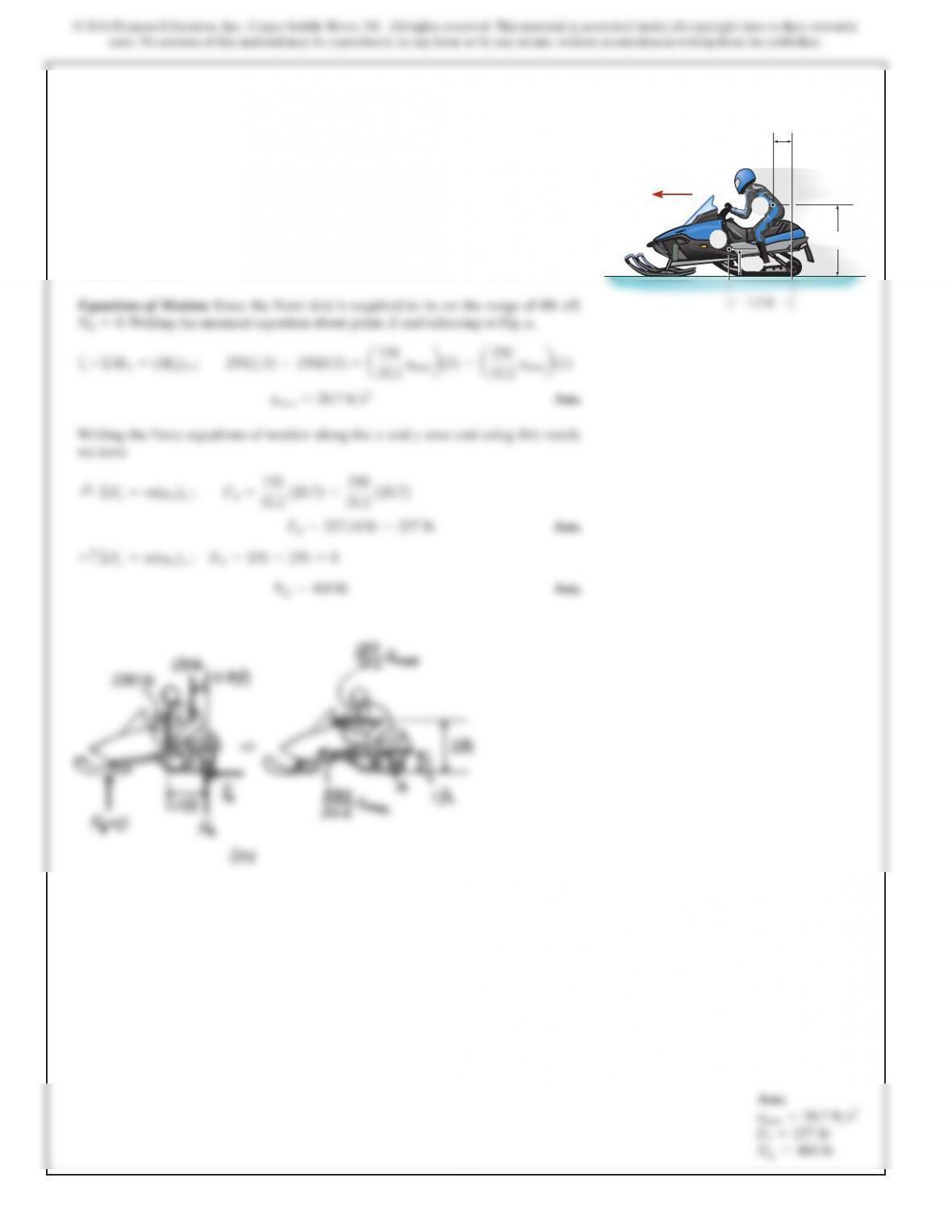
*17–48.
The snowmobile has a weight of 250 lb,centered at ,while
the rider has a weight of 150 lb,centered at .If ,
determine the snowmobile’s maximum permissible
acceleration aso that its front skid does not lift off the
ground. Also,find the traction (horizontal) force and the
normal reaction under the rear tracks at A.
h=3ftG2
G1
SOLUTION
a
Ans.
Writing the force equations of motion along the xand yaxes and using this result,
we have
Ans.
Ans.N
A=400 lb
+c©F
y=m(aG)y;N
A–150 –250 =0
F
A=257.14 lb =257 lb
;
+©F
x=m(aG)x;F
A=150
32.2 (20.7) +250
32.2 (20.7)
amax =20.7 ft>s2
+©MA=(Mk)A; 250(1.5) +150(0.5) =a150
32.2 amax b(3) +a250
32.2 amax b(1)
a
0.5 ft
G1
G2
1ft
h
A
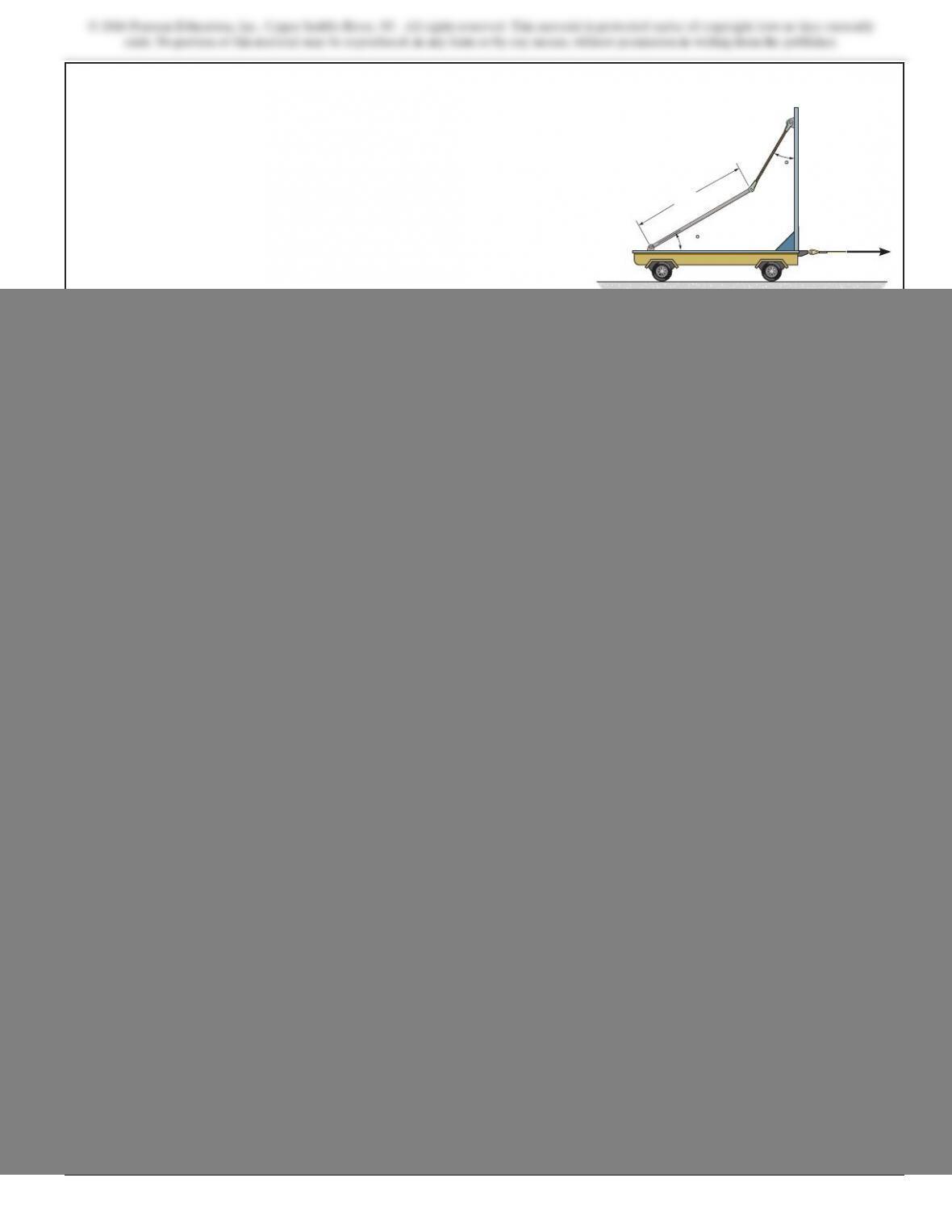
17–49.
P
30
30
1 m
C
B
A
If the cart’s mass is 30 kg and it is subjected to a horizontal
force of , determine the tension in cord AB and
the horizontal and vertical components of reaction on end
Cof the uniform 15-kg rod BC.
P=90 N
SOLUTION
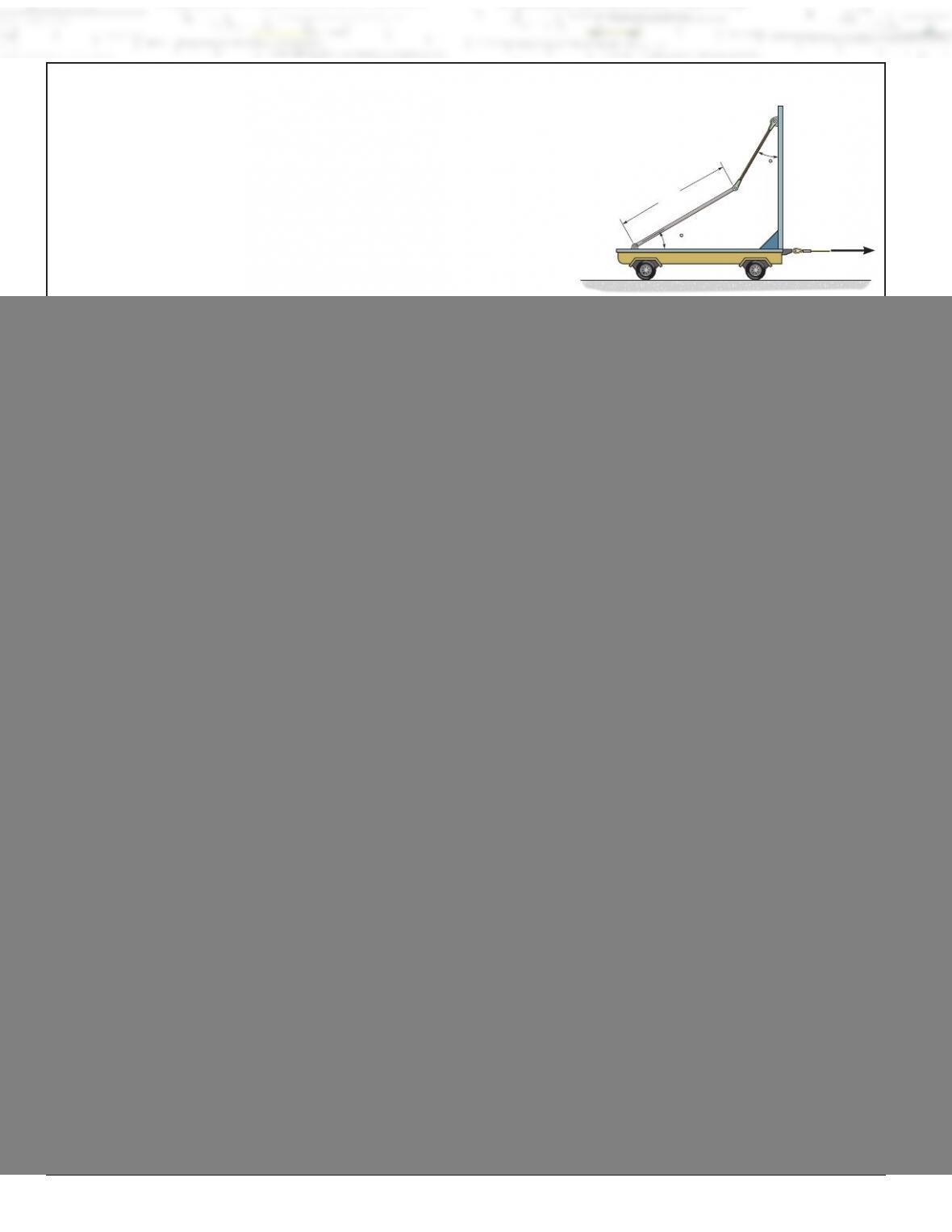
17–50.
P
30
30
1 m
C
B
A
If the cart’s mass is 30 kg, determine the horizontal force P
that should be applied to the cart so that the cord AB just
becomes slack. The uniform rod BC has a mass of 15 kg.
SOLUTION
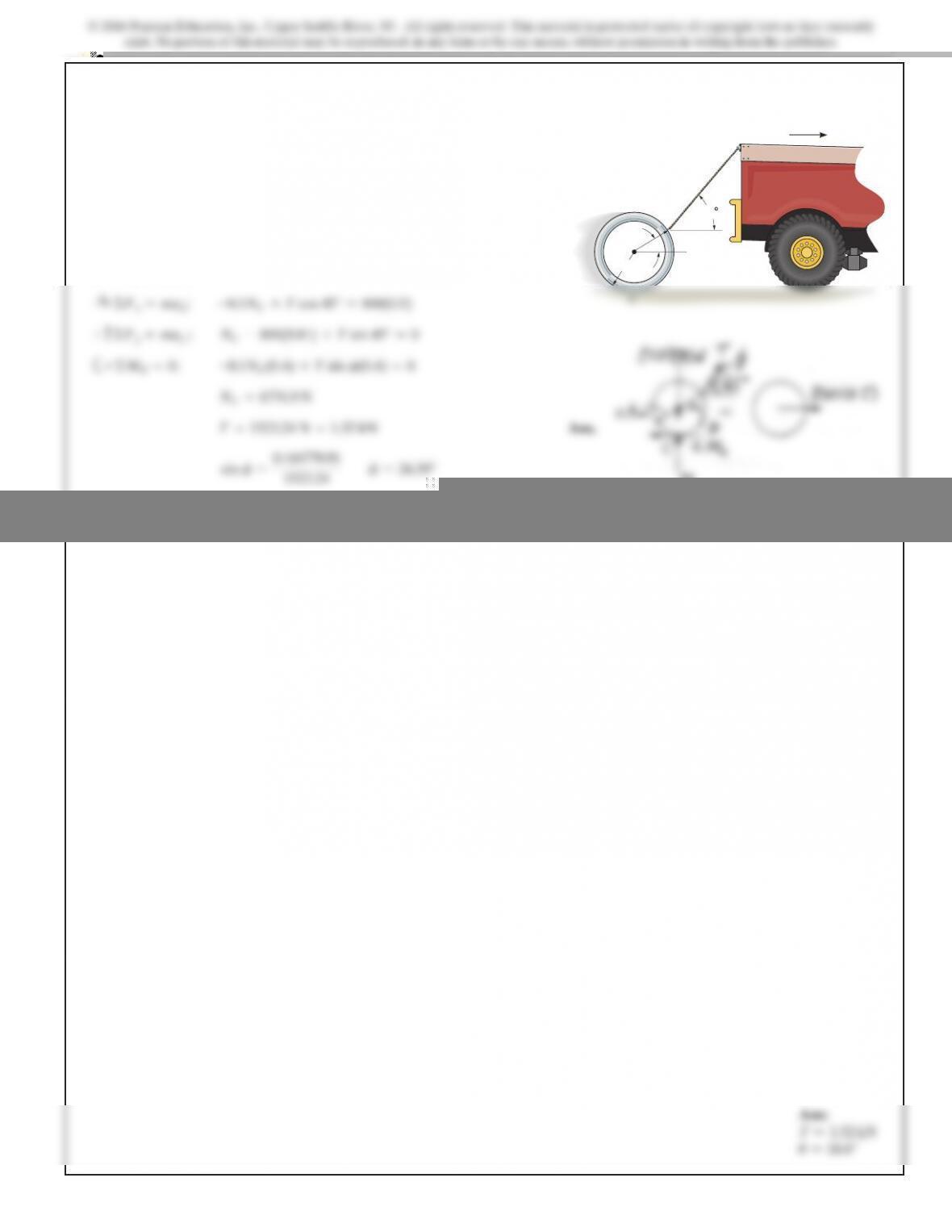
17–51.
The pipe has a mass of 800 kg and is being towed behind the
truck. If the acceleration of the truck is
determine the angle and the tension in the cable.The
coefficient of kinetic friction between the pipe and the
ground is mk=0.1.
u
at=0.5 m>s2,
SOLUTION
a
Ans.
Ans.
u
=45° –
f
=18.6°
sin f=0.1(6770.9)
1523.24
f=26.39°
T=1523.24 N =1.52 kN
NC=6770.9N
+©MG=0; –0.1NC(0.4) +Tsin f(0.4) =0
+c©Fy=may;NC–800(9.81) +Tsin 45° =0
:
45
0.4 m
G
A
B
a
t
u
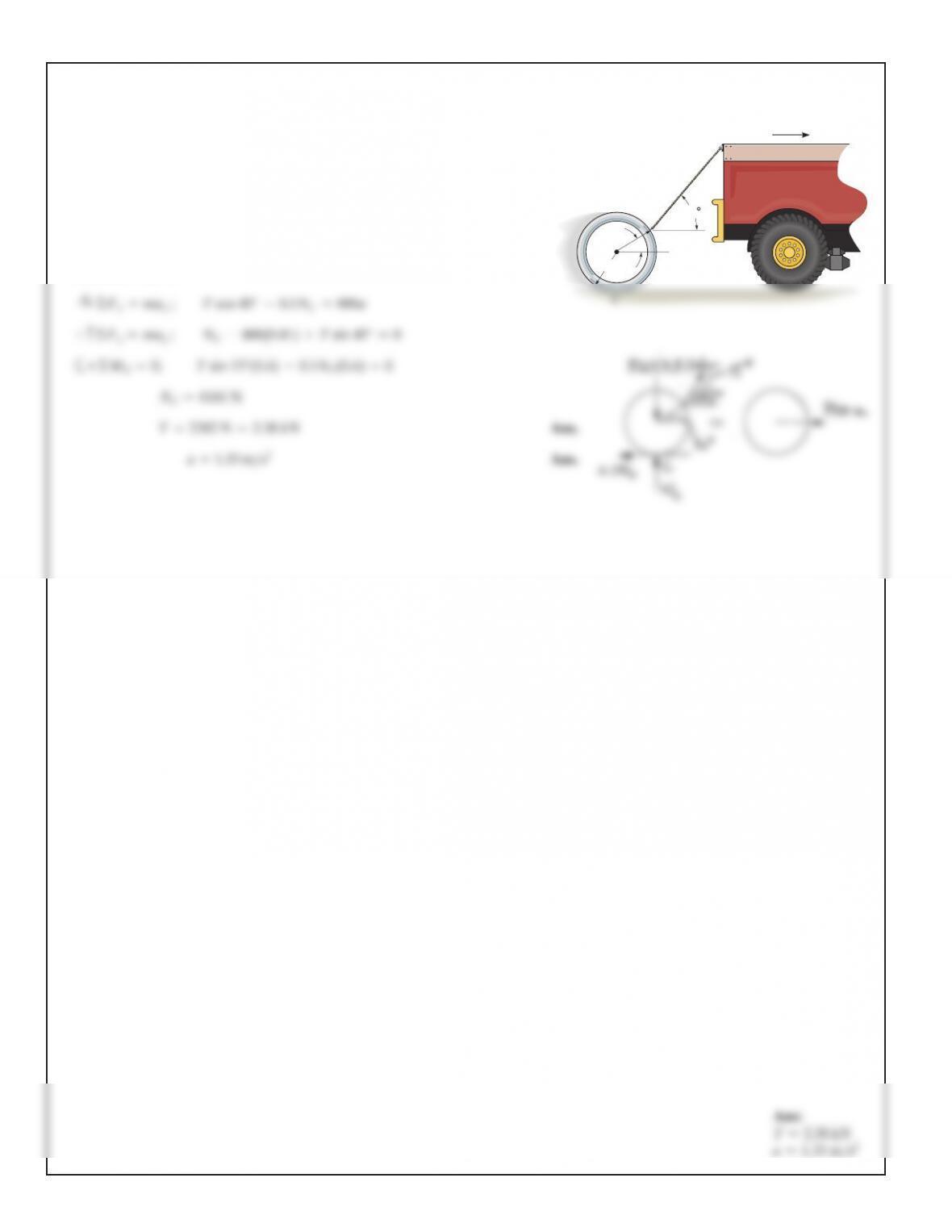
*17–52.
SOLUTION
a
Ans.
Ans.a=1.33 m>s2
T=2382 N =2.38 kN
NC=6161 N
+©MG=0; Tsin 15°(0.4) –0.1NC(0.4) =0
+c©Fy=may;NC–800(9.81) +Tsin 45° =0
:
T
h
e p
i
pe
h
as a mass of 800
k
g an
d
i
s
b
e
i
ng towe
d
b
e
hi
n
d
a
truck. If the angle determine the acceleration of the
truck and the tension in the cable.The coefficient of kinetic
friction between the pipe and the ground is mk=0.1.
u=30°,
45
0.4 m
G
A
B
a
t
u
843
17–53.
Ans:
a
=9.67 rad>s2
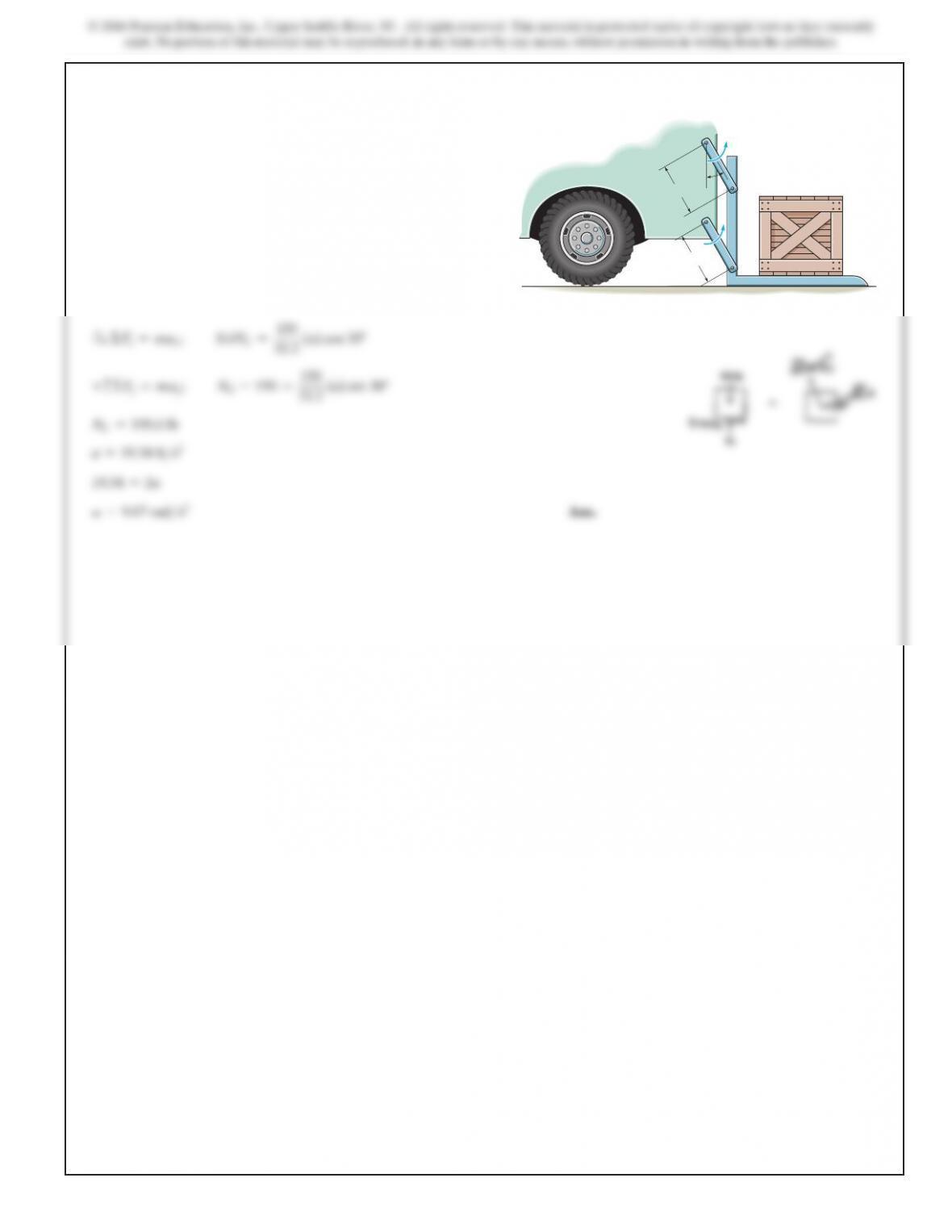
The crate C has a weight of 150 lb and rests on the truck
elevator for which the coefficient of static friction is
m
s=0.4.
Determine the largest initial angular acceleration
a,
starting from rest, which the parallel links AB and DE
can have without causing the crate to slip. No tipping occurs.
SOLUTION
150
B
AC
D
2 ft
2 ft
E
30
a
a
17–54.
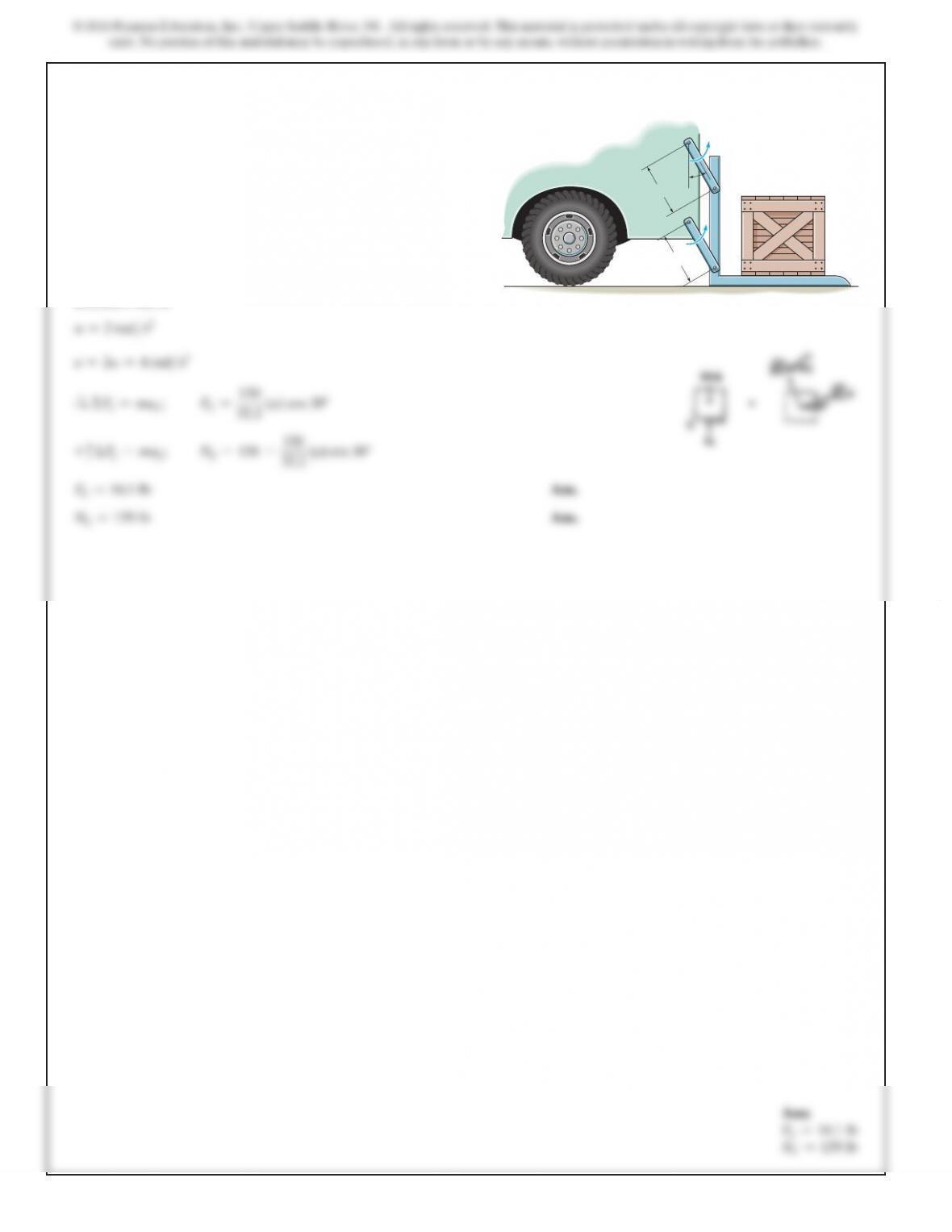
The crate C has a weight of 150 lb and rests on the truck
elevator. Determine the initial friction and normal force of
the elevator on the crate if the parallel links are given an
angular acceleration a
=
2 rad
>
s
2
starting from rest.
SOLUTION
B
AC
D
2 ft
2 ft
E
30
a
a
845
17–55.
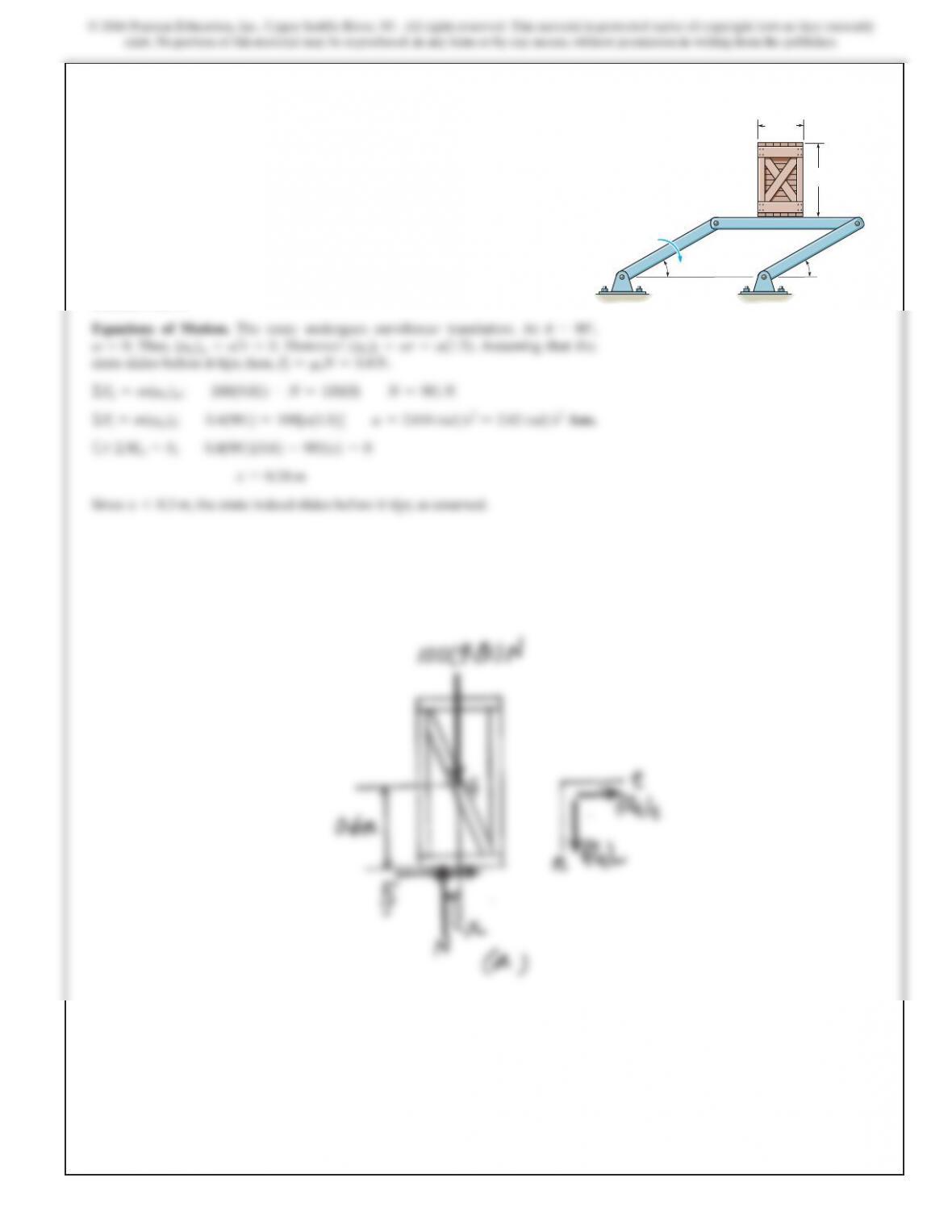
The 100-kg uniform crate C rests on the elevator floor
where the coefficient of static friction is m
s=0.4.
Determine the largest initial angular acceleration
a,
starting from rest at u
=90°,
without causing the crate
to slip. No tipping occurs.
Ans:
a
=
2.62 rad
>
s
2
SOLUTION
1.2 m
0.6 m
1.5 m
1.5 m
C
B
D
E
A
a
uu
846
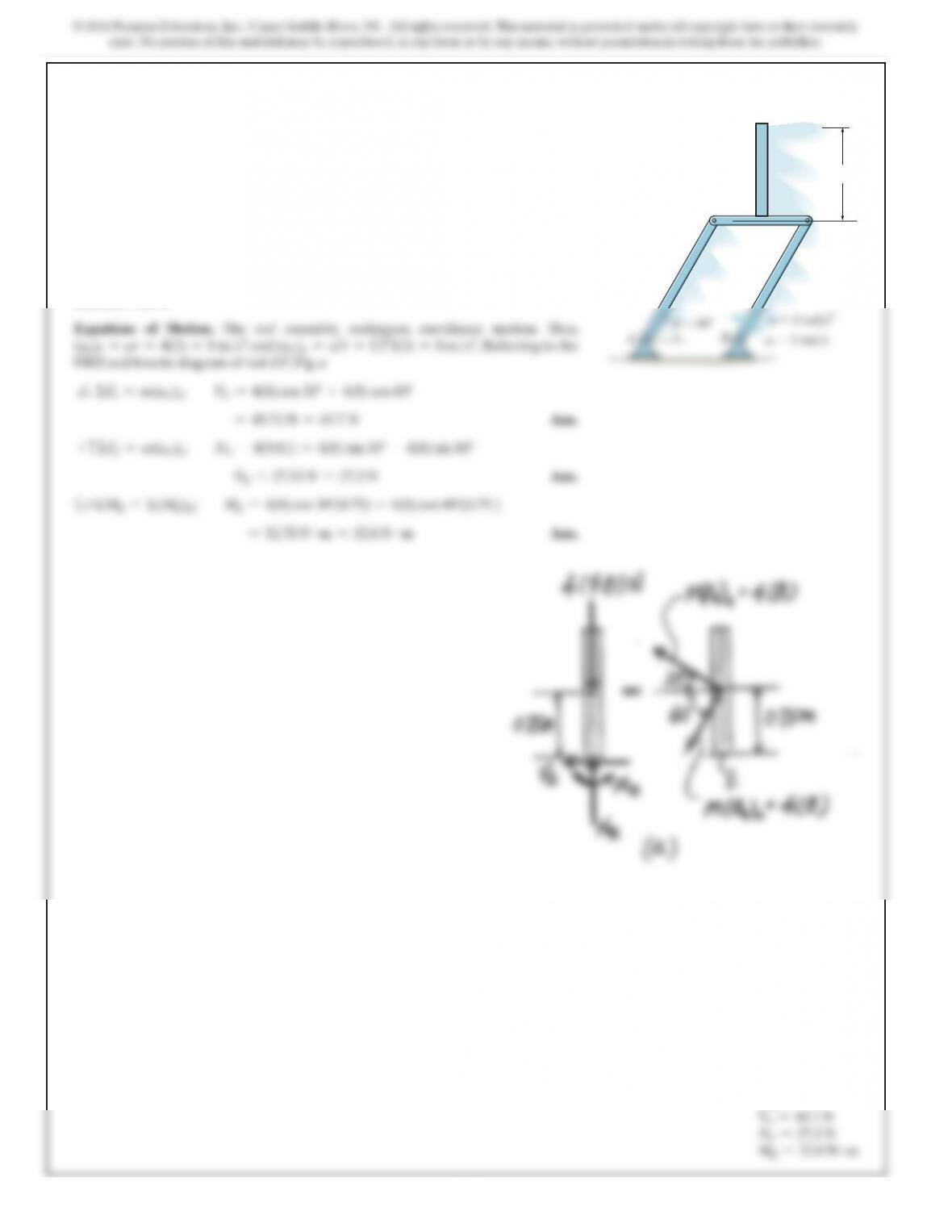
*17–56.
The two uniform 4-kg bars DC and EF are fixed (welded)
together at E. Determine the normal force
NE,
shear force
VE,
and moment
ME,
which DC exerts on EF at E if at the
instant
u=60°
BC has an angular velocity v
=2 rad>s
and
an angular acceleration a
=
4 rad
>
s
2
asshown.
a
4 rad/s2
E
F
2 m
2 m
D
C
1.5 m
SOLUTION
NE=27.53 N =27.5 N
Ans:
VE=43.7 N
NE=27.5 N
ME=32.8 N #m
17–57.
The 10-kg wheel has a radius of gyration If
the wheel is subjected to a moment where t
is in seconds, determine its angular velocity when
starting from rest. Also, compute the reactions which the
fixed pin Aexerts on the wheel during the motion.
t=3s
M=15t2N#m,
k
A
=200 mm.
SOLUTION
c
Ans.
Ans.
Ans.Ay
=
98.1 N
Ax=0
v=56.2 rad>s
v=L3
0
12.5tdt=12.5
2(3)2
a=dv
dt =12.5t
+©MA=Iaa;5t=10(0.2)2a
+c©Fy=m(aG)y;Ay–10(9.81) =0
:
+©Fx=m(aG)x;Ax=0
A
M
848
17–58.
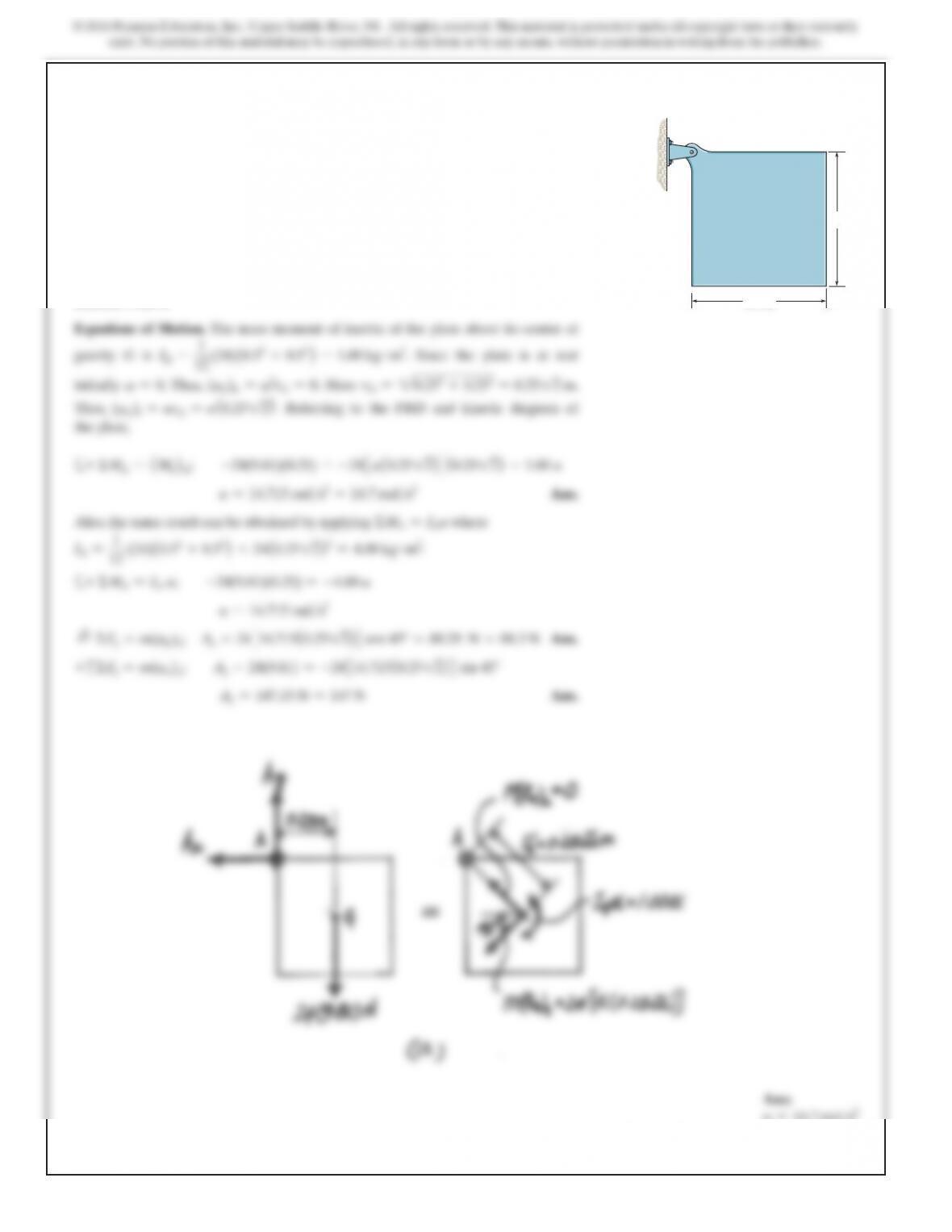
The uniform 24-kg plate is released from rest at the position
shown. Determine its initial angular acceleration and the
horizontal and vertical reactions at the pin A.
a
=
14.7 rad
>
s
2
Ax=88.3 N
A
y
=147 N
SOLUTION
0.5 m
A
0.5 m
849
17–59.
A
B
L
3
2
3L
u
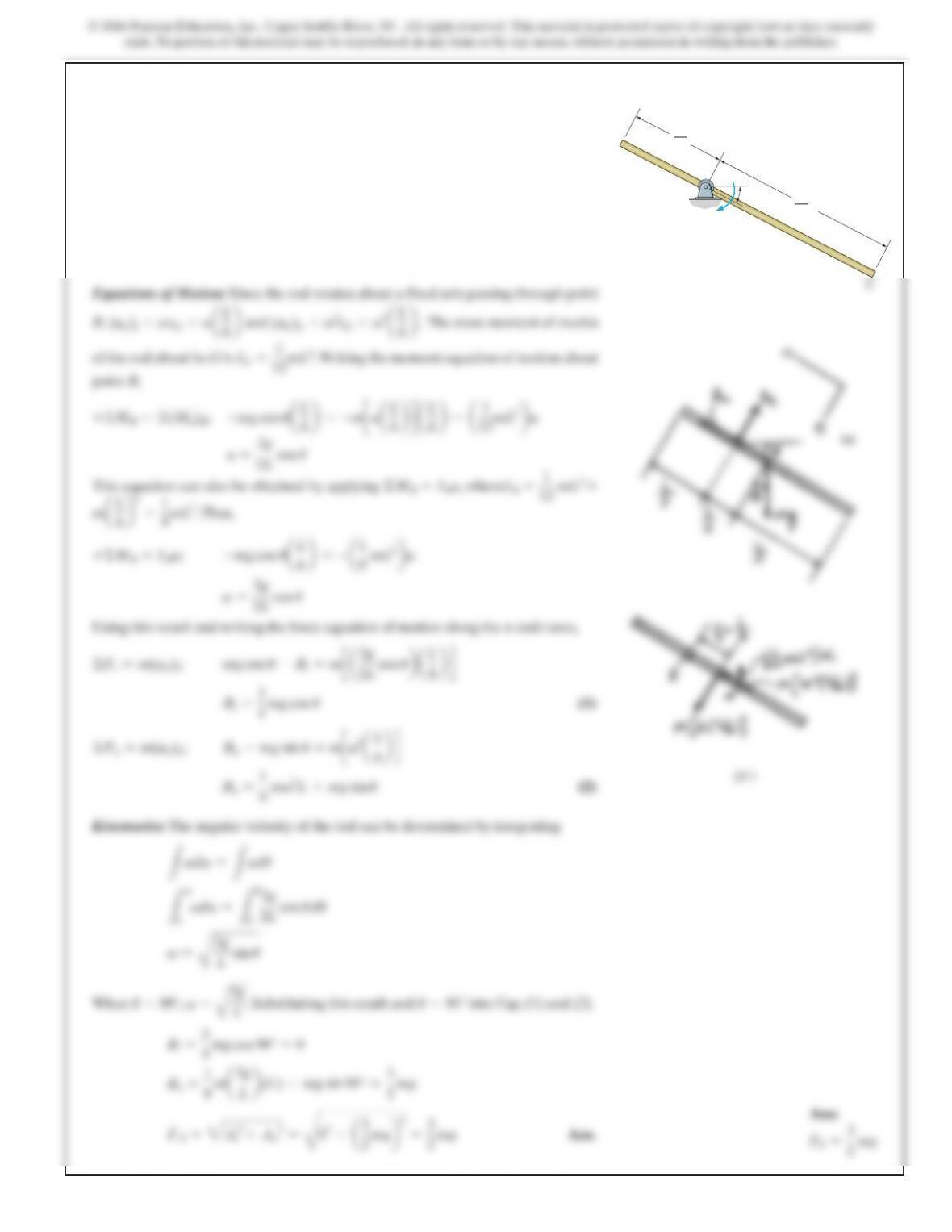
The uniform slender rod has a mass m. If it is released from
rest when , determine the magnitude of the reactive
force exerted on it by pin Bwhen .u=90°
u=0°
SOLUTION
2
*17–60.
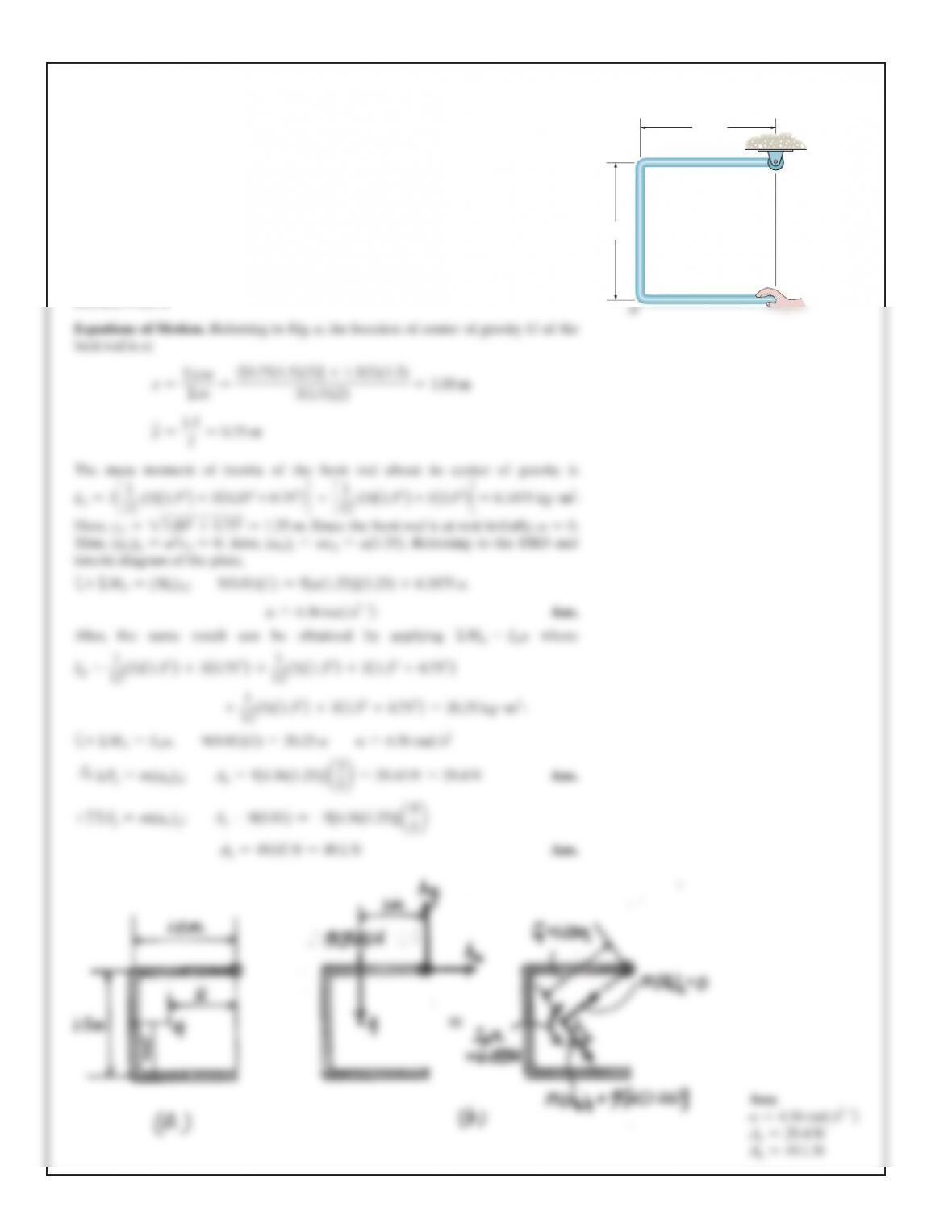
The bent rod has a mass of 2 kg
>
m. If it is released from rest
in the position shown, determine its initial angular
acceleration and the horizontal and vertical components of
reaction at A.
1.5 m
1.5 m
A
C
SOLUTION