Collaborative Writing Guide
Collecting Secondary and Primary Information. The next phase is to collect data for the report
(see Chapter 10). You may assign reports that require library (secondary) research, primary research
(typically collected through interviews), or both secondary and primary research. Primary research is
often included in business reports.
Begin by discussing with students your expectations for depth of research and types of sources you
expect the team to include in the report. For secondary research, be sure to include a discussion of what
you view as credible Internet sources.
If teams must conduct interviews, provide sufficient guidance in the development of questions. Also
teach students how to conduct interviews. Caution them to set up interviews early so that they can work
around the interviewee’s schedule. In addition to interviewing people who have information related to
their report topic, students might want to interview the audience for whom the report is intended, to
determine its needs and concerns. Remind students that the audience for the analytical or informational
report is whoever has authority to make changes. For example, the audience for an analytical report on
campus parking problems would be the administrator(s) with power to change parking policies.
Students may formulate interview questions individually, partly with the group, or completely with
the group. For example, they could bring possible questions to a group meeting, at which members would
select the questions. Or the entire group could brainstorm and then select the questions. Generally,
however, the questions are written as a group. Require teams to submit interview questions for your
review and constructive criticism. Groups should then revise the questions for your final review prior to
conducting actual interviews. (Strongly urge students to tape-record interviews so that they can concentrate
Composing a Rough Draft. So that students focus on essentials, ask them to provide rough drafts
consisting only of the introduction, body, and conclusions or recommendations. The introduction
describes the problem, the purpose, the methodology used for research, and any background information
necessary; the body describes and analyzes the results of the research. Pay little attention to format at this
stage.
Writing a Progress Report. The third document in the report package is a progress report, which is
written individually, not collaboratively. This progress report should be a one-page memo written to you
explaining what the group has accomplished and what the individual group member has accomplished.
Exhibit 2 is a handout for the assignment.
completion.
Collaborative Writing Guide
EXHIBIT 2
PROGRESS REPORT
information, he or she might make erroneous assumptions or decisions, which may later cause problems
for you and the company.
ASSIGNMENT
FORMAT
Use memo format and the following headings:
WORK COMPLETED: What you have done for the project (the exact tasks you have completed),
found
WORK TO BE COMPLETED: What remains to be done, what problems you anticipate, and what
you hope the results of your research will be
EVALUATION CRITERIA
honesty, and participation.
Collaborative Writing Guide
Copyright © 2014 Pearson Education, Inc.
When assigning progress reports, stress the importance of candor and honesty. The purpose of
progress reports in the business world is to give managers the information they need to make vital
decisions; painting an unduly rosy picture subverts the decision-making process. Also point out that
student complaints about other group members’ work will have no effect once the group has been graded,
so they should use the progress report to make you aware of any potential problems. In addition, remind
them that their progress reports are the equivalent of employee evaluations, which are expected to
include both negative and positive assessments.
Preparing a Final Report. Students’ final reports should have at least nine parts:
1. Professional–looking cover
2. Title page
3. Table of contents
4. Synopsis
background information)
6. Body of the report
7. Summary, conclusions, or recommendations
9. Bibliography
10. Visual aids (optional)
11. Letter of transmittal (optional)
format, sentence structure, and other matters discussed in Chapters 5 and 11. To clarify the distinction
between revising and editing, you might tell students that most report writers work together during revision
Giving a Presentation. In addition to the group-writing project, students may also collaborate on an
oral or online presentation (see Chapter 12), which they present to the class. Their presentations should
works together to rehearse and revise the presentation.
EVALUATING COLLABORATIVE PROJECTS
1. Evaluation of work plan (group grade)
2. Evaluation of rough draft (group conference)
Collaborative Writing Guide
3. Evaluation of progress reports (individual grade)
4. Evaluation of final report (group grade)
5. Evaluation of presentation (group and individual grade; optional)
6. Evaluation of participation in group (individual grade)
The purpose of the work plan is to allow students to develop goals for the project and for themselves
and to allow you to foresee any problems they might have in focusing their research. The criteria for the
part of the group decision-making process, often facilitating change and growth. But it’s destructive
when groups become dysfunctional because of it.
Exhibit 2 explains the evaluation criteria for the progress report (graded individually). The final
report is evaluated on its own merits, and the entire group receives that grade. In addition to asking the
and so on.
Finally, all students evaluate fellow group members, as well as themselves. This evaluation allows
you to give each student an individual grade for participation and for interaction with other group
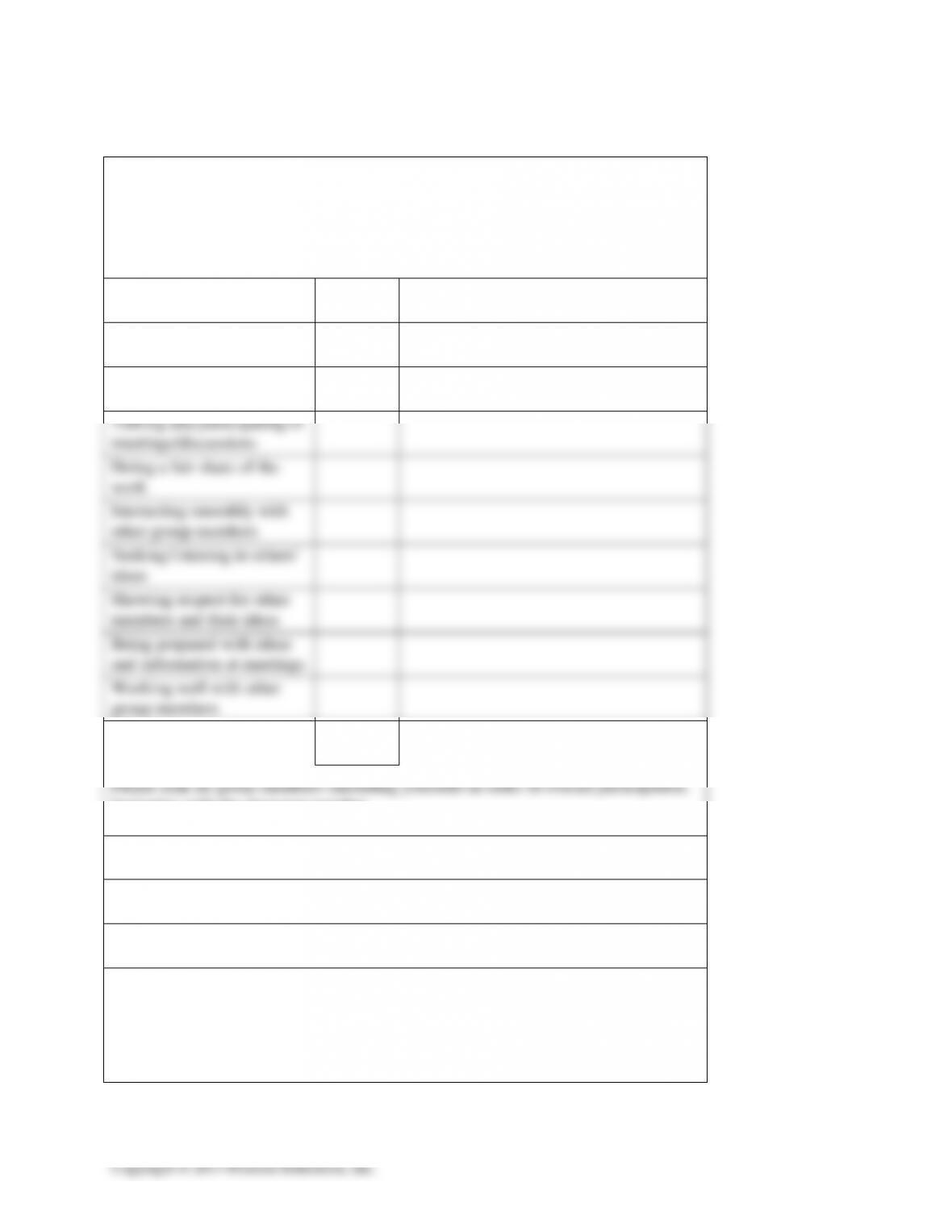
members. You may collect students’ task sheets (Exhibit 1). Also, the evaluation form in Exhibit 3 lets
students score and rank fellow group members’ work. You may find that students rank two or more group
individual grades ensures that all members contribute.4
Collaborative Writing Guide
REFERENCES
Notes
1. Lisa S. Ede and Andrea A. Lunsford, “Why Write . . . Together: A Research Update,” Rhetoric
Review 5 (1986): 71–81.
2. Shlomo Sharan, “Cooperative Learning in Small Groups: Recent Methods and Effects on
Achievement, Attitudes, and Ethnic Relations,” Review of Educational Research 50 (1980): 241–
271; Robert Slavin, “Cooperative Learning,” Review of Educational Research 50 (1980): 315–342.
Approach (New York: West, 1980).
4. Slavin, “Cooperative Learning.”
Bibliography
Business and Technical Communication 1 (1987): 70–90.
Bruffee, Kenneth. “Collaborative Learning: Some Practical Models.” College English 34 (1973): 48–57.
Cragan, John F., and David W. Wright. Communication in Small Group Discussions: A Case Study
Approach. New York: West, 1980.
5 (1986): 71–81.
Faigley, Lester, and Thomas P. Miller. “What We Learn from Writing on the Job.” College English 44
(1982): 557–569.
1975.
Sharan, Shlomo. “Cooperative Learning in Small Groups: Recent Methods and Effects on Achievement,
Collaborative Writing Guide
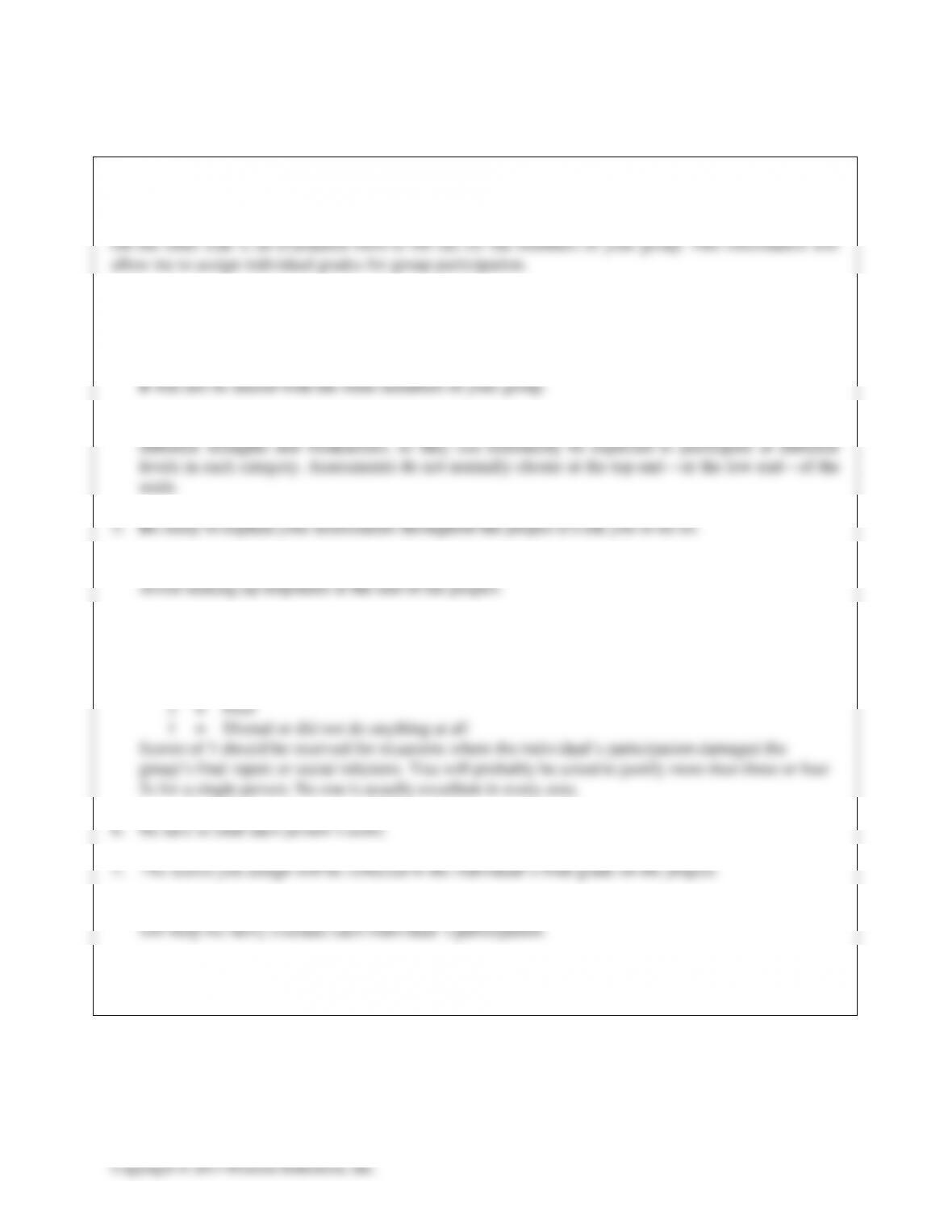
EXHIBIT 3
INDIVIDUAL EVALUATIONS
Write comments telling me specifically why each individual received the score he or she did. If these
forms are not filled out with comments, you will lose points.
1. The information you provide on this assessment sheet is private communication between you and me.
2. No two people should get exactly the same assessment. Group members are individuals, with
4. Keeping notes on each person’s participation will help you fairly evaluate fellow group members.
5. Assign points for each group member’s participation in each category:
5 = Excellent
4 = Good
3 = Average
8. You MUST write comments to justify your scores. Feel free to write any additional comments that
Collaborative Writing Guide
EXHIBIT 3 (Continued)
YOUR NAME _______________________________________________________
GROUP MEMBER’S NAME __________________________________________
CRITERIA
POINTS
COMMENTS
Being at and on time for
meetings
Accepting responsibility
and volunteering
Contributing ideas
Talking and participating in
meetings/discussions
Doing a fair share of the
work
Interacting smoothly with
other group members
Seeking/listening to others’
ideas
Showing respect for other
members and their ideas
Being prepared with ideas
and information at meetings
Working well with other
group members
TOTAL POINTS:
Please rank all group members (including yourself) in order of overall participation,
beginning with the strongest member.
Additional comments: