Answers to Additional Problems and Applications
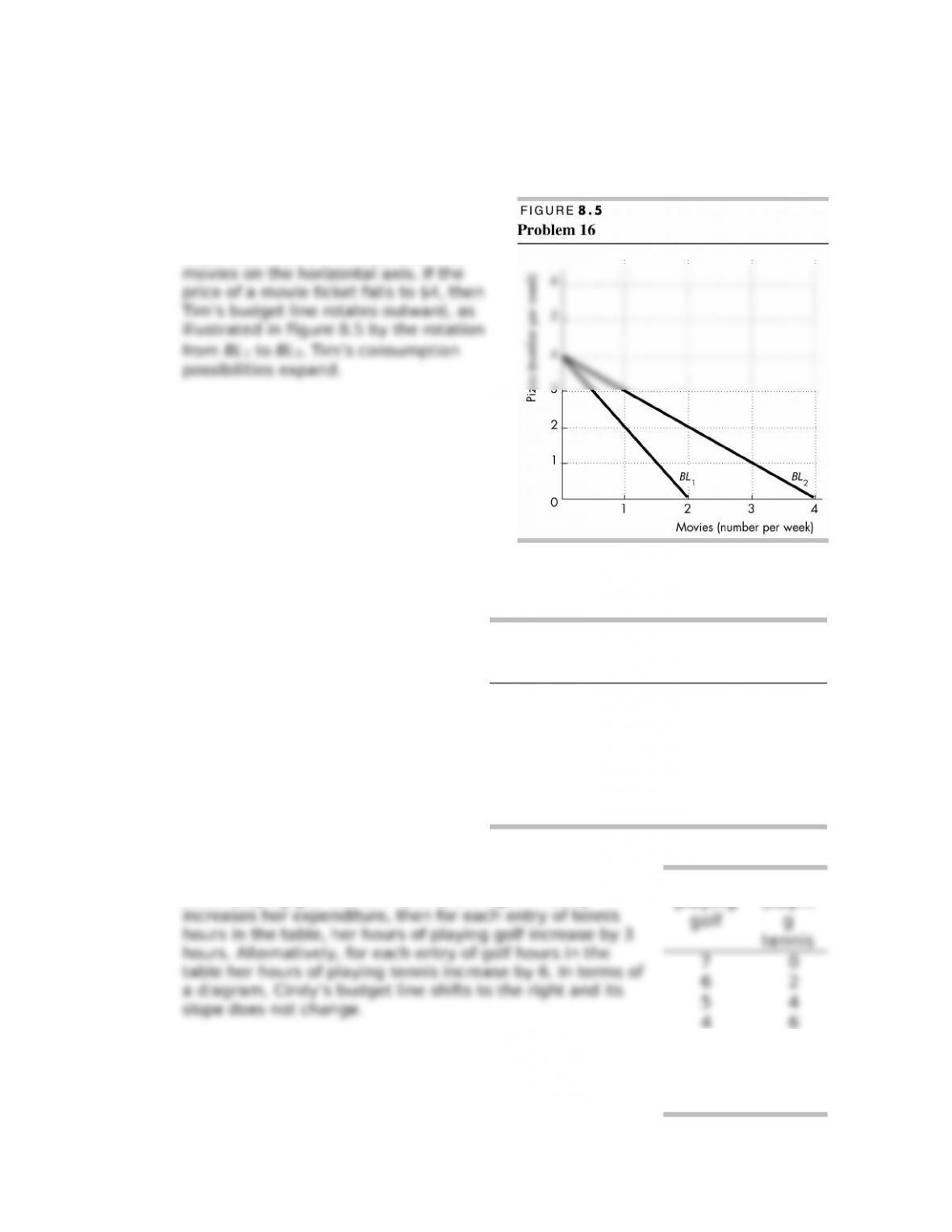
16. Tim buys 2 pizzas and sees 1 movie a week when he has $16 to spend, a
movie ticket is $8, and a pizza is $4. Draw Tim’s budget line. If the price of a
movie ticket falls to $4, describe how
Tim’s consumption possibilities change.
Figure 8.5 shows Tim’s budget line as
BL1. Pizza is on the vertical axis and
17. Cindy has $70 a month to spend,
and she can spend as much time as
she likes playing golf and tennis.
The price of an hour of golf is $10,
and the price of an hour of tennis is
$5. The table shows Cindy’s
marginal utility from each sport.
Make a table that shows Cindy’s
a-ordable combinations of hours
playing golf and tennis. If Cindy
increases her expenditure to $100,
describe how her consumption possibilities change.
The table showing Cindy’s a-ordable combinations of
hours playing golf and tennis is to the right. If Cindy
© 2016 Pearson Education, Inc.
Hours
per
month
Marginal
utility from
golf
Marginal
utility from
tennis
1 80 40
2 60 36
3 40 30
4 30 10
5 20 5
6 10 2
7 6 1
Hours
playing
Hours
playin
4 6
3 8
2 10
1 12
0 14
U T I L I T Y A N D D E M A N D 1 0 3
Use the information in Problem 17 to work Problems 18 to 24.
18.a. How many hours of golf and how many hours of tennis does she play to
maximize her utility?
Cindy plays golf for 5 hours and tennis for 4 hours to maximize her utility. This
b. Compared to part (a), if Cindy spent a dollar more on golf and a dollar less
on tennis, by how much would her total utility change?
If Cindy played another hour of golf, she pays $10 and gains 10 units of utility (the
marginal utility from the 6th hour), which is 1.0 unit of utility per dollar. So if she
spends a dollar more on golf, her utility from golf increases by 1.0. If she spends
c. Compared to part (a), if Cindy spent a dollar less on golf and a dollar more
on tennis, by how much would her total utility change?
If Cindy spends an hour less playing golf, she saves $10 and loses 20 units of
utility (the marginal utility from the 5th hour), which is 2.0 unit of utility per dollar.
So if she spends a dollar less on golf, her utility from golf decreases by 2.0. If she
19. Explain why, if Cindy equalized the marginal utility per hour of golf and
tennis, she would not maximize her utility.
Cindy would not maximize her utility by equalizing the marginal utility per hour of
golf and tennis because golf and tennis have di-erent prices. Golf is twice as
Cindy’s tennis club raises its price of an hour of tennis from $5 to $10, other things
remaining the same.
20.a. List the combinations of hours spent playing golf and tennis that Cindy can
now a-ord and her marginal utility per dollar from golf and from tennis.
© 2016 Pearson Education, Inc.
1 0 4 C H A P T E R 8
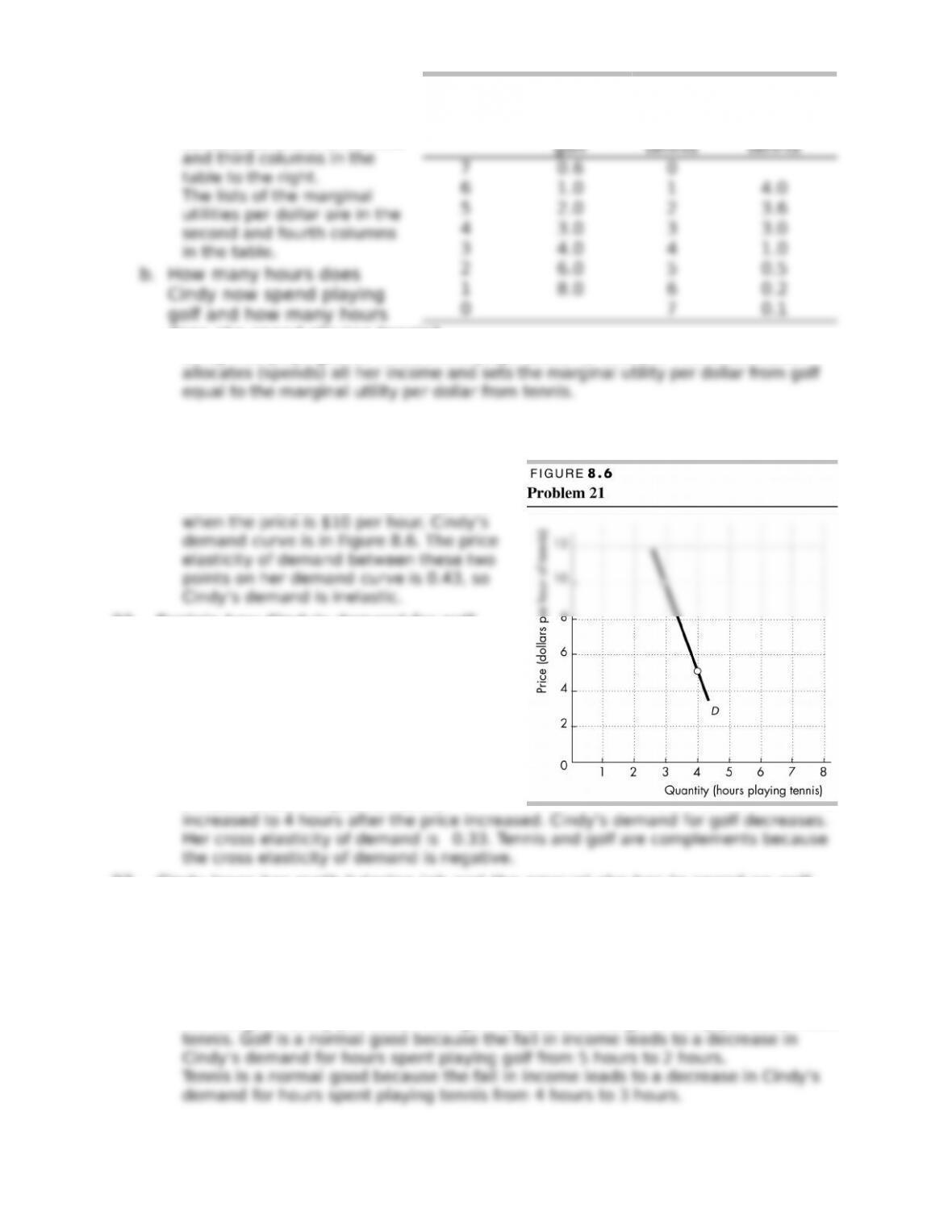
The lists of a-ordable
combinations are in the @rst
golf and how many hours
does she spend playing tennis?
Cindy now plays golf for 4 hours and plays tennis for 3 hours. This combination
21. Use the information in Problem 20 to draw Cindy’s demand curve for tennis. Over the
price range of $5 to $10 an hour of tennis, is Cindy’s demand for tennis elastic or inelastic?
One point on her demand curve is 4
hours of tennis when the price is $5 per
hour. Another point is 3 hours of tennis
22. Explain how Cindy’s demand for golf
changed when the price of an hour of
tennis increased from $5 to $10 in
Problem 20. What is Cindy’s cross
elasticity of demand for golf with
respect to the price of tennis? Are tennis
and golf substitutes or complements for
Cindy?
The quantity of golf Cindy plays falls from
5 hours before the price of tennis
23. Cindy loses her math tutoring job and the amount she has to spend on golf
and tennis falls from $70 to $35 a month. With the price of an hour of golf at
$10 and of tennis $5, calculate the change in the hours she spends playing
golf. For Cindy, is golf a normal good or an inferior good? Is tennis a normal
good or an inferior good?
With an income of $35, Cindy now plays golf for 2 hours and tennis for 3 hours to
maximize her utility. This combination allocates (spends) all her income and sets
the marginal utility per dollar from golf equal to the marginal utility per dollar from
© 2016 Pearson Education, Inc.
Hours
playing
golf
Marginal
utility per
dollar from
golf
Hours
playin
g
tennis
Marginal
utility per
dollar from
tennis
U T I L I T Y A N D D E M A N D 1 0 5
24. Cindy takes a Club Med vacation, the cost of which includes unlimited sports
activities. With no extra charge for golf and tennis, Cindy allocates a total of 4
hours a day to these activities.
a. How many hours does Cindy play golf and how many hours does she play
tennis?
b. What is Cindy’s marginal utility from golf and from tennis?
c. Why does Cindy equalize the marginal utilities rather than the marginal
utility per dollar from golf and from tennis?
Because the equipment is free, Cindy does not have to allocate her income
25. Jim has made his best a-ordable choice of muFns and co-ee. He spends all
of his income on 10 muFns at $1 each and 20 cups of co-ee at $2 each. Now
the price of a muFn rises to $1.50 and the price of co-ee falls to $1.75 a cup.
a. Will Jim now be able to buy 10 muFns and 20 co-ees?
Before the changes in price, Jim spent all his income on muFns and co-ee.
Therefore Jim’s income is (10 muFns) × ($1 each) + (20 cups of co-ee) × ($2
b. If Jim changes the quantities he buys, will he buy more or fewer muFns and
more or less co-ee? Explain your answer.
If Jim changes the quantities he buys, he will buy more co-ee and fewer muFns.
26. Ben spends $50 a year on 2 bunches of Jowers and $50 a year on 10,000
gallons of tap water. Ben is maximizing utility and his marginal utility from
water is 0.5 unit per gallon.
a. Are Jowers or water more valuable to Ben?
In total, water is more valuable to Ben because water has a (much!) higher total
b. Explain how Ben’s expenditure on Jowers and water illustrates the paradox
of value.
Flowers are more expensive than water even though water is essential to life. The
reason Jowers are more expensive is because people, such as Ben, enjoy fewer
Jowers than they do water. Because Ben consumes so much water, its marginal
Use the following news clip to work Problems 27 to 29.
Putting a Price on Human Life
Researchers at Stanford and the University of Pennsylvania estimated that a
healthy human life is worth about $129,000. Using Medicare records on treatment
© 2016 Pearson Education, Inc.
1 0 6 C H A P T E R 8
costs for kidney dialysis as a benchmark, the authors tried to pinpoint the
threshold beyond which ensuring another “quality” year of life was no longer
@nancially worthwhile. The study comes amid debate over whether Medicare
should start rationing health care on the basis of cost e-ectiveness.
Source: Time, June 9, 2008
27. Why might Medicare ration health care according to treatment that is
“@nancially worthwhile” as opposed to providing as much treatment as is
needed by a patient, regardless of costs?
Increasing the quantity of health care lowers the marginal utility from the last unit
of health care. At some amount of health care the point is reached such that the
28. What conJict might exist between a person’s valuation of his or her own life and the
rest of society’s valuation of that person’s life?
The marginal utility that an individual places on another year of their own life
29. How does the potential conJict between self–interest and the social interest
complicate setting a @nancial threshold for Medicare treatments?
Each individual has a very high marginal utility from an additional year of life.
Economics in the News
30. After you have studied Economics in the News (pp. 194–195), answer the
following questions.
a. If big cups of sugary drinks are banned at restaurants, theaters, and
stadiums:
(i) How will the price of an ounce of sugary drink change?
The data show that the larger the container, the lower the price per ounce. If big
(ii) How will consumers respond to the change in price?
The higher price decreases the marginal utility per dollar from sugary drinks. In
the consumer equilibrium, the marginal utility per dollar of all goods consumed is
b. If a tax is imposed on sugary drinks, how does
(i) The marginal utility of a sugary drink change?
The tax has no direct e-ect on the marginal utility of a sugary drink. However with
the tax imposed, the price of a sugary drink rises and consumers respond by
© 2016 Pearson Education, Inc.
U T I L I T Y A N D D E M A N D 1 0 7
(ii) The consumer surplus in the market for sugary drinks change?
The consumer surplus, the bene@t consumers receive from a good above the price
31. Five Signs You Have Too Much Money
When a bottle of water costs $38, it’s hard not to agree that bottled water is a
fool’s drink. The drink of choice among image-conscious status seekers and
high-end tee-totalers in L.A. is Bling H2O. It’s not the water that accounts for
the cost of the $38, but the “limited edition” bottle decked out in Swarovski
crystals.
Source: CNN, January 17, 2006
a. Assuming that the price of a bottle of Bling H2O is $38 in all the major U.S.
cities, what might its popularity in Los Angeles reveal about consumers’
incomes or preferences in Los Angeles relative to other U.S. cities?
If Bling H2O is a normal good, then the increased popularity in Los Angeles
b. Why might the marginal utility from a bottle of Bling H2O decrease more
rapidly than the marginal utility from ordinary bottled water?
One of the major attributes of Bling H2O is the “statement” it makes that the
consumer is one of the few who can a-ord it. But typically a consumer carries
32. How To Buy Happiness. Cheap
On any day, the rich tend to be a bit happier than the poor, but increases in
average living standards don’t seem to make people happier. The average
American’s income is up about 80% since 1972, but the percentage
describing themselves as “very happy” (roughly a third) hasn’t changed. As
living standards increase, most of us respond by raising our own standards:
Things that once seemed luxuries now are necessities and we work harder to
buy stu- that satis@es us less and less.
Source: CNN, October 1, 2004
According to the news clip,
a. How do widespread increases in living standards inJuence total utility?
“Utility” and “happiness” are not synonymous because they are di-erent
measures. Utility is an arbitrary measure that tells how people value di-erent
consumption bundles at a point in time. Happiness, presumably, is a measure that
© 2016 Pearson Education, Inc.
1 0 8 C H A P T E R 8
b. How do total utility and marginal utility from consumption changes over
time?
For two reasons, the news clip tells us nothing about how total utility has changed
over time. First, total utility is an arbitrary measure: its units and scale can be
changed with no e-ect on its predictions, so it does not make sense to try to
determine how it has changed over time. Second, even if its units and scale were
kept constant, total utility and happiness are not the same thing.
© 2016 Pearson Education, Inc.
U T I L I T Y A N D D E M A N D 1 0 9