W H AT I S E C O N O M I C S ? 1 2 7
A n s w e r s t o t h e R e v i e w Q u i z z e s
Page 180
1. Explain how a consumer’s income and the prices of goods limit consumption
possibilities.
A consumer’s consumption possibilities are limited by the consumer’s income and
the prices of the goods. The consumer is unable to consume limitless quantities of
2. What is utility and how do we use the concept of utility to describe a
consumer’s preferences?
Utility is the bene-t a person gets from the consumption of goods and services. We
use total utility to describe a consumer’s preferences by looking at the (total) utility
3. What is the distinction between total utility and marginal utility?
Total utility is the entire amount of satisfaction an individual obtains from the total
4. What is the key assumption about marginal utility?
Generally, more consumption gives more utility. A key assumption about marginal
Page 184
1. Why does a consumer spend the entire budget?
The more goods and services a person consumes, the higher the person’s utility.
2. What is the marginal utility per dollar and how is it calculated?
The marginal utility per dollar equals the marginal utility of the good or service
8UTILITY AND
DEMAND
127
1 2 8
3. What two conditions are met when a consumer is maximizing utility?
The two conditions that must be met to ensure that a consumer is maximizing his
4. Explain why equalizing the marginal utility per dollar for all goods maximizes
utility.
Equating the ratio of marginal utility per dollar for each good and service
consumed maximizes utility because it measures the utility gained when an
additional dollar of a good or service is consumed. This allows the consumer to
Page 190
1. When the price of a good falls and the prices of other goods and a
consumer’s income remain the same, explain what happens to the
consumption of the good whose price has fallen and to the consumption of
other goods.
When the price of a good falls, the marginal utility per dollar for that good
increases. The marginal utility per dollar for other goods does not change. To
2. Elaborate on your answer to the previous question by using demand curves.
For which good does demand change and for which good does the quantity
demanded change?
After the price of a good falls, the consumer increases consumption of the good to
lower the marginal utility per dollar. This action means that more of the good is
consumed at the lower price, which implies that the demand curve for the good is
downward sloping. The consumer increases the quantity demanded of this good.
3. If a consumer’s income increases and if all goods are normal goods, explain
how the quantity bought of each good changes.
If the consumer’s income increases and all the goods consumed are normal goods,
then the consumption of all goods increase. With the increase in income, the initial
consumption possibility is now a*ordable with money left over. If the consumer’s
utility for all goods increases with consumption, because the consumer seeks to
4. What is the paradox of value and how is the paradox resolved?
The paradox of value asks: “Why is water, which is essential to life, far cheaper
than diamonds, which are not essential?” Consumers have diminishing marginal
128
W H A T I S E C O N O M I C S ? 1 2 9
utility for water. The marginal utility of the last unit of water consumed is low
because water is readily available and so the quantity consumed is very high.
Consumers also have diminishing marginal utility for diamonds. The marginal
5. What are the similarities between utility and temperature?
The scales of both utility and temperature are arbitrary. The units used to measure
both can be changed without changing their predictive abilities. For instance, the
scale used to “measure” utility can be changed without consequence and the scale
Page 193
1. De-ne behavioral economics.
Behavioral economics studies the ways that limits on the ability of people’s brains
2. What are the three limitations on human rationality that behavioral
economics emphasizes?
Behavioral economics studies bounded rationality (the point that people’s
brain-computing power is limited and this limits people’s ability to make rational
3. De-ne neuroeconomics.
4. What do behavioral economics and neuroeconomics seek to achieve?
Behavioral economics and neuroeconomics seek to explain why we do not always
make rational economic decisions. Behavioral economists study how the bounded
129
A n s w e r s t o t h e S t u d y P l a n P r o b l e m s a n d
A p p l i c a t i o n s
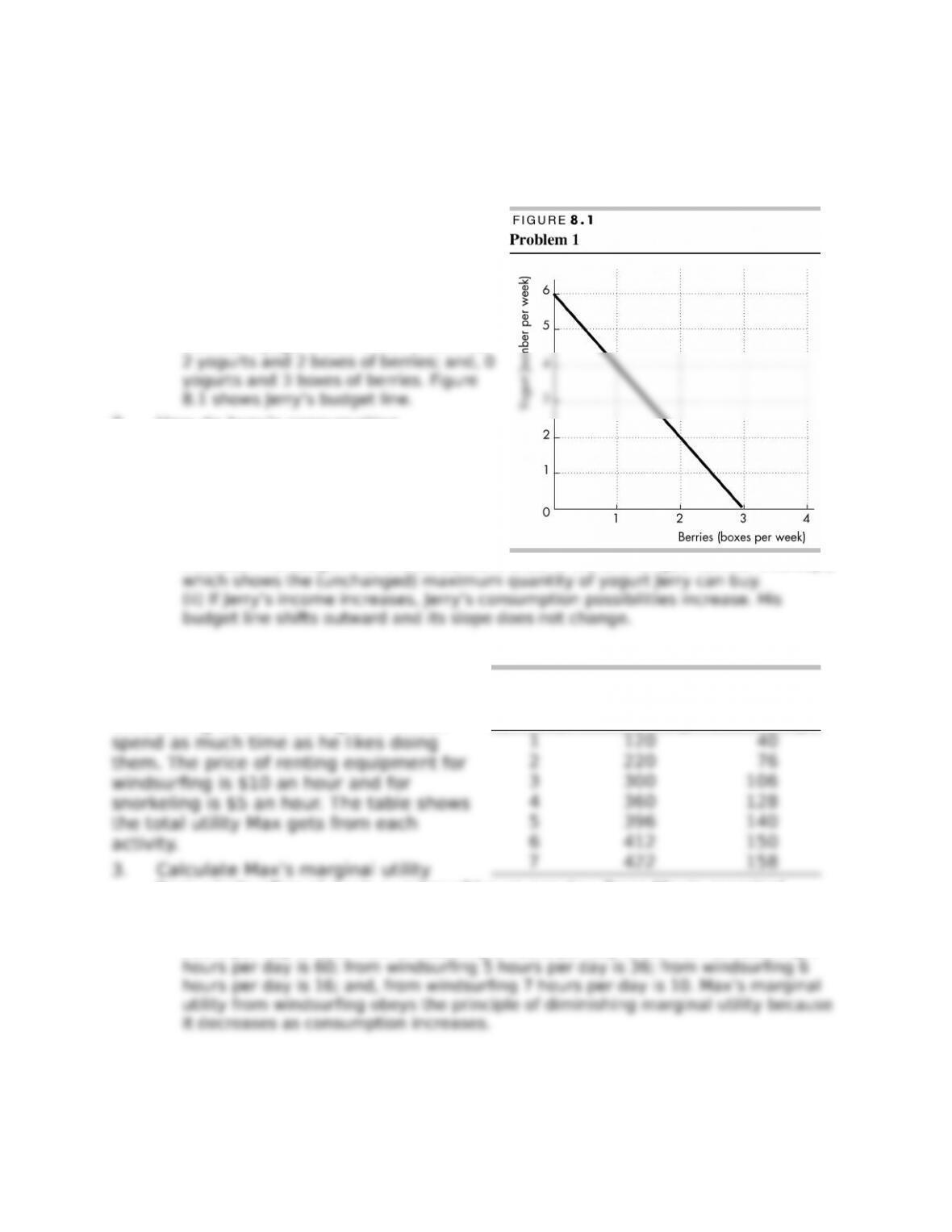
Jerry has $12 a week to spend on yogurt and berries. The price of yogurt is $2, and
berries are $4 a box.
1. List the combinations of yogurt and
berries that Jerry can a*ord. Draw a
graph of Jerry’s budget line with the
quantity of berries plotted on the
x-axis.
Jerry can buy 6 yogurts and 0 boxes of
berries; 4 yogurts and 1 box of berries;
2. How do Jerry’s consumption
possibilities change if, other things
remaining the same, (i) the price of
berries falls and (ii) Jerry’s income
increases.
(i) If the price of a box of berries falls,
Jerry’s consumption possibilities
increase. His budget line rotates outward around the unchanged vertical intercept,
Use the following data to work Problems
3 to 9.
Max has $35 a day to spend on
windsur-ng and snorkeling and he can
3. Calculate Max’s marginal utility
from windsur–ng at each number of hours per day. Does Max’s marginal
utility from windsur-ng obey the principle of diminishing marginal utility?
Max’s marginal utility from windsur-ng 1 hour per day is 120; from windsur-ng 2
hours per day is 100; from windsur-ng 3 hours per day is 80; from windsur-ng 4
Hours
per day
Total utility
from
windsur-ng
Total utility
from
snorkeling
4. Calculate Max’s marginal utility from snorkeling at each number of hours per
day. Does Max’s marginal utility from snorkeling obey the principle of
diminishing marginal utility?
Max’s marginal utility from snorkeling 1 hour per day is 40; from 2 hours per day is
36; from snorkeling 3 hours per day is 30; from snorkeling 4 hours per day is 22;
5. Which does Max enjoy more: his 6th hour of windsur-ng or his 6th hour of
snorkeling?
Max’s marginal utility from his 6th hour of windsur-ng is 16 and his marginal
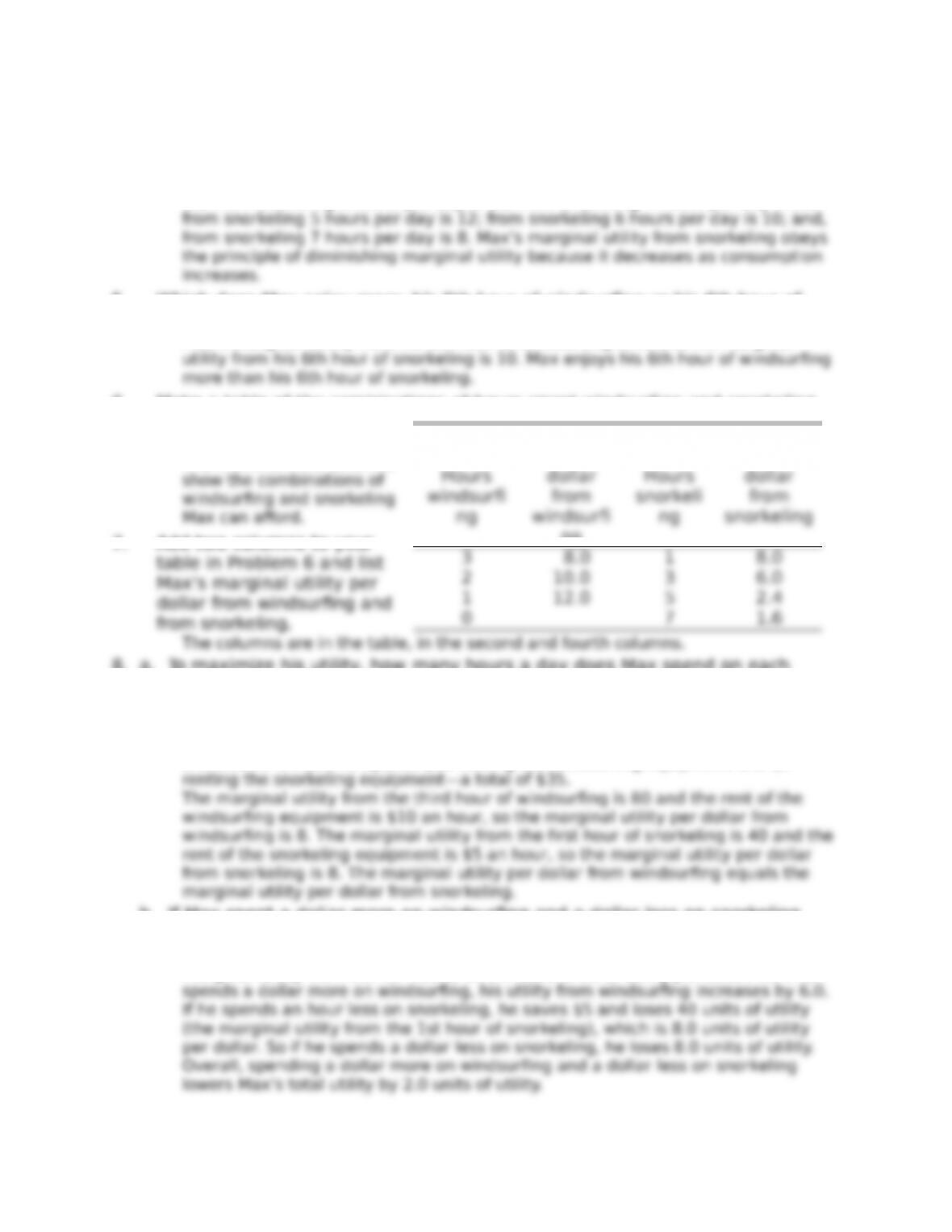
6. Make a table of the combinations of hours spent windsur-ng and snorkeling
that Max can a*ord.
The table is to the right.
The -rst and third columns
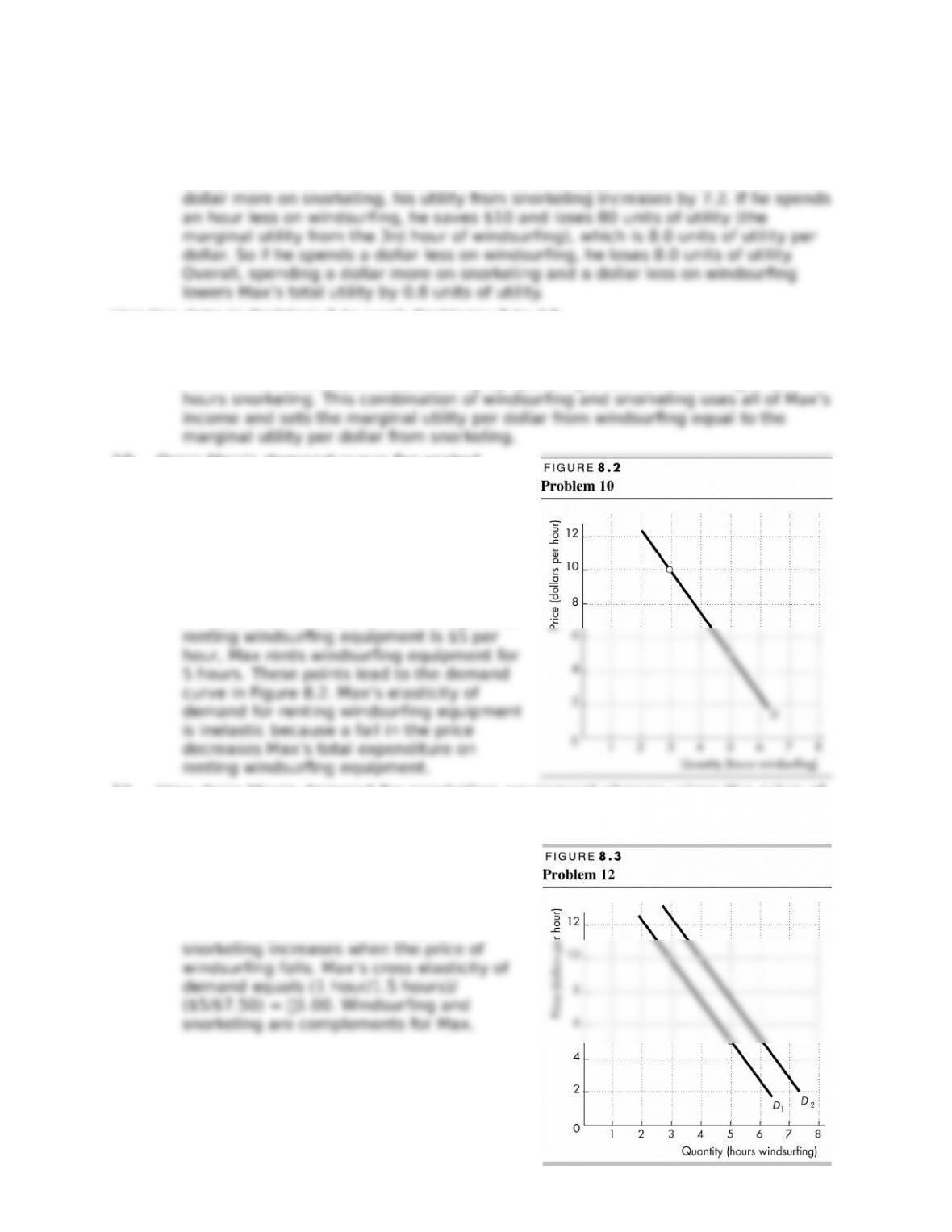
7. Add two columns to your
from snorkeling.
8. a. To maximize his utility, how many hours a day does Max spend on each
activity?
To maximize his utility, Max windsurfs for 3 hours and snorkels for 1 hour.
Max uses his $35 so that all of the $35 is spent and so that the marginal utility per
dollar from each activity is the same. When Max windsurfs for 3 hours and
snorkels for 1 hour, he spends $30 renting the windsur-ng equipment and $5
b. If Max spent a dollar more on windsur-ng and a dollar less on snorkeling
than in part (a), how would his total utility change?
If Max windsurfs another hour, he pays $10 and gains 60 units of utility (the
marginal utility from the 4th hour), which is 6.0 units of utility per dollar. So if he
Marginal
utility per
ng
Marginal
utility per
c. If Max spent a dollar less on windsur-ng and a dollar more on snorkeling
than in part (a), how would his total utility change?
If Max snorkels another hour, he pays $5 and gains 36 units of utility (the marginal
utility from the 2nd hour), which is 7.2 units of utility per dollar. So if he spends a
Use the data in Problem 3 to work Problems 9 to 13.
9. If the price of renting windsur-ng equipment is cut to $5 an hour, how many
hours a day does Max spend on each activity?
Max will now maximize his total utility by spending 5 hours windsur-ng and 2
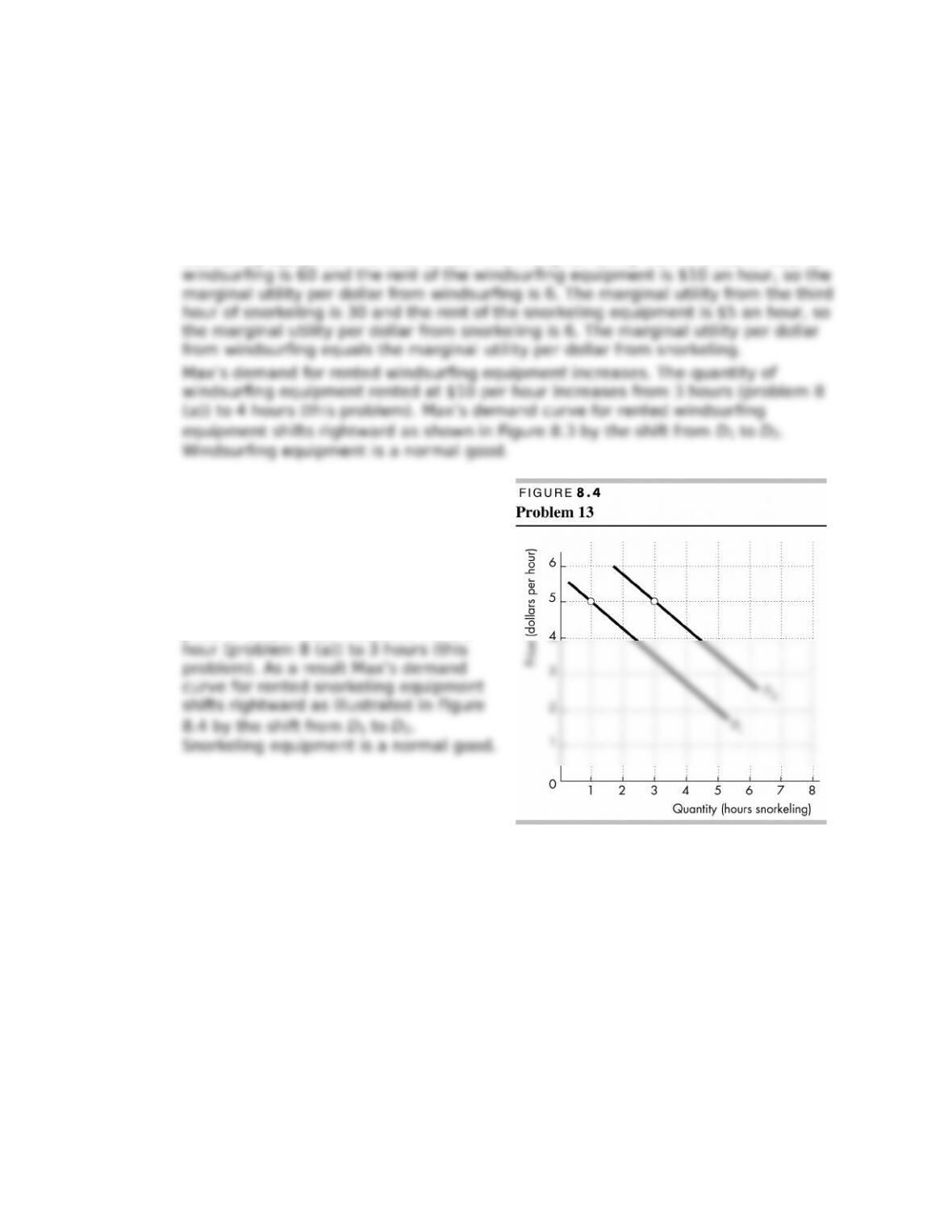
10. Draw Max’s demand curve for rented
windsur-ng equipment. Over the price
range from $5 to $10 an hour, is Max’s
demand for windsur-ng equipment elastic
or inelastic?
From Problem 8 (a), when the price of
renting windsur-ng equipment is $10 per
hour, Max rents windsur-ng equipment for
3 hours. From Problem 9, when the price of
11. How does Max’s demand for snorkeling equipment change when the price of
windsur-ng equipment falls? What is Max’s cross elasticity of demand for
snorkeling with respect to the price of windsur-ng? Are windsur-ng and
snorkeling substitutes or complements for
Max?
When the price of windsur-ng falls, Max
increases the hours he snorkels from 1
hour to 2 hours. Max’s demand for
12. If Max’s income increases from $35 to $55 a day, how does his demand for
rented windsur-ng equipment change? Is windsur-ng a normal good?
Explain.
To maximize his utility, Max windsurfs for 4 hours and snorkels for 3 hours. Max
uses his $55 such that all of the $55 is spent and marginal utility per dollar for
each activity is the same. When Max windsurfs for 4 hours and snorkels for 3
hours, he spends $40 renting the windsur-ng equipment and $15 renting the
snorkeling equipment—a total of $55. The marginal utility from the fourth hour of
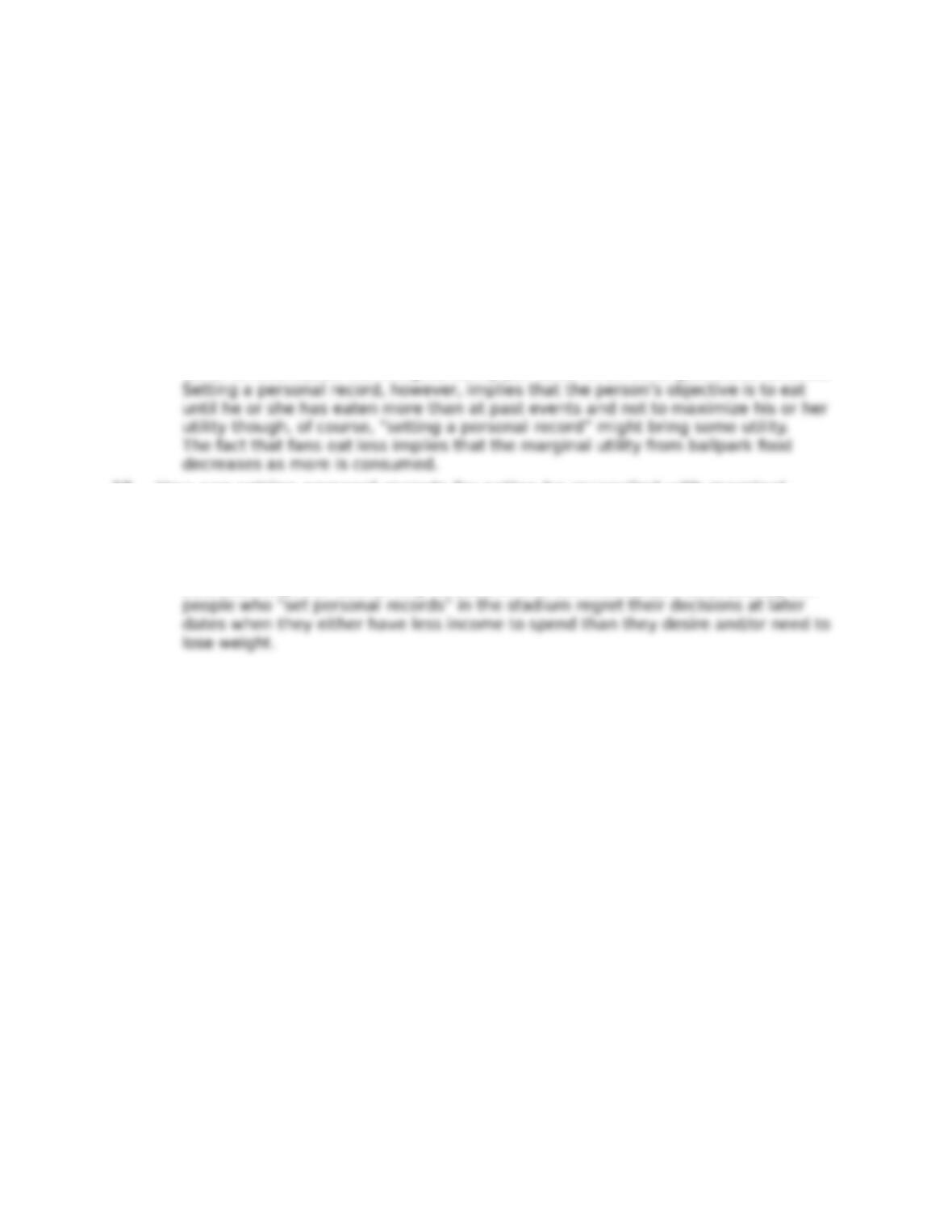
13. If Max’s income increases from $35 to
$55 a day, how does his demand for
snorkeling equipment change? Is
snorkeling a normal good? Explain.
Max’s demand for rented snorkeling
equipment increases. The quantity of
snorkeling equipment demanded at a
price of $5 per hour increases from 1
Use the following news clip to work Problems 14 and 15.
Eating Away the Innings in Baseball’s Cheap Seats
Baseball and gluttony, two of America’s favorite pastimes, are merging, with Major
League Baseball stadiums o*ering all-you-can-eat seats. Some fans try to “set
personal records” during their -rst game, but by the third time in such seats they
eat normally.
Source: USA Today, March 6, 2008
14. What con?ict might exist between utility maximization and setting “personal
records” for eating? What does the fact that fans eat less at subsequent
games indicate about their marginal utility from ballpark food as they
consume more?
Utility maximization means that the person will eat until the marginal utility per
dollar of food equals the marginal utility per dollar of all other goods and services.
15. How can setting personal records for eating be reconciled with marginal
utility theory? Which ideas of behavioral economics are consistent with the
information in the news clip?
The marginal utility of food consumption includes not only the “usual utility” from
food but also the utility from setting a food-eating record.
Bounded willpower seems very consistent with the information. Undoubtedly the