
T h e B i g P i c t u r e
Where we have been:
Chapter 2 introduced the gains from trade in a simple model with a linear
production possibilities frontier. This chapter continues the explanation of the
gains from trade by looking at individual markets using demand and supply.
The chapter uses the concepts of consumer surplus, producer surplus, and
deadweight loss, rst introduced in Chapter 5. Because of this mode of
analysis, the chapter now integrates tightly with the preceding chapter, which
examined changes in consumer surplus, producer surplus, and deadweight
loss resulting from government policies. The chapter examines trade
restrictions and protection with a focus on the deadweight loss resulting from
trade restrictions.
Where we are going:
Chapter 7 marks the end of the basic applications of supply and demand
analysis. Chapters 8 and 9 cover utility theory and indi$erence curves in
explaining consumer demand, and Chapters 10 to 15 develop the theory of the
rm and supply decisions.
N e w i n t h e Tw e l f t h E d i t i o n
The case studies in the chapter have been updated to incorporate new data. The
chapter ends with a new Economics in the News article about the di)culty of
achieving a free trade agreement. A new Worked Problem section has been
introduced. The Worked Problem covers comparative advantage and prices in the
global market. It gives U.S. demand and supply schedules for honey and the world
price of honey. It shows the students how to calculate the no-trade equilibrium
price and quantity and, from these results, how to determine whether the United
States imports or exports honey. Then it demonstrates how the quantity produced,
consumed, and traded internationally changes when honey is opened to trade.
Finally it shows the students how to calculate the U.S. gain from trade and the
distribution of the gains and losses. To include the new Worked Problem without
lengthening the chapter, some problems have been removed from the Study Plan
Problem and Applications. These problems are in the MyEconLab and are called
Extra Problems.
7GLOBAL MARKETS
IN ACTION
C h a p t e r
L e c t u r e N o t e s
Global Markets in Action
Comparative advantage means that all countries can gain from trade.
Total surplus increases with international trade.
There are many arguments in favor of restricting international trade, but restricting
free trade results in deadweight loss and ine)ciency.
The rst Economics in Action application shows the major U.S. exports and imports. A great
source of information about global business for undergraduates is Global Edge, which is
hosted by Michigan State University (http://globaledge.msu.edu). This site compiles
information from many sources and is great entry point for student research, in addition to
hosting modules and other resources for global business. Students can search by state or
country to compare what is traded and to get an overview of the economies of other
regions.
I. How Global Markets Work
The goods and services that we buy from people in other countries are called
imports. The goods and services that we sell to people in other countries are called
exports.
The United States is the world’s largest international trader and accounts for 10
percent of world exports and 13 percent of world imports.
In 2013, U.S. exports were $2.3 trillion (about 14 percent of the value of U.S.
production) and U.S. imports were $2.7 trillion (about 17 percent of total U.S.
expenditure).
The fundamental force that generates international trade is comparative advantage.
A country has a comparative advantage in producing a good if it can produce that
good at a lower opportunity cost than any other country. By specializing in producing
the good in which each country has comparative advantage, both countries gain
from international trade.
For more data on international trade: The data on U.S. international trade can be
accessed at the Bureau of Economic Analysis web site:
www.bea.gov/international/index.htm. Key facts worth emphasizing are the enormous
growth in volume of trade over time and huge two-way trade in manufactures. Explain that
the balance of trade along with the international borrowing and lending that nances it
results from spending and saving decisions in the United States and the rest of the world,
and is independent of the forces that generate the volume of trade, which this chapter covers.
U.S. Exports
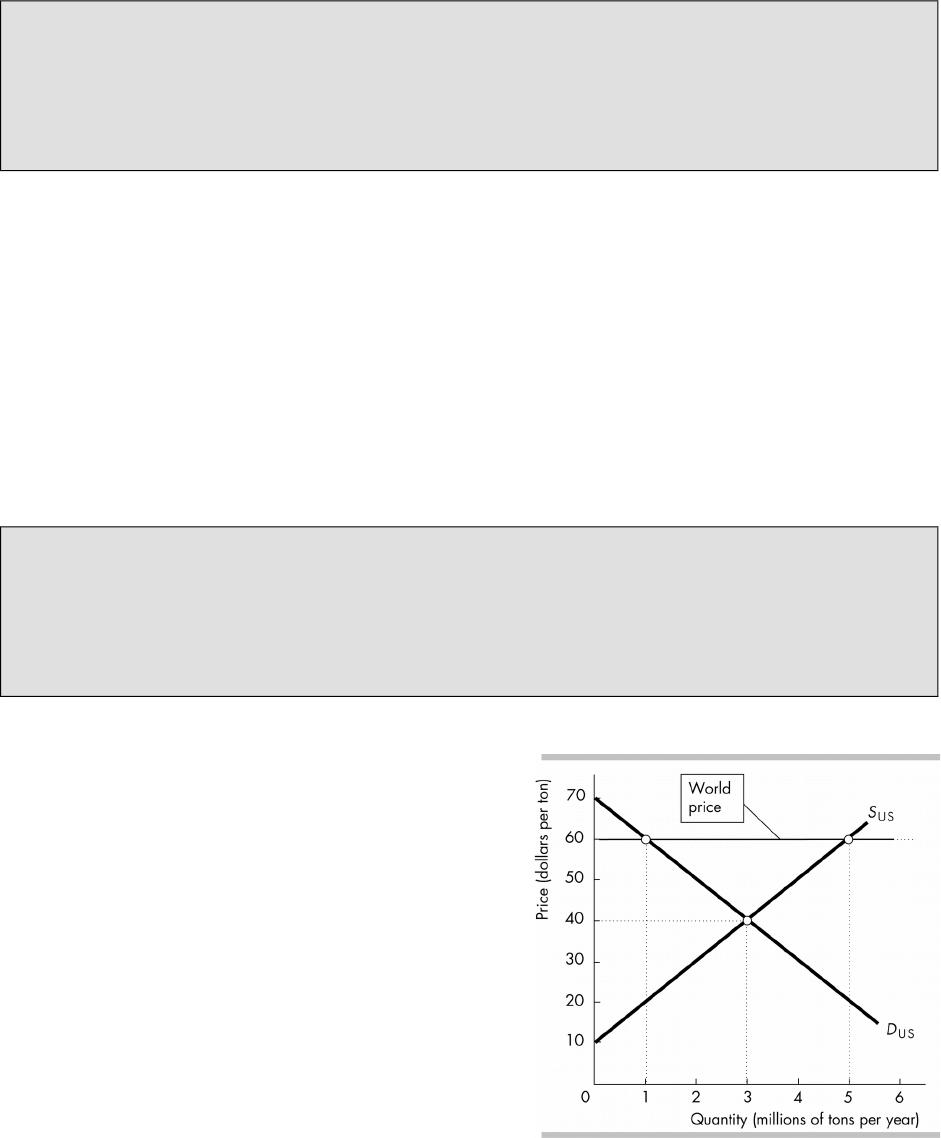
The United States will export goods for
which it has comparative advantage. In
the gure the world price of coal is $60
per ton and the price in the United States
before trade is $40 per ton. The United
States has a comparative advantage in
producing coal because the price before
trade is lower than the world price. In this
case the United States will export coal.
In the gure, before international trade the
price of coal in the United States was $40
per ton and at that price the United States
produced 3 million tons of coal per year and consumed 3 million tons per year. With
international trade, the price in the United States rises to the world price, $60 per
ton. At that price the United States produces 5 million tons of coal per year,
consumes 1 million tons per year, and exports the di$erence, 4 million tons per year.
U.S. Imports
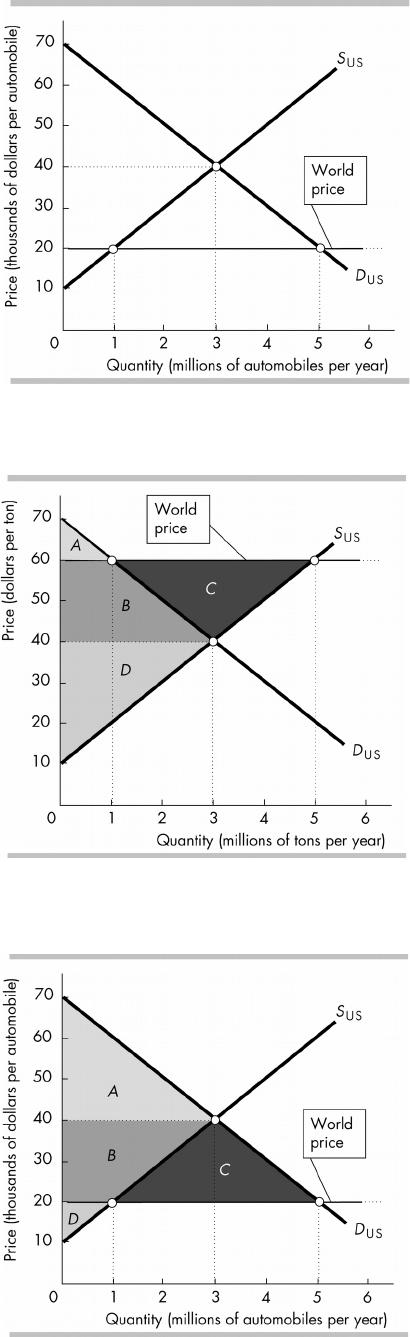
The United States will import goods in
which it does NOT have a comparative
advantage. In the gure, the world price of
automobiles is $20,000 per car and the
price in the United States before trade is
$40,000 per car, so the United States does
not have a comparative advantage in
producing automobiles. In this case the
United States will import cars.
In the gure, before international trade the
price of a car in the United States was
$40,000 per car and at that price the
United States produced 3 million cars per
year and consumed 3 million cars per year.
With international trade the price in the
United States falls to the world price,
$20,000 per car. At that price the United States produces 1 million cars per year,
consumes 5 million cars per year, and imports the di$erence, 4 million cars per year.
II. Winners, Losers, and the Net Gain
from Trade
U.S. Exports
Exports raise the U.S. price of the good or
service. With the higher price consumers
lose and producers gain. The gure shows
this breakdown of winners and losers.
Consumer surplus decreases from area A +
area B to only area A. Producer surplus
increases from area D to area B + area C +
area D. The increase in producer surplus
more than o$sets the decrease in
consumer surplus, so total surplus
increases. The total surplus increases by
area C. Also note that the loss to
consumers, area B, is picked up as a gain
to producers.
U.S. Imports
Imports lower the U.S. price of the good or
service. With the lower price consumers win
and producers lose. The gure shows this
breakdown of winners and losers.
Consumer surplus increases from area A to
area A plus area B + area C. Producer
surplus decreases from area B + area D to
only area D. The increase in consumer
surplus more than o$sets the decrease in

producer surplus, so total surplus increases. The total surplus increases by area C.
Also note that the loss to producers, area B, is picked up as a gain to consumers.
The Fable of Adam Blackbox: There is an enormously rich heritage of stories, parables,
fables, and satires that you can use to enliven your classes on this topic. The following
fable, inspired by James Ingram (from International Economic Problems, John Wiley, 1970)
is a powerful way to begin. Make up your own version with local Favor and embellishment.
Adam Blackbox announces that he has discovered an amazing way to produce low-price,
high-quality automobiles. He sets up a plant on a large tract of land along the coast of
Massachusetts, hires 10,000 employees, swears them to secrecy, and begins delivering his
low-price, high-quality autos to the nation’s showrooms. Adam Blackbox is hailed as an
American industrial hero. Blackbox Enterprises Foats stock and Wall Street booms.
Consumers love him. His automobiles are better and cheaper than those they could buy
before he came along. Automakers hate him, but their attempts to pass laws to restrict his
operations fail. The president and Congressional leaders explain that economic adjustment
is an inevitable consequence of technological advance. And Adam Blackbox’s new
technology for delivering low-price, high-quality automobiles is clearly part of the process
of achieving greater prosperity for all.
The press becomes increasingly curious about what is going on in the giant New England
auto plant. Investigative journalists create endless hours of speculative television
programming on the amazing new technology. Then a tabloid journalist with a big
checkbook nds a worker who is willing to talk. Adam Blackbox‘s secret is revealed.
Nothing is produced at the plant. Adam Blackbox is a trader, not a producer. He buys grain
from American farmers, exports it to Japan, and imports automobiles from Japan. His
secret revealed, Adam Blackbox is hauled before Congressional committees on fair trade
and denounced as an evil destroyer of American jobs. The president makes a special State
of the Union speech in which he denounces Adam Blackbox, praises a vigilant press for
saving Americans from the threat of cheap foreign labor, and announces a new budget
initiative that will spend $50 billion on research in technologies to produce low cost,
high-quality automobiles.
Ask your students why the president and Congress accepted Adam Blackbox initially but
then changed their tune. Was Adam Blackbox hurting America or helping America?
III. International Trade Restrictions
Governments restrict international trade to protect domestic industries from foreign
competition using tari$s, import quotas, other import barriers, and subsidies
Taris
A tarif is a tax that is imposed by the importing country when an imported good
crosses its international boundary.
A tari$ increases the price in the nation for the good. If the supply to the nation from
the rest of the world is perfectly elastic, the price rises by the full amount of the
tari$. The following occur:
Consumers buy less of the good and
producers increase the quantity
supplied
Government collects tari$ revenue
equal to the tari$ times the quantity
imported of the good
Less of the good is imported
A deadweight loss results.
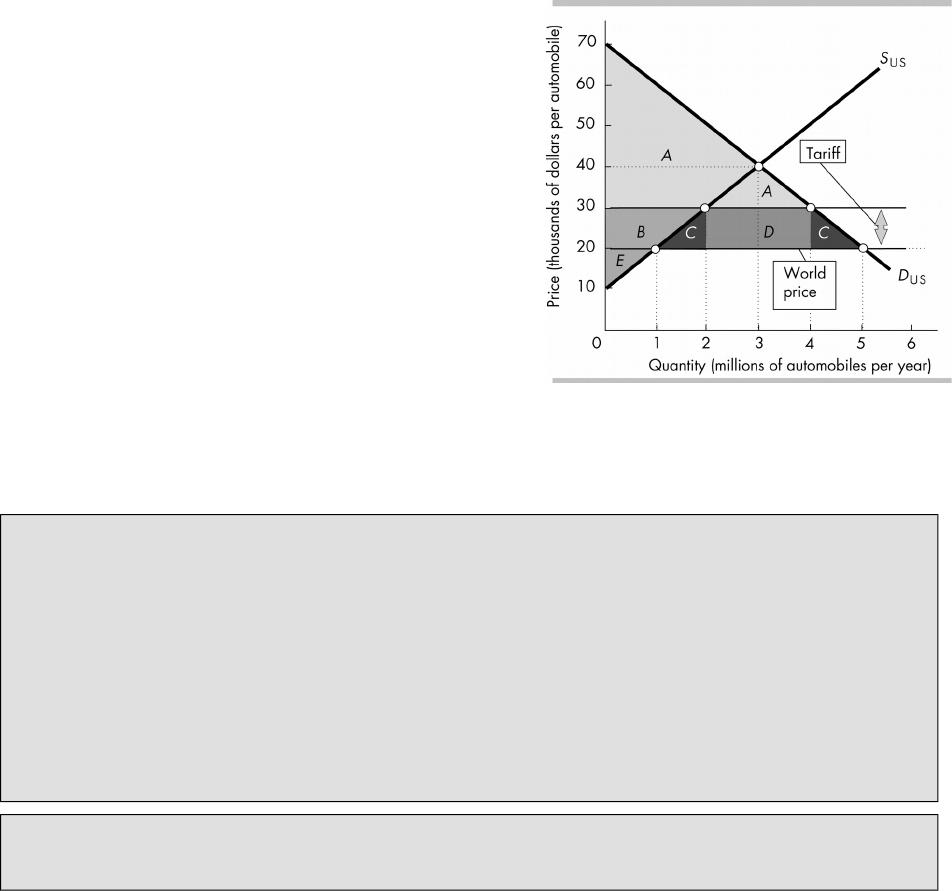
As a result of a tari$, U.S. consumers of the
good lose more than U.S. producers gain,
creating a deadweight loss. All these results
are shown in the gure. The government
imposes a $10,000 per car tari$ on
imported automobiles so the U.S. price
rises to $30,000. U.S. consumption of cars
decreases from 5 million per year to 4
million and U.S. production increases from
1 million per year to 2 million. Imports decrease from 4 million per year to 2 million.
Consumer surplus decreases from area A + area B + area C + area D + area C to
only area A. Producer surplus grows from area E to area E + area B. The government
gains tari$ revenue equal to area D. But both areas C are now deadweight losses, so
on net society is harmed by the tari$.
Two notes on the impact of tari$s to point out to students: First, when a tari$ is imposed
imports decrease more than domestic production increases. Flipping this observation
around means that when tari$s are lowered, imports increase by more than domestic
production decreases. Basically, every unit we import is not a lost sale to a domestic rm.
Indeed, if domestic supply is inelastic and demand elastic, domestic production may
expand very little even with a huge drop in imports. Second tari$s basically force foreign
rms to be more e)cient than domestic rms, something that harms incentives and may
limit domestic rms’ opportunities in the long run. They also can give foreign rms the
incentive to move operations into the domestic economy. For instance Japanese
automakers opened many manufacturing plants in the United States when their imports to
the U.S. economy were limited. The upshot? U.S. automakers now face competition from
Toyota, Honda, and many other automakers that have set up shop in the United States.
The Economics in Action application in this section considers the decrease in U.S. tari$s
over time. This feature gives you a good chance to discuss the current state of global trade
negotiations.
Import Quotas
An import quota is a restriction that limits the maximum quantity of a good that
may be imported in a given period.
An import quota increases the price in the nation for the good. As a result, the
following occur:
Consumers buy less of the good and producers increase the quantity supplied
The importers gain additional prot
Less of the good is imported
A deadweight loss results.
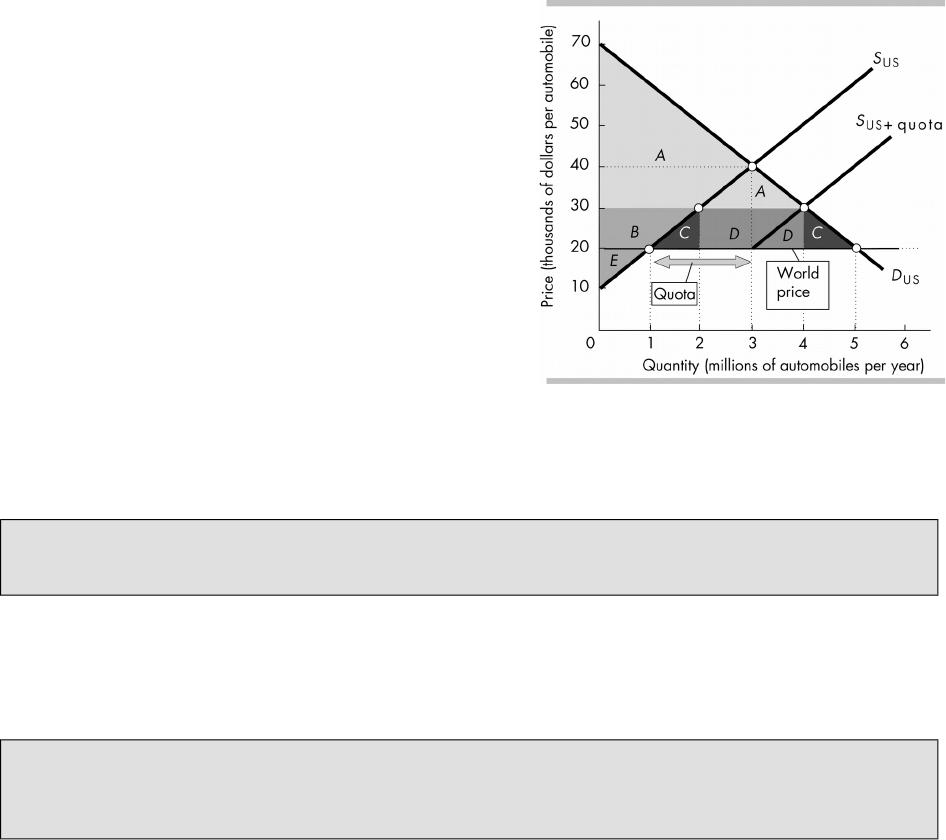
As was the case with a tari$, with an
import quota U.S. consumers of the good
lose more than U.S. producers gain,
creating a deadweight loss. All these
results are shown in the gure. The
government imposes a 2 million per year
import quota on automobiles as shown.
With this quota, the supply curve becomes
the U.S. supply curve below the world price
of $20,000 per car and then the U.S.
supply curve plus the 2 million import
quota at prices above the $20,000 world
price. The U.S. price rises to $30,000 per
car. As a result U.S. consumption of cars
decreases from 5 million per year to 4
million and U.S. production increases from
1 million per year to 2 million so that
imports decrease from 4 million per year to 2 million. Consumer surplus decreases
from area A + area B + area C + area D + area D + area C to only area A. Producer
surplus grows from area E to area E + area B. The importers’ prot is equal to the
total area D. Both areas C are deadweight losses, so on net society is harmed by the
import quota.
An Economics in the News case considers why the United States has switched from
exporting to importing coat hangers. It examines the potential impact of a 21 percent tari$
on imports of coat hangers.
Other Import Barriers
Although they might not have been designed to limit international trade, health,
safety, and regulation barriers have that e$ect.
Voluntary export restraints, while not common, act like a quota and exist if a country
negotiates with foreign trade partners to voluntarily limit their exports.
An Economics in Action case discusses the Doha Development Agenda, the World Trade
Organization and the problems with reaching agreement. Again, this is a good opportunity
to have students research the current status of this negotiation and the industries that are
most a$ected.
Export Subsidies
An export subsidy is a payment by the government to the producer of an exported
good. These are illegal under most international trade agreements. One of the
reasons that progress on international trade agreements such as the Doha Round
has been di)cult is that the United States and European Union pay subsidies to their
farmers, which would be illegal under the past trade agreements reached for most
other goods and services.