Answers to Additional Problems and Applications
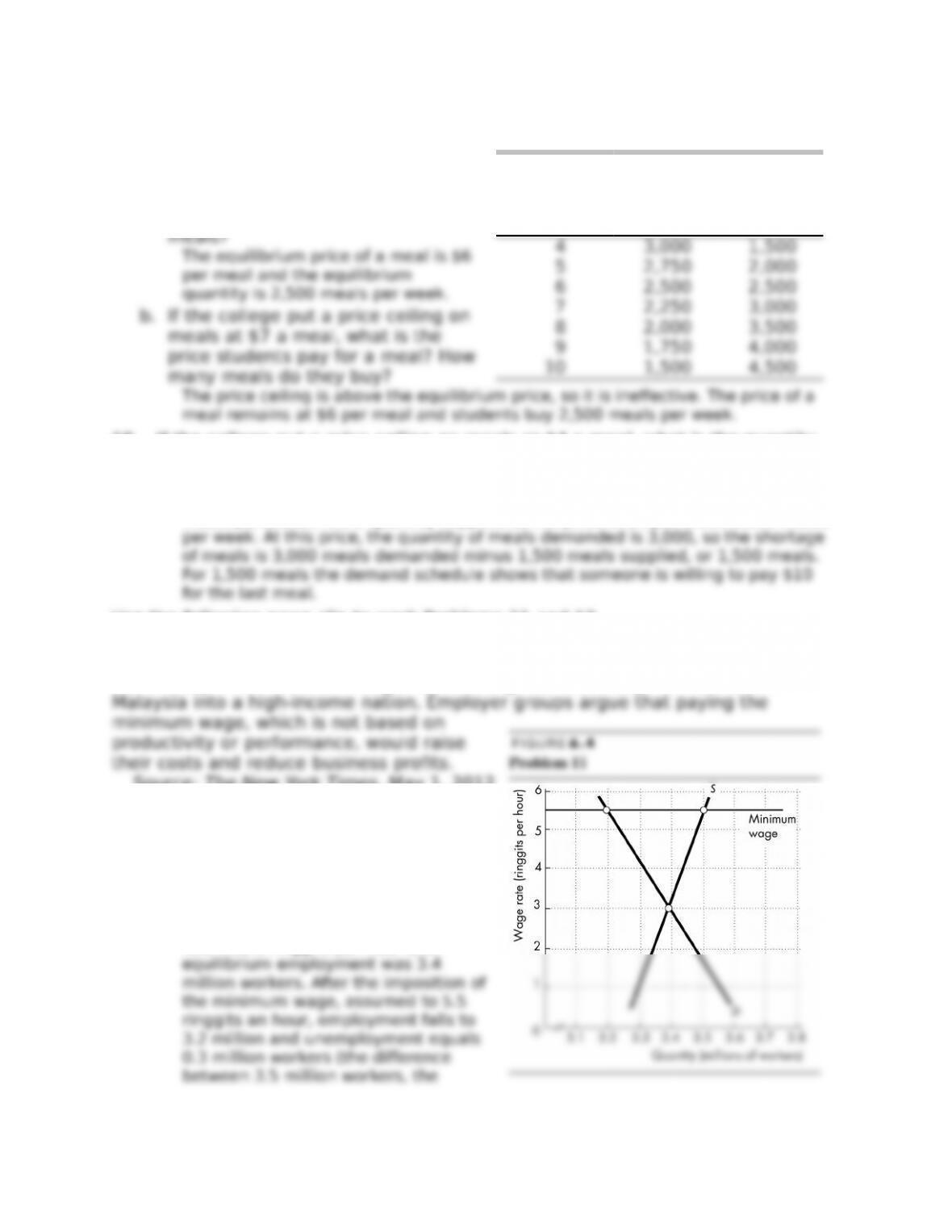
The table sets out the demand and supply
schedules for college meals.
9. a. What are the equilibrium meal
price and equilibrium quantity of
meals?
many meals do they buy?
10. If the college put a price ceiling on meals at $4 a meal, what is the quantity
bought, the shortage of meals, and the maximum price that someone is
willing to pay for the last meal available?
The price ceiling is below the equilibrium price, so it has an e’ect. The quantity of
meals purchased is the quantity supplied at the price of $4 per meal, 1,500 meals
Use the following news clip to work Problems 11 and 12.
Malaysia Passes Its First Minimum Wage Law
About 3.2 million low-income workers across Malaysia are expected to bene2t from
the country’s 2rst minimum wage, which the government says will transform
Source: The New York Times, May 1, 2012
11. On a graph of the market for
low-skilled labor, show the e’ect of
the minimum wage on the quantity of
labor employed.
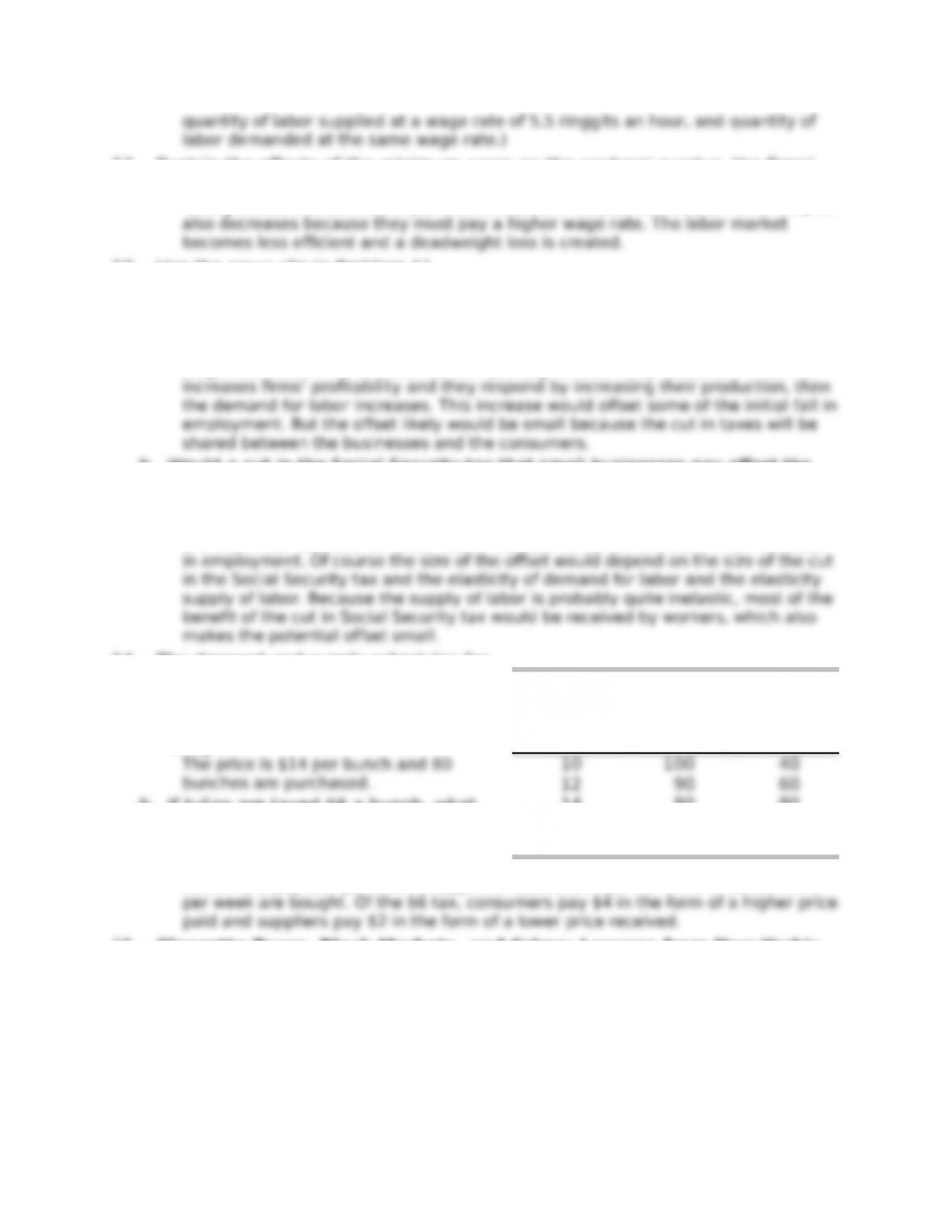
Figure 6.4 shows the e‘ect in the labor
market. Before the hike in the
minimum wage, the equilibrium wage
rate was 3 ringgits per hour and
Price
(dollars per
meal)
Quantity
demande
d
Quantity
supplied
(meals per week)
12. Explain the e’ects of the minimum wage on the workers’ surplus, the 2rms’
surplus, and the e=ciency of the market for low-skilled workers.
Taking account of the cost of job search, workers’ surplus decreases. Firms’ surplus
13. Use the news clip in Problem 11.
a. If the Malaysian government cut the tax on business pro2ts, would it o’set
the e’ect of the minimum wage on employment? Explain.
The tax cut on small businesses would o’set some of the harm imposed on small
businesses but it would not o’set much of the decrease in employment. The higher
wage rate leads 2rms to decrease the quantity of labor they demand. If a tax cut
b. Would a cut in the Social Security tax that small businesses pay o’set the
e’ect of the higher minimum wage on employment? Explain.
A cut in the Social Security tax imposed on small businesses could o’set the e’ect
the minimum wage hike had on decreasing employment. If Social Security taxes
are cut, 2rms’ demand for labor would increase which would result in an increase
14. The demand and supply schedules for
tulips are in the table.
a. If tulips are not taxed, what is the
price and how many bunches are
bought?
b. If tulips are taxed $6 a bunch, what
are the price and quantity bought?
Who pays the tax?
If tulips are taxed $6 a bunch,
consumers pay $18 per bunch, suppliers receive $12 per bunch, and 60 bunches
15. Cigarette Taxes, Black Markets, and Crime: Lessons from New York’s
50-Year Losing Battle
New York City has the highest cigarette taxes in the country. During the four
months following the recent tax hike, sales of taxed cigarettes in the city fell
by more than 50 percent as consumers turned to the city’s bustling black
market. The thriving illegal market for cigarettes has diverted billions of
dollars from legitimate businesses and governments to criminals.
Price
(dollars per
bunch)
Quantity
demand
ed
Quantity
supplied
(bunches per week)
14 80 80
16 70 100
18 60 120
Source: Cato Institute, February 6, 2003
a. How has the market for cigarettes in New York City responded to the high
cigarette taxes?
Consumers (and some suppliers!) have turned to the black market. In the black
b. How does the emergence of a black market impact the elasticity of demand
in a legal market?
c. Why might an increase in the tax rate actually cause a decrease in the tax
revenue?
If the demand is elastic, then the decrease in the equilibrium quantity from the tax
is large enough so that the government collects less tax revenue. More speci2cally,
Use the following to work problems 16 to 18.
Crop Prices Erode Farm Subsidy Program
High corn and soybean prices mean farmers are making the most money in their
lives. The reason: Grain prices are far too high to trigger payouts under the U.S.
primary farm-subsidy program’s “price support” formula. The market has done
what Congress couldn’t do and that is “slash farm subsidies.”
Source: The Wall Street Journal, July 25, 2011
16.a. Why are U.S. soybean farmers subsidized?
b. Explain how a subsidy paid to soybean farmers a’ects the price of soybean
and the marginal cost of producing it.
A subsidy increases the supply of soybeans. The increase in supply lowers the
17. Show in a graph how a subsidy paid to soybean farmers a’ects the consumer
surplus and the producer surplus from soybean. Does the subsidy make the
soybean market more e=cient or less e=cient? Explain.
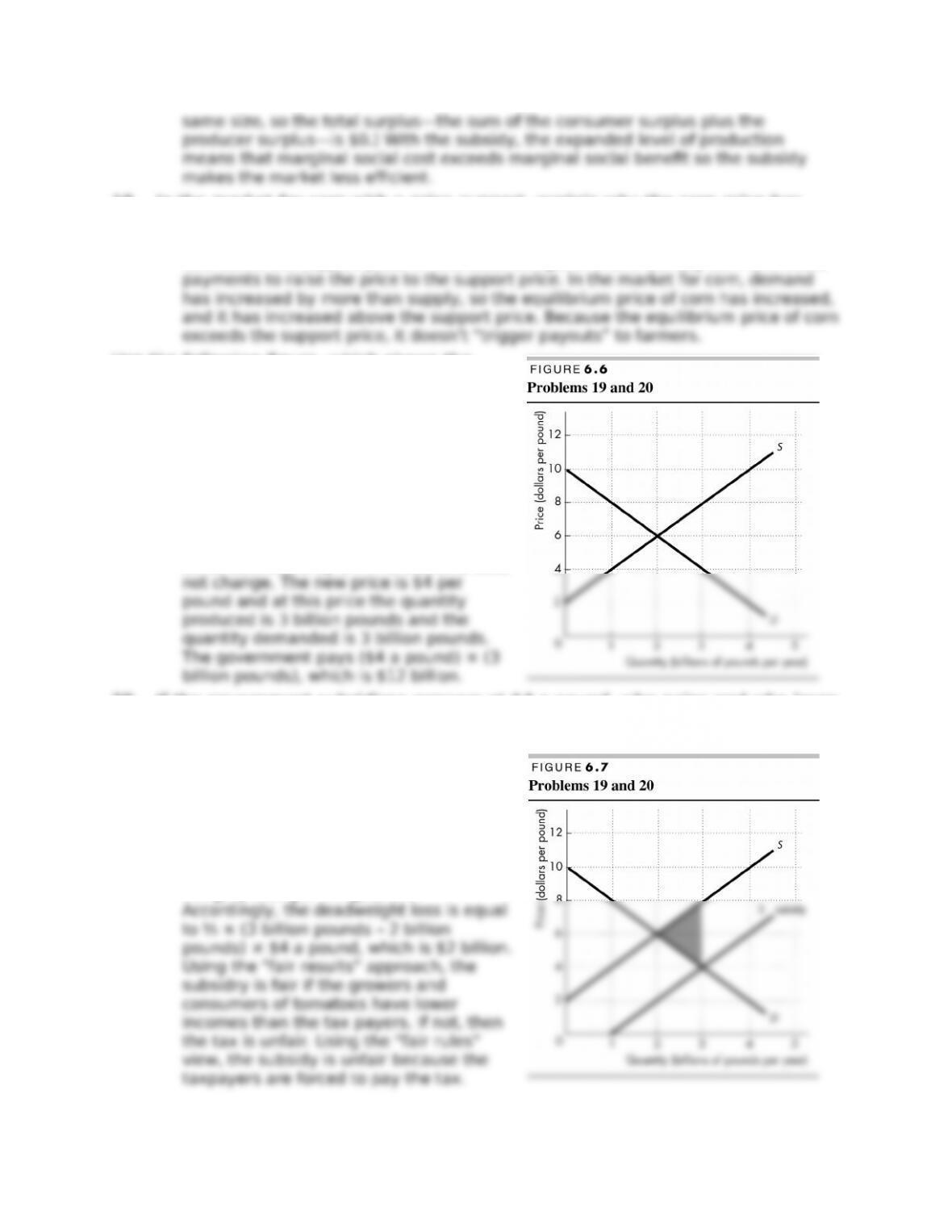
In Figure 6.5, with no subsidy, the
equilibrium price is $16 per bushel and
350 million bushels are produced. The
total surplus is the triangular area abc.
The upper half of the triangle is the
consumer surplus and the lower half is
18. In the market for corn with a price support, explain why the corn price has
risen and ended up being too high to “trigger payouts.”
The price supports are paid (“triggered”) only when the equilibrium price of corn
falls below the support price. In this case, the government will buy corn and make
Use the following 2gure, which shows the
market for tomatoes, to work Problems 19
and 20.
19. If the government subsidizes growers at
$4 a pound, what is the quantity
produced, the quantity demanded, and
the subsidy paid to growers?
If the government subsidizes growers at
$4 a pound, the supply increases. As
shown in Figure 6.7, the supply curve
shifts downward by $4. The demand does
20. If the government subsidizes growers at $4 a pound, who gains and who loses
from the subsidy? What is the deadweight loss? Could the subsidy be
regarded as being fair?
The suppliers and demanders of
tomatoes gain from the subsidy. The
taxpayers, who must send the
government $12 billion in taxes, lose.
Tomato producers in other countries lose
because they receive a lower price. The
deadweight loss is equal to the area of
the grey triangle in Figure 6.7.
21. The table gives the demand and supply
schedules for an illegal drug.
a. What is the price and how many units
are bought if there is no penalty on
drugs?
b. If the penalty on sellers is $20 a unit,
what are the price and quantity
consumed?
c. If the penalty on buyers is $20 a unit, what are the price and quantity
consumed?
Economics in the News
22. After you have studied Economics in the News on pp. 144–145, answer the
following questions.
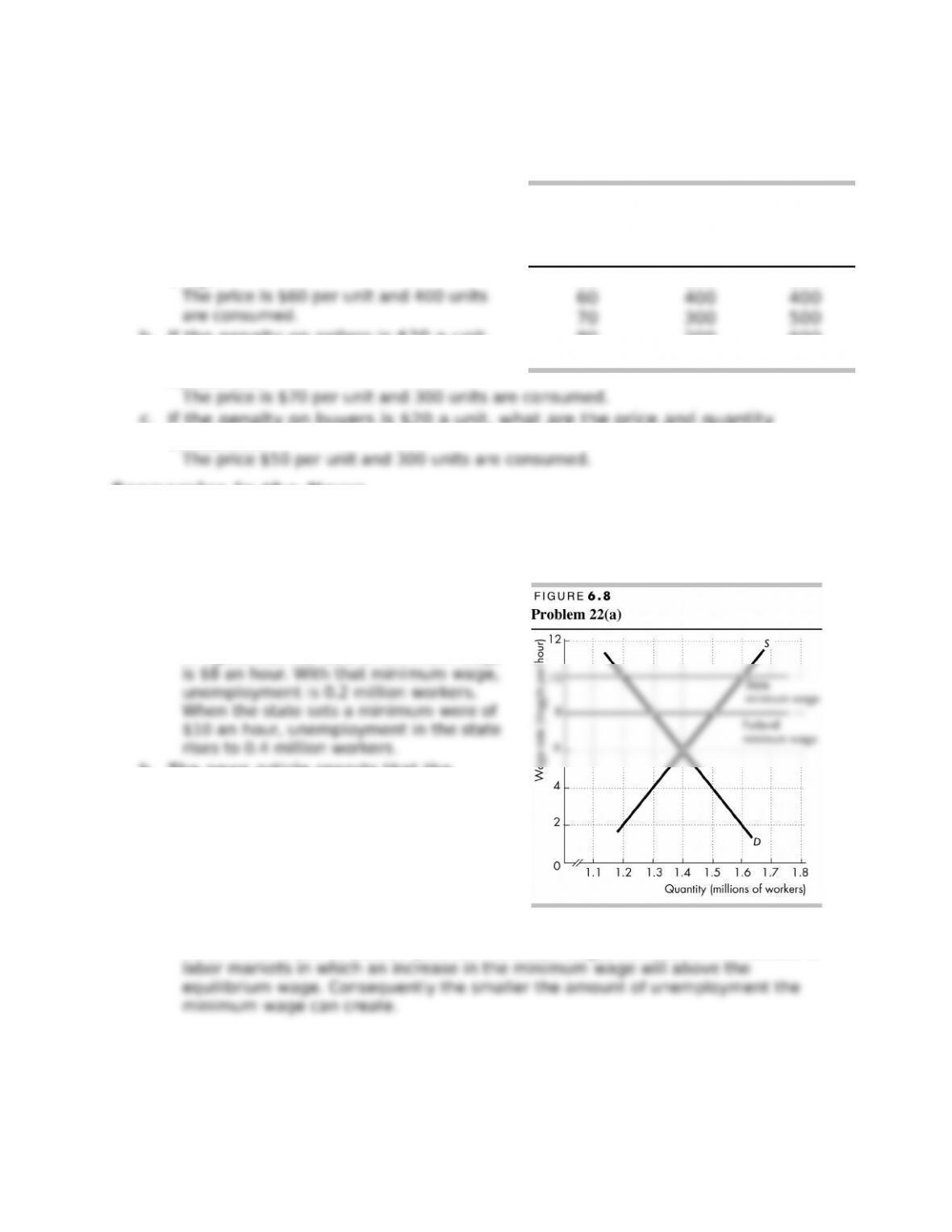
a. When a state raises its minimum wage above the federal minimum, what
would you expect to happen to
unemployment in that state? Illustrate
your answer with a graph.
Unemployment will increase in that state.
In Figure 6.8, the federal minimum wage
b. The news article reports that the
percentage of hourly paid workers paid
the minimum wage or less decreased
from 13.4 percent in 1979 to 4.3
percent in 2013. Would you expect the
rise in the minimum wage to have a
smaller e‘ect on unemployment today
than in 1979?
This factor decreases the impact the minimum wage has on unemployment. The
fewer the number of workers paid the minimum wage, the smaller the number of
Price
(dollars per
unit)
Quantity
demande
d
Quantity
supplied
(units per day)
50 500 300
80 200 600
90 100 700

c. The news article reports that during the recovery from the 2008–2009
recession, wage rates grew slowly and the bottom wage rates grew slower
than top wage rates, straining the budgets of low-paid workers. How would
you expect this fact to have inMuenced the e’ect of the minimum wage on
unemployment?
This factor increases the impact the minimum wage has on unemployment. The
23. Hollywood: Organized Crime Hits the Movies
The Mexican army seized 1,180 disc burners and 3.14 million copies of movies
and TV shows from 23 warehouses in a move to 2ght piracy that costs
Hollywood about $590 million a year.
Source: Bloomberg Businessweek, April 7, 2011
Assume that the marginal cost of producing a DVD (legal or illegal) is a
constant $3 and that legal DVDs bear an additional marginal cost of $5 each
in royalty payments to 2lm studios.
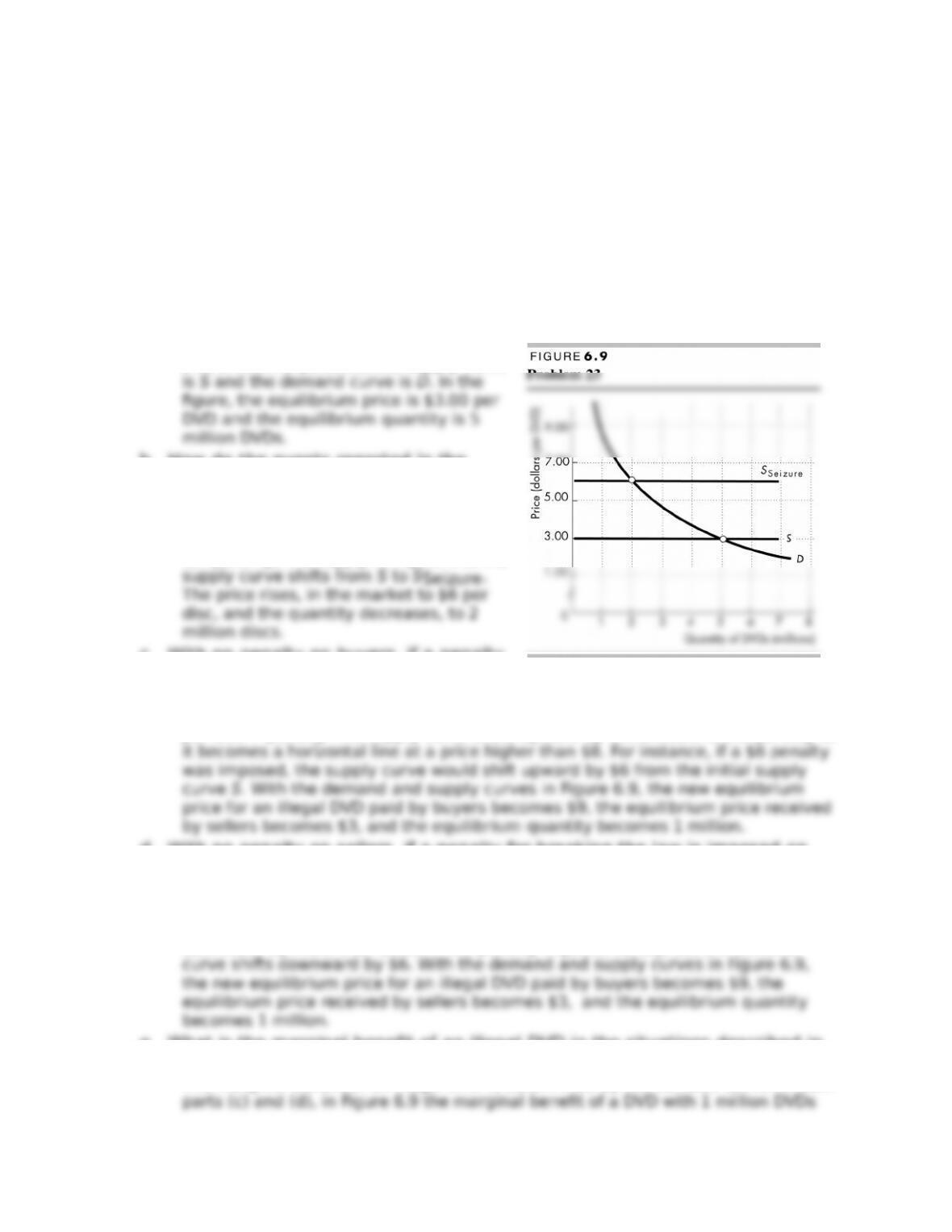
a. Draw a graph of the market for counterfeit DVDs, assuming that there are
no e’ective penalties on either buyers or sellers for breaking the law.
Figure 6.9 shows the market for illegal
DVDs. With no penalties the supply curve
b. How do the events reported in the
news clip change the market outcome?
Show the e’ects in your graph.
The seizure of the (approximately) 3
million discs decreases (at least
temporarily) the supply. In Figure 6.9, the
c. With no penalty on buyers, if a penalty
for breaking the law is imposed on sellers at more than $5 a disc, how does
the market work and what is the equilibrium price?
The marginal cost of producing illegal discs increases from $3.00 per disc to $3.00
per disc + penalty. The supply curve shifts upward by the amount of the penalty so
d. With no penalty on sellers, if a penalty for breaking the law is imposed on
buyers at more than $5 a disc, how does the market work and what is the
equilibrium price?
With a penalty imposed on buyers of more than $5.00 per disc, the demand curve
for illegal discs shifts downward by the amount of the penalty, that is, shifts
downward by more than $5.00. If the penalty imposed is, say, $6, the demand
e. What is the marginal bene2t of an illegal DVD in the situations described in
parts (c) and (d)?
The marginal bene2t of an illegal DVD is determined by the demand curve. In both

f. In light of your answer to part (e), why does law enforcement usually focus
on sellers rather than buyers?