
W H AT I S E C O N O M I C S ? 6 1
T h e B i g P i c t u r e
Where we have been:
Chapter 6 uses the demand and supply concepts of Chapter 3, the elasticity
concepts of Chapter 4, and the e#ciency concepts of Chapter 5 to study price
ceilings and &oors, taxes and subsidies, production quotas, and the markets
for illegal goods. The chapter helps round out the student’s exploration of the
demand and supply model and its application, and should be a ful-lling
exercise for putting together the “big picture.”
Where we are going:
Chapter 7 continues the theme of this chapter by exploring international trade
and the e1ects on consumer surplus, producer surplus, and national welfare. It
also examines the deadweight loss of government policies that limit trade,
such as tari1s and import quotas. E#ciency and deadweight loss are again
explored as we consider how perfectly competitive markets allocate resources
in Chapter 12, and then contrast that with results for monopoly (Chapter 13),
monopolistic competition (Chapter 14), and oligopoly (Chapter 15). We will
return to taxes and e#ciency issues when we study externalities in Chapter 16
and public goods and common resources in Chapter 17.
N e w i n t h e Tw e l f t h E d i t i o n
The opener to the chapter has been updated to address minimum wages laws in
New York City, which then links to a new end of chapter article about minimum
wages. A new Worked Problem section has been added. The Worked Problem
presents demand and supply schedules for concert tickets. Then it shows students
how to determine the equilibrium price and quantity if there is no tax and if there
is a tax imposed on the sellers. The Worked Problem also shows the students how
to calculate the tax incidence and tax revenue. Finally the Worked Problem
demonstrates to the students how to determine the e#ciency of the market once
the tax is imposed. To include the new Worked Problem without lengthening the
6GOVERNMENT
ACTIONS IN
MARKETS
C h a p t e r
61
6 2
chapter, some problems have been removed from the Study Plan Problem and
Applications. These problems are in the MyEconLab and are called Extra Problems.
62
L e c t u r e N o t e s
Government Actions in Markets
Government intervention in markets—using price controls, taxes, production quotas,
and making products illegal—can a1ect the price and quantity in those markets.
Government intervention a1ects the e#ciency of markets and can lead to the
creation of deadweight losses.
I. A Housing Market with a Rent Ceiling
A price ceiling is a government regulation that makes it illegal to charge a price
higher than a speci-ed level. When a price ceiling is applied to a housing market it is
called a rent ceiling.
A rent ceiling set above the equilibrium rent has no e1ect on the market.
A rent ceiling set below the equilibrium rent creates a housing shortage, increased
search activity, and a black market.
A Housing Shortage
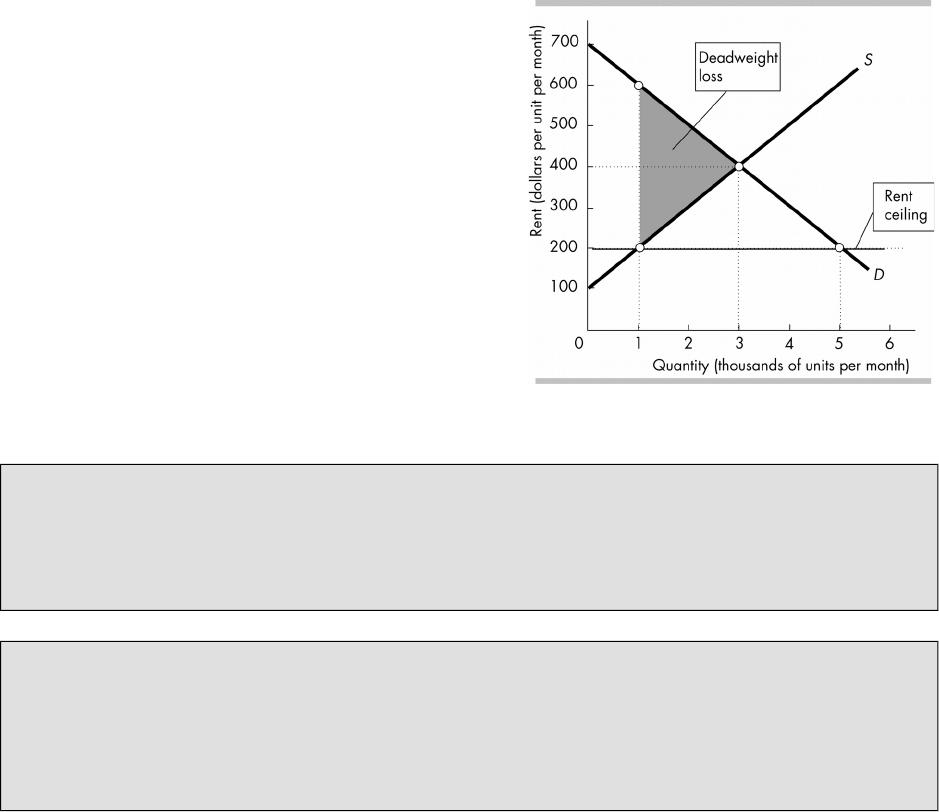
If the government imposes a rent ceiling
below the equilibrium rent, then a
shortage results. In the -gure the
equilibrium rent is $400 per month and
the equilibrium quantity of units rented is
3,000. If the government imposes a rent
ceiling of $200 per month, a shortage
results. The quantity demanded at that
price is 5,000 and the quantity supplied is
1,000. There is a shortage of 4,000
apartments per month.
Rent ceilings lead to ine#ciency. In a
competitive market, the equilibrium
quantity is the same as the e#cient
quantity. In a housing market with a rent
ceiling, the quantity of units available is
less than the equilibrium quantity and so
is less than the e#cient quantity. The market underproduces, and there is a
deadweight loss, as shown in the -gure as the darkened triangular area.
How is the “shortage” calculated? In looking at the e1ects of a price ceiling, students
sometimes focus only on the change in the quantity supplied relative to equilibrium
instead of looking at the entire di1erence between the quantity demanded and quantity
supplied. The shortage is measured by the di1erence between the quantity demanded and
the quantity supplied, NOT simply by the di1erence between the original equilibrium
quantity and the new quantity supplied.
Housing Markets and Rent Ceilings: Time and the elasticity of supply. Even given
the caveat above, it is worth noting the reduction in quantity supplied of rent controlled
housing, especially since policy makers’ intent is usually to make housing more available
to lower income tenants and less housing is available after the policy. Where might those
units and -rms go instead? Recall supply elasticity from Chapter 4 and ask students how
the passage of time might allow property owners to fully respond to the policy. In the long
run, apartment owners are more likely to change the number of apartments they o1er in

response to a price ceiling than in the short run. Will they switch to condominiums? Will
they be able to maintain public parts of the building given lower rents? What will happen
to the average age of buildings over time in a rent controlled city? Eventually, however,
apartment owners may -nd that alternative uses for their property (as a strip mall or a
storage facility, for example) become more pro-table.
Increased Search Activity
Search activity is the time spent looking for someone with whom to do business.
Search activity is costly and increases the opportunity cost of a given product or
service. A rent ceiling (or a price ceiling) that creates a shortage increases search
activity.
A Black Market
A black market is an illegal market in which the price exceeds the legally–imposed
price ceiling. In a black market, illegal arrangements are made between renters and
landlords—often at e1ective rental rates that are higher than would be the case in
an unregulated market.
The level of black market rent depends on how tightly the rent ceiling is enforced.
When the rent ceiling is strictly enforced, black market rent will be closer to the
maximum that consumers are willing to pay, which in the -gure is $600 per month.
Are Rent Ceilings Fair?
Using the “fair rules” criteria, blocking voluntary exchange is unfair.
Using the “fair outcomes” criteria, rent ceilings are fair if they help the poor and
disadvantaged. Some other allocative mechanism, such as a lottery, queuing, some
form of discrimination is often used to allocate housing. These alternative allocation
methods of distribution do not favor the poor and disadvantaged.
What is the goal of a rent ceiling? Point out to the students that replacing the market
price as an allocative mechanism for the rental market con&icts with the stated goals of
those who promote rent ceilings as a means to create a1ordable housing. Rent ceilings
lead to a shortage, which means landlords have more ability to discriminate against
renters who have a di1erent color of skin, or practice a di1erent religion, or who have “too
many” tattoos or “too many” children. It can increase incentives for corruption as outright
bribes or excessive deposits and charges for building services make up for below market
rent. In addition, there is less incentive for landlords to make needed electrical or plumbing
repairs, or perform maintenance on appliances. Builders have less incentive to build new
housing units so that in the long run, the stock of available housing will not grow with the
population, making the shortage worse.
Rent Ceilings in Practice
Cities with rent ceilings tend to have signi-cant housing shortages. Some tenants,
especially those who have lived longest in the city, have lower rents but others must pay
higher rents.
Economics in Action: Rent Control Winners: The Rich and Famous
This Economics in Action application examines the impact of rent controls in the New York
City housing market.
II. A Labor Market With a Minimum Wage
A price 0oor is a government-imposed regulation that makes it illegal to charge a price
lower than a speci-ed level. When a price &oor is applied to labor markets, it is called a
minimum wage. A minimum wage that is set above the equilibrium wage rate creates
unemployment.
Minimum Wage Brings Unemployment
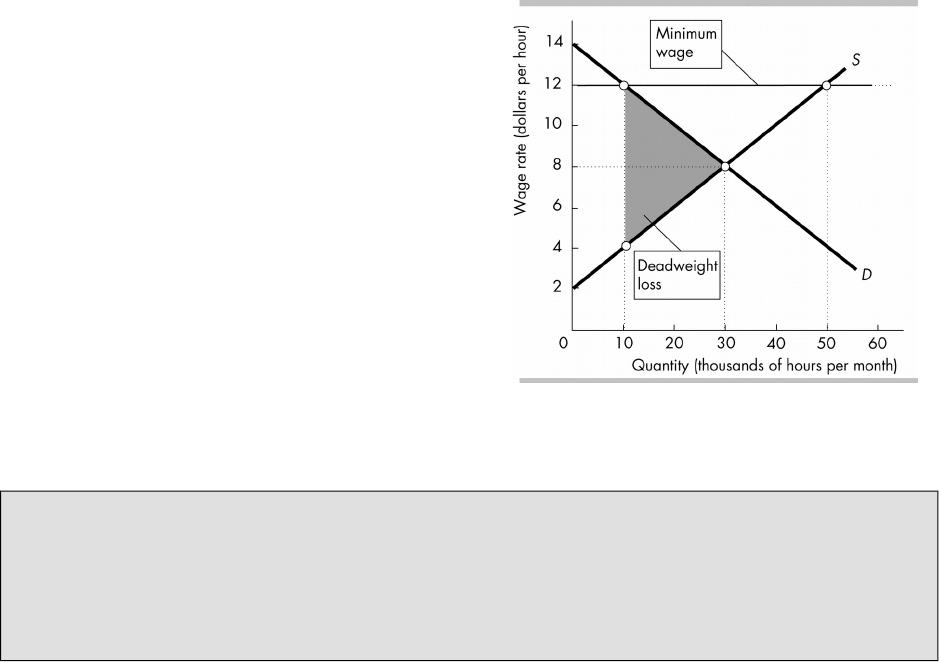
If a minimum wage is set above the
equilibrium wage rate, the quantity of
labor demanded is less than the
quantity of labor supplied. This surplus
of labor is unemployed workers. The
minimum wage creates unemployment
because some workers who are willing
to work at the minimum wage will not
-nd a job.
In the -gure, the equilibrium wage is $8
an hour and the equilibrium quantity of
employment is 30,000 hours per month.
If a minimum wage rate of $12 is
imposed, the initial equilibrium wage
rate is made illegal. At the minimum
age the quantity of labor supplied is
50,000 hours per month and the
quantity demanded is 10,000 so there is a surplus of 40,000 hours. The 40,000 hour
surplus means that 40,000 hours of labor is unemployed.
Labor is work that households supply and &rms demand. You might be surprised to
-nd that quite a few students think that the demand for labor is the demand by a
household for a job and the supply of labor is the supply of jobs by -rms. Of course, they
get into a big mess with this mirror image view of the labor market. Try to avoid this
all-too-common mistake by being very explicit that households supply labor and -rms
demand it. Sure, -rms provide jobs and people want jobs to earn an income. But it is labor,
not jobs, that is supplied and demanded in the labor market.
Ineciency of a Minimum Wage
Fewer workers are employed with a minimum wage, so less than the e#cient quantity
of workers is employed. At the quantity of labor employed, the marginal social bene-t
of labor exceeds its marginal social cost.
Because the quantity of labor employed is less than the e#ciency quantity, there is
deadweight loss. In addition to the deadweight loss, there is also increased job
search. Higher job search costs borne by workers add to the loss from the minimum
wage.
The Minimum Wage in Practice
While some estimates say that a 10 percent rise in the minimum wage results in a
decrease in employment 1 to 3 percent (particularly among teenagers), other
economists argue that higher minimum wages have little impact—and potentially
even a positive impact—on employment. Such studies emphasize the idea that
higher wages reduce a given employee’s incentive to quit, thereby reducing
recruitment and training costs for employers and increasing labor productivity and
labor demand.
Is the Minimum Wage Fair?
The minimum wage is unfair based on an evaluation of both the “result” and the
“rules” of a minimum wage. The result if unfair because workers who become
unemployed are worse o1 than they would be with no minimum wage. The minimum
wage imposes an unfair rule because it blocks voluntary exchange. Even if -rms are
willing to hire more labor at a wage that people are willing to take, they are not
permitted to do so by the minimum wage law.
At Issue: Does the Minimum Wage Cause Unemployment?
This At Issue examines the issue of whether the minimum wage creates unemployment. In
addition to considering the Yes and No cases presented for the minimum wage, consider
pulling up data on unemployment rates by educational level and race. Minority teens in
urban areas have signi-cantly higher rates than other populations. Ask your students why
they think this situation exists? Perhaps the minimum wage has become a price &oor about
equilibrium for this population as they have to compete with more experienced, older
workers. You can also ask them if they think this outcome is “fair”? Given that many
students are often paid the minimum wage, asking them if they think the di1erential
outcome is fair can create an interesting and perhaps even heated discussion.
III. Taxes
Tax Incidence
Tax Incidence is the division of the burden of a tax between the buyer and the
seller. The buyers’ burden arises when the price paid by the buyers rises after the
tax is imposed. The sellers’ burden arises when the price they receive falls after the
tax is imposed. Tax incidence does not depend on whether the tax law imposes the
tax on buyers or on sellers.
A Tax on Sellers
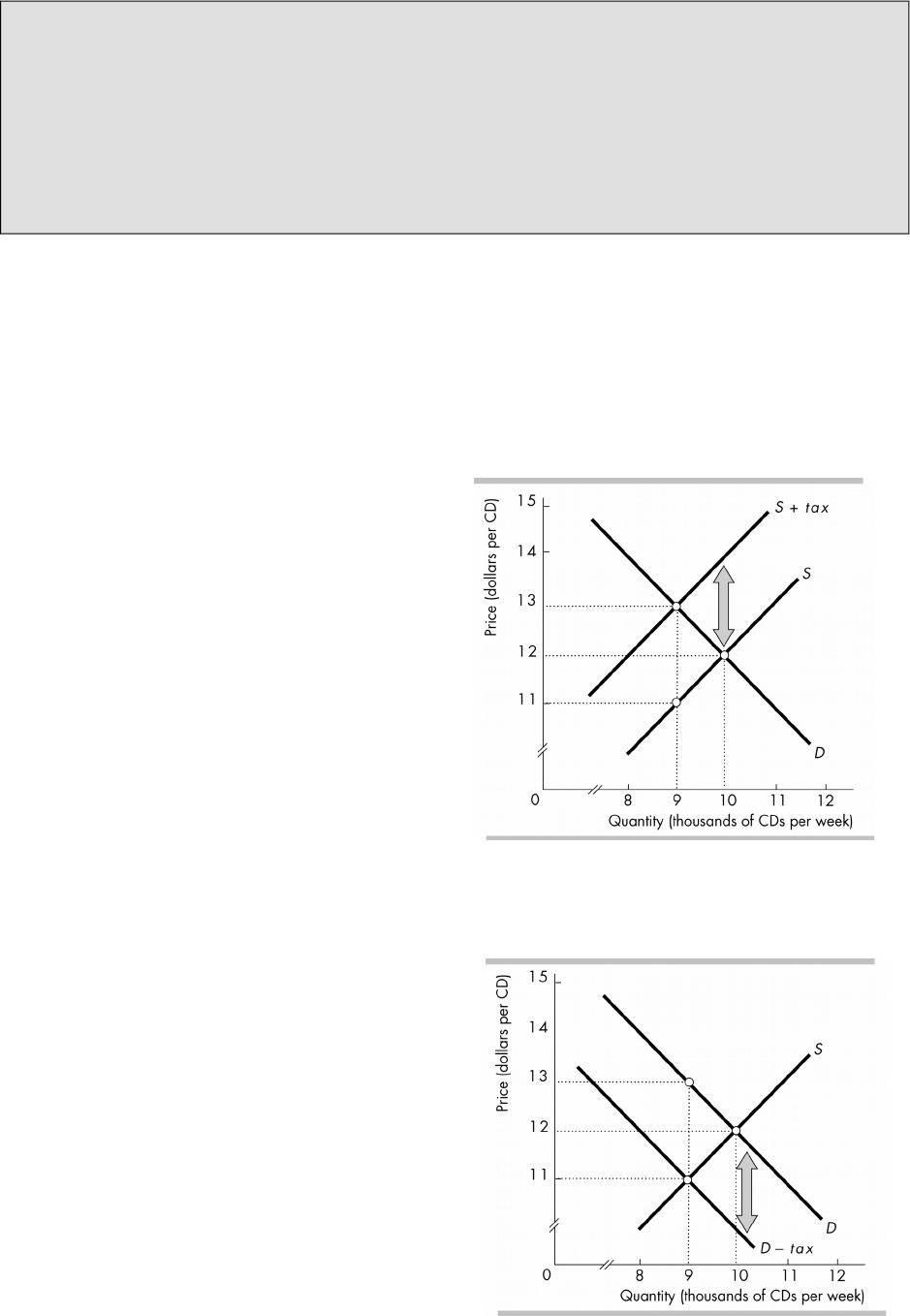
Imposing a tax on sellers decreases
supply because the tax is like a cost
that sellers must pay. The supply
curve shifts leftward. The vertical
distance between the initial supply
curve and the new supply curve is
equal to the amount of the tax. The
price paid by buyers rises, the price
received by sellers falls, and the
quantity decreases.
The -gure shows the e1ect of a tax
imposed on sellers. The initial price is
$12 per CD and the initial quantity is
10 thousand CDs per week. When the
tax is imposed, the supply curve shifts
from S to S + tax. The length of the
double headed arrow showing the
vertical distance between the two supply curves equals the amount of the tax, $2.
With the tax imposed, buyers pay $13 per CD, sellers receive $11 per CD, and the
quantity of CDs purchased decreases to 9 thousand CDs per week.
A Tax on Buyers
Imposing a tax on buyers decreases
demand because the tax lowers the
amount they are willing to pay to the
sellers. The demand curve shifts
leftward. The vertical distance between
the initial demand curve and the new

demand curve is equal to the amount of the tax. The price paid by buyers rises, the
price received by sellers falls, and the quantity decreases.
The -gure shows the e1ect of a tax imposed on buyers. The initial price is $12 per
CD and the initial quantity is 10 thousand CDs per week. When the tax is imposed,
the demand curve shifts from D to D tax. The length of the double headed equals
the amount of the tax, $2. With the tax imposed, buyers pay $13 per CD, sellers
receive $11 per CD, and the quantity of CDs purchased decreases to 9 thousand CDs
per year.
Equivalence of Tax on Buyers and Sellers
The -gures above con-rm the general conclusion: Regardless of whether the tax is
imposed on buyers or sellers, the tax leads to the same outcome in which the new
equilibrium price and quantity are identical. The tax burden is split the same way
regardless of who is responsible for paying the tax to the government.
Tax Incidence and Elasticity of Demand
With perfectly inelastic demand (a vertical demand curve), the buyer pays the
entire tax. In general, the less elastic the demand, the larger the tax burden paid by
the buyers (and the smaller the tax burden paid by the sellers).
With perfectly elastic demand (a horizontal demand curve) the seller pays the
entire tax. In general, the more elastic the demand, the smaller the tax burden paid
by the buyers (and the larger the tax burden paid by the sellers).
Tax Incidence and Elasticity of Supply
With perfectly inelastic supply (a vertical supply curve) the seller pays the entire
tax. In general, the less elastic the supply, the larger the tax burden paid by the
sellers (and the smaller the tax burden paid by the buyers).
With perfectly elastic supply (a horizontal supply curve) the buyer pays the entire
tax. In general, the more elastic the supply, the smaller the tax burden paid by the
sellers (and the larger the tax burden paid by the buyers).
Do consumer prices always rise when taxes rise? As long as the demand curve is not
horizontal and the supply curve is not vertical, when a tax is hiked buyers will bear some of
the burden of a tax and the prices they pay for good will increase. The elasticity of demand
relative to the elasticity of supply is the key to determining how much burden each side of
the market will bear. Consider the situation faced by smokers when the tax on cigarettes is
increased. First, the demand for cigarettes is relatively inelastic. (Ask your students why
they would expect cigarettes to have a relatively low elasticity of demand, relying on the
determinants of elasticity presented in Chapter 4.) With relatively inelastic demand, when
the government raises taxes on cigarettes, the price paid by buyers rises substantially. The
incidence of the tax falls heavily on buyers. In addition, state governments have sued
tobacco companies for past and future health care costs arising from the smoking-related
illnesses. Tobacco companies settled these suits, paying billions of dollars in penalties,
which raised their costs and decreased their supply. But smokers’ very inelastic demand
for cigarettes means that the tobacco producers were able to pass on most of these costs
to smokers without seeing a signi-cant decrease in the quantity sold. On the other hand,
when taxes were imposed on luxury yachts in the 1990s, because the demand for yachts
was relatively elastic, yacht buyers drastically reduced their yacht purchases, and
shipbuilders bore most of the burden of that tax.

Taxes and Eciency
Taxes drive a wedge between the price buyers pay and sellers receive. Therefore,
they put a wedge between marginal bene-t and marginal cost and create
ine#ciency. The quantity produced is less than the e#cient quantity.
Economics in Action: Workers and Consumers Pay the Most Tax
This Economics in Action case considers the incidence of employment and excise taxes and
concludes workers and consumers are most responsible for paying them.
Taxes and Fairness
The Bene-ts Principle
The bene5ts principle is the proposition that people should pay taxes equal to the
bene-ts they receive from the services provided by government.
The Ability-to-Pay Principle
The ability-to-pay principle is the proposition that people should pay taxes
according to how easily they can bear the burden on the tax.
Examples: The federal excise tax on gasoline is an example of the “bene-ts principle” of
taxation. Revenue collected from excise taxes on gasoline are used to -nance interstate
maintenance and improvements. To the extent that the purchasers of gasoline are the
same people who use the interstates, then gas taxes are paid by those who receive the
bene-ts of public interstates. On the other hand, income taxes are an example of the
“ability-to-pay” principle. The progressive marginal tax rates of the U.S. tax code require
those with higher incomes to pay a greater share of government expenditures.
IV. Production Quotas and Subsidies
Production Quotas
A production quota is an upper limit to the quantity of a good that may be
produced in a speci-c period of time. Production quotas will only have an impact if
they are set below the equilibrium level of output in a market.
A production quota results in a decrease in supply, a rise in price, a decrease in
marginal cost, ine#ciency from underproduction, and an incentive to cheat and
overproduce.
Subsidies
A subsidy is a payment made by the government to a producer. A subsidy increases
the supply.
A subsidy results in an increase in supply, a fall in price and increase in quantity
produced, an increase in marginal cost, payment to producers by the government,
and ine#ciency from overproduction.
Economics in Action: Rich High-Cost Farmers the Winners
This Economics in Action examines farm subsidies and the tension they are creating
between developed and developing countries.
V. Markets for Illegal Goods
The government prohibits the trade of some goods, such as illegal drugs. Yet markets
still exist, with both buyers and sellers engaging in trade.
A Free Market for a Drug
With no penalties for selling or buying drugs, drug prices would be lower and more
would be sold.

A Market for an Illegal Drug
Imposing penalties on sellers decreases the supply and shifts the supply curve
leftward compared to the free market case. These penalties raise the price and
decrease the quantity.
Imposing penalties on buyers decreases the demand and shifts the demand curve
leftward compared to the free market case. These penalties lower the price and
decrease the quantity.
When both buyers and sellers face penalties, both the demand and supply curves
shift leftward. The quantity decreases but the e1ect on the price is ambiguous.
If the decrease in demand exceeds the decrease in supply, the price falls.
If the decrease in demand equals the decrease in supply, the price does not
change.
If the decrease in demand is less than the decrease in supply, the price rises.
Legalizing and Taxing Drugs
Compared to a legal and untaxed market, if drugs are legal and taxed, the price of
drugs will be higher and the quantity consumed will be lower. But a high tax rate
might be necessary to decrease the consumption of drugs to the level that occurs
when they are illegal and so black markets might arise.
An advantage of legalization and taxation is that the government can raise tax
revenues for educating the population against using drugs. A disadvantage is that
legalization might signal that drugs are socially acceptable, which could increase
demand.
Economics in the News: Push to Raise the Minimum Wage
State Minimum Wages Rising to Exceed the Federal Minimum
This Economics in the News examines the push to raise state minimum wages above the
federal minimum wage. This is a very timely issue for students to apply their recently
learned economic analysis skills to understand. It shows how a minimum wage set above
the equilibrium wage rate creates unemployment while a minimum wage set below the
equilibrium wage rate has no e1ect.