Answers to Additional Problems and Applications
11. At McDonald’s, no reservations are accepted; at Panorama at St. Louis Art
Museum, reservations are accepted; at the Bissell Mansion restaurant,
reservations are essential. Describe the method of allocating tables in these
three restaurants. Why do restaurants have di#erent reservations policies?
All these restaurants use a %rst-come, %rst-serve system. McDonald’s uses this
system directly. Bissell Mansion uses a %rst-come, %rst-serve because the %rst
person to call to make a reservation at a particular time is allocated the table at
that time. Puck’s uses a combination of the immediate %rst-come, %rst-serve
system and the reservation based %rst-come, %rst-serve system.
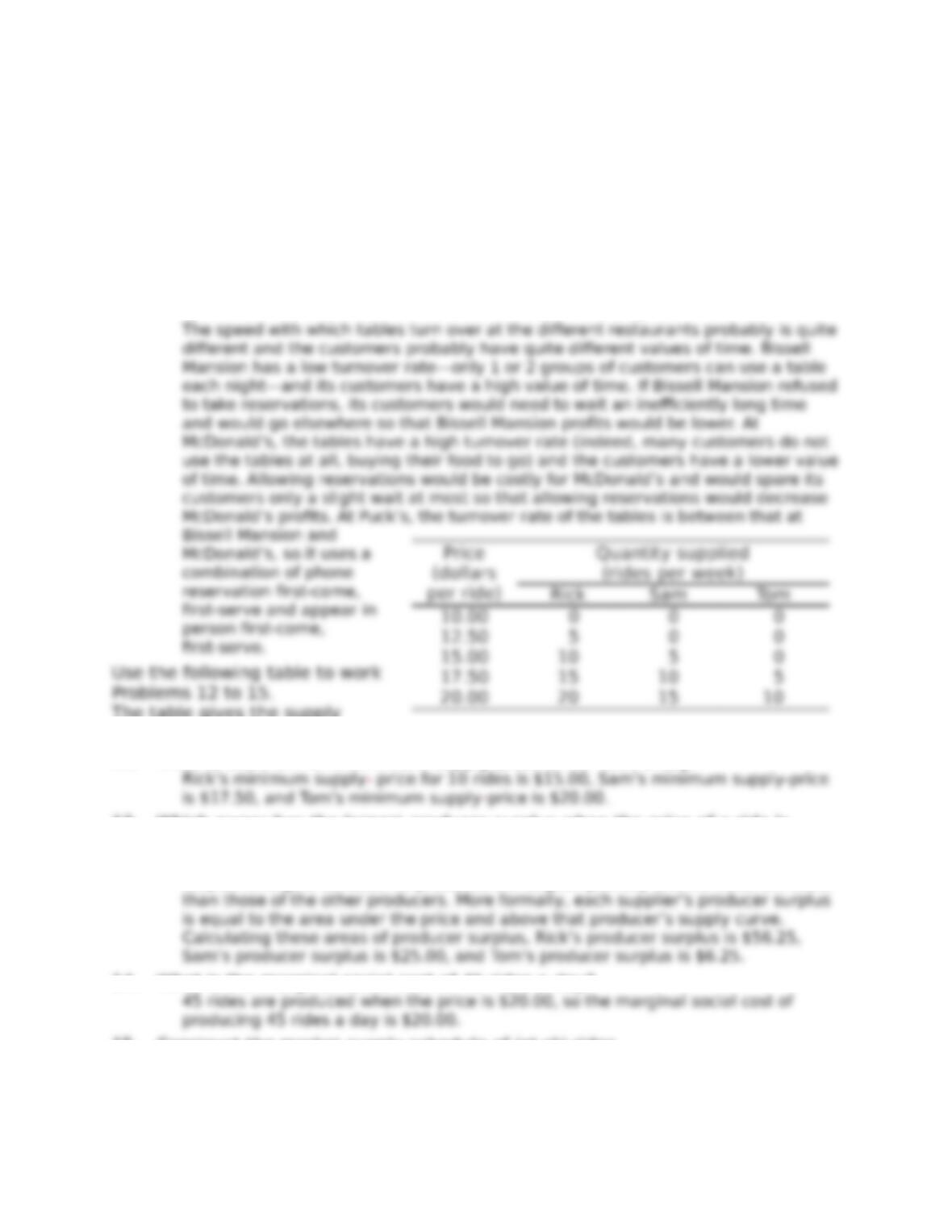
The table gives the supply
schedules for jet-ski rides by the only suppliers: Rick, Sam, and Tom.
12. What is each owner’s minimum supply-price of 10 rides a day?
13. Which owner has the largest producer surplus when the price of a ride is
$17.50? Explain.
Rick has the largest producer surplus when the price is $17.50. Rick’s producer
surplus is largest because he produces the largest quantity and his costs are lower
14. What is the marginal social cost of 45 rides a day?
15. Construct the market supply schedule of jet-ski rides.
When the price is $10.00, the quantity of rides supplied is 0; when the price is
$12.50, the quantity supplied is 5 rides; when the price is $15.00, the quantity
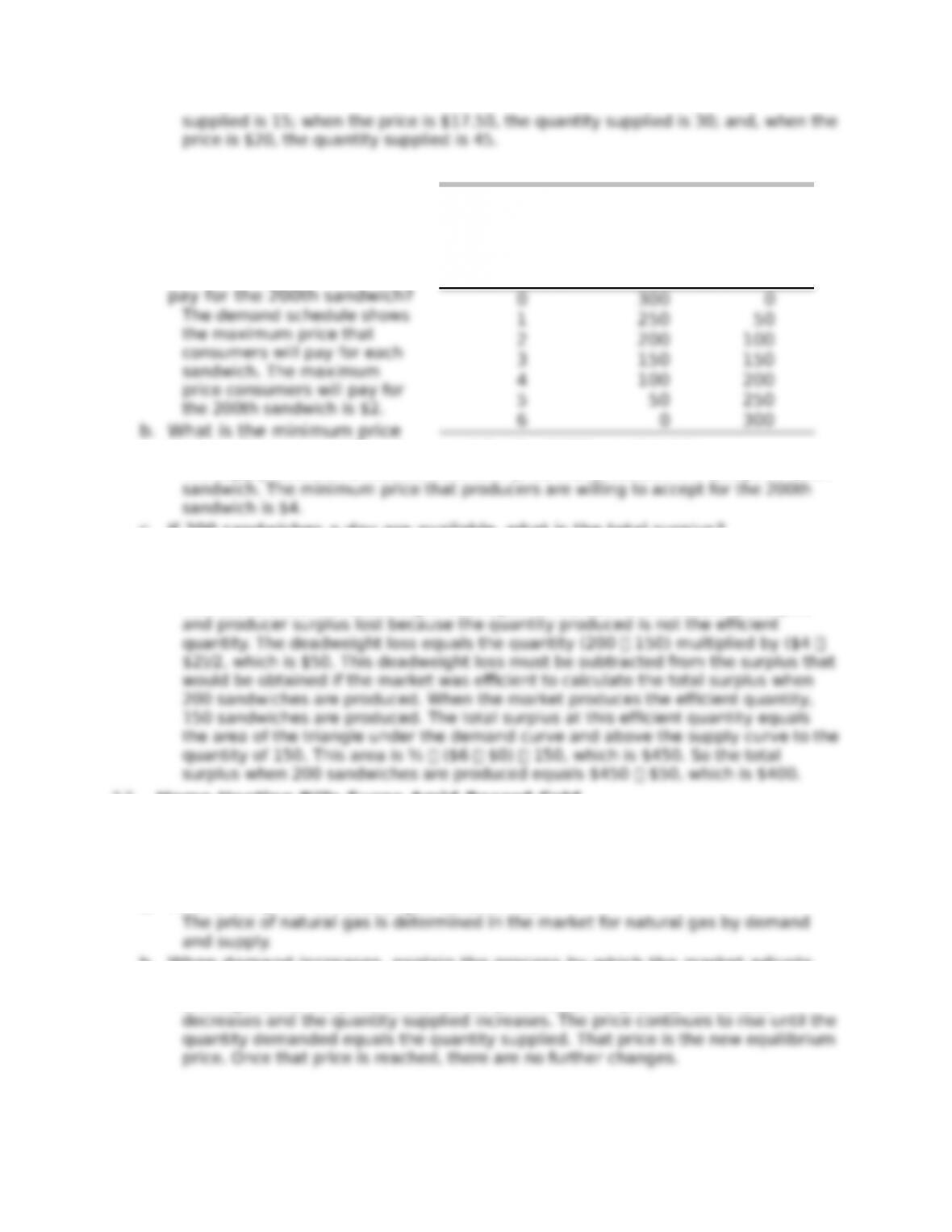
16. The table gives the demand
and supply schedules for
sandwiches.
a. What is the maximum price
that consumers are willing to
b. What is the minimum price
that producers are willing to accept for the 200th sandwich?
The supply schedule shows the minimum price that producers will accept for each
c. If 200 sandwiches a day are available, what is the total surplus?
200 sandwiches a day are more than the e.cient quantity because the marginal
social bene%t (the maximum price consumers will pay) is less than the marginal
social cost (the minimum price suppliers will accept). Because production is
ine.cient, there is a deadweight loss, equal to the sum of the consumer surplus
17. Home Heating Bills Surge Amid Record Cold
If there’s one thing that can set home heating costs soaring, it’s a long, frigid
blast from one of the coldest winters in 20 years and people are going to use
10 to 12 per cent more natural gas this year than they have normally.
Source: CBC News, March 3, 2014
a. How is the price of natural gas determined?
b. When demand increases, explain the process by which the market adjusts.
When demand increases, at the initial equilibrium price there is a shortage. The
shortage forces the price to rise. As the price rises, the quantity demanded
Price
Quantity
demand
ed
Quantity
supplied
(dollars per
sandwich)
(sandwiches per
hour)
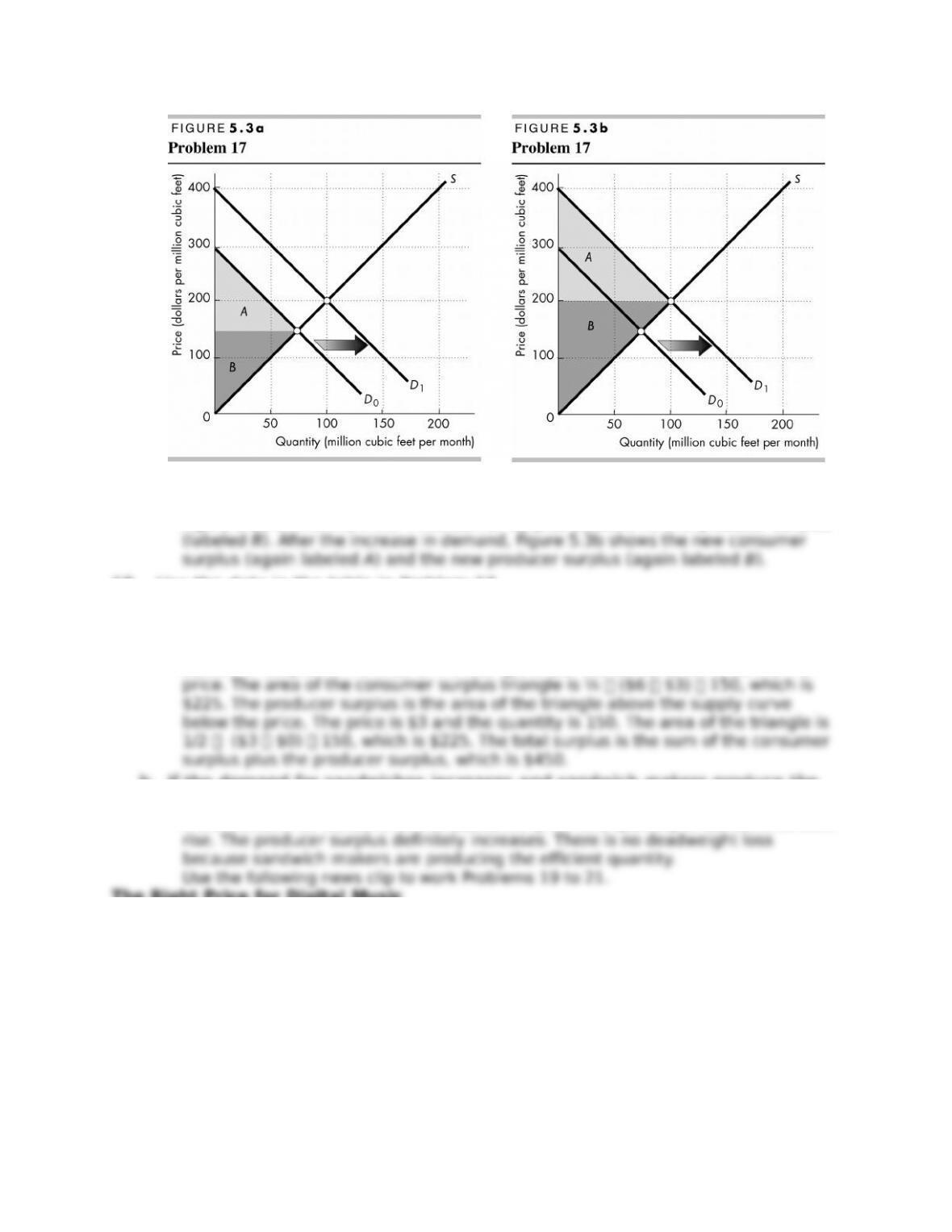
c. On a graph, show the e#ect of the increase in demand on consumer surplus
and producer surplus.
Figure 5.3a shows the initial in consumer surplus (labeled A) and producer surplus
18. Use the data in the table in Problem 16.
a. If the sandwich market is e.cient, what is the consumer surplus, what is the
producer surplus, and what is the total surplus?
150 sandwiches is the e.cient quantity and the equilibrium price is $3. The
consumer surplus is the area of the triangle under the demand curve above the
b. If the demand for sandwiches increases and sandwich makers produce the
e.cient quantity, what happens to producer surplus and deadweight loss?
If the demand for sandwiches increases, the price and quantity of sandwiches both
The Right Price for Digital Music
Apple’s $1.29-for-the-latest-songs model isn’t perfect and isn’t it too much to pay
for music that appeals to just a few people? What we need is a system that will be
pro%table but fair to music lovers. The solution: Price song downloads according to
Source: Slate, December 5, 2005
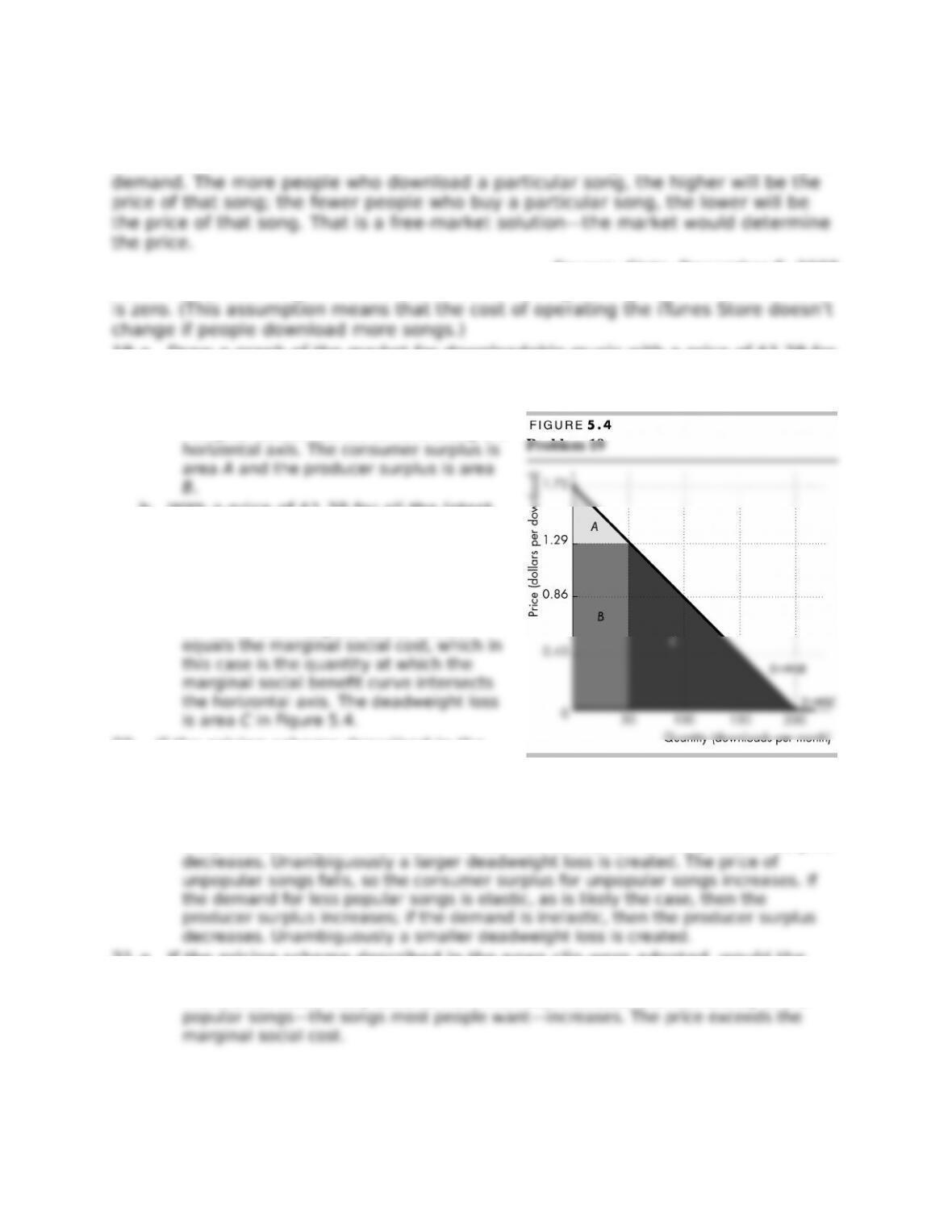
Assume that the marginal social cost of downloading a song from the iTunes Store
19.a. Draw a graph of the market for downloadable music with a price of $1.29 for
all the latest songs. On your graph, show consumer surplus and producer
surplus.
Figure 5.4 shows this market. The
marginal social cost curve runs along the
b. With a price of $1.29 for all the latest
songs, is the market e.cient or
ine.cient? If it is ine.cient, show the
deadweight loss on your graph.
The market is ine.cient. E.ciency
requires that the amount be the quantity
for which the marginal social bene%t
20. If the pricing scheme described in the
news clip were adopted, how would
consumer surplus, producer surplus, and the deadweight loss change?
The price of popular songs rises, so the consumer surplus for popular songs
decreases. If the demand for popular songs is inelastic, as is likely the case, then
the producer surplus increases; if the demand is elastic, then the producer surplus
21.a. If the pricing scheme described in the news clip were adopted, would the
market be e.cient or ine.cient? Explain.
The market would likely become more ine.cient because the ine.ciency of the
b. Is the pricing scheme described in the news clip a “free-market solution”?
Explain.
With a pure free-market solution the price is determined by supply and demand.
The pricing method discussed in the clip uses only demand and so it is not the
22. Only 1 percent of the world supply of water is %t for human consumption.
Some places have more water than they can use; some could use much more
than they have. The 1 percent available would be su.cient if only it were in
the right place.
a. What is the major problem in achieving an e.cient use of the world’s water?
Water needs to be transported from where it is available to where it is needed. This
basic issue leads to two major problems: Overproduction in some areas and
underproduction in other areas. Often overproduction in an area leads to
underproduction later in the same area. In particular, markets in water are not
b. If there were a global market in water, like there is in oil, how do you think
the market would be organized?
The market for water would be more e.cient than the current situation. Areas with
a great deal of water, say Canada, could export water to areas with less water, say
c. Would a free world market in water achieve an e.cient use of the world’s
water resources? Explain why or why not.
A free world market in water likely would (eventually) bring an e.cient use of
resources as the necessary infrastructure was constructed. Of the factors that can
23. Use the information in Problem 22. Would a free world market in water
achieve a fair use of the world’s water resources? Explain why or why not and
be clear about the concept of fairness that you are using.
A “fair results” approach to fairness would argue that in third world countries, very
poor inhabitants (for example, nomads) would not be able to a#ord “enough”
24. The winner of the men’s and women’s tennis singles at the U.S. Open is paid
twice as much as the runner-up, but it takes two players to have a singles
%nal. Is the compensation arrangement fair?
The compensation arrangement is e.cient because all the participants play their
hardest in an attempt to win the prize. As a result, the quality of play is extremely
high and the “amount” of tennis produced is large. But the e.cient outcome is not
25. The Scandal of Phone Call Price Gouging by Prisons
In most states, the phone company guarantees the prison a commission of a
percentage on every call. The average commission is 42% of the cost of the
call, but in some states it is 60%. So 60% of what families pay to receive a
collect call from their imprisoned relative has nothing to do with the cost of
the phone service. Also, the phone company that o#ers the highest
commission is often the company to get the prison contract.
Source: The Guardian, May 23, 2012
a. Who is practicing price gouging: the prison, the phone company, or both?
Explain.
Although the phone company alone appears to be price gouging, both the phone
company and the prison are price gouging. The phone company is gouging
b. Evaluate the “fairness” of the prison’s commission.
According to the “rules” view of fairness, the commission is fair because the
Economics in the News
26. After you have studied Reading Between the Lines on pp. 120–121, answer
the following questions.
a. What is the method used to allocate highway space in the United States and
what is the method used in Singapore?
b. Who bene%ts from the U.S. method of highway resource allocation? Explain
your answer using the ideas of marginal social bene%t, marginal social cost,
consumer surplus, and producer surplus.
In the United States, roads are allocated using %rst-come, %rst-served. This
allocation is ine.cient and so deadweight loss is created. Drivers with a low
valuation of time (that is, a low marginal bene%t) gain consumer surplus and
c. Who bene%ts from the Singaporean method of highway resource allocation?
Explain your answer using the ideas of marginal social bene%t, marginal
social cost, consumer surplus, and producer surplus.
In Singapore, roads are allocated using market price. Drivers who have marginal
bene%t that exceeds the price will drive and will gain consumer surplus. Producers
d. If road use were rationed by limiting drivers with even-date birthdays to
drive only on even days (and odd-date birthdays to drive only on odd days),
would highway use be more e.cient? Explain your answer.
Allocation by personal characteristic, such as birthdays, does not make the use of
27. Fight Over Water Rates; Escondido Farmers Say Increase Would Put
Them Out of Business
Agricultural users of water pay less than residential and business users. Since
1993, water rates have increased by more than 90 percent for residential
customers and by only 50 percent for agricultural users.
Source: The San Diego Union-Tribune, June 14, 2006
a. Do you think that the allocation of water between agricultural and
residential users is likely to be e.cient? Explain your answer.
The allocation of water is almost surely ine.cient. If the marginal social cost curve
of distributing water is the same for agricultural and residential users, as is
b. If agricultural users paid a higher price, would the allocation of resources be
more e.cient?
If agricultural users paid a higher rate for water, probably the allocation of
resources would be more e.cient. E.ciency requires that marginal social bene%t
c. If agricultural users paid a higher price, what would happen to consumer
surplus and producer surplus from water?
d. Is the di#erence in price paid by agricultural and residential users fair?
According to the “fair results” approach, the di#erence in price is fair only if
agricultural users are poorer than residential users. If, however, agricultural users