A n s w e r s t o t h e R e v i e w Q u i z z e s
Page 107
1. Why do we need methods of allocating scarce resources?
Because resources are scare, it is not possible to fulll everyone’s wants. As a
2. Describe the alternative methods of allocating scarce resources.
Resources can be allocated using:
Market price: People who are willing and able to pay the price get the
resource.
Command: Someone in command decides who gets the resource.
3. Provide an example of each allocation method that illustrates when it works
well.
Below are examples of when each allocation scheme works well:
Market price: Generally works well in competitive markets and for most
goods and services. An example is the allocation of cat food.
Command: Generally works well in organizations where lines of authority
are clear and it is easy to monitor subordinates. An example is in a fast
food restaurant when the supervisor tells a worker to clean the tables.
© 2016 Pearson Education, Inc.
5 EFFICIENCY AND
EQUITY
E F F I C I E N C Y A N D E Q U I T Y 7 9
8 0
4. Provide an example of each allocation method that illustrates when it works
badly.
Below are examples of when each allocation scheme would work poorly:
Market price: Deciding court cases on the basis of who will pay the most for
the decision.
Command: Running an economy.
Majority rule: Deciding how many acres of wheat to plant.
Page 111
1. What is the relationship between the marginal benet, value, and demand?
The value of one more unit of a good is its marginal benet. The marginal benet
of a good or service is measured by the maximum amount that consumers are
2. What is the relationship between individual demand and market demand?
The market demand equals the sum of the individual quantities demanded by all
3. What is consumer surplus? How is it measured?
Consumer surplus is the excess of the benet received from a good over the
amount paid for it. The total consumer surplus is the sum of the consumer
4. What is the relationship between the marginal cost, minimum supply-price,
and supply?
The marginal cost is the cost of producing an additional unit of a good. The
marginal cost is the minimum price that producers must receive to induce them to
5. What is the relationship between individual supply and market supply?
The market supply equals the sum of the individual quantities supplied by all the
© 2016 Pearson Education, Inc.
6. What is producer surplus? How is it measured?
Producer surplus is the excess of the amount received from the sale of a good or
Page 115
1. Do competitive markets use resources eEciently? Explain why or why not.
In the absence of the obstacles mentioned earlier in the chapter, competitive
markets use society’s resources eEciently. For resources to be used eEciently they
must be allocated to produce the quantity of a good or service where the marginal
2. What is deadweight loss and under what conditions does it occur?
The deadweight loss is the decrease in total surplus that results from an
ineEcient level of production. This is the decrease in consumer surplus plus the
3. What are the obstacles to achieving an eEcient allocation of resources in the
market economy?
Markets with price or quantity regulations, taxes or subsidies, externalities, public
goods or common resources, monopoly power, or high transactions costs will not
produce the eEcient quantity of a good or service. In each of these situations, the
Page 119
1. What are the two big approaches to thinking about fairness?
The two big approaches to thinking about fairness are:
2. What is the utilitarian idea of fairness and what is wrong with it?
The utilitarian idea of fairness implies that equality of incomes is necessary for the
allocation of resources to be “fair.” There should be income transfers from the rich
to the poor until equality is achieved, because the marginal benet of the last
dollar of income is the same for everybody. There are two problem with
utilitarianism:
© 2016 Pearson Education, Inc.
E F F I C I E N C Y A N D E Q U I T Y 8 1
8 2
3. Explain the big tradeo6. What idea of fairness has been developed to deal
with it?
The big tradeo6 is the tradeo6 between eciency and fairness. Redistributing
incomes changes the incentives facing producers and consumers. Taxing income
decreases producer surplus and taxing purchases decreases consumer surplus.
4. What is the idea of fairness based on fair rules?
The fair rules idea of fairness is that of providing equality of opportunity is
necessary for the allocation of resources to be “fair.” This is the economic
application of the symmetry principle, that people in similar situations be treated
A n s we r s t o t h e S t u d y P l a n P r o b l e m s a n d
A p p l i c a t i o n s
1. At Chez Panisse, a restaurant in Berkeley, reservations are essential. At
Mandarin Dynasty, a restaurant near the University of California San Diego,
reservations are recommended. At Eli Cannon’s, a restaurant in Middletown,
Connecticut, reservations are not accepted.
Describe the method of allocating scarce table resources at these three
restaurants. Why do you think restaurants don’t use the market price to
allocate their tables?
All these restaurants use a rst-come, rst-serve system. Eli Cannon’s uses this
system directly. Chez Panisse uses a rst-come, rst-serve system because the rst
person to call to make a reservation at a particular time is allocated the table at
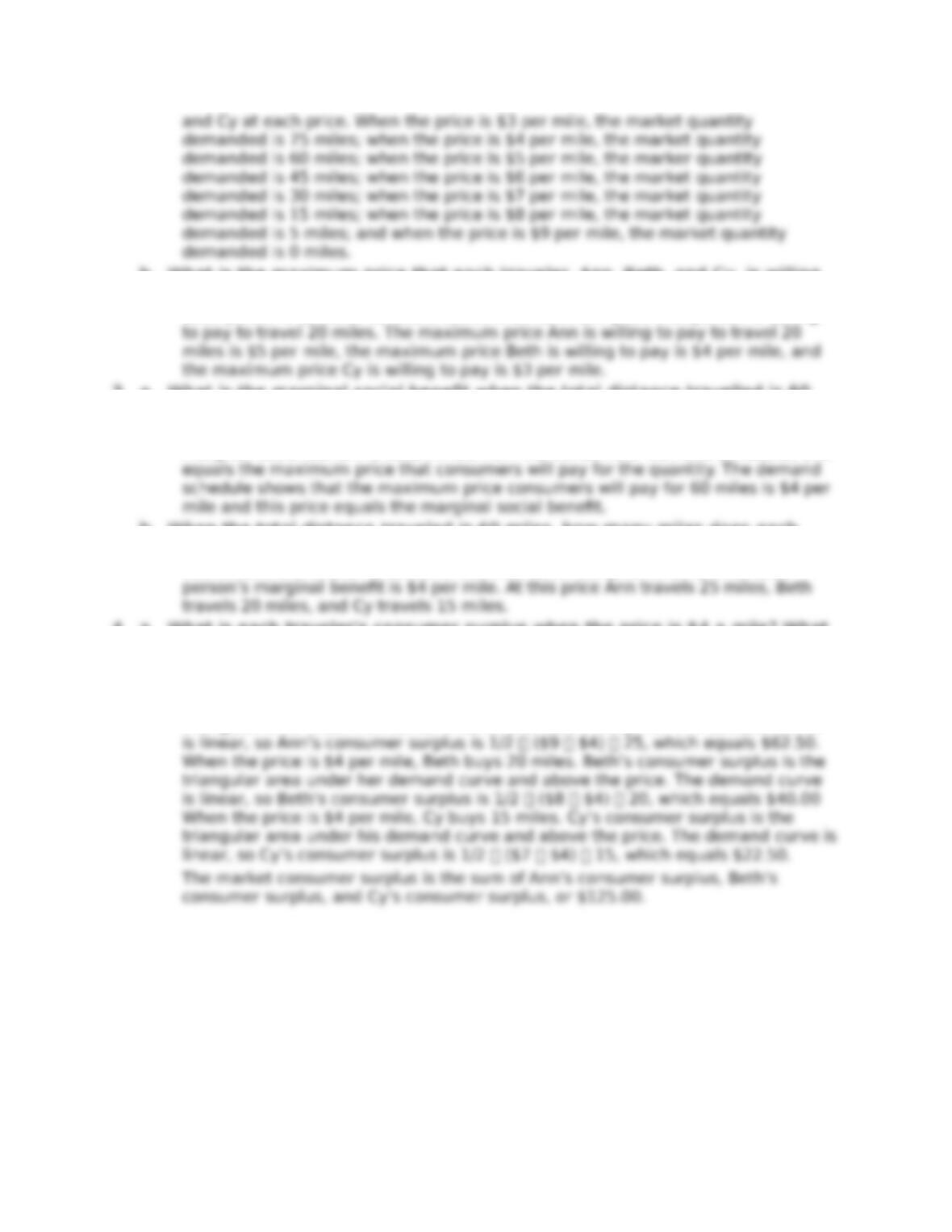
Use the following table to
work Problems 2 to 4.
The table gives the demand
schedules for train travel for
the only buyers in the market,
© 2016 Pearson Education, Inc.
Price
(dollars
per
mile)
Quantity demanded
(miles)
Ann Beth Cy
b. What is the maximum price that each traveler, Ann, Beth, and Cy, is willing
to pay to travel 20 miles? Why?
Each person’s demand schedule shows the maximum price that person is willing
3. a. What is the marginal social benet when the total distance travelled is 60
miles?
The marginal social benet when the quantity is 60 miles is $4 per mile. The
marginal social benet is determined from the consumers’ demand schedules and
b. When the total distance traveled is 60 miles, how many miles does each
travel and what is their marginal private benet?
The three travel a total distance of 60 miles when the price is $4 a mile. Each
4. a. What is each traveler’s consumer surplus when the price is $4 a mile? What
is the market consumer surplus when the price is $4 a mile?
Ann’s consumer surplus is $62.50; Beth’s consumer surplus is $40.00; and, Cy’s
consumer surplus is $22.50.
When the price is $4 per mile, Ann buys 25 miles. Ann’s consumer surplus is the
triangular area under her demand curve and above the price. The demand curve
© 2016 Pearson Education, Inc.
E F F I C I E N C Y A N D E Q U I T Y 8 3
8 4
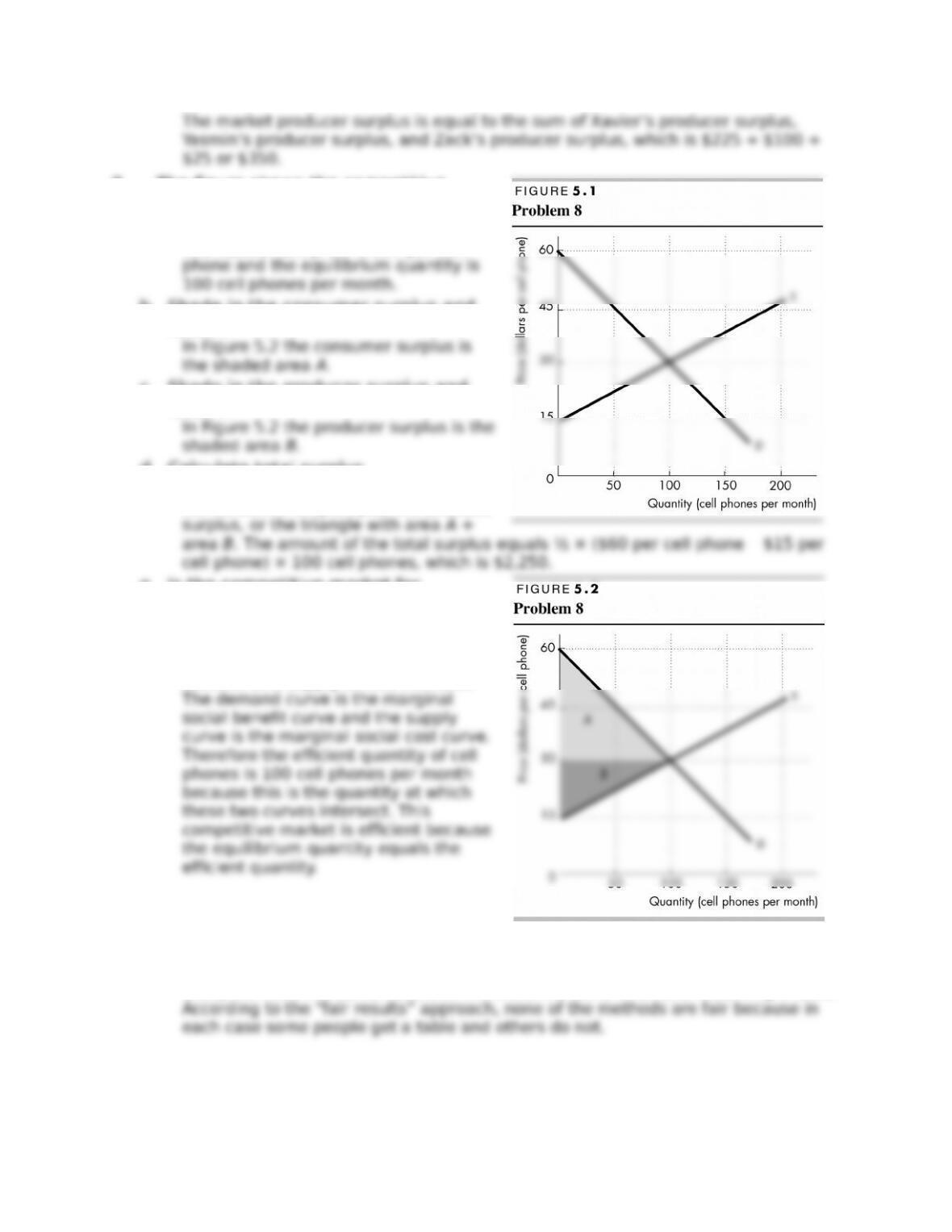
Use the following table to work
Problems 5 to 7.
The table gives the supply
schedules of hot air balloon
rides for the only sellers in the
by Xavier, Yasmin, and
Zack at each price. When the price is $100 per ride, the market quantity supplied
b. What are the minimum prices that Xavier, Yasmin, and Zack are willing to
accept to supply 20 rides? Why?
The minimum supply-price equals the lowest price at which a producer is willing to
produce the given quantity. The supply schedule tells us the minimum
6. a. What is the marginal social cost when the total number of rides is 30?
The quantity of rides supplied is 30 when the price is $70 per ride. The marginal
social cost of any quantity is equal to the price for which that quantity will be
b. What is the marginal cost for each supplier when the total number of rides is
30 and how many rides does each of the rms supply?
7. When the price is $70 a ride, what is each rm’s producer surplus? What is
the market producer surplus?
Xavier’s producer surplus is $225; Yasmin’s is $100; and, Zack’s is $25.
When the price is $70 per ride, Xavier supplies 15 rides. Xavier’s producer surplus
is the triangular area under the price and above his supply curve. The supply
curve is linear, so Xavier’s producer surplus is 1/2 ($70 $40) 15, which equals
$225.
© 2016 Pearson Education, Inc.
Price
(dollars
per
ride)
Quantity supplied
(rides per week)
Xavier Yasmin Zack
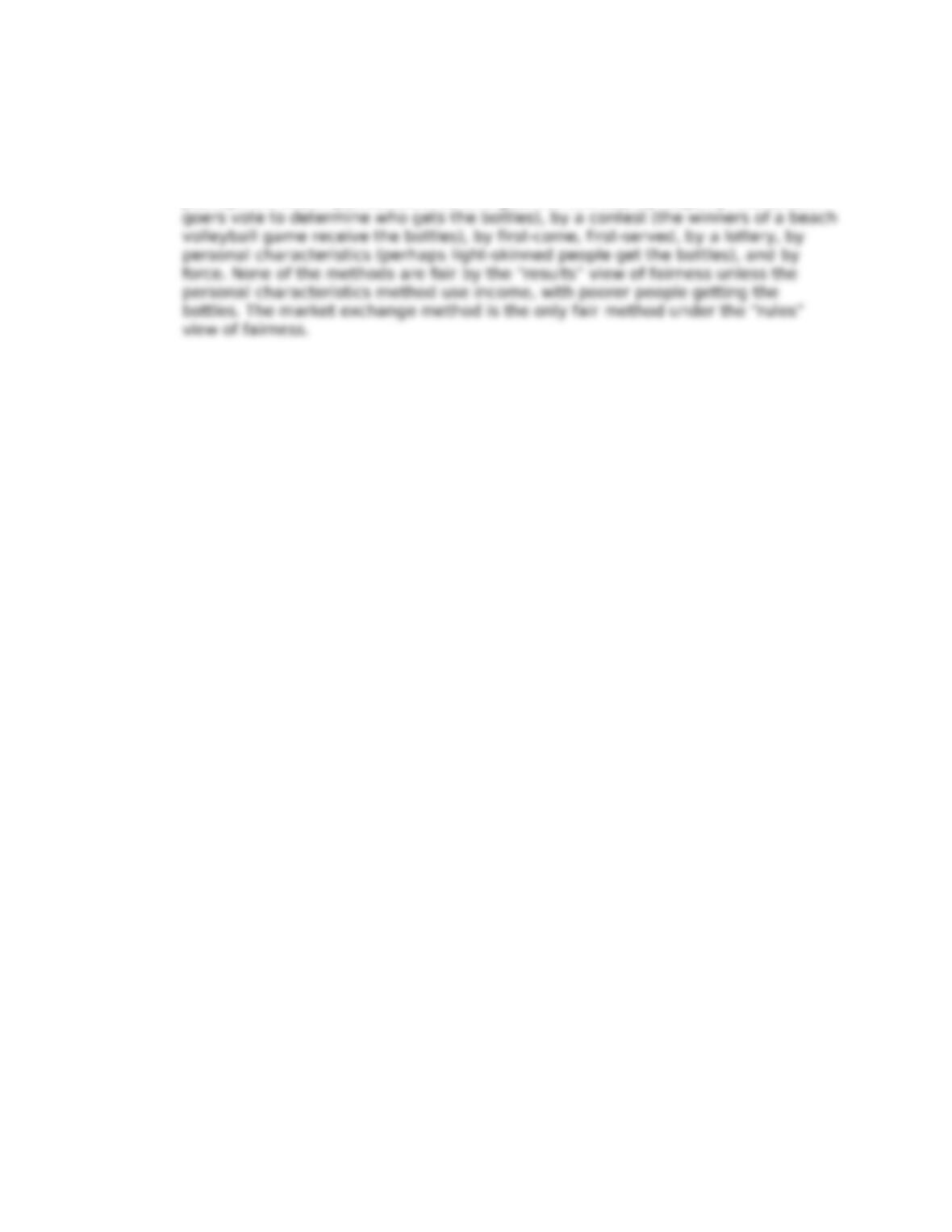
8. The gure shows the competitive
market for cell phones.
a. What is the market equilibrium?
The equilibrium price is $30 per cell
b. Shade in the consumer surplus and
label it.
c. Shade in the producer surplus and
label it.
d. Calculate total surplus.
The total surplus is equal to the sum of
the consumer surplus plus the producer
e. Is the competitive market for
cellphones eEcient?
The equilibrium quantity of cell phones
is 100 cell phones per month because
this is the quantity at which the
demand and supply curves intersect.
9. Explain why the allocation method
used by each restaurant in Problem 1
is fair or not fair.
According to the “fair rules” approach, all of the methods are fair because
everyone faces the same rules and therefore the same chance of obtaining a table.
© 2016 Pearson Education, Inc.
E F F I C I E N C Y A N D E Q U I T Y 8 5
8 6
10. In the Worked Problem (p. 123), how can the 50 bottles available be allocated
to beach-goers? Would the possible methods be fair or unfair?
The 50 bottles could be allocated by market price (the price would be $15, the
price that allocates the 50 bottles among the buyers), by command (someone,
perhaps the beach patrol, declares who gets the bottles), by majority rule (beach
© 2016 Pearson Education, Inc.