W H AT I S E C O N O M I C S ? 5 5
A n s w e r s t o t h e R e v i e w Q u i z z e s
Page 90
1. Why do we need a units-free measure of the responsiveness of the quantity
demanded of a good or service to a change in its price?
The elasticity of demand is a units-free measure. Compare it as a measure of the
responsiveness to some other candidate that depends on the units, such as the
slope. The slope of the demand curve changes as the units measuring the same
2. De/ne the price elasticity of demand and show how it is calculated.
The price elasticity of demand is units-free measure of the responsiveness of the
quantity demanded of a good to a change in its price when all other in0uences on
3. What makes the demand for some goods elastic and the demand for other
goods inelastic?
The magnitude of the price elasticity of demand for a good depends on three main
in0uences:
Closeness of substitutes. The more easily people can substitute other items for
a particular good, the larger is the price elasticity of demand for that good.
4. Why is the demand for a luxury generally more elastic (or less inelastic) than
the demand for a necessity?
Demand for a necessity is generally less elastic than demand for a luxury because
there are fewer substitutes for a necessity. Because there are more substitutes for
4 ELASTICITY
55
5 6
5. What is the total revenue test?
The total revenue test is a method of estimating the price elasticity of demand by
observing the change in total revenue, given a change in price, holding all other
Page 94
1. What does the income elasticity of demand measure?
The income elasticity of demand measures how the quantity demanded of a good
2. What does the sign (positive/negative) of the income elasticity tell us about a
good?
The sign of the income elasticity of demand reveals whether a good is a normal
3. What does the cross elasticity of demand measure?
The cross elasticity of demand measures how the quantity demanded of one good
4. What does the sign (positive/negative) of the cross elasticity of demand tell
us about the relationship between two goods?
The sign of the cross elasticity of demand reveals whether two goods are
Page 96
1. Why do we need a units-free measure of the responsiveness of the quantity
supplied of a good or service to a change in its price?
The elasticity of supply is a units-free measure. We need a units–free measure of
the elasticity of supply for the same reason we need a units-free measure of the
2. De/ne the elasticity of supply and show how it is calculated.
The elasticity of supply measures the responsiveness of the quantity supplied to a
3. What are the main in0uences on the elasticity of supply that make the supply
of some goods elastic and the supply of other goods inelastic?
The main in0uences on the elasticity of supply are:
56
W H A T I S E C O N O M I C S ? 5 7
Resource substitution possibilities: the greater the suppliers’ ability to
Time frame for the supply decision: the greater the amount of time available
4. Provide examples of goods or services whose elasticities of supply are (a)
zero, (b) greater than zero but less than in/nity, and (c) in/nity.
Here are some examples:
a) The momentary supply of wheat is perfectly inelastic. Once farmers have
b) The short-run supply of wheat. If the farmers already have a mature wheat
crop but have not yet harvested it, farmers with both relatively high and low
c) The supply of wheat to an individual buyer. Any one buyer can purchase as
5. How does the time frame over which a supply decision is made in0uence the
elasticity of supply? Explain your answer.
The momentary supply, short-run supply, and long-run supply all illustrate the
response of suppliers to changes in the price, but they di+er according to how
much time has elapsed after the price change.
The momentary supply is frequently the least elastic and shows how suppliers
The short-run supply shows suppliers’ response after enough time has elapsed
The long-run supply shows how suppliers react after enough time has passed
A n s w e r s t o t h e S t u d y P l a n P r o b l e m s a n d
A p p l i c a t i o n s
1. Rain spoils the strawberry crop, the price rises from $4 to $6 a box, and the
quantity demanded decreases from 1,000 to 600 boxes a week.
a. Calculate the price elasticity of demand over this price range.
The price elasticity of demand is 1.25. The price elasticity of demand equals the
percentage change in the quantity demanded divided by the percentage change in
the price. The price rises from $4 to $6 a box, a rise of $2 a box. The average price
57
5 8
b. Describe the demand for strawberries.
2. If the quantity of dental services demanded increases by 10 percent when the
price of dental services falls by 10 percent, is the demand for dental services
inelastic, elastic, or unit elastic?
The demand for dental services is unit elastic. The price elasticity of demand for
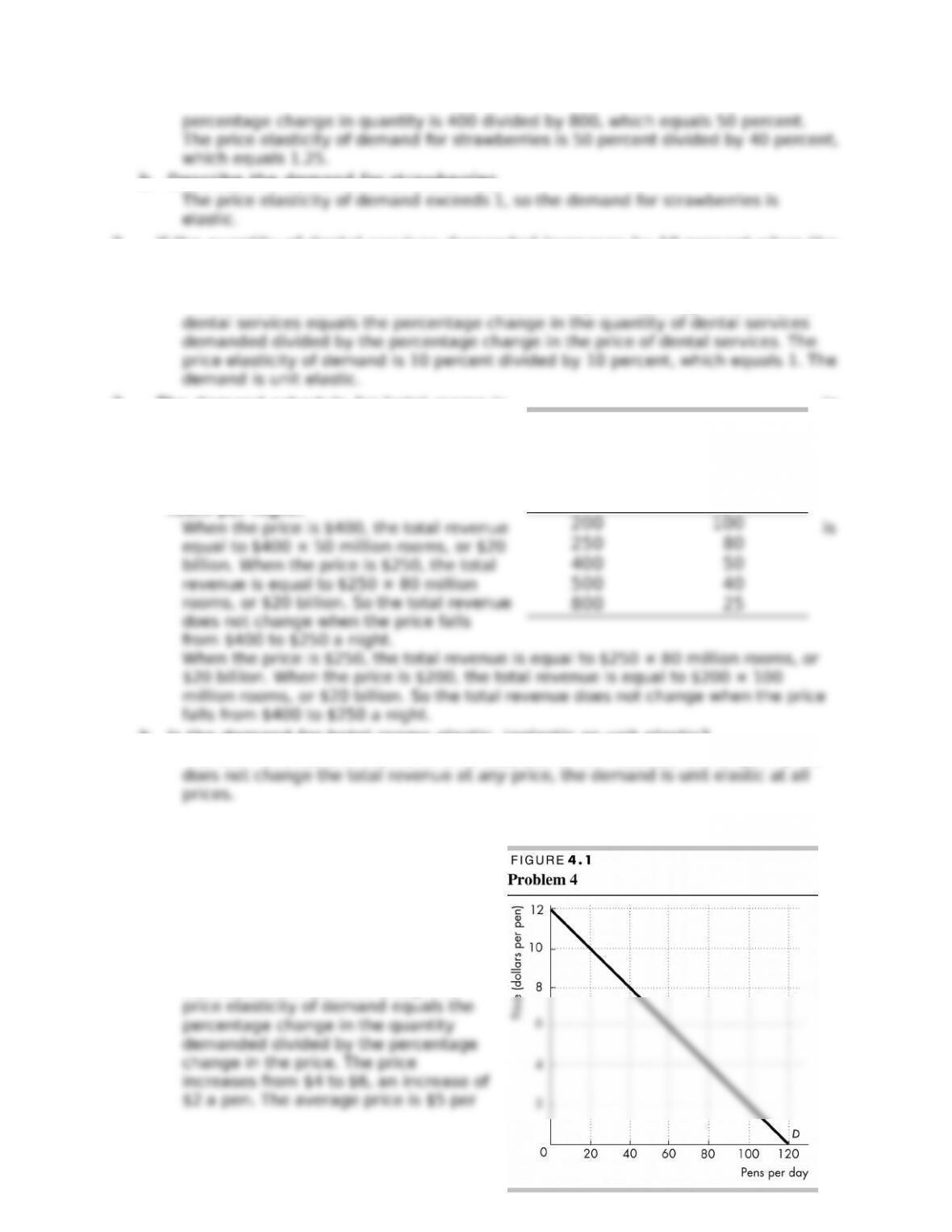
3. The demand schedule for hotel rooms is in
the table.
a. What happens to total revenue when
the price falls from $400 to $250 a
room per night and from $250 to $200 a
room per night?
b. Is the demand for hotel rooms elastic, inelastic or unit elastic?
The total revenue is the same at all prices, $20 billion. Because a change in price
4. The *gure shows the demand for pens.
Calculate the elasticity of demand
when the price rises from $4 to $6 a
pen. Over what price range is the
demand for pens elastic?
The price elasticity of demand is 0.72.
When the price of a pen rises from $4
to $6, the quantity demanded of pens
decreases from 80 to 60 a day. The
Price
(dollars
per night)
Quantity
demanded
(millions of
rooms per
night)
58
W H A T I S E C O N O M I C S ? 5 9
pen. So the percentage change in the price equals $2 divided by $5 and then
multiplied by 100, which equals 40 percent. The quantity decreases from 80 to 60
5. In 2003, when music downloading /rst took o+, Universal Music slashed the
average price of a CD from $21 to $15. The company expected the price cut
to boost the quantity of CDs sold by 30 percent, other things remaining the
same.
a. What was Universal Music’s estimate of the price elasticity of demand for
CDs?
Using the data in the question, the price elasticity of demand is 0.90. The change
in the price is $6 and the average of the two prices is $18, so the percentage
b. If you were making the pricing decision at Universal Music, what would be
your pricing decision? Explain your decision.
The demand is inelastic, so if nothing else changes the price cut leads to a
decrease in Universal Music’s total revenue. However, downloaded music and CDs
are substitutes for each other and the quantity of downloaded music was forecast
6. When Judy’s income increased from $130 to $170 a week, she increased her
demand for concert tickets by 15 percent and decreased her demand for bus
rides by 10 percent. Calculate Judy’s income elasticity of demand for (a)
concert tickets and (b) bus rides.
The income elasticity of demand for (a) concert tickets is 0.56 and (b) bus rides is
−0.375. The income elasticity of demand equals the percentage change in the
a. The change in the quantity demanded of concert tickets is 15 percent. The income
b. The change in the quantity demanded of bus rides is 10 percent. The income
7. If a 12 percent rise in the price of orange juice decreases the quantity of
orange juice demanded by 22 percent and increases the quantity of apple
juice demanded by 14 percent, calculate the
a. Price elasticity of demand for orange juice.
The price elasticity of demand for orange juice is 1.83. The price elasticity of
demand is the percentage change in the quantity demanded of the good divided
59
6 0
b. Cross elasticity of demand for apple juice with respect to the price of orange
juice.
The cross elasticity of demand between orange juice and apple juice is 1.17. The
cross elasticity of demand is the percentage change in the quantity demanded of
8. If a rise in the price of sushi from 98¢ to $1.02 a piece decreases the quantity
of soy sauce demanded from 101 units to 99 units an hour and decreases the
quantity of sushi demanded by 1 percent an hour, calculate the:
a. Price elasticity of demand for sushi.
b. Cross elasticity of demand for soy sauce with respect to the price of sushi.
The quantity of soy sauce decreases by (99 – 101)/100 = −2 percent. Therefore the
9. The table sets out the supply schedule of
jeans.
a. Calculate the elasticity of supply when the
price rises from $125 to $135 a pair.
The elasticity of supply equals the
percentage change in the quantity supplied
divided by the percentage change in price.
b. Calculate the elasticity of supply when the average price is $125 a pair.
To /nd the elasticity at an average price of $125 a pair, change the price such that
$125 is the average price—for example, a rise in the price from $120 to $130 a
c. Is the supply of jeans elastic, inelastic, or unit elastic?
The supply of jeans is elastic.
Price
(dollars
per pair)
Quantity
supplied
(millions of
pairs per year)
120 24
125 28
130 32
60