III. Elasticity of Supply
The elasticity of supply
measures how responsive
producers are to a change in the
price of the good.
The elasticity of supply
measures the responsiveness of
the quantity supplied to a
change in the price of a good
when all other inuences on selling plans remain unchanged.
The elasticity of supply is equal to:
Percentage change in quantity supplied
Percentage change in price .
Three Cases of Elasticity of Supply
Supply is perfectly inelastic if the elasticity of supply equals 0. In this case, the
supply curve is vertical.
Supply is unit elastic if the elasticity of supply equals 1. In this case, the supply
curve is linear and passes through the origin. If any supply curve is linear and
passes through the origin, the supply is unit elastic; the slope of the supply curve is
irrelevant.
Supply is perfectly elastic if the elasticity of supply is in”nite. In this case, the supply
curve is horizontal.
Again, elasticity is not the same as slope. The unit-elastic supply curve is a good one
to use to emphasize that elasticity and slope are not equal. Have the students calculate the
elasticity of supply on two linear demand curves that pass through the origin, one with a
slope of 0.5 and the other with a slope of 2. Regardless of the di)erence in slope, supply
elasticity will be equal to 1.
The table to the right has two points on the
supply curve for pizza from a
particular pizza parlor.
The percentage change in the quantity
supplied is
[(400 300) 350] 100 = 28.6 percent.
The percentage change in price is
[($16 $14) $15] 100 = 13.3 percent.
Between these two points, the elasticity of supply is 28.6% 13.3% = 2.15.
Supply is elastic if the elasticity of supply exceeds 1.0, unit elastic if the elasticity of
supply equals 1.0, and inelastic if the elasticity of supply is less than 1.0.
The Factors that Inuence the Elasticity of Supply
Resource substitution possibilities: The more unique or rare the resources used to
produce the good, the smaller the elasticity of supply. The more common the
resources used to produce the good, the larger the elasticity of supply.
The time frame for substitution possibilities: The longer the amount of time
producers have to adjust to a change in price, the more elastic the supply will be.
Momentary supply refers to the period of time immediately following a price
change. For some goods, the momentary supply can be perfectly inelastic—fresh
“sh the day of a price hike. For other goods, the momentary supply can be quite
elastic—when the number of telephone calls increases on a holiday, the supply
increases with no change in price.
© 2016 Pearson Education, Inc.
4ELASTICITY
Price
(dollars per
pizza)
Quantity
supplied
(pizzas per
week)
14 300
16 400
3 4 C H A P T E R 4

Short-run supply shows how the quantity supplied responds to a price change
when only some of the technological adjustments have been made.
Long-run supply shows how the quantity supplied responds to a price change
when all of the technological adjustments have been made.
Economics in the News: The Elasticity of Demand for Co”ee
Drop in Global Co ee Prices Shrinks Farmers’ Revenue
This feature connects to the chapter opening questions about the price elasticity of
demand for co)ee. It discusses the global decrease in co)ee prices due to increased co)ee
production and its a)ect on co)ee producer’s income. Additional data are added for the
economic analysis.
© 2016 Pearson Education, Inc.
3 5 C H A P T E R 4
A d d i t i o n a l P r o b l e m s
1. Better-than-average weather brings a
bumper tomato crop. The price of
tomatoes falls from $6 to $4 a basket,
and the quantity demanded increases
from 200 to 400 baskets a day. Over this
price range,
a. What is the price elasticity of demand?
b. Describe the demand for tomatoes.
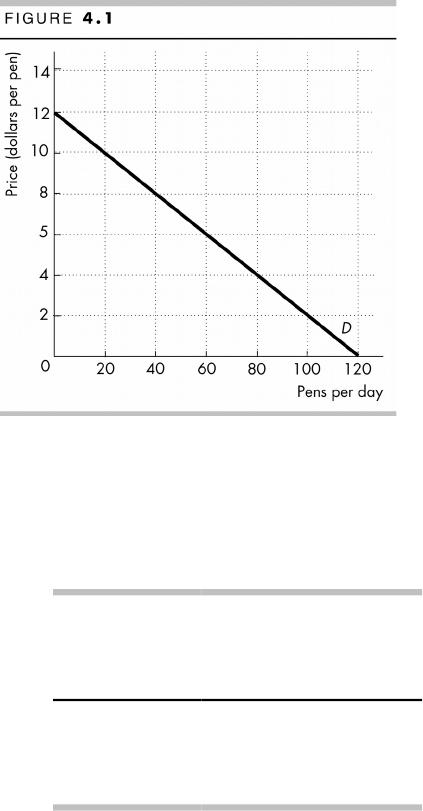
2. The “gure shows the demand for pens.
a. Calculate the elasticity of demand for
a rise in price from $2 to $4.
b. At what prices is the elasticity of
demand equal to 1, greater than 1,
and less than 1?
3. If the quantity of “sh demanded decreases by 5 percent when the price of
“sh rises by 10 percent, is the demand for “sh elastic, inelastic, or unit
elastic?
4. The table gives the demand schedule for
co)ee.
a. What happens to total revenue if the price
of co)ee rises from $10 to $20 per pound?
b. What happens to total revenue if the price
rises to $15 to $25 per pound?
c. What is the price when total revenue at a
maximum?
d. What quantity of co)ee will be sold at the price that answers part c?
e. At an average price of $15 a pound, is the demand for co)ee elastic or
inelastic? Use the total revenue test to answer this question.
5. If a 10 percent fall in the price of beef increases the quantity of beef
demanded by 20 percent and decreases the quantity of chicken demanded
by 15 percent, calculate the cross elasticity of demand between beef and
chicken.
6. Judy’s income has increased from $10,000 to $12,000. Judy increased her
demand for concert tickets by 10 percent and decreased her demand for bus
rides by 5 percent. Calculate Judy’s income elasticity of demand for (a)
concert tickets and (b) bus rides.
© 2016 Pearson Education, Inc.
Price
(dollars
per pound)
Quantity
demanded
(millions of
pounds per year)
10 30
15 25
20 20
25 15
E L A S T I C I T Y 3 6
7. The table gives the supply schedule
for shoes. Calculate the elasticity of
supply when
a. The price rises from $125 to $135 a
pair.
b. The price is $125 a pair.
S o l u t i o n s t o A d d i t i o n a l P r o b l e m s
1. a. The price elasticity of demand is 1.67. The price elasticity of demand equals the
percentage change in the quantity demanded divided by the percentage change in
the price. The price falls from $6 to $4 a basket, a fall of $2 a basket. The average
price is $5 a basket. So the percentage change in the price equals $2 divided by $5
and then multiplied by 100, which equals 40 percent. The quantity increases from
200 to 400 baskets, an increase of 200 baskets. The average quantity is 300
baskets. So the percentage change in quantity equals 200 divided by 300 and then
multiplied by 100, which equals 66.7 percent. The price elasticity of demand for
tomatoes equals 66.7 percent divided by 40 percent, which is 1.67.
b. The price elasticity of demand exceeds 1, so the demand for tomatoes is elastic.
2. a. The price elasticity of demand is 0.33. When the price of a pen rises from $2 to $4,
the quantity demanded of pens decreases from 100 to 80 a day. The price elasticity
of demand equals the percentage change in the quantity demanded divided by the
percentage change in the price. The price increases from $2 to $4, an increase of $2
a pen. The average price is $3 a pen. So the percentage change in the price equals
$2 divided by $3 and then multiplied by 100, which equals 66.7 percent. The
quantity decreases from 100 to 80 pens, a decrease of 20 pens. The average
quantity is 90 pens. So the percentage change in quantity equals 20 divided by 90
and then multiplied by 100, which equals 22 percent. The price elasticity of demand
for pens equals 22 percent divided by 66.7 percent, which is 0.33.
b. The price elasticity of demand equals 1 at $6 a pen. The price elasticity of demand is
greater than 1 at prices greater than $6 a pen. The price elasticity of demand is less
than 1 at prices less than $6 a pen. The price elasticity of demand equals 1 at the
price halfway between the origin and the price at which the demand curve hits the
y-axis. That price is $6 a pen. The demand curve is linear. Along a linear demand
curve, the price elasticity of demand is greater than 1 at points above the midpoint
and less than 1 at points below the midpoint. The price elasticity of demand is
greater than 1 at prices above $6 a pen and less than 1 at prices below $6 a pen.
3. The demand for “sh is inelastic. The price elasticity of demand for “sh equals the
percentage change in the quantity of “sh demanded divided by the percentage
change in the price of “sh. The price elasticity of demand equals 5 percent divided by
10 percent, which is 0.5. The demand is inelastic.
4. a. Total revenue increases. When the price of a pound of co)ee is $10, 30 million
pounds are sold and total revenue equals $300 million. When the price of a pound of
co)ee rises to $20, 20 million pounds are sold and total revenue is $400 million.
Total revenue increases.
b. Total revenue does not change. When the price of a pound of co)ee is $15, 25 million
pounds are sold and total revenue is $375 million. When the price of a pound of
co)ee is $25, 15 million pounds are sold and total revenue is $375 million. Total
revenue does not change.
© 2016 Pearson Education, Inc.
Price
(dollars per
pair)
Quantity supplied
(millions of pairs per
year)
120 1,200
125 1,400
130 1,600
135 1,800
3 7 C H A P T E R 4
c. Total revenue is maximized at $20 a pound. When the price of a pound of co)ee is
$20, 20 million pounds are sold and total revenue equals $400 million. When the
price is $15 a pound, 25 million pounds are sold and total revenue equals $375
million. Total revenue increases as the price rises from $15 to $20 a pound. When
the price is $25 a pound, 15 million pounds are sold and total revenue equals $375
million. Total revenue decreases as the price rises from $20 to $25 a pound. Total
revenue is maximized when the price is $20 a pound.
d. The quantity will be 20 million pounds a year. The demand schedule tells us that
when the price is $20 a pound, the quantity of co)ee demanded is 20 million pounds
a year.
e. The demand for co)ee inelastic. The total revenue test says that if the price rises
and total revenue increases, the demand is inelastic at the average price. For an
average price of $15 a pound, raise the price from $10 to $20 a pound. When the
price of a pound rises from $10 to $20, total revenue increases from $300 million to
$400 million. So at the average price of $15 a pound, demand is inelastic.
5. The cross elasticity of demand between beef and chicken is 2. The cross elasticity of
demand is the percentage change in the quantity demanded of one good divided by
the percentage change in the price of another good. The fall in the price of beef
resulted in a decrease in the quantity demanded of chicken. So the cross elasticity of
demand is the percentage change in the quantity demanded of chicken divided by the
percentage change in the price of beef. The cross elasticity equals 20 percent divided
by 10 percent, which is 2.
6. Income elasticity of demand for (a) concert tickets is 0.55 and (b) bus rides is 0.275.
Income elasticity of demand equals the percentage change in the quantity demanded
divided by the percentage change in income. The change in income is $2,000 and the
average income is $11,000, so the percentage change in income equals 18.2 percent.
a. The change in the quantity demanded of concert tickets is 10 percent. The income
elasticity of demand for concert tickets equals 10/18.2, which is 0.55.
b. The change in the quantity demanded of bus rides is 5 percent. The income
elasticity of demand for bus rides equals 5/18.2, which is 0.275.
7. a. The elasticity of supply is 3.25. The elasticity of supply is the percentage change in
the quantity supplied divided by the percentage change in the price. When the price
rises from $125 to $135, the change in the price is $10 and the average price is
$130. The percentage change in the price is 7.7 percent. When the price rises from
$125 to $135, the quantity supplied increases from 1,400 million to 1,800 million
pairs. The change in the quantity supplied is 400 million pairs, and the average
quantity is 1,600 million pairs, so the percentage change in the quantity supplied is
25 percent. The elasticity of supply equals (25 percent)/(7.7 percent), which equals
3.25.
b. The elasticity of supply is 3.57. The formula for the elasticity of supply calculates the
elasticity at the average price. So to “nd the elasticity of supply at $125, change the
price such that $125 is the average price—for example, a fall in the price from $130
to $120. When the price falls from $130 to $120, the change in the price is $10 and
the average price is $125. The percentage change in the price is 8 percent. When
the price falls from $130 to $120, the quantity supplied decreases from 1,600 million
to 1,200 million pairs. The change in the quantity supplied is 400 million pairs and
the average quantity is 1,400 million pairs. The percentage change in the quantity
supplied is 28.57 percent. The elasticity of supply is the percentage change in the
quantity supplied divided by the percentage change in the price. The elasticity of
supply is 3.57.
© 2016 Pearson Education, Inc.
E L A S T I C I T Y 3 8

A d d i t i o n a l D i s c u s s i o n Q u e s t i o n s
1. How does inelastic student demand for parking hinder police eorts
at preventing illegal student parking? Illegal student parking is a hassle
that every university police force must deal with. Ask the students whether the
campus police will have more success with doubling the current parking “ne,
or liberally using the “boot,” which is a heavy iron clamp locked to the wheel of
a car, rendering it immobile. Students will understand that raising the parking
ticket fees is simply raising the price for illegal parking, and if quantity
demanded does not decrease very much, demand for those choice parking
spots is inelastic. To signi”cantly decrease the incidence of illegal parking, the
price must be raised substantially. Having their personal transportation
severely restricted with a boot for a period of time is a much higher “price”
with a more e)ective result.
2. How inelastic is the demand for gasoline and how inelastic is the
supply? How might this explain sharp price uctuations in the
market for gasoline? Students recognize that there are few good substitutes
for gasoline. Ask them if they think the demand for gas is relatively elastic or
inelastic. They’ll likely say that demand for gasoline is relatively inelastic. Point
out that although there are some substitutes for gasoline (riding the bus,
riding a bicycle, or walking), those options are not necessarily easy to
substitute for driving a gas-powered vehicle. Discuss whether “rms have the
ability to bring more gas to the market in a short run time frame. If quantity
does not adjust much when demand or supply change, price is likely to
uctuate greatly.
3. If the demand for gasoline is relatively inelastic, why does Joe’s
Quick-Mart lose a lot of business when he raises his gas prices? Ask
your students if Joe’s Quick-Mart (substitute your actual local one) convenience
store would lose much business if Joe raised the price of gasoline more than a
penny or two compared to the other three gas stations at the same street
intersection. When the students conclude he’d lose much of his gasoline sales,
point out that this would imply that the demand for gas at Joe’s is relatively
elastic, not inelastic. (If an increase in price results in a decrease in revenues,
demand is elastic.) Ask them to reconcile the two results. How can demand for
gasoline be inelastic when demand for gasoline at Joe’s is elastic? Their
response should be that because other stations o)er gasoline that is a good
substitute for gasoline at Joe’s, demand for gasoline at Joe’s will be more
elastic than the demand for gasoline overall. If all gas stations at the
intersection raised their prices by a penny or two, the reduction in quantity
demanded would be much smaller.
4. How can knowing price elasticities of demand help student
government and university o&cials set prices for campus events?
Paying for programs in an increasingly tighter budget era makes pricing
decisions even more critical. Lower prices bring in more revenue if demand is
elastic. Higher prices bring in more revenue if demand is inelastic.
5. How can the owner of The Burger Barn determine if a one-day
promotional sale on milkshakes will aect the total revenues
generated by hamburger sales? This question will exercise student
knowledge of cross elasticities. First, the students need to assume that the
price of burgers remains unchanged. Next, the students need to determine
whether the cross elasticity is positive (substitutes) or negative
(complements). If burgers and milkshakes are substitutes, then burger
© 2016 Pearson Education, Inc.
3 9 C H A P T E R 4
revenues will decrease during the sale. However, if burgers and milkshakes
are complements, then burger revenues will increase.
6. Is the demand for higher education income elastic, income inelastic
or inferior? Enrollments in many institutes of higher education rose during
the economic downturn, although demand for community college education
may have increased the most dramatically and some institutions did see
declines in enrollment. Ask students to discuss how income changes have and
could a)ect enrollment choices and demands for “nancial aid programs and
products.
7. How does price elasticity of supply explain shortages of vaccinations
for H1N1 in the 2009-2010 school year and its wide availability as
part of the standard seasonal u vaccination in subsequent school
years? The diRculty involved and changes in resources needed to launch a
new vaccine meant priority lists and lack of availability in many places as the
threat of H1N1 was identi”ed. A year later, the vaccination was incorporated
into the standard seasonal u shot and everyone was encouraged to get
protected.
8. How might knowledge of the elasticity of supply for antibiotics be
important for the government’s ability to respond to potential
chemical and biological attacks? In the ensuing months after the terrorist
attacks, security concerns in the United States were heightened when rumors
and further proclamations of pending chemical and biological attacks on the
United States were reported in the media. Ask the students if it would be
important for the government to know what the elasticity of supply would be
for super–strength antibiotic medicines (like the popularized medicine
Ciprooxacin) available on the world market. They should consider how easy
or how diRcult it would be for producers to respond to an increase in demand
(and increase in the equilibrium price) for Cipro.
© 2016 Pearson Education, Inc.
E L A S T I C I T Y 4 0