W H AT I S E C O N O M I C S ? 7 7
A n s w e r s t o t h e R e v i e w Q u i z z e s
Page 472
1. What is the distinction between expected wealth and expected utility?
Expected wealth is the money value of what a person expects to own at a point in
time. Expected utility is the utility value of what a person expects to own at a point
2. How does the concept of utility of wealth capture the idea that pain of loss
exceeds the pleasure of gain?
The utility of wealth has diminishing marginal utility. Diminishing marginal utility
3. What do people try to achieve when they make a decision under uncertainty?
4. How is the cost of risk calculated when making a decision with an uncertain
outcome?
A decision made with uncertainty has an expected wealth and an expected utility
that depend on the probability, wealth, and utility associated with the di%erent
outcomes. Because people are risk averse, the amount of certain wealth that
Page 475
1. How does insurance reduce risk?
Insurance reduces the risk any individual faces because insurance pools risks.
Everyone pays into the pool but only the small fraction of people who su%er a loss
2. How do we determine the value (willingness to pay) for insurance?
2
0
UNCERTAINTY
AND
INFORMATION
77
7 8
The amount that someone would be willing to pay to avoid risk is measured using
Suppose a person faces the risky situation of receiving wealth of
W
1
(with utility
of
U1
) or a smaller amount,
W2
(with utility of
U2
). The expected wealth from
this situation is EW, and the expected utility is EU. This risky situation has the
3. How can an insurance company o%er people a deal worth taking? Why do
both the buyers and the sellers of insurance gain?
Insurance companies work by pooling risks so that everyone pays into the pool but
only the (small) fraction of people who su%er a loss are paid from the pool.
Although the likelihood of a bad occurrence is small for each individual, for a large
4. What kinds of risks can’t be insured?
Insurance works because the risks of adverse outcomes are independent, that is,
Page 480
1. How does private information create adverse selection and moral hazard?
Both moral hazard and adverse selection are the result of private information.
Moral hazard occurs when, after an agreement has been reached, one of the
parties to the agreement has the incentive to gain additional bene0ts at the
2. How do markets for cars use warranties to cope with private information?
78
W H A T I S E C O N O M I C S ? 7 9
Warranties serve to limit the adverse selection and moral hazard problems in the
market for cars. Essentially, warranties (and guarantees in general) are signals
3. How do markets for loans use signaling and screening to cope with private
information?
Lenders in the loans market want to separate high-risk borrowers from low-risk
borrowers so that they can charge high-risk borrowers a high interest rate and
low-risk borrowers a low interest rate. They use signals and screens to help them
4. How do markets for insurance use no-claim bonuses to cope with private
information?
“No-claim” bonuses are commonly used in auto insurance. One of the most
important pieces of information a person can give an auto insurance company is
his or her propensity to drive safely and avoid accidents. However, this information
is only believable to the extent that driving records really do di%erentiate good
Page 481
1. Thinking about information as a good, what determines the information
people are willing to pay for?
People are willing to pay for information so long as the marginal cost is less than or
equal to its marginal bene0t. For instance, consumers are willing to purchase
information that has a marginal bene0t to them that exceeds the price they must
2. Why is it ine>cient to be overinformed?
Information is costly to obtain. If the marginal cost of obtaining the information
3. Why are some of the markets that provide information likely to be dominated
by monopolies?
79
8 0
Objective information about, say, the quality of a good or service or the risk
80
A n s w e r s t o t h e S t u d y P l a n P r o b l e m s a n d
A p p l i c a t i o n s
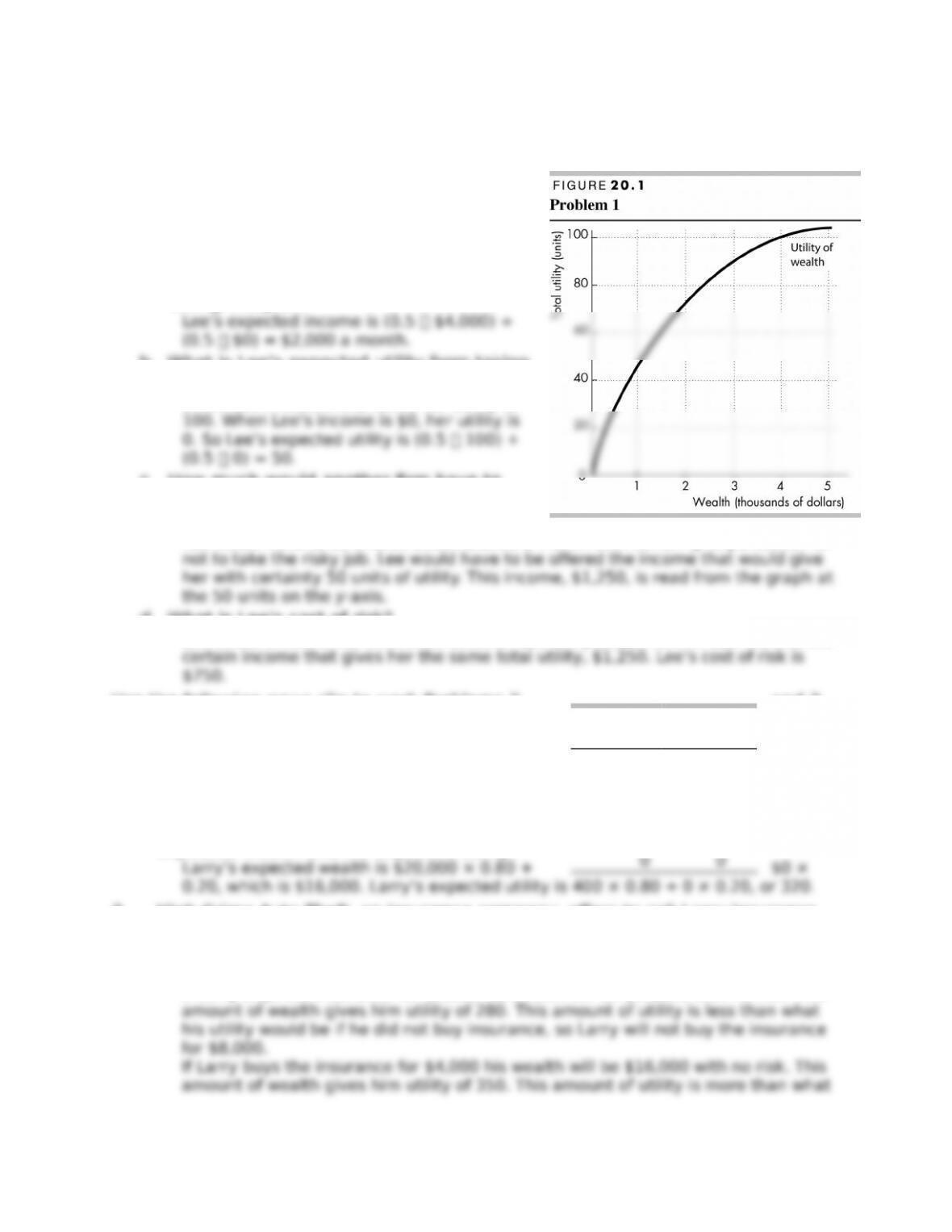
1. The 0gure shows Lee’s utility of wealth
curve. Lee is o%ered a job as a salesperson
in which there is a 50 percent chance that
she will make $4,000 a month and a 50
percent chance that she will make nothing.
a. What is Lee’s expected income from
taking this job?
b. What is Lee’s expected utility from taking
this job?
When Lee’s income is $4,000, her utility is
c. How much would another 0rm have to
o%er Lee with certainty to persuade her
not to take the risky sales job?
Lee would have to be o%ered about $1,250 a month with certainty to persuade her
d. What is Lee’s cost of risk?
Lee’s cost of risk is the di%erence between Lee’s expected income, $2,000, and the
Use the following news clip to work Problems 2 and 3.
Larry lives in a neighborhood in which 20 percent of the
cars are stolen every year. Larry’s car, which he parks
on the street overnight, is worth $20,000. (This is Larry’s
only wealth.) The table shows Larry’s utility of wealth
schedule.
2. If Larry cannot buy auto theft insurance, what is his
expected wealth and his expected utility?
3. High-Crime Auto Theft, an insurance company, o%ers to sell Larry insurance
at $8,000 a year and promises to provide Larry with a replacement car worth
$20,000 if his car is stolen. Is Larry willing to buy this insurance? If not, is he
willing to pay $4,000 a year for such insurance?
If Larry buys the insurance for $8,000 his wealth will be $12,000 with no risk. This
Wealth
(dollars)
Utility
(units)
20,000 400
16,000 350
12,000 280
8,000 200
4,000 110
0 0
4. Suppose that there are three national soccer leagues: Time League, Goal
Di%erence League, and Bonus for Win League. The leagues are of equal
quality, but the players are paid di%erently. Players in the Time League are
paid by the hour for time spent practicing and playing. Players in the Goal
Di%erence league are paid an amount that depends on the goals scored by
the team minus the goals scored against it. Players in the Bonus for Win
League are paid one wage for a loss, a higher wage for a tie, and the highest
wage of all for a win.
a. Describe the predicted di%erences in the quality of the games played by
each of the leagues.
In the Time League, players have no incentive to play hard or to win the game. In
this league the games are likely to be dull, drawn out, low quality a%airs with
players not playing particularly hard. In the Goal Di%erence League, the players
b. Which league is the most attractive to players?
c. Which league will generate the largest pro0ts?
If fans like action packed games and if the average salary is the same in all
5. You can’t buy insurance against the risk of being sold a lemon. Why isn’t
there such a market? How does the market provide a buyer with some
protection against being sold a lemon? What are the main ways in which
markets overcome the lemons problem?
There is not a market for “lemon insurance” for several reasons. De0ning a
“lemon” is far from clear cut. The de0nition would need to be speci0ed in the
contract. But that leads to a moral hazard problem because a buyer with a car
Even without insurance, the market does give protection against lemons.
Warranties are designed to help cope with the moral hazard and adverse selection
© 2016 Pearson Education, Inc.
8C H A P T E R 2 0
6. Show Us Our Money
I have no clue what my colleagues make and I consider my salary my own business. It
Source: Time, May 12, 2008
Explain why a worker might be willing to pay for the salary information of
other workers.
A worker could demand a higher salary by comparing his or her pay with that of a
Answers to Additional Problems and Applications
Use the table, which shows Jimmy’s and Zenda’s
utility of wealth schedules, to work Problems 7
to 9.
8. a. Calculate Jimmy’s and
Zenda’s marginal utility of
wealth schedules.
The table to the right sets
b. Who is more risk averse,
Jimmy or Zenda? How do
© 2016 Pearson Education, Inc.
Wealth
Jimmy’s
utility
Zenda’s
utility
Wealth
Jimmy’s
utility
Jimmy’s
margin
al utility
Zenda
’s
utility
Zenda
’s
margi
nal
0 0 0
2.00 5.12
U N C E RTA I N T Y A N D I N F O R M AT I O N 9
9. Suppose that Jimmy and Zenda each have $400 and are o%ered a business
investment opportunity that involves committing the entire $400 to the
project. The project could return $600 (a pro0t of $200) with a probability of
0.85 or $200 (a loss of $200) with a probability of 0.15. Who goes for the
project and who hangs on to the initial $400?
Jimmy puts his money into the project, but Zenda does not. Jimmy maximizes his
expected utility. If Jimmy puts his money into the project and it makes a pro0t, his
utility is 393; if Jimmy puts his money into the project and it fails, his utility is 300.
So Jimmy’s expected utility from the project is (0.85 393) + (0.15 300), which
© 2016 Pearson Education, Inc.
1 0 C H A P T E R 2 0
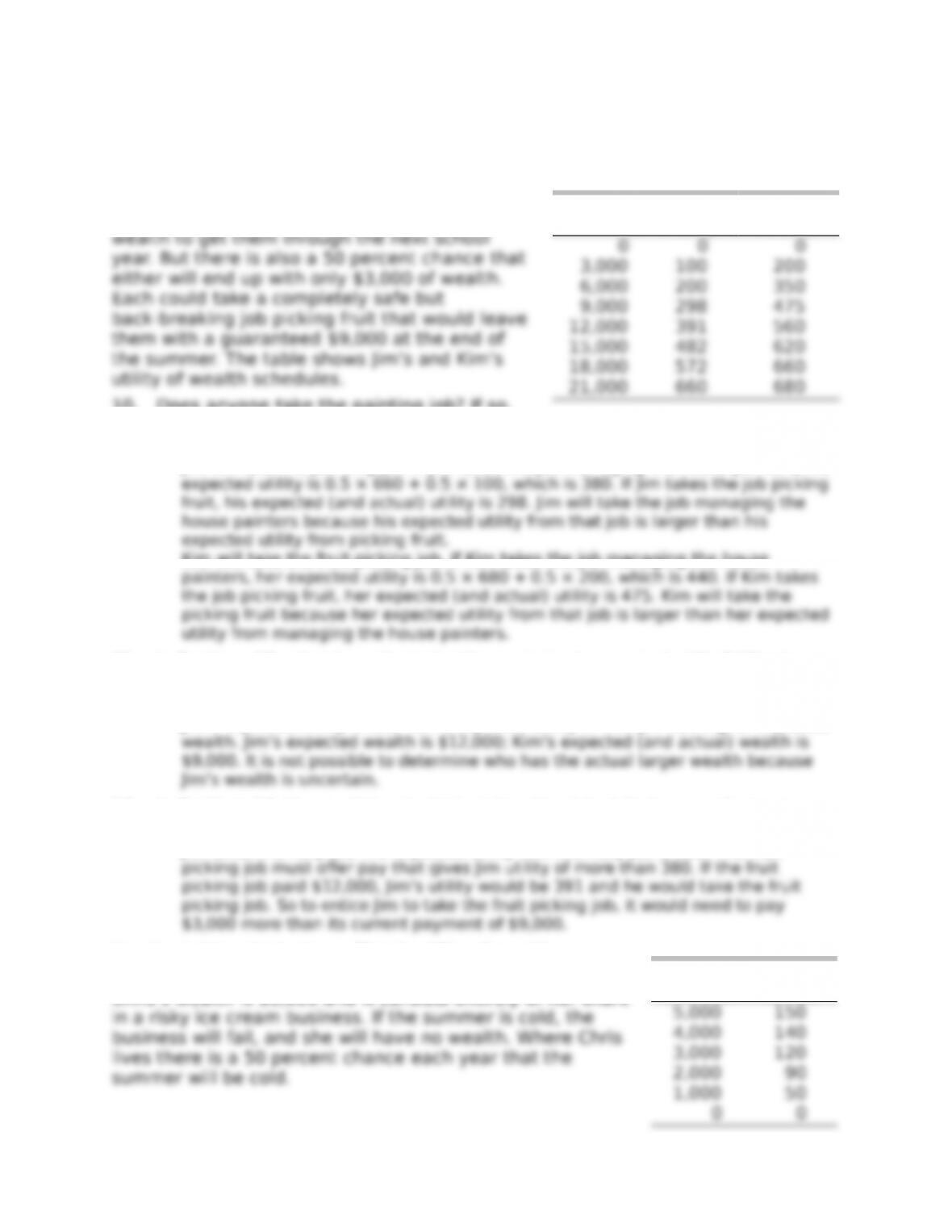
Use the following information to work Problems 10 to 12.
Two students, Jim and Kim, are o%ered summer jobs managing a student
house-painting business.
There is a 50 percent chance that either of them
will be successful and end up with $21,000 of
wealth to get them through the next school
10. Does anyone take the painting job? If so,
who takes it and why? Does anyone take the job picking fruit? If so, who takes
it and why?
Jim will take the painting job. If Jim takes the job managing the house painters, his
Kim will take the fruit-picking job. If Kim takes the job managing the house
11. In Problem 10, what is each student’s maximized expected utility? Who has
the larger expected wealth? Who ends up with the larger wealth at the end of
the summer?
Jim’s expected utility is 380; Kim’s expected utility is 475. Jim has higher expected
12. In Problem 10, if one of the students takes the risky job, how much more
would the fruit-picking job have needed to pay to attract that student?
Jim takes the risky job. His expected utility with the risky job is 380. The fruit
Use the table, which shows Chris’s utility of wealth
schedule, to work Problems 13 and 14.
Chris’s wealth is $5,000 and it consists entirely of her share
© 2016 Pearson Education, Inc.
Wealth Jim’s
utility
Kim’s
utility
Wealth
(dollars)
Utility
(units)
U N C E RTA I N T Y A N D I N F O R M AT I O N 1 1
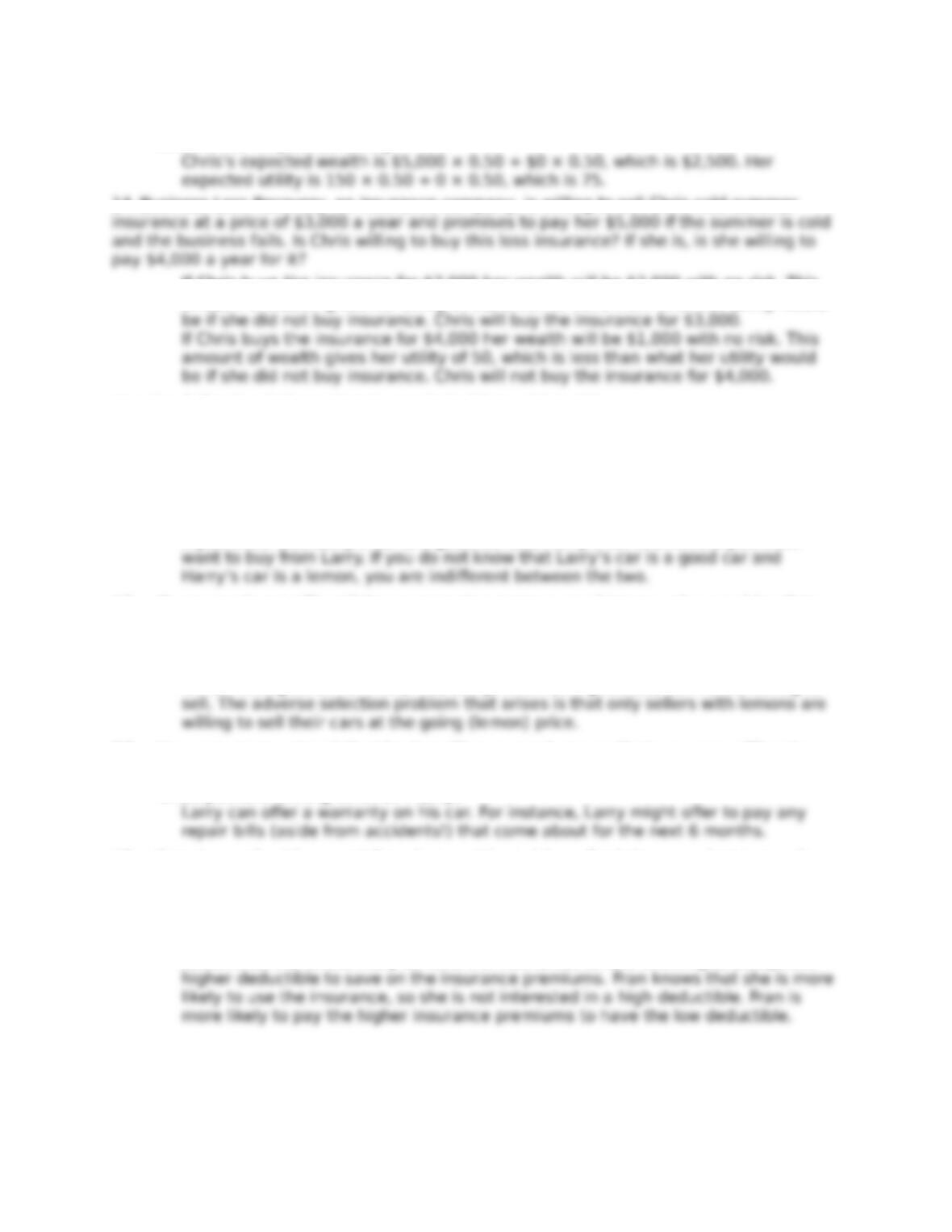
13. If Chris cannot buy cold-summer insurance, what is her expected wealth and
what is her expected utility?
14. Business Loss Recovery, an insurance company, is willing to sell Chris cold-summer
If Chris buys the insurance for $3,000 her wealth will be $2,000 with no risk. This
amount of wealth gives her utility of 90, which is more than what her utility would
Use the following information to work Problems 15 to 17.
Larry has a good car that he wants to sell; Harry has a lemon that he wants to sell.
Each knows what type of car he is selling. You are looking at used cars and plan to
buy one.
15. If both Larry and Harry are o%ering their cars for sale at the same price, from
whom would you most want to buy, Larry or Harry, and why?
If you know that Larry’s car is a good car and Harry’s car is a lemon, you most
16. If you made an o%er of the same price to Larry and Harry, who would sell to
you and why? Describe the adverse selection problem that arises if you o%er
the same price to Larry and Harry.
The price o%ered will be the price for which a lemon sells. Harry, who has a lemon,
will be willing to sell at that price; Larry, who has a good car, will not be willing to
17. How can Larry signal that he is selling a good car so that you are willing to
pay Larry the price that he knows his car is worth, and a higher price than
what you are willing to o%er Harry?
18. Pam is a safe driver and Fran is a reckless driver. Each knows what type of
driver she is, but no one else knows. What might an automobile insurance
company do to get Pam to signal that she is a safe driver so that it can o%er
her insurance at a lower premium than it o%ers to Fran?
One possibility is to o%er insurance with a higher deductible at a lower cost. Pam
knows that she is less likely to need the insurance, so she is willing to accept the
© 2016 Pearson Education, Inc.
1 2 C H A P T E R 2 0
19. Why do you think it is not possible to buy insurance against having to put up
with a low-paying, miserable job? Explain why a market in insurance of this
type would be valuable to workers but unpro0table for an insurance provider
and so would not work.
Insurance against a low-paying job is not available because of moral hazard and
adverse selection. In particular, the moral hazard exists that once someone
purchased this type of insurance, the person could then take a low-paying job that
Use the following news clip to work Problems 20 and 21.
Why We Worry About the Things We Shouldn’t … and Ignore the Things
We Should
We pride ourselves on being the only species that understands the concept of risk,
yet we have a confounding habit of worrying about mere possibilities while
ignoring probabilities, building barricades against perceived dangers while leaving
ourselves exposed to real ones: 20% of all adults still smoke; nearly 20% of drivers
and more than 30% of backseat passengers don’t use seat belts; two thirds of us
are overweight or obese. We dash across the street against the light and build our
homes in hurricane-prone areas—and when they’re demolished by a storm, we
rebuild in the same spot.
Source: Time, December 4, 2006
20. Explain how “worrying about mere possibilities while ignoring probabilities”
can result in people making decisions that not only fail to satisfy social
interest, but also fail to satisfy self-interest.
By “worrying about mere possibilities while ignoring probabilities,” society
sometimes devotes its scarce resources in ways that do not make people as well
o% as possible. In particular resources devoted to preventing mad cow pathogen
21. How can information be used to improve people’s decision making?
Information can improve people’s decision making by providing them with data
about the potential outcomes of their decisions. With this information readily at
Economics in the News
22. After you have studied Economics in the News on pp. 482–483, answer the
following questions.
a. What information do accurate grades provide that grade inUation hides?
Accurate grades provide valuable information about the student’s productivity and
the extent of the student’s skill base. High grades would be correlated with high
© 2016 Pearson Education, Inc.
U N C E RTA I N T Y A N D I N F O R M AT I O N 1 3
b. If grade inUation became widespread in high schools, colleges, and
universities, what new arrangements do you predict would emerge to
provide better information about student ability?
If grade inUation becomes too severe, a student’s class ranking, for instance, 23rd
c. Do you think grade inUation is in anyone’s self-interest? Explain who bene0ts
and how they bene0t from grade inUation.
The people who bene0t from grade inUation are the students who 0rst received
d. How do you think grade inUation might be controlled?
23. Are You Paid What You’re Worth?
How do you know if your pay adequately reUects your contributions to your
employer’s pro0ts? In many instances, you don’t. Your employer has more and
better information than you do about how your salary and bonus compare to
others in your 0eld, to others in your o>ce, and relative to the company’s
pro0ts in any given year. You can narrow the information gap a bit if you’re
willing to buy salary reports from compensation sources. For example, at
$200, a quick-call salary report from Economic Research Institute will o%er
you compensation data for your position based on your years of experience,
your industry and the place where your company is located.
Source: CNN, April 3, 2006
a. Explain the role that asymmetric information can play in worker wages.
Asymmetric information can lead to adverse selection and moral hazard, which
both play a role in determining workers’ wages. For instance, adverse selection
occurs if a 0rm o%ers to pay its salespeople a 0xed wage. The 0rm will attract
b. What adverse selection problem exists if a 0rm o%ers lower wages to
existing workers?
If a 0rm o%ers lower wages to its existing workers, the most productive workers will
c. What will determine how much a worker should actually pay for a detailed
salary report?
The bene0ts the worker expects to receive from the salary report will determine
how much he or she is willing to pay. For instance, if a worker believes that his or
© 2016 Pearson Education, Inc.
1 4 C H A P T E R 2 0
© 2016 Pearson Education, Inc.
U N C E RTA I N T Y A N D I N F O R M AT I O N 1 5