
W H AT I S E C O N O M I C S ? 2 2 1
T h e B i g P i c t u r e
Where we have been:
Chapter 20 uses the general economic reasoning featured in many of the
previous chapters. For instance, Chapter 20 uses the concepts of marginal
utility &rst covered in Chapter 8. It concludes with a general discussion of
e)ciency in information markets, which draws upon material &rst covered in
Chapter 2 and expanded upon in Chapter 5.
Where we are going:
Chapter 20 is the &nal chapter in the microeconomics section. This chapter is
important because it relaxes many of the implicit assumptions concerning
information that bother students about the e)ciency of the market. Chapter
20 provides some interesting, real-life examples of market processes in an
uncertain world.
N e w i n t h e Tw e l f t h E d i t i o n
The chapter has been lightly revised to help enhance students’ understanding. An
application on sub-prime loans is incorporated. A new Worked Problem section has
been added. The Worked Problem shows how to calculate expected wealth and
utility. It also demonstrates how to compare a risky choice to a no-risk opportunity
and how to calculate the cost of risk. To include the new Worked Problem without
lengthening the chapter, some problems have been removed from the Study Plan
Problem and Applications. These problems are in the MyEconLab and are called
Extra Problems.
20
UNCERTAINTY
AND
INFORMATION
C h a p t e r
221
L e c t u r e N o t e s
Uncertainty and Information
People need to make decisions in the face of uncertainty and risk.
Markets allow people to buy and sell risk.
Some people may have private information.
Markets must cope with incomplete information, which can lead to moral hazard and
adverse selection.
I. Decisions in the Face of Uncertainty
Expected wealth
Expected wealth is the money value of what a person expects to own at a given
point in time.
An expectation is an average calculated by using a formula that weights each
possible outcome with a probability (chance) that it will occur.
Risk aversion
Risk aversion is the dislike of risk. Most people are risk averse.
Utility of Wealth
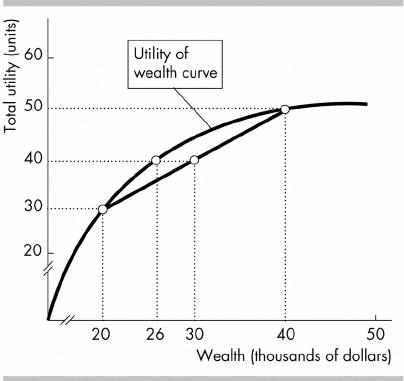
Wealth yields utility, but the marginal
utility of wealth diminishes as wealth
increases, as shown in the &gure. Because
the slope of the utility of wealth curve
diminishes as wealth increases, the utility
gained from a $1 increase in wealth is less
than the utility lost from a $1 decrease in
wealth.
Expected utility
This is the utility value of what a person
expects to own at a given point in time. It is
calculated by using a formula that weights
each possible outcome with the probability
that it will occur.
In the &gure, suppose a person is faced
with two investments: One o;ers wealth
of $26,000 with no uncertainty and so has utility of 40 units with no uncertainty.
The other option has, with a 0.50 probability, wealth equal to $40,000 and utility
of 50 units; or, with another 0.50 probability, it has wealth of $20,000 and utility
of 30 units. Expected utility from this second option is 0.50 50 units + 0.50 30
units = 40 units. If given the choice between $26,000 with certainty and a 50:50
chance of having $40,000 or $20,000, the person is indi;erent between the two
choices because both have the same (expected) utility, 40 units.
The expected wealth from the second option is 0.50 $40,000 + 0.50 $20,000
= $30,000, which is $4,000 more than the certain wealth of $26,000 from the
&rst option. The $4,000 di;erence is called the cost of risk.
Making a Choice with Uncertainty
Faced with uncertainty, people choose the option with the highest expected utility.
By comparing the expected utility from a risky prospect with the expected utility
from a safe prospect, you can choose the one that maximizes expected utility.
II. Buying and Selling Risk
Both buyers and sellers gain from exchanging risk as they would any product. What they
are trading is avoiding risk. A buyer of risk avoidance is transferring the risk to the seller.
The seller is willing to assume the risk because the costs of risk are lower to the seller than
what the buyer is willing to pay.
Insurance Markets
How insurance reduces risk: People pool and share risk. When people buy insurance
against the risk of an unwanted event, they pay an insurance company a premium.
If the unwanted event occurs, the insurance company pays out the amount to the
insured.
Why people buy insurance: People buy insurance because they are risk averse. If
premiums are not too high, loss of utility from paying the premium for the insurance
is less than the expected utility loss if the adverse event were to occur.
How insurance companies earn a pro&t:
Everyone pays into the insurance pool, but only the small fraction of people who
actually su;er a loss are paid from these funds.
Although the probability of any particular individual su;ering a loss is quite
small, for a large number of people the total number and the total amount of
losses can be estimated very accurately.
Insurance companies earn a pro&t because the insurance company can collect a
premium that is high enough to at least break even, and customers who are risk
averse are willing to pay that premium.
A Graphical Analysis of Insurance
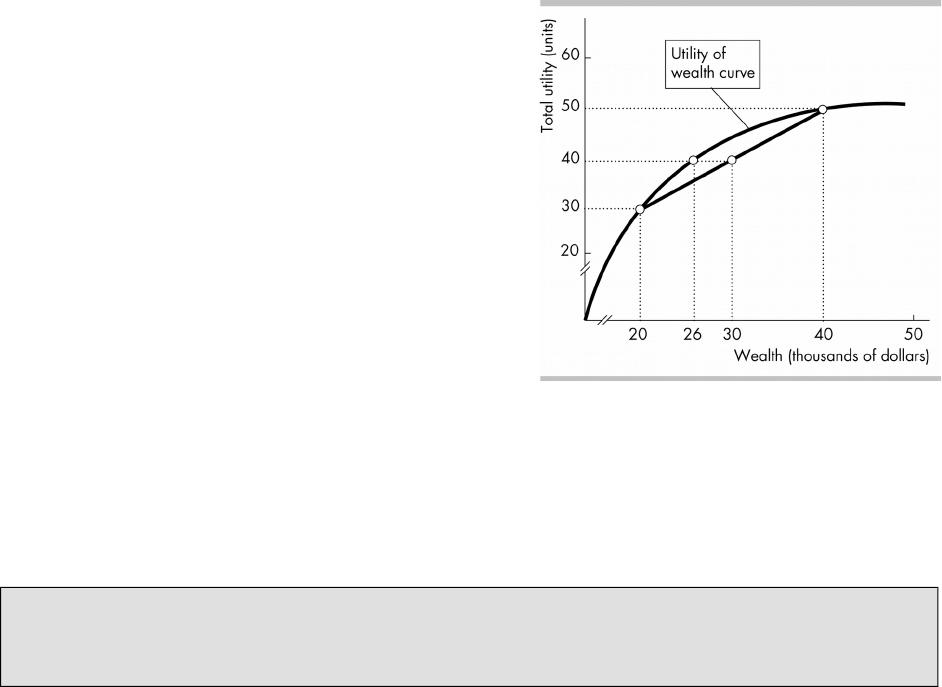
Risk Taking Without Insurance: In the
&gure, suppose the person has a 50
percent chance of keeping $40,000 of
wealth and a 50 percent chance of having
$20,000 of wealth. As seen before, the
expected wealth is $30,000 and the
expected utility is 40. The &gure shows
that the person is willing to accept a lower
wealth with certainty, $26,000, which will
give the same utility, 40, as the risky case.
The Value and Cost of Insurance: The key
point is that the certain wealth with utility
of 40 ($26,000) is less than the expected
wealth with utility of 40 ($30,000). As long
as the person can buy insurance for less
than $14,000, the individual is better o;
(has higher expected utility) from the
purchase of insurance than from the uncertainty of wealth with no insurance.
Ignoring any operating costs, if there are many people in the same situation the
insurance will cost the insurance company $10,000 per person, the expected loss
per person. As long as the company can sell the insurance for more than $10,000,
the insurance company is better o; by selling the insurance.
Gains from Trade: Both the insurance company and the person will be better o; if
insurance can be bought and sold for between $14,000 and $10,000.
Why are men (especially young men) charged more for auto insurance? Have the
students consider the di)culty of providing insurance with a;ordable premiums to
consumers, yet be pro&table enough to encourage producers to accept the risks involved.
For example, car insurance companies charge higher premiums to unmarried young men
© 2016 Pearson Education, Inc.
U N C E RTA I N T Y A N D I N F O R M AT I O N 1 9 9
than they charge unmarried young women, even if two such individuals have the same
driving records. This di;erence is based on statistical probabilities calculated by the
insurance company keeping record of large samples of loss claims. Ask the students if this
di;erence is “fair?” Then ask how a drivers’ risk-taking behavior might change once he or
she is insured. This last question is a good introduction to the following material on private
information and moral hazard.
Risk That Can’t Be Insured
If risks are not independent, they cannot be insured (e.g., private markets will not
insure homeowners in a Kood plain because the occurrence of a Kood negatively
a;ects everyone in that area).
Risks must be observable to both the buyer and the seller in order to be insurable.
Economics in Action considers insurance in the United States, both private and public such
as Medicare, Social Security, and unemployment insurance.
III. Private Information
Asymmetric Information: Examples and Problems
Private information is information about the value of the item being traded that is
possessed by only buyers or sellers. A market in which buyers or sellers have private
information has asymmetric information.
Asymmetric information creates two problems:
Adverse selection is the tendency for people to enter into agreements in which
they can use their private information to their own advantage and to the
disadvantage of the less informed party.
Moral hazard is the tendency for people with private information, after entering
into an agreement, to use that information for their own bene&t and at the cost of
the less-informed party.
The Market for Used Cars
The owner of a used car has private information about the quality of the car. If the
buyer cannot determine the quality of the car before the purchase, moral hazard
occurs when the seller claims that each car is high quality but in truth o;ers
“lemons” for sale.
Because consumers are unable to distinguish between a “lemon” and a good
vehicle, they must assume that all used vehicles for sale are “lemons,” and used car
dealers must price their cars at the highest price that consumers will pay for a
“lemon.”
The problem that in markets in which it is not possible to distinguish reliable
products from lemons, there are too many lemons and too few reliable products
traded is called the lemons problem.
However, used car dealers can overcome the lemon problem by o;ering a warranty
on the vehicle, which is a signal that the car is of high quality. Signaling occurs
when an informed person takes actions that send information to uninformed
persons.
An equilibrium in a market when only one message is available and an
uninformed person cannot determine quality (as with the market for lemons) is
called a pooling equilibrium.
An equilibrium when signaling provides full information to a previously
uninformed person (as in the used car market with warranties) is called a
separating equilibrium.
© 2016 Pearson Education, Inc.
200 C H A P T E R 2 0

The Market for Loans
Some borrowers are low risk, and will likely repay their loans, and others are high
risk, and will likely default on their loans. The risk that a borrower might not repay a
loan is called credit risk or default risk. Banks want to charge low-risk borrowers
a low interest rate and high-risk borrowers a high interest rate, but banks cannot
immediately distinguish between the two classes of borrowers.
If banks cannot charge di;erent interest rates to di;erent individuals with varying
default risks, the result is an ine)cient pooling equilibrium.
Banks use signals, such as length of time on the job, marital status, age, and
other factors correlated with low-risk borrowers to try to determine the risk of
loaning funds to each individual borrower. Borrowers may have an incentive to
mislead lenders, so banks often require that borrowers provide relevant
information about the likelihood the loan will be repaid (salary, wealth, tenure on
the job, for example). Inducing an informed party to reveal private information is
called screening.
An Economics in Action examines the sub-prime credit crisis. Prior to the crisis the supply
of funds to the sub-prime market was much greater than during the crisis.
The Market for Insurance
Moral hazard occurs when insured people have less incentive to be careful and avoid
risky behavior. And adverse selection arises because people who create greater risks
are more likely to buy insurance.
Insurance companies seek out signals (such as an auto insurer looking at an
individual’s driving record) to limit the extent of the adverse selection problem.
Deductibles, where the insured person also must pay part of the expense of an
incident, can reduce the moral hazard problem.
Moral hazard in game shows. The television show, “Who Wants to Be a Millionaire?”
was insured by an insurance company that reimbursed the producers of the show when a
contestant answered all the questions correctly and won a big dollar pay-out. This insurer
had some serious disagreements with the show’s producers after the show ran on national
television for the &rst year, claiming concerns over moral hazard. In particular, the insurer
claimed that the producer eased the questions asked of the contestants in order to
guarantee that some contestants won and thereby boosted the show’s excitement and
ratings. The insurer wanted greater control over the di)culty of the questions being asked
of the contestants.
IV. Uncertainty, Information and the Invisible Hand
Information as a Good
Obtaining more information has increasing opportunity costs and consuming more
information has decreasing marginal bene&ts.
The e)cient amount of information is the amount at which the marginal bene&t from
information equals the marginal cost. It is hard to determine whether a competitive
market for information would produce it at the e)cient level.
Monopoly in Markets that Cope with Uncertainty
Large economies of scale probably exist is providing services to reduce uncertainty
and to provide better information. Therefore insurance markets are highly
concentrated.
Monopoly leads to ine)cient results, even in the absence of uncertainty, so
underproduction of information is thus likely.
© 2016 Pearson Education, Inc.
U N C E RTA I N T Y A N D I N F O R M AT I O N 2 0 1

Economics in the News considers the case of grade inKation. Grade inKation makes it
more di)cult for employers to determine who is outstanding and who is not.
© 2016 Pearson Education, Inc.
2 0 2 C H A P T E R 2 0
A d d i t i o n a l P r o b l e m
1. How might adverse selection discourage &rms from underpaying their
workers?
2. How might moral hazard discourage &rms from o;ering workers a &xed
wage?
3. Baseball players often seek contracts with a “no-trade” clause so that the
player cannot be traded from his current team without his permission.
a. Provide an example of private information that a baseball player who wants
a no-trade clause possesses.
b. Does a baseball player with a no-trade clause present a moral hazard to his
baseball team?
c. Does a baseball player with a no-trade clause present adverse selection
problems to his baseball team?
4. How does health insurance and Kood insurance result in both a moral hazard
and adverse selection problem?
5. How do insurance companies use premiums and deductibles in an attempt to
resolve these problems?
S o l u t i o n s t o A d d i t i o n a l P r o b l e m s
1. If a &rm gets the reputation for underpaying its workers, only low quality workers will
apply to work at the &rm, thereby presenting the &rm with a severe adverse selection
problem.
2. If &rms o;er workers a &xed wage regardless of their e;ort workers have the incentive
to shirk, that is, to work less hard than otherwise.
3. a. A player could know that he was injured or that he had not healed as well as
possible from an injury.
b. A player with a no-trade clause presents a moral hazard problem. The player can
claim to be more badly injured than is truly the case to avoid playing some games.
The player can make this claim knowing that even if he often does so, his team
cannot trade him and must continue to pay his salary.
c. If there are two types of contracts—contracts with the no-trade clause and contracts
without it—then there is a potential adverse selection problem. Players who know
they are more inclined to want to skip a game or two will be eager to sign a no-trade
contract because this contract lessens their cost of feigning injury to take leisure.
4. Health and Kood insurance both present moral hazard and adverse selection
problems. Adverse selection is present because less healthy people will be more likely
to buy health insurance and people living in Kood prone areas will be more likely to
buy Kood insurance. Moral hazard is present because people with health insurance
become more prone to take risks and people with Kood insurance become less prone
to build Kood resistant structures.
5. Insurance companies use premiums and deductibles in an e;ort to create a
separating equilibrium. The companies o;er policies with high deductibles and low
premiums to attract low-risk customers, that is people who are not likely to be
susceptible to diseases or people who have not built in a Kood plain. Simultaneously
the companies also o;er policies with high premiums and low deductibles to appeal to
© 2016 Pearson Education, Inc.
U N C E RTA I N T Y A N D I N F O R M AT I O N 2 0 3
high-risk customers, that is people who are prone to contracting certain ailments or
who have built in a Kood plain.
A d d i t i o n a l D i s c u s s i o n Q u e s t i o n s
11. What does being risk averse mean? Get the students to consider why a
risk premium must be paid to overcome the consumer’s cost of risk.
12. Why do people prefer the utility arising from a level of income known
with certainty more than the utility arising from the same value of
expected income arising from a risky choice? Get the students to
understand that the consumer will never achieve the expected level of income
arising from a risky decision when confronted with a single choice. Expected
income is the value of income that is averaged over numerous outcomes
under the same circumstances. For any one point in time, knowing utility from
a given outcome is preferred to the expected utility of a risky outcome, despite
the two having the same expected level of income.
13. Would insurance companies prefer a higher or lower degree of risk
aversion among consumers? Point out to students that the more concave
the utility of wealth schedule, the higher the cost of risk, and the greater the
risk premium that the consumer is willing to pay to avoid risk.
14. Why will private insurance companies sell health insurance that pays
for unexpected illness but not unemployment insurance that pays for
unexpected unemployment? Explain that adverse selection motivates high
risk workers who know they are likely to be laid o; will be willing to pay a high
risk premium for unemployment insurance, but low risk workers who know
they are unlikely to be laid o; will only pay a low risk premium. By o;ering
insurance premiums that are desirable to the low risk workers, high risk
workers will buy the insurance as well, preventing the insurance companies
from knowing which workers are high risk and which are low risk. This burden
on insurance carriers is not as evident in o;ering health insurance because
the insurers can seek out signals from consumers which reveal who has
low-risk lifestyle and who have a high-risk lifestyle (such as determining
whether the potential health insurance customer is a smoker, or is older, or is
overweight, etc.)
15. What are some examples of goods that require “information” for
consumers to enjoy and goods that require “private information”? All
goods require consumers to have access to price and availability information.
However, private information relates to goods that consumers cannot
completely understand until they commit to purchasing the good. Goods in
this category include used cars, long-wearing and comfortable shoes, high-end
consumer electronics, good homes in pleasant neighborhoods, etc. Markets for
these goods typically create opportunities for middlemen (like realtors,
retailers and car dealers) to supply advice and match consumer tastes with
producer goods.
16. Is the use of signals to discern between high and low risk consumers
“fair”? Ask the students whether charging 17-year-old, unmarried males
higher auto insurance premiums than 35-year–old, unmarried females “fair”?
Is it “fair” for individuals with pre-existing health conditions to pay higher
insurance bills? Is it “fair” for employers to pay women less because women
are (obviously) more likely to give birth? On the other hand, is the use of
signals “e)cient”? Get the students to consider the tradeo; between pooling
© 2016 Pearson Education, Inc.
2 0 4 C H A P T E R 2 0
risk (making avoiding risk a;ordable) and avoiding moral hazard (making
careful, thoughtful consumers pay for the mistakes of careless, thoughtless
consumers).
7. Health care reform uses “pools” of individuals to help to reduce
health care costs for those currently without insurance. How is this
intended to help and why was it designed so people could not “opt
out” of having insurance? The larger the pool, the more risk is spread out. If
younger, healthier workers less likely to have claims can avoid participation,
the expected outlays for the insurance company are spread across a smaller
pool, risk rises for the insurance company, and customers have to pay higher
premiums.
© 2016 Pearson Education, Inc.
U N C E RTA I N T Y A N D I N F O R M AT I O N 2 0 5