Answers to Additional Problems and Applications
Use the table to work Problems 11 and 12. Suppose
that Yucatan’s production possibilities are given in
the table.
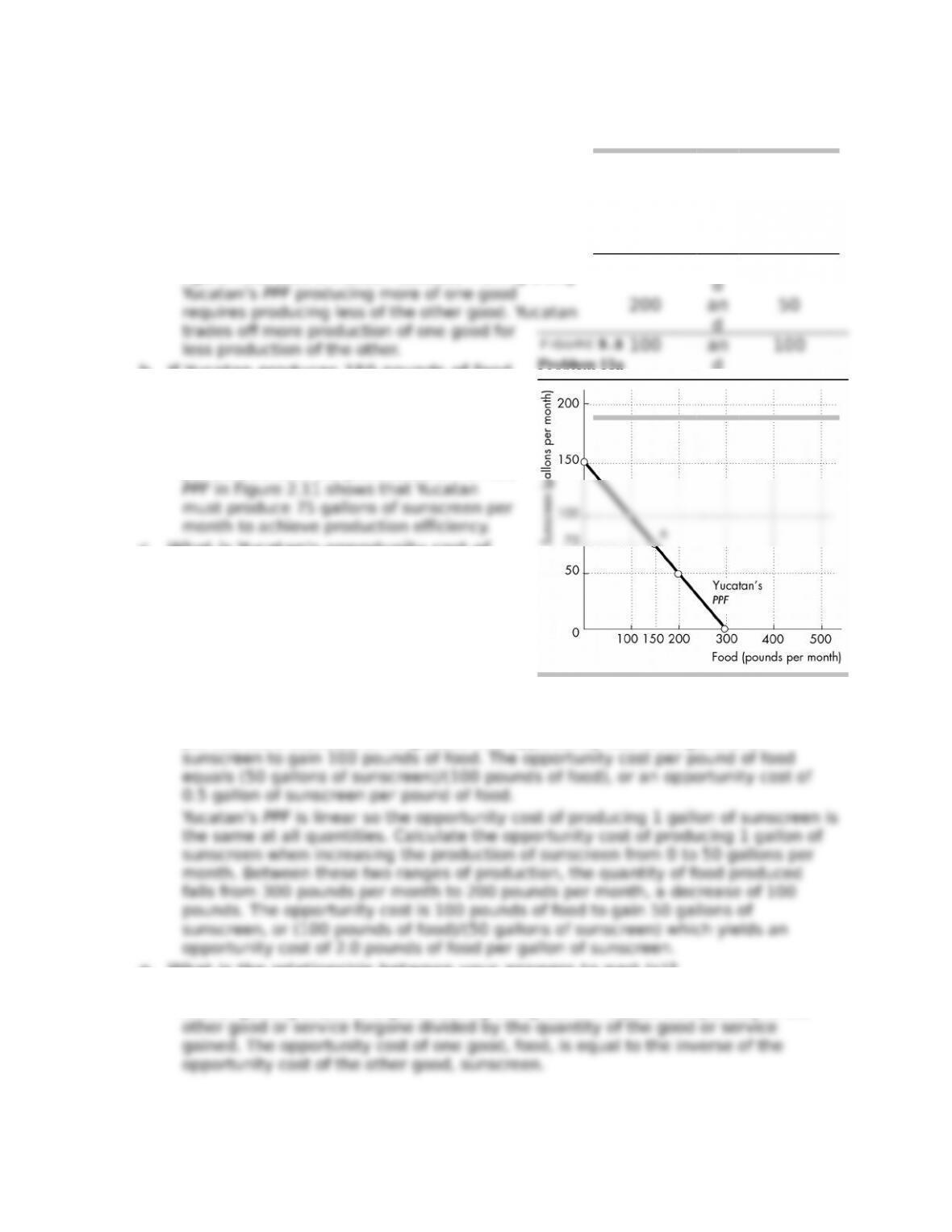
11.a. Draw a graph of Yucatan’s PPF and explain
how your graph illustrates a tradeo”.
Yucatan’s PPF is illustrated in Figure 2.3. The
&gure illustrates a tradeo” because moving along
b. If Yucatan produces 150 pounds of food
per month, how much sunscreen must it
produce if it achieves production
e,ciency?
If Yucatan produces 150 pounds of food
per month, then the point labeled A on the
c. What is Yucatan’s opportunity cost of
producing (i) 1 pound of food and (ii) 1
gallon of sunscreen?
Yucatan’s PPF is linear so the opportunity
cost of producing 1 pound of food is the
same at all quantities. Calculate the
opportunity cost of producing 1 pound of
food when increasing the production of
food from 0 to 100 pounds per month. Between these two ranges of production, the
quantity of sunscreen produced falls from 150 gallons per month to 100 gallons
per month, a decrease of 50 gallons. The opportunity cost is 50 gallons of
e. What is the relationship between your answers to part (c)?
Answers (c) and (d) re6ect the fact that opportunity cost is a ratio. The opportunity
cost of gaining a unit of a good moving along the PPF equals the quantity of the
© 2016 Pearson Education, Inc.
Food
(pounds
per
month)
Sunscree
n
(gallons
per
month)
300 an
d
0
d
0 an
d
150
T H E E C O N O M I C P R O B L E M 1 9
12. What feature of a PPF illustrates increasing opportunity cost? Explain why
Yucatan’s opportunity cost does or does not increase.
If opportunity costs increase, the PPF bows outward. Yucatan’s PPF is linear and
along a linear PPF the opportunity cost is constant. Yucatan does not face an
13. In problem 11, what is the marginal cost of 1 pound of food in Yucatan when
the quantity produced is 150 pounds per day? What is special about the
marginal cost of food in Yucatan?
The marginal cost of a pound of food in Yucatan is constant at all points along
Yucatan’s PPF and is equal to 0.5 gallons of sunscreen per pound of food. The
14. The table describes the preferences in
Yucatan.
a. What is the marginal bene&t from sunscreen
and how is it measured?
The marginal bene&t from sunscreen is the
bene&t enjoyed by the person who consumes
b. Use the table in Problem 11. What does Yucatan produce to achieve
allocative e,ciency?
To achieve allocative e,ciency, the marginal bene&t of a gallon of sunscreen must
equal the marginal cost of a gallon of sunscreen. Yucatan’s marginal cost of a
15. U.K. Music Stores Squeezed o Main Street
Music retailing is changing: Sony Music and Amazon are selling online,
discount stores are selling at low prices, and Main Street music retailers are
all struggling.
Source: The Economist, 20 January 2007
a. Draw the PPF curves for Main Street
music retailers and online music
retailers before and after the Internet
became available.
Before there was an Internet, there
were no online retailers and the
© 2016 Pearson Education, Inc.
Sunscreen
(gallons
per month)
Willingness to
pay
(pounds of
food per
gallon)
25 3
2 0 C H A P T E R 2

© 2016 Pearson Education, Inc.
T H E E C O N O M I C P R O B L E M 2 1
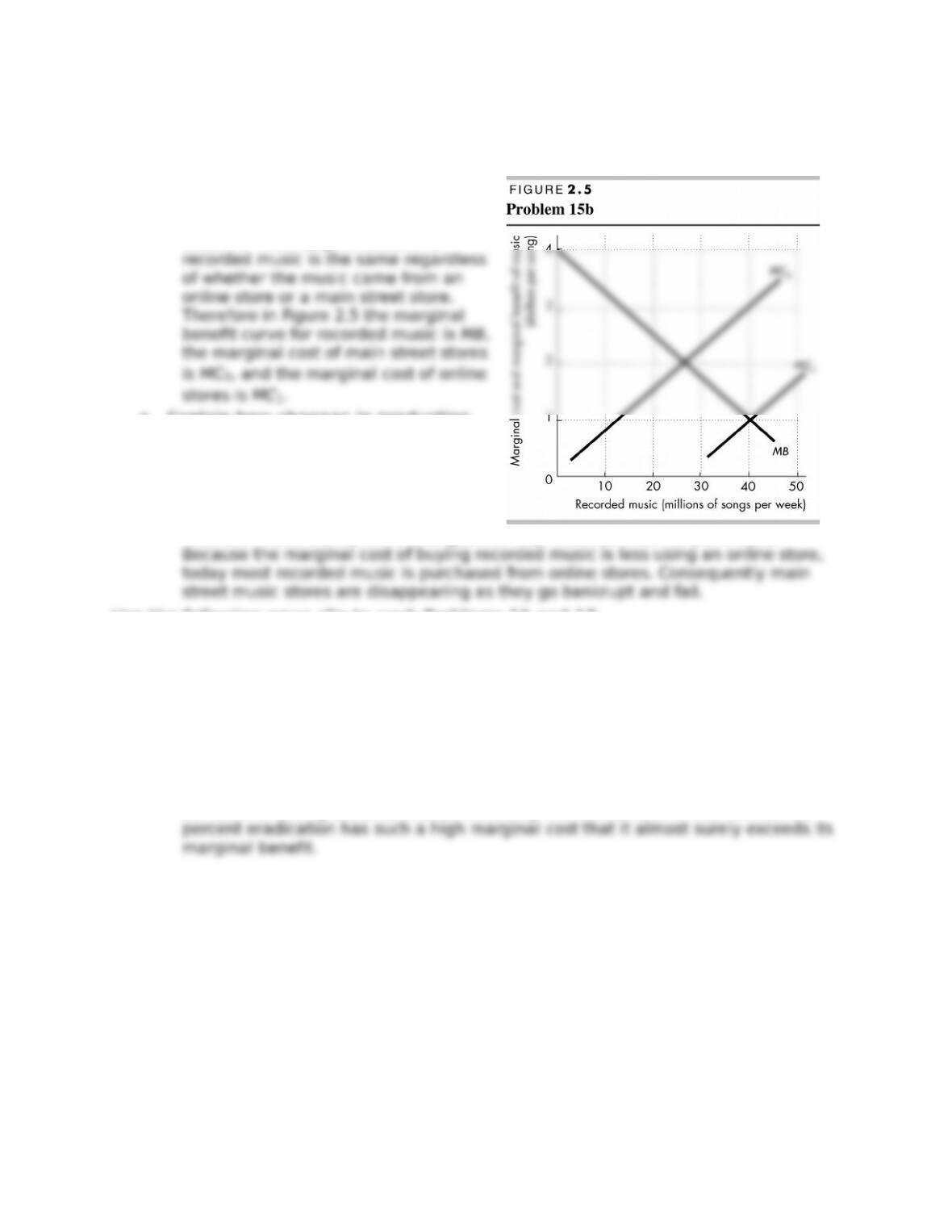
b. Draw the marginal cost and marginal bene&t curves for Main Street music
retailers and online music retailers before and after the Internet became
available.
Online music retailers have a lower
marginal cost of delivering recorded
music than do main street music
retailers. The marginal bene&t for
c. Explain how changes in production
possibilities, preferences or both
have changed the way in which
recorded music is retailed.
The change in production possibilities,
which created lower-cost online
recorded music stores, have changed the way recorded music is purchased.
Use the following news clip to work Problems 16 and 17.
Malaria Eradication Back on the Table
In response to the Gates Malaria Forum in October 2007, countries are debating
the pros and cons of eradication. Dr. Arata Kochi of the World Health Organization
believes that with enough money malaria cases could be cut by 90 percent, but it
would be very expensive to eliminate the remaining10 percent of cases, so
countries should not strive to eradicate malaria.
Source: The New York Times, March 4, 2008
16. Is Dr. Kochi talking about production eciency or allocative eciency or both?
Dr. Kochi is talking about allocative e,ciency. His assessment is that the last 10
© 2016 Pearson Education, Inc.
2 2 C H A P T E R 2
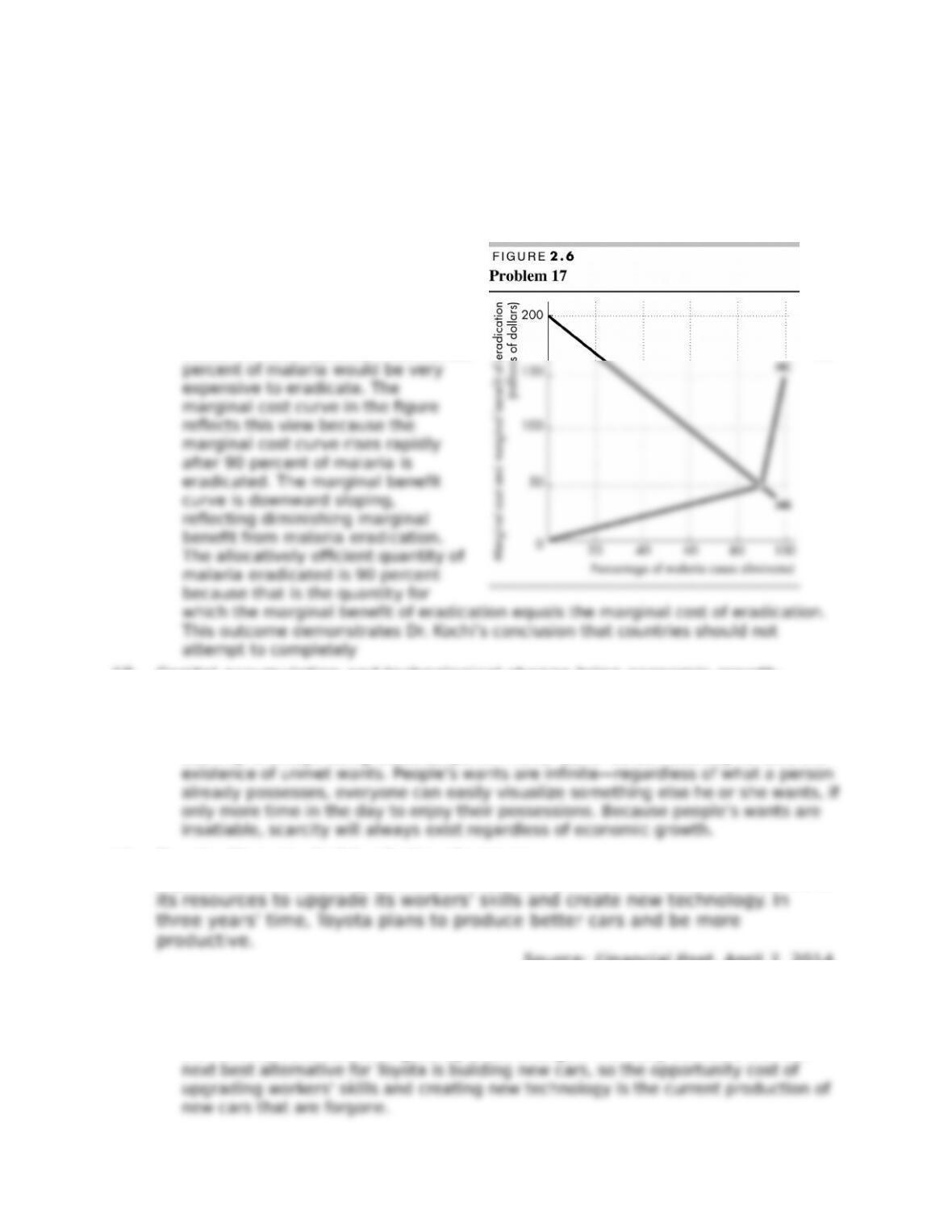
17. Make a graph with the percentage of malaria cases eliminated on the x-axis
and the marginal cost and marginal bene&t of driving down malaria cases on
the y-axis. On your graph:
(i) Draw a marginal cost curve and marginal bene&t curve that are
consistent with Dr. Kochi’s opinion.
(ii) Identify the quantity of
malaria eradicated that
achieves allocative e,ciency.
Figure 2.6 shows a marginal cost
curve and a marginal bene&t curve
that are consistent with Dr. Kochi’s
views. Dr. Kochi believes that the last 10
18. Capital accumulation and technological change bring economic growth:
Production that was unattainable yesterday becomes attainable today;
production that is unattainable today will become attainable tomorrow. Why
doesn’t economic growth bring an end to scarcity one day?
Scarcity is always being defeated yet will never su”er defeat. Scarcity re6ects the
19. Toyota Plans to Build a Better Company
Toyota will continue to produce 3 million cars per year and use the balance of
Source: Financial Post, April 7, 2014
a. What is the opportunity cost of upgrading its workers’ skills and creating
new technology?
The opportunity cost of upgrading workers’ skills and creating new technology is
the next best alternative forgone by these changes. The story indicates that the
© 2016 Pearson Education, Inc.
T H E E C O N O M I C P R O B L E M 2 3
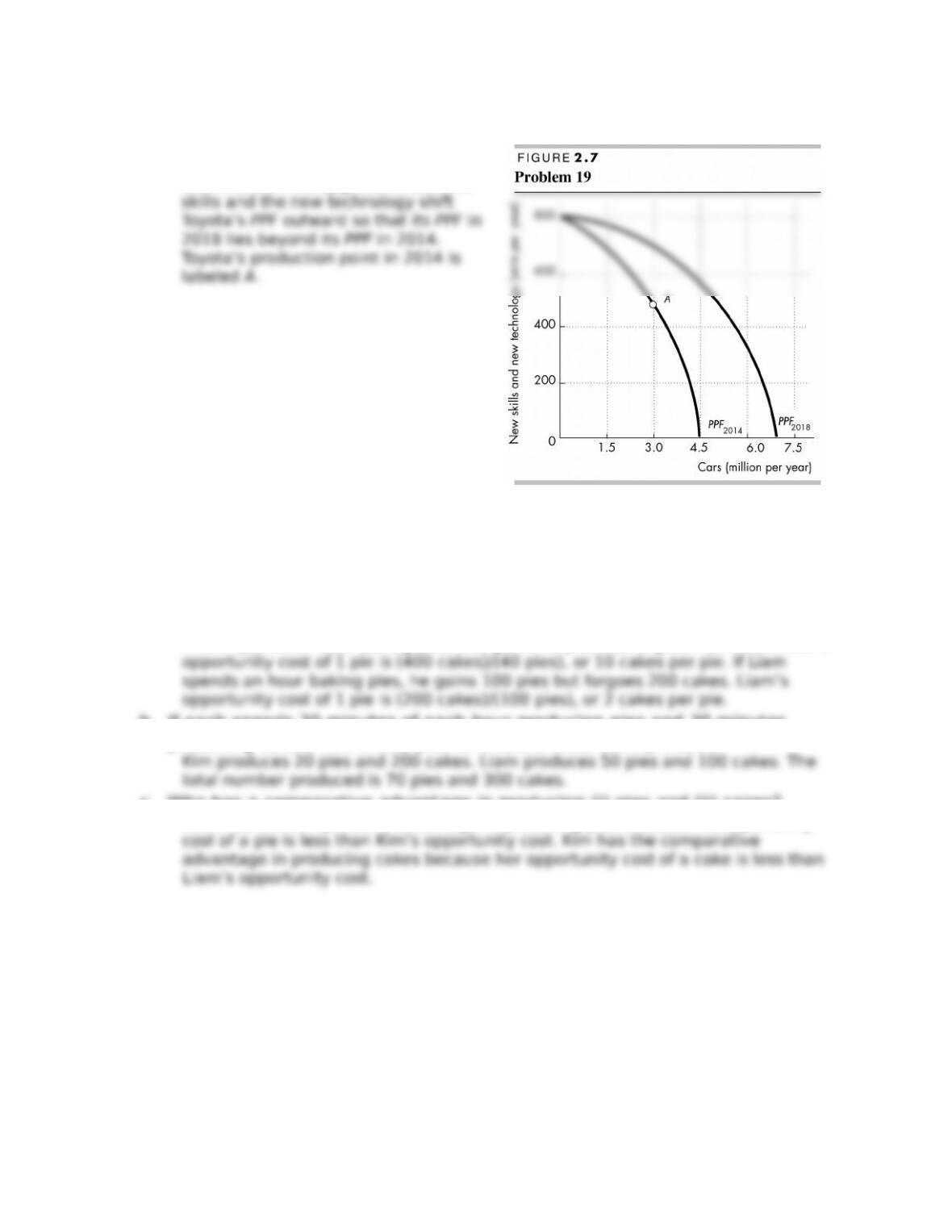
b. Sketch Toyota’s PPF and mark its production point in 2014. Now show on
your graph Toyota’s PPF in 2018.
Figure 2.7 shows Toyota’s PPF in 2014
and in 2018. The upgrade in workers’
Use the following data to work Problems 20 and 21.
Kim can produce 40 pies or 400 cakes an hour. Liam can produce 100 pies or 200
cakes an hour.
20.a. Calculate Kim’s opportunity cost of a pie and Liam’s opportunity cost of a
pie.
If Kim spends an hour baking pies, she gains 40 pies but forgoes 400 cakes. Kim’s
b. If each spends 30 minutes of each hour producing pies and 30 minutes
producing cakes, how many pies and cakes does each produce?
c. Who has a comparative advantage in producing (i) pies and (ii) cakes?
Liam has the comparative advantage in producing pies because his opportunity
© 2016 Pearson Education, Inc.
2 4 C H A P T E R 2
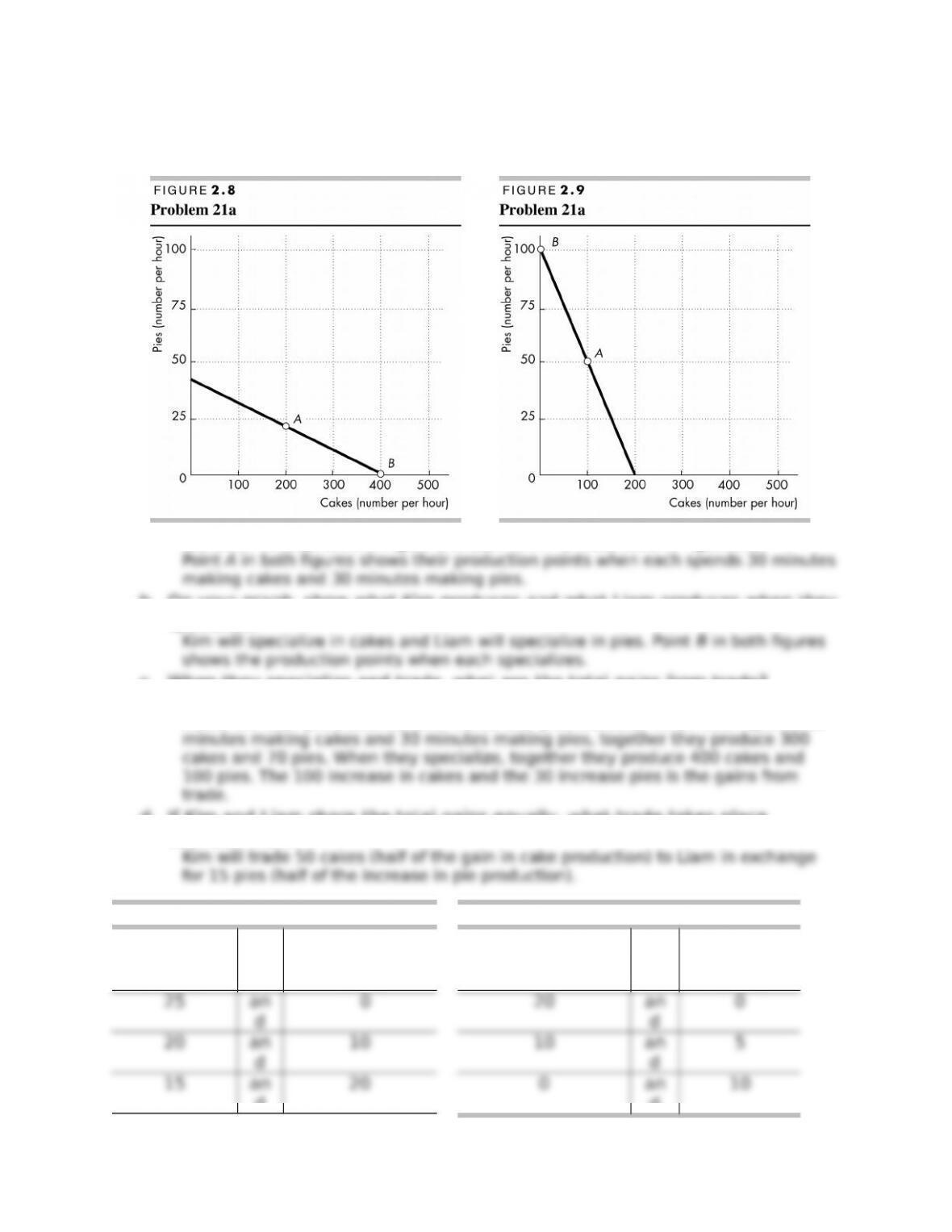
21.a Draw a graph of Kim’s PPF and Liam’s PPF and show the point at which each
produces when they spend 30 minutes of each hour producing pies and 30
minutes producing cakes.
Kim’s PPF is illustrated in Figure 2.8; Liam’s PPF is illustrated in Figure 2.9.
b. On your graph, show what Kim produces and what Liam produces when they
specialize.
c. When they specialize and trade, what are the total gains from trade?
Kim will specialize in cakes and Liam will specialize in pies. If they specialize and
trade, the total production of both cakes and pies increase. When each spends 30
d. If Kim and Liam share the total gains equally, what trade takes place
between them?
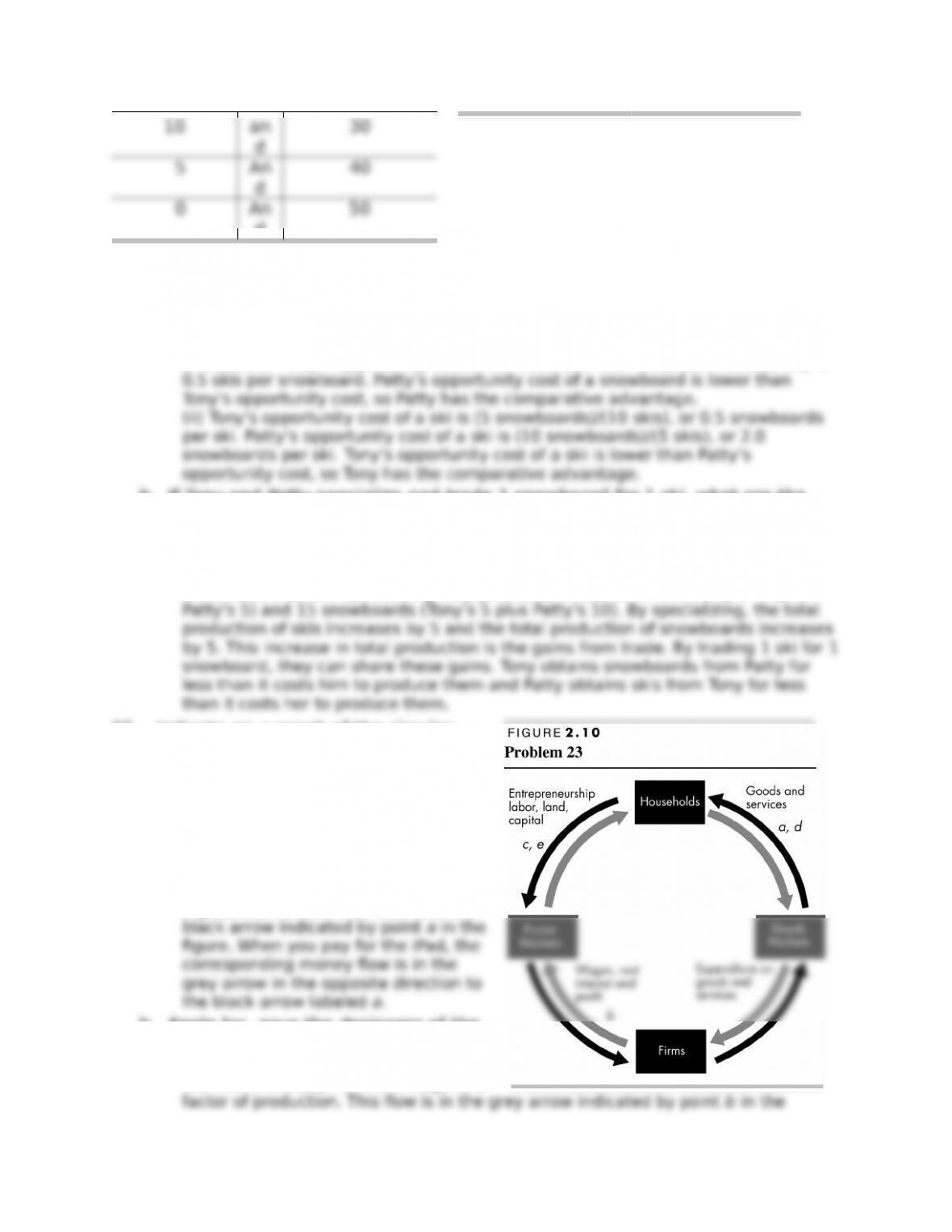
Tony’s Production Possibilities Patty’s Production Possibilities
Snowboards
(units per
week)
Skis
(units per
week)
Snowboards
(units per week)
Skis
(units per
week)
d
d
© 2016 Pearson Education, Inc.
T H E E C O N O M I C P R O B L E M 2 5
d
22. Tony and Patty produce skis and snowboards. The tables show their
production possibilities. Tony produces 5 snowboards and 40 skis a week;
Patty produces 10 snowboards and 5 skis a week.
a. Who has a comparative advantage in producing (i) snowboards and (ii) skis?
(i) Tony’s opportunity cost of a snowboard is (10 skis)/(5 snowboards), or 2 skis per
snowboard. Patty’s opportunity cost of a snowboard is (5 skis)/(10 snowboards), or
b. If Tony and Patty specialize and trade 1 snowboard for 1 ski, what are the
gains from trade?
Tony has a comparative advantage in producing skis, so he specializes in
producing skis. Patty has a comparative advantage in producing snowboards, so
she specializes in snowboards. Tony now produces 50 skis and Patty produces 20
snowboards. Before specializing they produced a total of 45 skis (Tony’s 40 plus
23. Indicate on a graph of the circular
6ows in the market economy, the real
and money 6ows in which the
following items belong:
a. You buy an iPad from the Apple
Store.
Figure 2.10 shows the circular 6ows in
a market economy. Your purchase of
an iPad from Apple is the purchase of
a good from a &rm. This 6ow is in the
b. Apple Inc. pays the designers of the
iPad.
Apple’s payment to the designers of
the iPad is the payment of a wage to a
© 2016 Pearson Education, Inc.
2 6 C H A P T E R 2
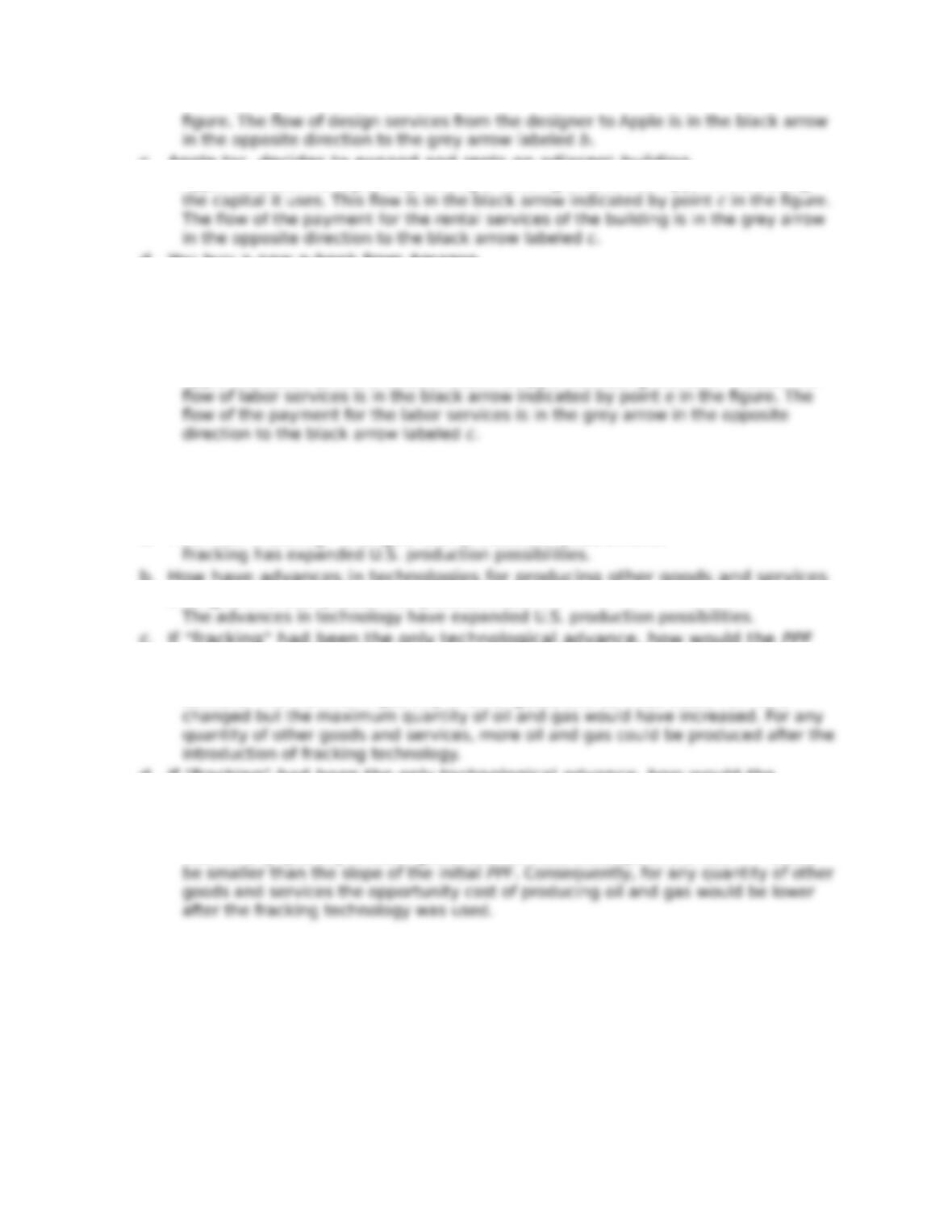
c. Apple Inc. decides to expand and rents an adjacent building.
Apple’s decision to expand by renting a building means that Apple is increasing
d. You buy a new e-book from Amazon.
Your purchase of an e-book from Amazon is the purchase of a good from a &rm.
This 6ow is in the black arrow indicated by point d in the &gure. When you pay for
the e-book, the corresponding money 6ow is in the grey arrow in the opposite
direction to the black arrow labeled d.
e. Apple Inc. hires a student as an intern during the summer.
Apple’s decision to hire a student intern is Apple increasing the labor it uses. The
Economics in the News
24. After you have studied Reading Between the Lines on pp. 46–47, answer the
following questions.
a. How has “fracking” changed U.S. production possibilities?
b. How have advances in technologies for producing other goods and services
changed the U.S. production possibilities?
c. If “fracking” had been the only technological advance, how would the PPF
have changed?
If fracking had been the only technological advance, the PPF would have rotated
outward. The maximum quantity of other goods and services would not have
d. If “fracking” had been the only technological advance, how would the
opportunity cost of producing oil and gas have changed? Would it have been
lower or higher than it actually was?
If fracking had been the only technological advance, the PPF would have rotated so
that for any quantity of other goods and services the slope of the new PPF would
© 2016 Pearson Education, Inc.
T H E E C O N O M I C P R O B L E M 2 7
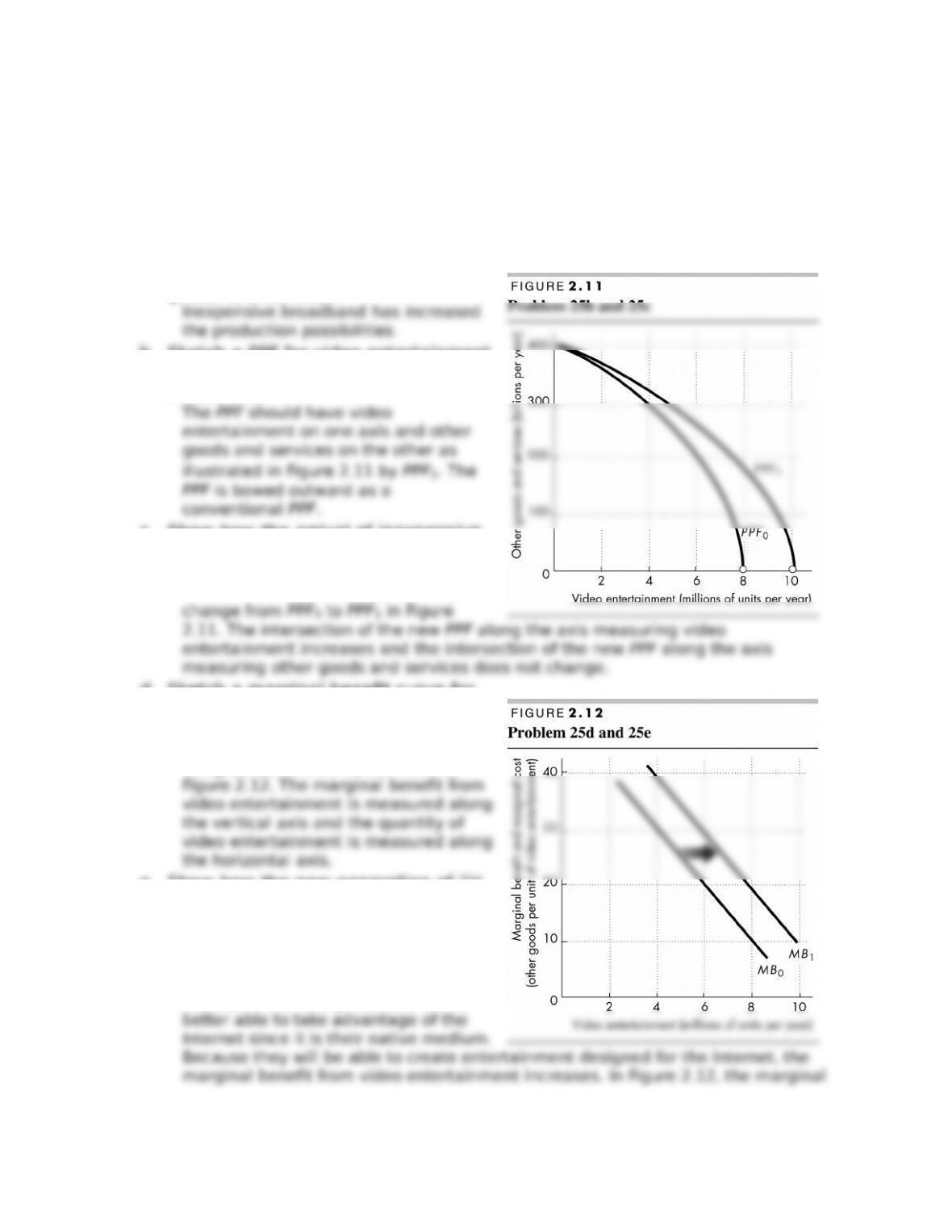
25. Lots of Little Screens
Inexpensive broadband access has created a generation of television
producers for whom the Internet is their native medium. As they redirect the
focus from TV to computers, cell phones, and iPods, the video market is
developing into an open digital network.
Source: The New York Times, December 2, 2007
a. How has inexpensive broadband changed the production possibilities of
video entertainment and other
goods and services?
b. Sketch a PPF for video entertainment
and other goods and services before
broadband.
c. Show how the arrival of inexpensive
broadband has changed the PPF.
The arrival of inexpensive broadband
shifts the PPF outward as shown by the
d. Sketch a marginal bene&t curve for
video entertainment.
The marginal bene&t curve should be a
conventional downward-sloping
marginal bene&t curve as shown in
e. Show how the new generation of TV
producers for whom the Internet is
their native medium might have
changed the marginal bene&t from
video entertainment.
The marginal bene&t increases
because these new producers will be
© 2016 Pearson Education, Inc.
2 8 C H A P T E R 2
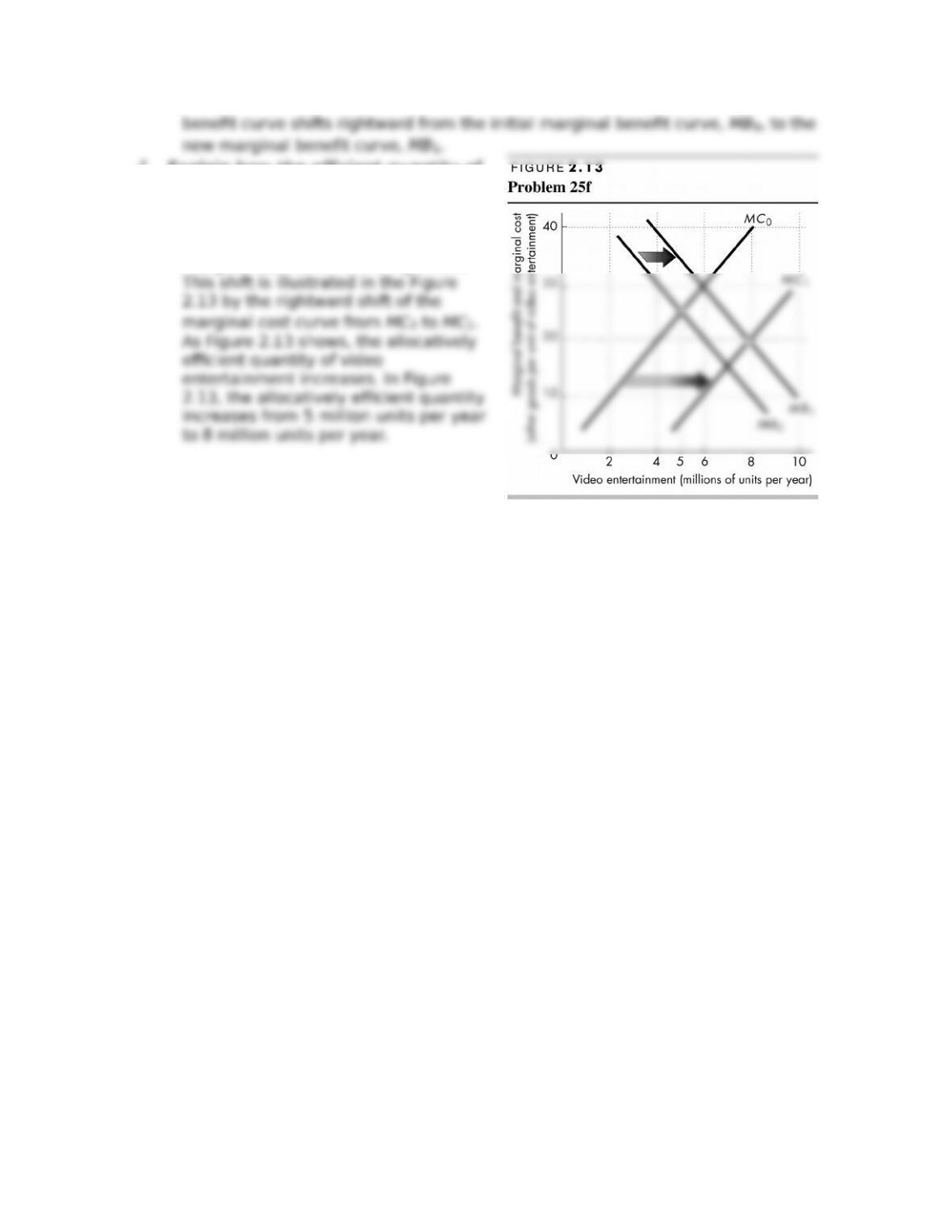
f. Explain how the e,cient quantity of
video entertainment has changed.
The arrival of broadband has
decreased the marginal cost of
providing video entertainment, so the
marginal cost curve shifts rightward.
© 2016 Pearson Education, Inc.
T H E E C O N O M I C P R O B L E M 2 9