
1 0
T h e B i g P i c t u r e
Where we have been:
Chapter 1 introduced the economic reality that wants exceed the resources
available to satisfy them—we face scarcity. Chapter 2 reinforces these central
themes by laying out the core economic model, the Production Possibilities
Frontier, or PPF, and uses it to illustrate the concepts of tradeo and
opportunity cost. Chapter 2 further details the concepts of marginal cost and
marginal bene!t, presenting a !rst look at the concept of e#ciency. It then
concludes with an explanation of the source of the gains from specialization
and exchange and the roles of !rms and markets in achieving those gains.
Where we are going:
The key concept of opportunity cost and the widespread tendency for the
opportunity cost of a good to increase as the quantity produced of that good
increases returns in Chapter 3 when we explain the supply curve. For Micro
classes, we see it again in Chapters 10 and 11 when we study a !rm’s costs
and cost curves. Preferences return and are treated more rigorously when we
explain marginal utility theory in Chapter 8 and indi erence curves in Chapter
9. E#ciency returns in Chapter 5 when we study the e#ciency of markets and
!rst preview the impediments to e#ciency. The gains from trade are explored
more completely in the context of international trade in Chapter 7 in
Microeconomics and Chapter 15 of Macroeconomics. Finally, the role of
markets and prices in allocating resources and coordinating activity is an
ongoing theme throughout most of the rest of the text. The next task, in
Chapter 3, is to develop the central demand and supply model.
N e w i n t h e Tw e l f t h E d i t i o n
Chapter 2 has been slightly rewritten. Parts of Joe and Liz’s Smoothie Bar example
are written more concisely without a loss or change in content. The “Economics in
the News” has a new article on fracking.
For all the chapters except Chapter 1, the end of chapter material now includes a
new section called Worked Problem. This problem includes questions, solutions,
and a key !gure. The Worked Problem is available in the Study Plan and the key
!gure is available as an interactive animation. The Study Plan Problems and
Applications have been reduced to one page, but all the deleted questions are
available in the Study Plan. Additional problems and Applications remain at two
pages. In this chapter the Worked Problem gives data for a production possibilities
2THE ECONOMIC
PROBLEM
C h a p t e r
10
1 1
frontier and then asks a variety of questions. The !rst question asks the students
if a combination of products is attainable and the second question asks if another
combination is e#cient. The answers point out how the available resources limit
production. The next question asks if a combination of products has a tradeo and
the last question asks the opportunity of increasing the production of a product.
The answers point out the relationship among production e#ciency, tradeo , and
opportunity cost.
Lecture Notes
The Economic Problem
Scarcity creates the need to make choices.
Economic choices can be evaluated in terms of their e#ciency.
We can expand possible choices through capital accumulation and specialization
and trade.
I. Production Possibilities and Opportunity Cost
The production possibilities frontier (PPF) is the boundary between those
combinations of goods and services that can be produced and those that cannot
given available resources and technology.
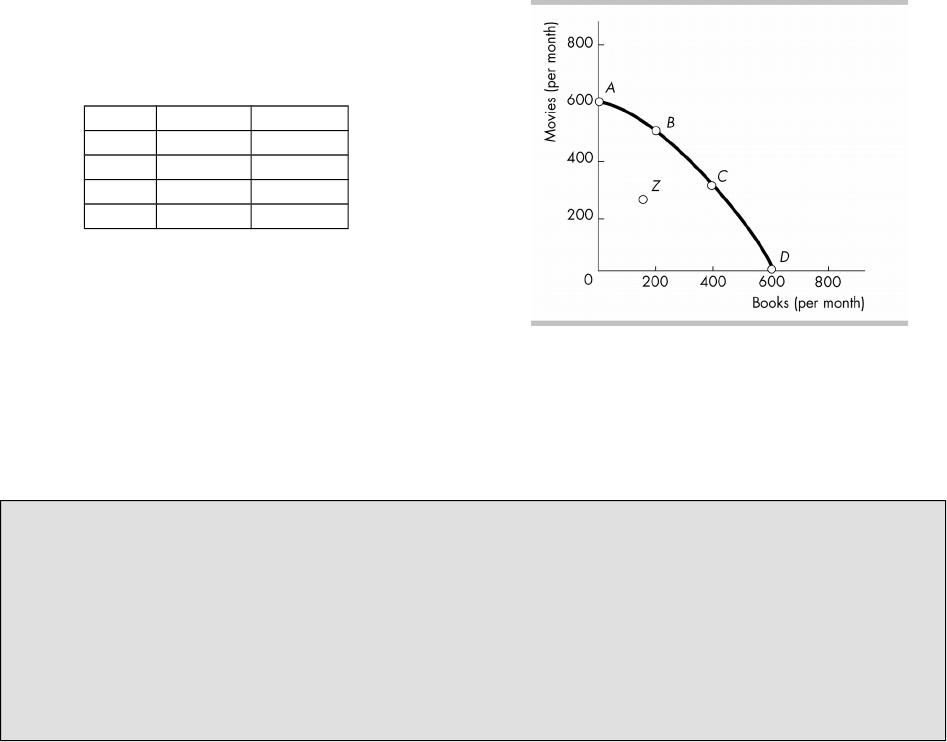
Consider the production choices for two
goods: books and movies. The table with
the data for the PPF is below and a !gure
showing the PPF is to the right.
Books Movies
A0 600
B200 500
C400 300
D600 0
Production points beyond the PPF are not
attainable without increases in resources
or technology (these factors shift the PPF);
Production points on and within the PPF
are attainable, but production points within the PPF, such as point Z, are ine#cient.
It is possible to get more of one good without giving up any of the other.
The PPF illustrates how scarcity creates the need to make choices. Producing more
books (moving from point A to point B) means producing fewer movies, and
producing more movies (moving from point C to point B) means producing fewer
books.
Using the PPF above, make a point outside the PPF and ask the students about it. Once they
state it is not possible, ask them how we could get there. After they highlight a few shifters,
summarize for them that the resources and technology we held constant when we drew the
PPF now relocate it when they change.
Now give them an example of a new movie camera invention and ask them if this will help
us get more books? You will likely get an immediate round of “NO.” Reply, “Are you sure?”
and you should be able to !nd a student who sees that the new resource frees up other
resources that can now be used for more books. Show them graphically a shift that is
pinned at the book axis and it will open their eyes to how technology and resource growth in
any sector can make more of all goods!
Production Eciency
Production is e#cient only on the frontier.
11

W H AT I S E C O N O M I C S ? 1 2
We achieve production e(ciency if we cannot produce more of one good without
producing less of some other good.
Inside the frontier (point Z), production is ine#cient. Resources could be better
employed to increase production of both books and movies.
Tradeo Along the PPF
Moving along the PPF, there is always a tradeo involved in diverting resources from
the production of one thing to another. We gain one thing but at the opportunity cost
of losing something else.
The key here is to make sure the student understands that given scarcity, because we
produce one thing, we cannot produce something else. Some students will see the tradeo
immediately as a cost (giving up something), but they will incorrectly interpret that cost as
only that valued in money units. To eliminate this ambiguity (better now than later), ask
them to think about a meal they purchased recently. Now ask them what the money cost
was as well as what else they might have picked for a meal? Most students pick up on this
concept quickly with one or two more examples. And since this is a consumption example,
tell them to put themselves in the place of an o#ce manager, who must produce a service
but can do so only given tradeo s. While money costs are measurable and useful, propose
to the students that opportunity costs are indeed even more useful in identifying the
tradeo s made in production.
Opportunity Cost
The opportunity cost of an action is the highest valued alternative forgone.
E#ciency means that the opportunity cost of producing more books or movies is the
tradeo along the frontier.
Increasing Opportunity Costs
The “bowed-out” shape of the PPF reIects the principle of increasing opportunity
cost.
Not all resources are the same, which is why the PPF bows out. Publishers are better
at producing books and Hollywood studios are better at producing movies. Moving
along the frontier and producing more movies inevitably means that more and more
publishers must produce movies. As this happens, the increase in movies becomes
smaller and the decrease in books becomes larger.
Emphasize the intercepts where the PPF crosses the axes. Take the vertical intercept
in the !gure. At this point all resources are used to produce movies. Basically to get
to that point the economy has crammed and slammed every resource into movie
production. Now when the economy moves down the PPF to produce the !rst book,
that book is really inexpensive—has very low opportunity cost—because the
economy uses resources better suited for book production !rst rather than movies.
As more and more resources are diverted from production of one good to another,
the smaller the additional increase in the production of the one good will be and the
larger the decrease in the production of the other good.
You can bring in the relationship of slope and opportunity cost here if you want. OPTION 1: A
soft way to bring in slope is to o er it as a double check on calculating marginal cost: “The
opportunity cost of whatever is being measured on the horizontal axis is equal to the
magnitude of the slope of the PPF.” OPTION 2: You can also introduce the slope of a curve as
the slope of a tangent line to the curve, that is, the slope of the line that is “just kissing” the
curve at a single point.
12
1 3
The bowed-out shape is a key feature of typical PPFs, often overlooked by the student (and
too often not accentuated by the instructor). The key here is to link the ever increasing
opportunity cost exhibited by the shape of a bowed out PPF with that of the marginal cost
curve, which is upward sloping.
To make the PPF model useful, it was necessary to simplify. By considering the case where
production of all goods other than two remain !xed, we can use a relatively simple picture
to see how concepts apply to the real world. With three goods, we would have a 3-D frontier
surface. With more than 3 goods, it would be impossible to represent the frontier using a
graph. The cool thing is that all relevant results of the 2-D model are true in the N-good
model.
II. Using Resources E(ciently
Which point on the PPF best serves the public interest? To answer this question, we must
measure and compare costs and bene!ts of di erent points.
The PPF and Marginal Cost
Marginal cost is the opportunity cost of producing one more unit of a good.
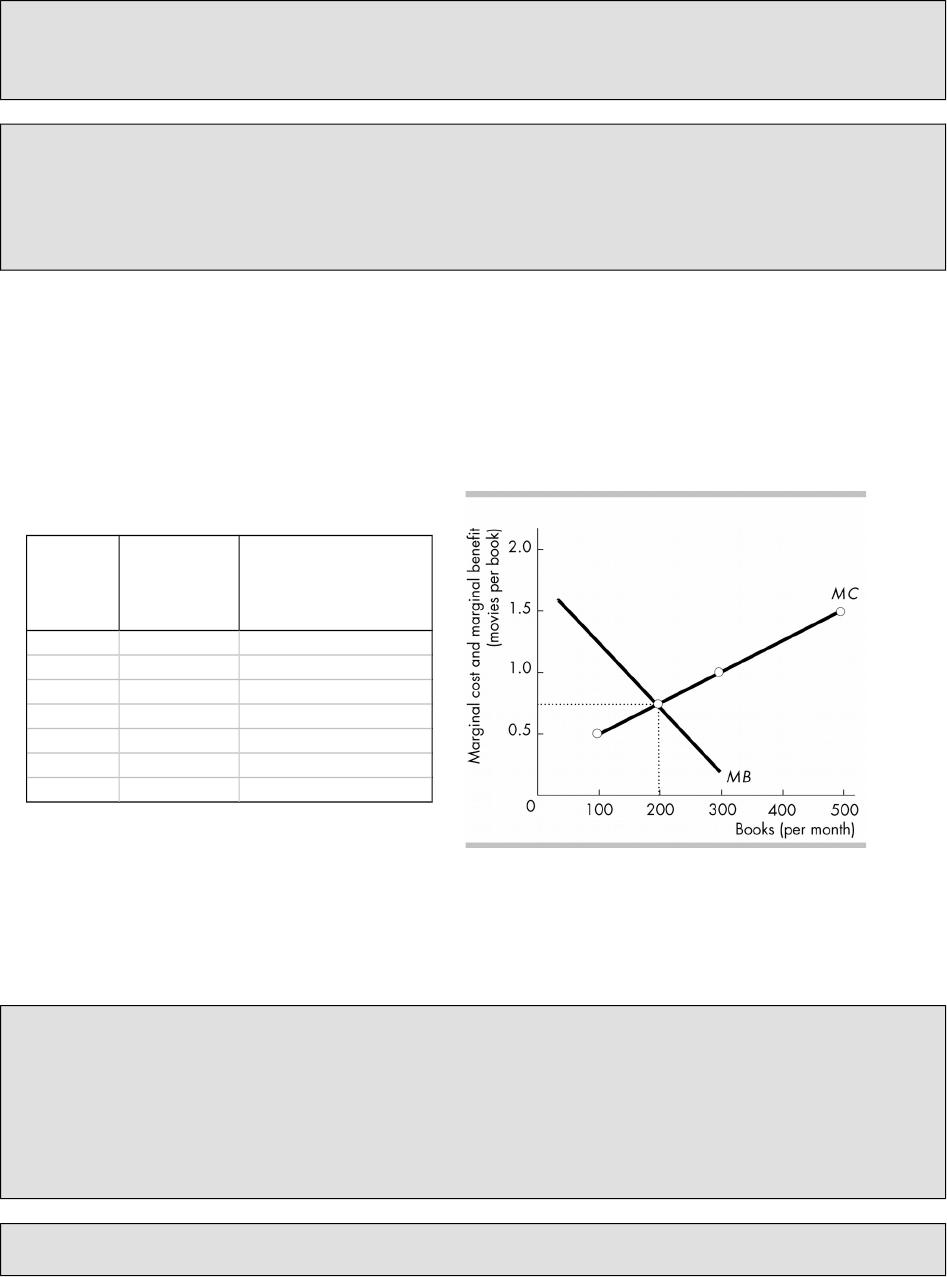
As more books are produced, the marginal cost of a book increases. The table shows
the marginal cost of producing books from the PPF data presented before and the
!gure shows the upward sloping
marginal cost curve.
Books
Marginal cost of
a book
(movies per
book)
A 0
0.5
B200
1.0
C400
1.5
D600
Preferences and Marginal Bene!t
Preferences are a description of a
person’s likes and dislikes.
The marginal bene,t of a good or services is the bene!t received from consuming
one more unit of it.
The principle of decreasing marginal bene!ts is why the marginal bene,t curve
in the !gure above slopes downward.
You might have some students that have had a microeconomics course in their past, and
have already been introduced to the concept of marginal cost and marginal bene!t. And,
they might inquire if the marginal bene!t curve is linked to the Law of Diminishing Marginal
Utility. While this might be adequate discussion for an advanced undergraduate course, and
certainly a graduate micro seminar, pass it up in your principles course. Let the student
know that the goal is to employ demand side concepts, in a marginal sense. As such, key in
on the fact that the marginal bene!t curve can be characterized as a willingness to pay
curve.
Keep the discussion of marginal cost and marginal bene!t separate and distinct, making
sure that the student realizes these are in essence the foundation of market forces (supply
13

W H AT I S E C O N O M I C S ? 1 4
and demand, respectively). While the PPF can tell us the opportunity costs in production,
and the tradeo s therein, it is the market that allows us to determine the allocatively
e#cient point. Allocative e#ciency only occurs with a balance between bene!ts and costs,
at the margin.
Allocative Eciency
Allocative e(ciency occurs only when marginal bene!t equals marginal cost.
In the !gure, when 100 books per month are produced, the marginal bene!t from
another book exceeds its marginal cost, which means that people prefer another
book more than the movies they must give up.
When the allocatively e#cient number of books, 200 per month, is produced, the
PPF in the previous !gure shows that the allocatively e#cient number of movies is
500 movies per month.
When marginal cost equals marginal bene!t it is impossible to make people better
o by reallocating resources.
III. Economic Growth
Economic growth expands production possibilities and shifts the PPF outward.
Technological change (the development of new goods and of better ways of
producing goods and services) and capital accumulation (the growth of capital
resources, which includes human capital) lead to economic growth.
You can have some fun and generate some discussion by getting the students to think
about what life might be like after another 200 years of economic growth. Provide some
numbers: In 2008, income per person in the United States was about $100 a day. In 1808 it
was about 70¢ a day, and if the past growth rate prevails for another 200 years, in 2208 it
will be $14,000 a day. Emphasize the magic of compound growth. If they think that $14,000
a day is a big income, get them to do a ballpark estimate of the daily income of Bill Gates
(about $10 million!). Encourage a discussion of why scarcity is still present even at these
large incomes.
The Cost of Economic Growth
Economic growth requires that resources must be devoted to developing technology
or accumulating capital, which means that current consumption decreases. The
decrease in current consumption is the opportunity cost of economic growth.
A Nation’s Economic Growth
Countries that devote a higher share of resources to developing technology or
accumulating capital are more likely to grow faster.
Some nations, such as Hong Kong, have chosen faster capital accumulation at the
expense of current consumption and so have experienced faster economic growth.
Running through the above example can really help students catch on to how economic
growth is linked to choices (less consumption now for more later). You may wish to
demonstrate more consumption or more capital biased shifts of the PPF, to demonstrate
changes in opportunity costs.
IV. Gains from Trade
Specialization and trade expand consumption possibilities
14
1 5
Comparative Advantage and Absolute
Advantage
A person has a comparative advantage in
an activity if that person can perform the
activity at a lower opportunity cost than
anyone else.
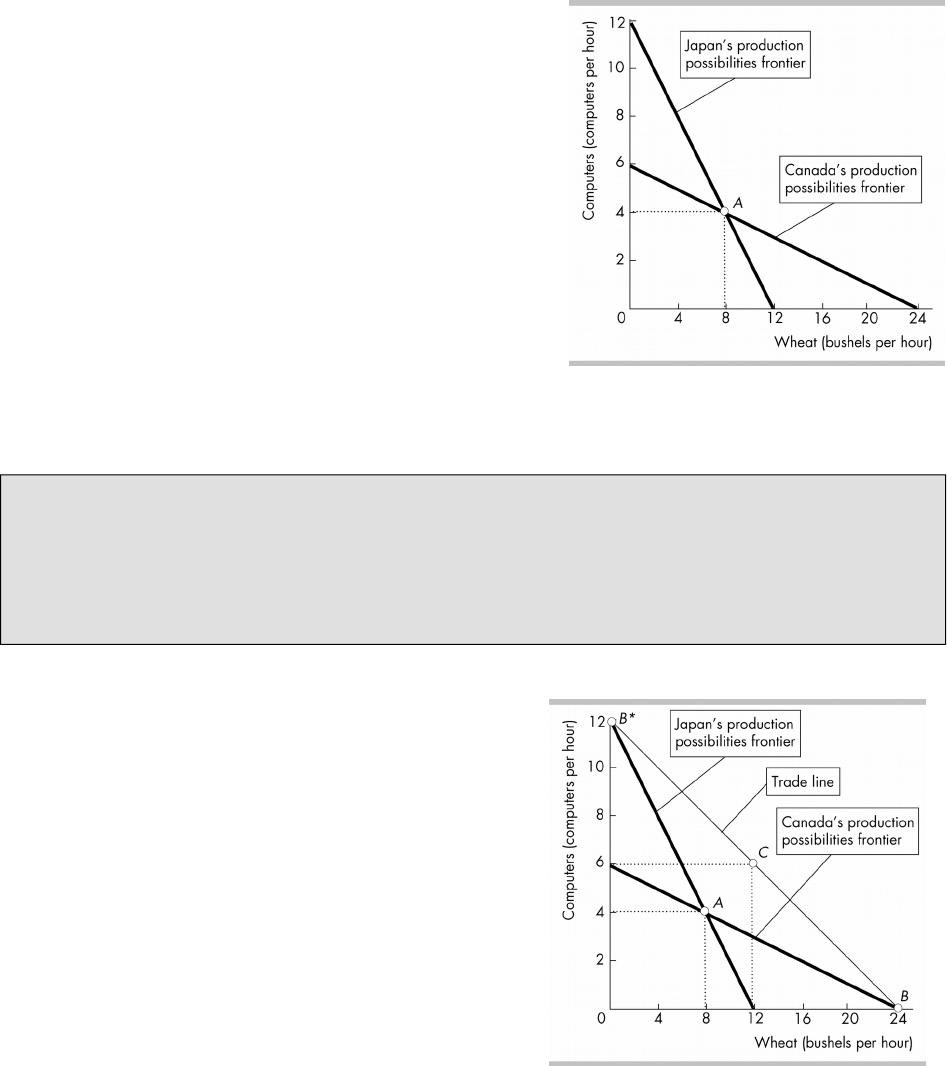
The PPF shows opportunity cost. In the !gure
the opportunity cost of a bushel of wheat in
Canada is 1/4 of a computer and in Japan it is
1 computer. In Canada the opportunity cost of
a computer is 4 bushels of wheat and in Japan
it is 1 bushel of wheat. Canada has a
comparative advantage in producing wheat
and Japan has a comparative advantage in
producing computers.
A person has an absolute advantage if that
person is more productive than others in that activity or activities. A person (or
country) can have an absolute advantage in all activities but that person (or
country) will not have a comparative advantage in all activities.
An easy way for students to remember the di erence between comparative and absolute
advantages is that with comparative advantage, the opportunity costs comparison matters.
If one has a comparative advantage in producing something, they should specialize in
production of that good or service. An absolute advantage can be characterized by being
able to “absolutely out-produce” the other economic agent. Even though a country might
have absolute advantages, it should not produce everything, and should focus on
identifying its comparative advantages.
Achieving the Gains from Trade
When countries specialize by producing the
good in which each country has a
comparative advantage more goods in total
can be produced. If without trade Canada
and Japan each produce at point A, a total
of 8 computers and 16 bushels of wheat are
produced. If they specialize according to
comparative advantage, Japan produces at
point B* and Canada produces at point B for
a combined total of 12 computers and 24
bushels of wheat.
Trade allows consumption to be di erent
than production for each nation, so Canada
can trade wheat for computers and Japan
can trade computers for wheat. Because
more computers and more wheat are
produced, both nations can consume more than they can produce on their own. For
example, suppose that the market price of wheat is ½ computer per 1 bushel of
wheat. As illustrated, each country can now be consuming at point C along the trade
line. Note that each country’s consumption point lies beyond its own PPF.
The gains from trade can now be easily seen in terms of Japan and Canada each
gaining 2 computers and 4 bushels of wheat compared to their initial, no-trade
consumption points. Note that it is more likely that point C for each country will be
on a di erent point on the trade line according to preferences. In the end, the sum
of consumption among the two countries must equal the sum of production
15

W H AT I S E C O N O M I C S ? 1 6
(imports=exports). For simplicity, this example has points A and C equal for both
countries.
You may want to motivate the gains from trade using an example loosely based on Tom
Hanks in the movie Castaway. Ask the students, “Was Tom by himself on the island an
economy?” Use a couple goods like !sh and coconuts and show Tom’s production
possibilities. Discuss what are the essential elements needed to have an economy. Tom
produces food and then he consumes it but is this su#cient for us to call him an economy?
It is an open-ended question that I end with Tom needing somebody to trade with. Once a
new person washes up on shore, the two can specialize in the good for which he or she has
a comparative advantage and trade for the other. Give one of them an absolute advantage
and then show how consumption possibilities lie outside each person’s production
possibilities. This shows the power of specialization and trade in a way that personalizes it
for the student.
16