Miner Sacks 17,000 Workers Over Pay Dispute
Impala Platinum has sacked 17,000 South African miners at its Rustenburg mine
because they took part in an illegal strike. The miners refused to have their union
negotiate in the two-week pay dispute with the world’s second largest platinum
producer. Mining provides a quarter of all jobs in Rustenburg.
Source: abc.com.au, February 3, 2012
17. How would the wage rate and employment for the Rustenburg miners be
determined in a competitive market?
In a competitive labor market, the wage rate and employment are determined by
18.a. Explain how it is possible that the mine workers were being paid less than
the wage that would be paid in a competitive labor market.
The mine provides a large fraction of total employment in the region. Hence
Impala Platinum, the owner of the mine, might have monopsony power in the labor
b. What would be the e4ect of a minimum wage law in the market for miners?
A minimum wage rate set above the monopsony wage rate increases the wage
rate paid the workers. The minimum wage rate makes the supply of labor perfectly
Use the following news clip to work Problems 19 to 22.
The New War over Wal-Mart
Today, Wal-Mart employs more people—1.7 million—than any other private
employer in the world. With size comes power: Wal-Mart’s prices are lower and
United Food and Commercial Workers International Union argues that Wal-Mart’s
wages are also lower than its competitors. Last year, the workers at a Canadian
outlet joined the union and Wal-Mart immediately closed the outlet. But does
Wal-Mart behave any worse than its competitors? When it comes to payroll,
Wal-Mart’s median hourly wage tracks the national median wage for general retail
jobs.
Source: The Atlantic, June 2006
19.a. Assuming that Wal-Mart has market power in a labor market, explain how
the 2rm could use that market power in setting wages.
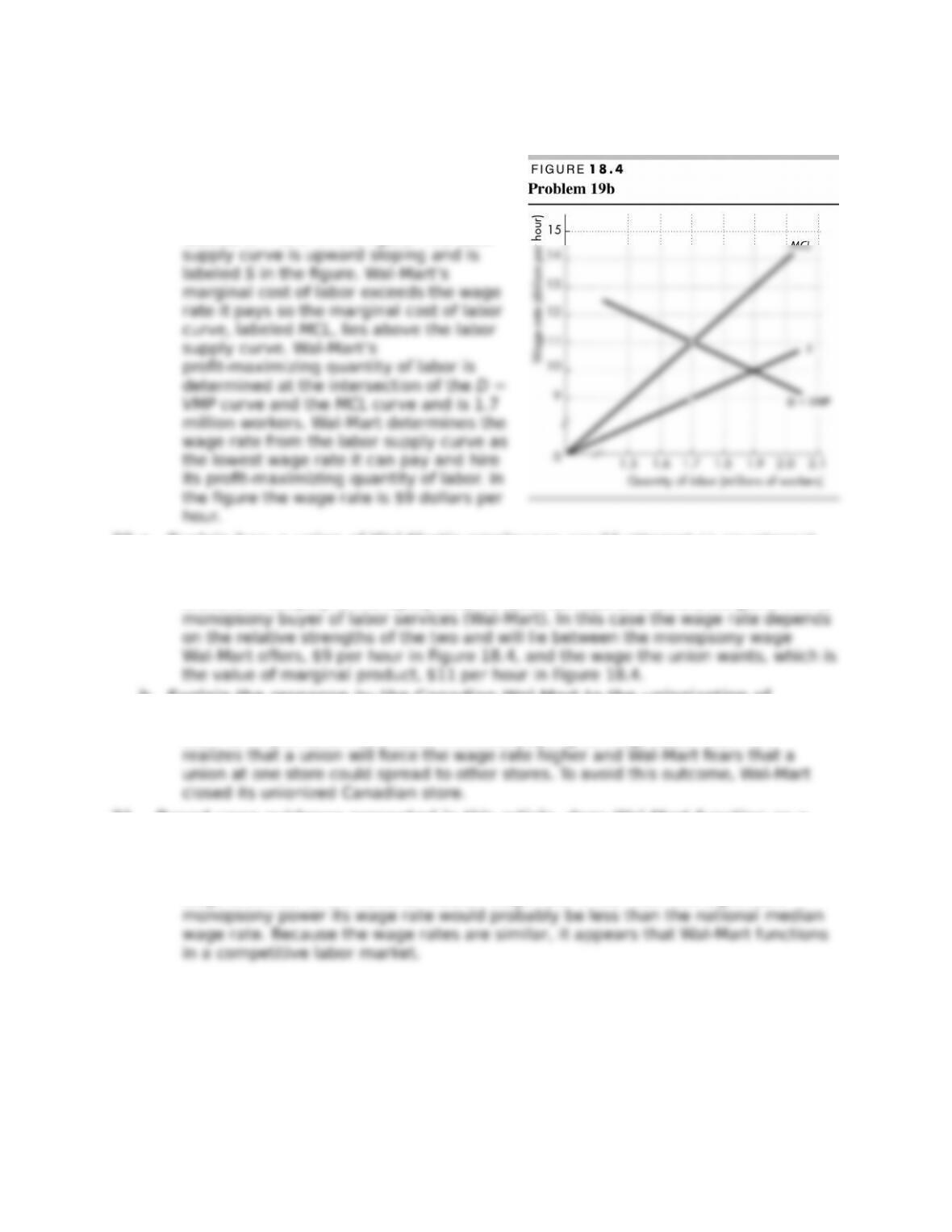
b. Draw a graph to illustrate how Wal-Mart might use labor market power to set
wages.
Figure 18.4 shows Wal-Mart’s situation if
it is a monopsony in the labor market.
Wal-Mart’s demand curve is the same as
its value of marginal product curve and is
labeled D = VMP in the 2gure. The labor
20.a. Explain how a union of Wal-Mart’s employees would attempt to counteract
Wal-Mart’s wage o4ers (a bilateral monopoly).
A union will bargain with Wal-Mart. If Wal-Mart faces a union, the situation is a
bilateral monopoly: a monopoly seller of labor services (the union) bargains with a
b. Explain the response by the Canadian Wal-Mart to the unionization of
employees.
Wal-Mart’s pro2ts are decreased if it must pay higher wage rates. Wal–Mart
21. Based upon evidence presented in this article, does Wal-Mart function as a
monopsony in labor markets, or is the market for retail labor more
competitive? Explain.
The key piece of evidence in the news clip is the point that Wal-Mart’s median
wage is similar to the national median wage rate. If Wal-Mart had signi2cant
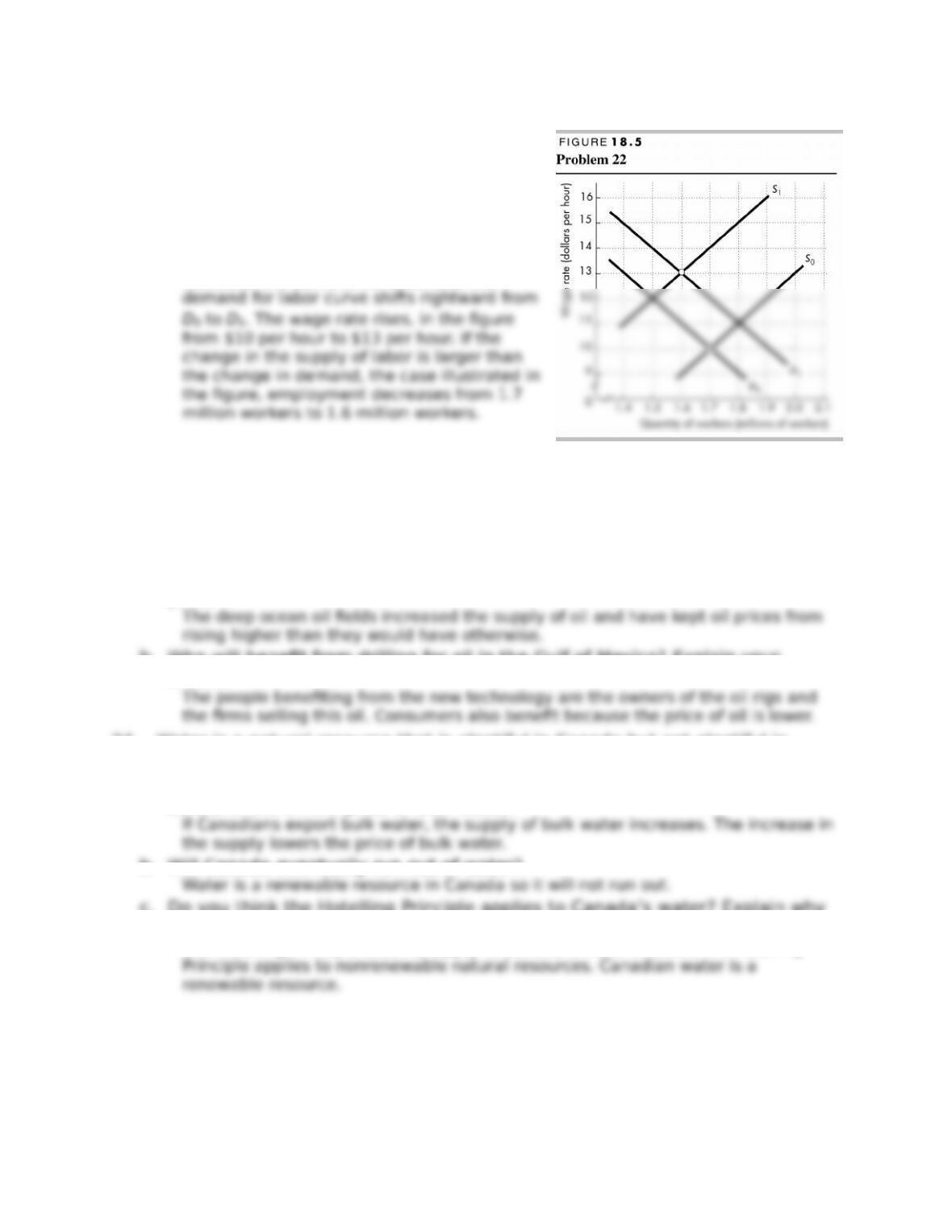
22. If the market for retail labor is competitive,
explain the potential e4ect of a union on
the wage rates. Draw a graph to illustrate
your answer.
Figure 18.5 shows a union in a competitive
labor market. The union decreases the
supply of labor and the supply of labor curve
shifts leftward from S0 to S1. The union
increases the demand for labor and the
23. New technology has allowed oil to be pumped from much deeper o4shore oil
2elds than before. For example, 28 deep ocean rigs operate in the deep
waters of the Gulf of Mexico.
a. What e4ect do you think deep ocean sources have had on the world oil
price?
b. Who will bene2t from drilling for oil in the Gulf of Mexico? Explain your
answer.
24. Water is a natural resource that is plentiful in Canada but not plentiful in
Arizona.
a. If Canadians start to export bulk water to Arizona, what do you predict will
be the e4ect on the price of bulk water?
b. Will Canada eventually run out of water?
c. Do you think the Hotelling Principle applies to Canada’s water? Explain why
or why not.
The Hotelling Principle does not apply to Canada’s water because the Hotelling
25. Gas Prices Create Land Rush
There is a land rush going on across Pennsylvania, but buyers aren’t
interested in the land itself. Buyers are interested in what lies beneath the
earth’s surface—mineral rights to natural gas deposits. Record high natural
gas prices have already pushed up drilling activity across the state, but
drilling companies have discovered a new technology that will enable deep
gas-bearing shale to be exploited. Development companies, drilling
companies and speculators have been trying to lease mineral rights from
landowners. The new drilling techniques might recover about 10 percent of
those reserves, and that would ring up at a value of $1 trillion.
Source: Erie Times-News, June 15, 2008
a. Explain why the demand for land in Pennsylvania has increased.
The demand for land increased because the price of natural gas increased. The
b. If companies are responding to the higher prices for natural gas by drilling
right now wherever they can, what does that imply about their assumptions
about the future price of natural gas in relation to current interest rates?
If companies assume that the price of natural gas is expected to rise at a rate that
c. What could cause the price of natural gas to fall in the future?
Technological change that decreases the demand for natural gas can lead the
price to fall in the future. Lower prices for substitutes for natural gas, such as coal
Economics in the News
26. After you have studied Economics in the News on pp. 436–437, answer the
following questions:
a. Is the average di4erence in the salaries of charter school and regular public
school teachers greater or smaller than the di4erence at the top end of the
pay scales?
b. What are the inFuences on the demand for the highest paid teachers that
explain their high wage rates?
There are three factors that a4ect the demand for the highest paid teachers.
These teachers are located in public schools, and the union has increased the
c. What are the inFuences on the supply of the highest paid teachers that
explain their high wage rates?
There are two factors that a4ect the supply of the highest paid teachers. These
teachers are located in public schools, and the union has decreased the supply of
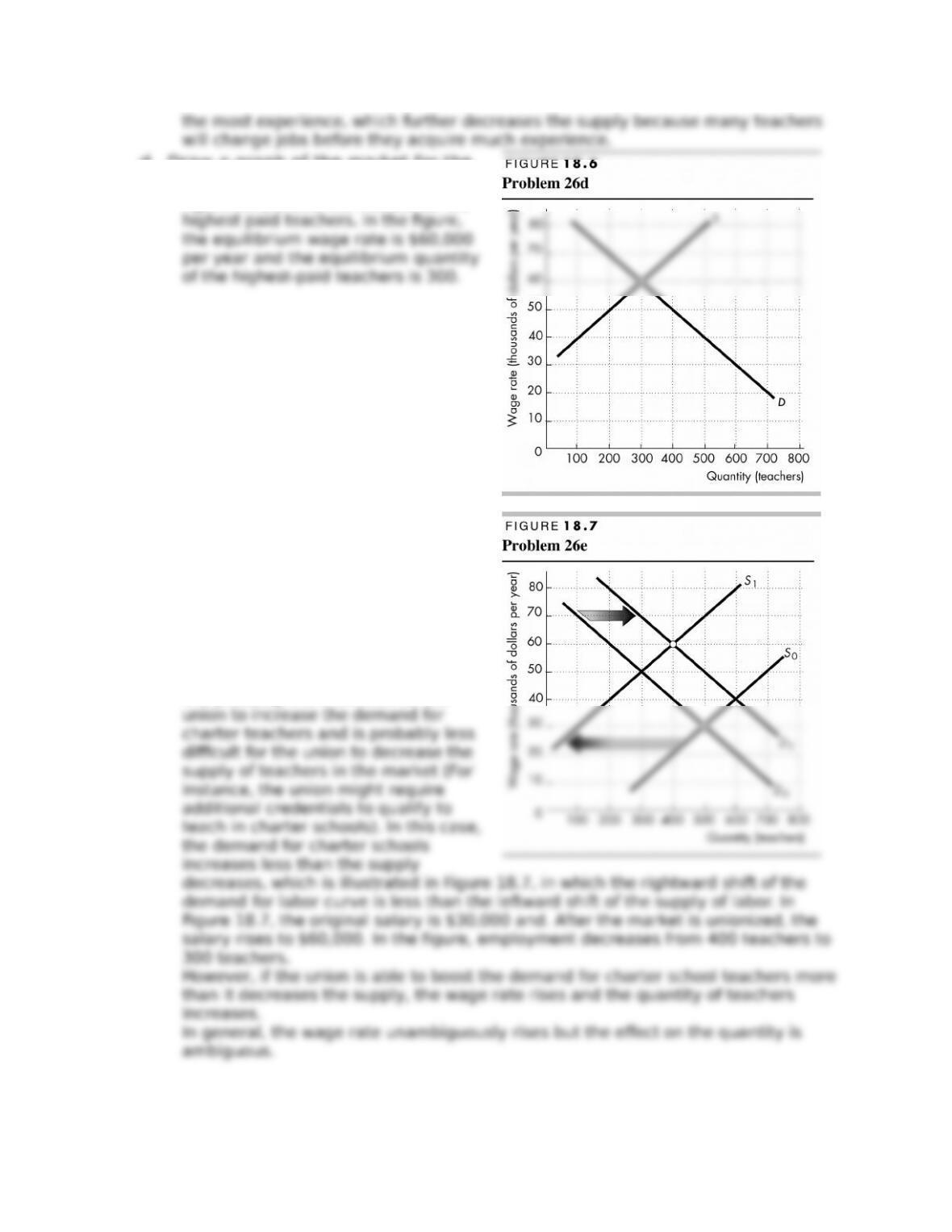
d. Draw a graph of the market for the
highest paid teachers.
Figure 18.6 shows the market for the
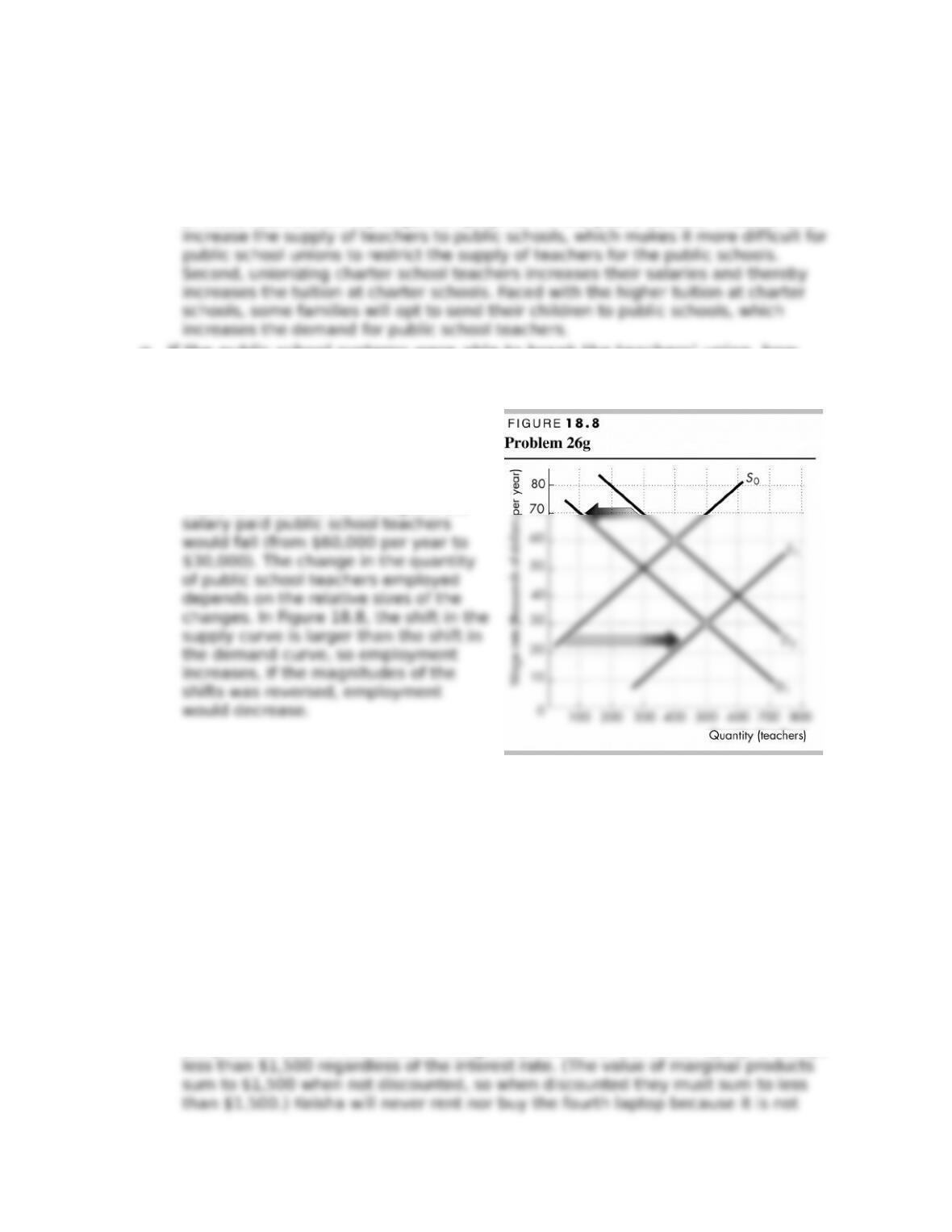
e. If all charter school teachers
became unionized, how would the
market for these teachers change?
Illustrate your answer with a graph.
If charter school teachers become
unionized, the union will strive to
increase the demand for charter
teachers and will strive to decrease
the supply of teachers in the market.
It is probably more diGcult for the
f. How would you expect unionization of charter school teachers to inFuence
the unionized market for regular public school teachers?
If charter school teachers were unionized, there would be several e4ects in the
unionized market for public school teachers. First, if unionizing of charter school
teachers decreases the equilibrium employment of charter school teachers, some
of these teachers will try to gain employment in the public schools. These e4orts
g. If the public school systems were able to break the teachers’ union, how
would the market for regular public school teachers change? Illustrate your
answer with a graph.
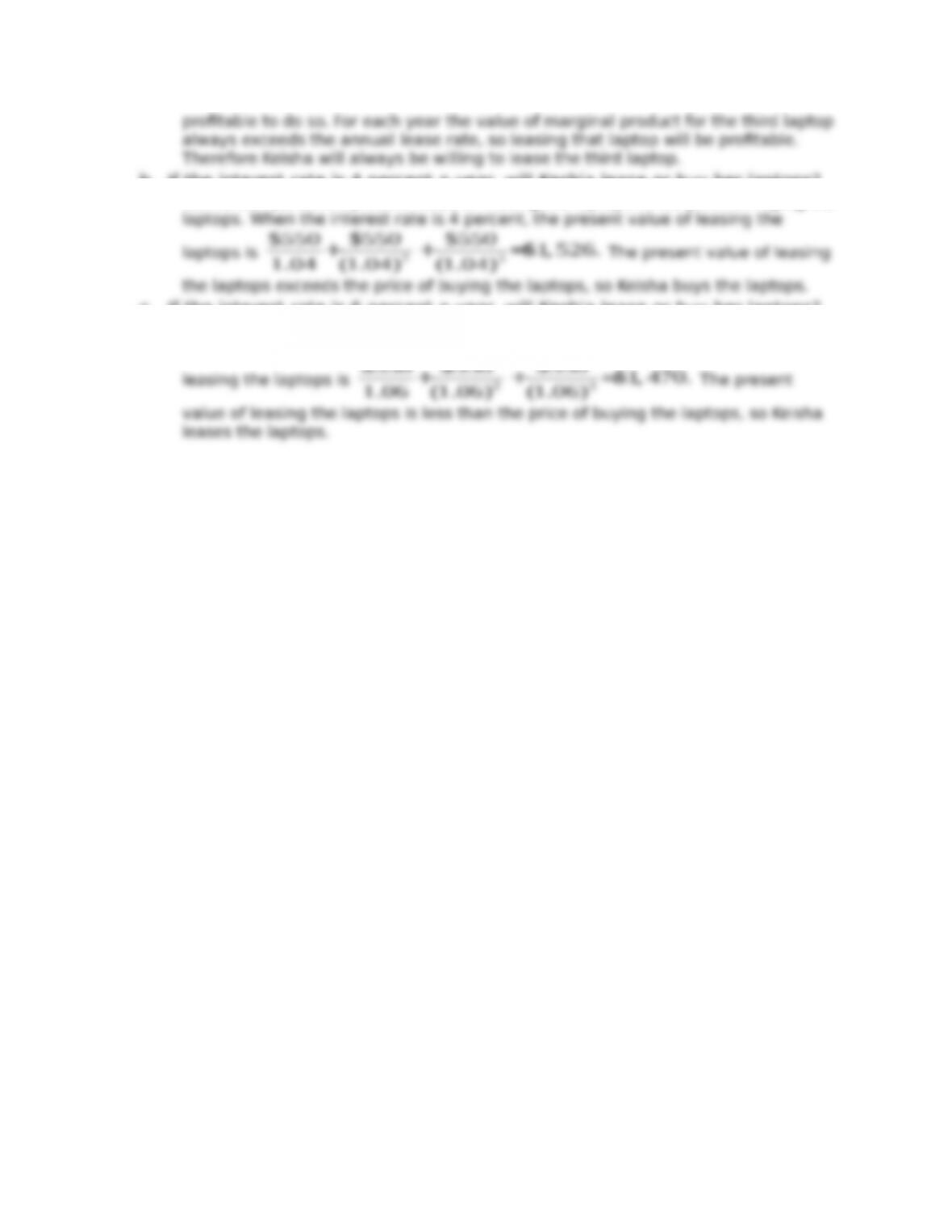
The union is broken, the supply of
teachers would increase and the
demand would decrease. In Figure
18.8, the supply curve shifts rightward
and the demand curve shifts leftward.
Then, as illustrated in the 2gure, the
27. Keshia is opening a new bookkeeping service. She is considering buying or
leasing some new laptop computers. The purchase price of a laptop is $1,500
and after three years it is worthless. The annual lease rate is $550 per laptop.
The value of marginal product of one laptop is $700 a year. The value of
marginal product of a second laptop is $625 a year. The value of marginal
product of a third laptop is $575 a year. And the value of marginal product of
a fourth laptop is $500 a year.
a. How many laptops will Keshia lease or buy?
Keshia will lease or buy 3 laptops. The fourth laptop’s value of marginal product is
less than the annual lease rate, so Keisha will never lease the fourth laptop. And
the present value of the value of marginal products for the fourth laptop is always
b. If the interest rate is 4 percent a year, will Keshia lease or buy her laptops?
Keshia compares the present value of leasing the laptops to the price of buying the
c. If the interest rate is 6 percent a year, will Keshia lease or buy her laptops?
Keshia again compares the present value of leasing the laptops to the price of
buying the laptops. When the interest rate is 6 percent, the present value of
$550