20. Polar Ice Cap Shrinks Further and Thins
With the warming of the planet, the polar ice cap is shrinking and the Arctic Sea is
expanding. As the ice cap shrinks further, more and more underwater mineral resources
will become accessible. Many countries are staking out territorial claims to parts of the
polar region.
Source: The Wall Street Journal, April 7, 2009
Explain how ownership of these mineral resources will in$uence the amount of damage
done to the Arctic Sea and its wildlife.
The Arctic Sea minerals might be privately owned, government owned, or owned by no one
—common resources. Regardless of who owns them, mining minerals creates pollution and
disturbs marine life habitat, which have external costs.
If the minerals are privately owned, then the quantity mined will be the amount
that sets the marginal private cost equal to the marginal private bene+t. This
quantity will have a deadweight loss because the marginal social cost exceeds the
marginal private cost.
If the minerals are government owned, then their allocation will be by majority
vote. Lobbyists will pressure elected o.cials to adopt their position in return for
help with reelection. In this case, “green” lobbyists and “business” lobbyists likely
will square o1. If the greens prevail, there is a possibility that no minerals will be
mined. This situation has a deadweight loss because less than the e.cient
quantity is mined. If the business groups prevail, then there might be signi+cant
amounts mined. This situation, similar, to the case of private ownership, has a
deadweight loss because of overuse of the minerals.
Finally if the minerals are owned by no one, they become a common resource. In
this case the quantity mined will be that at which marginal private cost equals
marginal private bene+t. This quantity creates a deadweight loss because the
marginal external cost of damage to the Arctic Sea and also the marginal social
cost of resource depletion will be ignored.
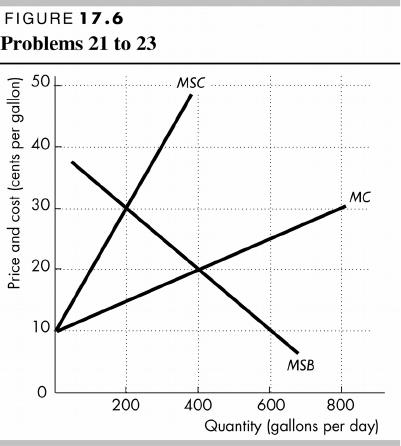
Use Figure 17.6 to work Problems 21 to 23.
A spring runs under a village. Everyone can
sink a well on her or his land and take water
from the spring. Figure 17.6 shows the
marginal social bene+t from and the
marginal cost of taking water.
21. What is the quantity of water taken
and what is the private cost of the
water taken?
With no government intervention, the
quantity of water taken is 400 gallons
per day, determined in the +gure by
where the marginal social bene+t and
the marginal private cost curves
intersect. The marginal private cost of
this quantity of water is 20¢ per gallon.
22. What is the e.cient quantity of water
taken and the marginal social cost at
the e.cient quantity?
The e.cient quantity of water taken is 200 gallons per day, determined in the
+gure by where the marginal social bene+t and the marginal social cost curves
intersect. The marginal social cost of this quantity of water is 30¢ per gallon.
23. If the village council sets a quota on the total amount of water such that the
spring is used e.ciently, what would be the quota and the market value of
the water taken per day?
The quota would be set at 200 gallons per day. This quantity of water would sell for
a price of 30¢ per gallon, so the market value of this quantity of water is 200
gallons × 30¢ per gallon, which is $60.
24. If hikers and other visitors were required to pay a fee to use the Appalachian
Trail,
a. Would the use of this common resource be more e.cient?
The Appalachian Trail, or AT, is a common resource because it is nonexcludable
and rival. As those who have hiked the AT know, this resource is over utilized; the
natural beauty is adversely a1ected by the number of hikers. If there was a fee to
hike the trail, its use would be more e.cient
b. Would it be even more e.cient if the most popular spots along the trail had
the highest prices?
It would be even more e.cient if the fee to use the trail was higher in more
popular areas, such as Annapolis Rock, because these areas are even more
over-utilized than the less popular areas.
c. Why do you think we don’t see more market solutions to the tragedy of the
commons?
It is probably the case that fees are not imposed because politicians resist
imposing fees that their constituents must pay on goods and services that had
previously been “free.”
Use the following data to work Problems 25
to 28.
The table shows the demand for college
education. The marginal cost of educating a
student is a constant $4,000 a year and
education creates an external bene+t of a
constant $2,000 per student per year.
25. If all colleges are private and the
market for education is competitive,
calculate the number of students, the
tuition, and the deadweight loss.
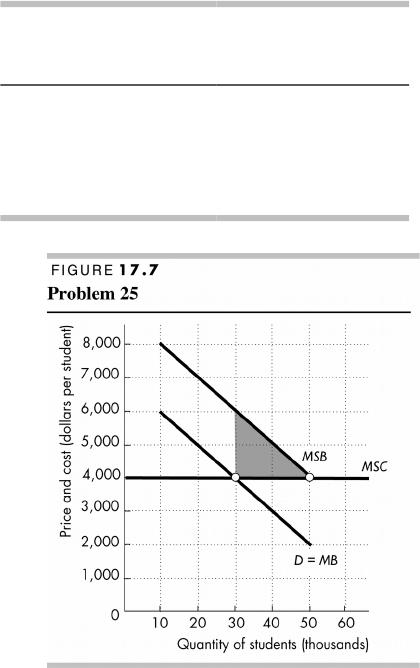
The equilibrium number of students will be
30,000 and the tuition will be $4,000. To
calculate the deadweight loss, Figure 17.7 is
helpful. The e.cient quantity of students is
50,000. Therefore deadweight loss is equal to
the area of the grey triangle in the +gure,
which is $20 million.
26. If all colleges are public colleges, calculate
the tuition that will achieve the e.cient
number of students. How much will
taxpayers have to pay?
The e.cient quantity of students is 50,000.
To have 50,000 students attending college,
the tuition must be $2,000. The marginal cost
of educating a student is $4,000 so taxpayers
Price
(dollars per
student)
Quantity
(students per
year)
6,000 10,000
5,000 20,000
4,000 30,000
3,000 40,000
2,000 50,000
must pay $2,000 per student. The total amount paid by taxpayers equals $2,000
per student × 50,000 students, which is $100 million.
27. If the government decides to subsidize private colleges, what subsidy will
achieve the e.cient number of college students?
The subsidy must equal to the marginal external bene+t at the e.cient quantity,
or $2,000 per student,
28. If all colleges are private and the government o1ers vouchers to those who
enroll at a college, calculate the value of the voucher that will achieve the
e.cient number of students.
The subsidy must equal to the marginal external bene+t at the e.cient quantity,
or $2,000 per student,
Economics in the News
29. After you have studied Economics in the News on pp. 410–411, answer the
following questions:
a. What are the marginal private costs of and marginal private bene+ts from
using gas rather than coal to generate electricity?
The marginal private cost of using gas is the price paid by the utilities for the gas;
the marginal private cost of using fuel made from coal is the price paid for the fuel
plus any additional taxes or fees imposed on the fuel. The marginal private bene+t
from using gas is the same as that using coal, namely the marginal private
bene+ts from electricity.
b. What are the marginal social costs of and marginal social bene+ts from
using gas rather than coal to generate electricity?
The marginal social cost of using gas is the marginal private cost of the fuel (the
price paid by the utilities for the fuel) plus the marginal external cost from the
(smaller amount of) carbon dioxide emitted. The marginal social cost of using fuel
from coal is the marginal private cost of the fuel (the price paid by the utilities for
the fuel) plus the marginal external cost from the (larger amount of) carbon
dioxide emitted. The marginal social bene+t from using gas is the same as that
from using coal, namely the marginal social bene+ts from electricity.
c. How will the EPA’s plan for power utilities to switch from coal to gas change
the price that households pay for electricity?
The price of electricity will rise as utilities switch from the lower-cost fuel, coal, to
the higher cost fuel, natural gas.
d. How will the EPA’s plan for utilities to switch from coal to gas change the
e.ciency of electricity production?
The e.ciency will increase because utilities will use less coal, which generates a
larger external cost, and more natural gas, which creates a smaller external cost.
30. Where the Tuna Roam
To the +rst settlers, the Great Plains posed the same problem as the oceans
today: a vast, open area where there seemed to be no way to protect
animals. But animals thrived once the settlers divvied up the land and
devised ways to protect their livestock. Today, the oceans are much like an
open range. Fishermen catch as much as they can this year, even if they are
over+shing. They +gure any +sh they don’t take for themselves will just be
taken by someone else.
Source: The New York Times, November 4, 2006
a. What are the similarities between the problems faced by the earliest settlers
in the West and today’s +shers?
The early settlers in the West faced animals that roamed across land. No one
owned the land and no one owned the animals; that is, the property rights to the
land and animals were not established. Today’s +shers face animals—+sh—that
roam across the sea. No one owns the sea and no one owns the +sh; that is,
property rights to the sea and the +sh have not been established.
b. Can the tragedy of the commons in the oceans be eliminated in the same
manner used by the early settlers on the plains?
The tragedy of the commons was eliminated in the West when property rights were
granted to the land and methods were developed to restrict animals to certain
areas so that they could be “owned.” Once the property rights to the land and the
animals were established, then the marginal private bene+t became the same as
the marginal social bene+t and the tragedy of the commons was averted. For this
method to work in the sea, however, it must be possible to create property rights
to areas of the sea and restrict the +sh to certain areas so that can be “owned.” It
is not clear how this can be done.
c. How can ITQs change the short-term outlook of +shers to a long-term
outlook?
ITQs that are enforced can change +shers’ incentives by limiting the amount of +sh
that can be caught. In this case once the +sher hits the ITQ limit, the +sher cannot
continue to +sh. But an ITQ means that the +sher can harvest the speci+ed
quantity of +sh inde+nitely, that is, day after day. As a result there is no need for
the +sher to rapidly and intensively +sh because the +sher knows that +sh not
caught today will still be available to be caught tomorrow.