W H AT I S E C O N O M I C S ? 2 9
A n s w e r s t o t h e R e v i e w Q u i z z e s
Page 392
1. What are the four types of externality?
Externalities can be: a negative production externality, a positive production
2. Provide an example of each type of externality that is di)erent from the ones
described above.
Dumping dangerous chemicals in river while producing paper is an example of a
negative production externality. Baking bread and the resulting odor enjoyed by
Page 400
1. What is the distinction between private cost and social cost?
A private cost of production is the cost of producing a good or service that is borne
2. How do external costs prevent a competitive market from allocating
resources e1ciently?
External costs create a marginal social cost (MSC) that exceeds the marginal
private cost (MC) for producing or consuming a good or service. That is, with an
external cost, MSC > MC. When the 4rm produces a good or service with an
3. How can external costs be eliminated by assigning property rights?
The existence of a negative externality means some group must bear some of the
costs of a production or consumption activity for which they are not involved. The
17EXTERNALITIES
29
3 0
4. How do taxes, pollution charges, and cap-and-trade work to reduce
emissions?
An emissions tax or pollution charge on the producers of the activities that
generate pollution or other negative externality will force these producers, when
deciding about their level of production, to take account of the external costs they
impose on society. Producers’ costs increase and, in response, they decrease their
production, which decreases pollution emissions. For cap-and–trade, the regulating
Page 405
1. What is the tragedy of the commons? Give two examples, including one from
your state.
The tragedy of the commons is the absence of incentives to prevent the overuse
and depletion of a commonly owned resource. The private market place will not
2. Describe the conditions under which a common resource is used e1ciently.
3. Review three methods that might achieve the e1cient use of a common
resource and explain the obstacles to e1ciency.
There are three di)erent methods that government can use to obtain the e1cient
allocation of resources in the event of a common resource:
Property Rights are assigned to private property, which is a resource that
Production Quotas can be set for total catch and divided among harvesting
An Individual Transferable Quotas (ITQ) is a production limit that is assigned
Page 409
1. Why would the market economy produce too little education?
30
W H A T I S E C O N O M I C S ? 3 1
The markets for education will produce less than the e1cient quantity because
2. How might governments achieve an e1cient provision of education?
Governments could use public provision, private subsidies, or vouchers to achieve
e1ciency in the market for education. Public provision: The government could
3. What are the key di)erences among public production, private subsidies, and
vouchers?
Public production means that the government is the producer of the product.
Private subsidies, however, are given to private producers of the product. Both
4. Why do economists generally favor vouchers to achieve an e1cient
outcome?
Economists generally favor vouchers because they allow for competition and they
limit the opportunity for overproduction. First, a voucher gives the consumer of the
good the buying power, which forces producers to compete for business. Vouchers
A n s w e r s t o t h e S t u d y P l a n P r o b l e m s a n d
A p p l i c a t i o n s
1. Describe three consumption activities that create external costs.
2. Describe three production activities that create external bene4ts.
Presuming people like the smell of baking bread, a bakery creates an external
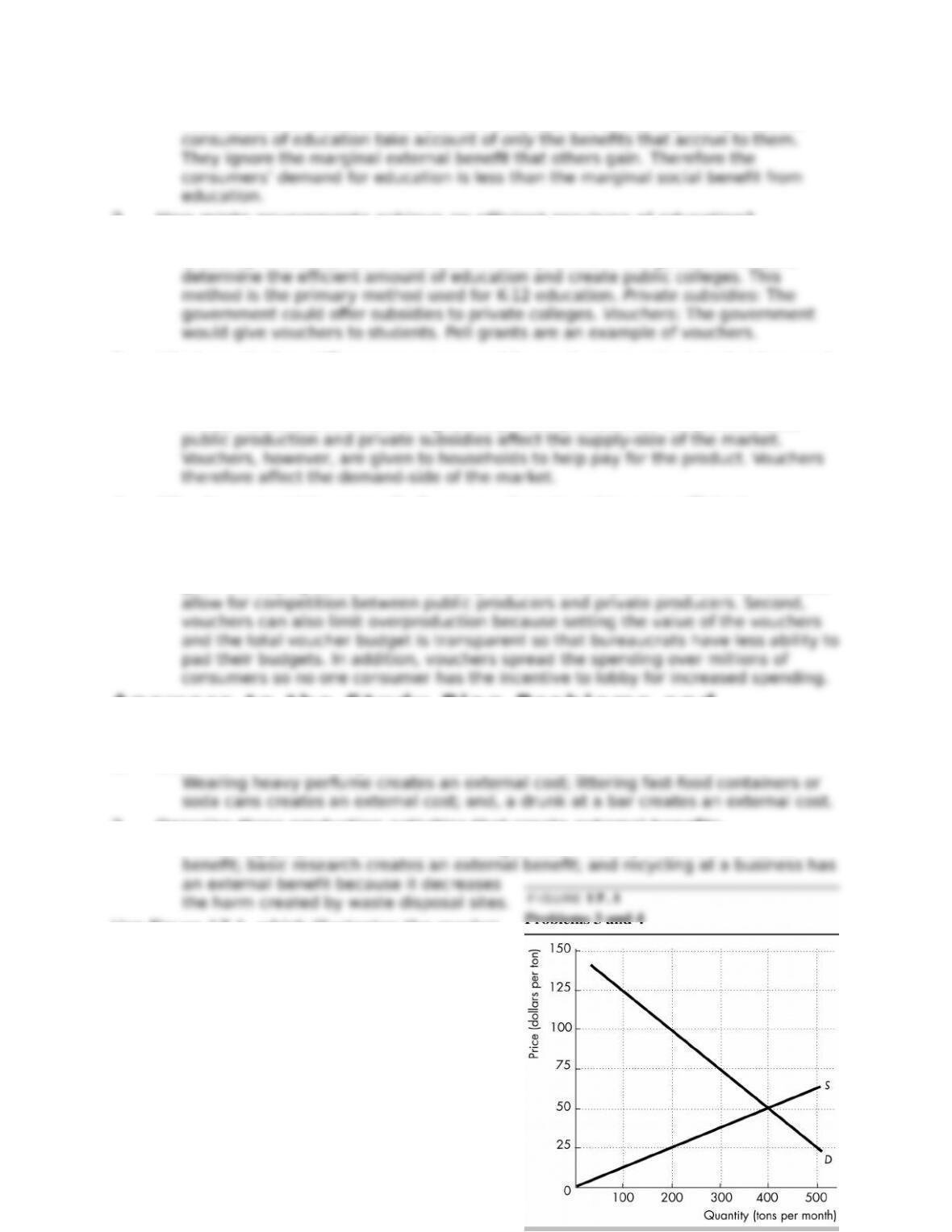
Use Figure 17.1, which illustrates the market
for cotton, to work Problems 3 and 4.
Suppose that the cotton growers use a
chemical to control insects and waste :ows
into the town’s river. The marginal social cost
of producing the cotton is double the
marginal private cost.
31
3 2
3. If no one owns the river and the town takes no action to control the waste,
what is the quantity of cotton and the deadweight loss created?
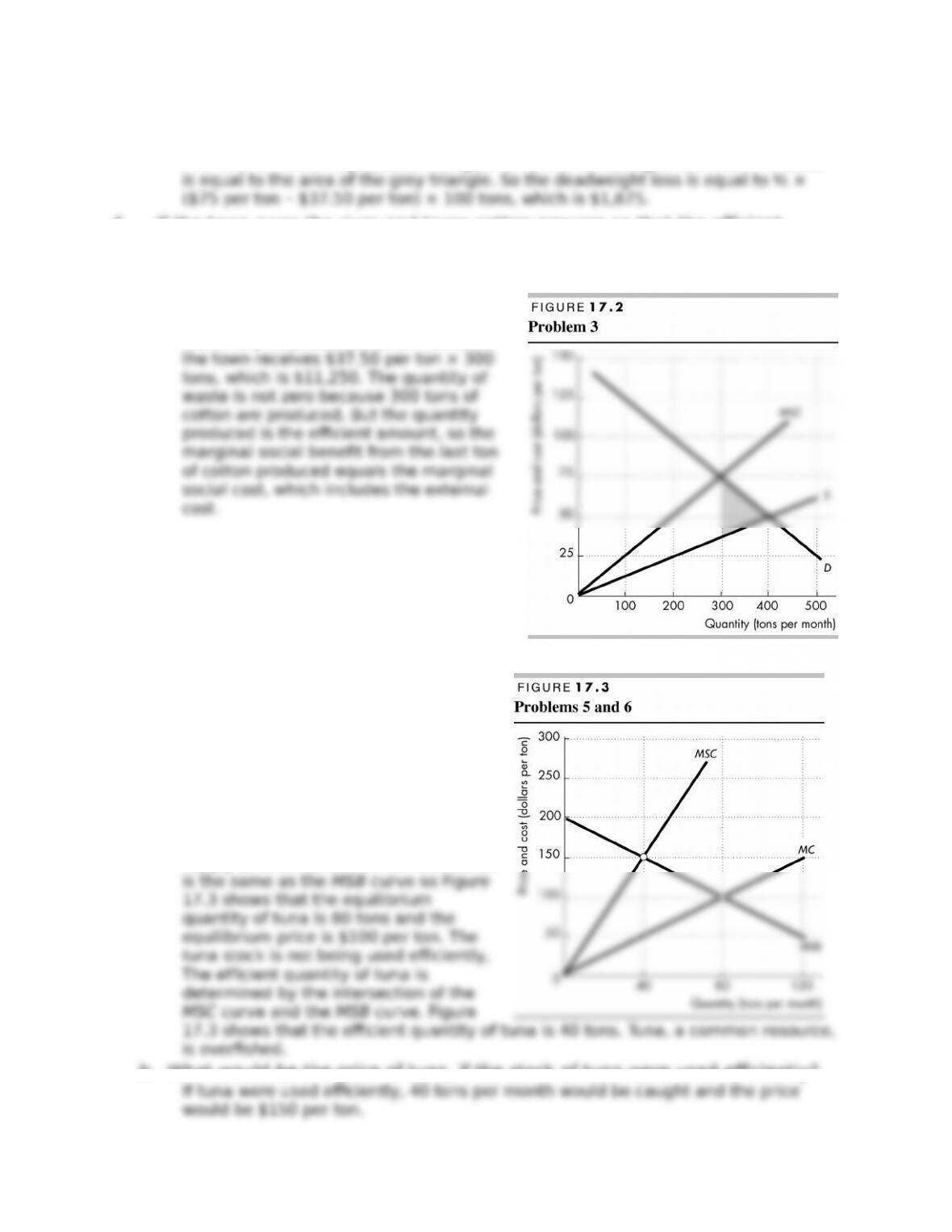
400 tons of cotton is produced. In Figure 17.2, the deadweight loss that is created
4. If the town owns the river and taxes cotton growers so that the e1cient
quantity is grown. How much tax revenue does the town receive? Is the
quantity of waste zero? Explain your answer.
The tax is equal to the marginal external
cost at the e1cient quantity, $37.50 per
ton of cotton. The e1cient quantity of
cotton is produced, 300 tons. Therefore
Use Figure 17.3 to work Problems 5 and 6.
The 4gure illustrates the market for North
Atlantic tuna.
5. a. What is the quantity of tuna that
4shers catch and the price of tuna? Is
the tuna stock being used e1ciently?
Explain why or why not.
When the market is unregulated, the
quantity of 4sh caught and their price is
determined by the equilibrium between
supply and demand. The demand curve
b. What would be the price of tuna, if the stock of tuna were used e1ciently?
32
W H A T I S E C O N O M I C S ? 3 3
6. With a quota of 40 tons a month for the tuna 4shing industry, what is the
price of tuna and the quantity caught? Does over4shing occur?
With a quota of 40 tons per month, the quantity of tuna caught will be 40 tons and
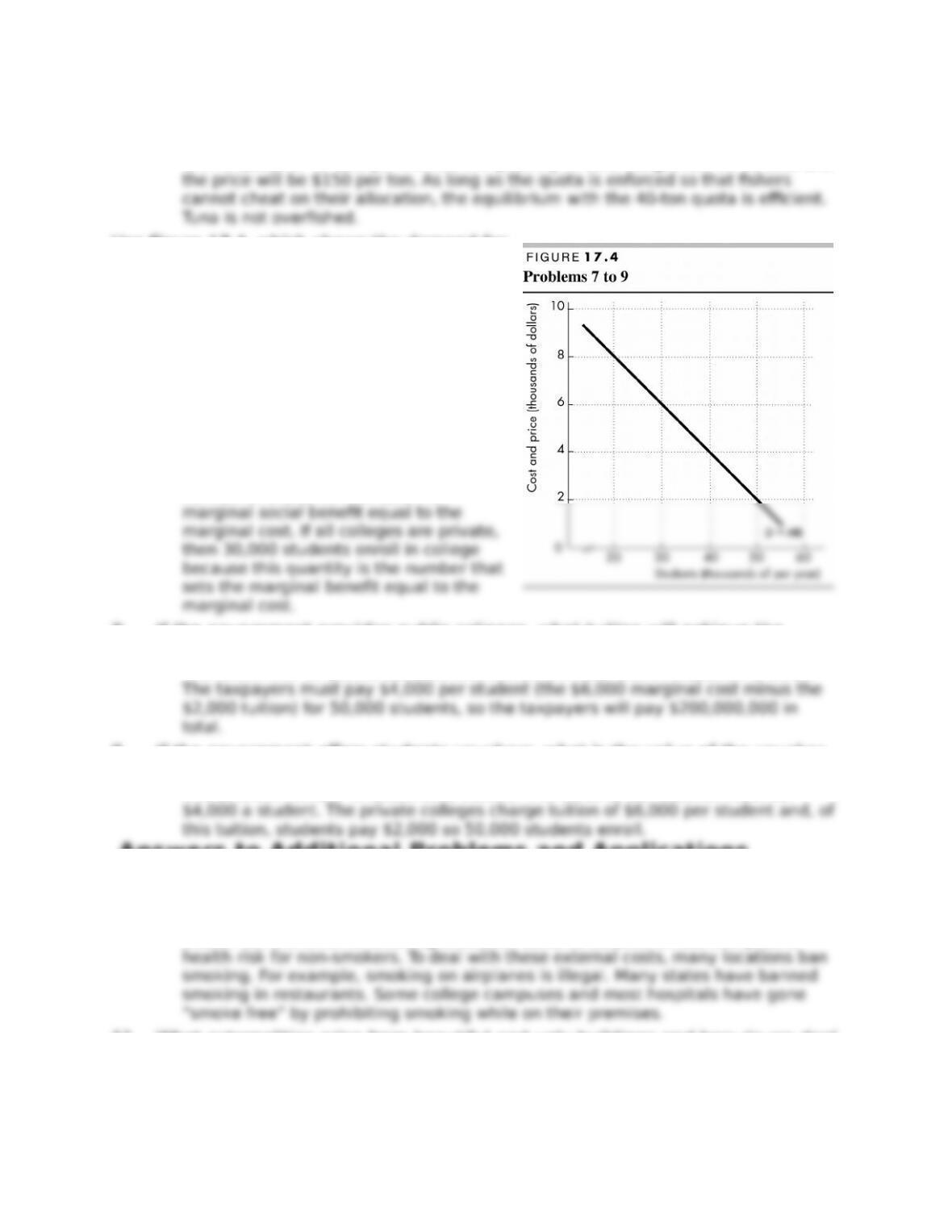
Use Figure 17.4, which shows the demand for
college education, to work Problems 7 to 9.
The marginal cost is a constant $6,000 per
student per year. The marginal external
bene4t from a college education is a
constant $4,000 per student per year.
7. What is the e1cient number of
students? If all colleges are private,
how many people enroll in college and
what is the tuition?
The e1cient number of students is
50,000 because this quantity is the
number of students that sets the
8. If the government provides public colleges, what tuition will achieve the
e1cient number of students? How much will taxpayers have to pay?
The tuition will be $2,000 because this tuition will lead 50,000 students to enroll.
9. If the government o)ers students vouchers, what is the value of the voucher
that will achieve the e1cient number of students?
The e1cient number of students is 50,000. The value of the voucher must be
Answers to Additional Problems and Applications
10. What externalities arise from smoking tobacco products and how do we deal
with them?
There are at least two externalities from smoking. First, many people who do not
smoke 4nd the smell of smoking o)ensive. Second, tobacco smoke can pose a
11. What externalities arise from beautiful and ugly buildings and how do we deal
with them?
Beautiful buildings create external bene4ts from the pleasure that people get from
observing them. For ugly buildings, it is the reverse: They create external costs
33
3 4
12. Betty and Anna work at the same o1ce in Philadelphia and they have to
attend a meeting in Pittsburgh. They decide to drive to the out-of-town
meeting together. Betty is a cigarette smoker and her marginal bene4t from
smoking a package of cigarettes a day is $40. Cigarettes are $6 a pack. Anna
dislikes cigarette smoke, and her marginal bene4t from a smoke-free
environment is $50 a day. What is the outcome if
a. Betty drives her car with Anna as a passenger?
If Betty drives her car, Betty has the property right to the air in her car. Anna can
o)er to pay Betty some amount more than $34 and less than $50 to not smoke.
b. Anna drives her car with Betty as a passenger?
If Anna drives her car, Anna has the property right to the air in her car. Betty will
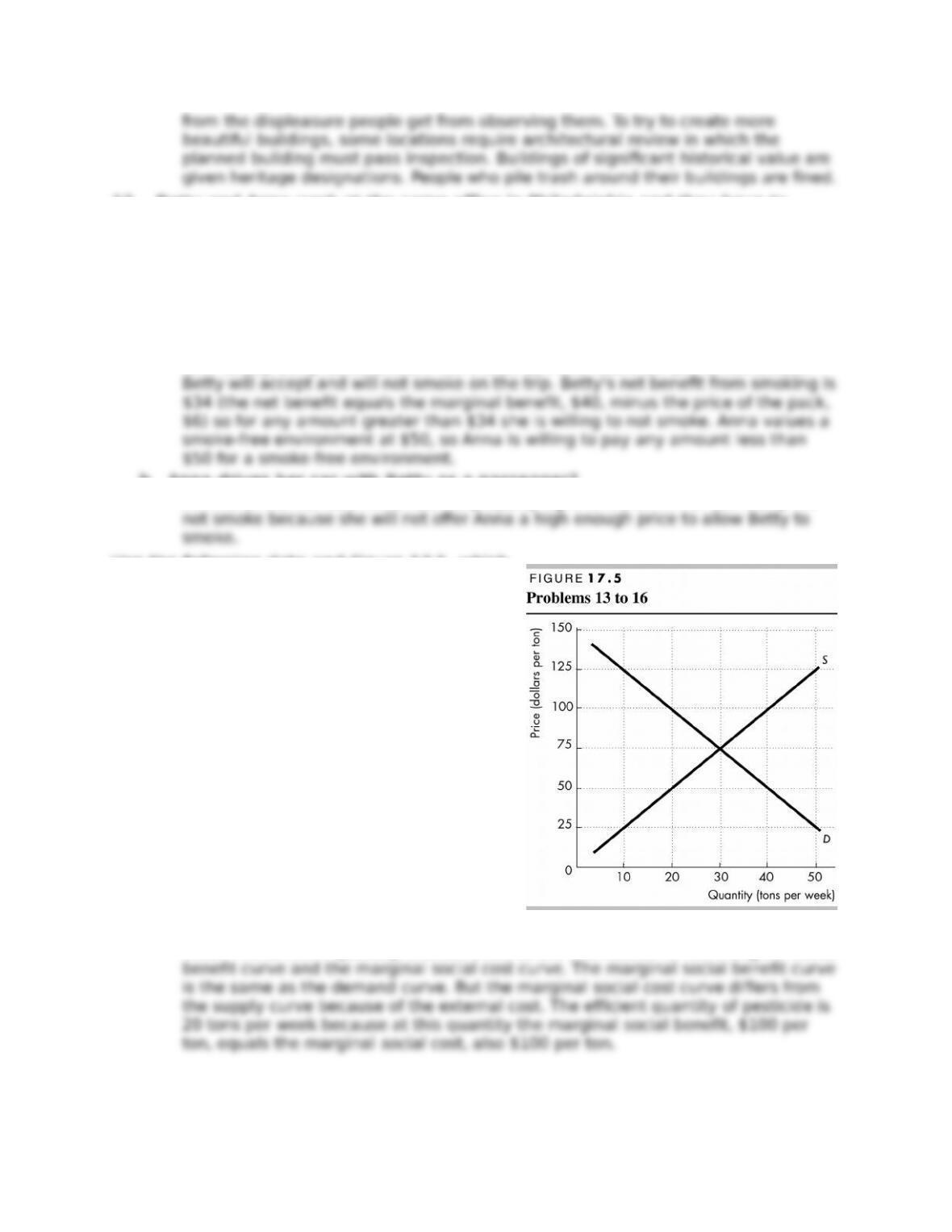
Use the following data and Figure 17.5, which
illustrates the market for a pesticide with no
government intervention, to work Problems
13 to 16.
When factories produce pesticide, they also
create waste, which they dump into a lake on
the outskirts of the town. The marginal
external cost of the waste is equal to the
marginal private cost of producing the
pesticide (that is, the marginal social cost of
producing the pesticide is double the
marginal private cost).
13. What is the quantity of pesticide
produced if no one owns the lake and
what is the e1cient quantity of
pesticide?
If no one owns the lake the equilibrium
quantity of pesticide produced is
determined at the intersection of the demand curve and supply curve, 30 tons per
week. The e1cient quantity is determined at the intersection of the marginal social
34
W H A T I S E C O N O M I C S ? 3 5
14. If the town owns the lake, what is the quantity of pesticide produced and how
much does the town charge the factories to dump waste?
Assuming that the transactions costs are low so that the Coase theorem applies, if
15. If the pesticide factories own the lake, how much pesticide is produced?
Assuming that the transactions costs are low so that the Coase theorem applies, if
16. If no one owns the lake and the government levies a pollution tax, what is the
tax that achieves the e1cient outcome?
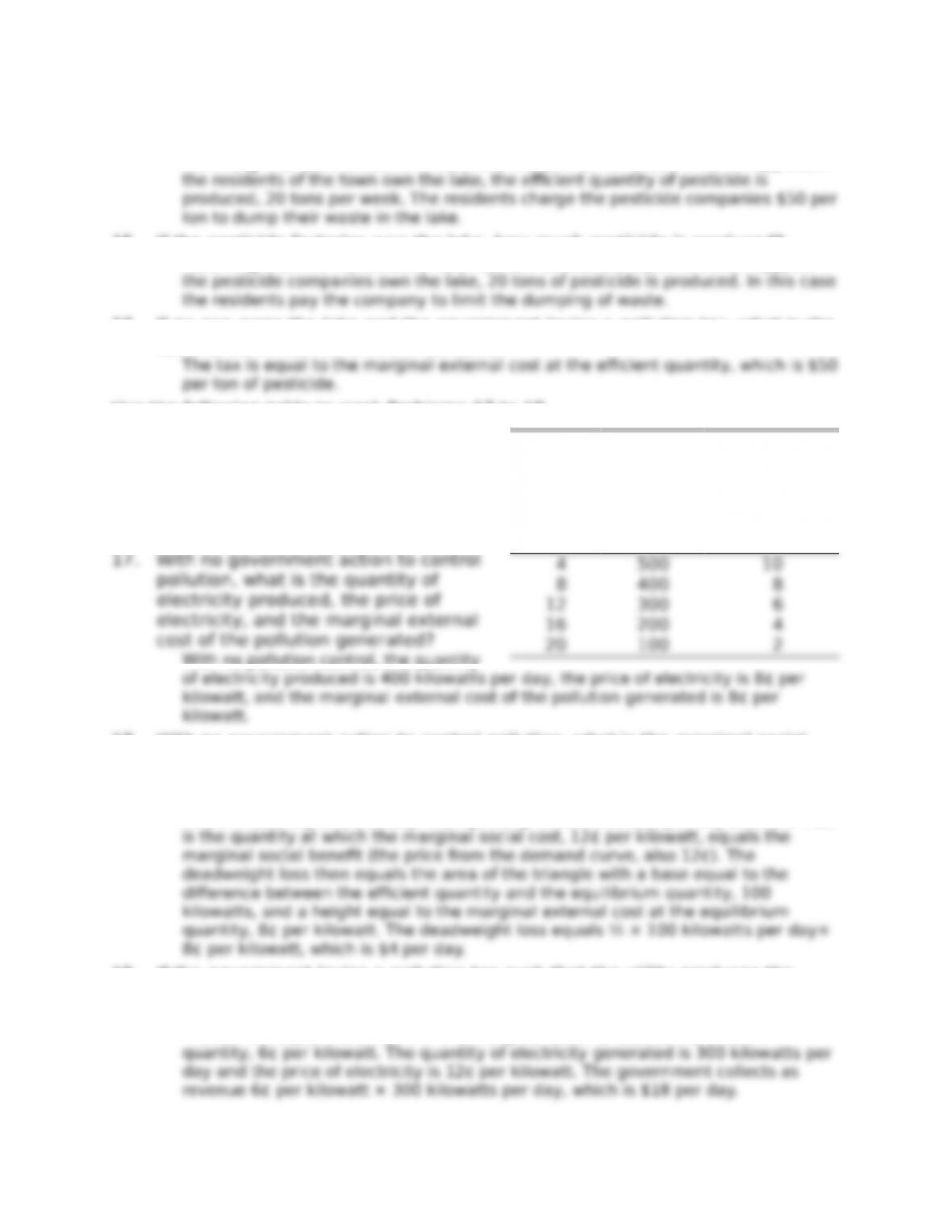
Use the following table to work Problems 17 to 19.
The 4rst two columns of the table show the
demand schedule for electricity from a coal
burning utility; the second and third
columns show the utility’s cost of producing
electricity. The marginal external cost of the
pollution created equals the marginal cost.
17. With no government action to control
With no pollution control, the quantity
18. With no government action to control pollution, what is the marginal social
cost of the electricity generated and the deadweight loss created?
With 400 kilowatts of electricity being produced, the marginal social cost is 16¢
per kilowatt. To calculate the deadweight loss, it is necessary to determine the
e1cient quantity of electricity. That quantity is 300 kilowatts per day because that
19. If the government levies a pollution tax such that the utility produces the
e1cient quantity, what is the price of electricity, the tax levied, and the
government’s tax revenue per day?
The tax will equal the amount of the marginal external cost at the e1cient
Price
(cents
per
kilowatt
)
Quantity
demande
d
(kilowatts
per day)
Marginal cost
(cents per
kilowatt)
35