
W H AT I S E C O N O M I C S ? 1 8 5
T h e B i g P i c t u r e
Where we have been:
Achieving eciency by equating marginal social bene!t and marginal social
cost introduced in Chapter 2 and elaborated upon in Chapter 5 is the key
concept used in this chapter. Mixed goods with external costs and the problem
of common resources were introduced in Chapter 16 as was the idea that
public choices might improve resource allocation or might make things worse.
Where we are going:
The eciency analysis introduced in Chapter 16 is extended in this chapter to
the case where private and social costs diverge and where resources are
common rather than private. Public choices about how to address the resulting
misallocations of resources are also analyzed.
N e w i n t h e Tw e l f t h E d i t i o n
This chapter has signi!cantly revised the material dealing with pollution.
Mandating clean technology is now discussed, along with taxes and the Coase
theorem. A section dealing with the positive externality from knowledge is now
included. The new Economics in the News examines how mandating a switch from
generating electricity from coal to natural gas a0ects the deadweight loss from
emissions leading to climate change. A new Worked Problem section has been
added. The Worked Problem gives information on the price, marginal bene!t,
marginal cost, and marginal external bene!t of exercise. It then shows the
students how to calculate the competitive market quantity, the marginal social
bene!t schedule, and the ecient quantity. To include the new Worked Problem
without lengthening the chapter, some problems have been removed from the
Study Plan Problem and Applications. These problems are in the MyEconLab and
are called Extra Problems.
17EXTERNALITES
C h a p t e r
185
1 8 6
Lecture Notes
Externalities
I. Externalities in Our Lives
External costs result when actions cause negative e0ects on bystanders. This
chapter considers why private markets might not act in the social interest and
whether government action can o0er incentives so that pollution and overuse of
common resources is less likely to occur.
An Economics in Action detail points out that many types of air pollution are less serious
today in the United States than they were in the past. But rising CO2 in the atmosphere has
accompanied an increase in the global temperature.
Private Costs and Social Costs of Pollution
A private cost of production is a cost that is borne by the producer. Marginal private
cost (MC) is the cost of producing an additional unit of a good or service that is borne
by the producer of that good or service.
An external cost is a cost of producing a good or service that is not borne by the
producer but is borne by other people. A marginal external cost is the cost of
producing an additional unit of a good or service that falls on people other than the
producer.
Marginal social cost (MSC) is the marginal cost incurred by the entire society—by
the producer and by everyone else on whom the cost falls—and is the sum of
marginal private cost and marginal external cost:
MSC = MC + Marginal external cost.
Have the students consider what is included in the idea of marginal external costs. Be sure
that they understand that external costs are the costs of either cleaning up the damage
caused by the polluting activity or the extra costs of having to take actions to avoid the
damage in the !rst place. Emphasize that both actions require payment by people other
than the producer or consumer, which is why the costs are considered “external.”
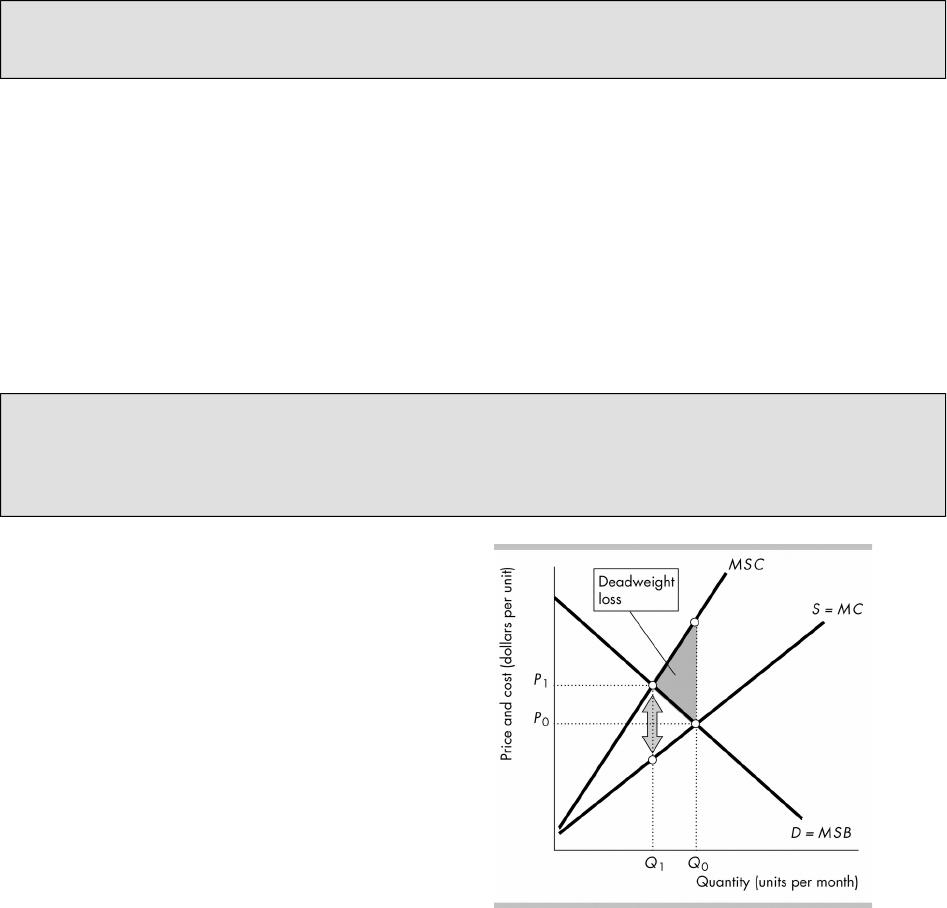
The !gure shows the marginal private cost
curve (MC) and the marginal social cost
curve (MSC) for a good with an
external cost. The vertical distance
between the two curves is the
marginal external cost.
Because the marginal social cost
includes the marginal private cost and
the marginal external cost, the
marginal social cost exceeds the
marginal private cost (MSC > MC) for
all quantities.
The ecient quantity of output
occurs where the marginal social cost
equals marginal bene!t, that is,
where MSC = MSB. In the !gure, the
ecient quantity is Q1. If the external cost re>ects pollution, there is still some
pollution created but it is the ecient quantity of pollution.
An unregulated market produces where S = D. In the !gure, the unregulated
market is at Q0. At this level of output, MSC exceeds MSB so there is inecient
overprovision and a deadweight loss, as illustrated in the !gure.
186

W H A T I S E C O N O M I C S ? 1 8 7
An At Issue case considers whether more should be done to eliminate carbon emissions.
While most agree that incentives need to change, there is fundamental disagreement about
how to change incentives. One side, represented by the Stern Review, argues for taxes on
prices on carbon emissions. The other side is taken by the Copenhagen Consensus, which
argues that raising the price of carbon emissions today has high present costs and low
future bene!ts.
Three Approaches to Address Negative Externalities
Three approaches can be taken to address the misallocation of resources created by the
negative externality
Establish property rights
Mandate clean technology
Tax or price pollution.
Establish Property Rights and the Coase Theorem
Property rights are legally established titles to the ownership, use, and disposal of
factors of production, goods, and services that are enforceable in the courts.
Assigning property rights can reduce the ineciency arising from an externality.
Once property rights are given, polluters can respond by using an abatement
technology or by producing less and thereby polluting less.
The Coase theorem is the proposition that if property rights exist, if only a small
number of parties are involved, and if the transactions costs are low, then private
transactions are ecient. Transactions costs are the opportunity costs of
conducting a transaction.
A remarkable feature of the Coase theorem is that it does not matter if the property
right is given to the creators of the externality (the polluters) or to the victims. In
either case, the result will be ecient.
If the polluters value the bene!ts from the activity generating the pollution more highly
than the victims value being free from the pollution (that is, the cost of reducing the
pollution exceeds the bene!t from the reduction), then the ecient outcome is for the
pollution to continue. If polluters are assigned the right to pollute, the victims are not able
to pay enough to convince the polluters to stop. If the victims are assigned the property
right to be free from pollution, then the polluters are able to pay the victims sucient
compensation to continue polluting. Either way, the pollution continues.
If the victims value the bene!ts from being free from pollution more highly than the
polluters value the bene!ts of the pollution, (that is, the bene!t from reducing pollution
exceeds the cost of the reduction) then the ecient outcome is for the pollution to stop. If
the polluters are assigned the right to pollute, then the victims are willing to pay the
polluters sucient compensation to stop the pollution. If the victims are assigned the right
to be free from pollution, then the polluters are not able to pay the victims enough to allow
them to continue polluting. Either way, the pollution stops.
The role of property rights in the market. Explain that when the property rights are
well de!ned, the owner of that right receives the full social bene!t and bears the full social
cost of using that resource. Assigning property rights “internalizes” the externality. The best
government policies emulate, rather than replace, the market process. Emphasize that of
all the possible government policies to increase eciency relative to unregulated market
outcomes, the ones that can potentially work the best are those that emulate the market
process rather than replace it.
In the case of negative externalities like pollution, the government can choose from three
policies (emissions charges, pollution taxes, or cap-and-trade), all of which require the
government to assess the marginal social costs and bene!ts to !nd the initial optimal level
of aggregate pollution to allow. However, the !rst two policies require the government to
constantly monitor the market and change the taxes or emissions permits to re>ect
187

1 8 8
changes in: i) the bene!ts of the goods or services made by the polluting process, or ii) the
costs of pollution abatement. The third policy forces the very !rms who are doing the
polluting to internalize this monitoring process by constantly comparing the cost of pollution
abatement technology with the market price for tradable permits. Governments (and the
taxpayers) are relieved of the monitoring and implementation cost burdens of pollution tax
or emissions charge policies.
Mandate Clean Technology
An abatement technology is a production technology that reduces or prevents
pollution. Cutting production will also reduce pollution and avoid the expense of
purchasing abatement technologies. Direct regulation that requires speci!c
abatement technologies can and has reduced emissions, but economists are
skeptical of this approach because it is not always the least cost alternative.
Tax or Cap and Price Pollution
Taxes: The government can set a tax equal to the marginal external cost, so that
marginal private cost plus the tax equals marginal social cost: MSC = MC + Tax. In
the !gure, the appropriate tax equals the length of the double headed arrow. These
sorts of taxes are called Pigovian taxes, in honor of the British economist Arthur
Cecil Pigou, the British economist who !rst proposed this approach to externalities.
An Economics in Action case reviews the use of taxes in British Columbia, Ireland, and the
United Kingdom. It concludes that whether it is overtly a carbon tax or simply a tax on
gasoline, the taxes reduce carbon emissions.
Cap-and-trade: The government sets a limit on the total amount of pollution
allowed, ideally the ecient amount. Initially the government allocates the cap
across the !rms by issuing marketable permits, wherein each !rm is assigned
permits that allow it to emit a certain amount of pollution. The !rms are allowed to
trade the permits. The market in permits determines the price of a permit and !rms
will buy or sell permits until their marginal cost of pollution reduction equals the
price of a permit.
An Economics in the News case thoroughly examines the Obama administration’s plan to
cut carbon dioxide emissions from power stations, primarily by decreasing use of coal to
generate power. Decreasing the use of coal decreases the deadweight loss from coal
emissions. Switching to natural gas decreases the deadweight loss from generating
electricity.
Coping with Global Externalities
The United States has made its own air much cleaner. But global warming and
climate change cannot be solved by a single, albeit large, industrial economy.
A lower CO2 concentration is a global public good and like all public goods leads to
free rider problems. No mechanisms currently compel participation in global carbon
reduction programs.
An Economics in Action case reviews the global prisoners’ dilemma in reducing carbon
emissions. If a nation reduces carbon emissions, its costs are higher than its trading
partners, making its exports less competitive. But if all nations reduced carbon emissions,
all nations would be better o0.
II. The Tragedy of the Commons
The tragedy of the commons is the absence of incentives to prevent the overuse
and depletion of a commonly owned resource. When nobody owns a resource, each
individual consumer fails to consider the full opportunity cost of consuming it, so the
resource is consumed at a higher than inecient rate.
188
W H A T I S E C O N O M I C S ? 1 8 9
The example of the commons problem comes from medieval England. Grasslands
near a town were called the commons because they were publicly accessible by all
villagers to support their livestock. These grasslands were over-grazed and usually
couldn’t support much livestock.
Are there examples of the “tragedy of the commons” on campus? Have the
students consider the many problems arising from the many commons areas on campus:
Why does so much trash like candy wrappers, gum stuck to the pavement and cigarette
butts litter the sidewalks and entry ways of all the buildings on campus?
Why does the library implement such a strict rule over the level of noise that students
can make (no loud conversations, laughing, etc.) in the open areas in and around the
library book shelves?
Why do some people talk incessantly at the back of a large classroom when they know it
bothers most of the students around them?
Unsustainable Use of a Common Resource
A renewable natural resource is one that replenishes itself by the birth and growth of
new members of the population. For !sh, the sustainable catch is the quantity of !sh
that can be caught year after year without depleting the stock.
A common resource is being used unsustainably of its use decreases the stock of the
resource.
Sustainable use of a resource is the rate of production that can be maintained
inde!nitely. As more of a renewable resource is harvested, there is less left to
reproduce and replace what has been harvested. If heavy harvesting depletes the
resource stock to levels that are too low to replace the amount harvested, then the
size of the stock available for harvest declines over time and that harvest rate is not
sustainable.
If the quantity of !sh harvested if less than the sustainable catch, the !sh stock
grows; if the quantity caught exceeds the sustainable catch, the !sh stock shrinks;
and if the quantity caught equals the sustainable harvest, then the !sh stock
remains constant and is available for future generations.
Ine(cient Use of a Common Resource
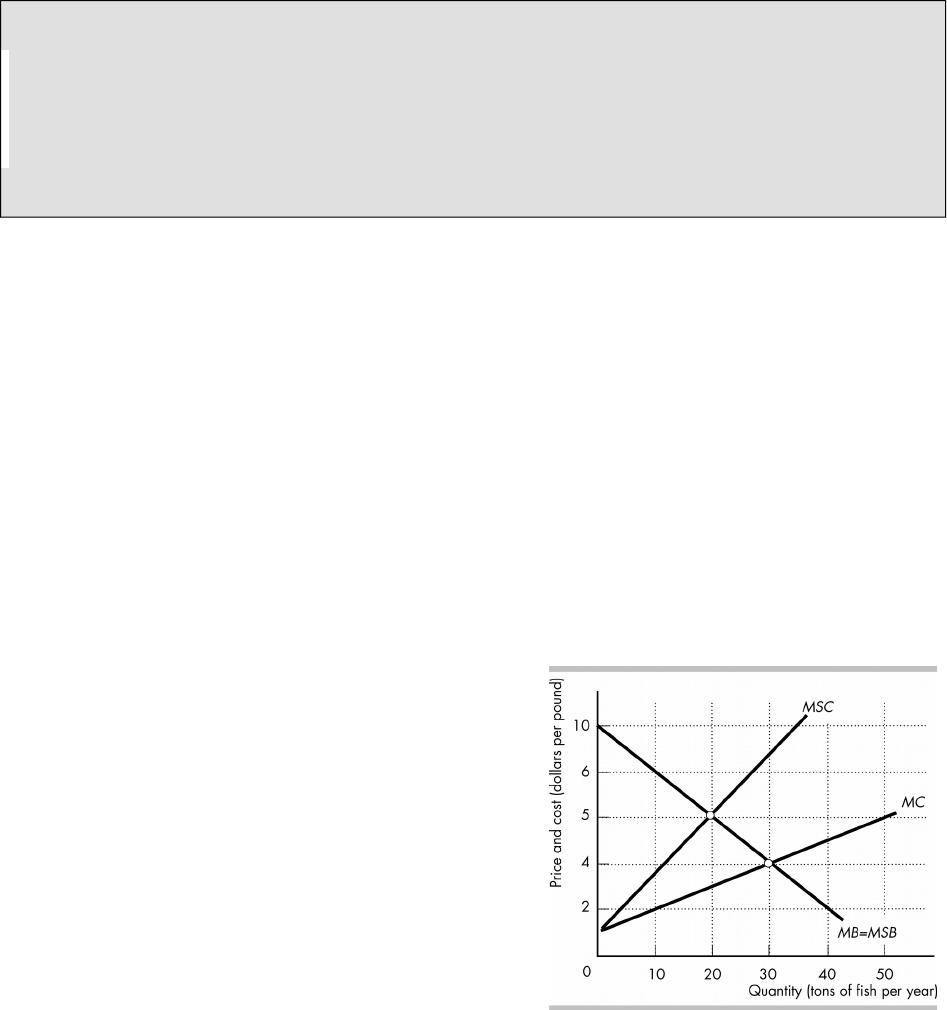
Marginal Private Cost: In the market for !sh,
the marginal private cost is the additional
cost incurred by keeping a boat and crew at
sea one more day. As the !gure shows,
marginal private costs, MC, increase as
more !sh are harvested due to diminishing
returns. The marginal private cost curve is
the same as the supply curve.
Marginal External Cost: This is the cost per
additional ton that one !sher’s production
imposes on all other !shers. This cost also
increases as the number of !sh harvested
increases.
Marginal Social Cost: The marginal private
cost plus the marginal external cost, MSC.
Because both of its components increase as more !sh are caught, marginal social
cost increases with the quantity of !sh harvested. The !gure shows the MSC curve.
Marginal Social Bene*t and Demand: The marginal private bene!t, MB, is the price
consumers are willing to pay for an additional quantity of !sh. If there is no external
bene!t, the marginal private bene!t equals the marginal social bene!t. As shown in
the !gure, the marginal private bene!t (and hence the marginal social bene!t)
189

1 9 0
decreases as more !sh are harvested and consumed. This curve is the same as the
demand curve.
Over*shing equilibrium: The market demand curve is the marginal social bene!t
curve because there are no external bene!ts. The market supply curve is the
marginal private cost curve. In the !gure the market equilibrium is 30 tons of !sh.
The ecient quantity sets the MSC equal to the MSB and is 20 tons of !sh in the
!gure. The equilibrium quantity exceeds the ecient quantity. A deadweight loss
occurs and the !sh stock is depleted.
Deadweight Loss from Over*shing: Every !sh harvested for which the marginal
social cost exceeds the marginal social bene!t increases the size of the deadweight
loss.
Achieving an E(cient Outcome
Society can use three di0erent methods to achieve the ecient outcome for common
resources:
Property rights: Property rights can be assigned to the common resource. The
owner then will receive the marginal bene!t of using the resource. The resource will
be used eciently and not overused. However, assigning property rights to some
resources, such as the !sh in the ocean, is not always feasible.
Production quotas: Quotas can be set for the ecient total catch, with the total
divided among all users. However, it is in every user’s self-interest to cheat on the
quota, so the quota might be ine0ective. In addition, the marginal cost of using the
resource varies across users, so an equal allocation of quotas generates an
inecient outcome.
Individual transferable quotas: An individual transferable quota scheme might
be used. An individual transferable quota (ITQ) is a production limit that is
assigned to an individual who is free to transfer the quota to someone else.
Less ecient users with higher marginal costs are willing to sell their quotas to
more ecient harvesters who are willing to buy them.
The price of the quota will equal the di0erence between the marginal social
bene!t of the quota minus the marginal private cost of using the quota. In the
!gure, at the ecient quantity the price of an ITQ is $3 per pound. Note that
marginal private cost + price of a quota = marginal social cost.
Users with the quotas will use the resource until the marginal social bene!t
equals the marginal private cost plus the price of the quota (the marginal private
cost plus the price of the quota equals the marginal social cost). If the quota was
set at the ecient quantity, the equilibrium is ecient.
An Economics in Action application considers ITQs. Evidence from Iceland, New Zealand,
and Australia suggests they work well to sustain !sh stocks. But they also reduce the size of
the !shing industry, making the industry oppose ITQs in every country in which they are
proposed. The opposition was not large enough to block them in New Zealand and Australia
but it did in the United States for a time. Since 2004 they have been used in 28 U.S.
!sheries. Economists have found them to be an e0ective tool.
III. Positive Externality: Knowledge
Private Bene*ts and Social Bene*ts
A private bene*t is a bene!t that the consumer of a good or service receives.
Marginal private bene6t (MB) is the bene!t from an additional unit of a good or
service that the consumer of that good or service receives.
An external bene*t from a good or service is a bene!t that someone other than the
consumer receives. A marginal external bene6t is the bene!t from an additional
unit of a good or service that people other than the consumer enjoy.
190
W H A T I S E C O N O M I C S ? 1 9 1
Marginal social bene6t (MSB) is the marginal bene!t enjoyed by the entire society
—by the consumer and by everyone else who enjoys a bene!t—and is the sum of
marginal private bene!t and marginal external bene!t:
MSB = MB + Marginal external bene!t.
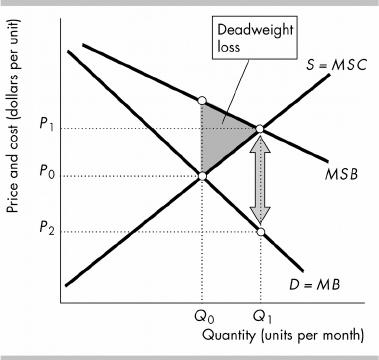
The !gure shows the marginal private
bene!t curve (MB) and the marginal social
bene!t curve (MSB) for a good with an
external bene!t. The vertical distance
between the two curves is the marginal
external bene!t.
Because marginal social bene!t includes
marginal external bene!t, the marginal
social bene!t exceeds the marginal
private bene!t (MSB > MB) for all
quantities.
The ecient quantity of output occurs
where the marginal social bene!t equals
marginal cost, that is, where MSB = MSC.
In the !gure, the ecient quantity is Q1.
An unregulated market, however,
produces where S = D. In the !gure, the unregulated market equilibrium is Q0. At
this level of output, MSB exceeds MSC so there is a deadweight loss, as
illustrated in the !gure.
Government Actions in the Market for with External Bene*ts
The ecient outcome is production of the quantity at which MSB = MSC. There are three
main methods that the government can use to cope with external bene!ts:
Public production: One possibility is public production, when a public authority
that receives its revenue from the government produces the good or service. (Public
colleges are an example.) In this case, the government can fund the authority to
produce the ecient quantity.
Private subsidies: A subsidy, a payment that the government makes to private
producers, can be used. If the government pays the producer a subsidy equal to the
marginal external bene!t, then the quantity produced by the private !rm increases
to that at which the marginal cost equals the marginal social bene!t and an ecient
allocation of resources occurs. In the !gure, the correct subsidy is equal to the length
of the double headed arrow.
Vouchers: A voucher, a token that the government provides to households to buy
speci!ed goods or services, can be used. Households receiving a voucher pay a
lower price to acquire the speci!c good or service, which increases their demand and
increases the quantity consumed.
Bureaucratic Ine(ciency and Government Failure
Government intervention might not make the marginal social bene!t equal the
marginal social cost. This situation is government failure.
Overproduction can result if bureaucrats seek to maximize their budgets and
programs.
Underproduction can result if bureaucrats pad their budgets and have wasteful
spending. In this case, the costs of enterprises run by bureaucracies often exceed
the minimum ecient cost.
Private subsidies might overcome some of the problems associated with
bureaucracies, but the subsidy budget ultimately depends on bureaucracies. It is
also in the best interests of those receiving the subsidies to try to maximize it,
leading to rent seeking activities and lost resources.
191

1 9 2
Vouchers have four advantages when it comes to insuring the ecient quantity of
the good or service is produced:
They can be used for public or private provision, which creates competition.
Governments set the value and total size of voucher programs which can avoid
bureaucratic padding and overprovision.
The public contribution is spread thinly across many participants, leaving little
incentive for individual recipients to engage in rent seeking.
The !nal consumer has the buying power, forcing !rms to compete by o0ering
more and better services.
An Economics in Action case considers charter schools’ role in improving educational
quality and controlling costs. Public provision, private subsidies and vouchers can all
increase the quantity of education, but not necessarily the quality while controlling costs.
Charter schools are funded as public schools, but set their own educational policies. When
spaces for students in charter schools are allocated by lottery (thereby eliminating
self-selection bias), charter school performance can be more easily tested. So far, charter
schools are doing well both in terms of achieving educational standards and controlling
costs.
192
A d d i t i o n a l P r o b l e m s
1. Fast-Food Trash Be Gone!
To help clean up the city, the Oakland City Council is considering a tax on
fast-food restaurants, gas station markets, liquor stores and convenience
stores that serve take-out food or beverages. The revenue from the tax will
be used to help pay the costs of clean-up crews picking up burger wrappers
and soda cans.
CNN, February 6, 2006
a. What is the external cost associated with takeout food and beverages?
b. Draw a graph to illustrate and explain why the market for take-out food and
beverages creates a deadweight loss.
c. Use your graph to illustrate and explain how Oakland’s policy might improve
eciency.
2. The table shows the marginal bene!t and
marginal cost of driving a private car into
central London. How many cars a day enter
London? In 2004, the city introduced a
congestion charge of £5 per car per day. How
many cars a day entered London after the
congestion charge was levied? What was the
reduction in congestion and how much
revenue did the congestion charge raise for
the city?
S o l u t i o n s t o A d d i t i o n a l
P r o b l e m s
1. a. The external cost is the pollution from discarding
the wrappers and beverage containers after use.
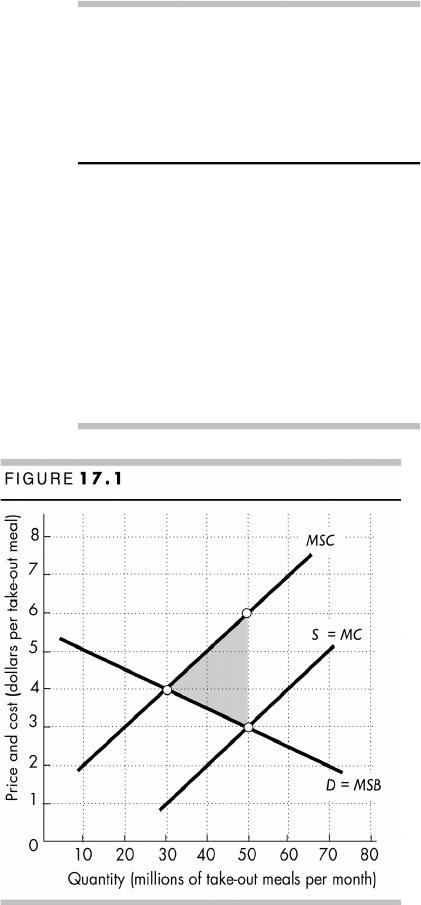
b. Figure 17.1 shows the market for take-out
food and beverages. The marginal social
cost, MSC, exceeds the marginal private
cost, MC, because of the marginal
external cost of pollution. The MC curve,
which is also the supply curve, lies below
the MSC curve. The equilibrium quantity
of take-out meals, which is determined at
the intersection of the supply curve and
the demand curve, is 50 million per
month. The ecient quantity of take-out
meals, which is determined at the
intersection of the marginal social cost
curve and the marginal social bene!t
curve, is 30 million meals per month. The
resulting deadweight loss from the
overproduction is equal to the area of the
grey triangle illustrated in the !gure. This
deadweight loss occurs because the
Numb
er of
cars
Margin
al
bene!t
(pound
s per
car)
Marginal
cost
(pounds
per car)
10,00
0
17 2
30,00
0
14 4
60,00
0
11 6
90,00
0
8 8
120,00
0
5 10
consumers of take-out meals do not pay the full marginal social cost of their take-out
meals. As a result the quantity of take-out meals consumed exceeds the ecient
quantity.
c. Presuming the tax equals the marginal external cost, which in Figure 17.1 is $3 per
meal, then in Figure 17.1 the tax shifts the S = MC curve so that it is the same as the
MSC curve. In this (optimal) case, the equilibrium quantity becomes the same as the
ecient quantity and there is no deadweight loss.
2. Before the congestion charge, 90,000 cars per day entered central London because
that is the quantity at which the marginal bene!t to the driver equals the marginal
cost to the driver. (Both equal £8.) After the congestion charge, the marginal cost to
the driver increased by £5, the amount of the charge. So after the congestion charge,
60,000 cars per day entered central London because that is the quantity at which the
marginal bene!t to the driver equals the marginal cost to the driver. (Both now equal
£11.) The congestion was reduced by 30,000 cars per day. The city gains £5 per car
entering central London. 60,000 cars now enter central London, so the city gains
revenue of £5 per car 60,000 cars, which is £300,000 per day.
A d d i t i o n a l D i s c u s s i o n Q u e s t i o n s
1. Do good fences make good neighbors? To illustrate the role of property
rights and prices in promoting ecient resource allocation within a market, tell
this story of a hearty apple tree that adorned the central square on the
campus of a local university. Each spring, an economics student watched as
the beautiful white apple blossoms transformed into little green spheres that
could eventually become juicy red delicious apples—if they were allowed to
mature. But he never once in his four years at school saw a single mature
apple hanging from that tree. Ask students why they think that was the case.
A few students will recognize that apples were often picked before they were
fully ripe. Every student wanting an apple assumed that waiting to pick one
when it was truly ripe would be futile, because someone else would surely pick
it one or two days earlier when it was almost as ripe and still somewhat
delicious. However, those people would think picking it only two days earlier
would also be futile, because someone else might pick it a day or two days
earlier than that when the apples were still somewhat good for eating if they
were allowed to ripen on the shelf. In this way the “best” harvest day for the
apples regressed until the very !rst day that any one apple would even be
worth trying to eat if it were left on the shelf to ripen. Every apple on the tree
was harvested before it was allowed to ripen suciently to create the highest
possible quality.
How else could the apples have been brought to their highest valued
use to society? The problem was that no individual had an ownership claim,
or property right, to the tree and the apples upon it. Perhaps, because it was a
state university, all the state taxpayers could lay claim to the tree. Either way,
no one could realistically expect to receive the full bene*ts that fully mature
apples could bring by protecting and maintaining the tree. This reality is at the
heart of the phrase, “What everybody owns, nobody takes care of.” A lack of
property rights meant that nobody would be held responsible for the full
opportunity cost of failing to wait until the apples were mature. Many di0erent
individuals acted in a way that destroyed all the potential value of those
apples to society, and none were held accountable for their actions.
Do property rights motivate socially bene(cial behavior using a
“carrot” or a “stick”? The answer is both. If someone were granted the
© 2016 Pearson Education, Inc.
1 7 0 C H A P T E R 1 7
property rights to the apple tree and its fruit, pilfering would be an illegal and
punishable o0ence. The owner would receive the full bene!ts from maintaining
the tree and waiting to harvest the apples until they were mature and would
maximize pro!t by picking the apples when their marginal cost equals their
marginal bene!t.
2. What is the optimal penalty for skipping class? Some professors penalize
students with excessive, unexcused absences by making a portion of a
student’s course grade depend on his or her attendance record. One reason
behind such a policy is that students interact in class and bene!t each other
with their insightful remarks and questions, creating a positive externality. So
a student missing classes deprives other students of these external bene!ts. To
draw a similar perspective on the issues of recycling and pollution abatement,
ask if a zero-tolerance policy giving an F to any student with even one
unexcused absence is optimal for the class. Just as a rule requiring zero
absences seems overly harsh, so would a rule requiring zero pollution. Zero
pollution can be achieved only by stopping all production, all transportation,
and, literally, all human activity. Clearly a balance between the marginal
social costs and marginal social bene!ts is required.
3. Evaluate the statement: “If this program saves even one life, it will
have been worth the money.” Ask the following questions: Is the value of
one life saved truly immeasurable? What is the opportunity cost of expending
resources to save one life? Could more than one life have been saved if the
same resources were used for a di0erent policy? Should we try to fund all
policies that could potentially save one life? Students should see the problem
with this idea. Just because something has value doesn’t mean we should use
resources to produce it. We must compare the value with its cost.
4. Can you apply the Coase theorem in your own life? Ask your students if
they’ve ever had the experience of studying for an important exam when a
neighbor decides to throw a party or play music loudly. At the very least,
students should understand that a party could interfere with their ability to
study e0ectively, generating an external cost. According to the Coase theorem,
this externality can be e0ectively dealt with by private transactions. The
student studying can o0er the partying student money to stop the party (or at
least move the party elsewhere). The partying student will accept the money if
the value of that money is at least as great as the cost of moving or stopping
the party. Whether the transaction takes place will depend on how much the
quiet time is worth to the studying student and how much the party is worth to
the partying student. If eciency would result in more quiet time and less
partying, then this private transaction will result in the ecient outcome.
5. Are laws that ban smoking economically e,cient? Many cities are
banning smoking in all public places including bars and restaurants. Consider
alternate solutions to a complete ban, especially given an application of
Coase’s theorem to smoking in shared oces. If smokers owned the air, would
smoking necessarily occur? What if nonsmokers owned the air?
© 2016 Pearson Education, Inc.
E X T E R N A L I T I E S 1 7 1