Answers to Additional Problems and Applications
11. Classify each of the following items as excludable, nonexcludable, rival, or
nonrival.
Homeland security
A Starbucks co%ee
A view of the Liberty Bell
The Appalachian Trail
A google Search
A google search is nonexcludable because anyone can search for the same item
12. Classify each of the following items as a public good, a private good, a
natural monopoly good, or a common resource. Explain your answer.
Measles vaccinations
Tuna in the Paci!c Ocean
Air service in the United States
Local storm-water system
13. Classify each of the following goods as either a private good, a public good, a
natural monopoly good, or none of the above.
Chewing gum
Cable TV
The New York City subway
A skateboard
The Santa Monica beach
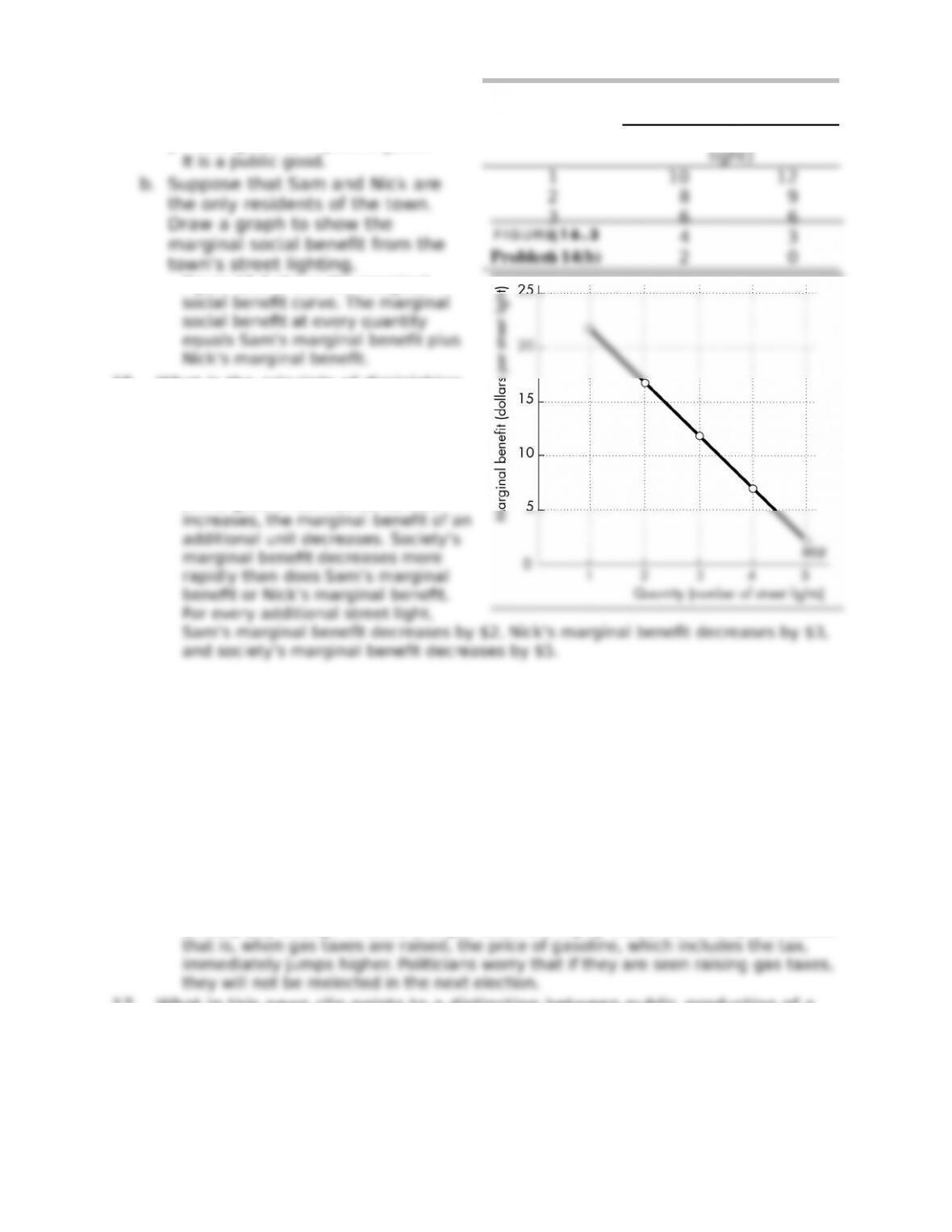
14. The table sets out the marginal bene!ts that Sam and Nick receive from the
town’s street lighting:
a. Is the town’s street lighting a
private good or a public good?
town’s street lighting.
Figure 16.3 shows the marginal
15. What is the principle of diminishing
marginal bene!t? In Problem 14,
does Sam’s, Nick’s, or the society’s
marginal bene!t diminish faster?
The principle of declining marginal
bene!t asserts that as the quantity
of the good or service consumed
Use the following news clip to work Problems 16 and 17.
A Bridge Too Far Gone
The gas taxes paid for much of America’s post-war freeway system. Now motorists
pay about one-third in gas taxes to drive a mile as they did in the 1960s. Yet
raising such taxes is politically tricky. This would matter less if private cash was
1ooding into infrastructure, or if new ways were being found to control demand.
Neither is happening, and private companies building toll roads brings howls of
outrage.
Source: The Economist, August 9, 2007
16. Why is it “politically tricky” to raise gas taxes to !nance infrastructure?
It is politically tricky to raise gas taxes because most people believe that they
already pay enough in taxes and gas taxes are highly visible when they are raised;
17. What in this news clip points to a distinction between public production of a
public good and public provision? Give examples of three public goods that
are produced by private !rms but provided by government and paid for with
taxes.
The di%erence between private provision of a public good and public provision
hinges around who—the private sector or the public sector—actually produces the
Number of
street lights
Marginal bene!t
Sam Nick
(dollars per street
light)
18. Vaccination Dodgers
Doctors struggle to eradicate polio worldwide, but one of the biggest
problems is persuading parents to vaccinate their children. Since the
discovery of the vaccine, polio has been eliminated from Europe and the law
requires everyone to be vaccinated. People who refuse to be vaccinated are
“free riders.”
Source: USA Today, March 12, 2008
a. Explain why someone who has not opted out on medical or religious
grounds and refuses to be vaccinated is a “free rider.”
The person who has not been vaccinating is free riding because he or she is
b. Polio in poor countries such as Myanmar has reappeared in 2010 and is
increasing. Are People are too poor to a%ord the vaccination “free riders”?
Should vaccinations be compulsory? Explain your answer.
19. Obamacare Hits Enrollment Goal
A last-minute enrollment surge enabled the White House to meet its 7 million
sign-up target for the A%ordable Care Act. President Barack Obama said on
Tuesday that 7.1 million people had signed up on federal or state exchanges
for coverage under the healthcare law.
Source: CNN, April 1, 2014
a. If the White House target was to enroll the eJcient quantity of families in
Obamacare, how would it have determined that target?
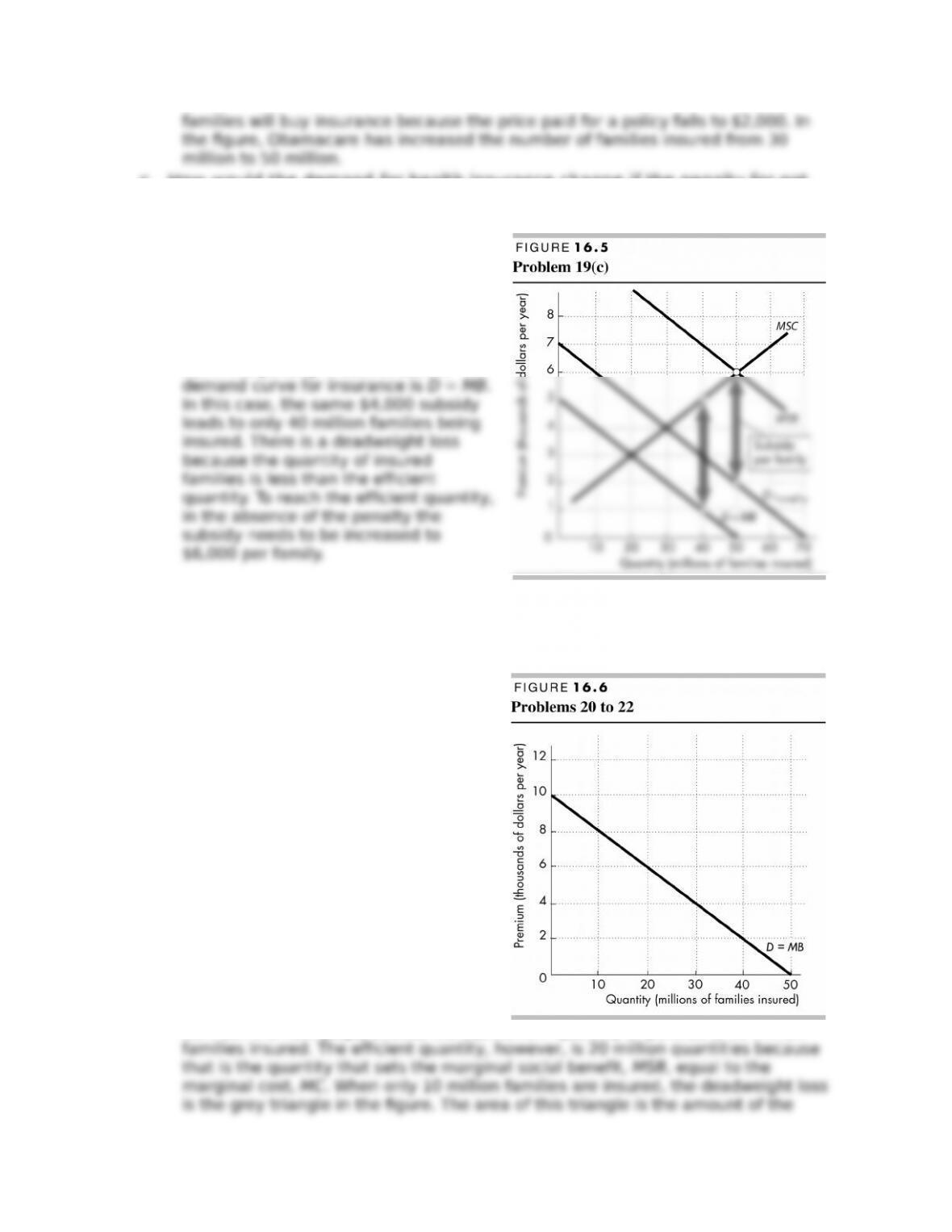
b. Draw a graph to illustrate the health
insurance market and illustrate how
the Obamacare subsidy in1uences the
number of families covered.
Figure 16.4 shows the market for health
insurance. In the absence of any
subsidy, the price of a health insurance
c. How would the demand for health insurance change if the penalty for not
signing up for Obama care were abolished? Draw a graph to illustrate the
outcome
The penalty increases the demand for
health insurance. In Figure 6.5, with the
penalty the demand curve for health
insurance is DPenalty and the $4,000
subsidy per family leads to the eJcient
quantity of families insured, 50 million.
But if the penalty is abolished, the
Use the following information and !gure to
work Problems 20 and 22.
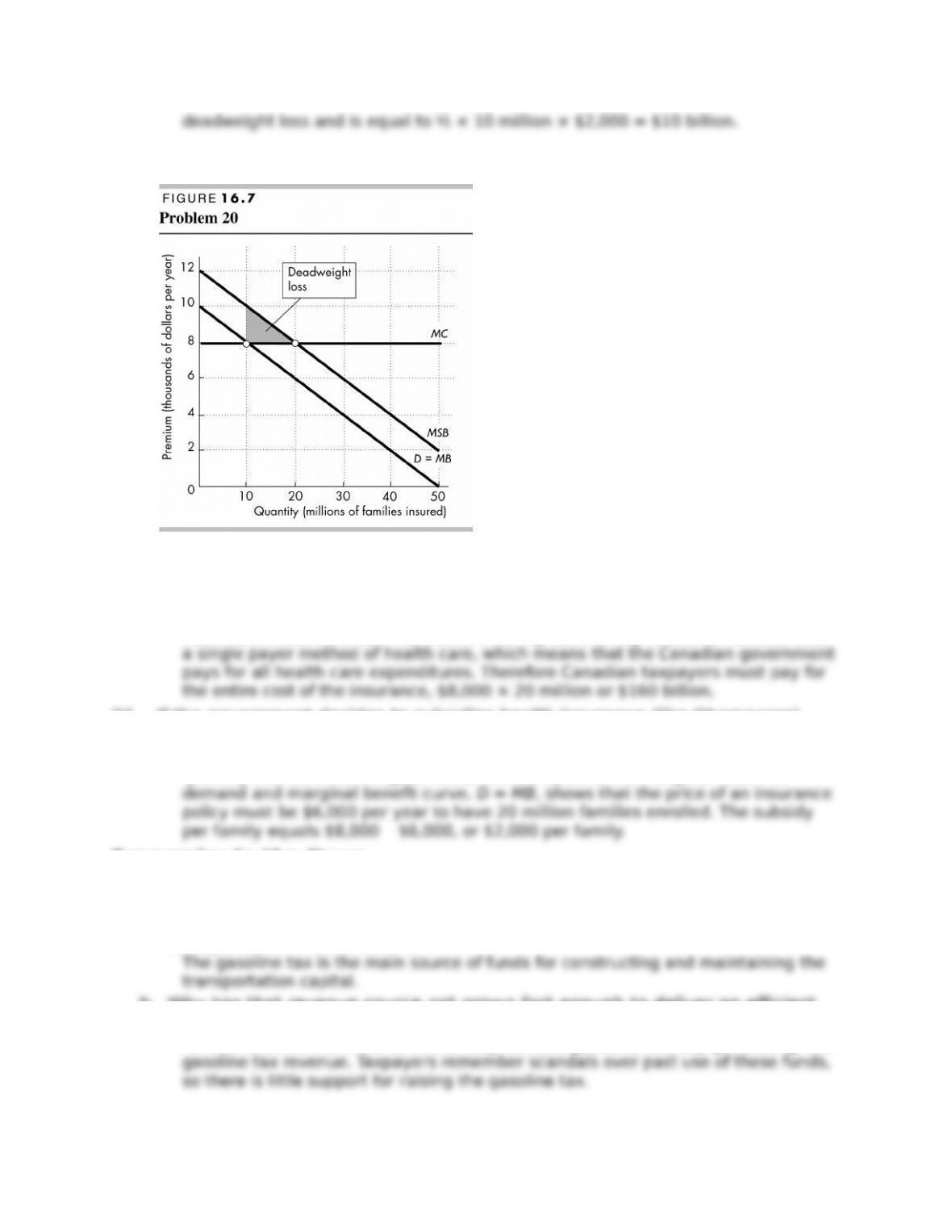
The marginal cost of health insurance is a
constant $8,000 a year and the !gure
shows the marginal bene!t and willingness
and ability to pay curve. Suppose that the
marginal social bene!t of insurance
exceeds the willingness and ability to pay
by a constant $2,000 per family per year.
20. If all health insurance is private and
the market for insurance is
competitive, how many families are
covered, what is the premium, and
what is the deadweight loss created?
If the market is private and
competitive, the price of health
insurance is $8,000 a year. As Figure
16.7 (on the next page) shows, the equilibrium quantity of policies is 10 million
21. If the government decides to provide public health insurance (like Canada),
what healthcare fee does it charge to achieve an eJcient coverage? How
much will taxpayers have to pay?
If the government provides public health insurance as does Canada, Canada will
insure 20 million families. The cost of insuring each family is $8,000. Canada uses
22. If the government decides to subsidize health insurance (like Obamacare),
what subsidy will achieve the eJcient coverage?
The subsidy must lead to insuring 20 million families because that is the eJcient
quantity that sets the marginal social bene!t equal to the marginal cost. The
Economics in the News
23. After you have studied Economics in the News on pp. 386–387, answer the
following questions:
a. What is the source of revenue for constructing and maintaining the
transportation infrastructure?
b. Why has that revenue source not grown fast enough to deliver an eJcient
scale of infrastructure provision?
As cars become more fuel eJcient, they use less gasoline, thereby generating less
c. What other revenue sources can you suggest that could provide a solution
to underprovision?
General tax revenue could be used to maintain the infrastructure. More tolls could
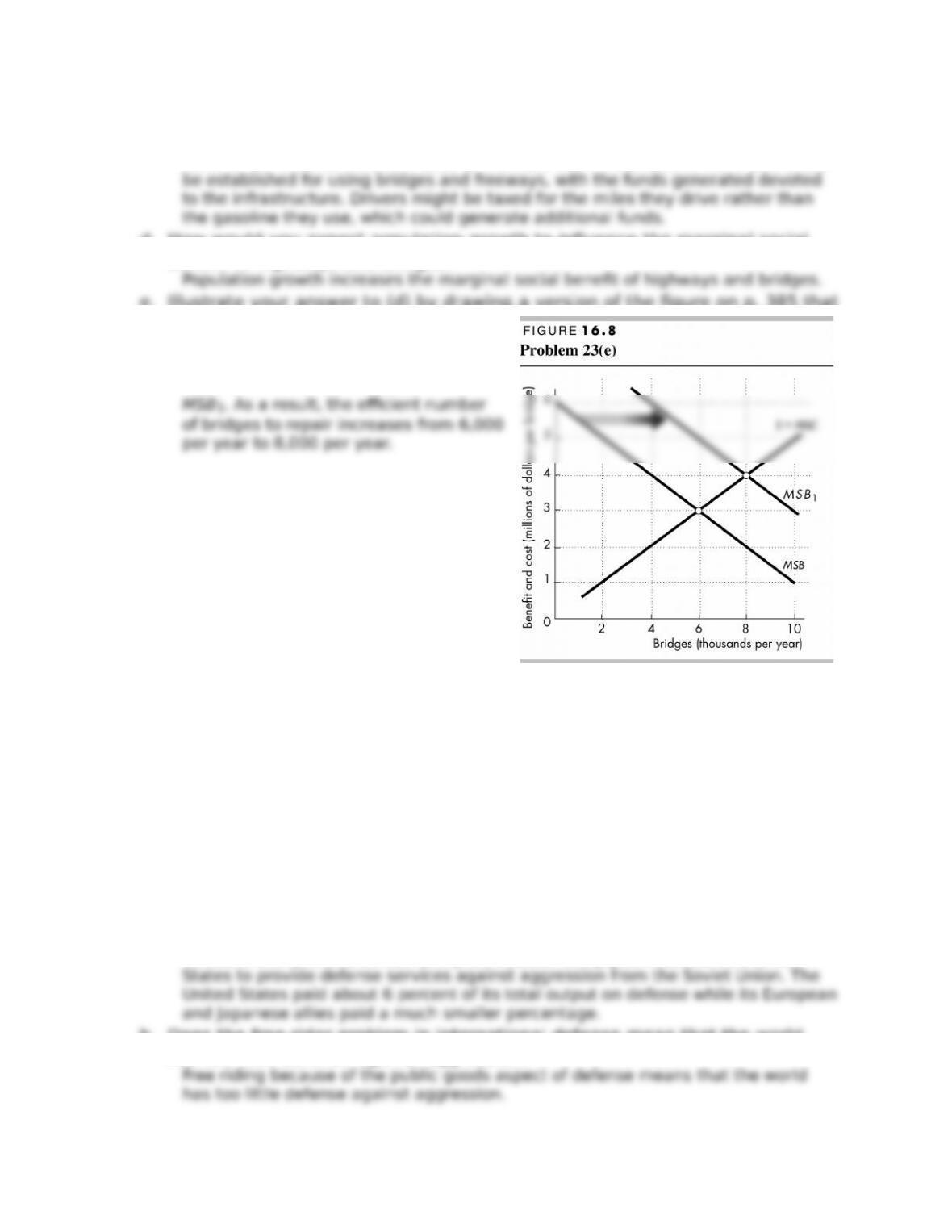
d. How would you expect population growth to in1uence the marginal social
bene!t of highways and bridges?
e. Illustrate your answer to (d) by drawing a version of the !gure on p. 385 that
shows the e%ect of an increase in
population.
Figure 16.8 shows how the marginal
social bene!t curve shifts rightward to
24. Who’s Hiding Under Our Umbrella?
Students of the Cold War learn that, to deter possible Soviet aggression, the
United States placed a “strategic umbrella” over NATO Europe and Japan,
with the United States providing most of their national security. Under
President Ronald Reagan, the United States spent 6 percent of total income
on defense, whereas the Europeans spent only 2 to 3 percent and the
Japanese spent only 1 percent, although all faced a common enemy. Thus the
U.S. taxpayer paid a disproportionate share of the overall defense spending,
whereas NATO Europe and Japan spent more on consumer goods or saved.
Source: International Herald Tribune, January 30, 2008
a. Explain the free-rider problem described in this news clip.
The free rider problem is that European nations and Japan relied on the United
b. Does the free-rider problem in international defense mean that the world
has too little defense against aggression?

c. How do nations try to overcome the free-rider problem among nations?
Nations can sign treaties that either obligate them to cut their weapons systems or
jointly develop new weapon systems. By cutting weapons, less additional defense