W H AT I S E C O N O M I C S ? 1 3
A n s w e r s t o t h e R e v i e w Q u i z z e s
Page 373
1. List the economic functions of governments.
Governments exist to establish and maintain property rights, to provide nonmarket
2. Describe the political marketplace. Who are the participants, what do they do,
and what is a political equilibrium?
Voters, .rms, politicians, and bureaucrats interact in the political marketplace.
Voters and .rms demand policies. Voters provide votes and/or funds while .rms
supply funds and other help to politicians or political parties that supply the
3. Distinguish among public goods, private goods, common resources, and
natural monopoly goods.
Public goods are nonexcludable and nonrival. As a result, anyone can consume the
good whether or not he or she paid for it and one person’s use of the good does not
decrease the amount available for other people. Private goods are excludable and
4. Why are healthcare and education not public goods and why do governments
play a large role in the markets for these services?
Healthcare and education are not public goods because they are rival and
excludable. But governments play a major role in the market for these services
1
6
PUBLIC CHOICES,
PUBLIC GOODS,
AND HEALTHCARE
13
1 4
Page 377
1. What is the free-rider problem? Why do free riders make the private provision
of a public good ine8cient?
If a .rm were to provide a public good, it would su2er from the free-rider problem,
which arises when non-paying consumers consume the public good without
2. Under what conditions will competition among politicians for votes result in
an e8cient provision of a public good?
Competition in the political marketplace will provide the e8cient quantity of a
3. How do rationally ignorant voters and budget maximizing bureaucrats
prevent the political marketplace from delivering the e8cient quantity of a
public good?
If the marginal bene.t to the voter of becoming well informed about a particular
policy issue is much smaller than the marginal cost of becoming well informed, the
voter is likely to remain rationally ignorant about the policy and the level of any
related public goods provision. The marginal bene.t of providing public goods is
4. Explain why public choices might lead to the overprovision rather than the
underprovision of a public good.
Rational ignorance of voters, combined with lobbying by public goods contractors
and bureaucrats, causes the political equilibrium to provide public goods at a
Page 383
1. What is special about healthcare that makes it a good provided by the
government?
The government provides healthcare services because the marginal social bene.t
of healthcare exceeds the marginal bene.t perceived by its consumers, Consumers
2. Why would the market economy produce too little healthcare?
The markets for healthcare will produce less than the e8cient quantity because
consumers of healthcare take account of only the bene.ts that accrue to them.
14
W H A T I S E C O N O M I C S ? 1 5
3. How do Canada and the United Kingdom deliver healthcare and what is the
problem left unresolved?
Canada and the United Kingdom provide healthcare using a universal coverage,
single payer system. Everyone is covered by health insurance and the government
4. What are the problem with Medicare and Medicaid?
The government expenditure on Medicare and Medicaid are determined by the
quantity of healthcare demanded, not by a .xed government budget. The scale of
5. What is the problem that Obamacare seeks to solve and how does the
solution work?
The Patient Protection and A2ordable Care Act, or Obamacare, attempts to
overcome the problem of too many people who do not have health insurance. It
seeks to make quality, a2ordable, private health-insurance plans available for
those currently uninsured and to stop insurance companies from denying coverage
A n s w e r s t o t h e S t u d y P l a n P r o b l e m s a n d
A p p l i c a t i o n s
1. Classify each of the following items as excludable, nonexcludable, rival, or
nonrival. Explain your answer.
A Big Mac
A Big Mac is excludable and rival. It’s excludable because a person must pay for a
Brooklyn Bridge
A view of the Statue of Liberty
Viewing the Statue of Liberty is nonexcludable and nonrival. It is nonexcludable
A hurricane warning system
A hurricane warning system is nonexcludable and nonrival. It is nonexcludable
15
1 6
2. Classify each of the following items as a public good, a private good, a
natural monopoly good, or a common resource. Explain your answer.
Highway control services
Internet service
Internet service is a natural monopoly good. Internet service is excludable because
Fish in the Atlantic ocean
UPS courier service
3. For each of the following goods, explain why a free-rider problem arises or
how is it avoided.
July 4th .reworks display
Interstate 81 in Virginia
Interstate 81 potentially has a free rider problem. However if the state of Virginia
Wireless Internet access in hotels
The public library in your city
The public library has a free rider problem because people can use the library
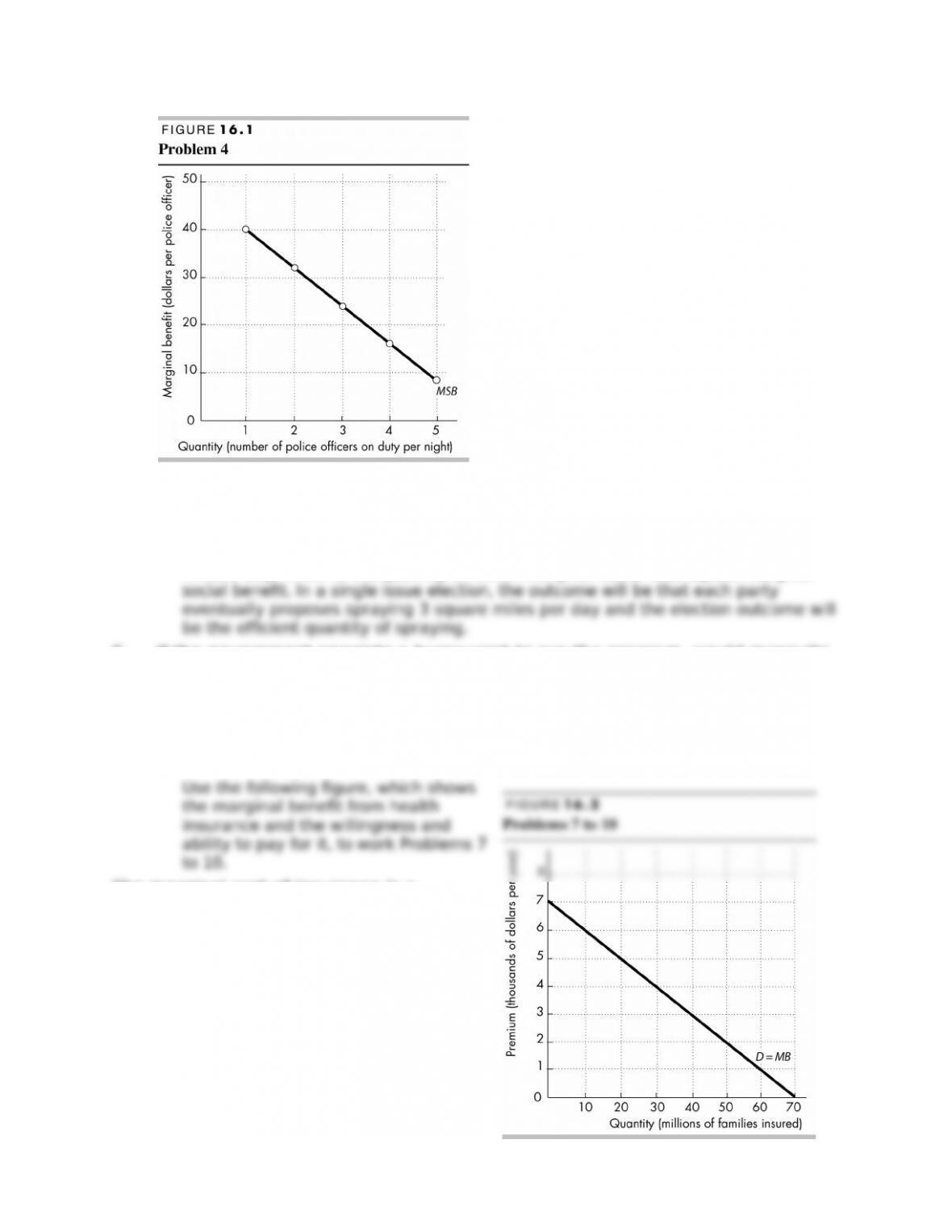
4. The table sets out the bene.ts that Terri and Sue receive from on-campus
police at night. Suppose that Terri and Sue are the only students on the
campus. Draw a graph to show the marginal social bene.t from the police at
night.
The marginal social bene.t at every
number of police o8cers equals
Police o8cers
night)
Marginal bene.t
o8cer)
1 18 22
2 14 18
3 10 14
4 6 10
5 2 6
16
W H A T I S E C O N O M I C S ? 1 7
Use the data on a mosquito control program
in the table to work Problems 5 and 6.
5. What quantity of spraying would a
private .rm provide? What is the e8cient quantity of spraying? In a
single-issue election on mosquito spraying, what quantity would the winner
provide?
Mosquito spraying is a public good and subject to free riding. As a result, a private
mosquito would supply no spraying. The e8cient quantity of spraying is 3 square
miles a day, which is the quantity at which marginal social cost equals marginal
6. If the government appoints a bureaucrat to run the program, would mosquito
spraying most likely be underprovided, overprovided, or provided at the
e8cient quantity?
With the bureaucratic department in charge of spraying, mosquito spraying likely
would be overprovided.
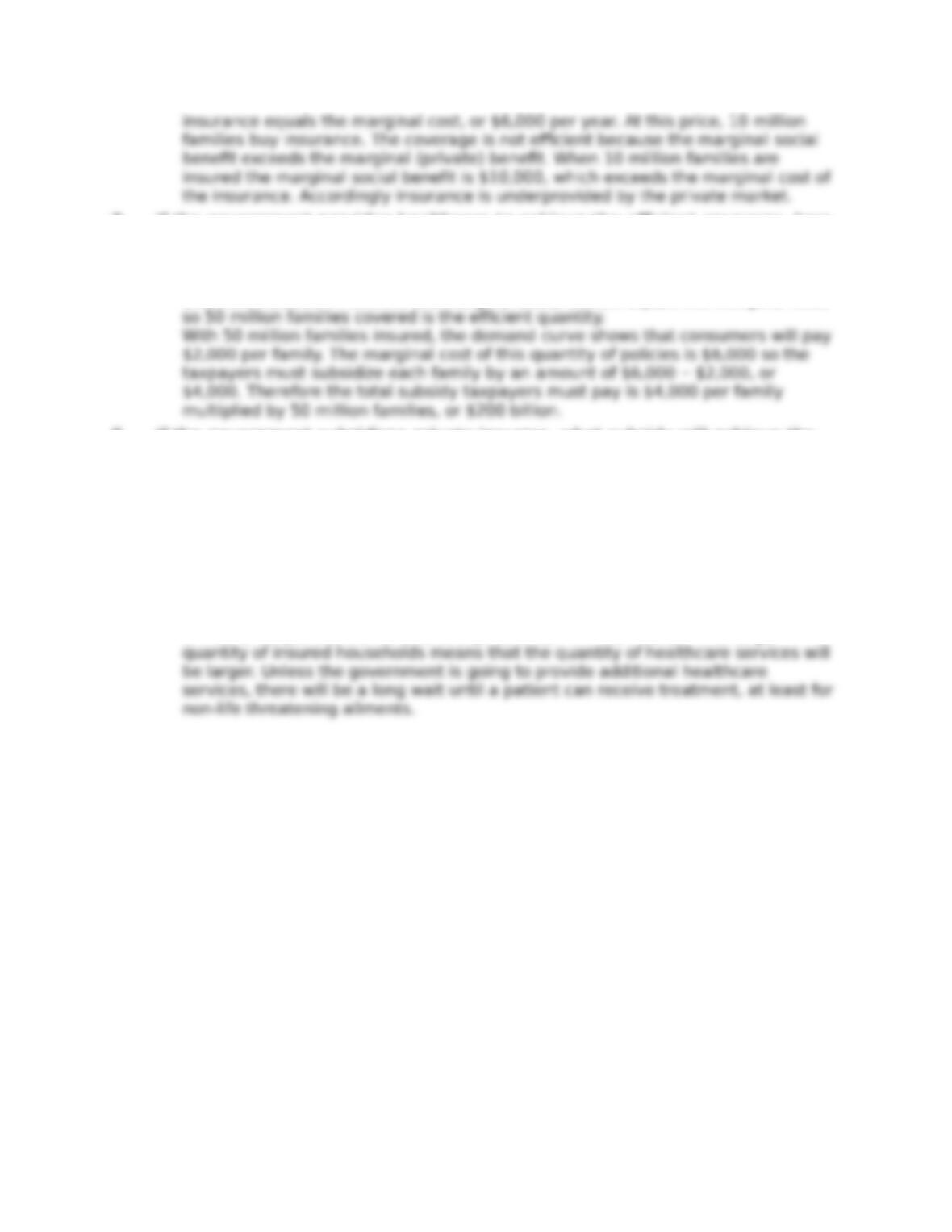
The marginal cost of insurance is a
constant $6,000 per family per year.
Marginal social bene.t from insurance
exceeds the willingness and ability to pay
by a constant $4,000 per family per year.
7. With no public health insurance
market, how many families buy
insurance, what is the premium, and
is the coverage e8cient?
With a private and competitive health
insurance market, the price of health
17
1 8
8. If the government provides healthcare to achieve the e8cient coverage, how
many families are covered and how much must taxpayers pay?
The e8cient quantity of health insurance is 50 million families covered. At this
quantity, the marginal social bene.t equals the marginal bene.t of $2,000 plus
$4,000, or $6,000. Therefore the marginal social bene.t equals the marginal cost,
9. If the government subsidizes private insurers, what subsidy will achieve the
e8cient coverage?
To insure 50 million families, the insurers’ total cost equals $6,000 per family
multiplied by 50 million, or $300 billion. With 50 million families covered, the
demand curve shows that a family is willing to pay $2,000 per policy. Accordingly
families will pay 50 million × $2,000, or $100 billion. Therefore the government
must provide a subsidy of $200 billion to private insurers.
10. If the government gave coverage to everyone what problems would arise in
the related market for healthcare services?
If the government gave everyone coverage, then 70 million families—the quantity
of insurance policies demanded at a price of $0—will be insured. This larger
18