
W H AT I S E C O N O M I C S ? 1 7 5
T h e B i g P i c t u r e
Where we have been:
A parallel is drawn between the equilibrium in markets, introduced in Chapter
3, and the concept of equilibrium in a political marketplace. The concept of
e%ciency, introduced in Chapter 2 and elaborated upon in Chapter 5, is used
in this chapter to assess market failure. The de)nitions of marginal social
bene)t, marginal social cost, and deadweight loss are used explore the
provision of public goods and mixed goods that have external bene)ts.
Where we are going:
Chapter 17 continues the analysis by studying the ine%ciencies that result
when private markets produce mixed goods with external costs and allocate
common resources. It also considers methods that can be used to )x the
misallocation. Chapters 18 and 19 cover the labor and other resource markets
and the resulting distribution of income. Redistribution of income is addressed
as a possible role for government in this chapter. Chapter 20 discusses risk
and uncertainty.
N e w i n t h e Tw e l t h E d i t i o n
In this edition, the focus and analysis of health care issues has been updated and
expanded. Applications have also been updated. A new Worked Problem section
has been added. The Worked Problem presents data on the marginal social cost of
mosquito spraying and three consumers’ marginal bene)t from the spraying. It
then shows the students how to calculate the (total) marginal social bene)t curve
and the e%cient quantity of spraying. To include the new Worked Problem without
lengthening the chapter, some problems have been removed from the Study Plan
Problem and Applications. These problems are in the MyEconLab and are called
Extra Problems.
16
PUBLIC CHOICES,
PUBLIC GOODS,
AND
HEALTHCARE
C h a p t e r
175

L e c t u r e N o t e s
Public Choices, Public Goods, and Healthcare
I. Public choices
A private choice is a decision that has consequences only for the person making it.
A public choice is a decision that has consequences for many people and perhaps
the entire society.
Decisions by political leaders and senior public servants might improve e%ciency,
but, as was observed in prior chapters, these choices might also make things worse
and lead to deadweight losses.
Why Governments Exist
Governments establish and maintain property rights, provide nonmarket
mechanisms for allocating scarce resources, and implement arrangements that
redistribute income and wealth.
Markets rely on property rights to function.
Choices made pursuing self interest may not always be in the social interest and
governments may reallocate resources.
The market economy delivers a distribution of income and wealth that many people
regard as unfair, so equity requires some redistribution.
Government failure occurs when government action leads to ine%ciency, which
could be underprovision or overprovision of resources to a given activity.
Public Choice and the Political Marketplace
The political marketplace is made up of many individuals each with their own
economic objectives. Four groups of decision makers—voters, )rms, politicians and
bureaucrats—interact in the political marketplace.
In the economic model of public choice, voters support the politicians whose policy
proposals make the voter better o>. Voters express their demand for policies by
voting, helping in campaigns, lobbying, and making political contributions.
In the economic model of public choice, )rms also support the politicians who policy
proposals make them better o> and express their demand for public goods and
services, but )rms can’t vote. They do make political contributions and engage in
lobbying activities.
Politicians are elected persons at all levels of government. They make the policies
that bureaucrats carry out. Politicians’ goals are to gain election and reelection, so
voters to a politician are like pro)ts to a )rm.
Bureaucrats are public servants who work in government departments. Their self
interest is best served by larger budgets, which bring more authority and prestige.
Political Equilibrium
All four groups make choices that are in their own self interest and are constrained
by what is feasible.
In a political equilibrium, the choices of all four groups are compatible and no
group can see a way of improving its position by making a di>erent choice.
Allocative e%ciency in the use of resources is possible but is not guaranteed.
The political marketplace does not work as smoothly as the private marketplace.
Throughout this text students have learned that competitive markets can deliver an
e%cient resource allocation:
Individuals and )rms act in their own self-interest, but in the private market (in the
absence of externalities) individuals receive the full bene)ts of making good decisions
with their resources, and bear the full costs of making poor decisions with their
resources. Market prices and pro)ts send signals to consumers and producers that
coordinate their decisions. In the absence of price Coors, price ceilings, quotas,

monopoly, and taxes, the competitive pressures of the market determine an equilibrium
price where the marginal social bene)t is equal to marginal social cost, and the
outcome is e%cient.
However, the political marketplace does not possess the same power as the competitive
market to convert self-interest into an e%cient outcome:
Individuals still act in their self-interest. As James Buchanan, the Nobel Prize winning
economist, once noted, when we pull the curtain closed in the voting booth to indicate
which representative we wish to elect, we do not suddenly sprout the wings of angels
and vote in the public interest. We vote our own best interests, possibly to the detriment
of the public interest. But one person, one vote does not ensure equal political inCuence
over the resource allocation process. Some avenues to seek favor from politicians and
bureaucrats require resources, which are unequally distributed. Individuals no longer
receive the full bene)ts nor bear the full costs of their decisions over publicly provided
resources, and so individuals are less motivated to act on the basis of complete
information. The absence of price and pro)t signals and incentives to make wise
decisions with publicly provided resources makes it di%cult to coordinate the decisions
of self-interested individuals to generate socially bene)cial outcomes. Many political
marketplace decisions over public goods provisions are inseparable, bundled together
as a package, which decreases the competitive pressures that force individuals to
respond to opportunity cost and marginal bene)t.
What is a Public Good?
Goods, services, and resources can be classi)ed along several dimensions:
Excludability: A good or service is excludable if only the people who pay for it are
able to enjoy its bene)ts. An automobile or watching an NFL game in person would
be excludable. A good or service is nonexcludable if everyone bene)ts from it
regardless of whether they pay for it. National defense or a town’s Fourth of July
)reworks display are nonexcludable.
Rivalry: A good, service, or resource is rival if its use by one person decreases the
quantity available for someone else. A blouse or a slice of pizza is rival. A good,
service, or resource is nonrival if its use by one person does not decrease the
quantity available for someone else. Watching television or national defense is
nonrival.
Examples: The more examples you give of each classi)cation, the easier this topic will be
for your students. Be sure to identify each characteristic for a given good. For example, a
candy bar is a private good. It is excludable because, if you purchased it, you can decide
who gets it. It is also rival because, once you eat it, there is less available for anyone else.
Sunshine, on the other hand, is a public good. It is nonexcludable because you can’t
determine who gets to use the sun and who can’t. It is nonrival because your use of the sun
does not diminish the amount of sun available for anyone else. Ask your students to think of
other goods and resources and evaluate each on the basis of these characteristics. More
examples are included in the “Additional Discussion Questions” section.
Is a highway a public good or a private good? Interstate highways are generally
public goods. They are nonexcludable because anyone is permitted to drive on the
interstate. When they are not congested, they are also nonrival because adding one more
car to the interstate has little to no impact on the ability of other drivers to continue using
the highway. However, interstate highways that charge a toll become excludable. And many
interstates become rival goods during rush hour. If a highway charges a toll and is often
jammed with tra%c, it is actually a private good.
© 2016 Pearson Education, Inc.
162 C H A P T E R 1 6

A Fourfold Classi%cation
Based on these di>erences, goods, services, or resources can be classi)ed into one of four
categories:
A private good is both rival and excludable. A cow owned by a dairy farmer is a
private good.
A public good is both nonrival and nonexcludable. National defense is a public
good.
A common resource is rival and nonexcludable. Fish in the ocean are a common
resource.
A natural monopoly is nonrival and excludable. Cable television is a natural
monopoly.
Is every publicly provided good a “public good”? Students often think that, by
de)nition, everything provided by the government is a public good. This belief is false. Point
out to them that many government services are neither nonrival nor nonexcludable:
Electricity provided by the TVA and many local governments, satellite launching services,
and food stamps are three quick examples. Food stamps are provided as a means of
redistribution. But for the goods and services that are rival and excludable (electricity and
satellites) the private market ought to be able to provide the e%cient allocation without
government provision.
Healthcare
Healthcare is actually two goods: Care supplied by doctors and other professionals
and insurance.
II. Providing Public Goods
The Free-Rider Problem
A public good creates a free-rider problem—the absence of an incentive for
people to pay for what they consume.
The free rider problem leads private markets to produce an ine%ciently small
quantity of a public good; that is, the private market underproduces a public good.
The marginal social bene)t from the public good exceeds the marginal social cost
and a deadweight loss arises.
Are you a free rider? Ask your students what they think would happen if Starbucks set
up a serve-yourself co>ee bar in the student union. No one would work the counter, and
charges would be collected on the honor system. How many of your students would actually
pay for co>ee in that case?
What free-rider problems do your students deal with on a daily basis?
In some classes the students are assigned to a group for completing a graded project,
where the grade earned on the project is shared by each group member. Sharing the
grade means that there are insu%cient incentives for each group member to provide the
level of e>ort that would achieve the highest potential grade for the group.
Waiting tables is a common part-time job for many students. Many restaurants make
the wait sta> share their tips with the other wait sta> and busboys that clear the tables.
Under this system, there are insu%cient incentives for the busboys and less-motivated
wait sta> to provide the level of service that maximizes tipping from diners.
Public restrooms are generally recognized as being far less clean than the vast majority
of users would like, especially compared to their own private bathrooms. There are
insu%cient incentives for each user of a public bathroom to keep it clean enough to
appease most users.
© 2016 Pearson Education, Inc.
P U B L I C C H O I C E S , P U B L I C G O O D S , A N D H E A LT H C A R E 163

Marginal Social Bene%t from a Public Good
Public goods have a marginal social bene)t that di>ers from the marginal social
bene)t for a private good. Because everyone can consume services from the same
unit of a public good, the marginal social bene)t of a public good is the maximum
amount that all the people are willing to pay for one more unit. The economy’s
marginal social bene)t curve for a public good is obtained by vertically summing
each individual’s marginal bene)t curve.
What is “vertical” vs. “horizontal” summation? Whether we add marginal bene)t
curves together vertically or horizontally is sometimes a source of confusion for students.
Tell them to focus on the unit of measurement on each axis. When we are looking at private
goods, we want to know how many units should be produced to satisfy market demand at a
given price. Because private goods are both rival and excludable, each buyer must have his
or her own units, so we must add together the number of units demanded by each
individual. In other words, we’re adding the horizontal coordinates (quantities) of individual
demand curves to get the market demand curve, and we say we are adding the individual
demand curves or marginal bene)t curves “horizontally.” For public goods that are nonrival
and nonexcludable, anyone who purchases a good is providing that good to everyone. If
every consumer in the market demands one unit of a good, we can’t simply add together all
of those units. Once one unit is provided to anyone, it is provided to everyone. The bene)t
of that unit will be determined by the sum of individual marginal bene)ts for that unit. An
individual’s marginal bene)t is measured as the y coordinate of an individual demand
curve, so to )nd the marginal social bene)t, we add all of the individual marginal bene)ts
together. We say we are adding the individual demand curves or marginal bene)t curves
“vertically.”
Marginal Social Cost of a Public Good
The marginal social cost of a public good is determined the same way as that of a
private good.
E+cient Quantity of a Public Good
The e%cient quantity of a public good is the quantity that sets the marginal social
bene)t equal to the marginal social cost. At this quantity, society’s net bene)t from
the public good is maximized.
Ine+cient Private Provision
A private market will produce an ine%cient quantity of a public good because of the
free rider problem. Consumers free ride by choosing not to pay for the public good,
and instead use the funds to purchase private goods.
E+cient Public Provision
Competition in the political marketplace can result in the e%cient provision of public
goods.
The Principle of Minimum Di4erentiation is the tendency for competitors
(including political parties) to make themselves similar in order to appeal to the
maximum number of customers. Consequently political parties tend to have similar
policies in order to appeal to the maximum number of voters.
For the political process to deliver e%cient outcomes in providing public goods,
voters must be well informed, evaluate the alternatives, and vote in the election.
Political parties must be well informed about voter preferences.
The Economics in Action feature considers the case of providing )re protection to extinguish
the 2012 Colorado wild )res. While )re protection is provided by the government, it is often
produced by private companies.
© 2016 Pearson Education, Inc.
1 6 4 C H A P T E R 1 6
Ine+cient Public Overprovision
Bureaucrats translate the choices of politicians into programs, and control the
day-to-day activities that deliver public goods. Bureaucrats may have other ideas
and frustrate rather than facilitate the e%cient outcome. By expanding the size and
scope of their programs, bureaucrats gain more power, potentially greater
management authority, and more lucrative compensation. Bureaucratic actions may
lead to government failure.
Rational ignorance is the decision not to acquire information because the cost of
doing so exceeds the expected bene)t. Each voter is likely to be rationally ignorant
about the e%cient quantity of a public good. Rational ignorance, combined with
special interest groups and bureaucrats seeking larger quantities of public goods,
might lead voters to support political policies that generate ine%ciently high levels
of public goods.
Do politicians and bureaucrats make choices the same way voters do? Economists
are comfortable with the assumption that, in their private lives, individuals make choices
based on their own self-interest. As a result, many economists believe that the same
assumption should be made about voters, politicians, and bureaucrats. If these groups
make choices in their own self-interest, the assumptions of the public choice theory are
upheld: voters will be rationally ignorant, bureaucrats will seek to increase the scale of their
programs, and politicians will propose more than the e%cient quantity of public goods.
III. The Economics of Health Care
Health Care Market Failure
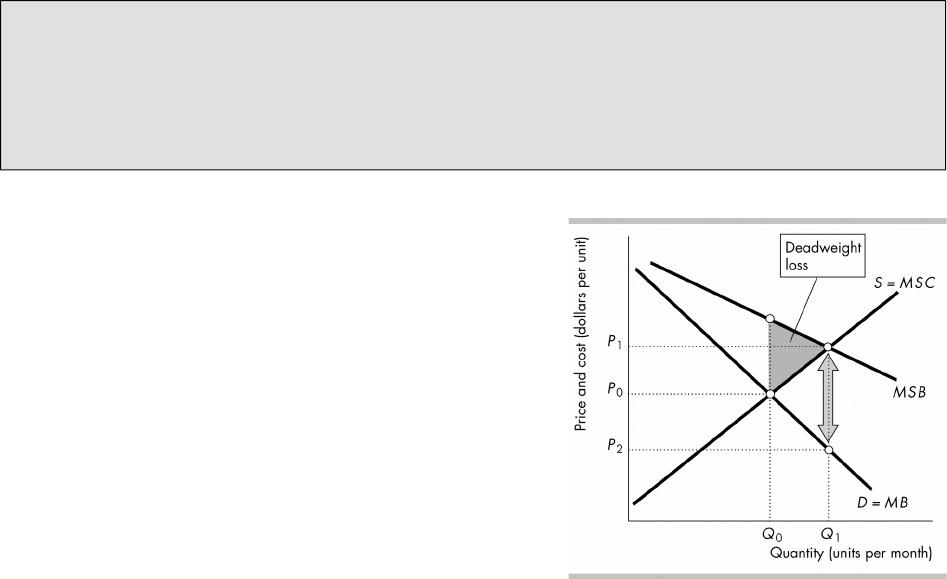
The market for health care consists of health
care services and health insurance.
Consumers underestimate the bene)ts of
health care, underestimate their own future
needs, and can’t a>ord the care they need, so
the marginal social bene)t exceeds the
private willingness to pay for it. Consequently
a private health care markets underproduces
health care.
The )gure shows the market demand
curve or perceived marginal bene)t curve
(MB) and the marginal social bene)t curve
(MSB) for health care.
The e%cient quantity of output occurs
where the marginal social bene)t equals marginal cost, that is, where MSB =
MSC. In the )gure, the e%cient quantity is Q1.
An unregulated market, however, produces where S = D. In the )gure, the
unregulated market equilibrium is Q0. At this level of output, MSB exceeds MSC
so there is a deadweight loss, as illustrated in the )gure.
This loss is unevenly spread across consumers leading to unfairness. Healthy,
higher income earners can a>ord care. The long-term sick, the aged, and the
poor can’t a>ord care and thus bear most of the deadweight loss.
Alternative Public Choice Solutions
Across nations, there is a wide range of public funding for health care. The text
examines three approaches to supplementing or replacing the private market for
health care: universal coverage, single payer; private and government insurance;
and, subsidized private insurance.
Universal Coverage, Single Payer
© 2016 Pearson Education, Inc.
P U B L I C C H O I C E S , P U B L I C G O O D S , A N D H E A LT H C A R E 1 6 5

The model in the United Kingdom and Canada: is universal coverage with a
single payer. The government is the sole buyer and everyone is covered. People
access services a zero (or a low) price and the quantity available is set by the
government, leading to excess demand. Services are allocated on a )rst-come,
)rst-served basis, resulting in long delays for treatment. The quantity made
available by the government is less than the e%cient quantity, so a deadweight
loss results.
Private and Government Insurance
In the United States, most health care is provided privately and paid for by
private health insurance, government, and patients. It is di%cult to determine if
healthcare is overprovided given the di>erent payment types, but the scale of
healthcare spending in the United States compared to other rich countries
suggests it may be. Over provision leads to deadweight losses. Government
spending on health care is dependent on the quantity of care demanded, not on
a set budget. Without changes, an aging population will signi)cantly increase
this spending in the future.
The Economics in Action case breaks down the sources of payment for health care in the
United States.
Subsidized Private Insurance
Obamacare, or the Patient Protection and A>ordable Care Act, uses a subsidized
insurance market. To determine whether the outcome of the subsidy is e%cient,
we need to know the extent to which the marginal bene)t of health insurance
actually exceeds a household’s ability to pay.
The At Issue feature considers whether Obamacare is the answer to U.S. health care
provision problems.
Vouchers a Better Solution?
When marginal social bene)ts exceed the ability and willingness to pay, economists
suggest vouchers can be used to attain e%ciency. A voucher is a token that can be
used to buy only the speci)ed item.
A voucher program could replace most government health programs. The total value
of vouchers would be set by government, but households would decide how to
allocate healthcare spending.
The markets for health care services and health insurance would be free to work
similarly to other competitive markets, which allocate resources e%ciently.
An Economics in Action case considers the challenge of maintaining the U.S. transportation
infrastructure given the decrease in gasoline taxes, which is the primary revenue source
used to maintain the infrastructure. The analysis shows how the outcome might be an
ine%cient quantity of infrastructure being provided.
© 2016 Pearson Education, Inc.
1 6 6 C H A P T E R 1 6
A d d i t i o n a l D i s c u s s i o n Q u e s t i o n s
1. How “public” are government goods and services? Challenge your
students to name public services provided by the government. In case the
students miss them, mention the following services:
Postal Services: This is somewhat nonrival, in that the postman is walking
by everyone’s house anyway, but de)nitely excludable—no stamp, no
delivery. It is a natural monopoly rather than a public good.
Education: This is also somewhat nonrival, in that increased human capital
bene)ts more than just the student. However, the private sector education
industry is growing rather than shrinking over time, indicating that the
private bene)ts are large compared to the public bene)ts. Also, it is
excludable, meaning that it is not a public good.
Passenger Rail Service like Amtrak: Rail service is nonrival when the trains
are not crowded because, in that case, one individual’s use of rail service
doesn’t preclude others from also using the service. When the train is at its
maximum carrying capacity, however, rail service is then rival because
adding an additional consumer requires that another consumer be
bumped. Train service is de)nitely excludable. As such, when the trains are
not crowded it would fall into the category of natural monopoly, and when
they are crowded they would be a public good.
National Parks and Forests: Given the vast size of our national parks and
forests, use by one individual has little impact on the level of bene)t others
receive from using the same services. However, parks and forests that are
overused and trashed become rival. Most national parks are excludable.
Fees are charged for camping in them, for example. However, the large
area covered by national parks and forests makes it more di%cult to
exclude others from using the parks and forests, even if fees aren’t paid,
making them somewhat nonexcludable. National parks and forests may be
public, private, common resources, or natural monopolies, depending on
the extent of rivalry and excludability.
2. Will resource allocation be e)cient when the price mechanism is
absent in the provision of public goods and services? Emphasize that
when political equilibrium conditions separate the people who consume the
services from the people who pay for the services, the valuable price signal is
lost. Those that consume the good do not take into account the opportunity
cost of consuming that good or service when making their own resource
allocation decisions. Examples:
Why are private schools and home schooling so prevalent when all
children in the United States (even the children of illegal immigrants)
are provided with free education? The student and his or her family
receive the bene)ts of increased human capital but pay only a portion of the
cost of providing it. The median voter is reluctant to support higher taxes for
educational programs and rational ignorance implies that he or she is also
unlikely to be motivated to see whether the existing funds are being utilized
e%ciently. This results in government delivering relatively poor public
educational services. Also point out that the parents of children attending
private school, or the parents who use their own labor to teach their children
at home, all still pay local taxes to support public education. This implies that
the high opportunity cost of consuming private education is still less than the
perceived opportunity cost of sending their children to public schools.
Why are private security companies so prevalent when each city has a
legitimate, professional police force? The greatest benefactors of police
© 2016 Pearson Education, Inc.
P U B L I C C H O I C E S , P U B L I C G O O D S , A N D H E A LT H C A R E 1 6 7
protective services are usually those citizens living in the poorest
neighborhoods with the lowest incomes. The median voter’s income level isn’t
so far away from the average income voter that the level of protective service
that he or she receives is above average. This means the median voter does
not support a level of protective services that could e>ectively deal with the
high crime areas as well as the less frequent incidence of crime that occurs in
average or above average income neighborhoods.
3. Is government regulation better than an ine)cient market result?
The simple answer is “not necessarily.” Stress that when market failure brings
pleas for political processes to replace the market process for resource
allocation, it should be shown that the ine%ciencies created by the market
failure are greater than the ine%ciencies inherent in the proposed political
allocation process. Point out that when politicians and bureaucrats propose
public sector policies to replace market allocation processes, they rarely
discuss whether their policy prescriptions would pass such an analysis.
Emphasize that when it comes to moving resource allocation decisions out of
the private market and into the realm of political markets, there is still an
opportunity cost to be weighed against the perceived bene)ts: there is no such
thing as a free lunch!
4. Are you a free-rider in your school’s computer lab? Many colleges and
universities have run into problems with the amount of printing that occurs on
their campuses. The more students print, the more paper expenses rise, and
the more frequent repairs and maintenance will be for printers at the school.
If a school does not charge students for printing in the computer labs, what
incentive is there to minimize printing? While this may be an expense that is
“included” in tuition and fees, because that cost is spread across all students,
no single student bears the entire cost of his or her printing. As more books
become available online as e-books, this problem has become more di%cult to
handle. Because e-books are typically cheaper than traditional paper books,
many students simply buy the e-book and then print the entire book in the
school computer lab, e>ectively pushing the cost of the book onto the school.
To alleviate some of this free-rider problem, many schools have begun to
charge their students for printing, or they have predetermined limits set on the
number of pages students are allowed to print.
5. Does a democratic process ensure an e)cient outcome? Many political
science classes tout that democratic politics is the “art of compromise,”
implying that the compromise solutions to conCicting objectives that are
inherent in democratic decision processes necessarily generate e%cient
outcomes. The example in the table below illustrates why a democratic vote
can fail to ensure the economic de)nition of e%ciency.
If tax policy proposal A (a levy supporting education) were presented by
itself, it would fail to receive support from the majority of voters.
Likewise, if tax policy proposal B (a levy supporting the police force) were
presented by itself, it would also fail to gain support from the majority of
voters.
Yet, the politicians sponsoring each bill can act cooperatively and present
an omnibus bill combining both policy proposals. This is known as
logrolling—trading political favors to pass separate bills that would
otherwise fail to achieve majority support on their own.
© 2016 Pearson Education, Inc.
1 6 8 C H A P T E R 1 6

The majority of voters will support the omnibus bill, despite the fact that
net bene)ts for all society would be higher if the omnibus bill had not
passed.
Policy Proposal
Policy
Valuation
by Voter A
Policy
Valuation
by Voter B
Policy
Valuation
by Voter C
Does Vote
Pass? Net
Social Bene)ts
A: Education +$150 -$100 -$100 No: (1-2)
-$50
B: Police -$100 +$150 -$100 No: (1-2)
-$50
Policy A + B +$50 +$50 -$200 Yes: (2-1)
-$100
6. Snow and road plowing—when is it a public good versus a private
good? If you teach in a part of the country that gets snow, state and local
governments may spend signi)cant resources plowing roads. Who plows which
roads and parking lots? Why? If state and local governments ceased o>ering
snow plowing services, what would happen in the local economies a>ected by
snow?
© 2016 Pearson Education, Inc.
P U B L I C C H O I C E S , P U B L I C G O O D S , A N D H E A LT H C A R E 1 6 9