Answers to Additional Problems and Applications
9. An Energy Drink with a Monster of a Stock
The $5.7 billion energy-drink category, in which Monster holds the No. 2
position behind industry leader Red Bull, has slowed down as copycat brands
jostle for shelf space. Over the past &ve years Red Bull’s market share in
dollar terms has gone from 91 percent to well under 50 percent and much of
that loss has been Monster’s gain.
Source: Fortune, December 25, 2006
a. Describe the structure of the energy-drink market. How has that structure
changed over the past few years?
The structure of the energy-drink market has changed from a virtual monopoly
several years ago, when Red Bull had 91 percent of the market, to a more
b. If Monster and Red Bull formed a cartel, how would the price charged for
energy drinks and the pro&ts made change?
Use the following data to work Problems 10 and 11.
Bud and Wise are the only two producers of aniseed beer, a New Age product
designed to displace root beer. Bud and Wise are trying to &gure out how much of
this new beer to produce. They know:
(i) If they both produce 10,000 gallons a day, they will make the maximum
attainable joint economic pro&t of $200,000 a day, or $100,000 a day
each.
(ii) If either &rm produces 20,000 gallons a day while the other produces
10,000 a day, the one that produces 20,000 gallons will make an economic
pro&t of $150,000 and the other will incur an economic loss of $50,000.
(iii) If both produce 20,000 gallons a day, each &rm will make zero economic
pro&t.
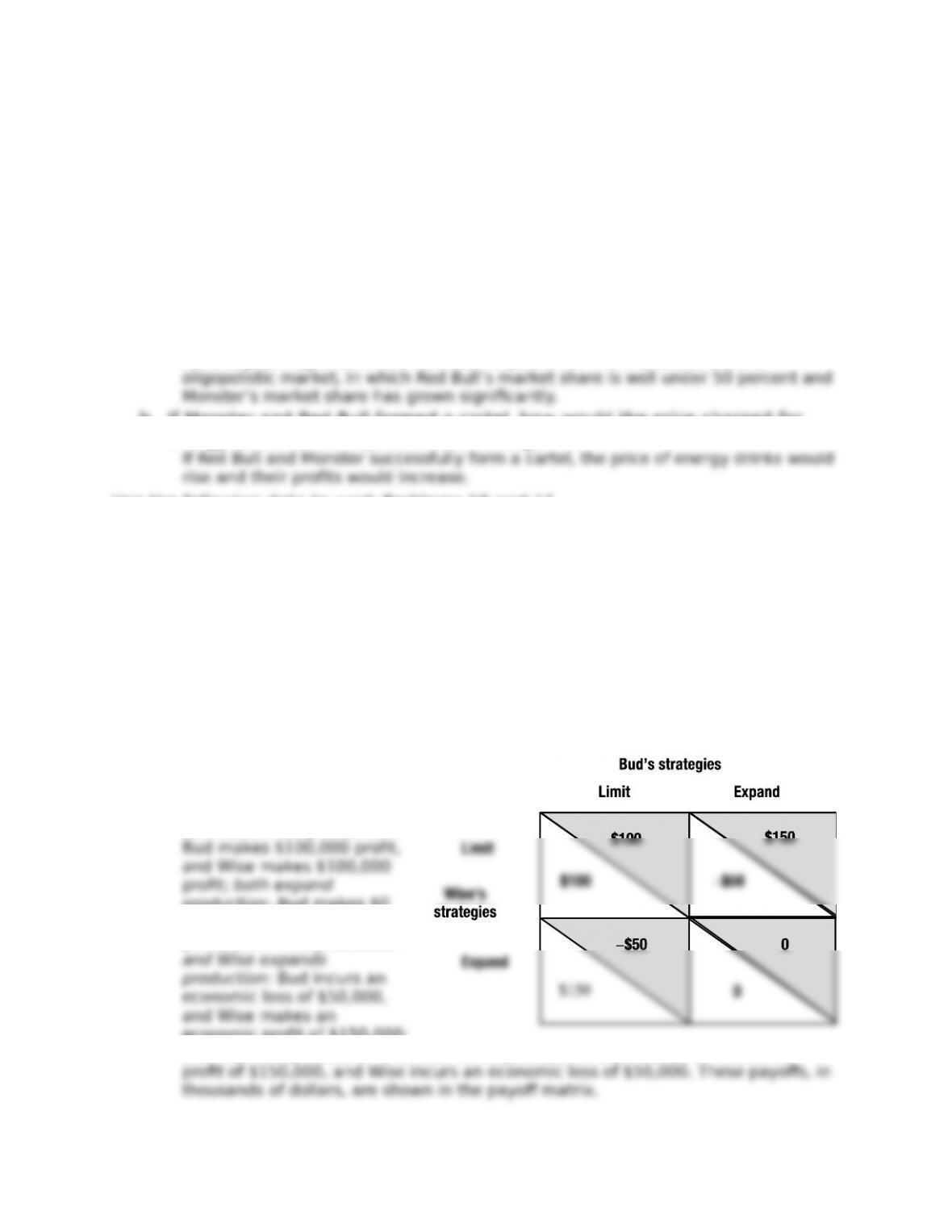
10. Construct a payo; matrix for
the game that Bud and Wise
must play.
The payo; matrix has four
cells: Both limit production:
production: Bud makes $0
pro&t, and Wise makes $0
pro&t; Bud limits production
economic pro&t of $150,000;
Bud expands production and Wise limits production: Bud makes an economic
11. Find the Nash equilibrium of the game that Bud and Wise play.
The Nash equilibrium is for both Bud and Wise to expand production. From Bud’s
perspective, if Wise limits production Bud’s pro&t is larger if it expands production.
12. Asian Rice Exporters to Discuss Cartel
The Asian rice-exporting nations planned to discuss a proposal that they form
a cartel. Ahead of the meeting, the countries said that the purpose of the rice
cartel would be to contribute to ensuring food stability, not just in an
individual country but also to address food shortages in the region and the
world. The cartel will not hoard rice and raise prices when there are
shortages. The Philippines says that it is a bad idea. It will create an oligopoly,
and the cartel could price the grain out of reach for millions of people.
Source: CNN, May 6, 2008
a. Assuming the rice-exporting nations become a pro&t-maximizing colluding
oligopoly, explain how they would inBuence the global market for rice and
the world price of rice.
To maximize their pro&t, the nations would decrease the quantity of rice they
produce and raise its price. Similar to any monopoly, they would produce the
b. Assuming the rice-exporting nations become a pro&t-maximizing colluding
oligopoly, draw a graph to illustrate their inBuence on the global market for
rice.
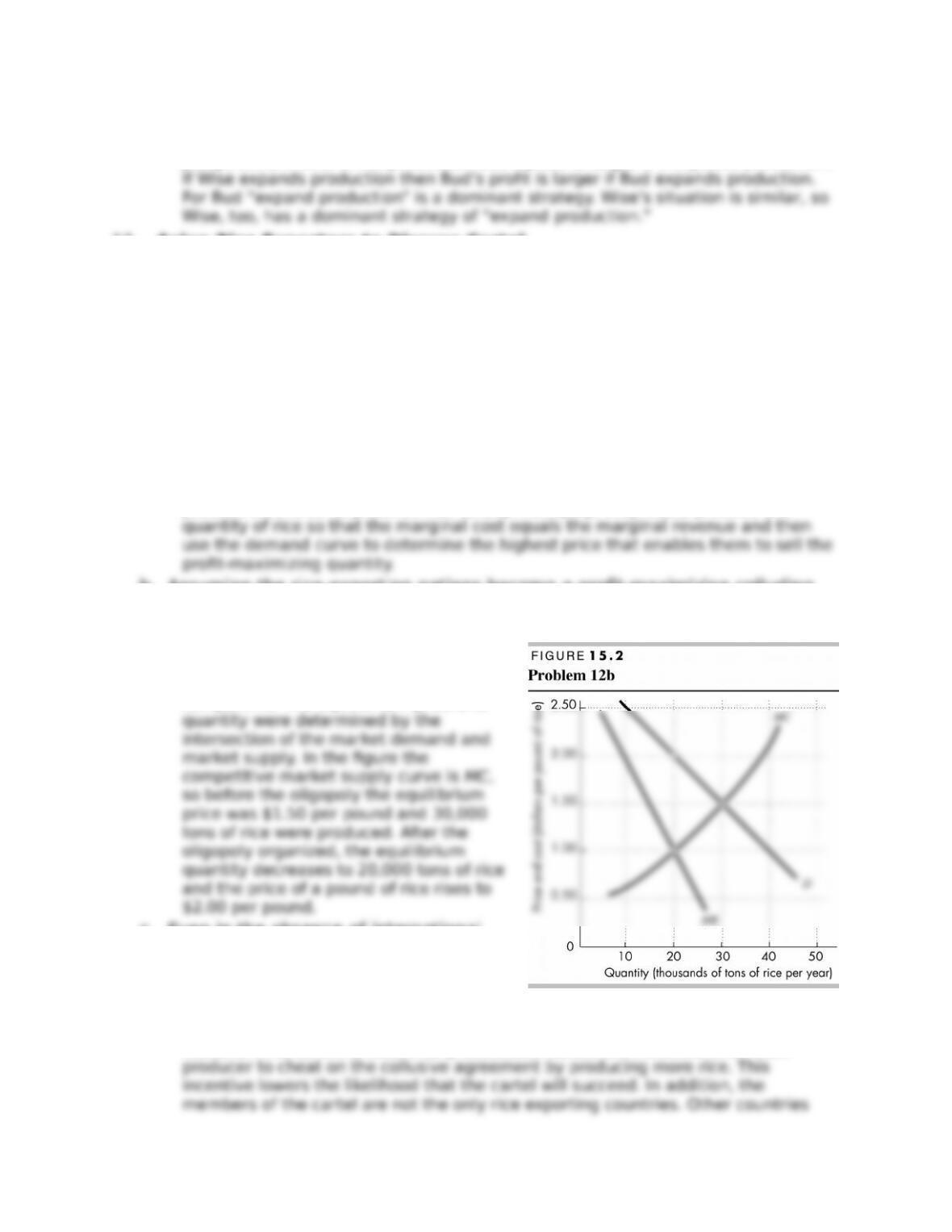
Figure 15.2 shows the outcome of this
cartel in the market for rice. Before the
oligopoly organized, the rice market was
competitive. The equilibrium price and
c. Even in the absence of international
antitrust laws, why might it be diEcult
for this cartel to successfully collude?
Use the ideas of game theory to
explain.
The rice exporting countries will &nd it diEcult to successfully collude for two
reasons. First, as is the case in any successful cartel, the incentive is for each
13. Suppose that Mozilla and Microsoft each develop their own versions of an
amazing new Web browser that allows advertisers to target consumers with
great precision. Also, the new browser is easier and more fun to use than
existing browsers. Each &rm is trying to decide whether to sell the browser or
to give it away. What are the likely bene&ts from each action? Which action is
likely to occur?
The more people use a particular browser, the more advertisers are willing to pay.
And charging for a browser also generates pro&t. If the browser is given away and
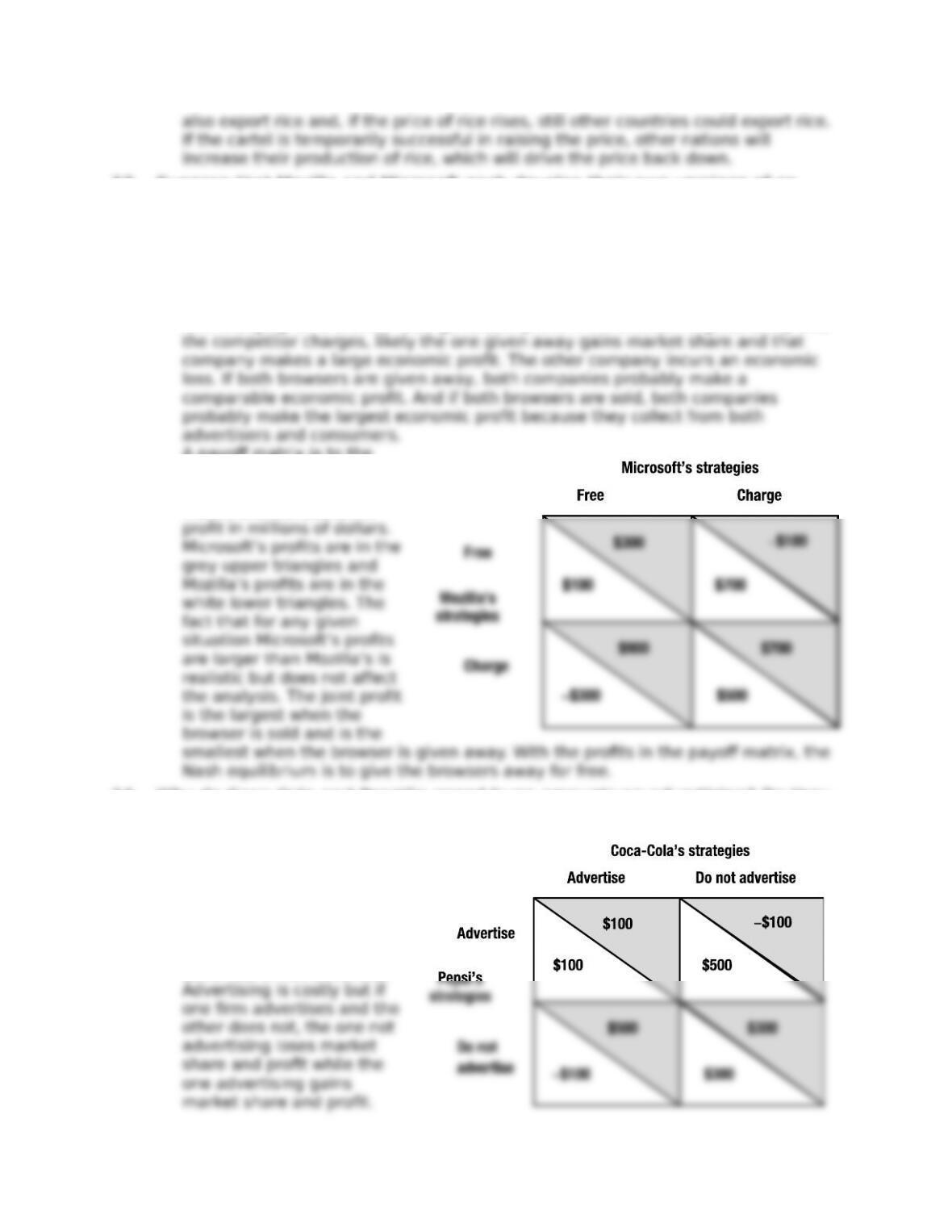
A payo; matrix is to the
right that reBects this
analysis. The numbers in the
matrix are the economic
14. Why do Coca-Cola and PepsiCo spend huge amounts on advertising? Do they
bene&t? Does the consumer bene&t? Explain your answer by constructing a
game to illustrate the
choices Coca–Cola and
PepsiCo make.
Coca-Cola and PepsiCo are
engaged in an advertising
game. In an advertising
game, two &rms can
advertise or not advertise.
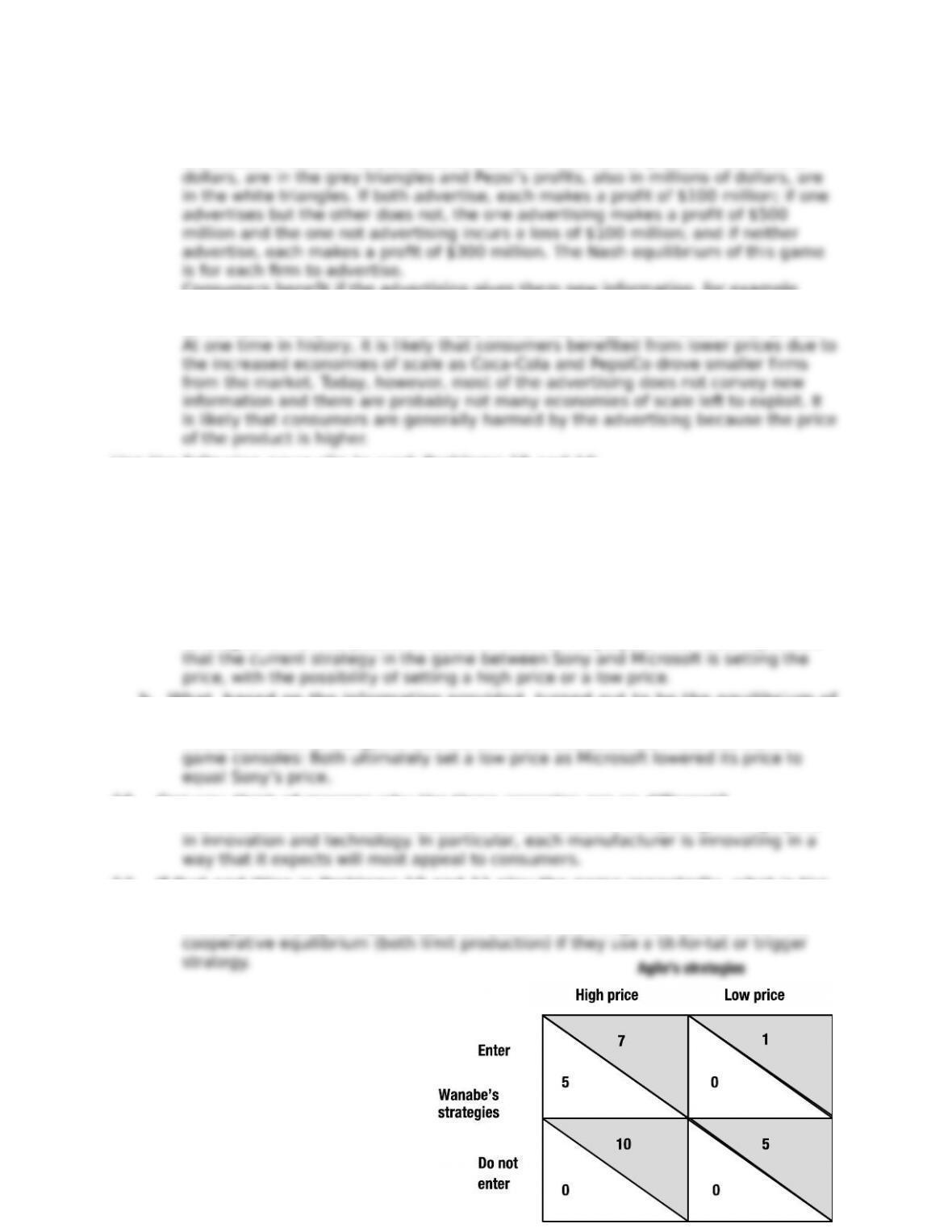
Both &rms would be better if neither advertised but the Nash equilibrium is that
both &rms advertise. The game to the right is a possibility. Both companies have
the choice of whether to advertise or not. Coke’s economic pro&ts, in millions of
Consumers bene&t if the advertising gives them new information, for example
information about a new drink. They also bene&t if the advertising allows the &rms
to increase their production and enjoy economies of scale that allow lower prices.
Use the following news clip to work Problems 15 and 16.
PS4 vs. Xbox One Battle Means Gamers Win, Sony Says
Microsoft’s latest move in the PlayStation 4 vs. Xbox One battle was to lower the
price of Xbox One to $399–the same price as the PS4.
Source: GameSpot, July 1, 2014
15.a. Thinking about the competition between Sony and Microsoft in the market
for game consoles as a game, describe the &rms’ strategies concerning
design, marketing, and price.
Strategies are all the possible actions of each of the players. The news clip shows
b. What, based on the information provided, turned out to be the equilibrium of
the game?
The equilibrium of the game was the outcome that occurred in the market for
16. Can you think of reasons why the three consoles are so di;erent?
The consoles are so di;erent because the &rms also are competing, in large part,
17. If Bud and Wise in Problems 10 and 11 play the game repeatedly, what is the
equilibrium of the game?
If the game is played repeatedly, then Bud and Wise might be able to reach the
18. Agile Airlines’ pro&t on a route
on which it has a monopoly is
$10 million a year. Wanabe
Airlines is considering entering
the market and operating on this
route. Agile warns Wanabe to
stay out and threatens to cut the price so that if Wanabe enters it will make no pro&t.
Wanabe determines that the payo; matrix for the game in which it is engaged with
Agile is shown in the table. Does Wanabe believe Agile’s assertion? Does Wanabe
enter or not? Explain.
Wanabe does not believe Agile’s assertion. If Wanabe does not enter, Agile’s best
19. Oil Trading Probe May Uncover Manipulation
Amid soaring oil prices the Commodity Futures Trading Commission (CFTC) is
looking into manipulation of the oil market—withholding oil in an attempt to
drive prices higher. The CFTC has found such evidence in the past and it’s
likely it will &nd evidence again. But it is unlikely that a single player acting
alone would be able to run the price up from $90 to $135.
Source: CNN, May 30, 2008
What type of market does the news clip imply best describes the U.S. oil
market?
The news clip implicitly views the oil market as an oligopoly.
Use the following news clip to work Problems 20 and 21.
Gadgets for Sale … or Not
How come the prices of some gadgets, like the iPod, are the same no matter where
you shop? No, the answer isn’t that Apple illegally manages prices. In reality, Apple
uses an accepted retail strategy called minimum advertised price to discourage
resellers from discounting. The minimum advertised price (MAP) is the absolute
Source: Slate, December 22, 2006
20.a. Describe the practice of resale price maintenance that violates the Sherman
Act.
Resale price maintenance in which a manufacturer agrees with a distributor on the
price for which a product will be sold is illegal under the Sherman Act if the
b. Describe the MAP strategy used by Apple and explain how it di;ers from a
resale price maintenance agreement that would violate the Sherman Act.
The MAP strategy used by Apple does not run afoul of the Sherman Act prohibition
of resale price maintenance because Apple does not agree with the retailer about
21. Why might the MAP strategy be against the social interest and bene&t only
the producer?
The MAP might harm consumers because it keeps the price of iPods higher than
would otherwise be the case if the retailers competed more vigorously on price. In
Economics in the News
22. After you have studied Economics in the News on pp. 360–361, answer the
following questions.
a. What are the strategies of T-Mobile and AT&T in the market for cellphone
service?
The strategies of T-Mobile are to increase the value of a cellphone service plan or
not increase the value of the service plan. The strategies of AT&T are to keep the
price of its service plan constant or lower the price.
b. Why, according to the news article, is it that AT&T and T–Mobile are in a
&erce battle?
AT&T and T-Mobile are in a particularly &erce battle because their cell phone
c. Why wouldn’t AT&T stick with its high price and leave T-Mobile to incur the
cost of o;ering higher–valued plans?
If T-Mobile improves the value of its plans, AT&T’s pro&t is larger if it cuts the price
d. Could T-Mobile do something that would make it the market leader? Would
that action maximize T-Mobile’s pro&t?
T-Mobile could slash the price it charges for its (enhanced) plans and win market
23. Boeing and Airbus Predict Asian Sales Surge
Airlines in the Asia-Paci&c region are emerging as the biggest customers for
aircraft makers Boeing and Airbus. The two &rms predict that over the next 20
years, more than 8,000 planes worth up to $1.2 trillion will be sold there.
Source: BBC News, February 3, 2010
a. In what type of market are big airplanes sold?
b. Thinking of competition between Boeing and Airbus as a game, what are the
strategies and the payo;s?
Boeing and Airbus are playing the duopolists’ game. They can set either low prices
or high prices. If both Boeing and Airbus set low prices, then they will both make a
smaller pro&t, perhaps even zero economic pro&t. If they both set high prices, then
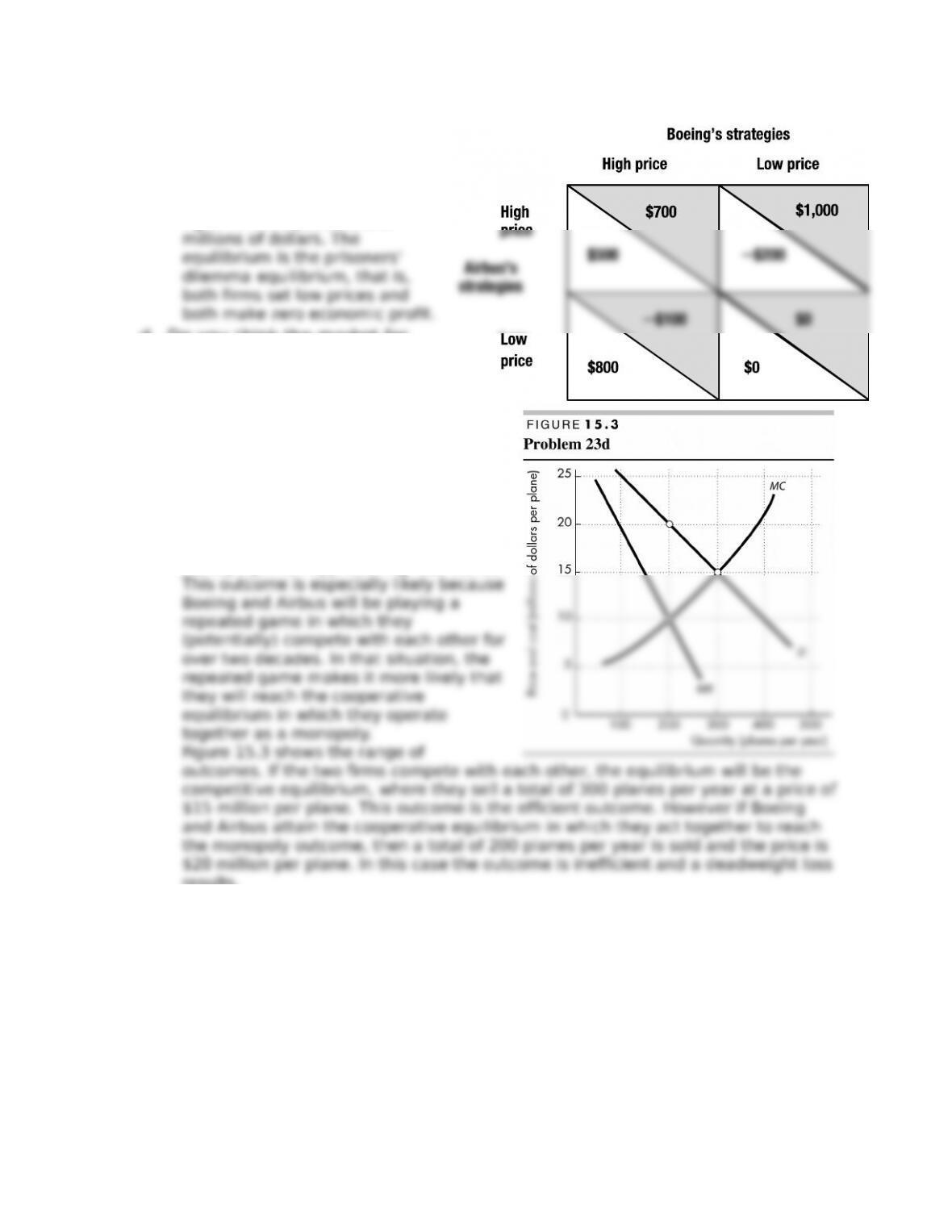
c. Set out a hypothetical payo;
matrix for the game you’ve
described in part (b). What is
the equilibrium of the game?
The payo; matrix is to the
right. In it the pro&ts are in
d. Do you think the market for
big airplanes is eEcient?
Explain and illustrate your
answer.
The market for big airplanes is
probably not eEcient. It is eEcient only if
Boeing and Airbus compete against each
other as if they were in perfect
competition. But this outcome is unlikely.
More likely is an outcome in which
Boeing and Airbus together operate a
monopoly or, if not precisely as a
monopoly, then approaching that status.
results.