
W H AT I S E C O N O M I C S ? 1 6 5
T h e B i g P i c t u r e
Where we have been:
Chapter 10 began the study of the theory of the rm by describing various
market structures and dening economic prot. Chapter 11 introduced various
cost and production measures. Chapters 12, 13, and 14 presented perfect
competition, monopoly, and monopolistic competition, respectively. Chapter 15
now wraps up the analysis of the rm’s output and price decision by
examining oligopoly. The chapter examines various approaches to studying
rm behavior in oligopoly and is the last of the chapters that focus on the
theory of the rm.
Where we are going:
Chapters 16 and 17 examine externalities, public goods, and common
resources. Chapter 18 focuses on competitive factor markets. Chapter 19
investigates the distribution of income, the trends in the distribution, and some
of the reasons for inequality and the trends. The nal chapter, Chapter 20,
analyzes some of the di5culties in making decisions when information is
incomplete. None of the material in this chapter is used explicitly in the
following chapters.
N e w i n t h e Tw e l t h E d i t i o n
The introduction and closing Economics in the News have been updated to focus
on competition in the cell phone service provider market. A new Worked Problem
section has been added. The Worked Problem presents a scenario dealing with two
competitive rms that could illegally collude to restrict their production and boost
their prices. It then shows the students how to analyze this situation using game
theory and what will be the Nash equilibrium. To include the new Worked Problem
without lengthening the chapter, some problems have been removed from the
Study Plan Problem and Applications. These problems are in the MyEconLab and
are called Extra Problems.
15OLIGOPOLY
C h a p t e r
165
1 6 6
166

L e c t u r e N o t e s
Oligopoly
Firms in oligopoly have only a few competitors. Their behavior can be analyzed using
game theory, which shows the prisoners’ dilemma they can face.
The Economics in Action shows the Herndahl-Hirschman Indices for 10 markets that are
oligopolies. The text points out that the dividing line between oligopolistic and monopolistic
competition is usually a HHI of 2,500.
I. What is Oligopoly?
The distinguishing features of an oligopoly are the presence of natural or legal barriers
that prevent the entry of new rms and so only a small number of rms compete.
Barriers to Entry
A natural oligopoly market occurs when the e5cient scale of production allows
only a few rms to meet the market demand.
A legal oligopoly arises when a legal barrier to entry protects the small number
of rms in the market.
Small Number of Firms
Because of entry barriers, the number of rms is small and each has a large
share of the market.
Because there are a small number of rms, the rms in an oligopoly market are
interdependent—each rm’s prot depends on its actions and the actions of its
competitors.
The rms have a temptation to form a cartel, which is a group of rms acting
together—colluding—to limit output, raise price, and increase economic prot.
Such collusion is illegal in the United States but it still occurs.
II. Oligopoly Games
Economists think of oligopoly as a game between just a few players and use game
theory to study oligopolistic behavior.
Game theory is a tool for studying strategic behavior—behavior that takes into
account the expected behavior of others and the recognition of mutual
interdependence.
What is a Game?
Games have rules, strategies, payo@s, and outcomes.
The Prisoner’s Dilemma captures many of the essential features of games and
gives a good illustration of how game theory works and generates predictions.
Game theory is an entirely di@erent approach to modeling a rm’s output and price
decisions. It allows for the expected actions of all other rms in the market to be explicitly
considered in the rm’s decision-making process. Game theory is a big step for the student
and need a signicant amount of time to develop. This chapter is designed to be Bexible
and provide you with many options on just how far to go.
1. You might want to introduce only the prisoner’s dilemma game.
2. You might want to spend serious time applying the prisoner’s dilemma to a cartel
game.
3. You might want to extend the range of examples and apply the prisoner’s dilemma to a
real-world research and development game.
4. Finally, you might want to introduce repeated and sequential games and some of their
applications and implications.
Each of the steps laid out above is optional, but cumulative. You can stop at any point, but
shouldn’t try to skip a step except that you can teach the R&D game based on the general
introduction to the prisoner’s dilemma without teaching the longer and more complex
cartel game.
The Prisoners Dilemma
In the prisoner’s dilemma, the rules specify that each prisoner is placed in a
separate room and must choose whether to confess without conferring with his
accomplice.
Strategies are all the possible actions of each player.
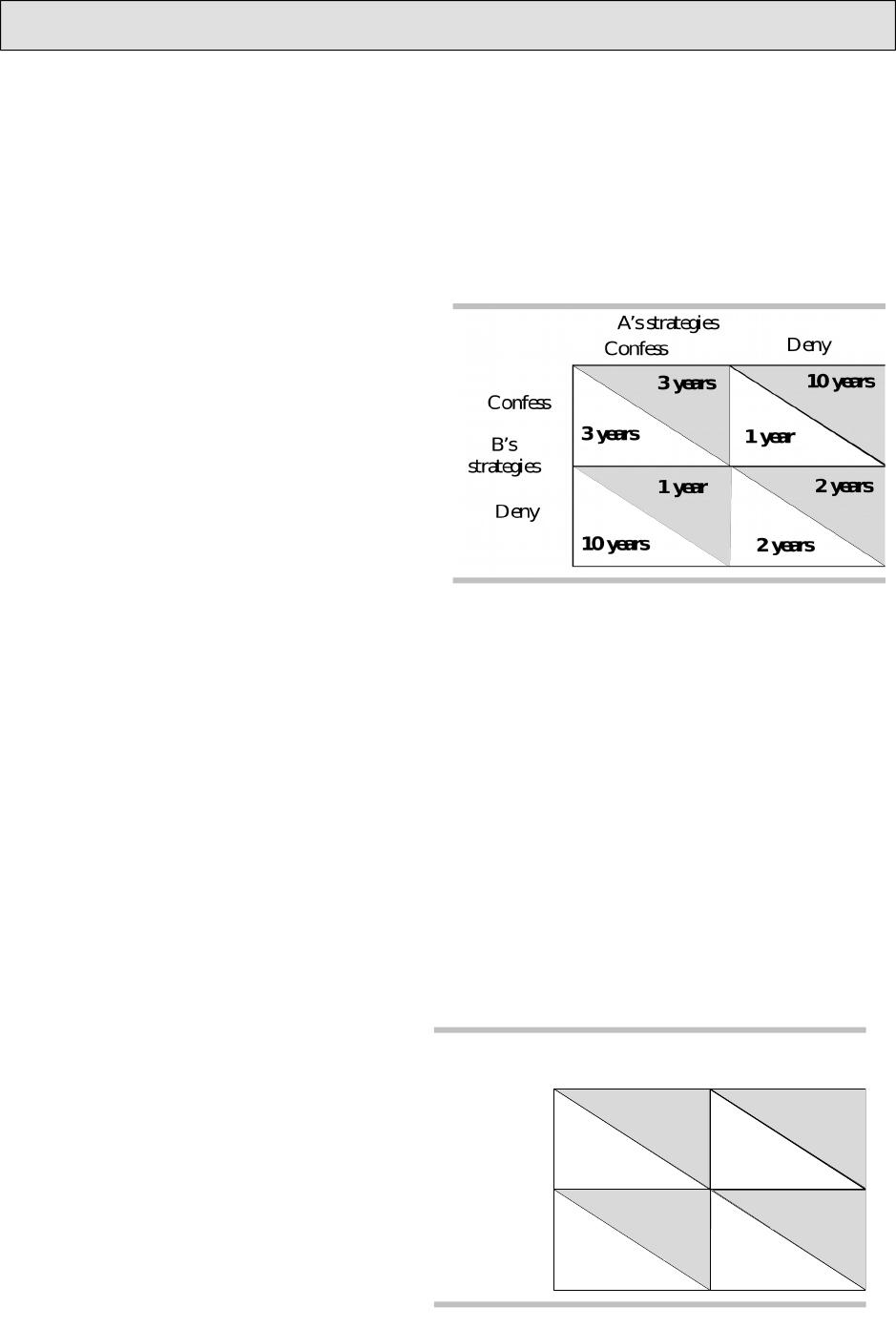
The game’s payo) matrix, a table that shows the payo@s for every possible
action by each player for every possible action by each other player, is to the
right. In it are the payo@s from each prisoner’s strategies, which are to confess or
deny involvement in the serious crime.
The choices of both players determine the outcome of the game. We use the
concept of a Nash equilibrium to predict the outcome of a game.
Art (A) and Bob (B) have been
caught stealing cars. Both men
are sentenced to two years in
jail for this crime. Both are
suspected of committing a
more serious crime for which
the prosecutor has insu5cient
evidence for a conviction. The
two men are each interrogated
for the more serious crime in
separate cells. Each prisoner is
told that if he confesses and his
partner denies, he will serve 1
year in jail and his partner will
serve 10 years, while if both confess, both serve 3 years. If neither confesses,
each man will spend 2 years in jail, after being convicted of a lesser crime. These
“payo@s” are in the payo@ matrix.
In the Nash equilibrium of the prisoner’s dilemma game, player A takes the best
possible action given the action of player B and player B takes the best possible
action given the action of player A. The Nash equilibrium for the prisoners’
dilemma is for both players to confess. This outcome is bad for them because
both would be better o@ if each denied.
A dominant strategy is a strategy is better than another for one player,
regardless of how the other players play. In the prisoners’ dilemma, each player
has a dominant strategy of “Confess.”
An Oligopoly Price-Fixing Game
Firms in an oligopoly can face a prisoners’ dilemma game. Suppose there are two
rms, A and B. The rms could enter into a collusive agreement to jointly
boost their price and decrease their output. Once the agreement is made, each
rm must select its strategy: cheat on the agreement or comply with the
agreement.
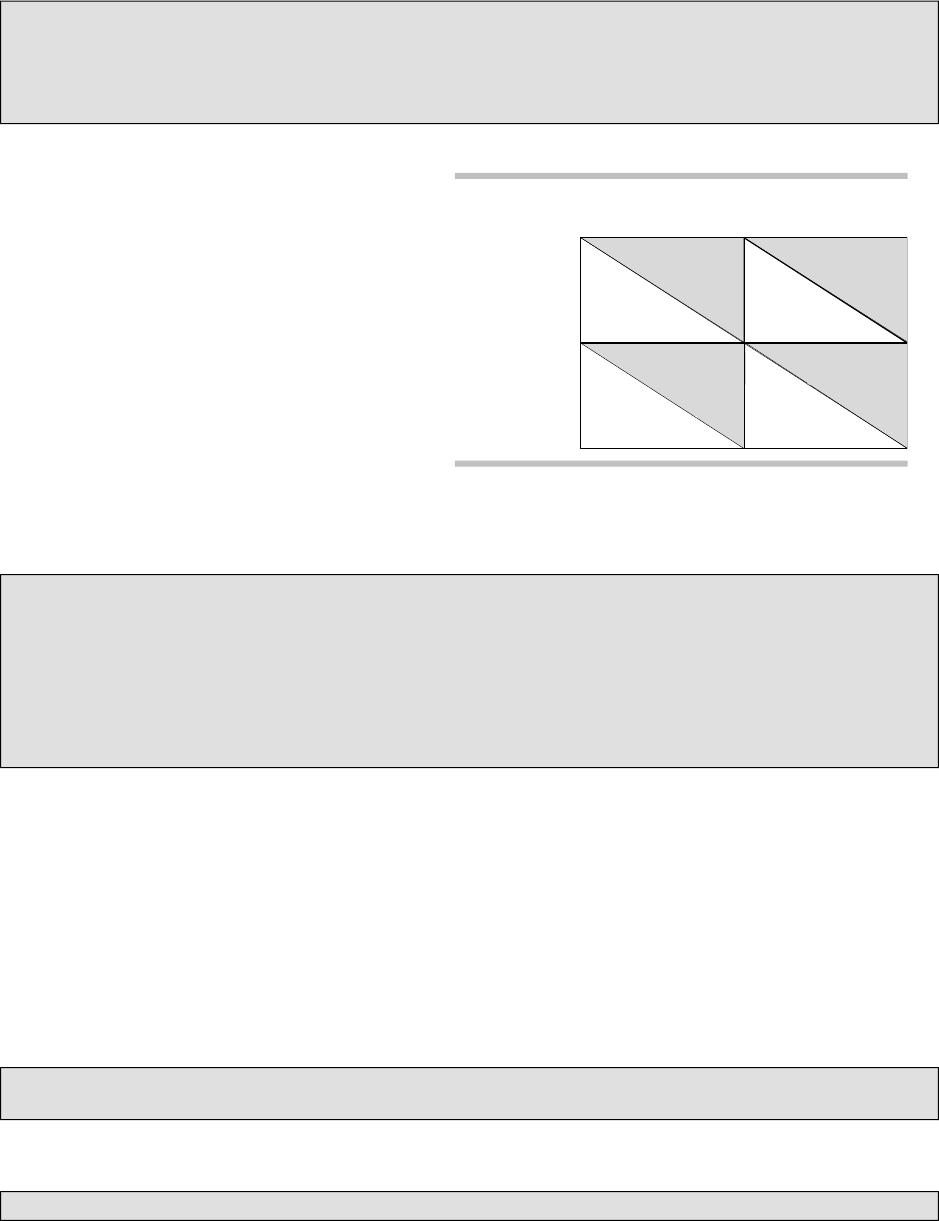
The payo@ matrix is to the
right. Each rm’s prot
depends on its strategy and
that of its competitor.
The Nash equilibrium for the
game is for both rms to
cheat on the agreement. The
outcome is bad for them
because both would be better
© 2016 Pearson Education, Inc.
O L I G O P O LY 153
$3 million
$1 million
$5 million
$0
$1 million
$3 million
$5 million
$0
Comply
Cheat
Comply
Cheat
B’s
strategies
A’s
strategies
o@ if each complied with the agreement. This Nash equilibrium is called a
dominant strategy equilibrium, which is an equilibrium in which the best
strategy of each player is to cheat regardless of the strategy of the other player.
The Economics in Action considers R&D spending in the facial tissue market, with Proctor &
Gamble producing Pu@s and Kimberly Clark, Kleenex. In this game both rms spend for
R&D, which is less protable for both than if they could collude and do no research. Rivalry
forces them to be innovative. This case reminds students that rms do R&D to sell products
rather than for higher moral purposes.
A Game of Chicken
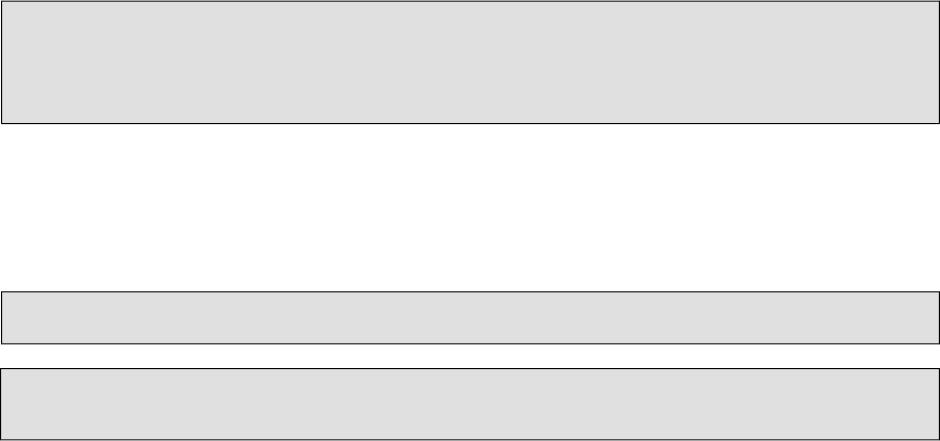
In an R&D game of chicken,
two rms, A and B, can
conduct R&D. The rm that
conducts the R&D must pay
for the R&D, but the R&D will
lead to a new product that
both rms can produce.
Each rm’s strategies are to
conduct the R&D or not
conduct the R&D. The payo@
matrix for this game is to the
right
This game does not have a
Nash equilibrium that is a
dominant strategy equilibrium. Here the equilibrium is for one rm to conduct
the R&D but we cannot predict which rm will conduct it.
Examples of oligopoly to discuss: Gillette and Schick compete aggressively to capture
the market for men’s razors; AMD and Intel do likewise for the CPU market. These products
are made by dominant consumer products corporations that spend signicant resources on
research and development and advertising to develop brand loyalty. Discuss the entry
barriers a rm considering going into these markets might face and why they are likely to
remain dominated by just a couple of key rms. Ask your students to apply this analysis to
another oligopolistic market and to identify the entry barriers and ways rms engage in
both price and non-price competition.
III. Repeated Games and Sequential Games
Many more potential outcomes are possible if players repeatedly play games. Players also
can often wait until a rival has made a move before choosing a response.
A Repeated Duopoly Game
If a game is played repeatedly, it is possible for players of the game to reach the
cooperative equilibrium in which the players make and share the monopoly
prot. Because the game is played repeatedly, a player can use a tit-for–tat
strategy, in which the player cooperates in the current period if the other player
cooperated in the previous period, but cheats in the current period if the other
player cheated in the previous period.
Economics in the News Airbus versus Boeing considers the plane makers’ rivalry in
producing passenger jets and their decisions whether to discount or charge list price.
A tit-for-tat strategy used with the payo@ matrix at the top of the page leads to
the cooperative equilibrium.
Are there any real-world cooperative equilibria? The OPEC oil cartel is an excellent
© 2016 Pearson Education, Inc.
1 5 4 C H A P T E R 1 5
$0 million
$3 million
$1 million
$2 million
$3 million
$0 million
$1 million
$2 million
No R&D
R&D
No R&D
R&D
B’s
strategies
A’s
strategies

example of how useful game theory can be to explain real world events. Use the prisoner’s
dilemma game to illustrate the incentive each nation faces: whether to cheat on their
agreement or comply with it. A tit-for–tat strategy makes all the nations (as a group) better
o@ but the demand for oil Buctuates and it is di5cult for each nation to determine whether
the other nations are cheating on the agreement. This combination makes a cartel
agreement di5cult to monitor, which is why we see the price of oil Buctuate so much, even
during peaceful times. Saudi Arabia is widely believed to be the market leader for the
cartel. Its oil output decisions have waxed and waned signicantly over time, so oil prices
fall when its government needs the extra oil revenues (cheating) or rises when the political
environment requires greater economic unity among the Arab nations (cooperating).
A Sequential Entry Game in a Contestable Market
A contestable market is a market in which rms can enter and leave so easily
that those rms in the market face competition from potential entrants.
Firms in a contestable market play a sequential entry game. In this game, the
rms in the market might set a competitive price and earn only a normal prot to
keep the potential entrant out. A less costly strategy is limit pricing, which sets
the price at the highest level that inBicts a loss on the entrant. The potential
entrant is kept out and the existing rms earn an economic prot. However, limit
pricing works only if the rm that sets the price is somehow locked into the price it
will set at the second stage of the game.
How does a game tree work? The textbook uses the simplest possible example to
illustrate the sequential entry game in a contestable market. It doesn’t explicitly explain
the “backward induction” method of solving such a game, but it implicitly uses that
method. If you choose to spend more time on sequential entry examples, you might want
to be more explicit.
IV. Antitrust Law
Antitrust law is the law that regulates oligopolies and prevents them from
becoming monopolies or behaving like monopolies.
The two federal agencies that enforce antitrust laws are the Federal Trade
Commission and the Antitrust Division of the U.S. Justice Department.
The Antitrust Laws
The Sherman Act (1890) made it a felony to create or attempt to monopolize an
industry. Section I declares it illegal to conspire with others to restrict
competition. Section II deems any attempt to monopolize illegal.
The Clayton Act (1914) makes illegal certain business practices if they
“substantially lessen competition or tends to create a monopoly.” These practices
include price discrimination, typing arrangements, requirements contracts,
exclusive dealing, territorial connement, acquiring a competitor’s shares or
assets, or becoming a director of a competing rm. If these actions do not
substantially lessen competition and do not tend to create a monopoly, the
actions are legal.
Price Fixing by Competitors Always Illegal
Price xing by competitors is per se illegal, which means it is always illegal.
There is no defense that can justify the practice.
By restricting production, a price-xing cartel raises the price to the monopoly
level. Consumers su@er and deadweight losses are created.
Three Antitrust Policy Debates
Resale Price Maintenance: Resale price maintenance (also called vertical
price xing) occurs when a distributor agrees with a manufacturer to resell a
© 2016 Pearson Education, Inc.
O L I G O P O LY 1 5 5
product at or above a specied minimum price. Resale price maintenance is
illegal only when it is judged to be anticompetitive. Whether resale price
maintenance creates an ine5cient or e5cient use of resources is debated. It is
e5cient when it induces retailers to provide the e5cient level of service to
customers (e.g., be nancially able to explain to potential consumers the benets
of a particular good).
Tying Arrangements: A tying arrangement is an agreement to sell one product
only if the buyer agrees to buy another, di@erent product. These bundling
arrangements may enable a rm to price discriminate, resulting in an increase in
e5ciency.
Predatory Pricing: Predatory pricing is setting a low price to drive competitors
out of business with the intention of setting a monopoly price when the
competition has gone. Economists are skeptical that predatory pricing occurs.
An Economics in Action case considers the U.S. versus Microsoft antitrust case, including
the charges, Microsoft’s response and the outcome. Students may want to consider how
Microsoft’s market power has changed in the last decade. Is it a result of government
intervention? Or is it a result of competition as Apple has gained increasing market share
in operating systems as its sales have grown?
Mergers and Acquisitions
A merger occurs when two or more rms agree to combine to create one larger
rm. Acquisitions occur when one rm buys another rm.
FTC guidelines stipulate that a HHI above 1,800 indicates a concentrated market,
and a merger in this market that would increase the index by 50 points is likely
to be challenged.
The Economics in Action feature describes how the FTC used its HHI guidelines to block the
proposed AT&T acquisition of T Mobile.
The Economics in the News feature examines price wars in the cell phone service provider
market between AT&T and T Mobile. It points that if the companies adopt tit-for-tat
punishment strategies, then the price war could end and their prots would increase.
© 2016 Pearson Education, Inc.
1 5 6 C H A P T E R 1 5
A d d i t i o n a l P r o b l e m s
1. Two rms, Faster and Quicker, are the only two producers of sports cars on an
island that has no contact with the outside world. The rms collude and agree
to share the market equally. If neither rm cheats on the agreement, each
rm makes $3 million economic prot. If either rm cheats, the cheater can
increase its economic prot to $4.5 million, while the rm that abides by the
agreement incurs an economic loss of $1 million. Neither rm has any way of
policing the actions of the other.
a. What is the payo@ matrix of a game that is played just once?
b. Describe the best strategy for each rm in a game that is played once.
c. What is the equilibrium if the game is played once?
S o l u t i o n s t o A d d i t i o n a l P r o b l e m s
1. a. The payo@ matrix has the following cells: Both abide by the agreement: Faster
makes $3 million prot, and Quicker makes $3 million prot; both cheat: Faster
makes $0 prot, and Quicker makes $0 prot; Faster cheats and Quicker abides by
the agreement: Faster makes $4.5 million prot, and Quicker incurs a $1 million loss;
Quicker cheats and Faster abides by the agreement: Quicker makes $4.5 million
prot, and Faster incurs $1 million loss.
b. The best strategy for each rm is to cheat. If Quicker abides by the agreement, the
best strategy for Faster is to cheat because it would make a prot of $4.5 million
rather than $3 million. If Quicker cheats, the best strategy for Faster is to cheat
because it would make a prot of $0 (the competitive outcome) rather than incur a
loss of $1 million. So Faster’s best strategy is to cheat, no matter what Quicker does.
Repeat the exercise for Quicker. Quicker’s best strategy is to cheat, no matter what
Faster does.
c. The equilibrium is that both rms cheat and each makes normal prot.
A d d i t i o n a l D i s c u s s i o n Q u e s t i o n s
1. Could you manage a successful cartel? Emphasize the fragility of cartel
arrangements by using the following numerical example. Point out that if a
cartel is to operate successfully, all the rms must behave collectively as a
monopoly, producing market output where MR = MC and charging the
resulting prot-maximizing price.
Because there are multiple rms in a
cartel, and each rm is likely to have
di@erent production cost functions,
then this raises two critical issues:
How should production quotas be
allocated across rms to minimize
total production costs and
maximize potential prots?
How should the pro-t quotas be
allocated across rms to maintain compliance?
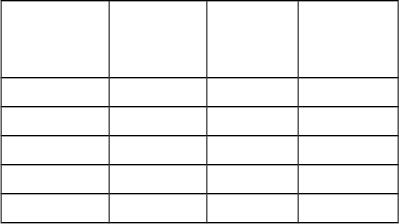
Start by assuming there are 3 rms in the cartel with the marginal cost
schedules in the table. Also assume that the prot-maximizing level of output
for a monopoly would occur at 9 units per period, where MR = $3. Finally
assume that there are no xed costs. Now, if you were the leader for the cartel,
© 2016 Pearson Education, Inc.
Quantit
y
MC for
Firm A
MC for
Firm B
MC for
Firm C
1 2 1 2
2 1 2 3
3 2 3 4
4 3 4 5
5 4 5 6
O L I G O P O LY 1 5 7
how would you propose the production quotas be allocated to minimize
production costs and maximize prots to share?
Based on minimizing variable costs, and knowing that MR = $3 at 9 units of
output, Firm A should produce 4 units, Firm B should produce 3 units and Firm
C should produce at 2 units per period. Total output is 9 units, MC = $3 for all
three rms, and the total cost of industry production is: $8 for Firm A, $6 for
rm B, and $5 for rm C for a total cost of $19 per period.
How should the pro!t quotas be distributed across the !rms? Ask the
students to consider allocating prots according to each rm’s share of total
production costs. Firm A would receive 8/19 of the prots, rm B would receive
6/19 and rm C would receive 5/19 of the prots. Most students will accept this
as a “fair” allocation of prots for the rms. But this agreement will not work
for long.
Will the cartel survive using this pro!t quota arrangement? Point out
that what keeps each rm in compliance with the agreement is not an
independent assessment of “fairness” for the ultimate prot distribution. The
prot quota agreement must be worthwhile to each and every rm in the
cartel. Emphasize that the prot from complying must exceed the prot from
cheating for each rm if the cartel agreement is to be successful in the long
run.
What is the opportunity cost for complying for each !rm? Point out that
based on Firm C’s cost function, the prospect of its competing with the other
rms is rather grim. But Firm A’s cost function implies that it would not fear
the threat of competition from the other rms because A’s marginal cost is
lower than each of its two (potential) competitors. Because A does not fear
cheating, it will have the upper hand in determining prot quotas for the
cartel. Clearly Firm A will want as much prot as it can have from each of the
other rms without making their prot from cheating exceed their prot from
complying. That is the only prot sharing arrangement that will allow the
cartel to survive over time. What, then, is the long-run prot-sharing
agreement? The answer depends on the demand for the good or service as
well as the strategies played by each rm. For instance if the demand is
inelastic but low, so that if Firm A increased its output by 1 unit the price would
fall so precipitously that Firm C su@ered an economic loss, then even though
the 4th unit would not be directly protable for Firm A to produce, the threat of
so doing might allow Firm A to grab some of Firm C’s “fair share” of prot.
2. What industries are dominated by cartels? OPEC isn’t the only example
of a cartel. Ask students what they think of when they hear the word “cartel,”
and a common response is “drug cartel.” Like the cartels studied in this
chapter, members of a drug cartel agree upon the price at which their
merchandise can be sold. Cooperation can be maintained through a repeated
game where a system of punishments is incorporated. Consider the
punishments members of a drug cartel can impose for violating an
agreed-upon price rule. It probably isn’t much of a surprise that cooperation
among drug cartel members can be maintained when the consequences of
cheating on any agreement include death or the slow and painful removal of
one’s ngernails.
Another example of a cartel that students won’t be as likely to suggest is the
NCAA. The NCAA is an example of a buyer’s cartel, as opposed to a seller’s
cartel, but the results are similar. Schools that are members of the NCAA have
agreed not to pay their student athletes a salary, e@ectively “xing” the price
paid for student athletes. Cooperation is maintained through a system of
© 2016 Pearson Education, Inc.
1 5 8 C H A P T E R 1 5
punishments for violations of NCAA rules. The incentive to cheat on those
agreements still exists, as the number of NCAA violations attests.
3. Has Microsoft attempted to create a monopoly? Whether Microsoft is a
monopoly depends on the market being dened. Many of your students will
have their own opinions, but use the “Antitrust Showcase” in the text is a
starting point for discussion. The issue of having a standard to create
programs and products around continues to be debated as programming for
Apple’s applications for the iPhone di@er from standards used by other rms,
and as Apple rejected Bash technology o@ered by Adobe and widely used in
other applications.
4. Can !rms create entry barriers? Students often have a di5cult time
identifying entry barriers. Some come from economies of scale, some from
government activity, and some the rms create. Consider the barriers in the
airline industry or cell phone services. Gates and landing slots may come from
government activity. Economies of scale certainly exist. But rms also work
hard to di@erentiate their products and try to capture market share through
strategic barriers such as AT&T’s initially exclusive ability to o@er the iPhone.
Students have little knowledge of distribution generally so using specic
examples from di@erent types of industries can broaden their knowledge.
5. If predatory pricing is generally not regarded as a problem by
economists and antitrust enforcers, why is dumping such a big deal?
Again as suggested in the lecture notes, this is a good place to reinforce the
trade theory discussed in chapter 7. Prior to the Uruguay Round, voluntary
export restraints were widely used (and abused) as a way around agreements
to reduce trade barriers. Their use was restricted by that agreement. Since
then, dumping cases have exploded at the same time predatory pricing cases
are largely no longer pursued. Searching the World Trade Organization web
site will yield many examples of dumping cases. Alleging dumping can be as
simple as saying the product is being sold at a lower price than a domestic
rm can match, which is often the denition of a product likely to be imported.
Do low prices hurt consumers? Consumer surplus and producer surplus can be
used to reinforce the prior examples.
© 2016 Pearson Education, Inc.
O L I G O P O LY 1 5 9