Answers to Additional Problems and Applications
10. Which of the following items are sold by rms in monopolistic competition?
Explain your selection.
Orange juice
Canned soup
PCs
Chewing gum
Breakfast cereals
Corn
11. The HHI for automobiles is 2,350, for sporting goods it is 161, for batteries it
is 2,883, and for jewelry it is 81. Which of these markets is an example of
monopolistic competition?
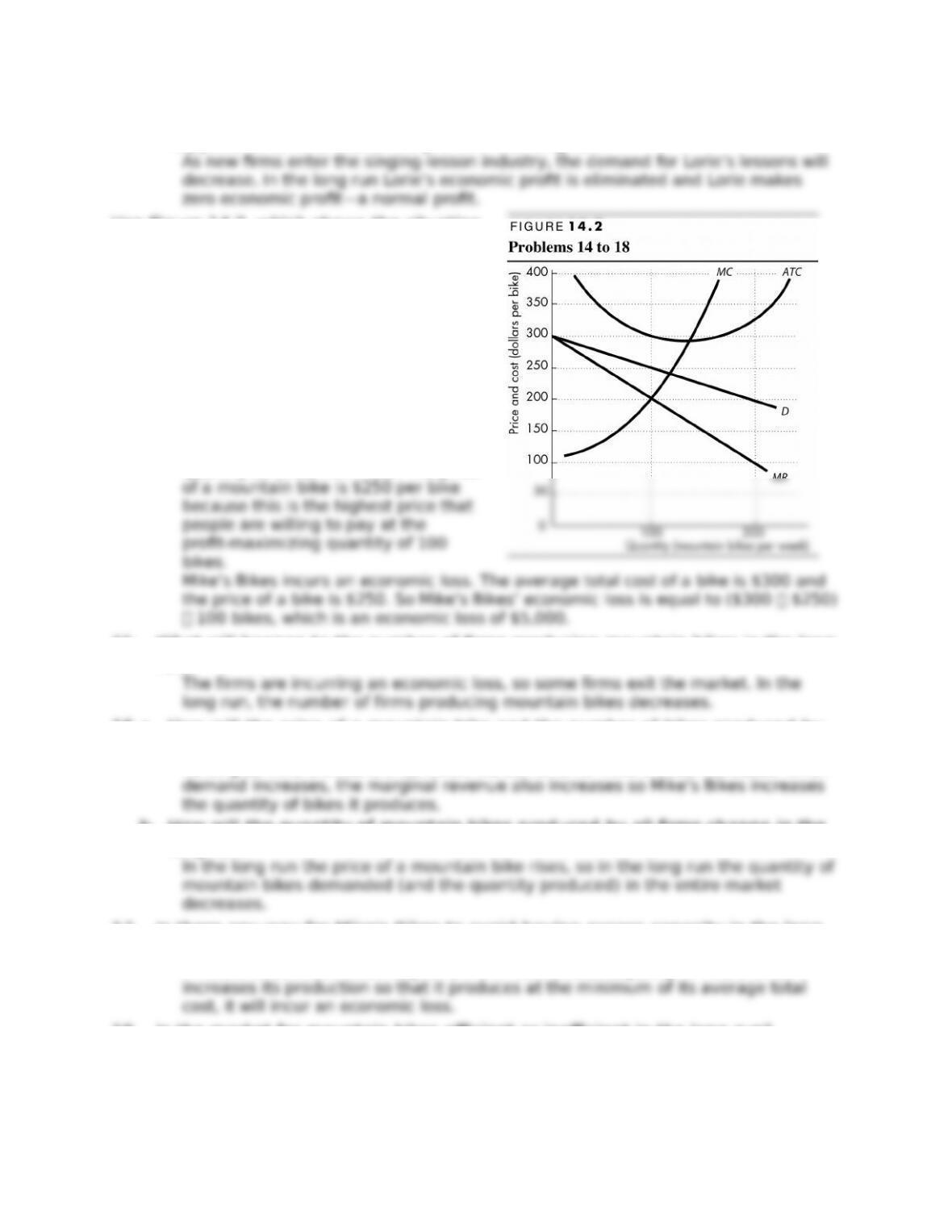
Use the following information to work Problems
12 and 13.
Lorie teaches singing. Her xed costs are
$1,000 a month, and it costs her $50 of labor to
give one class. The table shows the demand
her marginal revenue. Lorie’s marginal cost is
$50. Between the quantity of 50 and 100 lessons, Lorie’s marginal revenue is
13.a. Do you expect other rms to enter the singing lesson business and compete
with Lorie?
Price
(dollars
per
lesson)
Quantity
demanded
(lessons
per month)
b. What happens to the demand for Lorie’s lessons in the long run? What
happens to Lorie’s economic prot in the long run?
Use Figure 14.2, which shows the situation
facing Mike’s Bikes, a producer of mountain
bikes, to work Problems 14 to 18. The
demand and costs of other mountain bike
producers are similar to those of Mike’s
Bikes.
14. What quantity does the rm produce
and what is its price? Calculate the
rm’s economic prot or economic
loss.
Mike’s Bikes produces 100 mountain
bikes per week because this is the
quantity at which MR = MC. The price
15. What will happen to the number of rms producing mountain bikes in the long
run?
16.a. How will the price of a mountain bike and the number of bikes produced by
Mike’s Bikes change in the long run?
As long as Mike’s Bikes is a survivor, the demand for Mike’s Bikes increases. When
b. How will the quantity of mountain bikes produced by all rms change in the
long run?
17. Is there any way for Mike’s Bikes to avoid having excess capacity in the long
run?
If Mike’s Bikes maximizes its prot, it will have excess capacity. If Mike’s Bikes
18. Is the market for mountain bikes eCcient or ineCcient in the long run?
Explain your answer.
Based on the strict requirement for allocative eCciency, MSB=MSC, the market is
denitely not eCcient. In monopolistic competition the price of a mountain bike,
which is the MSB of a mountain bike, is greater than the marginal cost of a
Use the following news clip to work Problems 19 and20.
Groceries for the Gourmet Palate
No food, it seems, is safe from being repackaged to look like an upscale product.
Samuel Adams’ $120 Utopias, in a ridiculous copper-covered 24-oz. bottle meant to
resemble an old-fashioned brew kettle, is barely beer. It’s not carbonated like a
Bud, but aged in oak barrels like scotch. It has a vintage year, like a Bordeaux, is
light, complex, and free of any alcohol sting, despite having six times as much
alcohol content as a regular can of brew.
Source: Time, April 14, 2008
19.a. Explain how Samuel Adams has di”erentiated its Utopias to compete with
other beer brands in terms of quality, price, and marketing.
Samuel Adams di“erentiated Utopias by bottling it in a unique container, ageing it
b. Predict whether Samuel Adams produces at, above, or below the eCcient scale
in the short run.
20.a. Predict whether the $120 price tag on the Utopias is at, above, or below
marginal cost:
(i) In the short run.
In the short run the price exceeds the marginal cost. For a monopolistically
(ii) In the long run.
In the long run the price will exceed the marginal cost. For a monopolistically
b. Do you think that Samuel Adams Utopias makes the market for beer
ineCcient?
Samuel Adams Utopias possibly makes the beer market ineCcient. On the one
hand, allocative eCciency requires that MSB=MSC. The price of a Utopias beer,
Use the following news clip to work Problems 21 and 22.
Swinging for Female Golfers
One of the hottest areas of innovation is in clubs for women, who now make up
nearly a quarter of the 24 million golfers in the United States. Callaway and Nike,
two of the leading golf-equipment manufacturers, recently released new clubs
designed for women.
Source: Time, April 21, 2008
21.a. How are Callaway and Nike attempting to maintain economic prot?
Callaway and Nike are innovating by creating golf clubs for women. They expect
b. Draw a graph to illustrate the cost curves and revenue curves of Callaway
or Nike in the market for golf clubs
for women.
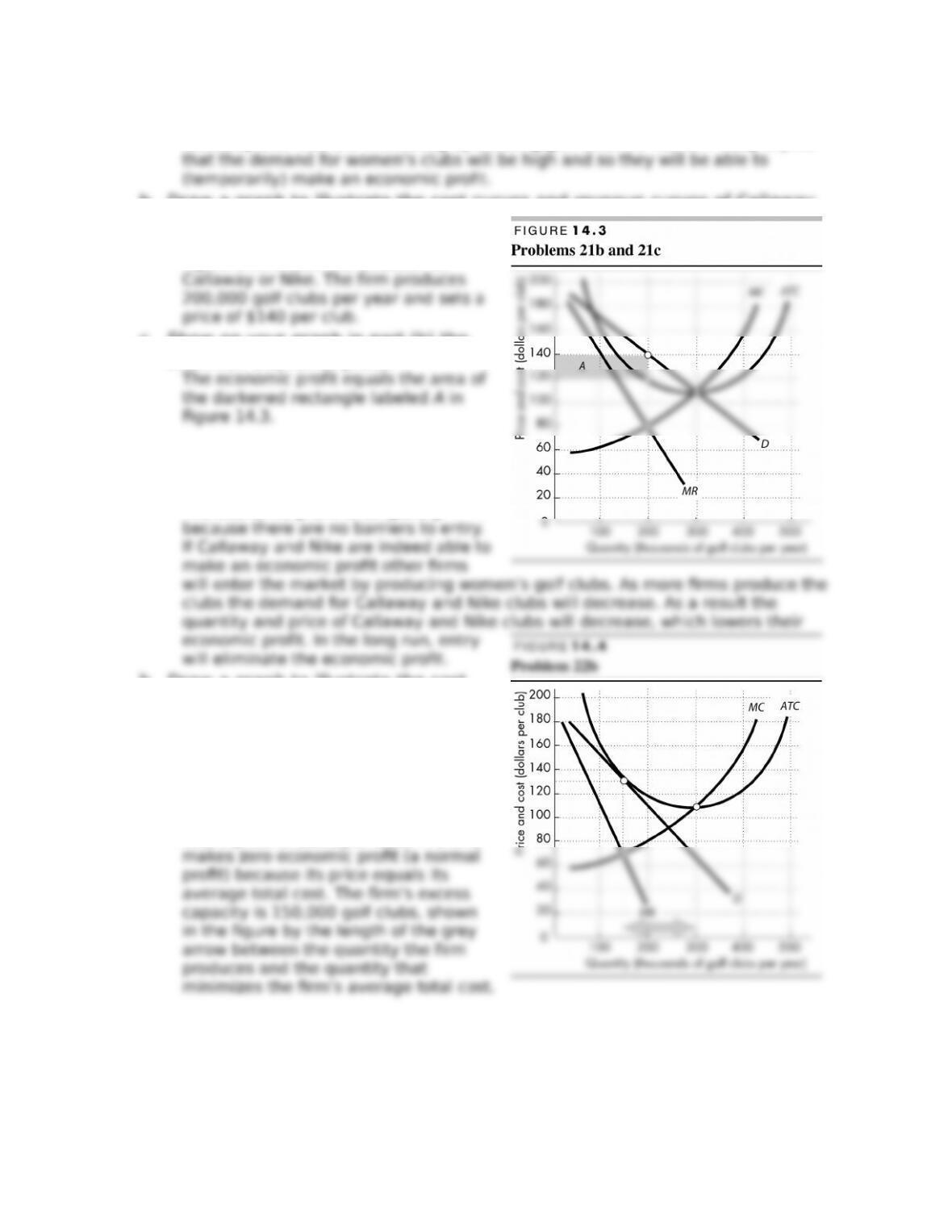
Figure 14.3 shows the situation at
c. Show on your graph in part (b) the
short-run economic prot.
22. a. Explain why the economic prot that
Callaway and Nike make on golf clubs for
women is likely to be temporary.
The economic prot is temporary
b. Draw a graph to illustrate the cost
curves and revenue curves of
Callaway or Nike in the market for
golf clubs for women in the long run.
Mark the rm’s excess capacity.
Figure 14.4 shows the long-run
equilibrium for Callaway or Nike. The
rm produces 150,000 golf clubs and
sets a price of $130 per club. The rm
Use the following information to work Problems 23 to 25.
Bianca bakes delicious cookies. Her total xed cost is $40 a day, and her average
variable cost is $1 a bag. Few people know about Bianca’s Cookies, and she is
maximizing her prot by selling 10 bags a day for $5 a bag. Bianca thinks that if
she spends $50 a day on advertising, she can increase her market share and sell
25 bags a day for $5 a bag.
23. If Bianca’s advertising works as she expects, can she increase her economic
prot by advertising?
If additional advertising enables sales to increase so that total revenue increases
more than total cost, she can increase economic prot. In the case at hand, her
24. If Bianca advertises, will her average total cost increase or decrease at the
quantity produced?
Before she advertised, Bianca’s total variable cost was $10 and her total xed cost
was $40, so her total cost was $50. With this total cost and production of 10 bags
of cookies, Bianca’s average total cost was $5 a bag. After she advertises, if her
average variable cost remains $1 a bag, her total variable costs become $25, her
Use the following news clip to work Problems 26 and 27.
A Thirst for More Champagne
Champagne exports have tripled in the past 20 years. That poses a problem for
northern France, where the bubbly hails from—not enough grapes. So French
authorities have unveiled a plan to extend the oCcial Champagne grape-growing
zone to cover 40 new villages. This revision has provoked debate. The change will
take several years to become e”ective. In the meantime the vineyard owners
whose land values will jump markedly if the changes are nalized certainly have
reason to raise a glass.
Source: Fortune, May 12, 2008
26.a. Why is France so strict about designating the vineyards that can use the
Champagne label?
France wants to protect the brand name for Champagne that has been created
b. Explain who most likely opposes this plan.
The vineyards that are presently part of the Champagne growing area likely will
27. Assuming that vineyards in these 40 villages are producing the same quality
of grapes with or without this plan, why will their land values “jump
markedly” if this plan is approved?
If the vineyards can label their wine as “Champagne,” then the demand for their
wine is likely to “jump markedly” because consumers value the brand name.
28. Under Armour’s Big Step Up
Under Armour, the red-hot athletic-apparel brand, has joined Nike, Adidas,
and New Balance as a major player in the market for athletic footwear. Under
Armour plans to revive the long-dead cross-training category. But will young
athletes really spend $100 for a cross training shoe to lift weights in?
Source: Time, May 26, 2008
What factors inIuence Under Armour’s ability to make an economic prot in
the cross-training shoe market?
According to the news clip, Under Armour is “the red-hot athletic-apparel brand.”
Consumers are already purchasing its T-shirts, so they believe its products are
high quality. After Under Armour enters the shoe market, its perceived high quality
Economics in the News
29. After you have studied Economics in the News on pp. 334–335, answer the
following questions.
a. Why do you think Babolat worked with the rm that helped Nintendo
develop the Wii remote?
Babolat’s designers have expertise in designing tennis rackets, not remote
b. How would Babolat’s cost curves (MC and ATC) have been di“erent if they
had not worked with the Wii developer?
Babolat’s average total cost and marginal cost would have been higher if it had
c. How do you think the launch of Babolat’s new-technology racquet has
inIuenced the demand for other rms’ racquets?
d. Explain the e”ects of the introduction of the new-technology racquet on
Prince and other rms in the market for tennis racquets.
The introduction of the smart racquet decreased the demand for existing racquets
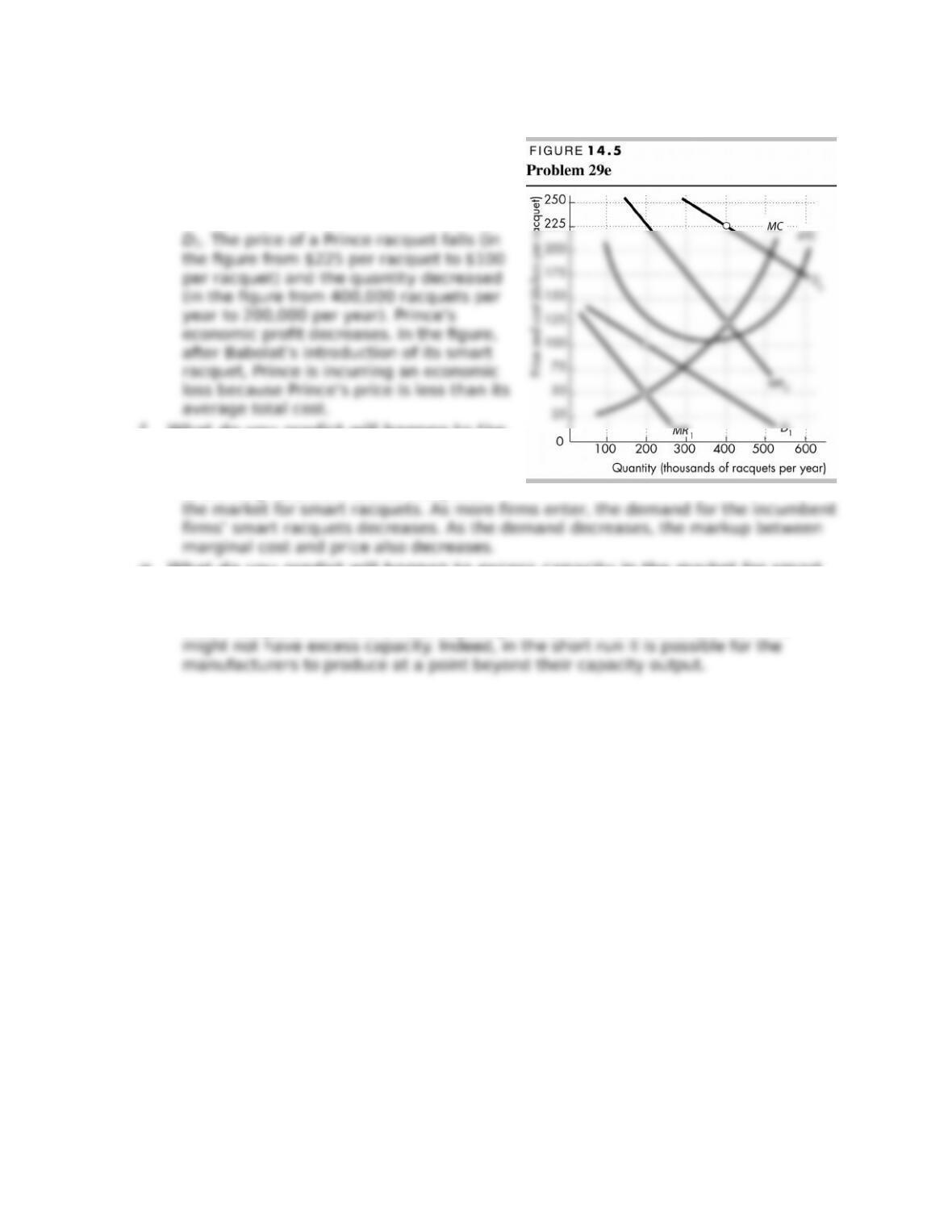
e. Draw a graph to illustrate your answer to part (c). Explain your answer.
Figure 14.5 shows how the smart racquet
a”ected the demand for other rm’s
racquets. The demand for existing, say,
Prince racquets decreased and the
demand curve shifted leftward from D0 to
f. What do you predict will happen to the
markup in the market for smart
racquets?
In the long run, there will be entry into
g. What do you predict will happen to excess capacity in the market for smart
racquets? Explain your answer.
In the long run, similar to all rms in monopolistic competition, the producers of
smart racquets will have excess capacity. In the short run, however, the rms