A n s w e r s t o t h e
R e v i e w Q u i z z e s
Page 325
1. What are the distinguishing characteristics of monopolistic competition?
The distinguishing characteristics of monopolistic competition are: i) a large
2. How do rms in monopolistic competition compete?
Firms in monopolistic competition compete in three areas: Quality—the physical
attributes of a product, including the product’s design and reliability, the service
3. Provide some examples of industries near your school that operate in
monopolistic competition (excluding those given on the text page in the
gure).
Hamburger restaurants, coee shops, and juice bars are examples of rms
Page 329
1. How does a rm in monopolistic competition decide how much to produce
and at what price to oer its product for sale?
A rm that has already decided the quality of its product and its marketing
program produces the output at which its marginal revenue equals its marginal
2. Why can a rm in monopolistic competition make an economic prot only in
the short run?
A rm in monopolistic competition can make an economic prot only in the
short-run because economic prot induces entry, which decreases the demand for
© 2016 Pearson Education, Inc.
1
4
MONOPOLISTIC
COMPETITION
M O N O P O L I S T I C C O M P E T I T I O N 2 3 7
2 3 8
3. Why do rms in monopolistic competition operate with excess capacity?
A rm’s capacity output is the output at which average total cost is at its
minimum. In monopolistic competition in the long run, MR = MC and P = ATC. At
4. Why is there a price markup over marginal cost in monopolistic competition?
A rm’s markup is the amount by which price exceeds marginal cost. There is a
5. Is monopolistic competition eAcient?
Monopolistic competition is not eAcient by the requirement for allocative eAciency
MSB = MSC. The price equals the consumer’s willingness to pay, which is the
marginal social benet and the rm’s marginal cost is the marginal social cost.
Page 333
1. How, other than by adjusting price, do rms in monopolistic competition
compete?
The two main ways rms in monopolistic competition compete other than by
2. Why might product development be eAcient and why might it be ineAcient?
Product development might be eAcient if the development represents actual
improvements to the product and not simply the perception of improvement. The
3. Explain how selling costs inCuence a rm’s cost curves and its average total
cost.
Selling costs increase a rm’s xed cost, which increase the rm’s total cost. This
means that an increase in selling costs shifts the average xed cost (AFC) curve
4. Explain how advertising inCuences the demand for a rm’s product.
If a rm’s advertising program is successful, it will shift the rm’s demand curve
rightward in the short run. But if this shift in demand increases economic prot, it
5. Are advertising and brand names eAcient?
Advertising and brand names can increase consumer information about product
dierences and quality. This information increases consumers’ wellbeing and
increases eAciency. But advertising and creating a brand name also are costly
238
© 2016 Pearson Education, Inc.
M O N O P O L I S T I C C O M P E T I T I O N 2 3 9
A n s w er s to t h e S t u d y P l a n P r o b l e m s a n d
A p p l i c a t i o n s
1. Which of the following items are sold by rms in monopolistic competition?
Explain your selections.
Cable television service
Wheat
Athletic shoes
Soda
Toothbrushes
Ready-mix concrete
2. The four-rm concentration ratio for audio equipment makers is 30 and for
electric lamp makers it is 89. The HHI for audio equipment makers is 415 and
for electric lamp makers is 2,850. Which of these markets is an example of
monopolistic competition?
Use the following information to work Problems 3 and 4.
Sara is a dot.com entrepreneur who has
established a Web site at which people can design
and buy sweatshirts. Sara pays $1,000 a week for
her Web server and Internet connection. The
sweatshirts that her customers design are made to
order by another rm, and Sara pays this rm $20 a
marginal cost equal to her marginal revenue.
Sara’s marginal cost is $20. Between the quantity of 20 and 40 sweatshirts, Sara’s
Price
(dollars
per
sweatshir
t)
Quantity
demanded
(sweatshirts
per week)
4. a. Do you expect other rms to enter the Web sweatshirt business and
compete with Sara?
b. What happens to the demand for Sara’s sweatshirts in the long run? What
happens to Sara’s economic prot in the long run?
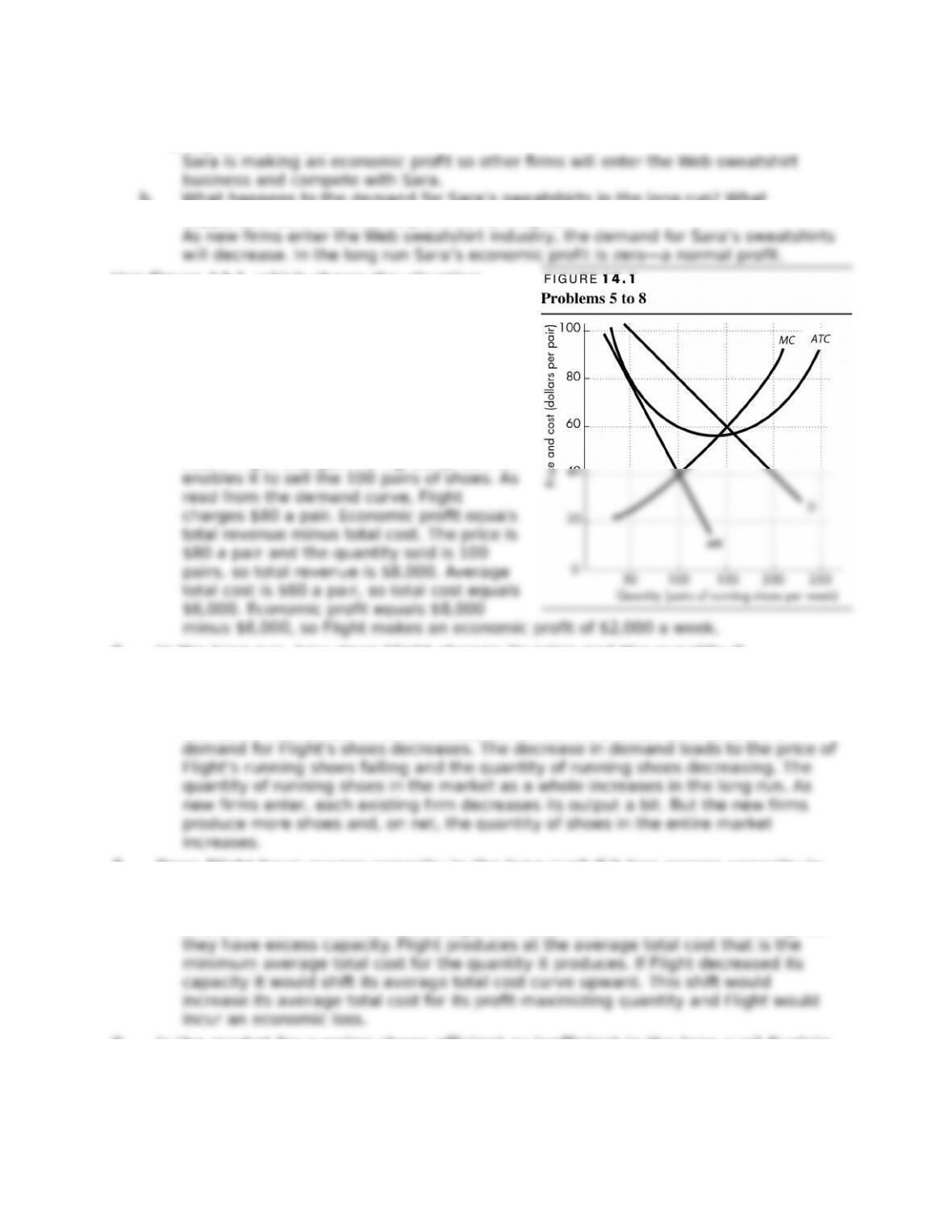
Use Figure 14.1, which shows the situation
facing Flight Inc., a producer of running shoes,
to work Problems 5 to 8.
5. What quantity does Flight produce, what
price does it charge, and what is its
economic prot?
To maximize prot, Flight produces the
quantity at which marginal revenue equals
marginal cost, so it produces 100 pairs a
week. Flight charges the highest price that
6. In the long run, how does Flight change its price and the quantity it
produces? What happens to the market output of running shoes?
The price of a pair of Flight’s running shoes falls and the quantity decreases in the
long run. Flight is making an economic prot and this prot attracts entry into the
market so the number of rms increases. As new rms enter the market, the
7. Does Flight have excess capacity in the long run? If it has excess capacity in
the long run, why doesn’t it decrease its capacity?
In the long run, monopolistically competitive rms produce less output than the
amount which minimizes the average total cost, which means that in the long run
8. Is the market for running shoes eAcient or ineAcient in the long run? Explain
your answer.
Based on the allocative eAciency criterion of producing the quantity at which MSB
= MSC, the market for running shoes is not eAcient. Producing at the allocatively
eAcient quantity P (which equals MSB) equals MC (which equals the MSC). But a
9. Suppose that Tommy Hilger’s marginal cost of a jacket is a constant $100
and the total xed cost at one of its stores is $2,000 a day. This store sells 20
jackets a day, which is its prot-maximizing number of jackets. Then the
stores nearby start to advertise their jackets. The Tommy Hilger store now
spends $2,000 a day advertising its jackets, and its prot-maximizing number
of jackets sold jumps to 50 a day.
a. What is this store’s average total cost of a jacket sold (i) before the
advertising begins and (ii) after the advertising begins?
Before the advertising begins, the average total cost of a jacket is $200. The
average total cost equals the total cost divided by the quantity. The xed cost is
$2,000. Because the marginal cost is $100 per jacket, the total variable cost is
$2,000. So the total cost is the $2,000 xed cost plus the $2,000 variable cost,
b. Can you say what happens to the price of a Tommy Hilger jacket, Tommy’s
markup, and Tommy’s economic prot? Why or why not?
If the advertising has decreased the demand and made it more elastic, which is
If the price falls, then the makeup falls; if the price rises, then the markup rises.
It is not possible to determine the eect on the prot in the short run. In the long
© 2016 Pearson Education, Inc.
1 9 0 C H A P T E R 1 4