
W H AT I S E C O N O M I C S ? 1 5 7
T h e B i g P i c t u r e
Where we have been:
Chapter 14 continues the general analysis of the rm’s output and price
decision by examining the case of monopolistic competition. This chapter also
examines e’ciency using the ideas introduced and explained in Chapters 2
and 5, and uses the market concentration measures explained in Chapter 10.
Where we are going:
Chapter 15 presents the nal market structure, oligopoly. Chapters 16 and 17
examine externalities, public goods, and common resources. Chapter 18
focuses on competitive factor markets. Chapter 19 investigates the
distribution of income, the trends in the distribution, and some of the reasons
for inequality and the trends. The nal chapter, Chapter 20, analyzes some of
the di’culties in making decisions when information is incomplete. The
material presented in this chapter is not used explicitly in the following
chapters.
N e w i n t h e Tw e l f t h E d i t i o n
A new chapter introduction and concluding Economics in the News application
focus on product di5erentiation in the market for tennis racquets. A new Worked
Problem section has been added. The Worked Problem gives students a demand
schedule for personal trainers, the marginal cost, and average total cost. Then it
shows the students how to determine the pro t-maximizing quantity and price,
the markup, and excess capacity. Finally it explains to the students whether the
scenario in the problem is the long-run equilibrium and what will happen to drive
the market to the long-run equilibrium. To include the new Worked Problem
without lengthening the chapter, some problems have been removed from the
Study Plan Problem and Applications. These problems are in the MyEconLab and
are called Extra Problems.
14MONOPOLISTIC
COMPETITION
C h a p t e r
157
1 5 8
158

L e c t u r e N o t e s
Monopolistic Competition
Firms in monopolistic competition face competition from many other rms that
produce a similar but di5erentiated product from its own.
Firms in monopolistic competition maximize their pro t by producing where MR =
MC.
I. What Is Monopolistic Competition?
Monopolistic competition is a market structure in which:
A large number of rms compete
Each rm produces a di5erentiated product
Firms compete on product quality, price, and marketing
Firms are free to enter and exit
Large Number of Firms
The large number of rms in a monopolistically competitive industry implies that
each rm has a small market share, no rm can dictate market conditions, and
collusion (conspiring to x a higher price) is impossible.
Product Dierentiation
Product di*erentiation means that each rm makes a product that is slightly
di5erent from the products of competing rms. Because close but not perfect
substitutes exist, some people will pay more for one variety of a product, so the
demand curve for the rm’s product is downward sloping.
Competing on Quality, Price, and Marketing
Product di5erentiation allows a rm to compete with other rms in product quality,
price, and marketing.
Quality: Physical attributes that di5erentiate a product, including di5erences in
design, reliability, and service provided.
Price: There is a tradeo5 between quality and price.
Marketing: The two main forms are advertising and packaging.
An Economics in Action application considers 10 monopolistically competitive industries.
The application shows the 4- rm concentration ratios and Her ndahl-Hirschman Index.
Entry and Exit
With no barriers to entry, rms in monopolistically competitive industries make zero
economic pro t in the long run.
Examples of Monopolistic Competition
Examples of a monopolistic industry include audio and video equipment, sporting
goods, and jewelry.
Ask students to bring in an empty beverage bottle of their choice. From the pile in the front
of the room, have students help separate them into products in competing markets. A
surprising large numbers of water bottles will appear, and di5erences as simple as
packaging enter the conversation.
II. Price and Output in Monopolistic Competition
The Firm’s Short-Run Output and Price Decision
The demand curve for a monopolistically competitive rm is downward sloping
(similar to the demand curve for a monopoly). The downward sloping demand curve
means that the rm’s marginal revenue curve also is downward sloping and lies
below the demand curve.
Why do these rms face a downward-sloping demand curve if there are so many
substitutes available? Remind the students about the “everything-else-constant”
condition that de nes a demand curve. Along the demand curve for Nike tennis shoes, the
prices of Adidas, Fila, Head, K Swiss, Prince, Reebok, and Wilson tennis shoes are constant.
Some people prefer Nike to the other brands and will pay a bit more for Nike. Other people
prefer some other brand and will buy Nike only if its price is low enough. Buyers have
brand preferences, but they will switch brands if price di5erences are large enough. So the
higher price of a Nike shoe, the prices of the other brands remaining the same, the smaller
is the quantity of Nike shoes demanded—a downward sloping demand.
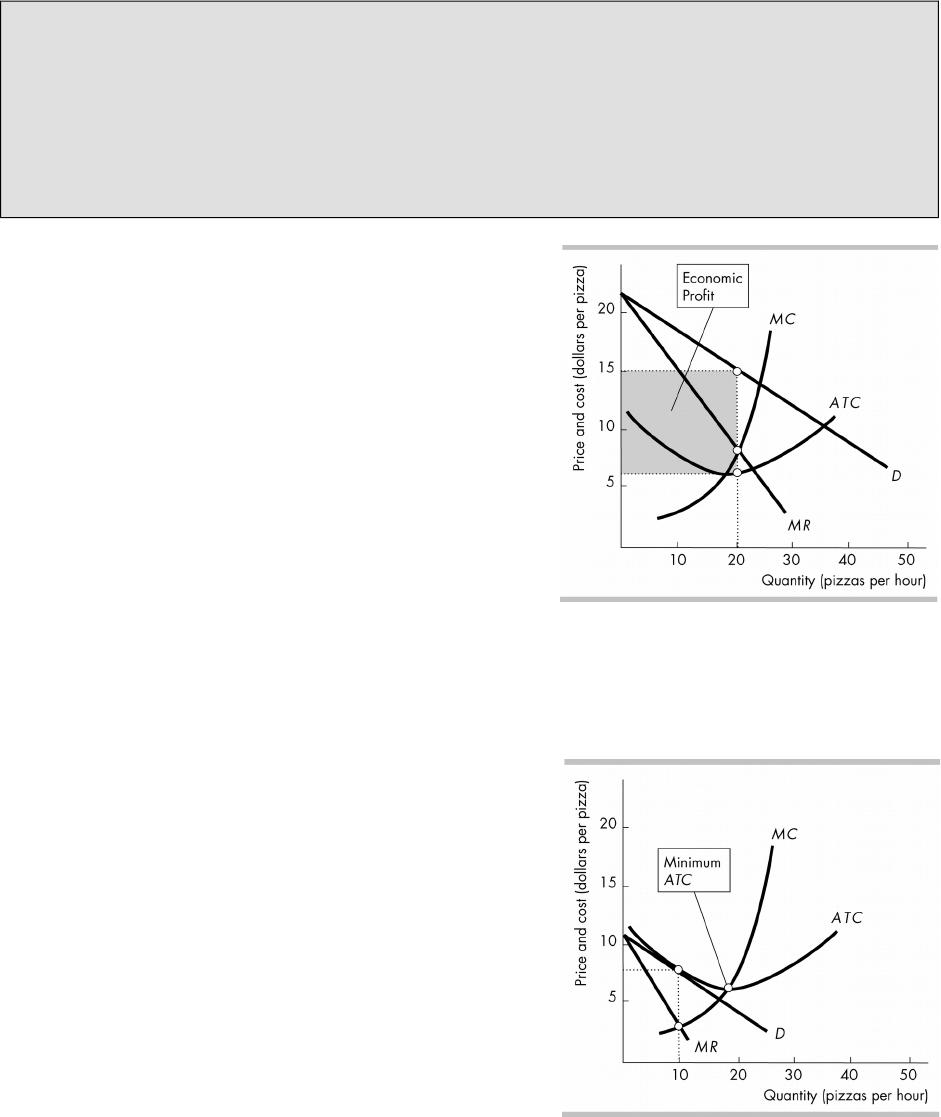
In the short run, a monopolistically
competitive rm makes its output and price
decisions just like a monopoly rm. The
gure shows a monopolistically competitive
rm’s downward sloping demand curve and
the downward sloping MR curve, which, as
noted, lies below the demand curve.
The rm maximizes its pro t by producing
the quantity where MR = MC and using the
demand curve to set the highest price at
which people will buy the quantity it
produces. In the gure, the rm produces 20
pizzas per hour and sets a price of $15 per
pizza.
The rm earns an economic pro t if P > ATC
(as is the case for the rm in the gure). If P
= ATC, the rm earns zero economic pro t, and if P < ATC, the rm incurs an
economic loss.
Pro,t Maximizing Might be Loss Minimizing
In the short run, pro t maximizing quantity of output might be the loss minimizing
quantity of output. The text explores the case of Excite@Home.
Long Run: Zero Economic Pro,t
Unlike a monopoly, rms in monopolistic
competition cannot earn economic pro t in
the long run. If the rms are earning an
economic pro t, other rms enter the
market. Entry continues as long as rms in
the industry earn an economic pro t. As
rms enter, each existing rm loses some of
its market share. The demand for each rm’s
product decreases and the rm’s demand
curve shifts leftward.
Eventually the demand decreases enough so
that the rms earn only a normal pro t,
where P = ATC. Entry then stops. This
outcome is illustrated in the gure, in which
the rm produces 10 pizzas per hour (where MR = MC) and sets a price of $7.50 per
pizza.
© 2016 Pearson Education, Inc.
M O N O P O L I S T I C C O M P E T I T I O N 1 4 7

Why do entry and exit shift the demand curve facing the rm? Students seem to
have a bit of trouble appreciating that entry and exit change the demand for a rm’s
product. You can now haul out your cell phone and return to it as your in-class example.
Likely your phone will have a camera. Though the early history is fuzzy—it’s replete with
small attempts that led to either small failures or small successes—the rst largely
successful cell phone/camera was the J-phone marketed in Japan in 1997. In the United
States, Sprint had the rst success: It sold over 1 million camera phones in 2002. Clearly
these phones were wildly popular and inspired imitators. You can draw the gure showing
a monopolistic competitive rm earning a large economic pro t and tell the students that
this was the case with these rst phones. But then competitors entered the market. When
the second phone entered the market, show how the demand for the rst rm was a5ected
by shifting it and its marginal revenue curve leftward. You can easily point out how entry
decreased the rst rm’s pro t. Continue by discussing how further entry shifted the
demand curve further leftward until, in the long run, the company was left with only a
normal pro t.
Monopolistic Competition and Perfect Competition
Unlike rms in perfect competition, rms in monopolistic competition have excess capacity
and a markup:
Excess Capacity: A rm has excess capacity if it produces less than its e-cient
scale, the quantity that minimizes its average total cost. In the long run, a rm in
perfect competition produces at the minimum ATC but, a rm in monopolistic
competition produces less than the quantity that minimizes the ATC.
Markup: A rm’s markup is the amount by which its price exceeds its marginal cost.
A rm in perfect competition has no markup but a rm in monopolistic competition
charges a price that is greater than its marginal cost of production.
Is Monopolistic Competition E1cient?
Firms in monopolistic competition have higher costs than rms in perfect
competition, but rms in monopolistic competition produce variety, which is valued
by consumers. So compared to the alternative of complete uniformity, monopolistic
competition might be e’cient.
III. Product Development and Marketing
Product Development
Product development is costly, but can bring in additional revenue. New product
development allows a rm to gain a temporary competitive edge and economic
pro t before competitors imitate the innovation. At a low level of product
development, the marginal revenue of better products exceed the marginal cost so
rms develop more new products. At high levels, the marginal cost exceeds the
marginal revenue and so rms develop fewer new products.
Because MR is less than P in monopolistic competition, product development is
probably not at its socially e’cient level.
Food lore says that bu5alo wings started out at a restaurant in Bu5alo, New York, and now
are on the menu of virtually every bar and casual dining restaurant in the nation. Many
other similar examples can be identi ed. Success breeds imitation in the world of
competition and sometimes the original creator is not in business in the end as rivals creep
in and engage in a never-ending series of one-upsmanship.
Advertising
Advertising and packaging allow a rm to di5erentiate its product. Firms in
monopolistic competition incur heavy advertising expenditures which make up a
large portion of the price it charges for the product.
© 2016 Pearson Education, Inc.
1 4 8 C H A P T E R 1 4

An Economics in Action case explores the cost of selling a pair of shoes. The vast majority of
the costs are selling costs.
Selling costs, such as advertising, are xed costs that increase the ATC at any given
level of output but do not a5ect the MC. Advertising e5orts are successful if they
increase demand, which can lead to increased pro t. But if all rms advertise, more
rms might survive, and so the demand for any one rm is less than otherwise.
Using Advertising to Signal Quality
Heavy marketing and advertising expenditures are a signal to consumers of a
high-quality product. A signal is an action taken by an informed person (or rm) to
send a message to uninformed people.
E1ciency of Advertising and Brand Names
Advertising and brand names might be e’cient if they provide consumers with
information about the precise nature of product di5erences and about product
quality. So the nal verdict about the e’ciency of monopolistic competition is
ambiguous.
An Economics in the News feature considers product di5erentiation in the market for tennis
racquets. It shows how a new, electronic racquet, will make an economic pro t in the short
run but zero economic pro t in the long run.
© 2016 Pearson Education, Inc.
M O N O P O L I S T I C C O M P E T I T I O N 1 4 9
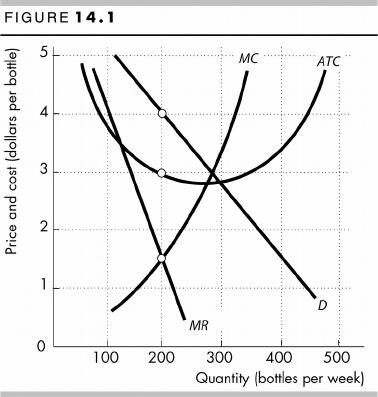
A d d i t i o n a l P r o b l e m s
1. The gure shows the situation facing Well
Done, Inc., a producer of steak sauce.
a. What quantity does Well Done produce?
b. What does it charge?
c. How much pro t does Well Done make?
d. If all steak sauce rms have identical cost
curves and face identical demand curves,
what happens to the number of rms in
the market in the long run?
e. In the long run, will the price of steak
sauce rise, fall, or not change?
S o l u t i o n s t o A d d i t i o n a l P r o b l e m s
1. a. To maximize pro t, Well Done produces the quantity at which marginal revenue
equals marginal cost. Well Done produces 200 bottles a week.
b. To maximize pro t, Well Done charges the highest price that allows it to sell the 200
bottles of steak sauce it produces. This price is read from the demand curve and is
$4 a bottle.
c. Economic pro t equals total revenue minus total cost. The price is $4 and the
quantity sold is 200 bottles, so total revenue is $800. Average total cost is $3, so
total cost equals $600. Economic pro t equals $800 minus $600, so Well Done
makes an economic pro t of $200 a week
d. The rms are making an economic pro t so new rms will enter the market. In the
long run the number of rms is greater than in the short run.
e. In the long run the number of rms increases so that each rm’s demand is less
than in the short run. With the lowered demand the price of steak sauce is lower in
the long run.
A d d i t i o n a l D i s c u s s i o n Q u e s t i o n s
1. In what sense is a rm in monopolistic competition similar to a
monopoly rm? Emphasize that each rm has some ability to raise market
price through marketing e5ort and product di5erentiation. This means MR < P
at all levels of output. In the long run, both markets are ine’cient in the strict
allocative e’cient sense because: i) production does not occur at the lowest
possible unit cost, and ii) P (=MSB) > MC (=MSC) at equilibrium, so each rm
produces less output than is socially e’cient.
2. In what sense is a rm in monopolistic competition similar to a
perfectly competitive rm? Emphasize that entry and exit a5ect the market
price that each rm can charge in both markets. Also, low barriers to entry
and exit make it impossible for any rm to enjoy economic pro ts in the long
run.
3. Is advertising real information or is it just hype? Have the class discuss
whether an increase in the consumer’s willingness to pay for a product is
© 2016 Pearson Education, Inc.
150 C H A P T E R 1 4
su’cient to justify advertising as socially bene cial. There are only normative
answers to this question, but it is still a useful exercise in carefully thinking
about how we de ne e’ciency in economic modeling.
4. Imagine a four lane road in any suburban area in the country. Often
there will be gas stations directly across the road from one another,
rarely facing peak demand. Would it be more e$cient to have just
one gas station? If so, why do two survive over long periods of time?
The situation of competing gas stations on opposite corners is a good example
of excess capacity in monopolistic competition. Empty pumps and a less busy
attendant mean gas costs a little more than otherwise; that is, the mark-up is
positive. But consumers much prefer the convenience of pulling up to an open
pump on the side of the road on which they are traveling rather than trying to
cross multiple lanes of tra’c to get in line for a gas pump with slightly
cheaper gas which would more likely be the case if gasoline stations competed
in a perfect competitive industry. Drivers nd it worth paying a few cents more
rather than having to maneuver across tra’c and then wait available pump at
a big busy station.
5. What does it mean for a product to be di%erentiated? In papers and
other assignments, I have had students argue that beer and soda were
products that were “identical” or homogeneous rather than di5erentiated. It is
worth having a discussion about what it means to be di5erentiated and the
various methods rms can use to di5erentiate their products. Location, sta’ng
and service, Pavors, sizes, formulas, and even just packaging might
di5erentiate products. As long as there is some di5erence between the goods
or services, they might well be di5erentiated.
6. Ford Motor Company today is taking market share from rivals and
innovating new products with features consumers nd desirable. But
in the past, Ford famously lost market share to rivals when founder
Henry Ford refused to engage in product di%erentiation, preferring
instead the e$ciency of mass production of a single product, saying
that customers could get a Model T in any color, as long as it was
black. What are the advantages and disadvantages of product
di%erentiation? Can the market itself work out the right amount of
product di%erentiation over time? If there are economies of scale, having
fewer, larger amounts of production reduces cost. Di5erentiation adds costs,
not just in formulas, but in packaging and other resources. If the di5erentiation
is meaningful to consumers, then having various types of products and levels
of quality and service adds meaningful value. To some degree, if a
di5erentiation persists in the market, people must nd it worth paying for.
Consumers though must have good access to information and rms must be
free to enter and exit as what the market wants changes over time.
7. Are brands the same as companies? Does a crowded aisle at the
store mean lots of competition? Most nationally distributed consumer
products are created by rms in markets that are oligopolistic. The breakfast
cereal aisle is crowded with all kinds of brands, but only 3-4 companies make
most of the breakfast cereal sold nationwide. The toothpaste aisle is again
crowded with varieties but the toothpaste market is dominated by just a
couple of rms. Going back to the material in Chapter 10 about the di5erences
between market structures and market concentration measures, now is a good
time for an assignment or a discussion about the di5erences between brands
and rms. Brand proliferation can be a sign of a lack of competition when
© 2016 Pearson Education, Inc.
M O N O P O L I S T I C C O M P E T I T I O N 1 5 1
students may interpret it as robust competition. This assignment or discussion
can serve as a good bridge to discussing oligopoly.
© 2016 Pearson Education, Inc.
152 C H A P T E R 1 4