Answers to Additional Problems and Applications
Use the following list, which gives some information about seven rms, to answer
Problems 10 and 11.
Coca-Cola cuts its price below that of Pepsi-Cola in an attempt to increase
its market share.
10. In which of the seven cases might monopoly arise?
11. Which of the seven cases are natural monopolies and which are legal
monopolies? Which can price discriminate, which cannot, and why?
It is not possible to determine if the second case is a legal barrier or natural barrier
to entry because we do not know the type of barrier. The sixth case describes a
legal barrier to entry because Nike has been given an “exclusive license” by the
Use the following information to work
Problems 12 to 16.
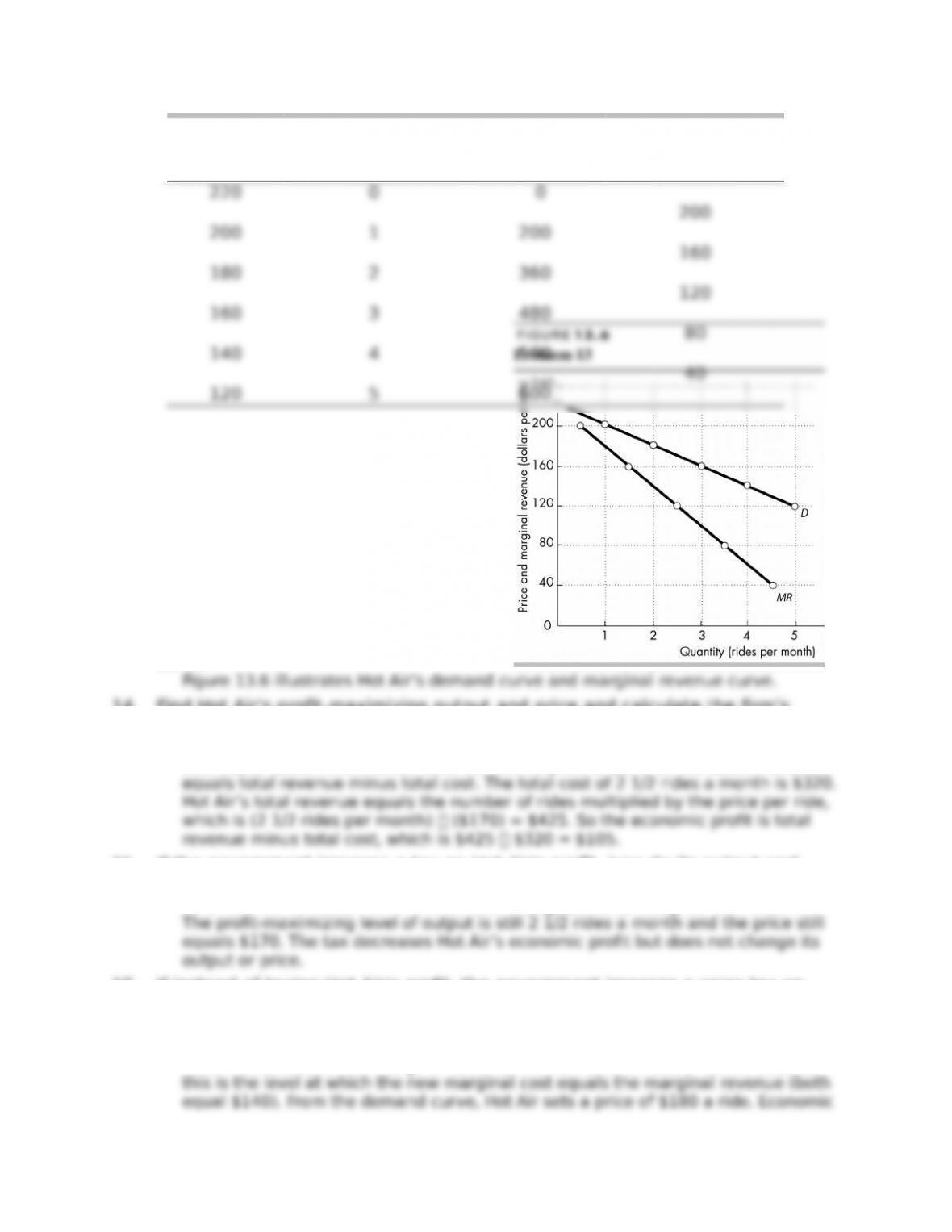
Hot Air Balloon Rides is a single-price
monopoly. Columns 1 and 2 of the table
set out the market demand schedule and
revenue schedule and marginal
Price
(dollars
per
ride)
Quantity
demanded
(rides per
month)
Total cost
(dollars
per
month)
13. Draw a graph of the market demand
curve and Hot Air’s marginal revenue
curve.
14. Find Hot Air’s prot-maximizing output and price and calculate the rm’s
economic prot.
Hot Air’s marginal cost equals marginal revenue at 2 1/2 rides a month, where
both equal $120. From the demand curve, the price is $170 a ride. Economic prot
15. If the government imposes a tax on Hot Air’s prot, how do its output and
price change?
As a result of the tax, Hot Air’s xed cost changes, but its marginal cost does not.
16. If instead of taxing Hot Air’s prot, the government imposes a sales tax on
balloon rides of $30 a ride, what are the new prot-maximizing quantity,
price, and economic prot?
A $30-a-ride tax increases Hot Air’s marginal cost by $30 at every level of output.
With the increase in the marginal cost, Hot Air now sells 2 rides a month because
Price
(dollars
per ride)
Quantity
demanded
(rides per month)
Total revenue
(dollars
per month)
Marginal revenue
(dollars
per ride)
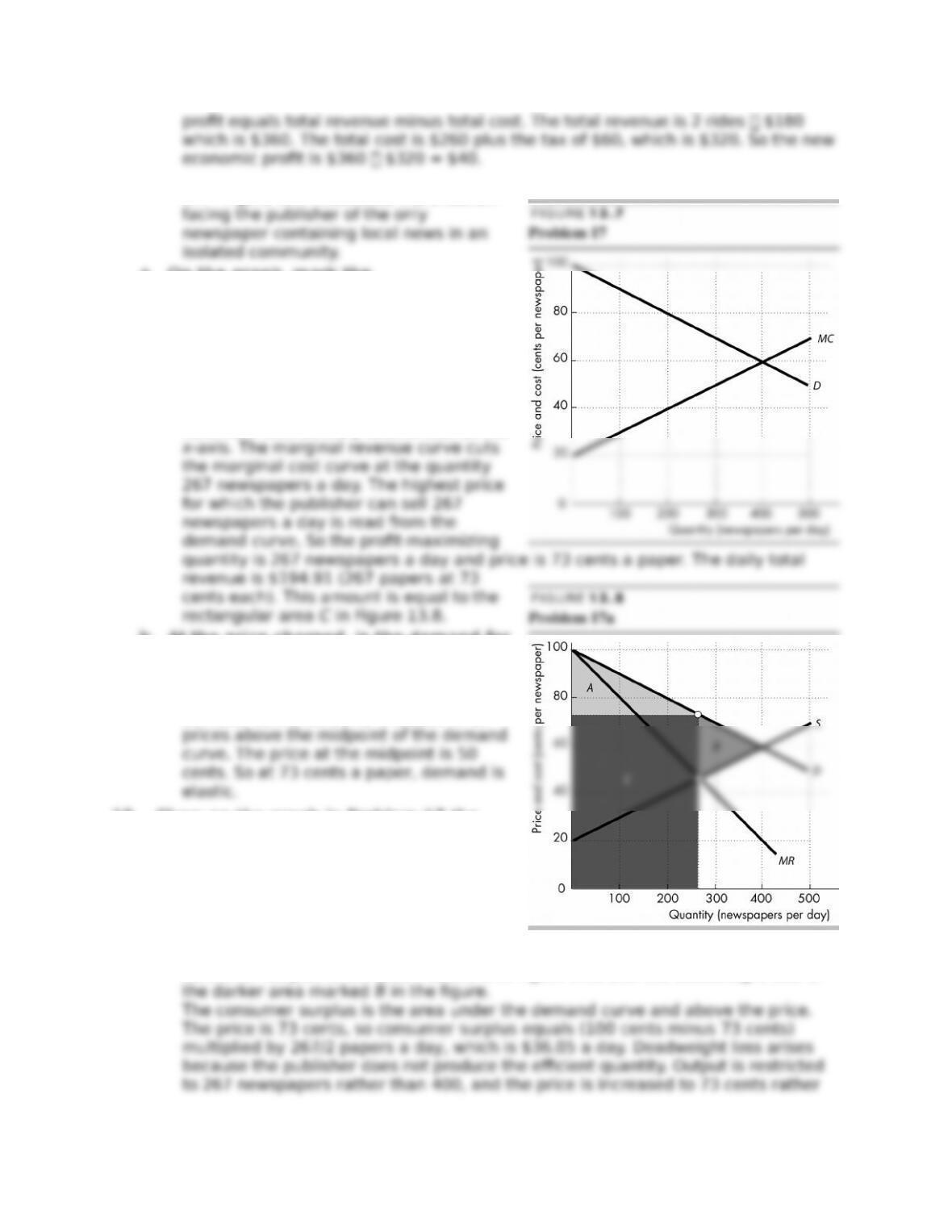
17. Figure 13.7 illustrates the situation
a. On the graph, mark the
prot-maximizing quantity and price
and the publisher’s total revenue per
day.
Prot is maximized when the rm
produces the output at which marginal
cost equals marginal revenue. As Figure
13.8 shows, the marginal revenue curve
runs from 100 on the y-axis to 500 on the
b. At the price charged, is the demand for
this newspaper elastic or inelastic?
Why?
Demand is elastic. Along a straight-line
demand curve, demand is elastic at all
18. Show on the graph in Problem 17 the
consumer surplus from newspapers and
the deadweight loss created by the
monopoly. Explain why this market might
encourage rent seeking.
Figure 13.8 shows the consumer surplus,
area A, and the deadweight loss, area B.
The consumer surplus is $36.05 a day and the deadweight loss is $8.65 a day. The
consumer surplus is the area marked A in Figure 13.8 and the deadweight loss is
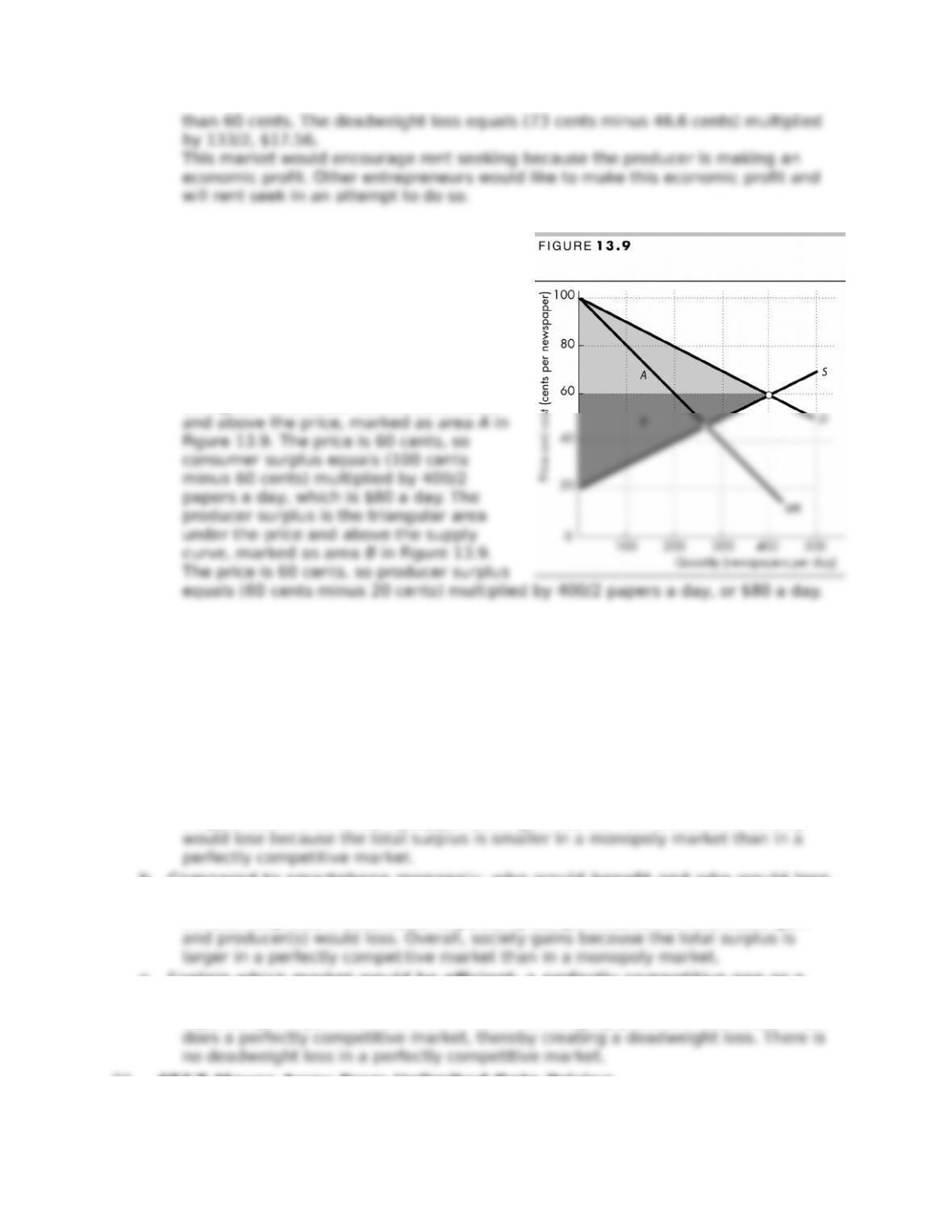
19. If the newspaper market in Problem 17
were perfectly competitive, what would
be the quantity, price, consumer surplus,
and producer surplus? Mark each on the
graph.
The quantity would be 400 newspapers a
day and the price would be 60 cents a
newspaper. The consumer surplus is the
triangular area under the demand curve
20. What the Apple-Samsung Verdict Means for Your Smartphone
A California jury found Samsung guilty of violating the majority of the patents
in question, including software features like double-tap zooming and scrolling.
It recommended that Apple be awarded more than $1 billion in damages. This
verdict could signicantly a$ect both smartphone users and producers.
Source: CNN Money, August 26, 2012
a. If Apple became a monopoly in the smartphone market, who would benet
and who would lose?
If Apple became a monopoly, Apple would gain. Consumers would lose. Society
b. Compared to smartphone monopoly, who would benet and who would lose
if the smartphone market became perfectly competitive?
If the smartphone market became perfectly competitive, consumers would gain
c. Explain which market would be eFcient: a perfectly competitive one or a
monopoly.
A perfectly competitive market is eFcient. A monopoly produces less output than
21. AT&T Moves Away From Unlimited-Data Pricing
AT&T said it will eliminate its $30 unlimited data plan as the crush of data use
from the iPhone has hurt call quality. AT&T is introducing new plans costing
$15 a month for 200 megabytes of data traFc or $25 a month for 2
gigabytes. AT&T says those who exceed 2 gigabytes of usage will pay $10 a
month for each additional gigabyte. AT&T hopes that these plans will attract
more customers.
Source: The Wall Street Journal, June 2, 2010
a. Explain why AT&T’s new plans might be price discrimination.
AT&T’s new plans are price discrimination because users pay a di$erent price per
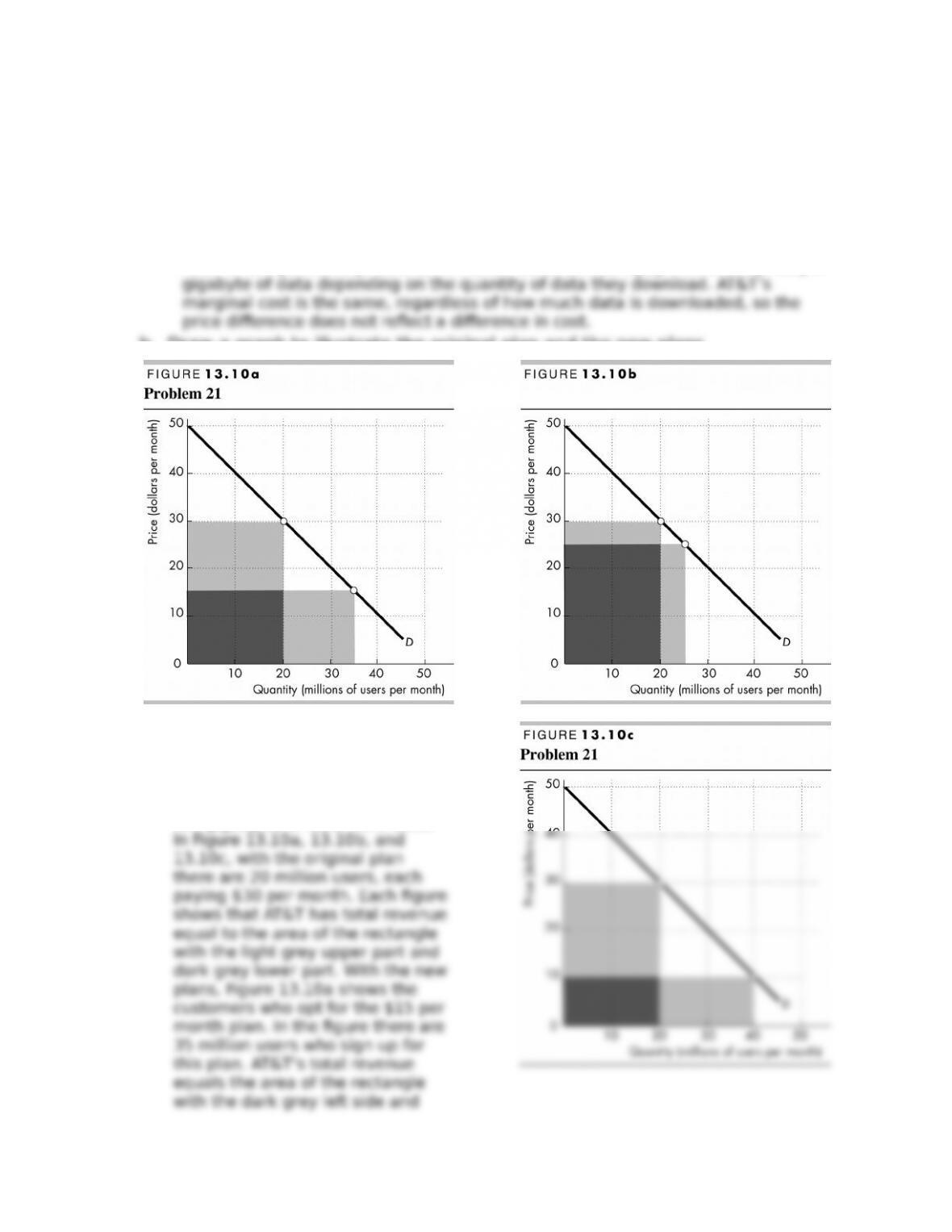
b. Draw a graph to illustrate the original plan and the new plans.
Figures 13.10 can be used to
illustrate the original plan and the
new plan. Initially AT&T charged
everyone a fee of $30 per month
regardless of how many or how
few gigabytes of data were used.
the light grey right side. Next
Figure 13.10b shows the users
who opt for the
$25 per month plan. In the gure there are 25 million customers who sign up for
22. iSurrender
In 2008, getting your hands on a new iPhone meant signing a two-year AT&T
contract. Some markets, because of the costs of being a player, tend toward
either a single rm or a small number of rms. Everyone hoped the wireless
market would be di$erent. A telephone monopoly has been the norm for most
of American telecommunication history, except for what may turn out to have
been a brief experimental period from 1984 through 2012 or so. It may be
that telephone monopolies in America are a national tradition.
Source: Slate, June 10, 2008
a. How did AT&T, the exclusive provider of wireless service for the iPhone in
2008, inKuence the wireless telecommunication market?
When AT&T was the exclusive provider of service for the iPhone the amount of
b. Explain why the wireless market might “tend toward either a single rm or a
small number of rms.” Why might this justify allowing a regulated
monopoly to exist in this market?
If the wireless industry is a natural monopoly, there is a natural tendency for the
market to have only one rm. The rm that survives obtains a cost advantage over
Economics in the News
23. After you have studied Economics in the News on pp. 316–317, answer the
following questions.
a. Why did the European regulators say that Google was misusing its monopoly
power? Do you agree? Explain why or why not.
The European regulators asserted that Google was abusing its power in search to
extend its reach to other markets, such as commercial searches for digital
b. Explain why it would be ineFcient to regulate Google to make it charge the
same price per keyword click to all advertisers.
EFciency requires that Google sell the number of clicks so that the marginal social
cost of a click equals the marginal social benet of a click. The marginal social cost
c. Explain why selling keywords to the highest bidder can lead to an eFcient
allocation of advertising resources.
Selling keywords to the highest bidder allocates the words to those bidders who
value them most highly, which means the words and hence advertising resources,
24. F.C.C. Planning Rules to Open Cable Market
The Federal Communications Commission (F.C.C.) is setting new regulations
to open the cable television market to independent programmers and rival
video services. The new rules will make it easier for small independent
programmers to lease access to cable channels and the size of the nation’s
largest cable companies will be capped at 30 percent of the market.
Source: The New York Times, November 10, 2007
a. What barriers to entry exist in the cable television market?
The major barrier to entry is that the cable industry is a natural monopoly. Firms
b. Are high cable prices evidence of
monopoly power?
High prices are not necessarily evidence
of monopoly. Prices can be high in
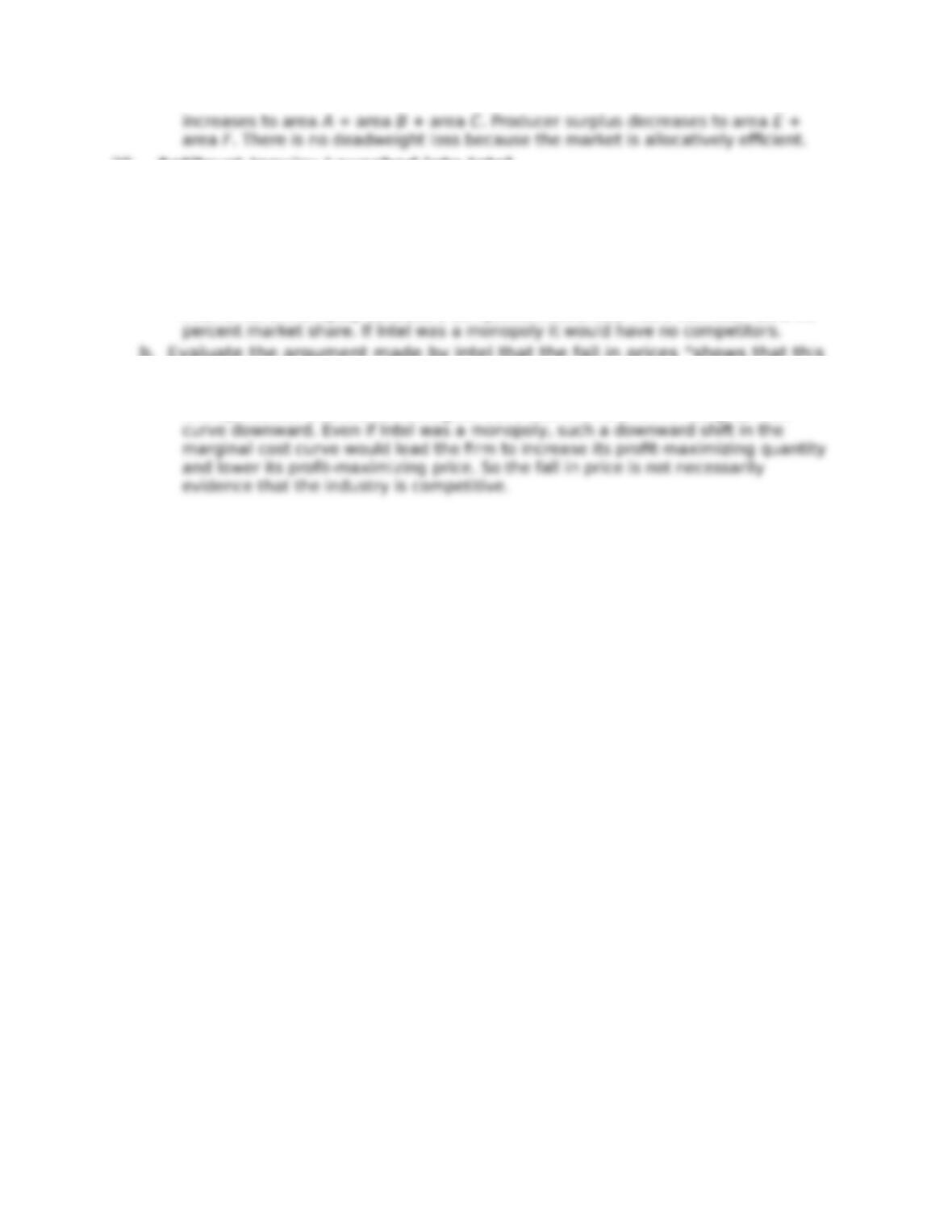
c. Draw a graph to illustrate the e$ects
of the F.C.C.’s new regulations on the
price, quantity, total surplus, and
deadweight loss.
Presuming that the cable market was an
unregulated monopoly before the FCC’s
actions and that the market becomes
competitive after the actions, Figure
25. Antitrust Inquiry Launched into Intel
Intel, the world’s largest chipmaker, holds 80 percent of the microprocessor
market. Advanced Micro Devices complains that Intel stiKes competition, but
Intel says that the 42.4 percent fall in prices between 2000 and 2007 shows
that this industry is ercely competitive.
Source: The Washington Post, June 7, 2008
a. Is Intel a monopoly in the chip market?
Intel is not a monopoly because a competitor, Advanced Micro Devices, has a 20
b. Evaluate the argument made by Intel that the fall in prices “shows that this
industry is ercely competitive.”
This argument is not sound. Technology has advanced rapidly in the
microprocessor market. Technological advances shift the rm’s marginal cost