W H AT I S E C O N O M I C S ? 2 1 7
A n s w e r s t o t h e R e v i e w Q u i z z e s
Page 299
1. How does monopoly arise?
Monopoly arises if a rm is selling a good that has no close substitutes and if the
2. How does a natural monopoly di(er from a legal monopoly?
The barrier to entry protecting a natural monopoly is the rm’s cost. For a natural
monopoly, the costs are such that one rm can supply the entire market at lower
3. Distinguish between a price-discriminating monopoly and a single-price
monopoly.
A single-price monopoly charges every consumer the same price for each unit of
the good or service the consumer buys. A price-discriminating monopolist might
Page 303
1. What is the relationship between marginal cost and marginal revenue when a
single-price monopoly maximizes prot?
A single-price monopoly rm maximizes prot by producing an amount of output
2. How does a single-price monopoly determine the price it will charge its
customers?
The market demand curve is the monopolist’s demand curve. The demand curve
3. What is the relationship between price, marginal revenue, and marginal cost
when a single-price monopoly is maximizing prot?
MR < P for every level of output. A prot-maximizing monopoly rm produces the
13MONOPOLY
217
2 1 8
4. Why can a monopoly make a positive economic prot even in the long run?
Barriers to entry prevent the monopoly rm from enduring the pressure of
Page 307
1. Why does a single-price monopoly produce a smaller output and charge more
than the price that would prevail if the market were perfectly competitive?
The market supply curve for a competitive market is the horizontal sum of the
individual rm’s marginal cost curves. Equilibrium output in this competitive
market is determined where the market supply curve intersects the market
2. How does a monopoly transfer consumer surplus to itself?
The monopoly raises price by lowering the quantity o(ered for sale. This raises the
3. Why is a single-price monopoly ine;cient?
In a competitive market, the supply curve is the marginal social cost curve for
society, and the demand curve is the marginal social benet curve to society. The
perfectly competitive market is e;cient because production occurs where the
4. What is rent seeking and how does it in=uence the ine;ciency of monopoly?
Rent seeking is the pursuit of wealth by capturing economic rent. Any surplus—
consumer surplus, producer surplus, or economic prot—is called economic rent.
There are two forms of rent seeking activity to pursue a monopoly status: i) Buying
Page 311
1. What is price discrimination and how is it used to increase a monopoly’s
prot?
Price discrimination is the practice of selling di(erent units of a good or service for
di(erent prices. To practice price discrimination, a monopoly must be able to: i)
218
W H A T I S E C O N O M I C S ? 2 1 9
2. Explain how consumer surplus changes when a monopoly price discriminates.
When a monopoly price discriminates, it charges di(erent prices for di(erent units
of the product or it charges di(erent prices to di(erent consumers. Consumer
surplus is the value (or marginal benet) of a good minus the price paid for it,
3. Explain how consumer surplus, economic prot, and output change when a
monopoly perfectly price discriminates.
Perfect price discrimination occurs when a monopoly charges each consumer the
maximum price he or she is willing to pay. The closer the price paid is to the value
placed on the good, the smaller is the consumer surplus. This transfers the entire
4. What are some of the ways that real-world airlines price discriminate?
Vacation travelers are willing to pay less than business travelers, so airlines need
to sort vacation travelers from business travelers. Vacation travelers generally
know well in advance when their vacation will occur and so they are able to
purchase their tickets in advance. In addition vacation travelers are often willing to
Page 315
1. What is the pricing rule that achieves an e;cient outcome for a regulated
monopoly? What is the problem with this rule?
Regulating the actions of a natural monopoly to achieve an e;cient outcome
implies setting the level of output at the quantity where MB = MC, and the
monopoly must set its price equal to marginal cost. This type of regulation is called
the marginal cost pricing rule. A marginal cost pricing rule maximizes total
219
2 2 0
2. What is the average cost pricing rule? Why is it not an e;cient way of
regulating monopoly?
An average cost pricing rule requires that the rm set its price equal to its average
total cost and produce the quantity at which the LRAC curve intersects the demand
curve. This pricing rule leads to an ine;cient quantity of output. Allocative
3. What is a price cap? Why might it be a more e(ective way of regulating
monopoly than rate of return regulation?
A price cap is a price ceiling, a regulation that sets the maximum price the
regulated rm can charge. This type of regulation might be a more e(ective
4. Compare the consumer surplus, producer surplus, and deadweight loss that
arise from average cost pricing with those that arise from prot-maximization
pricing and marginal cost pricing.
For a natural monopoly, marginal cost is less than average total cost at all levels of
output in the market. Compared to an average cost pricing rule a marginal cost
pricing rule generates greater consumer surplus and less producer surplus
because P = MC (which determines production with the marginal cost pricing rule)
at a larger level of output than when P = LRAC (which determines production with
A n s w e r s t o t h e S t u d y P l a n P r o b l e m s a n d
A p p l i c a t i o n s
220
W H A T I S E C O N O M I C S ? 2 2 1
1. The U.S. Postal Service has a monopoly on non-urgent First Class Mail. Pzer
Inc. makes LIPITOR, a prescription drug that lowers cholesterol. Cox
Communications is the sole provider of cable television service in some parts
of San Diego. Are any of these rms protected by a barrier to entry? Do any of
these rms produce a good or service that has a substitute? Might any of
them be able to prot from price discrimination? Explain your answers.
The U.S. Postal Service and Pzer are protected by legal barriers to entry. The
Postal Service has the legal right given to it by the Private Express Statutes to be
Use the following table to
work Problems 2 to 4.
Minnie’s Mineral Springs is
a single-price monopoly.
Columns 1 and 2 of the
table set out the market
demand schedule for
Minnie’s water and columns
2 and 3 set out Minnie’s
total cost schedule.
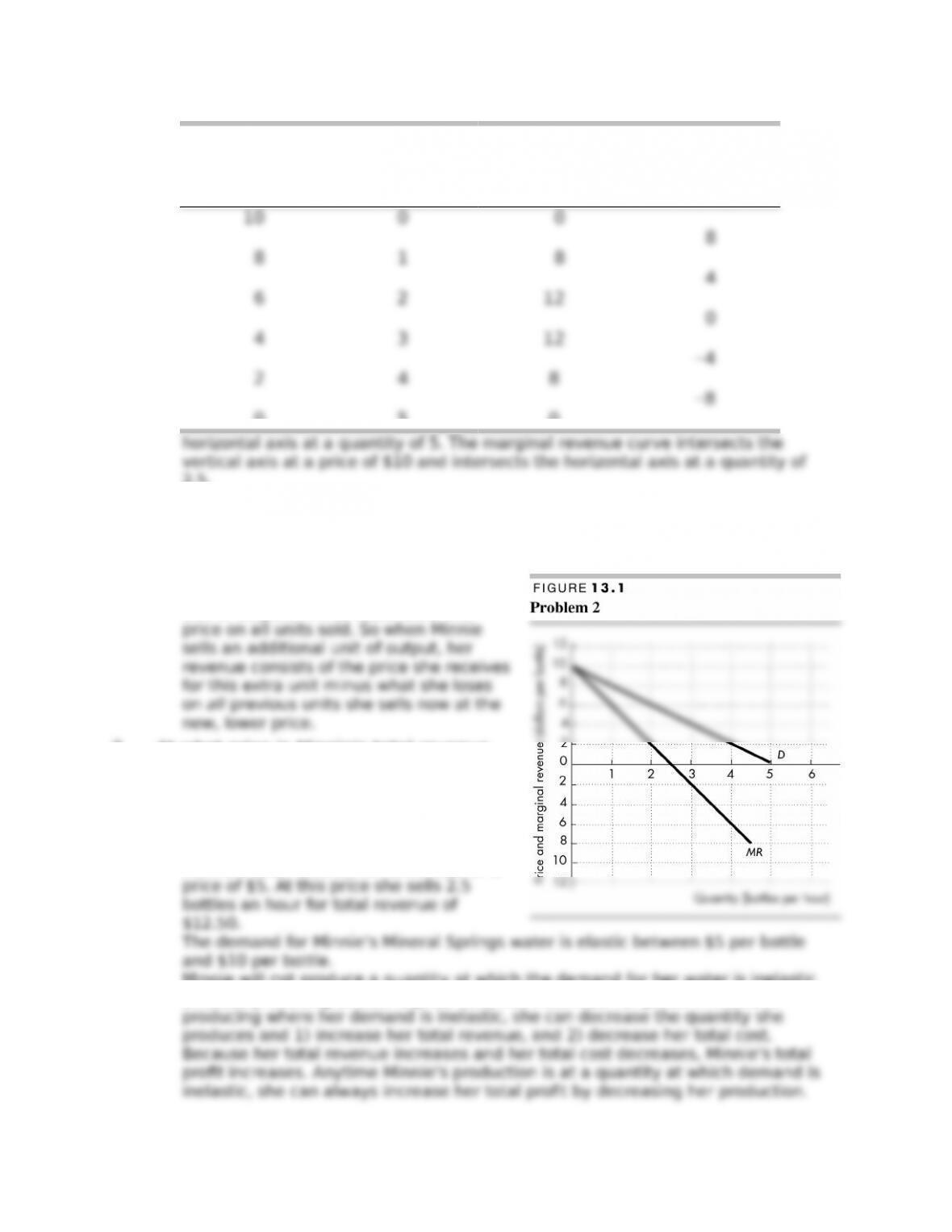
2. Calculate Minnie’s
marginal revenue schedule and draw a graph of the market demand curve
and Minnie’s marginal revenue curve. Explain why Minnie’s marginal revenue
is less than the price.
To calculate Minnie’s marginal revenue, we rst need to calculate the total
revenue. Minnie’s total revenue schedule lists the total revenue at each quantity
sold. For example, Minnie’s can sell 1 bottle for $8 a bottle, which is $8 of total
revenue at the quantity 1 bottle. Minnie’s entire total revenue schedule is in the
table on the next page.
Price
(dollars per
bottle)
Quantity
demanded
(bottles per
hour)
Total cost
(dollars per
hour)
10 0 1
8 1 3
6 2 7
4 3 13
2 4 21
0 5 31
221
222
2.5.
.
Minnie’s marginal revenue is less than
her price because to sell an additional
unit of output, Minnie must lower her
3. At what price is Minnie’s total revenue
maximized and over what range of
prices is the demand for water elastic?
Why will Minnie not produce a quantity
at which the market demand is inelastic?
Interpolating along the demand curve,
Minnie’s total revenue is maximized at a
Minnie will not produce a quantity at which the demand for her water is inelastic
because producing at such a price does not maximize her prot. If Minnie is
Price
(dollars per
bottle)
Quantity
demanded
(bottles per
hour)
Total revenue
(dollars)
Marginal
revenue
(dollars per
bottle)
0 5 0
222
W H A T I S E C O N O M I C S ? 2 2 3
4. Calculate Minnie’s prot-maximizing output and price and economic prot.
To maximize prot Minnie’s needs to produce the quantity at which marginal
revenue equals marginal cost. The marginal cost of increasing the quantity from 1
Economic prot equals total revenue minus total cost. Total revenue equals price
($7 a bottle) multiplied by quantity (1.5 bottles), which is $10.50. Total cost of
5. Use the data in Problem 2 to work Problem 5.
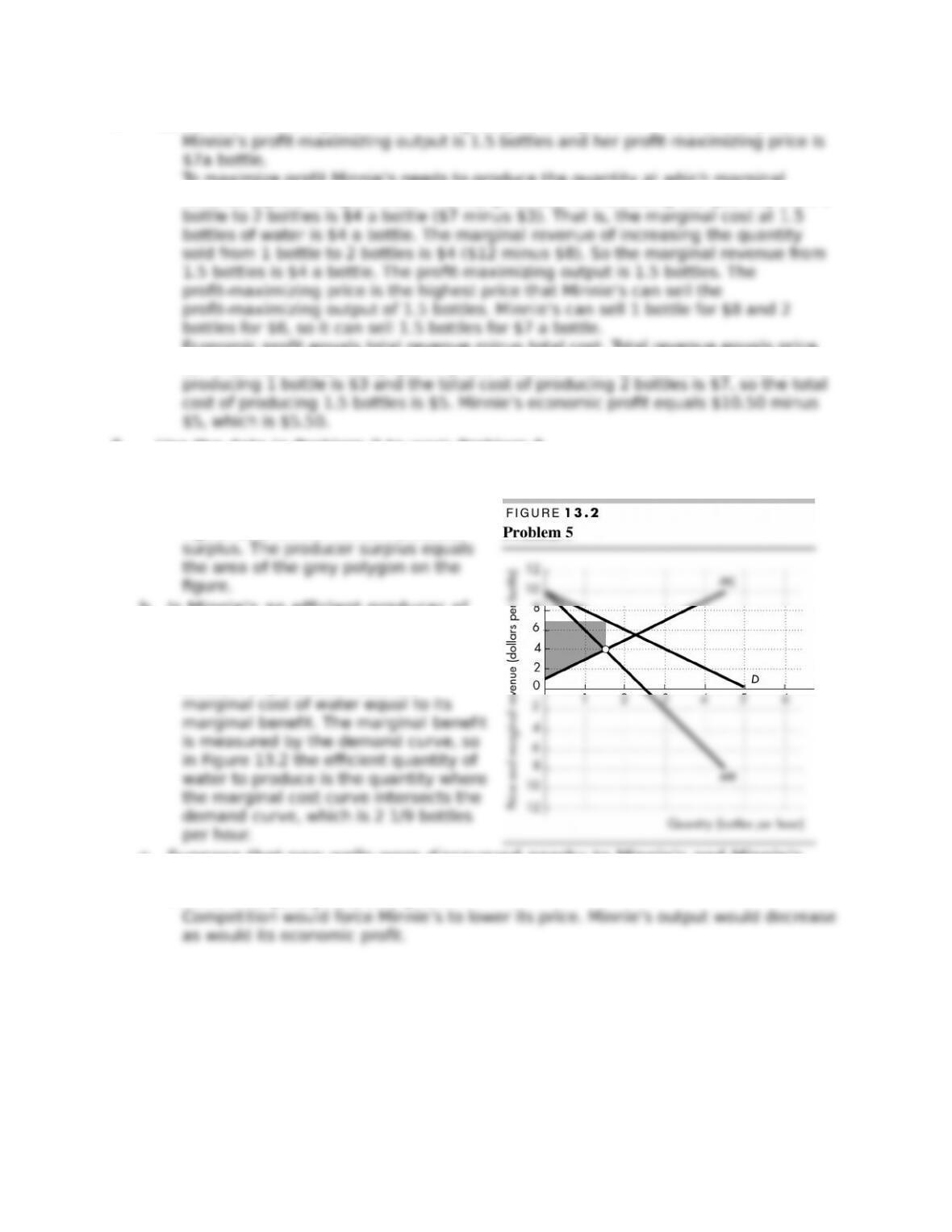
a. Use a graph to illustrate the producer surplus generated from Minnie’s
Mineral Springs’ water production
and consumption.
Figure 13.2 shows Minnie’s producer
b. Is Minnie’s an e;cient producer of
water? Explain your answer.
Minnie’s is not an e;cient producer of
water. E;ciency requires that the
amount of production sets the
c. Suppose that new wells were discovered nearby to Minnie’s and Minnie’s
faced competition from new producers. Explain what would happen to
Minnie’s output, price, and prot.
223
224
6. LaBella Pizza can produce a pizza for a marginal cost of $2. Its price of a pizza
is $15.
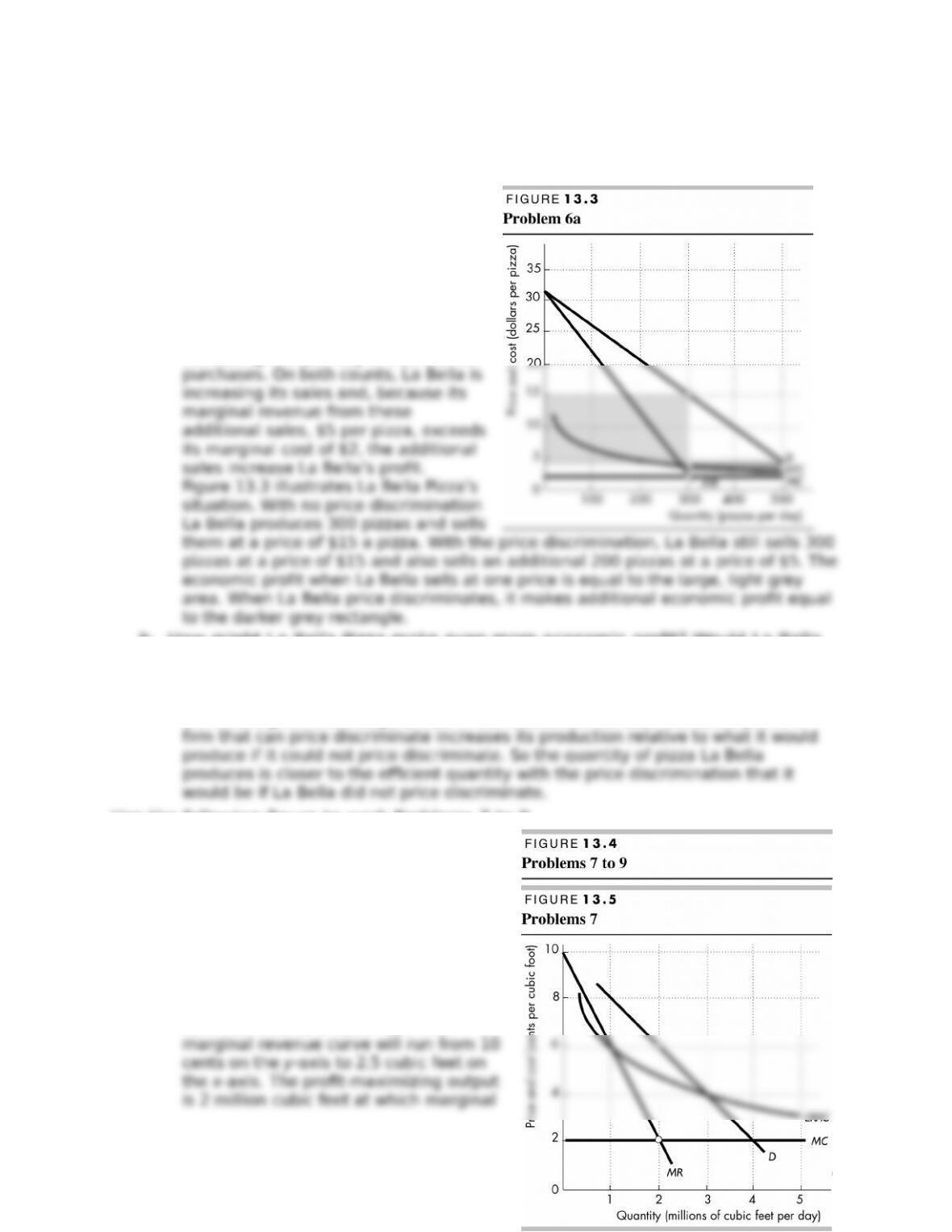
a. Could La Bella Pizza make a larger economic prot by o(ering a second
pizza for $5? Use a graph to
illustrate your answer.
La Bella Pizza is price discriminating,
which increases its prot. It is
charging consumers a second price
for the second pizza they buy. This
sort of price discrimination essentially
is moving downward along a
consumer’s demand curve and
increasing the quantity the consumer
b. How might La Bella Pizza make even more economic prot? Would La Bella
Pizza then be more e;cient than it would be if it charged $15 for each
pizza?
La Bella could further price discriminate. For instance, it might sell a third pizza for
$4, which, given the marginal cost of $2, would still increase economic prot. A
Use the following gure to work Problems 7 to 9.
The gure shows Calypso, a U.S. natural gas
distributor. It is a natural monopoly that
cannot price discriminate. What quantity will
Calypso produce, what price will it charge,
and what will be the total surplus and
deadweight loss if Calypso is:
7. An unregulated prot-maximizing rm?
As shown in Figure 13.5, Calypso will
produce 2 million cubic feet a day and
sell it for 6 cents a cubic foot. The
224
W H A T I S E C O N O M I C S ? 2 2 5
revenue equals marginal cost. The price charged is the highest that people will pay
for 2 million cubic feet a day, which is 6 cents a cubic foot. The consumer surplus
is $40,000, the producer surplus is $80,000, and the deadweight loss is $40,000.
The consumer surplus is the triangular area under the demand curve and above
8. Regulated to make zero economic prot?
If Calypso is regulated to make zero economic prot, it produces the output at
which price equals average total cost—at the intersection of the demand curve
and the LRAC curve. Calypso will produce 3 million cubic feet a day and charge 4
cents a cubic foot. The consumer surplus is $90,000, the producer surplus is
$60,000, and the deadweight loss is $10,000. The consumer surplus is the
9. Regulated to be e;cient?
If the rm is regulated to be e;cient, it will produce the quantity at which price
(marginal social benet) equals marginal social cost—at the intersection of the
demand curve and the marginal cost curve. Calypso will produce 4 million cubic
225