Additional Problems
1. The table has the demand schedule for
industrial diamonds faced by Dolly’s
Diamond Mines, a single-price monopoly.
a. Calculate Dolly’s total revenue
schedule.
b. Calculate its marginal revenue
schedule.
2. Dolly’s Diamond Mines in problem 1 has
the total cost schedule in the table.
Calculate the pro t-maximizing levels of
a. Output
b. Price
c. Economic pro t
d. Does Dolly’s Mines use resources
e&ciently? Explain your answer.
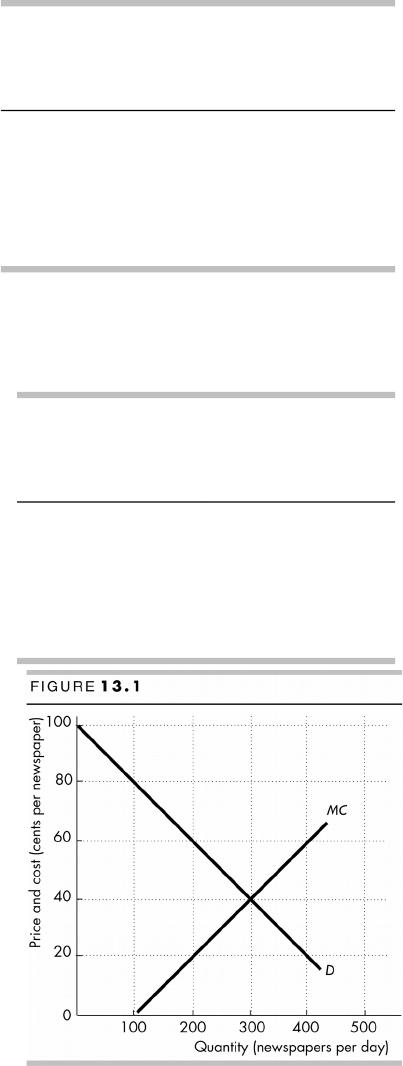
3. Figure 13.1 illustrates the situation facing
the publisher of the only newspaper
containing local news in an isolated
community. The publisher’s marginal cost
for the new plant is constant at 20 cents
per copy printed.
a. What quantity of newspapers will
maximize the publisher’s pro t?
b. What price will the publisher charge for a
daily newspaper?
c. What is the publisher’s daily total
revenue?
d. At the price charged for a newspaper, is
the demand for newspapers elastic or
inelastic? Why?
4. In the monopoly newspaper market described in problem 3,
a. What is the e&cient quantity of newspapers to print each day? Explain your
answer.
b. When the market is a monopoly, what is the consumer surplus of the
readers of the newspaper?
c. What is the deadweight loss created by the monopoly newspaper publisher?
Price
(dollars per
pound)
Quantity
demanded
(pounds per
day)
2,200 5
2,000 6
1,800 7
1,600 8
1,400 9
1,200 10
Quantity
produced
(pounds per
day)
Total cost
(dollars)
5 8,000
6 9,000
7 10,000
8 11,600
9 13,200
10 15,000

5. What is the maximum value of resources that will be used in rent seeking to
acquire Dolly’s monopoly in problem 1? Considering this loss, what is the total
social cost of Dolly’s monopoly?
Solutions to Additional Problems
Price
(dollars
per pound)
Quantity
demanded
(pounds per
day)
Total
revenue
(dollars
per day)
Marginal
revenue
(dollars
per pound)
2,200 5 11,000
1,000
2,000 6 12,000
600
1,800 7 12,600
200
1,600 8 12,800
−200
1,400 9 12,600
−600
1,200 10 12,000
1. a. The table above shows the total revenue schedule. Dolly’s total revenue schedule
lists the total revenue at each quantity sold. For example, Dolly’s can sell 10 pounds
for $1,200 a pound, which gives it total revenue of $12,000 at the quantity 10
pounds.
b. The table above shows the marginal revenue schedule. Dolly’s marginal revenue
schedule lists the marginal revenue that results from increasing the quantity sold by
1 pound. For example, Dolly’s can sell 5 pounds for $2,200 each, which is total
revenue of $11,000 at the quantity of 5 pounds. Dolly’s can sell 6 pounds for $2,000
each, which is $12,000 of total revenue at the quantity of 6 pounds. By increasing
the quantity sold from 5 pounds to 6 pounds, marginal revenue is $1,000 a pound
($12,000 minus $11,000).
2. a. Dolly’s pro t-maximizing output is 5.5 pounds. The marginal cost of increasing the
quantity from 5 pounds to 6 pounds is $1,000 a pound ($9,000 minus $8,000). That
is, the marginal cost of 5.5 pounds is $1,000 a pound. The marginal revenue of
increasing the quantity sold from 5 pounds to 6 pounds is $1,000 ($12,000 minus
$11,000). So the marginal revenue from 5.5 pounds is $1,000 a pound. Pro t is
maximized when the quantity produced is such that marginal cost equals marginal
revenue. The pro t-maximizing output is 5.5 pounds.
b. Dolly’s pro t-maximizing price is $2,100 a pound. The pro t-maximizing price is the
highest price that Dolly’s can sell the pro t-maximizing output of 5.5 pounds. Dolly’s
can sell 5 pounds for $2,200 and 6 pounds for $2,000, so it can sell 5.5 pounds for
$2,100 a pound.
c. Economic pro t equals total revenue minus total cost. Total revenue equals price
($2,100 a pound) multiplied by quantity (5.5 pounds), which is $11,550. Total cost of
producing 5 pounds is $8,000 and the total cost of producing 6 pounds is $9,000, so
the total cost of producing 5.5 pounds is $8,500. So Dolly’s economic pro t equals
$11,550 minus $8,500, which is $3,050.
© 2016 Pearson Education, Inc
1 3 4 C H A P T E R 1 3
d. Dolly’s is ine&cient. Dolly’s charges a price of $2,100 a pound, so consumers receive
a marginal bene t of $2,100 a pound. Dolly’s marginal cost is $1,000 a pound. That
is, the marginal bene t of $2,100 a pound exceeds Dolly’s marginal cost.
3. a. The pro t-maximizing output is 200 newspapers a day. Pro t is maximized when the
rm produces the output at which marginal cost equals marginal revenue. Draw in
the marginal revenue curve. It runs from 100 on the y-axis to 250 on the x-axis. The
marginal revenue curve cuts the marginal cost curve at the quantity 200
newspapers a day.
b. The highest price that the publisher can sell 200 newspapers a day is determined
from the demand curve. The price charged is 60 cents a paper.
c. The daily total revenue is $120 (200 papers at 60 cents each).
d. Demand is elastic. Along a straight-line demand curve, demand is elastic at all
prices above the midpoint of the demand curve. The price at the midpoint is 50
cents. So at 60 cents a paper, demand is elastic.
4. a. The e&cient quantity is 300 newspapers—the quantity that makes marginal bene t
(price) equal to marginal cost. With 300 newspapers available, people are willing to
pay 40 cents for a paper. To produce 300 newspapers, the publisher incurs a
marginal cost of 40 cents a paper.
b. Consumer surplus is the area under the demand curve above the price. When the
market is a monopoly, the price is 60 cents, so consumer surplus equals (100 cents
minus 60 cents) multiplied by 200/2 papers a day, so the consumer surplus is $40 a
day.
c. Deadweight loss arises because the publisher does not produce the e&cient
quantity. Output is restricted to 200, and the price is increased to 60 cents. The
deadweight loss equals (60 cents minus 40 cents) multiplied by 100/2 so the
deadweight loss is $10 a day.
5. The maximum that will be spent on rent seeking is $3,050 a day—an amount equal to
Dolly’s economic pro t. The total social cost equals the deadweight loss plus the
amount spent on rent seeking. To calculate the deadweight loss, rst calculate the
e&cient output—the intersection point of the demand curve (marginal bene t curve)
and the marginal cost curve. Do this by nding the equations to the two curves and
solving them. The e&cient output is 8.25 pounds. The deadweight loss equals
$1,512.50. The loss to society is $4,562.50 ($3,050 plus $1,512.50).
A d d i t i o n a l D i s c u s s i o n Q u e s t i o n s
1. The double-edged sword of a natural monopoly. Emphasize how
economic analysis reveals the social bene ts and costs of an industry
characterized by a downward sloping, long-run LRAC curve. Ask the student
the following questions:
What is the characteristic of the monopoly market that allows a
natural monopoly to potentially produce output at the lowest possible
LRAC? The student should see that a lack of competition allows the rm to
potentially serve the entire market at a lower unit cost than if it had to share
the market with any other number of rms. A multi– rm market would be
forced to produce at a higher LRAC.
What is the characteristic of a monopoly market that allows a natural
monopoly to potentially charge consumers a price premium above
long-run LRAC? If the natural monopoly has the freedom to set its own price,
the student should identify the lack of competition that prevents the consumer
from bene ting from production actually occurring at the lowest LRAC. On the
one hand, the lack of competition is the only way to allow society to enjoy a
(potentially) more e&cient allocation of resources, yet it also allows the rm to
extract consumer surplus while generating an ine&cient resource allocation—
a “double-edged sword.”
2. Troubles with price discrimination: The ethics of scalping. Get the
students to address the realities of arbitrage in secondary markets that arise
when the primary seller of a good refuses to price discriminate.
Is it in society’s best interest (economically e#cient) to allow the
scalping of tickets? The students should see that ticket scalping is just a
form of price discrimination, which is a business practice shown in the text to
increase the level of e&ciency in resource allocation within a monopoly market
context.
Why do the original ticket sellers refuse to price discriminate like the
scalpers? There are many possible reasons:
The original seller of the tickets (usually the music group giving the concert
or the ticket sellers that are under direct contract for them) may want to
avoid the reputation of charging diHerent prices to diHerent people, or
diHerent prices at diHerent time intervals before the concert.
The original seller may not have the ability to distinguish between high and
low demand customers, unlike the “scalpers” who sell the tickets standing
outside the doors on the day of the concert.
The original sellers may be very risk averse and prefer to sell every ticket
well in advance of the concert date, based on the expectations of sales
potential made with the best available information at the time. They may
reason that if a concert sells out quickly, the demand for future concerts
will increase because more people come to believe that the group is “hot”
and a must-see act. However, information about the actual demand for a
concert becomes clearer as the concert date draws nearer and the
equilibrium price for a ticket may change signi cantly. Scalpers must
gamble that ticket prices will increase when it eventually becomes clear
that demand for the event is relatively high. They bear the risk that the
original ticket seller would not bear: that the ticket prices may also
decrease if it is revealed that demand for the event is relatively low.
Is it “fair” to allow scalping of concert tickets? Remind the students that
the practice of price discrimination can increase monopoly pro ts for the
resellers while simultaneously increasing e&ciency for society. Remind them
also of the principle of opportunity cost and ask them to consider how much
eciency they are willing to give up in the name of “fairness.” Point out that
fairness is a normative concept—diHerent people might have diHerent ideas of
fairness. For instance, the scalper who sells his or her tickets surely believes
that the actions are fair. The purchaser of the scalped ticket might believe that
paying above the asked price is unfair but the person is still willing to buy the
ticket as long as the scalped price is less than the maximum price he or she is
willing to pay.
If it is unfair to scalp tickets because of the way price discrimination
transfers consumer surplus to producer surplus, then what about
other forms of price discrimination? Ask the students to consider the
following scenarios. They should understand that, in each case, there is an
identi able group of consumers who have a diHerent willingness to pay for the
product or service mentioned.
© 2016 Pearson Education, Inc
1 3 6 C H A P T E R 1 3
If the costs of projecting a movie are the same at all times of day, why are
matinee movie prices lower than evening movie prices for the exact same
movie in the exact same theater? Why do movie theaters often give
students discounts?
If the cost of publication is the same for all potential subscribers, then why
do magazines and newspapers oHer students discounts on subscription
prices?
If the cost of serving beverages and supplying entertainment (live bands)
is the same for both men and women, then why do bars and clubs oHer
“Ladies’ Night” where women get free drinks or pay no cover charge?
If the cost of serving food and beverages is the same for all diners, then
why do seniors get a price break from restaurants for the exact same
meals?
3. How would you measure the ine#ciency of a monopoly? The students
should see that the lost potential for consumer and producer surplus could be
calculated as deadweight loss, but that is only part of the total loss of bene ts.
Ask the students:
Is there more to the ine#ciency of a monopoly than meets the eye? If
you are rather brave, you may want to ask the students to play the following
game: Show the class a fresh, real ve-dollar bill. Announce that it is a
monopoly pro t that anyone in class can receive simply by submitting the
highest, non-zero price bid for it. Mention that even if the highest bid is only
one penny, then that person will receive the ve-dollar bill. However, everyone
else that submits a bid must also pay you the value of that bid, regardless of
whether they are successful. (This bid price reKects the cost involved with
rent-seeking behavior.) In the case of a tie for highest bid, a run-oH bidding
contest among the tied high bidders will occur, but their rst bid still stands as
a debt to you, the holder of the monopoly prot.
How much would YOU bid for this monopoly pro-t? Ask the students to
write down on a small piece of paper their name and the price he or she is
willing to bid for the ve-dollar bill. They may write a bid of zero cents, but
they will not get a chance to win. Announce that you will collect the money
from them later (you will have their name and their bid). After collecting the
bids, roughly tally them up and announce the winning bid, as well as the total
sum of the bids to be collected. There are two possible scenarios to the
outcome of this auction:
There is one high bidder, and this bid is usually very close to the monopoly
pro t oHered for sale—there are usually one or two students who want to
signal their “devil-may-care” attitude or signal their status as a relatively
wealthy student who can aHord to play extravagant games.
There is a tie between two or more students. The resulting run-oH bidding
is usually very high, because each of the remaining students hasn’t yet
fully appreciated the economic notion of sunk costs. In this latter case, do
not be surprised if the winning bid is more than ve dollars, as the
“winner” wants desperately not to lose the full amount of his or her initial
bid.
What is the total opportunity cost of the resources used to pursue
monopoly pro-ts? Point out that the bids represent the resources people use
(usually through lobbying eHorts) to pursue a monopoly market position by
convincing government to restrict competition. Ultimately, only one person
wins, but all contenders expend resources in the pursuit. That is why all losing
bidders had to pay their bid price.
Can we compare the value of lost output in other markets that could
have been produced against the value of those goods and services
produced speci-cally for pursuing a monopoly? Emphasize that the
goods and services that were used to pursue a monopoly would not have been
chosen for production if the monopoly pro t hadn’t been oHered up for sale in
the rst place. That is how we can know that rent seeking is ine&cient—there
was a decline in net bene ts for society from forgone production of
higher-valued goods. After the discussion is over, give the highest bidder the
ve-dollar bill in exchange for the bid he or she pledged. (You were warned
about having to be brave!) If the highest bid is over ve dollars, just state that
you will forgive the student his or her debt and call it a wash. Then announce
that the other bidders are also oH the hook, as you were just trying to make
the scenario as realistic as possible. Many sighs of relief will be heard.
4. When the old AT&T had a virtual monopoly on long distance service, it
created a rate structure that had high prices M-F 8 am to 5 pm,
medium prices M-F 5:01 pm – 11 pm, and low prices M-F 11:01 pm
-7:59 am and all day weekends and holidays. How might the
di9erences in elasticities for business phone users and household
phone users explain this rate structure? Long distance pricing under the
unregulated AT&T monopoly is a great example of price discrimination. Add on
to the example the “Reach Out and Touch Someone” campaign to increase
residential demand, and price sensitive households across America called
Grandma on Sunday evening. Businesses had little ability in that era to shift
their demand to other periods and phone service, while expensive, was a small
part of their total costs. Both these factors made business demand for long
distance phone services relatively inelastic and lead to the high price of
long-distance calling during business hours.
5. Gilead has changed the pricing structure on its essential AIDS
medications so that prices are high in industrialized countries,
medium in emerging countries, and low in the poorest countries.
Discuss whether this is an example of price discrimination and
whether resources are e#ciently allocated given patents and high
drug development costs. This issue could easily be the basis for a good
debate or opinion essay. Clearly Gilead is price discriminating. Likely Gilead is
increasing its economic pro t. Society has a strong interest in creating more
innovation and technological change. Perhaps Gilead’s pricing structure can
further these goals by increasing the pro t from its innovation. This three-tier
pricing model could be regarded as “fair” or “unfair” depending on which
nation and which part of the health care matrix an agent represents.
6. How does technological change lead to new competition for old
monopolies and sometimes to their failure? Changes at the U.S. Postal
Service are widely reported. Kodak led bankruptcy. Streaming on computers
becomes potentially a viable substitute for cable television. These examples
certainly help frame an answer to the important question “Does having a
monopoly guarantee success?”
© 2016 Pearson Education, Inc
1 3 8 C H A P T E R 1 3