A n s w e r s t o t h e
R e v i e w Q u i z z e s
Page 273
1. Why is a rm in perfect competition a price taker?
One rm’s output is a perfect substitute for another rm’s output and each rm is
2. In perfect competition, what is the relationship between the demand for the
rm’s output and the market demand?
The market demand curve for the goods and services in a perfectly competitive
market is downward sloping. However, no single rm in this market can inuence
3. In perfect competition, why is a rm’s marginal revenue curve also the
demand curve for the rm’s output?
A perfectly competitive rm’s demand curve is a horizontal line at the market
price. This result means that the price it receives is the same for every unit sold.
4. What decisions must a rm make to maximize prot?
The rm has three decisions it must make. First it must determine how to produce
Page 277
1. Why does a rm in perfect competition produce the quantity at which
marginal cost equals price?
A rm’s total prot is maximized by producing the level of output at which
marginal revenue for the last unit produced equals its marginal cost, or MR = MC.
© 2016 Pearson Education, Inc.
1
2
PERFECT
COMPETITION
P E R F E C T C O M P E T I T I O N 1 9 9
200
2. What is the lowest price at which a rm produces an output? Explain why.
The lowest price at which a rm will produce output is the price that equals the
rm’s minimum AVC. At this price the rm has just enough total revenue to cover
3. What is the relationship between a rm’s supply curve, its marginal cost
curve, and its average variable cost curve?
The rm will produce output as long as the price is greater than the minimum AVC.
Page 281
1. How do we derive the short-run market supply curve in perfect competition?
The short-run market supply curve is the horizontal sum of each individual rm’s
2. In perfect competition, when market demand increases, explain how the price
of the good and the output and prot of each rm changes in the short run.
When market demand increases, the market price of the good rises, and the
market quantity increases. Because price equals marginal revenue, the rise in the
3. In perfect competition, when market demand decreases, explain how the
price of the good and the output and prot of each rm changes in the short
run.
When market demand decreases, the market price of the good falls and the
market quantity decreases. Because the price equals marginal revenue, the fall in
the price means marginal revenue falls. As a result, each rm moves down its
Page 283
1. What triggers entry in a competitive market? Describe the process that ends
further entry.
When rms in a competitive market make an economic prot, the economic prot
2. What triggers exit in a competitive market? Describe the process that ends
further exit.
When rms in a competitive market are incurring an economic loss, some of the
rms will exit the market. As these rms exit, the supply decreases and the price
200
Page 287
Describe what happens to output, price, and economic prot in the short run and
in the long run in a competitive market following:
1. An increase in demand.
An increase in demand increases the market quantity, and the market price rises
above ATC for each rm. In the short run, rms in the market make an economic
prot, attracting rms from outside the market to enter the market in the long run.
2. A decrease in demand.
Starting from an initial point of long-run equilibrium, a permanent decrease in
demand decreases the market quantity, and the price falls below the minimum
ATC for each rm. In the short run, rms in the market incur an economic loss,
which leads some rms to exit the market in the long run. This exit shifts the
3. The adoption of a new technology that lowers production costs.
Technological advances result in lower costs for the rm that adopts them and
initially these rms make an economic prot. Two actions occur in the market: i)
rms from outside the market enter the market; ii) rms with old technology either
Page 289
1. State the conditions that must be met for resources to be allocated eBciently.
Resource use is eBcient when the economy produces the goods and services that
people value most highly. This situation requires that consumers are on their
demand curves, thereby allocating their budgets to get the most possible value
© 2016 Pearson Education, Inc.
P E R F E C T C O M P E T I T I O N 201
2 0 2
2. Describe the choices that consumers make and explain why consumers are
eBcient on the market demand curve.
Consumers allocate their budgets so they get the most value from their budgets.
3. Describe the choices that producers make and explain why producers are
eBcient on the market supply curve.
Competitive rms maximize prot. We derive the rm’s supply curve by nding the
4. Explain why resources are used eBciently in a competitive market.
Resources are used eBciently in a competitive market because the market
demand curve is the same as the marginal social benet curve and the market
Answers to the Study Plan Problems
and Applications
1. Lin’s makes fortune cookies. Anyone can make and sell fortune cookies, so
there are dozens of producers. All fortune cookies are the same and buyers
and sellers know this fact. In what type of market does Lin’s operate? What
determines the price of fortune cookies? What determines Lin’s marginal
revenue?
Lin is operating in a perfectly competitive market. The equilibrium price is
Use the following table to work Problems 2 to 4.
Pat’s Pizza Kitchen is a price taker and the table
shows its costs of production.
2. Calculate Pat’s prot-maximizing output and
output is 4 pizzas an hour and economic
prot is $2 an hour. Pat’s maximizes its prot by producing the quantity at
which marginal revenue equals marginal cost. In perfect competition,
Output
(pizzas per
hour)
Total cost
(dollars per
hour)
202
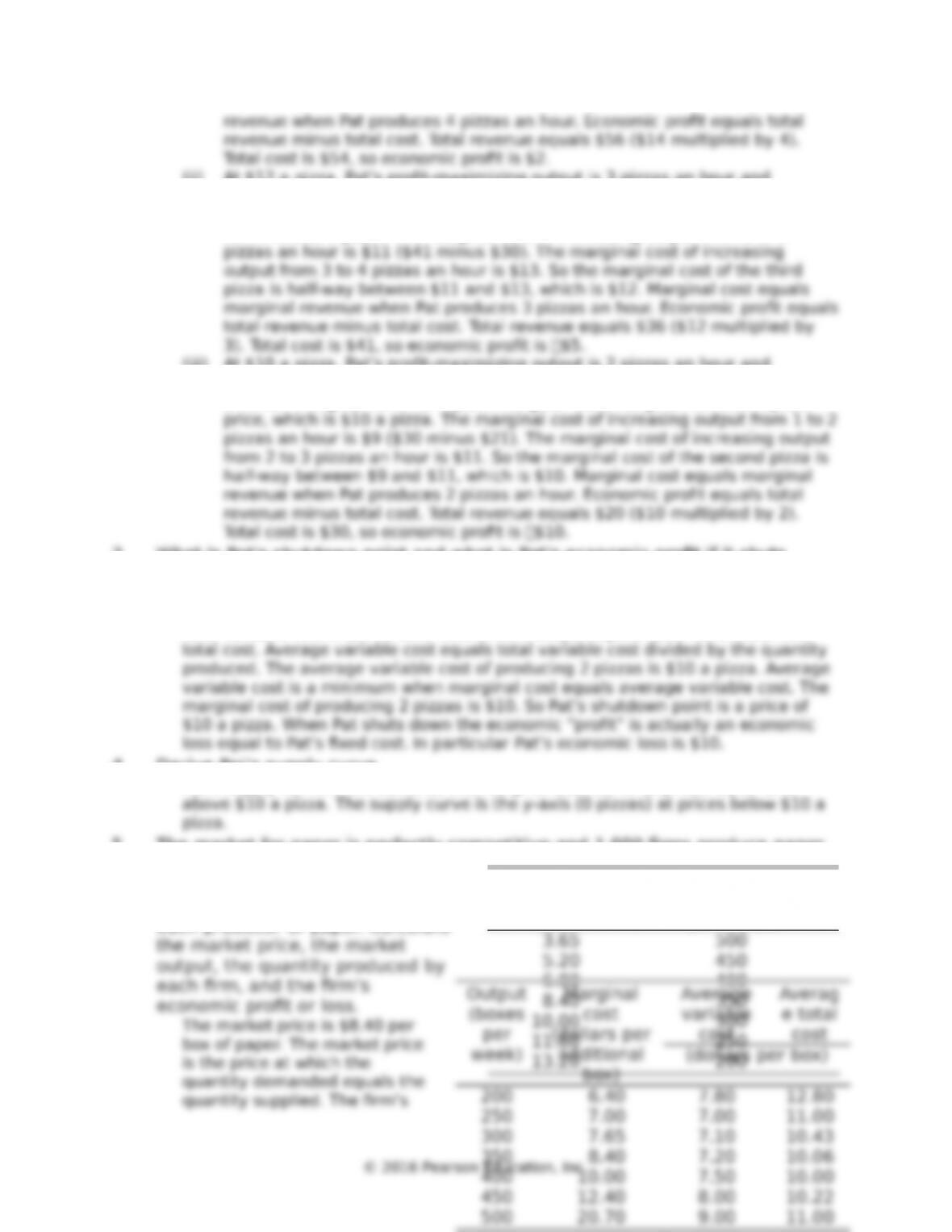
(ii) At $12 a pizza, Pat’s prot-maximizing output is 3 pizzas an hour and
economic prot is $5. Pat’s maximizes its prot by producing the quantity at
which marginal revenue equals marginal cost. Marginal revenue equals price,
which is $12 a pizza. The marginal cost of increasing output from 2 to 3
(iii) At $10 a pizza, Pat’s prot-maximizing output is 2 pizzas an hour and
economic prot is $10. Pat’s maximizes its prot by producing the quantity
at which marginal revenue equals marginal cost. Marginal revenue equals
3. What is Pat’s shutdown point and what is Pat’s economic prot if it shuts
down temporarily?
The shutdown point is the price that equals minimum average variable cost. To
calculate total variable cost, subtract total xed cost ($10—when output is zero,
total variable cost is $0, so total cost at zero output equals total xed cost) from
4. Derive Pat’s supply curve.
Pat’s supply curve is the same as the marginal cost curve at prices equal to or
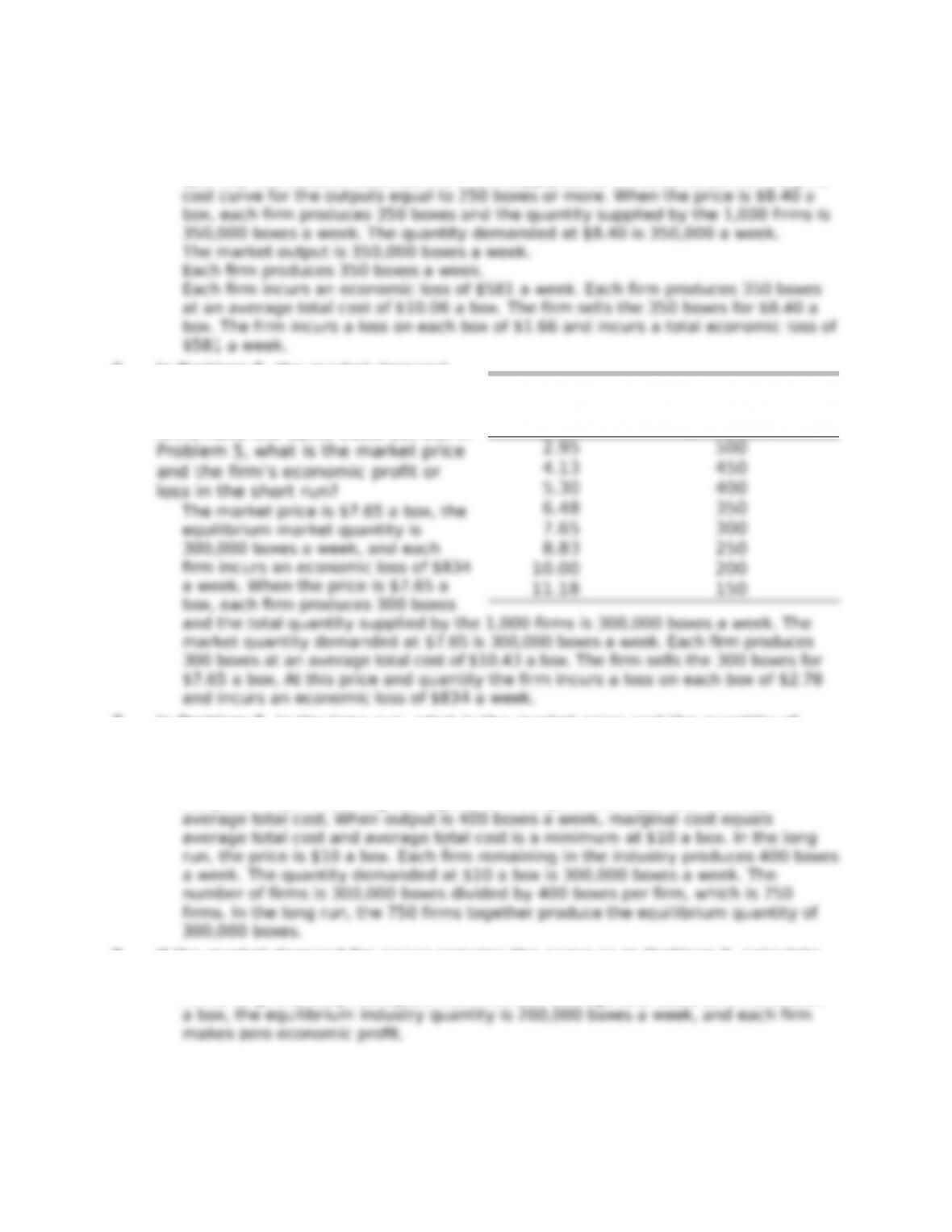
5. The market for paper is perfectly competitive and 1,000 rms produce paper.
The rst table sets out the market
demand schedule for paper. The
second table sets out the costs of
each producer of paper. Calculate
Price
(dollars per
box)
Quantity demanded
(thousands of boxes
per week)
P E R F E C T C O M P E T I T I O N 203
2 0 4
supply curve is the same as its marginal cost curve at prices above minimum
average variable cost. Average variable cost is at its minimum when marginal cost
equals average variable cost. Marginal cost equals average variable cost at the
quantity 250 boxes a week. So the rm’s supply curve is the same as the marginal
6 In Problem 5, the market demand
and the demand schedule becomes
the schedule shown in the table. If
rms have the same costs set out in
7. In Problem 5, in the long run, what is the market price and the quantity of
paper produced? What is the number of rms in the market?
In the long run, the price equals the minimum average total cost, $10 a box. The
number of rms in the long run is 750. In the long run, as rms exit the industry,
the price rises. In the long-run equilibrium the price will equal the minimum
8. If the market demand for paper remains the same as in Problem 6, calculate
the market price, market output, and the economic prot or loss of each rm.
In the long run, the price equals the minimum average total cost, which is $10.00
Price
(dollars per
box)
Quantity demanded
(thousands of boxes
per week)
204

9. In perfect competition in the long-run equilibrium, can consumer surplus or
producer surplus be increased? Explain your answer.
Once at the competitive equilibrium quantity, which is the same as the eBcient
quantity, the sum of consumer surplus plus producer surplus is as large as
possible. If the price is lowered, consumer surplus increases but only at the
© 2016 Pearson Education, Inc.
P E R F E C T C O M P E T I T I O N 205