Answers to Additional Problems and Applications
15. A Bakery on the Rise
Some 500 customers a day line up to buy Avalon’s breads, scones, muns,
and coee. Stang and management are worries. Avalon now employs 35
and plans to 15 more. Its payroll will climb by 30 percent to 40 percent. The
new CEO has executed an ambitious agenda that includes the move to a
larger space, which will increase the rent from $3,500 to $10,000 a month.
Source: CNN, March 24, 2008
a. Which of Avalon’s decisions described in the news clip is a short-run decision
and which is a long-run decision?
b. Why is Avalon’s long-run decision riskier than its short-run decision?
Avalon’s long-run decision is riskier than its short-run decision because it is more
16. The Sunk-Cost Fallacy
You have good tickets to a basketball game an hour’s drive away. There’s a
blizzard raging outside, and the game is being televised. You can sit warm
and safe at home and watch it on TV, or you can bundle up, dig out your car,
and go to the game. What do you do?
Source: Slate, September 9, 2005
a. What type of cost is your expenditure on tickets?
b. Why is the cost of the ticket irrelevant to your current decision about
whether to stay at home or go to the game?
The cost of the ticket is a sunk cost; that is, the cost of the ticket has already been
17. Terri runs a rose farm. One worker produces 1,000 roses a week; hiring a
second worker, doubles her total product; hiring a third worker doubles her
output again; hiring a fourth worker increased her total product but by only
1,000 roses. Construct Terri’s marginal product and average product
schedules. Over what
range of workers do
marginal returns
increase?
The easiest way to
construct the marginal
© 2016 Pearson Education, Inc.
Labor
(workers
per week
Output
(roses
per
week)
Average
product
(roses per
week)
Marginal
product
(roses per
week)
O U T P U T A N D C O S T S 1 4 5
divided by the quantity of labor and the marginal product of labor is equal to the
18. Use the events described in the news clip
in Problem 15. By how much will Avalon’s
short-run decision increase its total
variable cost? By how much will Avalon’s
long-run decision increase its monthly
total 6xed cost? Sketch Avalon’s short-run
ATC curve before and after the events
described in the news clip.
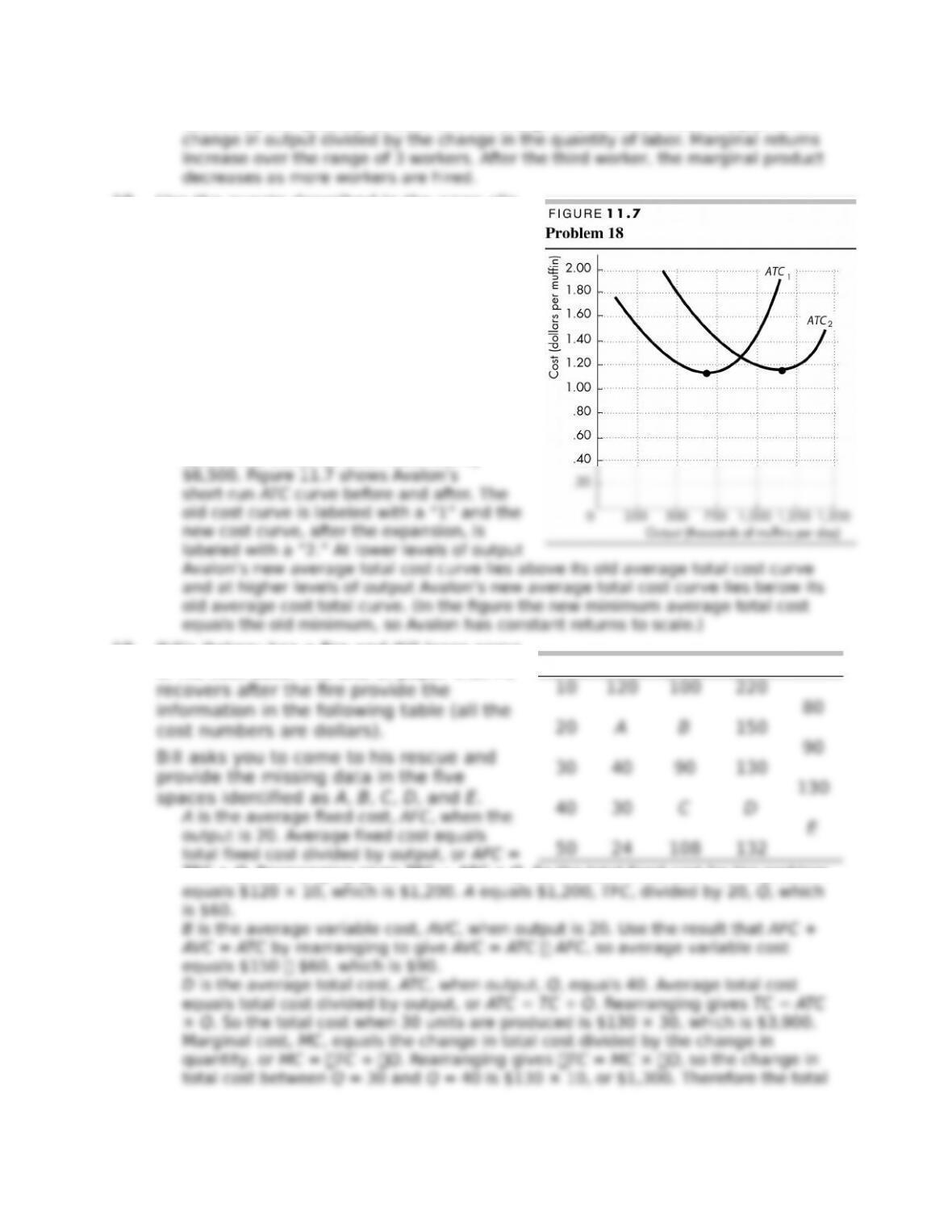
Avalon’s short-run decision to increase its
workforce increases its total variable cost
(its payroll) by 30 percent to 40 percent,
the increase in its wages. Avalon’s long-run
decision to increase the size of its plant (its
space) increases its total 6xed cost by
19. Bill’s Bakery has a 6re and Bill loses some
of his cost data. The bits of paper that he
total 6xed cost divided by output, or AFC =
TFC ÷ Q. Rearranging gives TFC = AFC × Q. So the total 6xed cost for the problem
© 2016 Pearson Education, Inc.
TP AFC AVC ATC MC
1 4 6 C H A P T E R 1 1
cost when Q equals 40 is $3,900 + $1,300, or $5,200. The average total cost when
Q is 40 is $5,200 ÷ 40, or $130.
C is the average variable cost, AVC, when output, Q, equals 40. Use the result that
AFC + AVC = ATC by rearranging to give AVC = ATC AFC. As a result, average
variable cost equals $130 $30, or $100.
Use the following table to work Problems 20 and 21.
ProPainters hires students at $250 a week to paint
houses. It leases equipment at $500 a week. The
table sets out its total product schedule.
students) and the total 6xed cost is $500 (the
21. Explain why the gap between ProPainters’ total cost and total variable cost is
the same no matter how many houses are painted.
The gap between total cost and total variable cost is total 6xed cost. Because the
22. A Pepsi, a Business Decision
PepsiCo has done a deal with 300 small Mexican farmers close to their two
factories to buy corn at a guaranteed price. PepsiCo saves transportation
costs and the use of local farms assures it access to the type of corn best
suited to its products and processes. “That gives us great leverage because
corn prices don’t Puctuate so much, but transportation costs do,” said Pedro
Padierna, president of PepsiCo in Mexico.
Source: The New York Times, February 21, 2011
a. How do Puctuations in the price of corn and in transportation costs inPuence
PepsiCo’s short-run cost curves?
Fluctuations in the price of corn and transportation costs shift Pepsi’s short-run
© 2016 Pearson Education, Inc.
Labor
(students
)
Output
(houses
painted per
week)
O U T P U T A N D C O S T S 1 4 7
b. How does the deal with the farmers to avoid Puctuations in costs bene6t
PepsiCo?
Pepsi lowers its costs because it will receive the type of corn that is best for its
If ProPainters doubles the number of students it hires and doubles the amount of
equipment it leases, it experiences diseconomies of scale.
23. Explain how the ATC curve with one unit of equipment diers from that when
ProPainters uses double the amount of equipment.
Because ProPainters experiences diseconomies of scale, when ProPainters doubles
its inputs the minimum average cost is higher than when it uses the lesser
24. Explain what might be the source of the diseconomies of scale that
ProPainters experiences.
ProPainters might experience diseconomies of scale because when it gets larger
Use the following
information to work
Problems 25 to 27.
The table shows the
hires.
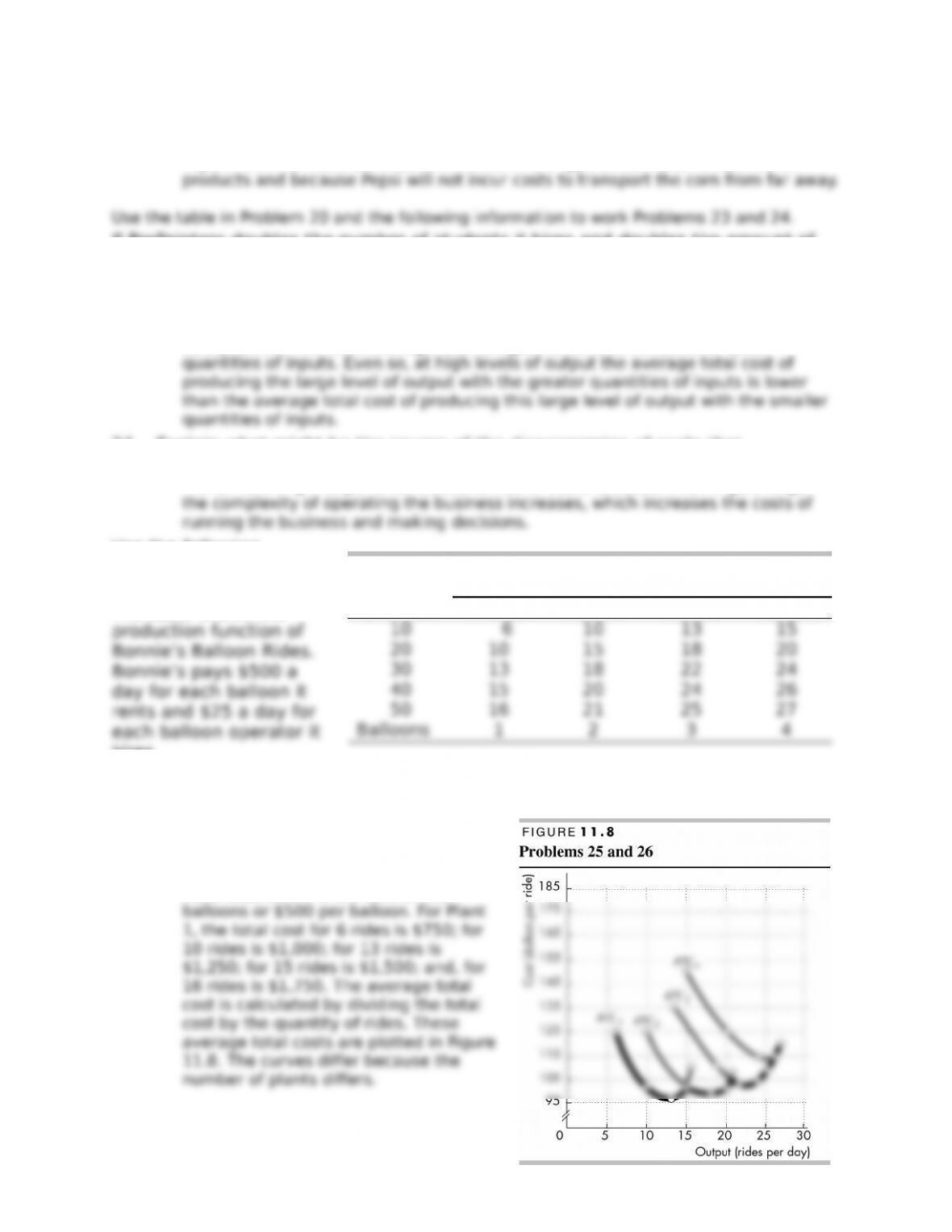
25. Graph the ATC curves for Plant 1 and Plant 2. Explain why these ATC curves
dier.
To 6nd the average total cost for each
plant, at the dierent levels of output
add the variable cost, which is the cost
of the workers or $25 per worker, to the
6xed cost, which is the cost of the
© 2016 Pearson Education, Inc.
Labor
(workers
per day)
Output
(rides per day)
Plant 1 Plant 2 Plant 3 Plant 4
1 4 8 C H A P T E R 1 1
26. Graph the ATC curves for Plant 3 and Plant 4. Explain why these ATC curves
dier.
27.a. On Bonnie’s LRAC curve, what is the average cost of producing 15 rides and
18 rides a day?
The long-run average total cost curve is illustrated in Figure 11.8 as the darker
line. The long-run average cost curve is comprised of the segments of the dierent
b. Explain how Bonnie’s uses its long-run average cost curve to decide how many
balloons to rent.
Bonnie’s will use its long-run average total cost curve by building the size of the
Economics in the News
28. After you have studied Economics in the News on pp. 264-265, answer the
following questions.
a. Explain the distinction between the short run and the long run and identify
when Starbucks would want to make each type of change.
The short run is a time frame during which the quantity of at least one factor of
production is 6xed. The long run is a time frame in which the quantities of all
factors of production can be varied. Starbucks will make changes that lower its
b. Explain economies of scale. Does Starbucks reap economies of scale in the
example on p. 265?
Economies of scale occur when a 6rm’s average total cost falls as the 6rm’s output
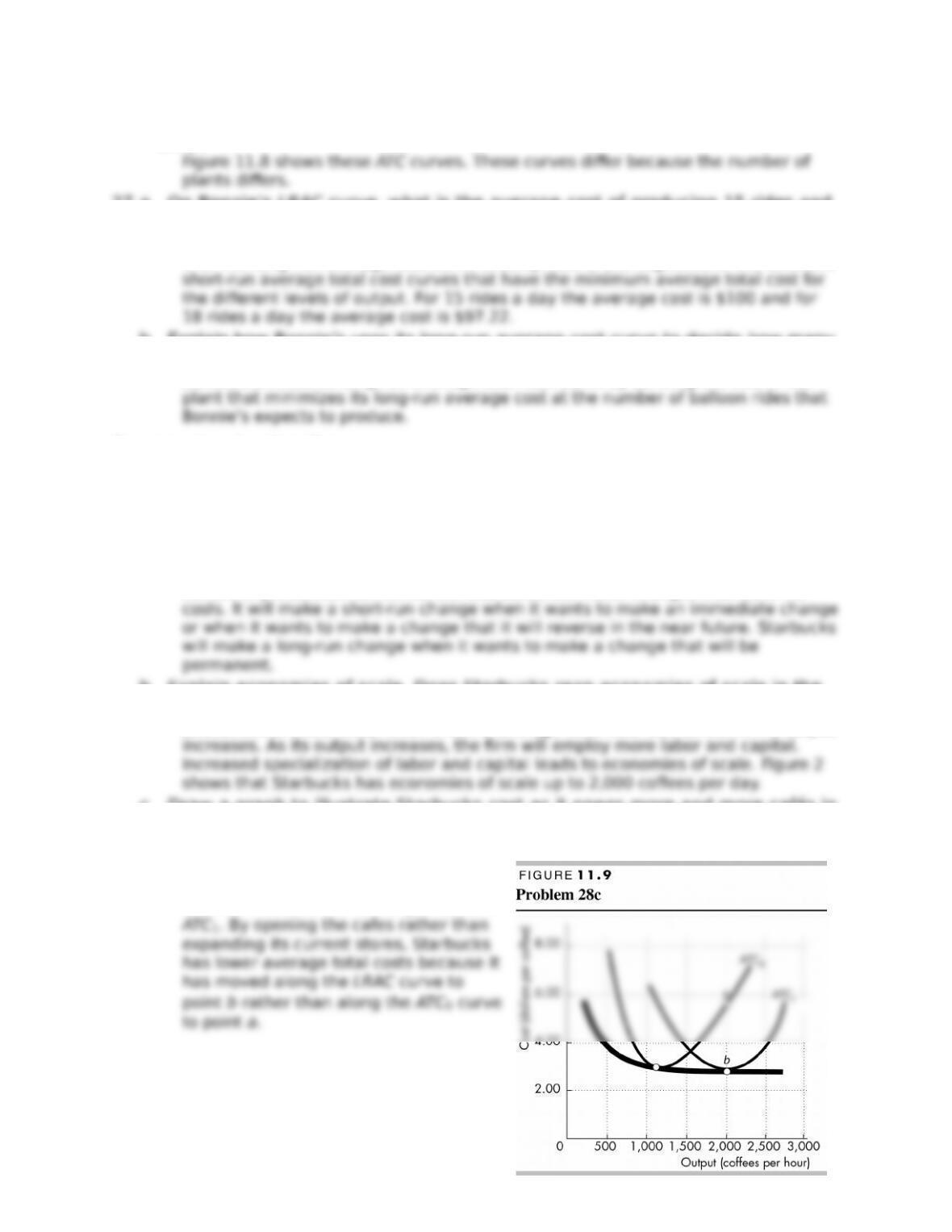
c. Draw a graph to illustrate Starbucks cost as it opens more and more cafés in
Target stores.
Figure 11.9 shows Starbucks long-run average total cost, LRAC, as it opens more
cafés in Target. The short-run average
total cost curve with no cafes is ATC0
and with the cafes in the Target stores is
© 2016 Pearson Education, Inc.
O U T P U T A N D C O S T S 1 4 9
d. Explain why Starbucks is opening cafés in Target stores rather than stand
alone cafés.
Starbucks is opening in Target stores rather than stand alone cafés because
Starbucks believes its pro6t will be higher. If Starbucks opens in Target stores, it
avoids the cost of constructing new cafés, the utility cost of operating the café, and
29. Starbucks Unit Brews Up Self-Serve Espresso Bars
Coinstar has installed automated, self–serve espresso kiosks in grocery stores.
Kiosks cost just under $40,000 each and Coinstar provides maintenance. The
self-serve kiosks remove the labor costs of having a barista serve Starbucks’
coee and store personnel re6ll the machine.
Source: MSNBC, June 1, 2008
a. What is Coinstar’s total 6xed cost of operating one self-serve kiosk? What
are its variable costs of providing coee at a self-serve kiosk?
The 6xed costs are the cost of the machine itself, $40,000. The variable costs
b. Assume that a coee machine
operated by a barista costs less than
$40,000. Explain how the 6xed costs,
variable costs, and total costs of
barista-served and self-served coee
dier.
The 6xed cost of the Coinstar machine
exceeds that of the barista–operated
machine. The variable cost of the
barista–operated machine exceeds that
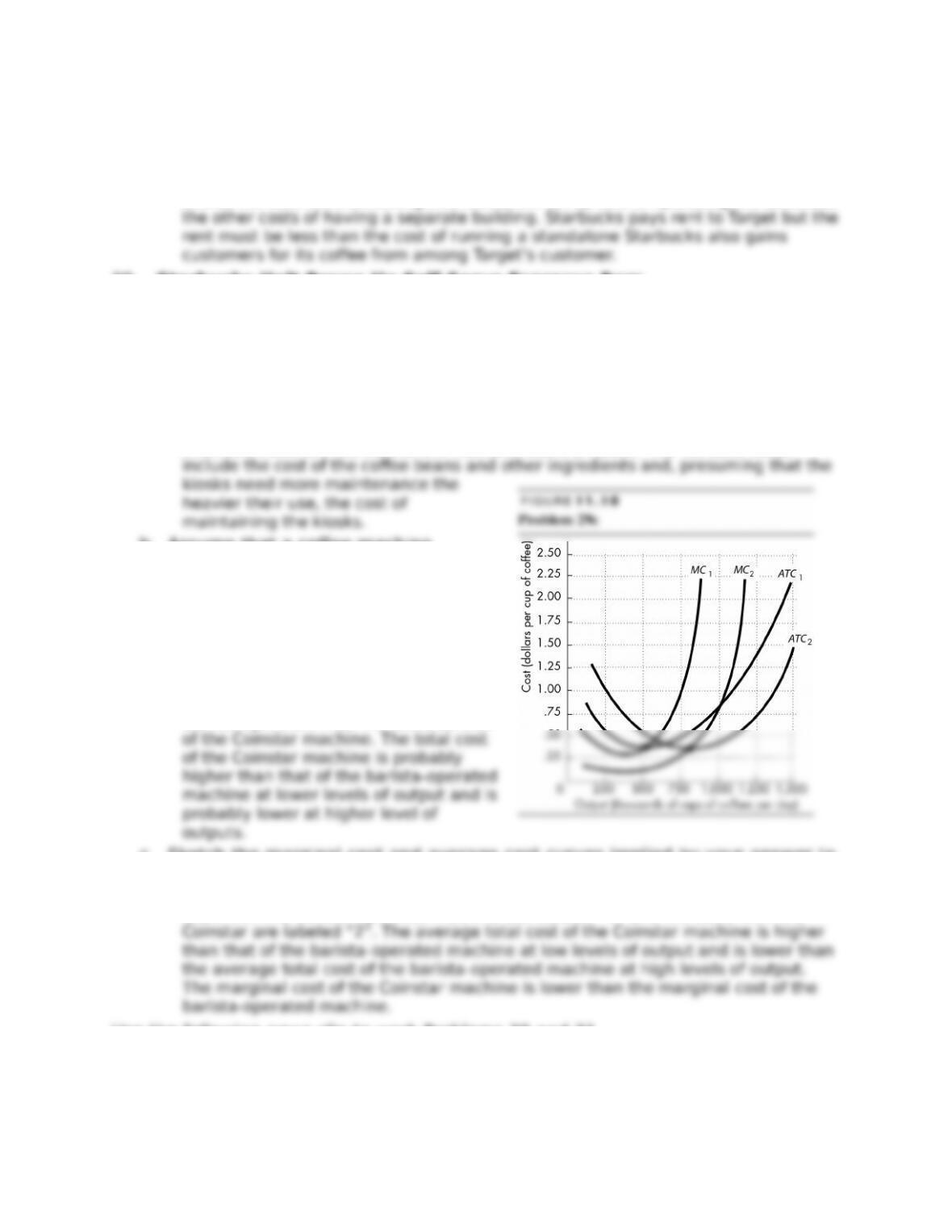
c. Sketch the marginal cost and average cost curves implied by your answer to
part (b).
Figure 11.10 shows the dierent marginal costs and average total cost curves. The
costs with the barista-operated machine are labeled “1” and the costs with the
Use the following news clip to work Problems 30 and 31.
Gap Will Focus on Smaller Scale Stores
Gap has too many stores that are 12,500 square feet. The target store size is 6,000
square feet to 10,000 square feet, so Gap plans to combine previously separate
© 2016 Pearson Education, Inc.
150 C H A P T E R 1 1
concept stores. Some Gap body, adult, maternity, baby and kids stores will be
combined in one store.
Source: CNN, June 10, 2008
30. Thinking of a Gap store as a production plant, explain why Gap is making a
decision to reduce the size of its stores. Is Gap’s decision a long-run decision
or a short-run decision?
Gap believes that its stores are too large and that it is operating where it has
31. How might Gap take advantage of economies of scale by combining concept
stores into one store?
At 12,500 square feet Gap’s stores were too large and Gap was incurring
diseconomies of scale. When Gap combines its separate Gap concept stores into a
© 2016 Pearson Education, Inc.
O U T P U T A N D C O S T S 1 5 1