66. Negotiations – BWA Discovers the Indonesian Way – Case Text
NEGOTIATIONS – BWA DISCOVERS THE INDONESIAN WAY
M.E. (Pete) Murphy
Jared Campbell, a project manager for BWA, sat down at his desk and wondered where
he should begin to fix the problems at the building site. BWA was a Canadian/American
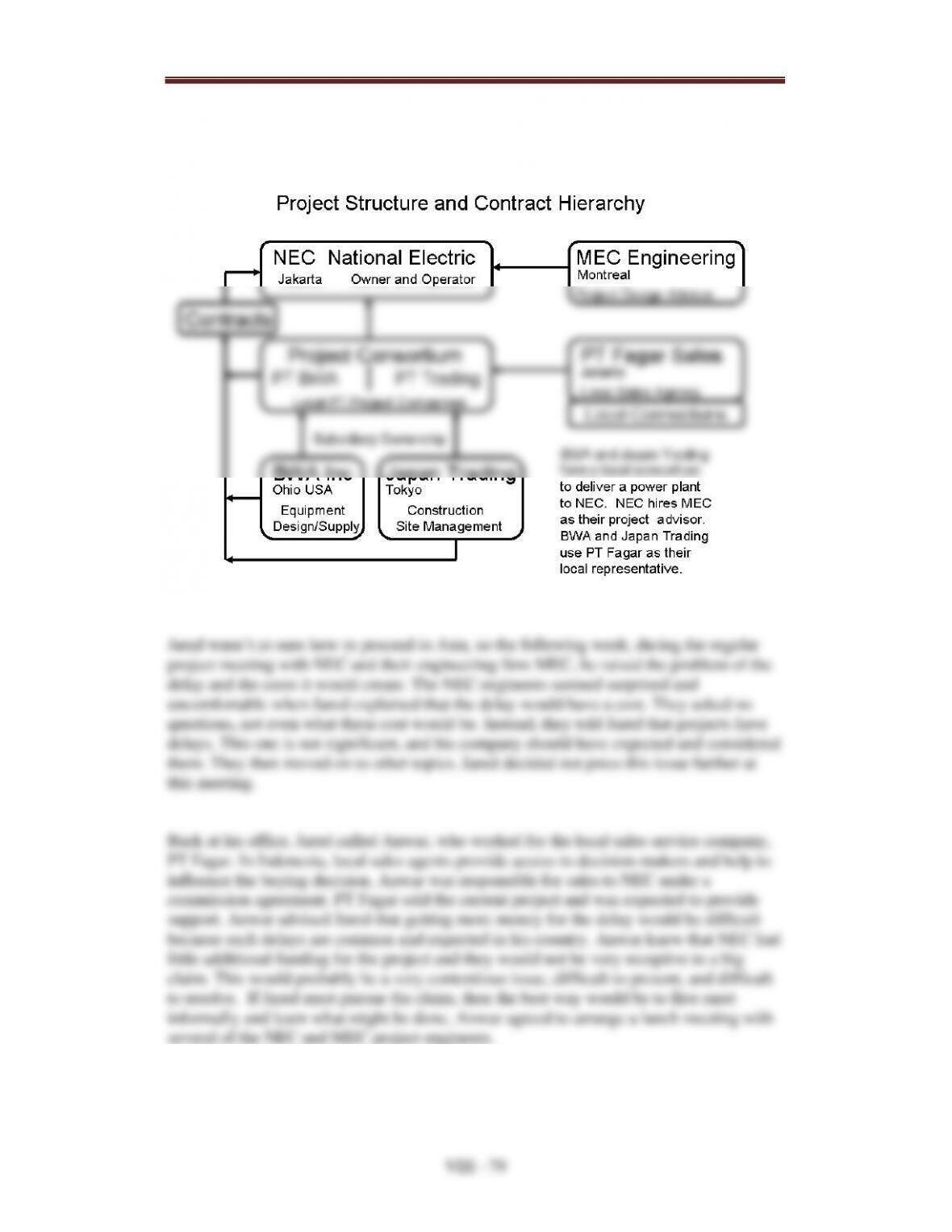
firm that had a contract to design, supply, and construct a power plant for the National
Electric Company (NEC) in Indonesia. This project was part of a World Bank financed
power development initiative with a value of near $1 billion U.S. dollars. Many piling
casings, steel pipes that are the first step in a building’s foundation, were effective and
needed to be replaced. This setback would add a six-month or longer delay to the project
schedule. Besides having to reschedule materials and labor, Jared would have to calculate
the cost impact and extend his family’s planned three-year stay.
Although Jared was an experienced U.S. project manager who had managed other
projects of equal size and complexity, this was his first international assignment. He
expected that the Asian location would add additional problems, particularly in terms of
communication but he felt these could be resolved with frequent progress meetings and
good record keeping. To prepare for the assignment, Jared talked with other experienced
BWA project managers, who had already completed complex foreign assignments. He
learned that delays were common, particularly in obtaining payments and that
communication could be problematic due to cultural differences.
The Issues
When Jared arrived in Indonesia, some of the equipment was already at the job site.
Other materials were still in the process of being shipped by sea and more was in
fabrication in shops around the world. Special construction machinery and skilled
workers from Japan were poised to travel to the site. Now, everything would have to be
changed and rescheduled. Such delays create the need to store materials and escalate
construction costs. Cash flow is interrupted and a cost of working capital is incurred.
Jared needed to estimate these cost increases and prepare a contract claim with a price
increase for the buyer, NEC. Since payments to BWA were based on percent of actual
would have prepared his claim calculation, submitted it with an invoice, and met with the
client to discuss and negotiate a financial resolution.
66. Negotiations – BWA Discovers the Indonesian Way – Case Text
66. Negotiations – BWA Discovers the Indonesian Way – Case Text
The Informal Campaign – Asian Style
At lunch, Anwar raised the issue of the project delay during conversation about the
project. He explained that extra costs would occur and asked if the engineers could help
A week later, Jared happened to meet some of the same engineers at a party. While
discussing the project, Jared asked about delay costs. The engineers said that it was a
very difficult problem, but they had been discussing it internally. They said it might take
some time to find an answer. They offered nothing else and Jared thanked them for their
efforts.
Jared and Anwar met with Hasan to hear the results of the meeting with Madjid. When
Hasan explained the offer of $1 million, he advised Jared to redo his cost estimate based
on specific, expected cost increases in material and labor, storage, and personnel. No cash
flow or interest cost could be included, since these would not be accepted. The total cost
in the estimate should be close to the $1 million limit suggested. This revised estimate
should remain informal for the time being, and should be given without a formal cover
letter. Hasan would then meet informally again with Madjid of NEC to confirm an
66. Negotiations – BWA Discovers the Indonesian Way – Case Text
agreement. After this informal confirmation, Jared could include the claim as an agenda
item for the next regular project meeting and formally present the estimate. NEC would
then formally accept the claim and Jared could submit an invoice.
A Different Approach
After hearing these recommendations, Jared needed to update his boss and obtain
approval to continue to proceed on this basis. So, Jared prepared a report, sent it back to
his boss, Malcolm Johns, the VP of Project Management in Ohio, with the original
explain the situation and the reason for his recommendation, Alex said this approach was
wrong. There was no need for all of these informal discussions. Anwar and his local
company, PTF, were just a sales group and knew nothing about managing construction
projects and delay claims. The contract was quite clear. NEC must pay all reasonable
costs since they were responsible for the delay and the calculation of the costs were based
on long-time industry standards.
He ordered Jared to meet directly with NEC and to negotiate a better deal. Alex also told
Jared that he was sending Malcolm, Jared’s boss, to assist in the negotiation of the claim
because Malcolm had a lot of useful experience in these types of claims. Jared was told to
set up a meeting with Madjid at NEC for early next week. Malcolm would fly in the day
before, meet with Madjid for the first time, present the invoice, and negotiate the
additional payment. Jared hung up the phone in shock. Jared tried calling Malcolm to
promote the acceptance of the $1 million settlement but Malcolm seemed confident he
could make a better deal in the meeting next week.
The Meeting – American Style
When he arrived, Malcolm spent some time reviewing the delay cost calculations with
Jared, but made no changes. The following day Jared and Malcolm met with two
engineers who had been involved informally and two other NEC managers. After
introductions and the exchange of business cards, Malcolm went directly to the topic. He
passed out the delay cost calculation and an invoice for $5 million. He discussed the
details of the claim calculation and pointed out that a standard industry format was used
in the calculation. He concluded by stating that the delay costs were justified and
amounted to $5 million U.S. dollars, which NEC was obligated to pay under the terms of
the contract. When he finished his explanation, there was silence. Finally, Madjid quietly
said, “We reject your claim for delay costs. You will not be paid. There is no point to
66. Negotiations – BWA Discovers the Indonesian Way – Case Text
discuss the matter further.” Then he stood, as did the others from his company, and left.
Malcolm looked at Jared and asked, “What just happened?”
Discussion Questions

66. Negotiations – BWA Discovers the Indonesian Way – Case Text
Epilogue
No one from NEC was ever willing to discuss the delay claim again, formally or
informally, either with Anwar or representatives of PTF. Jared began to have other
project problems, particularly the processing of any invoices for payment. Unpaid
invoices piled up and Jared received very little cooperation from anyone in NEC in
resolving any problems. The project became increasingly difficult to manage.
Some months later at the end of Ramadan, the Muslim holy month, Anwar called Jared
and suggested a solution. The last two days of Ramadan are holidays and days of
atonement known as Idul Fitri. Atonement means that forgiveness can be asked, and if
asked, it should be given. Anwar suggested going to Madjid at NEC during these days
and asking for forgiveness.
Madjid did see them and Jared asked for forgiveness for any wrongs he or his company
had committed in the past year. Madjid expressed his appreciation and assured Jared that
they would work together in the coming year. No mention was made of any specific
project problems or claims. Jared did not get to discuss the delay claim again and no
payment was ever made but other problems simply disappeared. Other invoices got paid,
problems got resolved, and the project working relationship improved enormously.
The $1 million payment offered was never mentioned again. The contract terms could
have supported a delay claim payment, but BWA would probably have to file a suit in
local courts, an unwise choice for a foreign firm. The delay costs were minimized in
other ways.
__________
For further reproduction permission contact M.E. Murphy at: Petemurphy3@gmail.com
Bibliography
Ferraro, G. P. (2006). The Cultural Dimension of International Business. (5th ed.). Upper
Saddle River: Prentice Hall.
Hall, E.T. (1976). Beyond Culture. New York: Doubleday.
Hofstede, G. (1980). Culture’s Consequences: International Differences in Work-related
Values. London: Sage.
Kluckhohn, F. & Strodtbeck, F. L. (1961). Variations in Value Orientations. New York:
Harper & Row.
Salacuse, J W. (2004, September/October). Negotiating: The top ten ways that culture
can effect your negotiation. Ivey Business Journal, 1–6.

66. Negotiations – BWA Discovers the Indonesian Way – Case Text
Writing Assignment
Countries and cultures are not homogeneous. Although each culture and each country
has distinctive social and business customs, the members of each culture vary
considerably from each other. In addition, when individuals migrate to another
culture, they make changes in their social and business behavior as they adapt and
integrate into the new culture.
Research members of the country you selected for your Briefing Paper who now
reside in the United States. Write a two or three page explanation of how their current
social and business customs differ from those of their country of origin.

66. Negotiations – BWA Discovers the Indonesian Way – Case Text
Diversity on the Web
BRIEFING PAPER
M. June Allard
Assumption College
Worcester State University, Professor Emerita
You have been assigned the task of preparing a briefing paper for teams departing for
an extended overseas assignment in one of the countries listed below. The briefing
paper will present in very concise form, important information about the country and
its people – information that will aid the visitors in understanding and in living in the
country. Assume that the team members know very little about the country to which
they are being sent and assume further that many will have their families with them.
General Country Information. Include information such as: geographic location,
climate, type of government, currency, religion, ethnicity/ethnic groups,
relationships, class structure, sources of national pride, ratings on Hofstede’s
dimensions (Hofstede ratings may be included under Business Customs and
Behaviors instead), etc.
Social Customs and Manners. Include information on greetings, forms of proper
address, dress code, tipping, gift-giving, attitudes toward foreigners, general etiquette
and manners, etc.
Business Customs and Behaviors. Include information such as greetings, business
card usage, gift-giving, dress code, religious significance, communication and negoti-
ation style, attitude toward women workers, attitude toward older workers, etc.
COUNTRIES
Asia______ Central and South America
CHINA ARGENTINA
RUSSIA BOLIVIA
JAPAN BRAZIL
MALAYSIA CHILE
TURKEY MEXICO
INDIA PERU
SOUTH KOREA VENEZUELA

66. Negotiations – BWA Discovers the Indonesian Way – Case Text
Suggested Internet Sources
for Briefing Paper
http://globaledge.msu.edu
http://globaledge.msu.edu/ibrd/busresmain.asp?ResourceCategoryID=17
http://www.state.gov/www/regions/background_info_countries.html
http://getcustoms.com
http://cyborlink.com
http://cyborlink.com/besite/hofstede.htm
http://cyborlink.com/default.htm
http://memory.loc.gov/frd/cs/cshome.html
http://dir.yahoo.com/Society_and_Culture/Cultures_and_Groups/Cultures/
http://www.itim.org

66. Negotiations – BWA Discovers the Indonesian Way – Instructor’s Notes
NEGOTIATIONS – BWA DISCOVERS THE INDONESIAN WAY
M. E. (Pete) Murphy
Goals
• To show students how cultural factors can significantly alter the process of
business negotiations
• To engage students in a discussion of the cultural origins of traditional American
business behaviors that do not necessarily extend to other business environments
and cultures
• To increase knowledge about the fundamental concepts of culture that can create
different behaviors and priorities between cultures
• To prepare students to work in the global business environment with a clear
expectation of different norms and priorities, so they will understand that
learning about culture and diversity is an important component of business
success
Synopsis
The American business meeting is highly influenced by American cultural values,
particularly speed and efficiency. When business people come together for the purpose
of dealing with issues, finding solutions, and planning action, the meeting is governed by
norms that come from traditional practices and legal principles. Most Americans in
business know these norms and this process, but they do not understand that they are
uniquely American.
This case, which is true, is about an American manager Jared Campbell recently sent to
Indonesia to supervise a major construction project. Immediately, he is confronted with a
costly construction delay where the traditional American direct methods do not work.
Since he cannot confront the problem directly in a meeting, he must adapt to new cultural
norms where the business meeting plays a very different role. This creates conflict
within his own organization and with the clients.

66. Negotiations – BWA Discovers the Indonesian Way – Instructor’s Notes
Teaching Tips
This is an excellent case to use to illustrate inter-cultural communication and negotiation
issues and the impact they have on solving problems and resolving conflicts. It also
works well when considering how to prepare personnel to serve an organization in a
different cultural environment.
Key Concepts in Culture
Harmony and Hierarchy
Two very important components of Asian culture are harmony and hierarchy. Public
disagreement violates harmony. Raising a new issue, taking an opposed position,
suggesting actions in a business meeting; they all risk upsetting the harmony of the
business relationship. This may cause “loss of face”, i.e. public embarrassment for Asian
business people. This kind of embarrassment is serious enough to disrupt the deal and
stall any progress, even when that disruption creates a financial disadvantage. In
American business culture, the focus is on the action, getting the deal done but this
doesn’t work in Asian cultures.
Public harmony is best explained through Hofstede’s uncertainty avoidance measure.
Societies with high uncertainty avoidance view conflict and emotion as unacceptable in
public. Informal discussion is preferred when conflict is likely, and formal discussion is
only permitted when conflict is resolved and the outcome certain. In general, Asian
societies have high levels of uncertainty avoidance. American society tends to have low
uncertainty avoidance. Americans therefore tolerate open public conflict and use the
business meeting as a place to resolve conflict.
In the case, the first time the delay claim is raised, there is immediate avoidance. It is an
unknown topic with uncertain outcome. Therefore, discussion is shutdown without any
exploration of details. Anwar suggests and arranges informal discussion because in his
culture, his procedure is used when conflict is likely. The informal exchange allows
possibilities to be explored without the commitment of a public meeting. Positions can
be changed without embarrassment or loss of face.
For the Americans, the final meeting between the senior manager and the company VP
was expected to be the formal confirmation of the settlement offering. Therefore, the
senior manager was both surprised and publicly embarrassed, or even humiliated, when
the demand for full claim payment was made. Clearly, the senior U.S. managers had no
understanding of this important cultural difference.
Differences in attitudes about hierarchy between Americans and Asians created another
cultural obstacle in the case. Rank in Asia commands respect. You do not contribute in a
business meeting unless specifically invited to contribute by the ranking member present.
No matter how good your idea, no matter that you have the solution, you keep quiet. You

66. Negotiations – BWA Discovers the Indonesian Way – Instructor’s Notes
bring a pencil and bite down hard every time you have the urge to speak. Even if you are
specifically invited to contribute, whatever you say should not, in any way, contradict the
position of the ranking member of your organization. If this happens, there will be a
“loss of face”, and this will be the last meeting you attend for a long time.
The equality hierarchy dimension is explained through Hofstede’s power distance
dimension. In societies with high power distance and clear hierarchical structures,
employees do not take the initiative to solve problems. Instead, one’s role is to determine
what the senior person in the hierarchy will want done. This person is sometimes called
the father or bapak (bah’pahk) in Indonesia. This is the preferred way to resolve conflict.
No decisions can be made unless the desired outcome of the superior is known. Asian
societies, in general, are hierarchical societies with a preference to push decisions to the
highest organizational level possible. American society, by contrast, is egalitarian, with
authority delegated, and a preference for the best solution to the conflict, often regardless
of the opinion of superiors.
In this case, when the claim is first raised at the project meeting, no one will risk
discussing the claim because the position of the superiors is unknown. The sales agent
begins the informal process with the engineers, asking for help, which is really a request
to find out the position of their superiors. The agent and the engineers both know the
solution will come from the superior. The president has the initial informal meetings
with the senior manager both due to relationship and title. In the local business
hierarchy, the president is on the right level to meet with the senior manager. Anwar and
Jared are not at that level. In the final meeting with the senior manager, Jared is able to
arrange the meeting because his boss is a vice-president and will be attending. Otherwise,
Jared would probably not be given his own meeting with the senior manager. Because
Jared would be at the meeting, the senior manager invited the engineers who were Jared’s
equals.
Establishing Relationships
Strong relationships and cooperation can also interfere with the American style of
business meetings. A relationship of trust and cooperation must be in place in Asia to
before moving to a formal business meeting. Managers and their companies must be
known in the proper context. Participants must have confidence that you will behave
properly, with patience and harmony for the group. In many Asian societies, this
obstacle must be overcome by using a third party, generally a local firm or individual like
Anwar who will “vouch” for you and your company.
Relationships can be explained by using the individual versus collective characteristic of
societies. This characteristic can be found throughout the literature beginning with
Kluckhohn and Strodtbeck (1961). Asian societies, in general, highly value collective
action. The emphasis is on the group and obligations that are created through business
activities. American society, by contrast, is oriented toward the individual, self-reliance,

66. Negotiations – BWA Discovers the Indonesian Way – Instructor’s Notes
VIII – 90
and personal achievement. Connections are casual and with little obligation. Getting
things done is more important than relationships.
In this case, Anwar and his company are the third party that won the contract for the U.S.
company by vouching for their good behavior. The president, in meeting with the senior
manager, is providing assurance that the U.S. company can be trusted to accept a solution
that is good for everyone. The U.S. managers, however, behave in a typical, American
way, demanding their terms with no regard for the relationship. They see no value in the
local representative agency. When the VP shows up for the first time, he launches into a
negotiation without regard for establishing context or trust. This is incredibly offensive
to the Asian side. It will also cause significant difficulty for the local agency, because the
U.S. company has behaved badly.
Timeline
Time is the final factor that impacts the business meeting and problem resolution. In
most Asian societies, except for Japan, time is simply not very important. Relationships
come first and schedule is just an approximation of how things might be organized. In
the Indonesian language, the term Jam Keret (Jahm carrot’ – rubber time) is used to
explain every delay. Of course, this attitude is in glaring contrast to the American need
for punctuality and scheduling.
Edward Hall (1976) used the terms polychronic and monochronic to describe the
difference between low and high time focus, or time as a friend and time as money. This
case raises the issue of time and delay. The monochronic, hard schedule approach of
American culture and business does not work well in Asia. “Time is money” is not
accepted as truth. Delay as a cause of cost and the expectation of compensation for delay
is not automatic and must be well justified. In this case, the development and resolution
of the claim proceeds on a rather leisurely pace. In Asia, the process is more important
than the time. Back in the United States, things suddenly move more quickly, with the
demand to get a meeting and get this issue resolved.
The Cost of Money
Finally, the cost of money, interest, is not widely accepted as a legitimate cost in many
Asian societies. In Muslim countries, charging interest is a violation of the Koran, and a
cost justification based on cost of capital is likely to go nowhere. How a claim for delay
is presented is very important in determining the ultimate success.

66. Negotiations – BWA Discovers the Indonesian Way – Instructor’s Notes
VIII – 91
So How Does Business Get Done?
The answer is that the culture has developed different methods to raise and resolve
business issues, as described in this case. These methods are less public, more private
methods that respect the cultural need for harmony and hierarchy. Asian business people
use private direct discussion and intermediaries to deal with difficult issues,
disagreements, and negotiations. The business meeting is where the agreements that
result from these private discussions are publicly confirmed and where a solution that all
sides have already adopted is acknowledged and embraced.
Harmony and hierarchy are maintained when the ranking members present the solution
and no “face” is at risk. It all works very well for them, except that it is a bit slower than
most American business people would like. However, Americans soon learn that
disrupting harmony and hierarchy stops the process and then there is no progress at all.
Discussion Questions and Answers
1. What reaction did Jared get the first time he raised the delay cost with NEC?
In terms of hierarchy and uncertainty, what was happening?
2. Why did Jared consult Anwar? Why did Anwar take the approach that he did?
Why didn’t Anwar handle the problem himself?
3. Did Jared make any mistakes in getting the $1 million offer? Did he get the best
deal for his company? Should he have handled things differently? How? What
were the cultural issues in terms of relationship, harmony and time?
Jared recognized that he was involved in a different cultural and business process.
He used relationship through Anwar’s company to initiate the required informal
66. Negotiations – BWA Discovers the Indonesian Way – Instructor’s Notes
negotiation. He maintained harmony by avoiding conflict and respecting rank. He
4. Why did things go so wrong with Jared’s manager in Ohio? What should he
have done differently? Could Jared have better prepared the way as a link
between cultures?
Jared assumed his managers would understand the new cultural context. This was a
5. After Jared was instructed by his vice president to present the original claim,
was it too late to save the situation? Why or why not? What other actions could
have been taken by Anwar? By Jared?
Anwar could have traveled with Jared to Ohio to try to save the situation by
6. What really happened in the meeting with NEC? What were NEC’s
expectations? Why did they do what they did?
7. Will Jared now be able to get any money for the delay? Explain.
8. What is a contract? Why were there different views of a contract? Is one view
right and the other wrong? At this point should Jared’s company sue?
Contracts in U.S. culture and business processes are the governing documents and the
only documents. Contract language expressly says this, “the only agreement”.
66. Negotiations – BWA Discovers the Indonesian Way – Instructor’s Notes
VIII – 93
Modifying the contract requires a new negotiation and a formal contract addendum.
In Asian culture, the contract is a binding agreement, but one that can be changed as
circumstances change. It is a flexible document. These changes can be quickly and
easily made. Formal meetings are often the forum for change.
There is no expectation in Asia that contracts will ever have to be enforced by courts.
Courts are not independent and can be corrupt. The agreement is enforced by the
relationship. Therefore, the contract does not have to be a fixed agreement, and
change needs only an informal recognition by the parties. In the U.S., contracts often
end up in court for enforcement and courts require a clear agreement and contract
process. The courts can choose not to enforce a contract or terms that do not derive
from a proper process.
A lawsuit by a foreign company in Indonesian court against any local firm would be
a waste of time and money. There is little chance the court will rule for the foreign
firm.
9. American businesses often use the phrase “Time is money.” What is the issue
with this expression in terms of the interest and time value of money? How are
these issues viewed in different cultures?
The cost of money and interest are a Western concept. They are still not recognized
10. What is the model for resolving problems in Asia? Do American managers have
to follow this model when working in Asia?
11. There are some very successful economies in Asia and a lot of business is getting
done. So, how does this happen if every time you go to a business meeting you
can’t discuss the important issues and you can’t suggest any solutions?

66. Negotiations – BWA Discovers the Indonesian Way – Instructor’s Notes
VIII – 94
social hours. This is a typical venue for the exchange of information about project
problems and potential solutions. Business success in Asia requires learning this
informal system. It has to be used. Used correctly, it can facilitate success.
Epilogue
Because of these cultural conflicts, the negotiation failed. Even though the local BWA
manager learned about the conflicts and attempted to adapt, he was unable to convince
inexperienced senior managers to change. The cost was one million U.S. dollars.