SECTION VIII
ADDITIONAL CASES
From previous texts
61. The UBS Diversity Case
Arlene O. DeWitt
62. Believability: A Case of Diversity in Law Enforcement
Egidio A. Diodati
63 The U.S. Air Force Academy Case
Egidio A. Diodati
64. Briarwood Industries
Carol P. Harvey
65. The Best Buy Case: Committed to the Inclusion of People with Disabilities
David P. Harvey
66. Negotiations – BWA Discovers the Indonesian Way
M. E. (Pete) Murphy

61. The UBS Diversity Case – Case Text
VIII – 2
THE UBS DIVERSITY CASE
Arlene O. DeWitt
Assumption College
Look out, Wall Street. The professional women of high finance are fighting back and
attacking the entrenched male-dominated culture and glass ceilings that have long
characterized this industry. Female professionals are going after the very thing that their
financial firms value most – money – by winning sexual discrimination lawsuits. While
many financial firms realized the marketing advantages of matching culturally diverse
employees with global customers of similar ethnicities, these same firms failed to
capitalize on the advantages that a well-managed and motivated professional female
workforce offers to the marketplace.
A case in point was the lawsuit of Zubulake v. UBS Warburg LLC, the financial,
investment and banking services company that resulted from the merger of the United
Bank of Switzerland and Swiss Bank Corporation in 1998. In 2005, Laura Zubulake, a
top-ranked equities trader sued UBS AG for gender discrimination, failure to promote her
and for retaliation while working at her firm’s offices in Stamford, CT and Manhattan
from 1999 to 2000. She won this case and was awarded $29.27 million in damages:
$2,241.90 million in back pay, $6,863 million in front pay and $20,169 million in
punitive damages (Lexis Nexis, 2007, 9). This was one of the largest awards to a single
plaintiff in a discrimination lawsuit.
This sends a message not just to Wall Street, but to everybody. The
message is that all senior women on Wall Street are not afraid to stand up
and speak out when they feel they are being treated differently,” says
Ms. Zubulake (Porter, 2005). ‘It’s not a culture that changes overnight,’
Zubulake continues. ‘It’s going to take time. I’m sure there are lots of
other firms out there saying, ‘This can’t happen to us.…You’re going
to see more and more of these cases’ (Zambito, 2006).
UBS History and Organizational Culture
UBS AG was formed from the 1998 merger of the Union Bank of Switzerland and the
Swiss Bank Corporation (SBC). The resulting financial giant became the second largest
bank in Europe, after Deutsche Bank AG, and one of the tenth largest financial
institutions in the world. In 2000, UBS acquired the U.S. Paine Webber Group Inc. to
become the world’s largest wealth management firm. Headquartered in Switzerland, the
organization employs approximately 64,000 people in over 50 countries with 37% of its
employees in the Americas, 37% in Switzerland, 16% in Europe and 10% in Asia Pacific
(UBS, Who, 2008). UBS has a major presence in the U.S. located in New York City,
Weehawken, NJ, and Stamford, CT. The corporation is divided into three business units:
61. The UBS Diversity Case – Case Text
Wealth Management, Global Asset Management and Investment Banking (UBS, 2010).
The UBS brand of wealth and asset management and investment banking is valued at
$4.4 billion, making it the 72nd most valuable brand in the world.
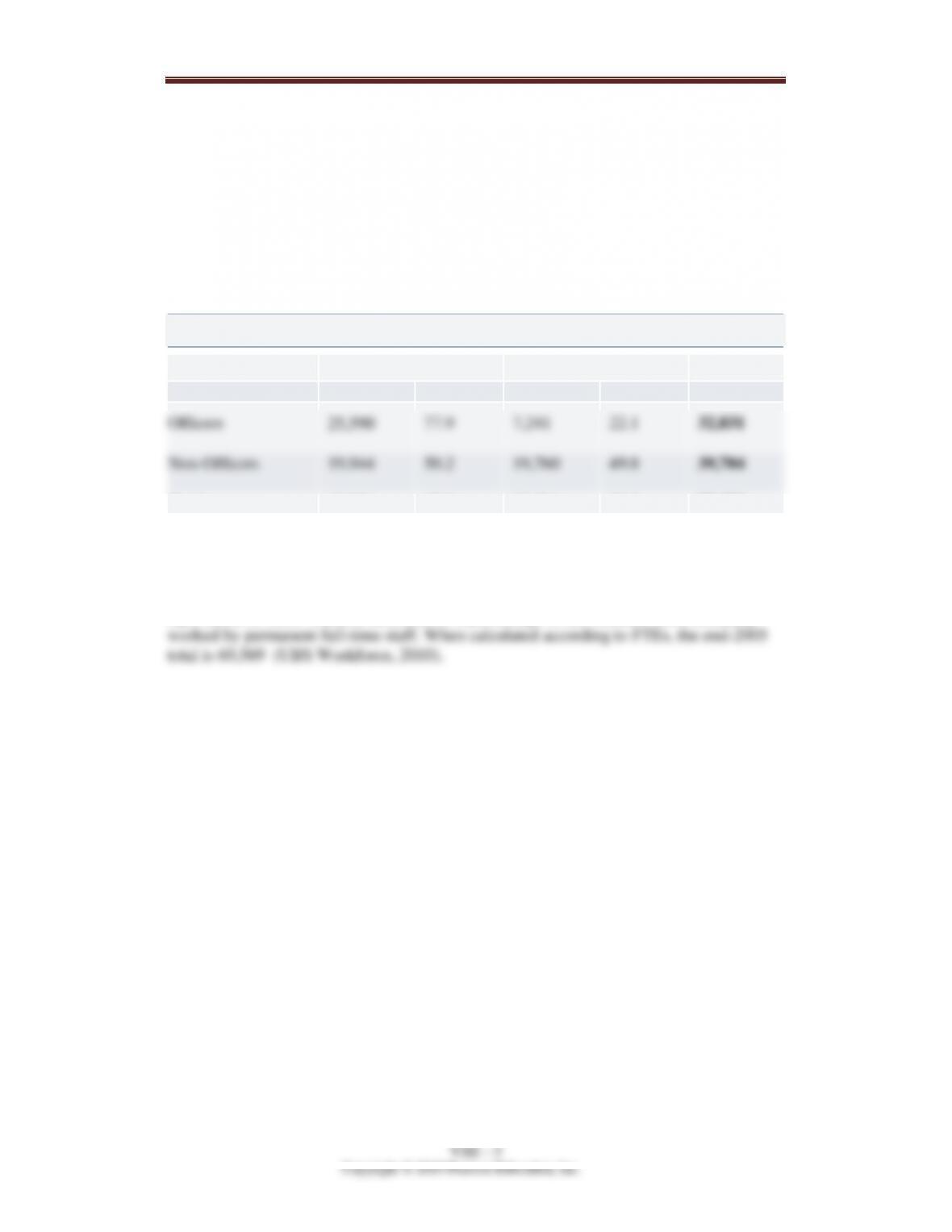
Current gender distribution by employee category is heavily male-dominated, especially
at its upper management levels, as shown in Exhibit 1.
Exhibit 1. Gender Distribution by Employee Category1
Male
Female
Total
Number
Percent
Number
Percent
Officers
25,590
77.9
7,241
22.1
32,831
Non-Officers
19,944
50.2
19,760
49.8
39,704
Total
45,534
62.8
27,001
37.2
72,535
_________________________________________________________________________________________________________________
1Calculated on the basis that a person (working full-time or part-time) is considered one
headcount in this table only. This accounts for the total UBS end-2005 employee number
of 72,535 in this table. Normally, UBS expresses employee numbers in terms of full-time
equivalents (FTEs), which is measured as a percentage of the standard hours normally
It is significant to note that Simmons Associates, a highly respected international
consulting firm focused on issues related to global diversity leadership and inclusion
management, targets German executives for diversity and inclusion training because of
this country’s having a history of leading a homogeneous workforce while having a
diverse external customer base. Simmons Associates states on their website:
Companies whose focus in on the higher-end consumer, who is often
older, white and male, face less pressure to diversify. Success comes
from treating it like a business issue and holding people accountable.
Companies focusing on the higher–end investor don’t always have as
strong a business case to push it because of the demographics (Diversity,
2010).
Tanya Hinton, president and chief executive officer of Diversified Search Services of
Chicago, states: “You want to see people who look like you” (Trends, 2010).
61. The UBS Diversity Case – Case Text
Demographics of Professional Women in Finance Drive Gender Diversity Lawsuits
Women held 37% of the jobs in the securities workforce in 2003 and racial minorities
made up 18.3% of the securities industry workforce in 2003, according to the Security
Industry Association’s (SIA) Report on Diversity Strategy, Development and
Lance LaVergne, Vice President of Human Capital Management at Goldman Sachs and
manager of the firm’s U.S. diversity efforts, says:
The focus on many diversity efforts is on gender, mainly because women
are both a larger demographic and more evolved politically and
organizationally than Blacks and Hispanics. There are more women in
the organization than any other minority group. They have critical mass
(Trends, 2010).
A lot of different things are coming together,” reports Attorney Wayne N. Outten of
Outten and Golden who represented female plaintiffs in sexual discrimination cases.
“There are a large number of women going to business schools who are running into the
glass ceiling. There will be others – more and more women are saying – I don’t have to
put up with this” (Porter, 2005).
A 2005 Harvard Business Review article reported that in a survey of 2,443 women,
nearly four in ten highly qualified women left work voluntarily at some point in their
careers; i.e., they were not forced out for any other reasons by their firms (Trends, 2010).
The financial industry is still and dominated by white males who fill the bulk of the most
powerful and highest-paying jobs in the industry. EEOC data shows that: men make–up
more than two-thirds of the officials and managers in the securities industry; white men
fill four out of five executive management positions and comprise more than 70% of
investment bankers, traders and brokers (McGeehan, 2004).
A 2010 study conducted by Catalyst Inc, a non-profit focused on workplace diversity,
found that women occupy only 16.8% of executive officer positions and only 2.5% of
chief executive officers positions in financial companies. This is especially significant
because the number of women who joined the industry in the 1970’s and 80’s and are
now older (over age 55) has grown by 56% since 1999, outpacing a 34% increase in
similar-aged men.
It is evident that longevity does not necessarily equate to advancement (Stock, 2010).
Quite the contrary is true as seen in the class-action lawsuit filed in 2010 by five former
managing directors and analysts who were laid off from Citigroup in November 2008.

61. The UBS Diversity Case – Case Text
VIII – 5
The women charge Citigroup with “recessionary discrimination” in denying women
employees equal terms and conditions of employment that it provides to similarly
situated and sometimes less qualified male employees, in their cut back of a tenth of their
workforce in 2008 (Ali, 2010).
Since 2000, the number of young women between the ages of 20-35 working in the
financial industry has dropped by 16.5% or 315,000, while the number of men in that age
range increased by 7.3% or 93,000. Analysts suggest a variety of reasons for this decline:
women bore the blunt of layoffs in the late 90’s and recessions, technology and
computers have replaced entry level and junior positions, more men are being hired for
entry level and junior positions and women, in general, are not as attracted to jobs in the
finance industry given recent volatility in the markets and scrutiny on compensation
(Stock, 2010).
The Zubulake v. UBS Warburg LLC Case, 2005
Laura Zubulake was a top-ranked equities trader who sold Asian equities to institutional
investors and earned about $650,000 per year. In her complaint against UBS, she said
she was passed over for the job of manager of the Asian Equities Sales Desk in the U.S.
and that the position was given to Matthew Chapin (Porter, 2005).
Ms. Zubulake, who was 40, said Mr. Chapin proceeded to undermine her by belittling her
and ridiculing her in front of her co-workers, excluding her from some outings, making
sexist remarks and denying her important accounts. She alleged that her boss singled her
out for public verbal abuse about her age and looks and said that she was not attractive or
young enough to handle her accounts. Zubulake’s case was bolstered by a former UBS
sales assistant’s testimony that she heard Chapin call Zubulake “old and ugly” and that he
made sexual insinuations about women at work (White, 2005).
Ms. Zubulake also alleged that her department, on two occasions, took her clients to adult
entertainment clubs and excluded her from the outings (Boyd, 2005). She said her
mistreatment extended to the repositioning of her desk in the Manhattan office across the
aisle from the rest of her colleagues into the area of lower-level desk assistants (Porter,
2005).
A year later, in August 2001, Ms. Zubulake filed a complaint with the Equal Employment
Opportunity Commission, and in October of that year, Mr. Chapin sent her a letter stating
her employment was terminated. Ms. Zubulake then sued UBS for gender discrimination,
failure to promote and retaliation (Porter, 2005).
Her lawyer, James Hubbard of Liddle and Robinson, said the three-year lawsuit was a
routine gender-discrimination case with a lot of he-said, she-said and circumstantial
evidence to prove Ms. Zubulake’s claims. Evidence of co–workers’ trips with clients to
strip clubs was admitted into court proceedings because women might not want to attend

61. The UBS Diversity Case – Case Text
such outings and Ms. Zubulake alleged discriminatory treatment that included purposeful
exclusion from client outings (LexisNexis, 2005).
In addition, plaintiff Zubulake was allowed to introduce evidence of alleged acts of
discrimination directed at a sales associate, Peggy Yeh, by Mr. Chapin. These acts
included: (1) use of the expressions “chicks” and “yellow fever” when referring to Asian
women; (2) asking whether Yeh planned to wear a one-piece or two-piece bathing suit on
vacation; (3) asking whether Yeh had any “weekend exploits;” (4) stating his beliefs that
extramarital affairs between consenting adults are acceptable and (5) suggesting that Yeh
use her feminine charms to improve client relationships (LexisNexis, 2005).
At trial, UBS said Ms. Zubulake herself was the problem, not gender discrimination.
Officials testified during the three-week trial that Zubulake undermined colleagues, had
problems getting along with associates and was insubordinate to Mr. Chapin. UBS argued
that the two types of discrimination were different: (1) the sexual harassment experienced
by Yeh was because of Chapin’s attraction to her; and (2) the alleged treatment of Ms.
Zubulake by Chapin was because she is a woman. But the court ruled that there was a
common thread – both resulted from Mr. Chapin’s reaction to individuals based on their
gender and degraded individuals because of their sex in different ways (Lexis Nexis,
2005).
When the court ordered UBS to re-construct e-mails from its backup computer system, it
proved that relevant e-mails were deleted and even falsified. Mr. Chapin claimed that
Ms. Zubulake’s colleagues and co-workers sent him e-memos and e-complaints about
her. The back-up tapes proved that in at least one case, Mr. Chapin took an e-mail and
falsified the language and then sent it to his superiors. Other e-mails from Mr. Chapin to
Ms. Zubulake proved her retaliation claim (White, 2005).
At the conclusion of the trial, Zubulake’s lawyer, James Hubbard, said, “The jury saw
what her life would be like after this and gave her a real head start on starting over.” He
also conceded that Wall Street traditionally shuns those who litigate against it. “There’s a
lot of history and tradition in the way” (Boyd, 2005). Barbara Gatfield, an executive
recruiter at Gatfield-Greenwich, agrees:
Firms often hire perspective employees who have had private arbitrations
over salary disputes with former employers, but would draw the line on
someone involved in public litigation. Anything that draws attention to
how they make their money is going to be a big problem (Boyd, 2005).
In resounding dispute, the official UBS reply to the Zubulake case was:
We are disappointed with the verdict rendered by the jury. We regard the
amount as excessive and will now move to set aside the verdict. UBS is
committed to its diversity efforts and will continue to ensure that it has
an open and diverse work environment (Porter, 2005).
61. The UBS Diversity Case – Case Text
The Trend: Other Sexual Discrimination Lawsuits Against Wall Street
During the same period as the Zabulake v. UBS lawsuit, a series of class action sexual
discrimination cases were brought by female professionals against other Wall Street
houses and financial firms. In 2004, Morgan Stanley agreed to pay $54 million to settle a
sexual discrimination lawsuit brought by former bond seller Allison Schieffelin on behalf
of herself and approximately 300 other female employees (Porter, 2005). The women
claimed discriminatory promotion practices, being subjected to breast-shaped cakes,
hearing lewd comments and being invited to events that featured strippers. Morgan
Stanley denied any wrong doing in the case, but it later fired a research analyst and three
salesmen for taking a client to an Arizona strip club after a company-sponsored
conference (Boyd, 2005).
Smith Barney, a brokerage unit of Citigroup, Inc, was ordered to pay $3.2 million to four
current and former female employees who sued the company for sex discrimination in the
U.S. District Court in San Francisco, CA. The women sought class-action status for 5,000
female brokers alleging that male branch managers routinely passed over female brokers
when assigning the most lucrative accounts and gave them poorer offices, less training
and sales support. Citigroup tried to dismiss the allegations as being “entirely without
merit” (Facts, 2005).
Despite the success of these sexual discrimination lawsuits, “complaints – even salacious
suits, continue to occur – up and down the Street, from trading operations to investment
and these claims are pretty consistent” (Touryalai, 2006).
David Thomas, a Harvard professor, sums it up by saying, “ If you look at any of the top
20 brokerage houses, they have a pretty poor record in diversity. This portion of the
financial services lags about 20 years behind the rest of corporate America” (Touryalai,
2006).
Linda Friedman, a partner at Stowell & Friedman in Chicago, backs up Thomas’ claim:
The industry has failed…Ten years ago I would have said Wall Street
is behind 30 years. Today I say it is 10 years behind. Some might
call that progress, but it’s not fast enough…Firms are much more
cooperative about resolving claims than ever before, and they realize they
are just as vulnerable as the rest of corporate America to discrimination
suits. They used to stick their fingers in our faces and tell us there was
no problem with the way things are. They had the support of the NASD
and NYSE, and knew getting a jury to hear our cases was a long shot.
If there was no fear back then, there is certainly fear today (Touryalai, 2006).
61. The UBS Diversity Case – Case Text
What Drives UBS’ Diversity Strategy and Leadership?
“Diversity is one of our core values,” states Robert Wolf, president and chief operating
officer of UBS Investment Bank.
UBS sold 21 of their 27 Beijing Securities branches to another company (Merchants
Securities) and even persuaded their customers to use these offices. “At first we couldn’t
UBS Cultural Diversity vs. Gender Diversity Strategies
If UBS’ corporate “diversity” strategy is solely based on a profit motive to secure
culturally diverse customers around the globe, why does its strategy not include gender
diversity – or the profit potential of targeting wealthy women as investors?
61. The UBS Diversity Case – Case Text
Women are becoming an increasingly powerful and formidable force in owning and
managing wealth. Boston Consulting Group (BCG) valued female global wealth at $20
trillion in 2010 (Wilkinson, 2010) and estimates women’s share of wealth in financial
management will increase at a compound annual growth rate of 8 percent through 2014,
to $29 trillion. Women in the U.S. and Canada controlled 33 percent of wealth in 2009, or
about $9 trillion and BCG estimates it will grow to $11.7 trillion by 2014. BCG states
the reasons for women’s wealth growth are: a growing presence of women in the
workforce; their greater involvement in managing family finances and the greater
incidence of inherited wealth due to women’s longevity (Gleeson, 2010).
The global distribution of women’s wealth reveals trends on which UBS could capitalize.
Forty-six percent of the UK’s millionaires are female and this is predicted to rise by 53%
in 2020 according to BCG. These women include author JK Rowling and Christina
Green, wife of Topshop founder (Wilkinson, 2010). Female investors at Forex, a UK
estimated in 2007 that one-third of women-owned businesses in the United Arab
Emirates generated over $100,000 a year compared to 12 percent of American women–
owned companies (Reuters, 2010).
The UBS Strategic Diversity Response
Mona Lau, Global Head of Diversity for UBS, sees two trends in the industry: “For
diversity to take, business leaders have to be involved. It’s a key to success.” She refers
levels, they’re also trying to strengthen their retention efforts through employee
networks, surveys to measure real (and perceived) progress, and mentoring
programs designed to help employees navigate the organization and achieve the
visibility often necessary for advancement (Trends, 2010).
Ms. Lau’s comment on the “shallow pool” of women and minorities begs the question.
Or, could there be a male-dominated, macho culture at UBS ? Their bottom line is the
profit motive which is funded and secured by their “culturally diverse” customers around
the globe. It’s called the “diversity dividend” or the ability of organizations to capture
and “capitalize on diversity and extract the value to the business that can be gained from
… developing business opportunities that arise from this difference” (Diversity, 2010).
61. The UBS Diversity Case – Case Text
Beyond the necessity for UBS, a foreign company operating in the U.S., to comply with
legal requirements, diversity at financial institutions has emerged as a practical business
opportunity that enhances the bottom line in a world in which the ownership of wealth is
increasingly diverse. However, in their strategic diversity planning, UBS has not yet
focused on the profit potential of the rising global wealth of women to the same extent
that they have focused on the wealth of culturally diverse investors. Their first strategic
step would be to redefine their organizational culture and promotional practices to assure
equity for women.
Points of Law
Foreign companies, employing workers within the U.S., are subject
to Title VII of the Civil Rights Act of 1964 that prohibits
discrimination based on race, color, religion, sex or national origin.
Title VII applies to a foreign employer when it discriminates
within the United States. See, e.g., Ward v. W & R Voortman,
685 F. Supp. 231, 233 (M.D. Ala. 1988) (any company, foreign
or domestic, that elects to do business in this country falls
within Title VII’s reach).
By employing individuals within the United States, a foreign employer
invokes the benefits and protections of U.S. law. As a result, the
employer should reasonably anticipate being subjected
to the Title VII enforcement process should any charge of
discrimination arise directly from the business the employer does
in the United States. (Commission Decision No. 84-2, supra).
Discussion Questions

5. What are some workplace situations in this case that could demonstrate valid sexual
harassment claims?
Diversity on the Web
Visit the following website, www.corporateleavers.org, “The Cost of Employee
Turnover due to Failed Diversity Initiatives in the Workplace: The Corporate
Leavers Survey 2007”, Korn/Ferry International. Analyze this report for key
findings and structural requirements of diversity programs, and then
compare/contrast with UBS’ new diversity model and make recommendations.
Bibliography
Ali, Sam. (2010, October 15) Citigroup accused of gender bias. Retrieved October 16,
2010, from http://www.diversityinc.com/article/8078/Citigroup-Accused-of-Gender–
Bias
Boyd, Roderick (2005, April 19) Woman who sued UBS aims to get back on wall street,
The New York Sun, Retrieved August 1, 2010 from
http://www.nysun.com/business/woman-who-sued-ubs-aims-to-get-back-on-the-
street
Civil Rights; News in Brief (2005, May 5) Facts on File World News Digest, 311D2.
Diversity and inclusion training for Germany, cross cultural and global skills from
Simmons Associates, Retrieved August 1, 2010 from
http://www.simmonsassoc.com/html/germanyleadership2020print.html
Diversity working – about, Retrieved August 1, 2010 from
http://www.diversityworking.com/employerZone/diversityManagement
EEOC, Retrieved October 15, 2010 from
http://www.eeoc.gov/policy/docs/extraterritorial-vii-ada.html.
Foley, Jane. (2010, March 8) Women on course to control larger proportion of wealth
Retrieved October 30, 2010 from http://blogs.reuters.com/great-debate-
uk/2010/02/03/women-on-course-to-control-larger
Gleason, Jerry. (2010, August 25) Women investors want more from advisors, report
finds
Retrieved October 30, 1010 from
http://registeredrep.com/newsletters/wealthmanagement/women_want_more_from–
advisors

61. The UBS Diversity Case – Case Text
LexisNexis, Freddie H. Cook, Sylvester L. Fleming, JR. and Timothy J. Gandy, on behalf
of themselves and all other similarly situated persons, Plaintiffs – against- UBS
Financial Services, Inc, Defendant, March 21, 2006, 1-6.
LexisNexis, Zabulake v.UBS Warburg LLC, Case in Brief, LexisNexis, Reed Elsevier
Inc, 2007, 1-23.
LexisNexis, Zabulake v.UBS Warburg LLC, Case text, LexisNexis, Reed Elsevier Inc,
2007, 1-9.
McGeehan, Patrick (2004, July 4) MARKET PLACE; Discrimination on Wall Street?
The numbers tell the story, The New York Times. Retrieved August 1, 2010 from
http://www.nytimes.com/2004/07/14/business/market-placediscrimination–on-the-
street-the-numbers-tell-the-story
Mijuk,Goran. (2010, July 24) UBS turns to Hong Kong’s Yam, The Wall Street Journal,
B3.
Ng, Grace. (2008, March 17) Making career comeback easier for former execs; UBS–
SMU course lets them update knowledge and strategies before re-entering workforce,
The Straits Times, Singapore.
Pederson, Jay P. (2003) International Directory of Company Histories, St. James Press:
Thomas/Gale, 52, 352-359.
Porter, Eduardio. (2005, April 7) UBS ordered to pay $29 million in sex bias lawsuit, The
New York Times, 4.
Reuters. (2010, October 27) Mideast banks funds seek to tap women’s wealth. Retrieved
October 30, 2010 from
http://www.aawsat.com/english/news.asp?section=6&id=22819
Solis, Diane (2005, June 14) Diversity slowly seeps into corporate America, The Dallas
Morning News, Business and Financial News Section.
Stock, Kyle. (2010, Sept 20) Women on Wall Street declining, Wall Street Journal, C1,
C3.
Trends in diversity: industry chases same minority talent, Retrieved August 1, 2010 from
http://news.efinancialcareers.com/NEWS_ITEM/newsltemld-5780
Touryakai, Halan. (2006, March 1) Our diversity problem, registered red: the source for
professionals, Retrieved August 1, 2010 from
http://registeredrep.com/mag/finance_diversity_problem.

61. The UBS Diversity Case – Case Text
UBS Investment Bank, Leadership in Diversity and Inclusion, Retrieved August 1, 2010
from UBS Who we are, Retrieved July 15, 2010, from http:\\ubs.com/1/e/about/our
profile.html.
UBS The UBS workforce, Retrieved July 15, 2010 from
http://ubs.com/1/e/investors/annual_reporting 2005/handbook/0012/0014.html.
Webster, Noah. 1983. Webster’s New Universal Unabridged Dictionary, Second Ed,
New York: New World Dictionaries/Simon and Schuster, 1672.
Wei, Tang. (2006, December 19) UBS takeover a serious makeover, Beijing
Review.com.cn.
White, Natalie. (2005, May 21) Wall Street firm hit with $29 million discrimination
award, St Louis Daily & St. Louis Countian.
Wilkinson, Tara Loader. (2010, October 25) Women on the rise as wealth managers,
Financial News. Retrieved October 30, 2010, from
http://www.efinancialnews.com/story/2010–10-25/women-on-the-rise-as-wealth-
managers.
Zambito, Thomas (2006, January 15) Wall St. women fight back, Daily News, 30.
_____
Arlene O. DeWitt is an Assistant Professor of Organizational Communication and
Marketing at Assumption College, Worcester, MA.

61. The UBS Diversity Case – Instructor’s Notes
VIII – 14
THE UBS DIVERSITY CASE
Arlene O. DeWitt
Assumption College
Goals
• To examine the relationship between corporate culture and gender discrimination
• To illustrate the costs of inadequate diversity management
• To demonstrate opportunities for marketing to diverse markets
Synopsis
This case analyzes the gender discrimination, failure to promote, and retaliation lawsuit of Laura
Zubulake v. UBS Warburg LLC financial, investment and banking services (2005). This case
resulted in one of the largest awards (over $29 million) to a single plaintiff in a discrimination
lawsuit. The suit underscores the lack of gender diversity management and the resulting loss of
strategic profitability and the diversity dividend at Wall Street financial firms. This case analyzes
the lawsuit within the context of:
• the pervasive and entrenched, male-dominated and glass-ceiling culture at UBS and at
other financial firms, such as Smith Barney and Morgan Stanley, which also resulted in
extremely costly lawsuit losses
• a 2010 study of the demographics, decreasing numbers, and lack of women at the
corporate level in the financial industry
• the discrimination studies of financial industry analysts and lawyers
• the impressive statistics on the growing and powerful number of women who own and
manage global wealth
However, this case also examines how UBS successfully manages and promotes cultural diversity
within its ranks because it recognizes the strategic marketing and profitability advantages of
matching culturally diverse employees with global customers of similar ethnicities. This case
concludes that UBS will continue to incur lawsuits and be unable to capitalize on and extract the
value of diversity for their business – or achieve the diversity dividend – until they redefine their
organizational culture and assure equity for women and recognize the rising global wealth of
women as potential investors.
61. The UBS Diversity Case – Instructor’s Notes
Discussion Questions and Answers
1. What socio/economic changes over the past twenty-five years may indicate women
as investors might be an untapped target market?
2. How could a women’s network or affinity group (ERG) have been utilized at UBS to
prevent these gender discrimination lawsuits?
3. Given the fact that there are not a lot of women in upper management positions at
UBS, what are the issues with implementing an effective mentoring program?
The fact that males dominate the upper level management is the reason to institute
mentoring programs. It is impossible to have effective gender diversity unless
VIII – 16
4. Analyze the UBS organizational culture using Edgar Schein’s model of levels of
culture: artifacts, espoused and operational values and basic underlying
assumptions.
5. What are some workplace situations in this case that could demonstrate valid sexual
harassment claims?
Sexual harassment in the workplace falls into one or more of three categories:
Quid pro quo sexual harassment: Quid quo pro means “this for that” or when a job
benefit is directly tied to an employee submitting to unwelcome sexual advances.
here is repetition. Examples include sexually explicit verbal abuse or comments and/or
physical contact on a regular basis.

61. The UBS Diversity Case – Instructor’s Notes
Points of Law
Foreign companies, employing workers within the U.S., are subject to Title VII
of the Civil Rights Act of 1964 that prohibits discrimination based on race, color,
religion, sex or national origin.
Title VII applies to a foreign employer when it discriminates within the United
States. See, e.g., Ward v. W & R Voortman, 685 F. Supp. 231, 233 (M.D. Ala.
1988) (any company, foreign or domestic, that elects to do business in this
country falls within Title VII’s reach).
By employing individuals within the United States, a foreign employer invokes
the benefits and protections of U.S. law. As a result, the employer should
reasonably anticipate being subjected to the Title VII enforcement process should
any charge of discrimination arise directly from the business the employer does
in the United States. (Commission Decision No. 84-2, supra).
Diversity on the Web
Visit the following website, www.corporateleavers.org, “The Cost of Employee
Turnover due to Failed Diversity Initiatives in the Workplace: The Corporate
Leavers Survey 2007,” Korn/Ferry International. Analyze this report for key
findings and structural requirements of diversity programs, and then
compare/contrast this with UBS’ new diversity model and make
recommendations.

62. Believability: A Case of Diversity in Law Enforcement – Case Text
VIII – 18
BELIEVABILITY: A CASE OF DIVERSITY IN LAW ENFORCEMENT
Egidio A. Diodati
Assumption College
Here I sit, waiting to see the Chief. Waiting to see if any of those jerks are going to get
what is coming to them and waiting to see just what is my fate. When this started, I was
pretty much all I wanted to be—a uniformed patrol officer on a city police department.
Now I am facing the possibility of disciplinary action.
My name is Janet Cruz and I am a 24-year-old Hispanic woman, who grew up like a lot
of others in this city. My neighbourhood was pretty diverse but I can’t say that I ever felt
any outright hostility to me personally. When I was in high school, my mom would say,
“Stay with your own kind,” When she did not like someone I was dating or hanging out
with. You know, I dated just about anybody I wanted and it worked out or it didn’t. To
me most people are just people.
In my high school, they had this junior police cadet program, and I knew once I saw it
that being a cop was for me. Maybe it was the uniform, or the drilling, or taking care of
each other—but as far as I was concerned, it was all good. After high school, I joined the
National Guard to pay for college. There was no way mom could afford that. I made sure
that I was in a military police unit. The state university had a campus in the city with a
major in Criminal Justice. So, I enrolled there. It was nearby and I could live with my
mom to save money.
All of these exposures to the “police” business left me with some valuable beliefs. First
of all, this is a job about doing the right thing and helping people. Second, officers did not
just work together; it was closer than that. It was a family that took care of each other—or
at least I thought it was that way.
It really thrilled me that I had scored highly enough on the competitive entrance
examination and got an appointment to the “Academy” the very first time I took the
examination. When the academy started, the following weeks of training seemed to
affirm much of what I had felt about police work with one exception. One of the sessions
at the academy was given by someone who was not on the instructional staff, the Union
Chief Steward. Although he was in the uniform of a patrol officer, he was sterner, older,
heavier, and generally less neatly dressed than the other instructors.
The class was told that the union represented the brotherhood of officers (collectively and
individually) to the command staff made up of “superior officers.” He said, “Our job is to
represent all officers fairly, equally, and to the best of our ability.” I think that
unfortunately I may have placed too much faith in that statement.

62. Believability: A Case of Diversity in Law Enforcement – Case Text
After I finished my probationary period, I think I began to fit pretty well into the ranks.
Sure, lots of guys came on to me, but I’m grown up and I dealt with it. I got to know Jack
MacKenzie while working in Precinct Three, a tough section known as “the mile.” He
was a patrol officer and the steward of the precinct union local: everybody seemed to like
him. We began to date. You know, I actually thought that he was a very funny guy and he
told me that I was “cute.” It worked for a while at least. It took me about three months to
figure out that he was just too high maintenance. He wanted me to move in but when we
spent too much time in his apartment, I noticed that it was all about him, his
accomplishments, and his family. I never got much airtime. It must have been a power
thing. Another thing that I noticed was that, after a few drinks, he began to make
references to minorities that made me uncomfortable.
One night we went out for dinner and I broke up with him. I started with the, “It’s me not
you.” thing, since I knew I had to leave room for his precious ego. I finished with the,
“time apart” suggestion. It seemed to have gone fairly well. A bit later, a couple of guys
on my shift mentioned that they had heard he broke up with me. I did not get into it. It
was just not worth it.
When a couple of overtime details got canceled, I figured it was just bad luck. The
overtime list was maintained by the union, and I could have filed a grievance, but it
would have meant getting MacKenzie involved. When my backup was slower than usual,
I chalked it up to a busy night. It occurred to me that Jack might just be behind this stuff,
but I figured if I made anything out of it, things would just get worse
Well, here I sit 11 months later, at risk of losing my job, and I either see a pattern or am
letting my imagination run away with me. Nevertheless, I see Jack MacKenzie as a major
part of my recent twist of fate. About a month ago, a flyer was put in each officer’s mail
slot by the union and posted on the union bulletin board. It encouraged all officers to
attend a political rally for one of the candidates for governor in the upcoming election.
The union was going to rent a bus, and I could swear it said something about
refreshments on the bus. I was going to be available and asked a couple of people if they
were going and they said yes. So, I figured it might be fun.
On the day of the rally, my shift ended about 4 P.M. and I had just enough time to get
home to shower, before getting back to get on the union bus going to the rally. As usual, I
carried my badge and personal service weapon with me when I left the house. I spotted
Paul Wilson, one of the guys from my precinct who said he was going. We talked for a
couple of minutes and walked to the bus. Paul is a great guy with a great family. He is
always showing pictures of his wife and kids and is very easygoing. Paul is African
American and he helped to found the minority officers association. As we walked toward
the bus, I spotted MacKenzie and two other union shop stewards standing near some
coolers at the back entrance to the bus. The other two guys were named Dalton and
Taggert. I had seen them at a union meeting a couple of months earlier.

62. Believability: A Case of Diversity in Law Enforcement – Case Text
Paul and I sat near the front, about two seats behind the driver and began to talk with
some of the people sitting up there. The noise level went up as MacKenzie and company
entered through the back door. He yelled from the back to the driver to, “get going.” I had
seen him with a few drinks in him before, and he did seem like he had a few in him
already. The rally was about a 45-minute drive, and although the noise level did go up, it
was not bad. I could hear his voice in the back telling jokes and hear people laughing.
Because one of the coolers was up near us in the front, I had a couple of beers.
After we got to where the rally was and went in, I heard that MacKenzie and couple of
guys went across the street to a local pub. The rally went till about 10:30. After that, a
group of us (Paul and a couple of other guys from my precinct) went over to the pub to
get a sandwich and a beer. I could see MacKenzie gesturing in my direction, with the
others around him laughing. About midnight, we all went back to the bus. I sat up near
the front again because I was hoping to get some sleep on the way back and because I did
not trust what MacKenzie or his crew might be up to doing.
It was getting loud in the back of the bus. They were still drinking. It was then that I
began to hear his voice mentioning my name. Things like, “Yeh, Cruz was my Monica
Lewinsky. It got worse but Paul Wilson said, “Just ignore them. They’re drunk and
they’re just being jerks.” The comments continued with things like (I’m not sure but I
think it was MacKenzie who said it.) that he had a “cruz” missile. I kept my back to them
but I’m sure I also heard Taggert and Dalton’s voices with some comments.
You know what was really awful? Nobody spoke up to tell them to back off or that they
were out of line. I really expected more. Then it got worse. First, one then another of the
three would ask for oral sex saying, “Hey Monica, how about it?” Even though there
were two other women on the bus, I just knew that they were talking to me.
After a bit, it quieted down for a while and I thought it was over. I was sitting in a seat on
the aisle and I started to drift off when I felt a tap on my shoulder. I turned and saw
MacKenzie standing over my right shoulder exposing himself with his pants open and I
think he said something like, “You know that I am better than Wilson, how about it?”
That’s when I yelled for the driver to pull over and I got out. I heard a couple of voices
tell the driver to, “Let the spic bitch go.” The bus pulled away and I was left standing
there.
Just when I thought that things could not get any worse, a guy jumped out of doorway
and said, “How much baby?” I guess he thought I was a hooker. I tried to walk away and
then he pushed me against the building. That’s when I drew my personal service weapon,
put him on the ground and started to scream for help. Pretty soon, the local police came.
Would you believe that they drew their weapons, put me on the ground in cuffs, and then
searched me?