SECTION VII
CAPSTONE EXPERIENCES FOR
UNDERSTANDING AND MANAGING DIVERSITY

57. Creating a Case to Better Understand and Manage Diversity
CREATING A CASE TO BETTER UNDERSTAND AND MANAGE DIVERSITY
Carol P. Harvey
Suffolk University
Assumption College, Professor Emerita
Goals
• To offer a capstone learning experience based on student-conducted secondary
research that provides them with an opportunity to integrate and apply the
concepts learned in this course
• To learn how to research, write, and conduct a discussion of a diversity case that
illustrates some current diversity management issue
• To provide an opportunity for critical thinking and discussion either in class or
online
Introduction
While many students may have had the experience of reading and analyzing cases, few
have actually researched and written a case. While the Diversity Audit project provides
an opportunity for students to conduct primary research for their capstone experience,
this assignment is intended to provide a similar critical thinking experience that utilizes
secondary research for courses where primary research may not be as feasible.
Pedagogy/Project Instructions
1. Research
Students may complain that they don’t know how to locate a suitable subject for the case.
Suggest that they begin by exploring websites like DiversityInc.com (free access if one
has an “edu” address, but it does require registration), The Wall Street Journal (if your

57. Creating a Case to Better Understand and Manage Diversity
library has a subscription), diversityexecutive.com, diversitycelebration.com, etc. for
initial ideas.
To get individuals to buy-in to the team project, each student should conduct his/her own
individual research to locate a suitable topic or two and then bring these ideas to the
group for discussion. This starts the project off on the right path by getting everyone
involved and by not allowing social loafers to sit back and wait for the more ambitious
students to do the work for them. This also works best if you require each student to
submit in writing their two possible ideas for cases with the accompanying source(s). Be
clear that you will be collecting these. When students have to pass these in, even though
these ideas will not be graded, they are more motivated to search for a suitable topic.
Once a group selects a topic, then, students should deepen the search through the use of
databases such as ABI Inform, Business Source Premier, etc. Check with your librarian to
see what business databases your institution subscribes to and inform the students. Local
newspapers from the city where the case occurred can also be a rich source of
information.
It is imperative that students utilize databases and not just websites to research this case.
There is a lesson in research to be learned here – that not everything can be located by
simply typing a term into a search bar. If you do not allow the use of Wikipedia, be sure
to make this clear to the class. Remind them that the team will have to produce a
bibliography detailing all sources and (if possible) you will be checking for plagiarism
through Turnitin or some other similar software.
2. Writing
The writing assignment consists of the case with a bibliography, and a separate set of five
to six discussion questions that require higher levels of critical thinking. Impress upon
students that writing is a process, i.e., a good product requires many revisions.
After students have gathered their data, but before they begin the actual writing, the
teams need to determine what the problem/decision is, and think about how to integrate
this into the case. The teams should also brainstorm some alternative solutions along with
pros and cons for each possible solution. One technique that often helps students to
manage the data is to have them develop a time-line that details when the issue originated
and what events led up to this being a problem.
When the team is ready to write the case, the order should be: a hook to get the reader’s
attention; some short relevant context about the industry, organization, etc.; the core of
the problem with sufficient details to generate alternative decisions; and a conclusion that
relates back to the opening hook. What actually happened should not be included in the
case.

57. Creating a Case to Better Understand and Manage Diversity
The team should submit the bibliography and thoughtful discussion questions based on
higher levels of critical thinking to the instructor separate from the actual case.
3. Class Discussion
This will vary according to the delivery method for the course.
For in-class discussions, you should establish a time limit and hold student teams to it.
Usually 20-30 minutes is sufficient. Caution them about spending too much time
summarizing the case. They should assume that the class has read the case several times.
The point of the discussion is to encourage critical thinking by generating multiple
perspectives on how to solve the problem and considering the pros and cons of each.
For online classes, post a specific schedule (day and time) that details when you will post
the case and its discussion questions. Then establish a timeline for the rest of the class to
publish their answers. Encourage the presenting team to comment frequently (perhaps
each team member can be responsible for answering a day’s posts for example) to keep
the discussion lively.
4. Postscript
Instructors are usually reluctant to reveal what decision was actually made in a case
because it implies that this was the only right answer. However, after the discussion, it is
appropriate for the presenting team to disclose the true name of the company and reveal
what actually happened. Just remind the rest of the class, that there still is no one” best”
answer. This is just the one that the individual or organization selected.
Note: An alternative approach to using this as a capstone project is to assign the case
preparation to smaller teams of two to three students and to have each team present a case
related to each major topic in the course as the semester progresses. For example, when
covering racism, after discussing the McIntosh, McNickles, and Dunlap articles, have a
team that has been assigned to write on racism conduct a class discussion of their case
that involves something related to race. This will help to synthesize the readings with
reality.
Additional Resources on the Case Method
Barnes, L.B. Christensen, C.R. & Hansen, A.J. (1993). Teaching and the Case Method:
Text, Cases and Readings, 3rd edition, Boston: Harvard Business School Press.
Ellet, W. (2007). The Case Study Handbook: How to Read Discuss and Write
Persuasively about Cases. Boston: Harvard Business School Publishers.

57. Creating a Case to Better Understand and Manage Diversity
Naumes, W. and Naumes, M. (2011). The Art and Craft of Case Writing, 3rd edition.
Armonk, NY: M.E. Sharpe Publishers.
Smith, R. A. (2010). Professors’ use of case discussion leadership at Harvard and Darden
MBA programs: Characteristics of a successful case discussion. Academy of
Educational Leadership Journal, vol. 14, 2, 13-30.
Vega, G. (2013). The Case Writing Workbook: A Self-guided Workshop. Armonk, NY:
M.E. Sharpe Publishers.

57. Creating a Case to Better Understand and Manage Diversity
VII – 6
RUBRIC FOR EVALUATING DIVERSITY CASE PROJECT
Does Not Meet Expectations Meets Expectations Exceeds Expectations
Case Poorly written with many Writing is adequate; a few Case is very well organized;
spelling and/or grammatical spelling and/or grammatical practically no spelling or
Errors; content inadequately errors; content is sufficient grammatical errors; extensive
researched; lacking sufficient and properly cited. & properly documented sources.
sources.
Questions Questions mostly require only Some but not all questions Questions are thoughtfully
recall of case details. require higher levels of critical developed and all require
thinking such as application, higher levels of critical
analysis, synthesis, and/or thinking such as analysis,
evaluation synthesis, and/or evaluation.
Class Uneven participation by Good discussion with Discussion is lively and
Discussion team members; discussion participation of the interesting with a high level
is flat and uninteresting; whole team and the class. of class discussion.
class is minimally involved.
Online Team does not evenly participate Most team members participate All team members are active
Discussion in discussion; team members do in discussion on a timely basis; and respond on a timely basis
not respond in a timely manner, and insert new ideas and follow with questions and comments
discussion is flat and does not up questions as appropriate. that take the discussion to
stimulate higher levels of higher levels of critical thinking
thinking. such as analysis, synthesis and
evaluation of course material.

58. Creating Diversity Awareness: Video Project Rubric
CREATING DIVERSITY AWARENESS: A VIDEO PROJECT
Cary J. LeBlanc
Assumption College
Goals
• To provide a capstone learning experience for this course
• To understand that barriers to inclusion are real and still exist in the form of
blocking mechanisms
• To learn how to break down barriers to inclusion
• To learn how to work on a team
Overview of the Project
This capstone group project is designed to integrate video media as a creative expression,
explanation, and interpretation of ways that individuals and organizations limit diversity
and, as a result, block inclusion. As our society, and more specifically our workplaces,
become more diverse, organizations will face numerous challenges to developing
effective, innovative, and sustainable business practices that include all voices. Efforts to
be more diverse can be blocked by individual perceptions, biases, and stereotypes as well
as by organizational cultures.
Student groups will select a topic from a primary (race, gender, ethnicity, age, physical
and mental challenges, and sexual orientation) or secondary dimension of diversity
(social class, first language, etc.). The group will use technology to create a five-minute
original video that increases awareness, promotes inclusion, and may motivate viewers to
change their perspective about some facet of diversity. The student groups will show this
video to the class and conduct a discussion of their chosen topic.
1. Introduction
This project will typically identify negative perceptions, attitudes, and behaviors that can
be attributed to individuals or groups of people. For example, racism has been socially
constructed to prevent people of color from having equal opportunities. While it can be
argued that blatant racism is becoming relatively rare, it still exists in subtle ways and
particularly as institutional racism that is embedded within systems, such as healthcare

57. Creating a Case to Better Understand and Manage Diversity
VII – 8
and education. Because most people remember more of what they see than what they
read or hear, it is hoped that through this video, students will understand how personal
and organizational values still influence our perceptions and attributions.
It is the intent of this project to illustrate how blocking mechanism(s) exist in explicit yet
subtle ways. More often than not, inclusivity is blocked because of our personal lack of
awareness or because of organizational systems and practices that privilege certain
groups. By conducting research and producing an instructional video, students should
gain a deeper understanding of blocking mechanisms and how these limit and/or prevent
inclusion. This document will provide the basis for the complete project. Therefore,
careful attention should be paid to the group reaching consensus on this definition of the
blocking mechanism, for it will drive all aspects of the video creation.
2. Developing a Storyboard
After students select, define, and research their topic, the next step is to develop a
storyboard that outlines the key elements, or scenes, of the video. This storyboard can
contain sketches, images, descriptions of segments, or specific scenes that will be used to
depict the particular block to Inclusion. The initial storyboard is relatively general but
more detailed scenes usually will emerge as the project progresses. A few storyboard
templates will be provided.
3. Storyboard Review
Each student group should meet with the instructor to review their initial storyboard. At
this meeting, the group should explain the overall intent and message of their video. The
group should be prepared to discuss their creative approach and how they will use the
video to capture and present their original interpretation of a block to Inclusion. At this
meeting, the instructor should be sure that the definition created in the research step is
well integrated into the storyboard. A key question to ask is, “Will the groups’ creative
approach help them to achieve what they want to communicate as stated in their
definition?”
4. Equipment & Filming
Once the storyboard has been reviewed and discussed with the instructor, filming may
commence. This project has been designed so that it can be done effectively with the sole
use of smartphone video technology. Using iPhones and other similar smartphones with
video capture, students will film primary elements/scenes of the project. The raw footage
will then be downloaded to a personal computer with video making software. Certainly,
students may have access and are encouraged to use more professional equipment.

57. Creating a Case to Better Understand and Manage Diversity
However, these more sophisticated technologies may hinder the project because of the
learning curve needed to use them effectively.
It is expected that most, if not all, of the video will be original material, although there
may be the need for existing materials to be used. If so, the use of photos, video clips,
music, and other copyright protected material, not in the public domain, must be
appropriately cited and all copyright laws followed. All sources used must be listed in the
credits as well as in the written documentation and bibliography provided to the
instructor along with the video.
One student should take the lead technical role, usually someone who has previous
experience creating a video such as connecting hardware and software, along with video
editing. The latter usually being the most labor intensive.
5. Initial Screening
Two weeks prior to the formal presentation of the video to classmates and/or external
judges, each student group should meet with the instructor and present their completed
(or nearly completed) video. The intent of this screening is for the group to evaluate by
how well the video has integrated their Block to Inclusivity definition into the video. This
also provides the instructor an opportunity to critique the project, so the group can make
changes and improve the video, if necessary.
6. Presentation
Each group will have a prepared DVD of their video to bring to the presentation to the
class. The order of the presentation should be: a) the introduction of the team and the
topic; b) the showing of the video presentation; and c) questions and/or a brief class
discussion.
7. Grading
Use the rubric provided in the text to present additional feedback and to grade the project.

57. Creating a Case to Better Understand and Manage Diversity
Storyboard for Video Projects
Group/Project Name____________________________________________ Date________
Use the following to help you create your storyboard for your video.
1. Briefly describe the story you are going to tell. Give the main idea in one statement. Include who is going to
be involved with your production and the roles they are going to play.
2. Fill in the chart below. For each numbered step of your story, fill in a new shot. Be sure to include your title
slides, beginning, and credits at end. Each change of shot would be a new shot number.
3. What are the location(s) for shooting?
Shot #
Description
Shot type:
Close-up or wide
Visual clues to help communicate the idea –
sketch out the shot

57. Creating a Case to Better Understand and Manage Diversity

57. Creating a Case to Better Understand and Manage Diversity
VII – 12

57. Creating a Case to Better Understand and Manage Diversity
Useful websites include: www.msstate.edu/create/howto/storyboard
www.videomaker.com/article/2313-how-to-create-a-storyboard
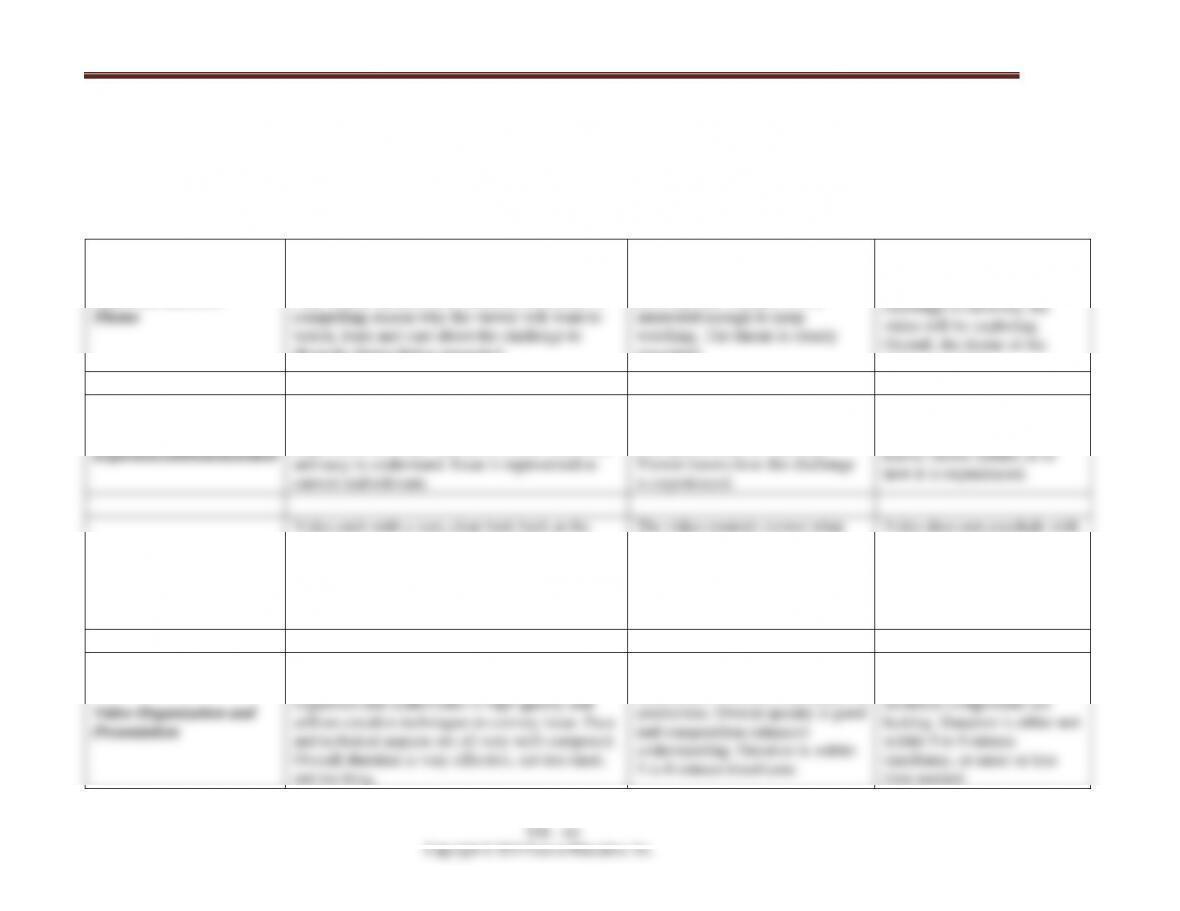
58. Creating Diversity Awareness: Video Project Rubric
Creating Diversity Awareness
Video Project Rubric
This project’s intent is to fully illustrate a “challenge to diversity,” and in doing so raise awareness, if not action.
Excellent
Satisfactory
Fair
Video Introduction –
Theme
The video immediately draws viewers in. The
challenge to diversity that will be explored is
very clearly defined. The introduction creates a
compelling reason why the viewer will want to
watch, learn and care about the challenge to
diversity theme being presented.
The introduction provides a
definition of the challenge to
diversity that will get viewer
interested enough to keep
watching. The theme is clearly
presented.
The introduction leaves
viewers confused and not
knowing exactly what
challenge to diversity the
video will be exploring.
Overall, the theme of the
video is unclear.
Video Core – Challenge
Experienced/Demonstrated
The challenge to diversity is well illustrated,
using multiple creative ways to show how people
experience the issue. Narrative is well rehearsed
and easy to understand. Issue is represented as
current and relevant.
The challenge to diversity is
displayed adequately, and
example(s) used are succinct.
Viewer knows how the challenge
is experienced.
Illustration of the challenge to
diversity is confusing and
leaves viewer unsure as to
how it is experienced.
Video Conclusion –
Awareness to Advocate
Video ends with a very clear look back at the
challenge to diversity. Restates how the
challenge was illuminated, and leaves viewer
compelled to take some action. Possibly creating
advocates to help bring awareness and solutions
to the issue.
The video reminds viewer what
the challenge to diversity issue is,
and creates a full level of
awareness. Video message is
effective enough so viewer could
explain it to others.
Video does not conclude with
a clear review of the
challenge to diversity issue
and leaves viewer unsure of
what they should do about the
issue.
Video Organization and
Presentation
There is very clear evidence of care taken in the
production of the video. All parts are well
organized and audio/video is high quality and
utilizes creative techniques to convey issue. Pace
and technical aspects are all very well composed.
Overall duration is very effective, not too short,
not too long.
Video is well organized, and uses
limited, yet effective, techniques in
production. Overall quality is good
and composition enhances
understanding. Duration is within
5 to 8 minute timeframe.
Video lacks organization.
Pieces seem out-of-place and
technical components are
lacking. Duration is either not
within 5 to 8 minute
timeframe, or more or less
time needed.