SECTION I
UNDERSTANDING INDIVIDUAL PERSPECTIVES OF DIVERSITY

1. Diversity Today: Fact or Fiction?
DIVERSITY TODAY: FACT OR FICTION?
Carol P. Harvey
Suffolk University
Assumption College, Professor Emerita
Goals
• To introduce students to current diversity issues and topics
• To stimulate students interest in the content of the course
• To demonstrate that there are many misconceptions about workplace diversity
Pedagogy
This exercise is intended to generate conversation around current issues of diversity. It
was designed to be administered very early in the semester, ideally in the first class, to
provide an overview of the semester. If students do not have a text yet, use the Power
Point slides to ask the questions. Then, ask students for a show of hands whether each
item is fact or fiction. After they have “voted,” show the slide with the correct answer
and perhaps expand a bit on any topic of particular interest.
1. Fiction: While somewhat difficult to measure, recent studies conducted by
Catalyst, McKinsey & Co., the Society for Human Resource Management
(SHRM), and others are starting to document that having diversity, coupled with
having policies and procedures that lead to employees feeling included and
valued, can result in cost savings through retention, productivity, improved team
work, and improved creativity. (Sources: catalyst.org,
www.mckinsey.com/careers/women/~/media/Reports/Women/Changing_
companies_minds_about_women.ashx, shrm.org/diversity.businesscase.asp)
2. Fiction: In the U.S. (as in China), there are no federal laws that require that
fathers receive paid paternity leave. A few U.S. states such as California,
Washington, and New Jersey, as well as the District of Columbia, do have local
laws that require some paid time off for new fathers. Even when employers
choose to provide such leaves, few men take advantage of this benefit and those
who do usually take about a week off from work. (Sources:
ChildrensChances.org and PaidFamilyLeave.org)
3. Fact: Finnigans is an interesting example of corporate philanthropy and social
responsibility to the poor. The organization has a halo as part of its corporate

1. Diversity Today: Fact or Fiction?
I – 3
logo, and supports food banks for families, children, and veterans in Minnesota,
South and North Dakota, and Wisconsin by donating 100% of its profits to these
causes. Their packaging says, “belly-up and fill a belly up.” (Source:
finnigans.org)
4. Fact: This question was asked as part of Gallop’s annual Values and Beliefs poll.
Not only is it true, but this is the largest gap ever reported between these two
opinions. As recently as 1990, only 19 percent answered that sexual orientation
was inborn, with 48 percent saying that it was caused by external factors.
(Source: www.gallup.com/poll/162569/americans-gay-lesbian-orientation-birth-
factor.aspx).
5. Fact: Figures released in June 2013 from the Bureau of Labor Statistics
estimated that the 2012 unemployment rate for people without a disability but
who were actively seeking work was 7.9 percent, while the similar rate for
people actively seeking work but with a disability was 13.4 percent.
(Source: http://www.bls.gov/news.release/disabl.nr0.htm)
6. Fiction: Actually, racial prejudice in the U.S. has increased slightly. Researchers
from Stanford University, the University of Michigan, and the University of
Chicago found that racial prejudice is increasing. In 2008, 48 percent of those
surveyed using an implicit racial attitude bias test scored as racist, but the study
was repeated in 2012 and 51 percent scored as racist. (Source: Agiesta, J, and
Ross, S. (2012). Poll finds majority hold racist views. The Boston Sunday Globe,
October 28, A-4)
7. Fiction: First, Hispanics and Latinos are ethnic minority groups, not racial
categories. They can be of mixed race or of any race. Asians were the fastest
growing racial group increasing by 45.6 percent between 2000 and 2010
according to the U.S. Census Bureau reports. (Source: census.gov)
8. Fact: Started as a roadside stand in Japan, this retailer has a strong sense of social
responsibility to people with disabilities and to refugees. In addition to its
program to hire those with physical and mental challenges, UNIQLO has a goal
of donating at least one piece of clothing to each refugee in the world. So far,
they have donated over three million items of clothing to this cause. (Source:
UNIQUO.com)
9. Fiction: According to a 2010 Catalyst study, informal mentoring
relationships are much less successful than formal programs that include
matches based on an employee’s individual needs, establishment of measurable
developmental goals, and linkages to the strategy of the organization. (Source:
Making Mentoring Work, by S. Dinolfo and J.S. Nugent, available at
http://www.catalyst.org/knowledge/making-mentoring-work-0)

1. Diversity Today: Fact or Fiction?
10. Fact: Workplace bullying is four times more prevalent than sexual harassment,
and a recent survey by the Workplace Bullying Institute revealed that 37 percent
of American workers reported being bullied at work. While 60 percent of the
bullying is done by men, when women do act as bullies, 70 percent of the time
they target other women. (Sources: workplacebullyinginstitute.org and
http://www.forbes.com/sites/worldviews/2012/04/30/why-women-are-the-worst-
kind-of-bullies)

2. DIVERSITY!
I – 5
DIVERSITY!
Christopher Laib
University of Massachusetts Dartmouth
Jeanne M. Aurelio
Bridgewater State College
This game is designed to be played in the classroom using software found on the
textbook website. It can be used as a dynamic course opener that, besides being fun, will
interest students in various course concepts and identify aspects of diversity with which
they may or may not be familiar. The game may be played twice: once as an introductory
experience, and once as an assessment activity later in the semester.
Teaching Tip
The instructor is able to alter the questions to focus on particular course material or to
change, for example, the diversity law questions to cover Canadian laws as needed.
Goals of Diversity!
• To enable students to test their knowledge of some aspects
of diversity in an engaging way
• To learn about diversity and its wide-ranging subject matter
• To become acquainted with fellow students
Time Required
A single round (board) of Diversity! can be completed in a 50-minute class session, while
a 60- or 75-minute session will accommodate more discussion or two rounds (both
boards) of the game.
Materials
To “host” the Diversity! game, access from the classroom to the Diversity! Power Point
presentation on the textbook website is needed. Some practice with the software prior to
class is necessary.

2. DIVERSITY!
I – 6
Pre-class Preparation
1. To access the Diversity! game:
a) Go to http://www.pearsonhighered.com/educator/.
b) Search for the 6th edition by author, title, or ISBN.
c) Go to the Resources tab and click on the Diversity! game link for the
download.
Note: Adopters will need to obtain access to the course website through their
Pearson Sales Representatives.
2. Once you have the “board” displayed, click one of the cells to reveal a question.
For best results, do not click directly on top of the point designator. Click again and
the answer is revealed.
3. To return to the main board, click on the icon in the lower right corner of the screen.
4. To advance to the second board, forward to the next slide and click the logo in the
middle of the screen. This should take you to the Extreme Diversity! board (Board 2).
5. You will likely want to familiarize yourself with all of the questions and answers that
appear in the Appendix at the end of these instructions.
Team materials
Determine the number of teams you will have in class and make a sign for each with a
legible marker. (Alternatively, you could provide a manila folder and marker to each
team in class.) Also, determine if you would like teams to have audible sounds (e.g., bell,
horn, whistle, kazoo, harmonica, maracas, etc.) for registering their readiness. If so, either
assemble the required number of instruments, or assign the teams to bring them to class.
Assistant
It is helpful to choose an assistant (e.g., a student or a teaching assistant) to record the
order of team responses for each question, and to record the scores so they are visible to
all teams. (Note: The authors recommend having an assistant, especially the first time
you administer the game.)
Prizes
You may wish to hand out low monetary value prizes, like candy or pencils, to
give students either as they answer or at the conclusion of the game. (Your commitment
to diversity may be established by providing “diverse” prizes such as chopsticks, or
Turkish delight). Prizes of any sort add to the spirit of fun in the classroom.

2. DIVERSITY!
Classroom Instructions (once the software is displayed in the classroom)
A. 1 minute
Tell the class they will be playing a diversity game. If you have one, introduce your
assistant and explain that s/he will be determining the answer order and recording
scores.
B. 4 minutes
Select teams of 4-5 people or more. Allow them to move their chairs so that each
team may sit close together to confer quietly. Hand out or allow them to make team
designator signs.
C. 5 minutes
Read these instructions to the class:
• One team will randomly be selected to choose the first question category and
level. Once a question is read aloud, all teams will debate the answer. One
team will raise a hand or use his or her assigned team noisemaker when the
team is ready to answer.
• I will call on the first team to respond. If they answer correctly, they will
receive the number of points indicated, and they will choose the next
question category and level. If their answer is incorrect, I will call upon the
second quickest team that responded, and so on.
• In the event that no team answers the question correctly, I will give the
correct response. The team that chose last still has control of the board and
should choose the next question.
• Scores will be recorded and the winner announced at the end of the round.
There will be one round of 25 questions (or two rounds of 25 questions
each).
Ask for and answer any questions the students have. Give them time to look over the
practice questions that appear in the textbook article, Diversity!
D. 30 minutes for 50-minute class (40 minutes for 60-minute class)
(50 minutes for 75-minute class)
Randomly select a team to choose the first category and level. Display and read
the question they select and call on the first team indicating readiness. You are the
judge of whether they answer correctly. If they are correct, have them choose another
category and level.
2. DIVERSITY!
If no team answers correctly, you should give the correct response and allow the last
team that chose to select the next question. For longer classes, move on to the second
screen of questions once they have completed the first. The game can be stopped at
any point.
E. 10 minutes for 50-minute class (15 minutes for 60- and 75-minute classes)
Determine who won and recognize them or hand out prizes. Then ask the class
the following Discussion Questions.
Discussion Questions & Answers
1. Which of the Diversity! questions would you like to discuss further?
2. What did you learn as a result of this game that you did not know prior to
playing it?
3. In which areas did you notice that you and/or class members were particularly
knowledgeable? In which areas did you and/or class members lack knowledge?
4. What is your reaction to this experience?
I – 9
5. How do you think this experience ties in with the purpose of your course?
You should be able to guide them into consideration of all the areas that are going to
2. DIVERSITY!
DIVERSITY! BOARDS: QUESTIONS AND ANSWERS
Board 1 (Blue Board) Categories:
1. LGBT (Lesbian, Gay, Bisexual, Transgendered)
2. Judaism
3. World Languages
4. Symbols
5. The Amazing Race
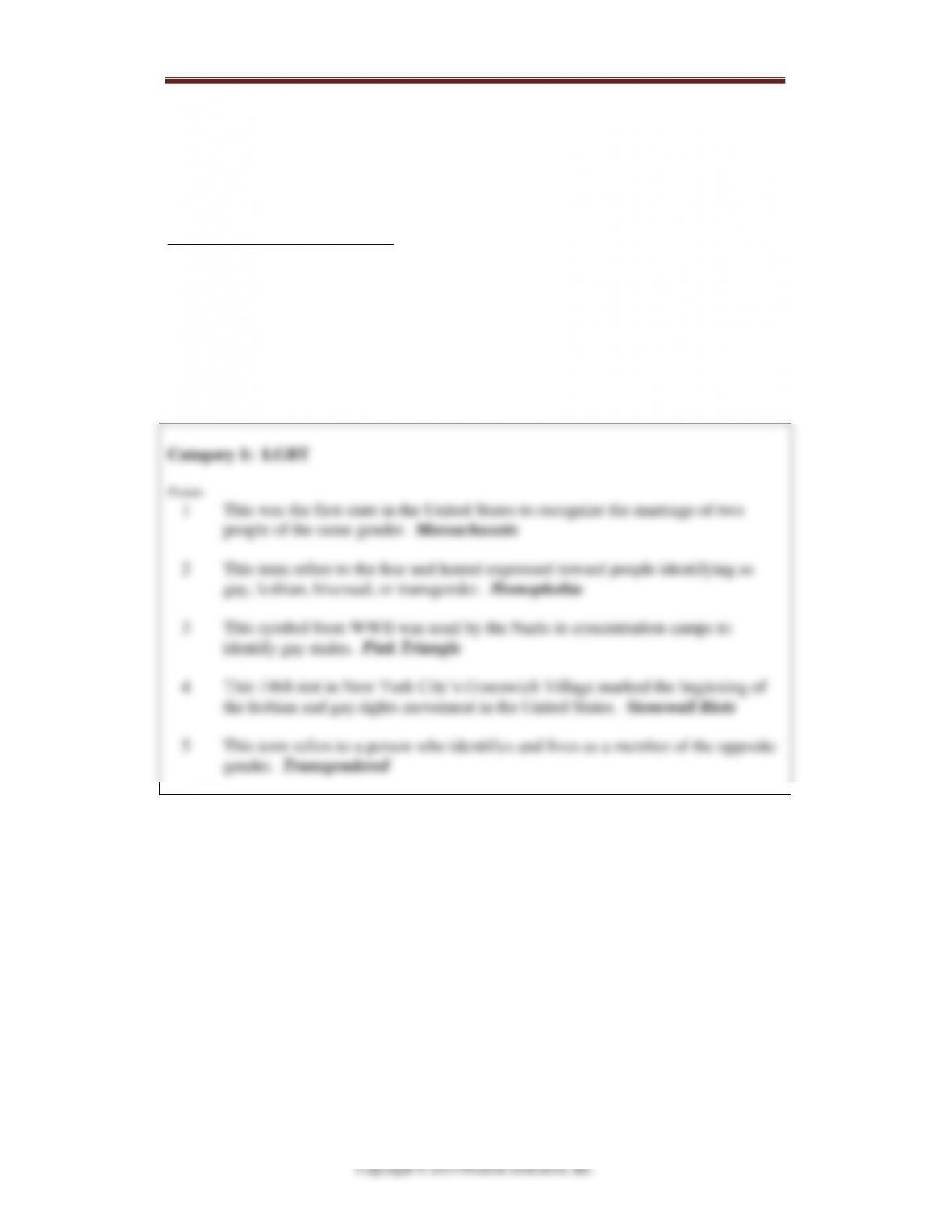
Category 1: LGBT
Points
1 This was the first state in the United States to recognize the marriage of two
people of the same gender. Massachusetts
2 This term refers to the fear and hatred expressed toward people identifying as
gay, lesbian, bisexual, or transgender. Homophobia
3 This symbol from WWII was used by the Nazis in concentration camps to
identify gay males. Pink Triangle
4 This 1968 riot in New York City’s Greenwich Village marked the beginning of
the lesbian and gay rights movement in the United States. Stonewall Riots
5 This term refers to a person who identifies and lives as a member of the opposite
gender. Transgendered
2. DIVERSITY!
Category 3: World Languages
Points
1 This is the second most common language in the United States. Spanish
2 This world organization has six official languages for business: English,
French, Spanish, Arabic, Russian, and Chinese. United Nations
3 Between 1000 and 1500 languages are spoken on this continent. Africa
Category 2: Judaism
Points
1 The majority of Christians worship in a church and many Muslims worship in a
mosque. Followers of the Jewish faith worship in this edifice.
Synagogue or Temple
2 Not mixing milk and meat because it is forbidden by Jewish law is an example of
this type of Jewish meal preparation. Kosher
3 Observant Jews may leave the office early on Friday afternoons to celebrate this
holy observance. Shabbat or Sabbath
4 This holiday is considered to be the Jewish New Year. Rosh Hashanah
5 The mystical teachings of Judaism, made popular by Madonna and Britney
Spears and symbolized by a red string bracelet, are known collectively as this.
Kabbalah
2. DIVERSITY!
Category 4: Symbols
Points
1 This symbol of gay pride was created in 1978 by artist Gilbert Baker. It is
generally flown in lesbian and gay pride marches worldwide. Rainbow Flag
2 This symbol, used by the Nazis, was actually used for more than 3000 years by
cultures across the globe to represent the sun, power, strength, and good luck.
Swastika
3 While the color white is used in weddings in many cultures, it is also used in this
ritual in many Asian countries. Funerals or mourning
4 This textile, originally from Ghana, has come to represent pride in one’s heritage
in the African American community. Kente cloth
5 This Hindu symbol is applied to a woman’s forehead and is said to strengthen
concentration and protect the spirit of the wearer. Bindi
Category 5: The Amazing Race
Points
1 Their history of slavery has made the road to full equality a laborious journey.
African Americans.
2 This Civil Rights icon prompted the Montgomery, Alabama Bus Boycott when
she refused to give up her seat on the bus. Rosa Parks
3 Created in the pan-Latin melting pot of New York City in the late 1960s and
early 1970s, this musical genre is based on rock, jazz, and Latin American
musical traditions. Salsa
Americans. Honolulu
genetically alike by this percentage. 99%
2. DIVERSITY!
DIVERSITY! BOARDS: QUESTIONS AND ANSWERS
Board 2 (Green Board) Categories:
6. Here Comes the Judge
7. Cane & Able
8. Islam
9. Women in the Workforce
10. U.S. Culture
Category 6: Here Comes the Judge
Points
2 This law protects women from losing their jobs after taking maternity leave.
Family and Medical Leave Act
4 This law makes it illegal for work organizations to discriminate against
anyone born in another country or with a different ancestral heritage.
Title VII of the Civil Rights Act of 1964
6 Policies against sexual harassment, as a form of discrimination, have been
developed in work organizations as a result of this law. Civil Rights Act of 1964
8 This is one of two forms of discrimination not covered by the U.S. Equal
Employment Opportunity Commission. Sexual orientation, weight, height,
or social class
10 This man, who later became a Supreme Court Justice, presented the legal
argument in the historic 1954 case of Brown vs. the Board of Higher Education,
2. DIVERSITY!
Category 7: “Cane & Able”
Points
2 This piece of legislation enacted in 1990 provides equal access for people with
disabilities. Americans with Disabilities Act
4 Discrimination based on an individual’s or group’s perceived socio-economic
status is referred to as _________. Classism
6 This condition affects a person’s ability to read letters and numbers, often
distorting the image and making it difficult to read. Dyslexia
8 This non-verbal language has just as many cultural variations as spoken English.
American Sign Language
10 This breed of primate has been trained to assist quadriplegics with day–to-day
household chores. Capuchin monkey
Category 8: Islam
Points
2 This holy text of Islam is believed to be the word of Allah given to Muhammad.
Koran or Quran
4 According to religious teachings, Muslims are required to pray this number of
times per day. Five (5) times per day.
6 This city is said to be the ancient birthplace of the Prophet Muhammad and is the
most revered city for Muslims. Mecca
8 A yarmulke is to the Jewish religion as this headgear is to Islam. Kufi
2. DIVERSITY!
Category 9: Women in the Workforce
Points
2 This term refers to prejudice or discrimination based on gender. Sexism
4 In 1981, this woman, appointed by President Reagan, became the first female
Supreme Court Justice. Sandra Day O’Connor
6 In 2009, women comprised this percentage of the United States workforce. 47%
8 According to the U.S. Department of Labor, men comprised 8% of the workforce
in this traditional female occupation in 2009. Nursing
10 In what year were men first outpaced by women in the number of baccalaureate
degrees they earned? 2000
Category 10: U.S. Culture
Points
2 This religious group in the United States is known for their horse-drawn buggies
and rejection of electricity. Amish
4 This term is used by the United States government to classify people who come
from a Spanish or Spanish-speaking background. It should not be confused with
the terms Latino and Latina, which refer to people from Latin America. Hispanic
6 These Americans hold the view that people should live in harmony with the
natural world. Native Americans (American Indians)
2. DIVERSITY!
Additional Questions
2. DIVERSITY!
I –
17
Appendix A: Diversity! Source Notes
Board 1 (Blue Board) Categories :
1. LGBT (Lesbian, Gay, Bisexual, Transgendered)
2. Judaism
3. World Languages
4. Symbols
5. The Amazing Race
Category 1: LGBT
2. DIVERSITY!
I –
Copyright © 2015 Pearson Education, Inc.
18
4 The United States http://www.strictlyspanish.com/whitepaper2.htm Retrieved
6-17-2010
5 Mandarin Chinese
http://www.nationsonline.org/oneworld/most_spoken_languages.htm Retrieved
6-17-2010
Category 4: Symbols
1 Rainbow Flag http://www.gay-web.de/service/symbole/rainbowflag.shtml
Retrieved 6-17-2010
Retrieved 6-17-2010
5 Bindi http://en.wikipedia.org/wiki/Bindi_(decoration) Retrieved 6-17-2010
Category 5: The Amazing Race
2. DIVERSITY!
Board 2 (Green Board) Categories :
6. Here Comes the Judge
7. Cane & Able
8. Islam
9. Women in the Workforce
10. U.S. Culture
Category 6: Here Comes the Judge
Points
Category 7: “Cane & Able”
Category 8: Islam
Category 9: Women in the Workforce
2. DIVERSITY!
I –
20
Category 10: U.S. Culture
Sources for Additional Questions