Matrix of Teaching Materials
PEDAGOGICAL FEATURES
Readings
Exercises
Cases
Diversity on
the Web
Writing
Assignment
Points of Law
Global Notes
Capstone
Assignments
Rubrics
Best
Practices
V. Introduction to Managing Diversity: Ethical, Legal, Media
and Marketing Issues X
40. Ethics of Workplace Diversity X X
41. Ethics/Legal Cases X X X
42. Canada – Workplace Diversity X X X X X
43. Health of the Media X X X
44. Media Diversity Exercises X
45. Changing Consumer Markets X X
46. Bar Exam X
47. Chick-Fil-A X X
VI. Introduction to Managing Change/Diversity: Current Issues X
49. Leadership, Mentoring, ERGs, Training, Supplier
Diversity and Social Responsibility X X X X X
50. Work-Life Balance Issues X X X X
51. Six Sigma Case X X X
Matrix of Teaching Materials
PEDAGOGICAL FEATURES
Readings
Exercises
Cases
Diversity on
the Web
Writing
Assignment
Points of Law
Global Notes
Capstone
Assignments
Rubrics
Best
Practices
VII. Introduction to Capstone Experiences* X
57. Create a Case X
58. Diversity Awarness: A Video Project X
59. Diversity Audit X X X
VIII. Cases in Instructor‘s Manual Only
61. UBS Case X X X X
62. Law Enforcement X
63. US Airforce Academy X X X
64. Briarwood X
65. Best Buy X X X X X
66. BWA/Indonesia Way X X X
* Topics depend on projects selected by students.
Integrating Diversity with Organizational Behavior Topics
INTEGRATING DIVERSITY WITH ORGANIZATIONAL BEHAVIOR TOPICS
ORGANIZATIONAL BEHAVIOR TOPICS
Organizational
Culture
Teamwork
Pereception and
Attribution
Motivation
Performance
Management
Communication
Leadership
Decision Making
Managing Conflict
Global
Management
Understanding Workplace Diversity
X X X X X X X
I. Introduction to Individual Diversity X
1. Diversity Today X X
2. DIVERSITY! X X
3. Body Ritual/Nacirema X X X
4. Increasing Multicultural Understanding X X
5. I AM… X
6. Are You Privileged? X
7. White Privilege and Male Privilege X
8. The Emotional Connection X X
9. Diversity in Your Organization X X X X
10. Pitney Bowes Case
X X X X
Integrating Diversity with Organizational Behavior Topics
ORGANIZATIONAL BEHAVIOR TOPICS
Organizational
Culture
Teamwork
Pereception and
Attribution
Motivation
Performance
Management
Communication
Leadership
Decision
Making
Managing
Conflict
Global
Management
III. Introduction to Primary Dimensions of Diversity: Age,
Gender, Sexual Orientation, and Physical/Mental Challenges X X X X X X X X X
18. To Drive A Bus? X X
19. Generational Diversity X X X X X X
20. Gender Gap X X X X X X
21. Gender Bias 2013 Style X X X X X X X X X
22. Male Privilege X X
23. LGBT Issues X X
24. Sexual Harassment X X X X X X X X X
25. Musical Chairs X X
26. Disability and Diversity X X X X
27. Cracker Barrel X X X X X X X X
Integrating Diversity with Organizational Behavior Topics
ORGANIZATIONAL BEHAVIOR TOPICS
Organizational
Culture
Teamwork
Pereception and
Attribution
Motivation
Performance
Management
Communication
Leadership
Decision Making
Managing Conflict
Global
Management
V. Introduction to Managing Diversity: Ethical, Legal, Media
and Marketing Issues X X X X X X X X X
40. Ethics of Workplace Diversity X X X
41. Ethics/Legal Cases X X X X X X X X
42. Canada – Workplace Diversity X X
43. Health of the Media X X
44. Media Diversity Exercises X
45. Changing Consumer Markets X X X X
46. Bar Exam X X X X X X
47. Chick-Fil–A X X X X X X X X
VI. Introduction to Managing Change/Diversity: Current Issues X X X X X X X X X X
49. Leadership, Mentoring, ERGs, Training, Supplier
Diversity and Social Responsibility X X X X X X X
50. Work-Life Balance Issues X X X

Integrating Diversity with Organizational Behavior Topics
ORGANIZATIONAL BEHAVIOR TOPICS
Organizational
Culture
Teamwork
Pereception and
Attribution
Motivation
Performance
Management
Communication
Leadership
Decision Making
Managing Conflict
Global
Management
VII. Introduction to Capstone Experiences*
57. Create a Case
58. Diversity Awarness: A Video Project
59. Diversity Audit
VIII. Cases in Instructor‘s Manual Only
61. UBS Case X X X X X X X X X
62. Law Enforcement X X X X X X X X X
63. US Airforce Academy X X X X X X X X X
64. Briarwood X X X X X X X X
65. Best Buy X X X X
66. BWA/Indonesia Way X X X X X X X X
* Topics depend on projects selected by students.
Integrating Diversity with Human Resources Topics
INTEGRATING DIVERSITY WITH HUMAN RESOURCES TOPICS
HUMAN RESOURCES TOPICS
Strategic HR
Discrimination/
Stereotypes
Recruitment/Selection/
Retention
Benefits/Work-Life
Balance
Legal/Ethical
Managing Talent
(Training, Mentoring
etc.)
Current Challenges
Gobal Issues
Communication
Understanding Workplace Diversity
X X X X X X X X
I. Introduction to Individual Diversity X X
1. Diversity Today X X X
2. DIVERSITY! X X
3. Body Ritual/Nacirema X
4. Increasing Multicultural Understanding X X
5. I AM… X
6. Are You Privileged? X X
7. White Privilege and Male Privilege X X
8. The Emotional Connection X
9. Diversity in Your Organization X
10. Pitney Bowes Case
X X X X X
II. Introduction to Primary Dimensions of Diversity:
Integrating Diversity with Human Resources Topics
HUMAN RESOURCES TOPICS
Strategic HR
Discrimination/
Stereotypes
Recruitment/Selection/
Retention
Benefits/Work-Life
Balance
Legal/Ethical
Managing Talent
(Training, Mentoring
etc.)
Current Challenges
Gobal Issues
Communication
III. Introduction to Primary Dimensions of Diversity: Age,
Gender, Sexual Orientation, and Physical/Mental Challenges X X X X X X X X
18. To Drive A Bus? X X X X
19. Generational Diversity X X X X X X X
20. Gender Gap X X X X X X X
21. Gender Bias 2013 Style X X X X X X
22. Male Privilege X X
23. LGBT Issues X X X X
24. Sexual Harassment X X X X X X
25. Musical Chairs X X X
26. Disability and Diversity X X X X X
27. Cracker Barrel X X X X
Integrating Diversity with Human Resources Topics
HUMAN RESOURCES TOPICS
Strategic HR
Discrimination/
Stereotypes
Recruitment/Selection/
Retention
Benefits/Work-Life
Balance
Legal/Ethical
Managing Talent
(Training, Mentoring
etc.)
Current Challenges
Gobal Issues
Communication
IV. Introduction to Secondary Dimensions of Diversity:
Social Class, Religion, Appearance/Weight
Language/Communication and Military Services X X X X X X X X
29. Social Class X X
30. Social Class: Meritocracy X X
31. Religion in the Workplace X X X
32. Intercultural Communication X X X X
33. Global Call Center X X
34. Mobile Training Team Case X X X X
35. Women‘s Changing Roles in the U.S. Military X X X X
36. Choosing the Board X X X X X
37. Appearance and Weight X X X X X
38. Fairfax Hospital X X X X X
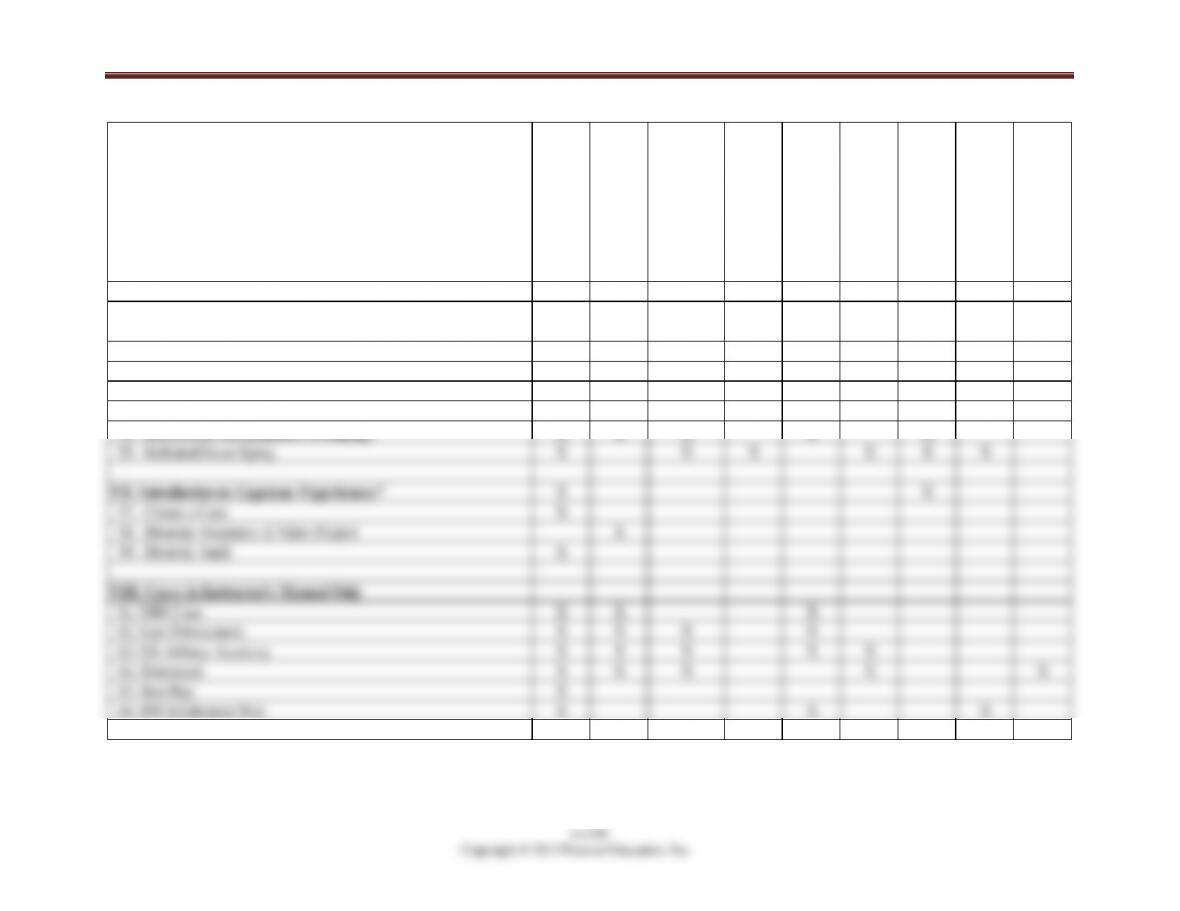
Integrating Diversity with Human Resources Topics
HUMAN RESOURCES TOPICS
Strategic HR
Discrimination/
Stereotypes
Recruitment/Selection/
Retention
Benefits/Work-Life
Balance
Legal/Ethical
Managing Talent
(Training, Mentoring
etc.)
Current Challenges
Gobal Issues
Communication
VI. Introduction to Managing Change/Diversity: Current Issues X X X X X X X X X
49. Leadership, Mentoring, ERGs, Training, Supplier
Diversity and Social Responsibility X X X X X
50. Work-Life Balance Issues X X X
51. Six Sigma Case X X X X X X X
52. Diversity and Inclusion Awards X X X X
53. The Four Faces of Bullying X X X X
54. Harassment, Discrimination, or Bullying? X X X X X
55. Inclusion/Ocean Spray X X X X X X
VII. Introduction to Capstone Experiences* X X
57. Create a Case X
58. Diversity Awarness: A Video Project X
59. Diversity Audit X
VIII. Cases in Instructor‘s Manual Only

Teaching an Online Diversity Course
TEACHING AN ONLINE DIVERSITY COURSE
Carol P. Harvey
Five years ago, if you had asked me whether diversity courses could be taught effectively
online, I would have said no very quickly. Now that I have taught this course in an online
format, I have learned that such technology offers several advantages that can add
substance and relevancy to a diversity course. Students have more anonymity and
respond more openly than in a traditional classroom, but at the same time, it is harder for
them to hide in an online class. The asynchronous nature of online learning allows
students time to formulate more thoughtful responses. There is a stronger probability of a
more diverse class, particularly in terms of age, life experiences, and geography. Lastly,
video resources and the ability to update information are only a click away. So, today, I
would say yes to this question. (See Exhibit #1.)
Teaching any class online requires more thoughtful planning, explicit directions, and
careful organization than teaching in the classroom. With technology in mind, the 6th
edition of Understanding and Managing Diversity: Readings, Cases, and Exercises
includes several features that will make it easier for you to adapt this course to online
teaching. For example:
Incorporation of Higher Levels of Critical Thinking – The best learning is
achieved when students have to analyze, synthesize, and evaluate material,
rather than merely reiterating it. In an online format, students have constant
access to their text material and commentary from others. The Discussion
Questions and many of the text assignments are designed to require students to
think critically about organizational diversity. Online students can be assigned to
respond publically on discussion boards or privately in the journal feature.
An Interdisciplinary Approach – Students in online classes may represent a
wider variety of majors and programs than in traditional classrooms. As in
previous editions of this text, the authors represent many disciplines such as
business, psychology, education, sociology, economics, etc., thereby providing the
opportunity to customize your course by reordering and selecting articles.
Pedagogical Features – The Diversity on the Web assignments, many of which
guide students to video material, can enrich an online curriculum. The Writing
Assignments and Integrative Questions (found at the end of each section of the
text), and the three Capstone Experiences all provide assessment opportunities that
are appropriate for online classes. The Power Point slides can be posted for
students. Finally, most of the experiential exercises can be done individually and
then processed in groups on discussion boards.

Teaching an Online Diversity Course
Exhibit #1
Pros and Cons of Teaching Diversity Courses Online
Pros Cons
Students have more time to develop Instructors usually do not have the
more thoughtful, deeper answers. ability to see body language
English as a second language and student reactions to controversial
students have more time to process. readings or statements.
Visual diversity, such as age, race, Graded assessments have to be
and physical challenges, can be designed more carefully because
less of a factor in the stereotyping students usually will have access to
of other students. their notes and tests.
Students can be assigned to watch Group work can be done but is
web-based video material that sometimes more complicated
might take too much classroom time. than in traditional classrooms.
Easier to keep course current using Instructors must consistently monitor
WIKI and Announcements postings. and respond to student posts.
Encourages greater participation
in collaborative discussions. Planning the syllabus takes more time.
Planning Your Online Course
Carefully writing the syllabus is crucial to the success of an online class. When face-to–
face contact is removed, assignments need to be more carefully designed and explained.
Begin by deciding what major topics you will cover in each weekly module. This may
depend on the course focus, as well as on the students who will be taking your course.
For example, in the online class that I am currently teaching, most of the students are
non-traditional working adults and are a mix of social science and business majors.
Each weekly module is designed to be thorough, require that students think critically
about the material, and provide detailed directions that minimize student questions about
what to do and where to place their work. I provide an introduction to the topic and
learning objectives (found at the beginning of the readings, cases, and exercises in this
Instructor’s Manual) followed by very detailed instructions. (See Exhibit #2.)
It is also helpful if each module contains a blend of assignments that involve different
learning domains: cognitive (thinking); affective (feeling); and whenever possible,
psychomotor (doing). The matrices provided in this Instructor’s Manual are useful for

Teaching an Online Diversity Course
selecting specific readings, cases, exercises, Writing Assignments, and Diversity on the
Web assignments, etc. that will help students to accomplish your objectives. You can also
work with your librarian to add links to additional library resources.
To build a sense of social presence and community, and to reduce student apprehension, I
send an introductory email to each student about a week before the course starts in which
I try to relieve their anxieties about the class by introducing myself, telling them a little
about the content of the class, and giving them information about the text that they will
need. Their first posting requires them to introduce themselves on the discussion board.
This allows me to get a sense of the class. At the same time, the students find that they
often have similarities with each other.
To continue building a social presence and to ensure participation, I assign some tasks to
small groups and require that students comment on classmate postings. I also encourage
students to write in their online journals, where they can reflect on their own thoughts and
perceptions about the week’s lesson.
Exhibit #2
MODULE #3. INDIVIDUAL DIVERSITY: STEREOTYPES, PRIVILEGE,
AND CULTURE – WEEK OF February 3rd
All work must be completed by 9 pm, Sunday, Feb. 9th.
Most people deny that they have any stereotypes or that they treat anyone differently.
Psychology tells us that stereotypes are the brain’s way of organizing data, that not
all stereotypes are negative, and that almost everyone does have stereotypes. It is a
part of being human. Once we are willing to recognize this, we can stop ourselves
from acting on them. However, this can be problematic when someone believes
that treating others as he/she wants to be treated is the only solution. Because
individuals have different life experiences, often influenced by their primary social
identity group memberships such as race and gender, this denies the uniqueness of
those factors and of the different ways in which others may experience the world.
LEARNING OBJECTIVES
In this module, you will:
• Examine the effects of privilege and stereotypes on your experiences
• Explore how our life experiences can shape our perceptions
• Recognize the unconscious nature of stereotypes

Teaching an Online Diversity Course
ASSIGNMENTS
1. Read White Privilege, article #7. Answer Discussion Questions #4 & #5 on your
group’s discussion board in 150 words or less. Return to the group discussion board
after the Feb. 9th deadline when others have submitted. Respond/react to at least one
posting made by another group member in terms of how he/she has added to your
knowledge of diversity issues.
2. Visit the Harvard Project Implicit website (implicit.harvard.edu). Read the
background information on the project, and select and take any one of the tests.
Note: The best learning experience here is to select a category that you have little
experience with in your own life. On the course Discussion Board, under the
Module #3 Harvard link, post your answers in 150 words or less to the following
question: What has the privilege reading and the Project Implicit test clarified for
you about your own stereotypes and privileges?
3. Read Body Ritual…, article #3. Post on your group discussion board brief answers
to Discussion Questions #1 & #2. Also, answer the following question: This article
was written in 1956. Why do teachers still assign this reading, i.e., what does it
teach us that is just as valuable a lesson about diversity in 2014?
4. Make your weekly journal entry and add any interesting new course related material
to the WIKI course.
Because the personal nature of this topic can challenge perceptions and beliefs, teaching
diversity courses is always a challenge. If the course is online, the challenges are still
there, but just a bit different!

Understanding Workplace Diversity: Where Have We Been and Where Are We Going?
UNDERSTANDING WORKPLACE DIVERSITY:
WHERE HAVE WE BEEN AND WHERE ARE WE GOING?
Carol P. Harvey
Suffolk University
Assumption College, Professor Emerita
Goals
• To provide a brief historical context for workplace diversity issues
• To demonstrate the evolution of workplace diversity from a legal issue to an
inclusion issue
• To present some of the major theoretical concepts that underlie managing
diversity in the workplace
• To explain the business case for diversity
Introduction
This article provides students with the historical and theoretical context for this course
and should be assigned as required reading. Because the United States has an African
American President, there are a few high-profile female CEO’s like Sheryl Sandburg, and
more states now permit gay marriages, students sometimes assume that workplace
diversity is not an issue in the 21st century. Yet the Obamas and Sandburgs are
exceptions, not the norm, and it is currently still illegal for gays to marry in thirty-seven
states. For context, students should also watch at least one of the historical videos listed
in the second Diversity on the Web.

Understanding Workplace Diversity: Where Have We Been and Where Are We Going?
Copyright © 2015 Pearson Education, Inc.
Outline
I. Workplace diversity defined
II. Historical context of workplace diversity (first era, 1960s-1970s)
A. Civil Rights legislation
B. Quotas
C. Assimilation/melting pot
III. Valuing diversity (second era, 1980s-1990s)
A. Hudson Report: Workforce 2000
B. Diversity as a competitive advantage
1. Cox & Blake
2. R.R. Thomas
C. Loden
1. Primary – more permanent, more central to one’s identity
2. Secondary – more changeable
D. Gardenswartz & Rowe
1. Personality
2. Organizational differences
E. Thomas & Ely
1. Discrimination & fairness
2. Access & legitimacy
3. Learning & effectiveness
F. Business case for diversity
IV. Diversity management & inclusion (third era, 21st century)
A. Diversity as an organizational benefit
B. Diversity expanded beyond essentialism
C. Miller & Katz – Inclusion
1. Diversity out of the box
2. Diversity tied to achievement of organizational mission and goals
D. Diversity as an organizational change process
Understanding Workplace Diversity: Where Have We Been and Where Are We Going?
Discussion Questions & Answers
1. Recently, there has been a growing movement to abolish Affirmative Action.
Develop arguments that support both sides of the debate.
The arguments for abolishing Affirmative Action (AA) include but are not limited to:
• It is no longer legally necessary and is based on an outdated statistical
approach to diversity management.
2. Interview someone over fifty-five years of age who lived and worked through
these eras. Ask them about their experiences with diversity in the 1960s and 70s.
Does their gender, race, ethnicity, or religion appear to affect their answers?
What did you learn?
These answers will depend on who is interviewed and the questions that students ask.
groups’ experiences.
3. What are some of the reasons that diversity management is so complex?

Understanding Workplace Diversity: Where Have We Been and Where Are We Going?
Diversity on the Web
Go to http://www.loden.com/Site/Dimensions.html. Here you will find Loden’s updated
wheel of primary and secondary dimensions of diversity. Circle the three that you feel
are the most important dimensions that define your identity. Write a two-page essay that
explains why these dimensions are so important to who you are, and support your
answer with examples from your life.
Diversity on the Web
To better understand the historical context of diversity today, watch one or more of the
following videos. Go to youtube.com and search by the titles below, or click on the
following links.
The History of the Civil Rights Movement
(http://www.youtube.com/watch?v=URxwe6LPvkM)
The March on Washington
(http://www.youtube.com/results?search_query=march+on+washington+1963&oq=&gs
_l=youtube)
The Freedom Riders
(http://www.youtube.com/watch?v=1zBY6gkpbTg)