172 Gitman/Zutter Principles of Managerial Finance, Brief, Seventh Edition
P9-11. Retained earnings versus new common stock
LG 5; Intermediate
1
0
r
D
r g
P
= +
1
n
n
D
r g
N
= +
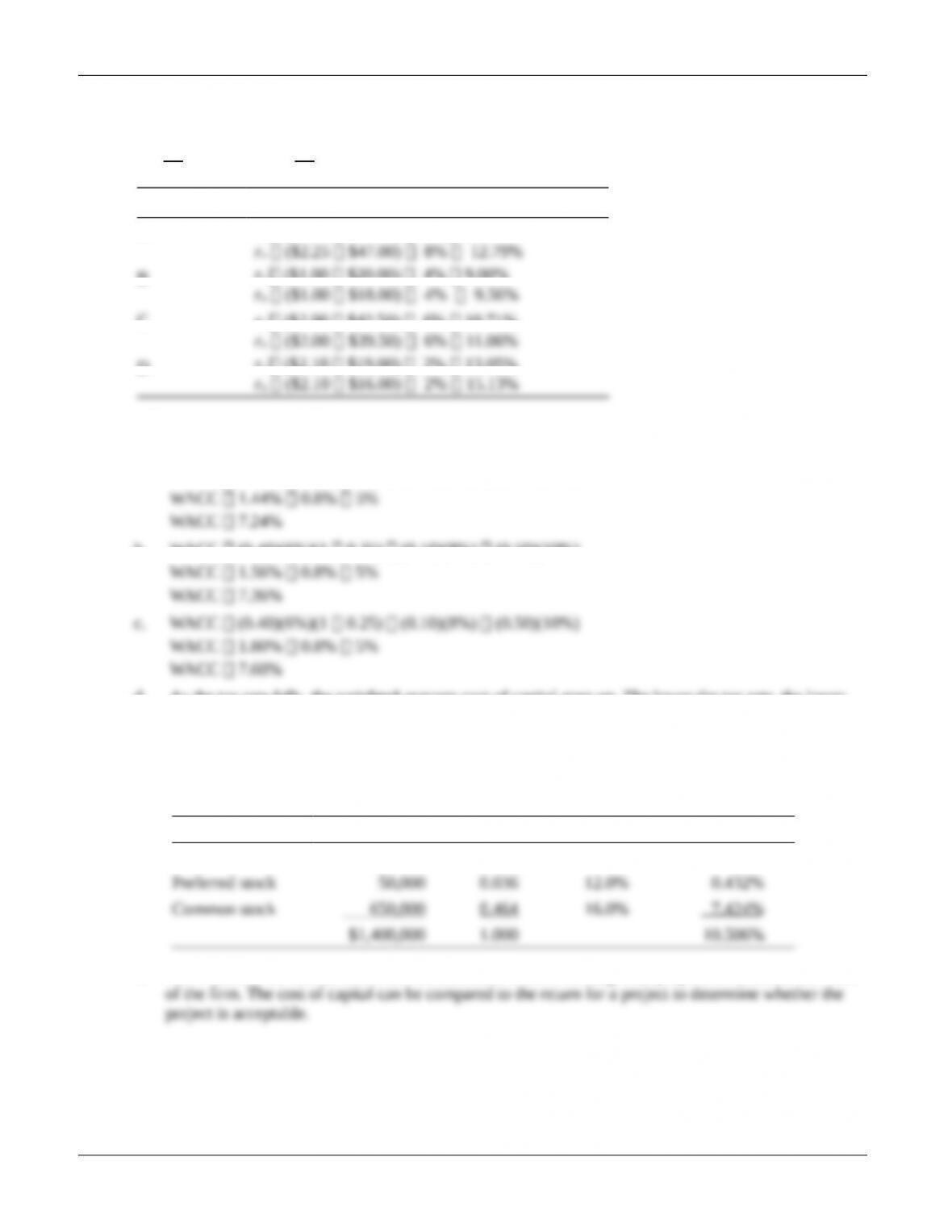
Firm Calculation
Arr ($2.25 $50.00) 8% 12.50%
Brr ($1.00 $20.00) 4% 9.00%
Crr ($2.00 $42.50) 6% 10.71%
Drr ($2.10 $19.00) 2% 13.05%
P9-12. Effect of tax rate on WACC
LG 3, 4, 5, 6; Intermediate
a. WACC (0.40)(6%)(1 0.40) (0.10)(8%) (0.50)(10%)
b. WACC (0.40)(6%)(1 0.35) (0.10)(8%) (0.50)(10%)
d. As the tax rate falls, the weighted-average cost of capital goes up. The lower the tax rate, the lower
the government “subsidy” for debt.
P9-13. WACC—book weights
LG 6; Basic
a.
Type of Capital Book Value Weight Cost Weighted Cost
Long-term debt $700,000 0.500 5.3% 2.650%
b. The WACC is the rate of return that the firm must receive on long-term projects to maintain the value
© 2015 Pearson Education, Inc.
173 Gitman/Zutter Principles of Managerial Finance, Brief, Seventh Edition
P9-14. WACC—book weights and market weights
LG 6; Intermediate
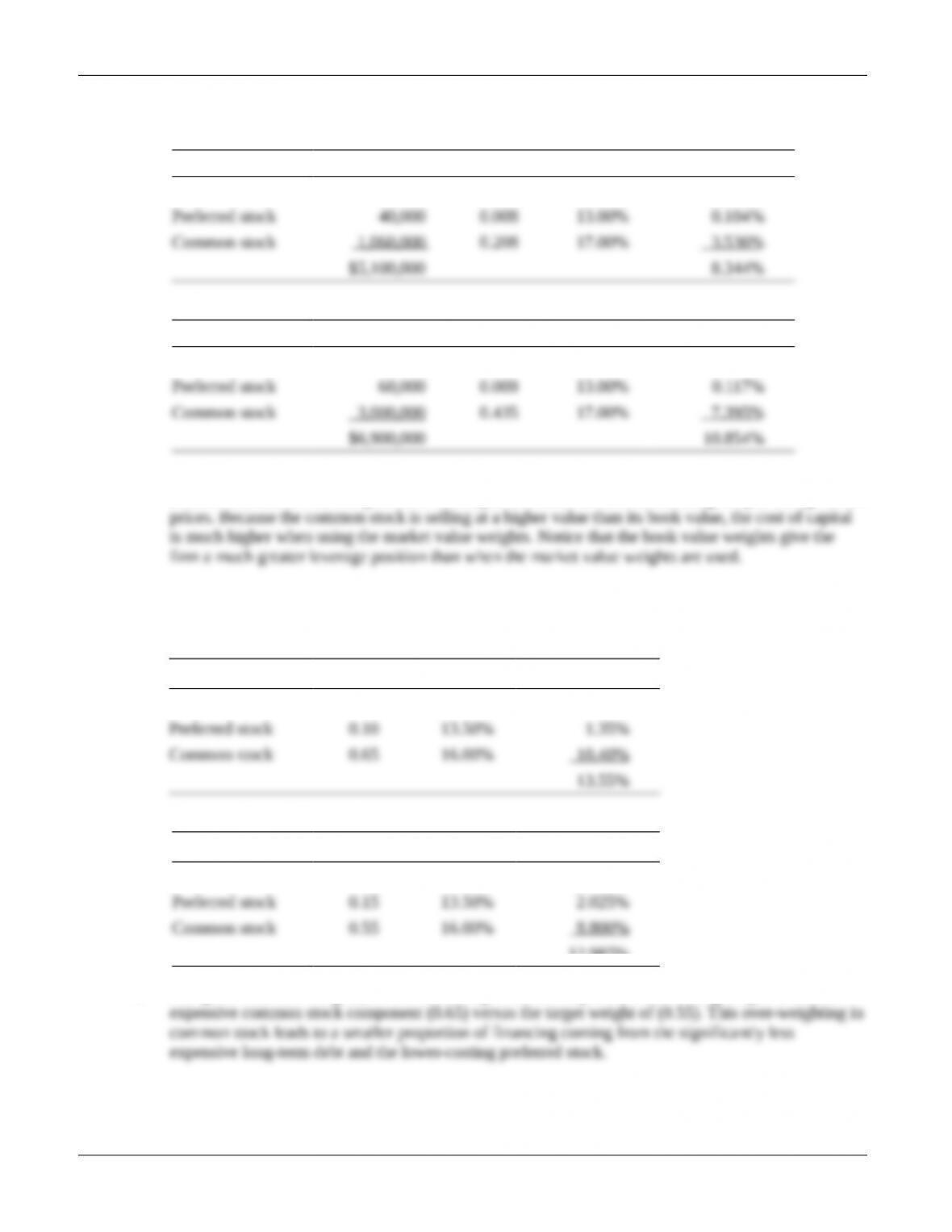
a. Book value weights:
Type of Capital Book Value Weight Cost Weighted Cost
Long-term debt $4,000,000 0.784 6.00% 4.704%
b. Market value weights:
Type of Capital Market Value Weight Cost Weighted Cost
Long-term debt $3,840,000 0.557 6.00% 3.342%
c. The difference lies in the two different value bases. The market value approach yields the better value
because the costs of the components of the capital structure are calculated using the prevailing market
P9-15. WACC and target weights
LG 6; Intermediate
a. Historical market weights:
Type of Capital Weight Cost Weighted Cost
Long-term debt 0.25 7.20% 1.80%
b. Target market weights:
Type of Capital Weight Cost Weighted Cost
Long-term debt 0.30 7.20% 2.160%
12.985%
c. Using the historical weights, the firm has a higher cost of capital due to the weighting of the more
© 2015 Pearson Education, Inc.

Chapter 9: The Cost of Capital 174
P9-16. Cost of capital
LG 3, 4, 5, 6; Challenge
a. Cost of retained earnings
$1.26(1 0.06) $1.34
0.06 3.35% 6% 9.35%
$40.00 $40.00
r
r+
= + = = + =
b. Cost of new common stock
$1.26(1 0.06) $1.34
0.06 4.06% 6% 10.06%
$40.00 $7.00 $33.00
s
r+
= + = = + =
–
c. Cost of preferred stock
$2.00 $2.00 9.09%
$25.00 $3.00 $22.00
p
r= = =
–
d.
$1,000 $1,175
$100 $65.00
55.98%
$1,175 $1,000 $1,087.50
2
d
r
–
+
= = =
+
e. WACC (0.40)(3.59%) (0.10)(9.09%) (0.50)(9.35%)
P9-17. Calculation of individual costs and WACC
LG 3, 4, 5, 6; Challenge
a. After–tax cost of debt
Approximate Approach
($1,000 )
( $1,000)
2
d
d
d
N
In
rN
–
+
=+
($1,000 $950)
$100 $100 $5
10 10.77%
($950 $1,000) $975
2
d
r
–
++
= = =
+
Calculator approach
N 10, PV $950, PMT $100, FV $1,000
Solve for I: 10.84%
175 Gitman/Zutter Principles of Managerial Finance, Brief, Seventh Edition
b. Cost of preferred stock:
p
p
p
D
rN
=
$8 12.70%
$63
p
r= =
c. Cost of new common stock equity:
Solve for g:
N 4, PV $2.85, FV $3.75
Solve for I: 7.10%
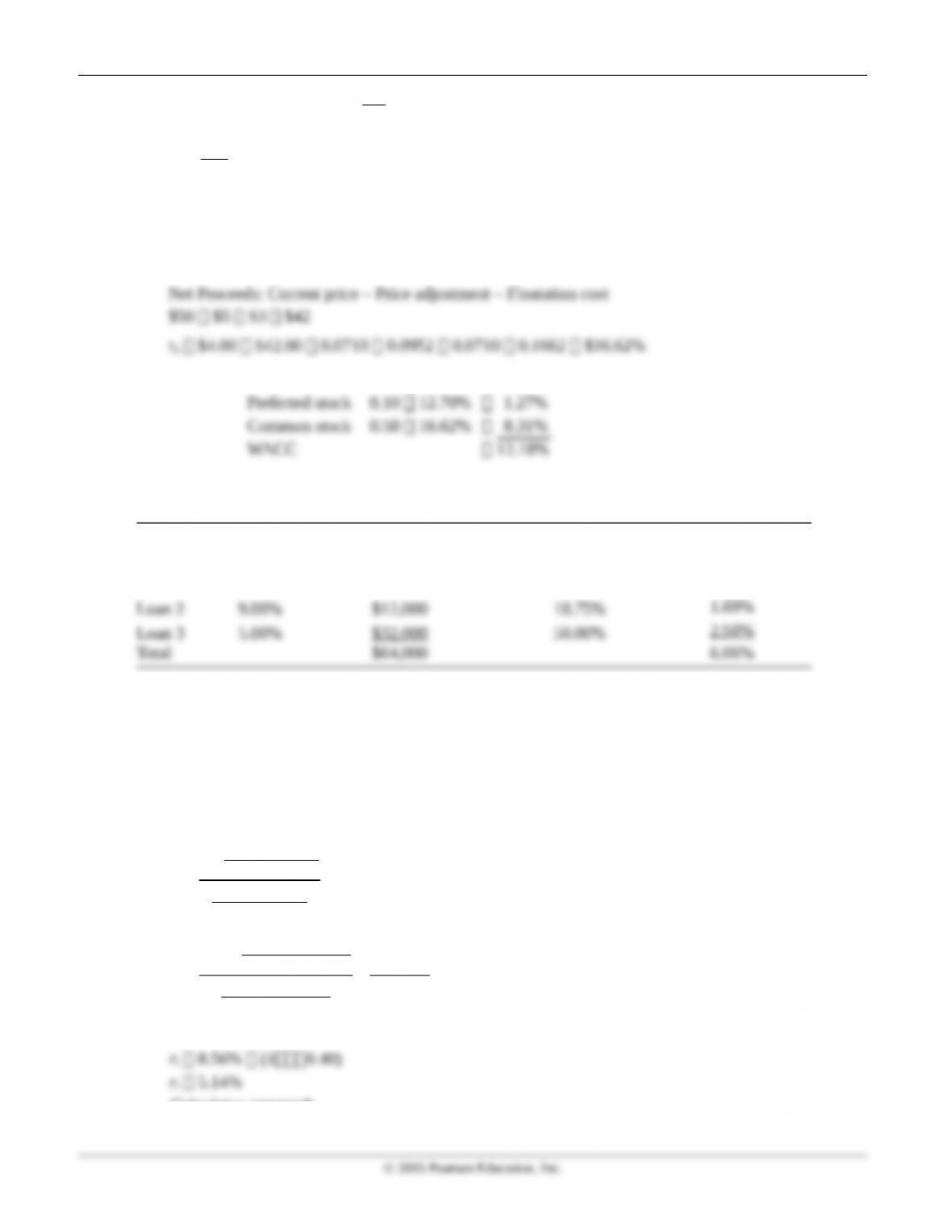
Net Proceeds: Current price – Price adjustment – Floatation cost
$50 $5 $3 $42
rn $4.00 $42.00 0.0710 0.0952 0.0710 0.1662 $16.62%
d. WACC: Long-term debt 0.40 6.51% 2.60%
P9-18. Personal finance problem: Weighted-average cost of capital
LG 6; Intermediate
Rate
[1]
Outstanding Loan Balance
[2]
Weight
[2] 64,000 [3]
WACC
[1] [3]
Loan 1
6.00%
$ 20,000
31.25%
1.88%
John Dough should not consolidate his college loans because their weighted cost is less than the 7.2%
offered by his bank.
P9-19. Calculation of individual costs and WACC
LG 3, 4, 5, 6; Challenge
a. After–tax cost of debt
Approximate approach
($1,000 )
( $1,000)
2
d
d
d
N
In
rN
–
+
=+
($1,000 $940)
$80 $80 $3
20 8.56%
($940 $1,000) $970
2
d
r
–
++
= = =
+
ri rd (1t)
Calculator approach
Chapter 9: The Cost of Capital 176
b. Preferred stock:
$7.60 8.44%
$90
p
p
p
p
D
rN
r
=
= =
c. Retained earnings:
1
0
= ($7.00 ÷ $90) + 0.06 = 0.0778 + 0.0600 = 0.1378 or 13.78%
r
D
r g
P
= +
New common stock:
1
= [$7.00 ÷ ($90 $7 $5)] + 0.06
= [$7.00 ÷ $78] + 0.06 = 0.0897 + 0.0600 = 0.1497 or 14.97%
n
n
D
r g
N
= +
– –
Type of Capital
Target
Capital
Structure %
Cost of
Capital
Source
Weighted
Cost
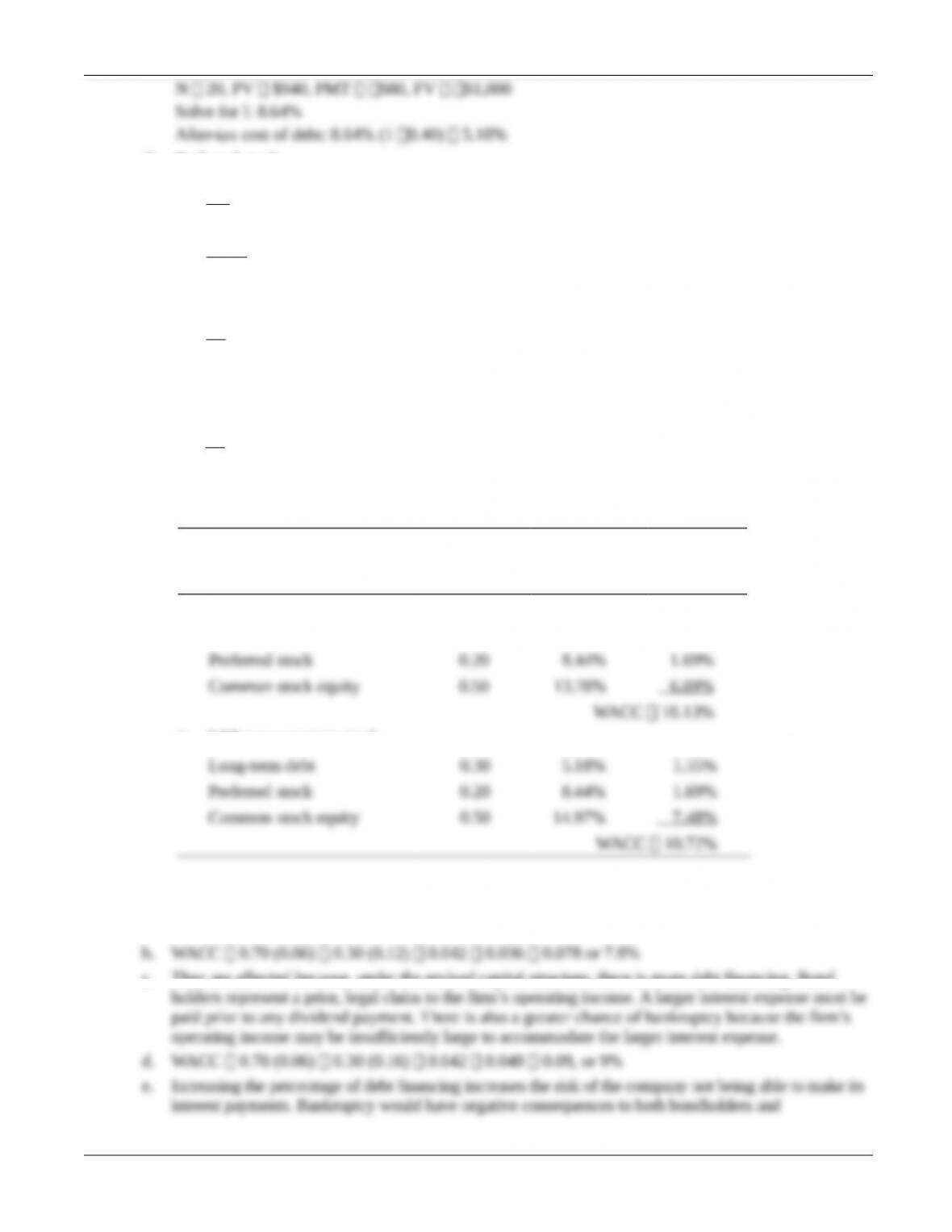
2. With retained earnings
Long-term debt 0.30 5.18% 1.55%
3. With new common stock
P9-20. Weighted-average cost of capital
LG 6; Intermediate
a. WACC 0.50 (0.06) 0.50 (0.12) 0.03 0.06 0.09 or 9.0%
c. They are affected because, under the revised capital structure, there is more debt financing. Bond
© 2015 Pearson Education, Inc.
177 Gitman/Zutter Principles of Managerial Finance, Brief, Seventh Edition
stockholders. As shown in part d, if stockholders increase their required rate of return, the cost of capital
P9-21. Ethics problem
LG 1; Intermediate
GE’s long string of good earnings reports made the company seem less risky, so it’s cost of capital would
Case
Case studies are available on www.myfinancelab.com.
Making Star Products’ Financing/Investment Decision
The Chapter 9 case, Star Products, is an exercise in evaluating the cost of capital and available investment
opportunities. The student must calculate the component costs of financing, long-term debt, preferred stock, and
common stock equity; determine the break points associated with each source; and calculate the WACC. Finally,
the student must decide which investments to recommend to Star Products.
a. Cost of financing sources
Debt:
(1) Below $450,000:
Calculator Method:
Approximation Method:
($1,000 )
( $1,000)
2
d
dd
N
In
rN
–
+
=+
($1,000 $960)
$90 15
($960 $1,000)
2
$92.67 0.0946 9.46%
$980
d
d
r
r
–
+
=+
= = =
ri rd (1t)
ri 9.46 (1 0.4)
ri 5.68%
(2) Above $450,000: ri rd (1 t)
ri 13.0 (1 0.4)
ri 7.8%
© 2015 Pearson Education, Inc.
Chapter 9: The Cost of Capital 178
(3) Preferred stock:
$9.80 0.1508 15.08%
$65
p
p p
p
D
r r
N
= = = =
Common stock equity:
(4) $0$1,500,000:
0
$0.96 0.11 19%
$12
i
r
r
D
r g
P
r
= +
= + =
(5) Above $1,500,000:
$0.96 0.11 21.67%
$9
i
r
n
r
D
r g
N
r
= +
= + =
b. Weighted average cost of capital:
Type of Capital
Target
Capital
Structure %
Cost of
Capital
Source
Weighted
Cost
1. Long-term debt less than $450,001 and common equity less than $500,001:
Long-term debt 0.30 5.7% 1.71%
2. Long-term debt greater than $450,000 and common equity less than $1,500,00:
Long-term debt 0.30 7.8% 2.34%
Preferred stock 0.10 15.1% 1.51%
3. Long-term debt greater than $450,000 and common equity more than
$1,500,000:
Long-term debt 0.30 7.8% 2.34%
c. Break points
Long-term debt
common equity
Break point
$450,000
(1) BP $1,500,000
0.30
$1,500,000
(2) BP $2,500,000
0.60
AF
W
=
= =
= =
179 Gitman/Zutter Principles of Managerial Finance, Brief, Seventh Edition
(3) Based on the information above, cheaper debt financing is exhausted when the value
of projects accepted exceeds $1,500,000. Retained earnings can finance $2,500,000 of new projects
d. Investments are ranked in terms of their rate of return. The project with the highest rate of return is Project C,
e. (1) Cheap debt and equity
(2) Cheap debt and half as much retained earnings
If Star Products only had $750,000 in common stock equity available, its equity break point would be
(3) Cheap debt and all $1,500,000 of retained earnings (illustrated in Part d)
(4) Limited total debt and $1,500,000 of retained earnings
If Star Products is limited by access to only a $1,000,000 of long-term debt, its break point would be
Spreadsheet Exercise
The answer to Chapter 9’s measurement of the cost of capital at Nova Corporation spreadsheet problem is located
on the Instructor’s Resource Center at www.pearsonhighered.com/irc under the Instructor’s Manual.
© 2015 Pearson Education, Inc.
Chapter 9: The Cost of Capital 180
Group Exercise
Group exercises are available on www.myfinancelab.com.
Accurately measuring the cost of capital is the topic of this chapter. The group exercise will use current
information from the shadow firm to provide details for each group’s fictitious firm. The balance sheet is the
source of this information and the assignment begins with an investigation into the shadow firm’s debt/equity mix.
The group uses the shadow firm’s balance sheet as a guide to developing a balance sheet for their fictitious firm.
© 2015 Pearson Education, Inc.