Chapter 9
The Cost of Capital
Instructor’s Resources
Overview
This chapter introduces the student to an important financial concept, the cost of capital. The mechanics of computing the
sources of capital debt, preferred stock, common stock, and retained earnings are reviewed. These individual costs are then
combined into a weighted average cost of capital. Students are encouraged to devote time and effort to learning Chapter 9’s
materials because acceptable projects encountered in their professional life or investment decisions made in their personal life
will be correct if they earn a return higher than the cost of capital.
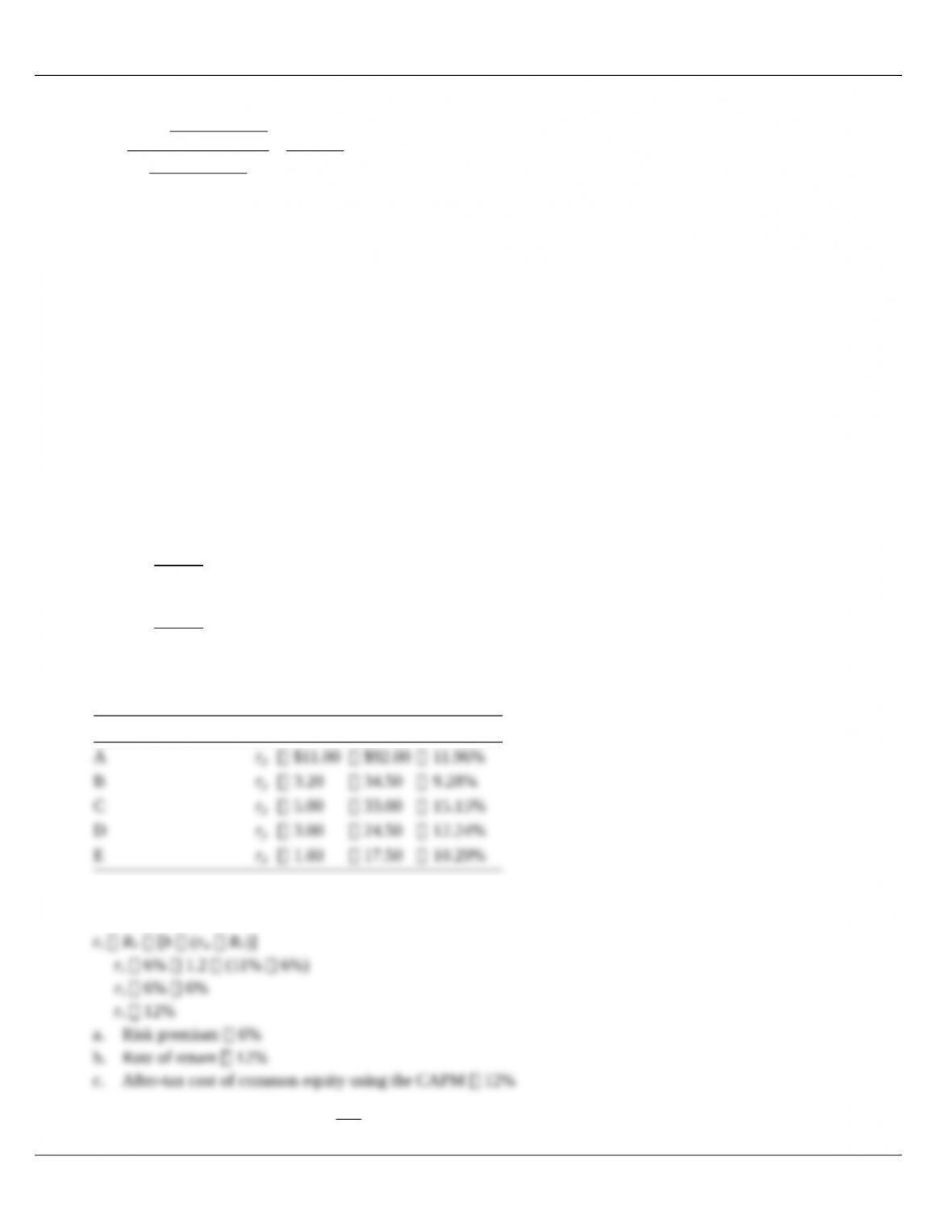
Answers to Review Questions
1.The cost of capital represents the firm’s cost of financing in percentage terms. A firm’s cost of capital is the expected
average future cost of funds over the long run. It is the rate of return a firm must earn on its investment in order to
maintain the market value of its stock.
2.The cost of capital provides a benchmark against which the potential rate of return on an investment is compared. Financial
managers should only invest in projects that are expected to provide a rate of return in excess of the cost of capital.
3.Capital structure consists of long-term sources of financing, coming from bondholders and stockholders. The cost of each
source of financing is weighted by the proportion of long-term funds that come from that source of financing. The
long-run average amount of financing from each of these sources represents the target capital structure. When the cost of
4.The four basic long-term sources of capital available to firms are long-term debt, preferred stock, common stock, and
retained earnings. Common stock refers to the amount obtained by the firm through the issuance of shares, either in an
initial public offering or subsequent stock sale.
© 2015 Pearson Education, Inc.
2 Gitman/Zutter Principles of Managerial Finance, Brief, Seventh Edition
5.The net proceeds from the sale of a bond are the funds received from its sale after all underwriting and brokerage fees have
been paid. A bond sells at a discount when the rate of interest currently paid on similar–risk bonds is above the bond’s
6.The three approaches to finding the before-tax cost of debt are the following:
c. The approximation approach uses the following formula to approximate the before-tax cost of the debt.
[($1,000 )]
( $1,000)
2
d
d
d
N
In
rN
–
+
=+
where: Ithe annual interest payment in dollars
7.The before-tax cost is converted to an after-tax debt cost (ri) by using the following equation:
ri rd (1 T), where T is the firm’s tax rate.
9.The cost of preferred stock is found by dividing the annual preferred stock dividend by the net proceeds from the sale of
10. The assumptions underlying the constant-growth valuation (Gordon) model are:
11.The CAPM technique directly considers a firm’s risk, through the inclusion of “beta,” in determining the required rate of
12. The cost of retained earnings is technically less than the cost of new common stock because by using retained earnings
13. The weighted average cost of capital (WACC), ra, is an average of the firm’s cost of long-term financing. It is calculated
Chapter 3: Financial Statements and Ratio Analysis 3
14. The weighted average cost of capital (WACC), ra, is highly dependent upon the firm’s target capital structure. As the
proportion of financing arising from a specific source rises, the importance of the cost of that source of financing rises
15. Using target capital structure weights, a firm is trying to develop a capital structure that is optimal for the future, given
present investor attitudes toward financial risk. Target capital structure weights are most often based on desired changes
Suggested Answer to Focus on Practice Box: Uncertain Times Make for an
Uncertain Weighted Average Cost of Capital
Why don’t firms generally use both short- and long-run weighted average costs of capital?
Firms maximize shareholder wealth through investment in fixed assets. Capital budgeting is the process of evaluating and
Short-term borrowing is frequently cheaper than long-term sources of funding because the short-term lender knows that the
long-term sources of capital back up the loan. This box reports that Caraustar uses both a short-term and long-term cost of
Another reason most companies do not operate with a short-term and long-term cost of capital is that debt is only a fraction
(and in many companies a small fraction) of the financing. Also, to be accurate, one would have to consider the fact that
Answers to Warm-Up Exercises
E9-1. Weighted average cost of capital
E9-2. Cost of preferred stock
E9-3. Cost of common stock equity
© 2015 Pearson Education, Inc.
4 Gitman/Zutter Principles of Managerial Finance, Brief, Seventh Edition
E9-4. Weighted average cost of capital
E9-5. Weighted average cost of capital
Solutions to Problems
P9-1. Concept of cost of capital
LG 1; Basic
a. Project North is expected to earn an 8% return. If the analyst expects the cost of debt to be 7%, he will probably
b. Project South is expected to earn 15%, but if the analyst believes that it will be financed with equity that costs
c. These decisions may not be in the best interest of a firm’s investors because the firm uses a blend of debt and
f. When the analysts focus on a single source of financing rather than the blend that the firm actually uses, then
P9-2. Cost of debt using both methods
LG 3; Intermediate
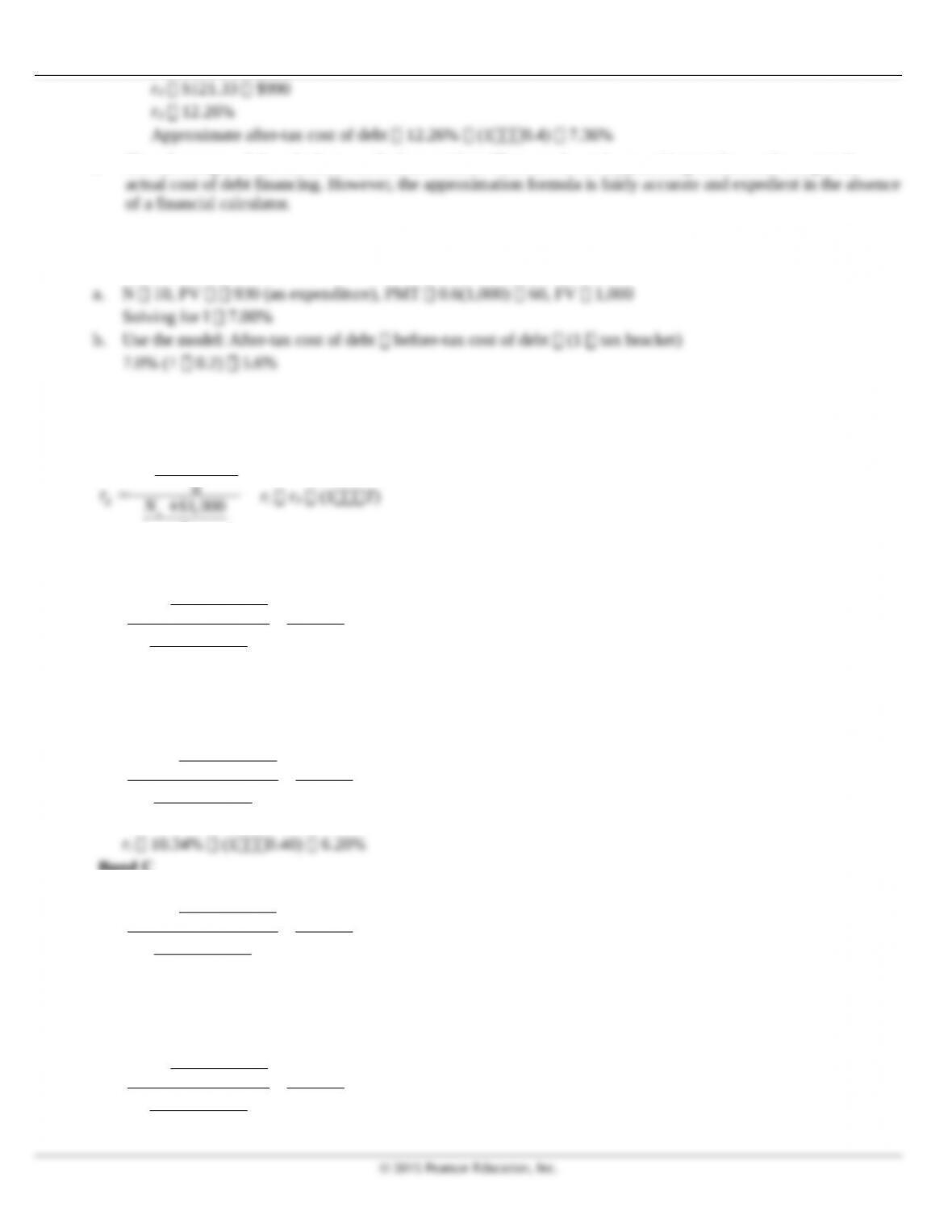
b. Cash flows: T CF
c. Cost to maturity:
d. Approximate before-tax cost of debt
($1,000 $980)
$120 15
($980 $1,000)
2
dr
–
+
=+
Chapter 3: Financial Statements and Ratio Analysis 5
e. The advantages of the calculator method are evident. There are fewer keypunching strokes, and one gets the
P9-3. Before-tax cost of debt and after-tax cost of debt
LG 3; Easy
P9-4. Cost of debt using the approximation formula:
LG 3; Basic
$1,000
$1,000
2
d
d
N
In
–
+
Bond A
$1,000 $955
$90 $92.25
20 9.44%
$955 $1,000 $977.50
2
d
r
–
+
= = =
+
ri 9.44% (10.40) 5.66%
Bond B
$1,000 $970
$100 $101.88
16 10.34%
$970 $1,000 $985
2
d
r
–
+
= = =
+
Bond C
$1,000 $955
$120 $123
15 12.58%
$955 $1,000 $977.50
2
d
r
–
+
= = =
+
ri 12.58% (10.40) 7.55%
Bond D
$1,000 $985
$90 $90.60
25 9.13%
$985 $1,000 $992.50
2
d
r
–
+
= = =
+

6 Gitman/Zutter Principles of Managerial Finance, Brief, Seventh Edition
ri 9.13% (10.40) 5.48%
Bond E
$1,000 $920
$110 $113.64
22 11.84%
$920 $1,000 $960
2
d
r
–
+
= = =
+
ri 11.84% (10.40) 7.10%
P9-5. Cost of debt
LG 3; Intermediate
$1,000
$1,000
2
d
d
d
N
In
rN
–
+
=+
ri rd (1T)
Alternative A
$1,000 $1,220
$90 $76.25
16 6.87%
$1,220 $1,000 $1,110
2
d
r
–
+
= = =
+
ri 6.87% (10.40) 4.12%
Calculator: N 16, PV $1,220, PMT $90, FV $1,000
Solve for I: 6.71%
After-tax cost of debt: 4.03%
Alternative B
$1,000 $1,020
$70 $66.00
56.53%
$1,020 $1,000 $1,010
2
d
r
–
+
= = =
+
ri 6.53% (10.40) 3.92%
Calculator: N 5, PV $1,020, PMT $70, FV $1,000
Solve for I: 6.52%
After-tax cost of debt: 3.91%
Alternative C
$1,000 $970
$60 $64.29
76.53%
$970 $1,000 $985
2
d
r
–
+
= = =
+
ri 6.53% (10.40) 3.92%
Calculator: N 7, PV $970, PMT $60, FV $1,000
Solve for I: 6.55%
After-tax cost of debt: 3.93%
© 2015 Pearson Education, Inc.
Chapter 3: Financial Statements and Ratio Analysis 7
Alternative D
$1,000 $895
$50 $60.50
10 6.39%
$895 $1,000 $947.50
2
d
r
–
+
= = =
+
ri 6.39% (10.40) 3.83%
Calculator: N 10, PV $895, PMT $50, FV $1,000
Solve for I: 6.46%
After-tax cost of debt: 3.87%
P9-6. After-tax cost of debt
LG 3; Intermediate
a. The after-tax cost of borrowing from the motorcycle dealer is the same as the pretax cost, 5%.
b. The after-tax cost of taking out the second mortgage is 6% × (1 – 25%) = 4.5%.
c. The mortgage loan would cost less after taxes compared to the loan from the dealer.
d. If Bella takes out a loan on her home that she cannot repay, she may risk losing her home. If she cannot repay the
motorcycle loan, the lender may not have a claim against Bella’s home and may only be able to retake possession
of the motorcycle.
P9-7. Cost of preferred stock: rp Dp Np
LG 2; Basic
a.
$12.00 12.63%
$95.00
p
r= =
b.
$10.00 11.11%
$90.00
p
r= =
P9-8. Cost of preferred stock: rp Dp Np
LG 4; Basic
Preferred Stock Calculation
P9-9. Cost of common stock equity—capital asset pricing model (CAPM)
LG 5; Intermediate
P9-10. Cost of common stock equity:
1
n
D g
nN
k+
=
© 2015 Pearson Education, Inc.

8 Gitman/Zutter Principles of Managerial Finance, Brief, Seventh Edition
LG 5; Intermediate
a. N 4 (2015 2011), PV (initial value) $2.12, FV (terminal value) $3.10
c. rr (Next Dividend Current Price) growth rate
d. rr ($3.40 $52) 0.0997
© 2015 Pearson Education, Inc.