Chapter 7: Stock Valuation 123
P7-13. Personal finance: Common stock value—variable growth
LG 4; Challenge
P0
0 1
1
(1 )
(1 )
Nt
t
ts
D g
r
=
´ +
+
å
1
2
1
(1 ) ( )
N
N
s s
D
r r g
+
´
+ –
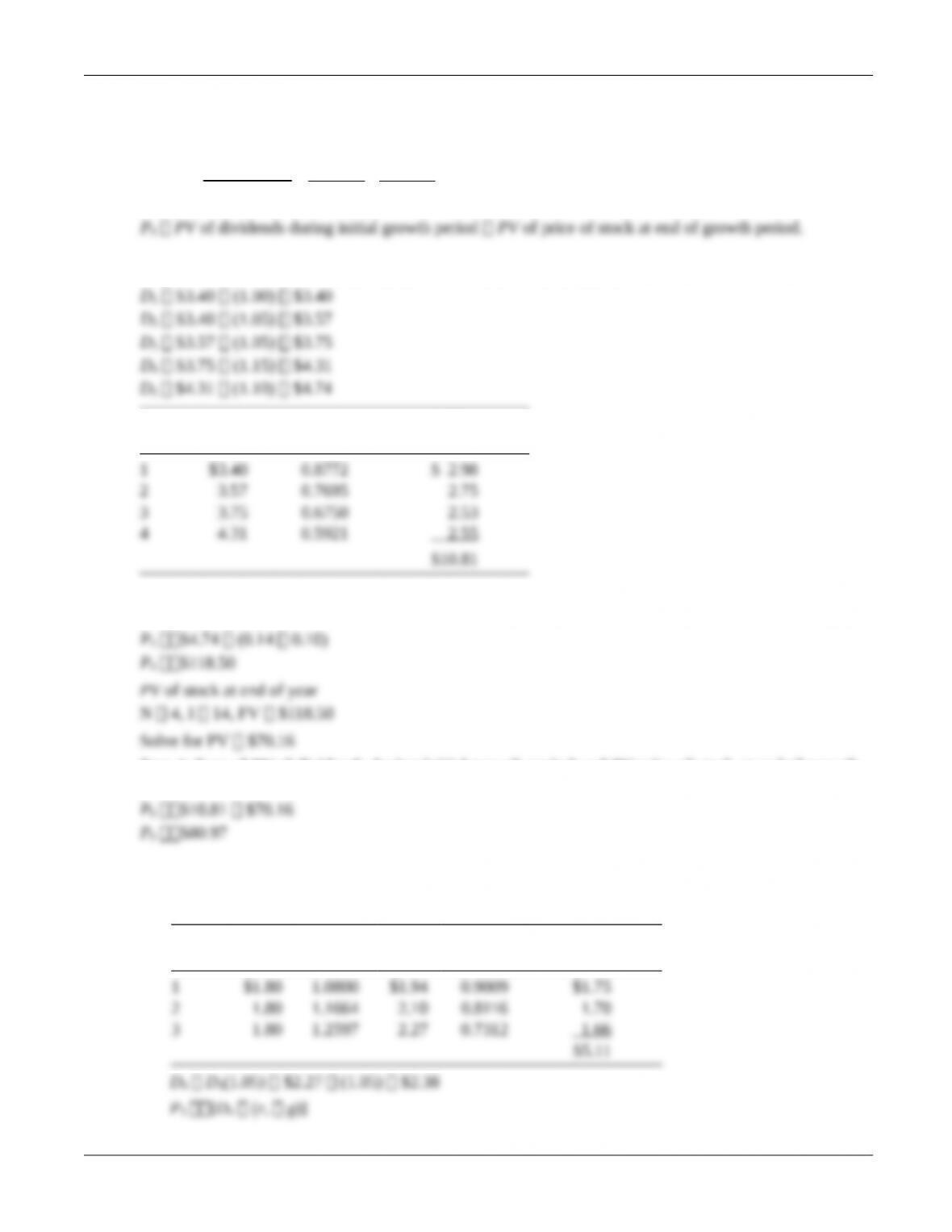
Steps 1 and 2: Value of cash dividends and PV of annual dividends
t Dt1/(1.14)t
PV
of Dividends
Step 3: PV of price of stock at end of initial growth period
P4 [D5 (rs g)]
Step 4: Sum of PV of dividends during initial growth period and PV price of stock at end of growth
period
P7-14. Common stock value—variable growth
LG 4; Challenge
a.
t D01.08tDt1/(1.11)t
PV
of Dividends
© 2015 Pearson Education, Inc.
124 Gitman/Zutter Principles of Managerial Finance, Brief, Seventh Edition
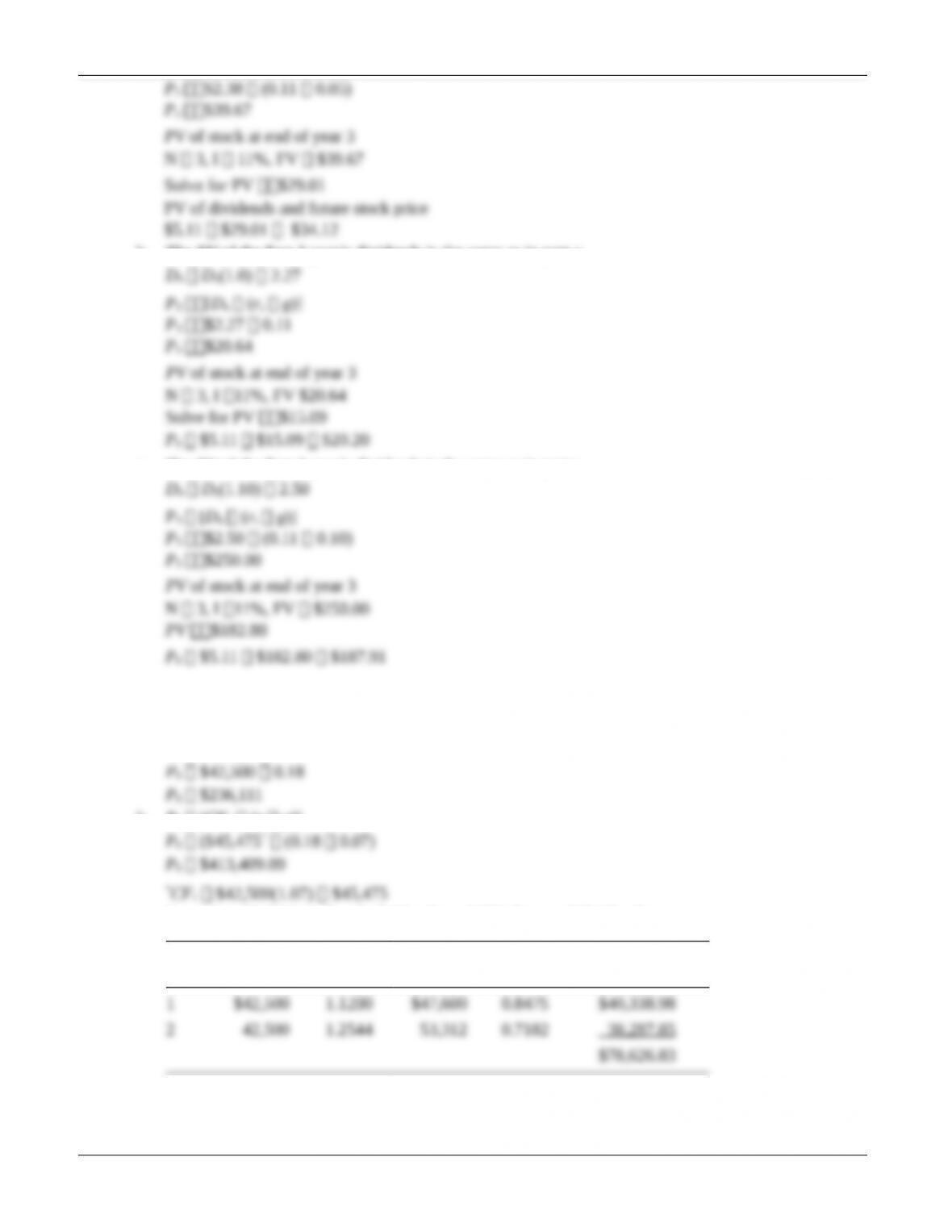
b. The PV of the first 3 year’s dividends is the same as in part a.
c. The PV of the first 3 year’s dividends is the same as in part a.
P7-15. Personal finance: Common stock value—all growth models
LG 4; Challenge
a. P0 (CF0 r)
b. P0 (CF1 (r g))
c. Steps 1 and 2: Value of cash dividends and PV of annual dividends
t D01.12tDt1/(1.18)t
PV
of Dividends
© 2015 Pearson Education, Inc.
Chapter 7: Stock Valuation 125
Step 3: PV of price of stock at end of initial growth period
Step 4: Sum of PV of dividends during initial growth period and PV price of stock at end of growth
period
P7-16. Free cash flow (FCF) valuation
LG 5; Challenge
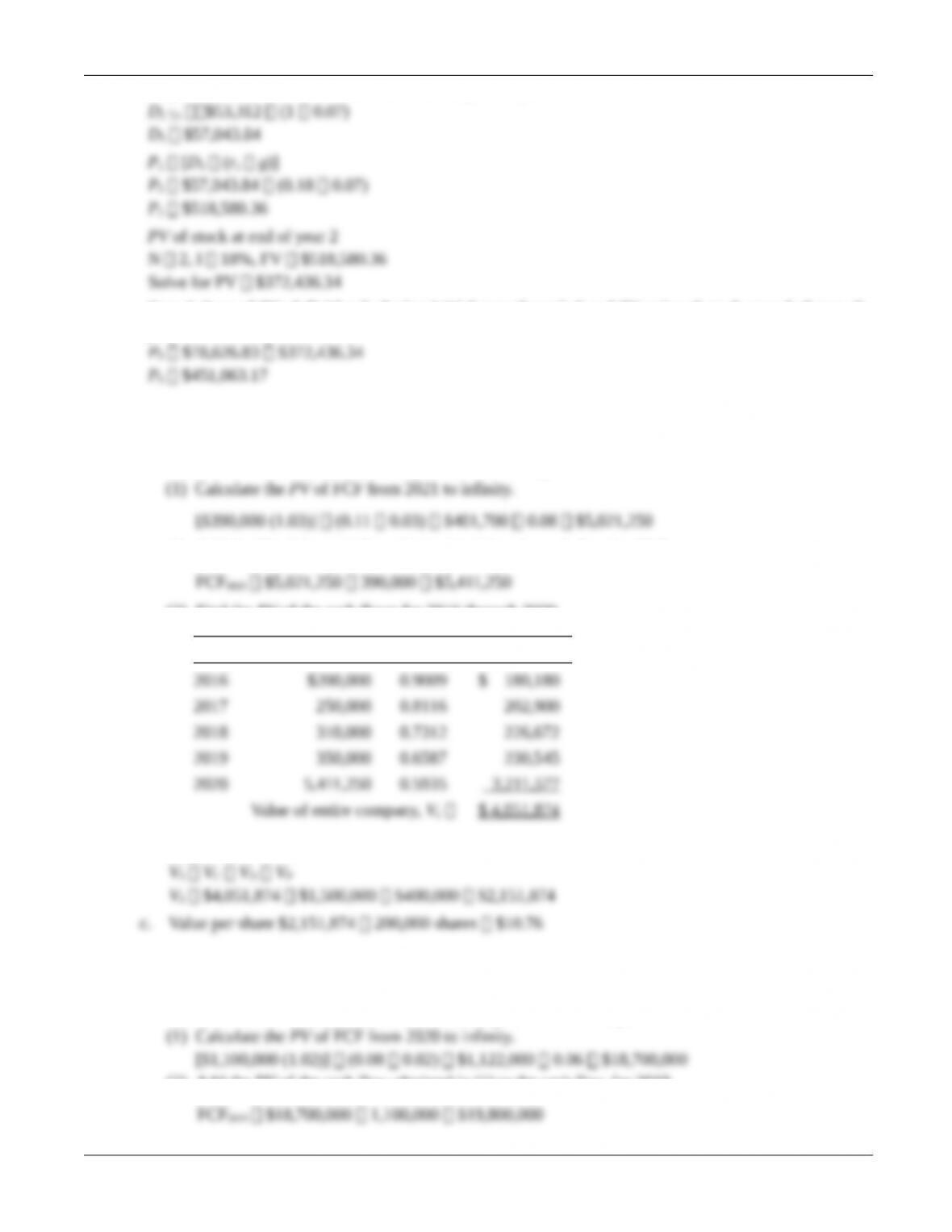
a. The value of the total firm is accomplished in three steps.
(2) Add the PV of the cash flow obtained in (1) to the cash flow for 2020.
(3) Find the PV of the cash flows for 2016 through 2020.
Year FCF 1/(1.11)tPV
b. Calculate the value of the common stock.
P7-17. Personal finance: Using the free cash flow valuation model to price an IPO
LG 5; Challenge
a. The value of the firm’s common stock is accomplished in four steps.
(2) Add the PV of the cash flow obtained in (1) to the cash flow for 2019.
© 2015 Pearson Education, Inc.
126 Gitman/Zutter Principles of Managerial Finance, Brief, Seventh Edition
(3) Find the PV of the cash flows for 2016 through 2019.
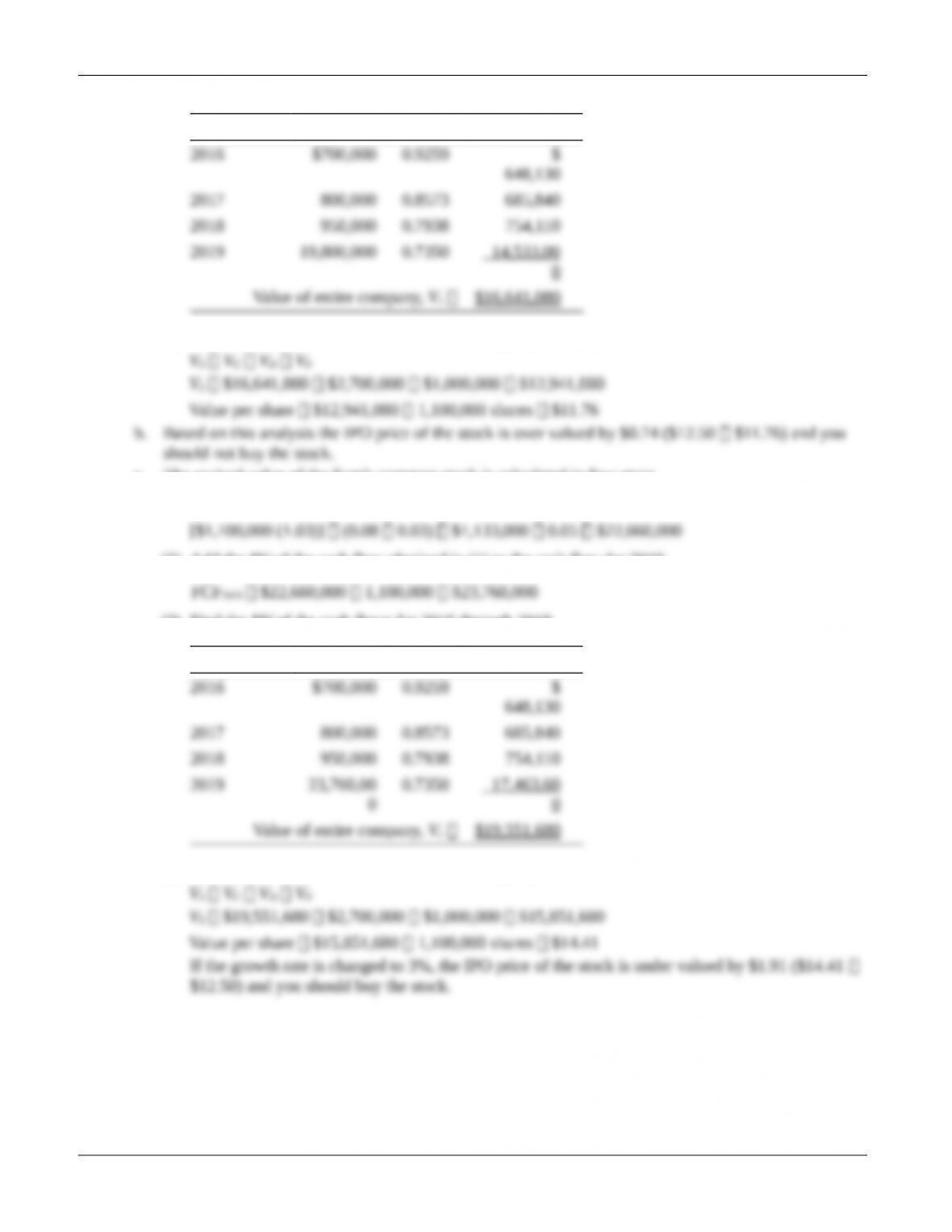
Year FCF 1/(1.08)tPV
(4) Calculate the value of the common stock using Equation 7.8.
c. The revised value of the firm’s common stock is calculated in four steps.
(1) Calculate the PV of FCF from 2020 to infinity.
(2) Add the PV of the cash flow obtained in (1) to the cash flow for 2019.
(3) Find the PV of the cash flows for 2016 through 2019.
Year FCF 1/(1.08)tPV
(4) Calculate the value of the common stock using Equation 7.8.
© 2015 Pearson Education, Inc.
Chapter 7: Stock Valuation 127
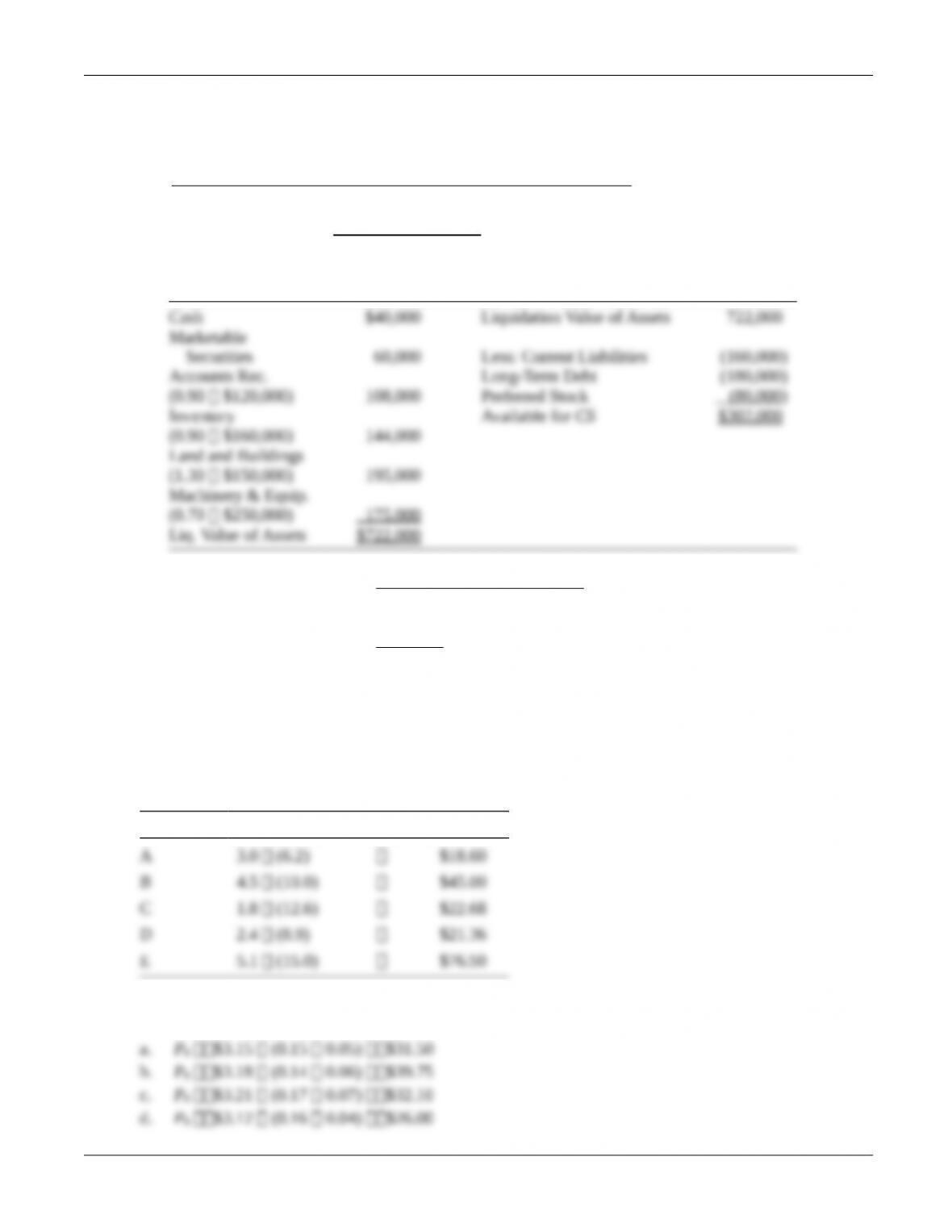
P7-18. Book and liquidation value
LG 5; Intermediate
a. Book value per share:
Book value of assets (liabilities + preferred stock at book value)
number of shares outstanding
–
$780,000 $420,000
Book value per share $36 per share
10,000
–
= =
b. Liquidation value:
Liquidation value of assets
Liquidation value per share Number of shares outstanding
=
$302,000
Liquidation value per share $30.20 per share
10,000
= =
c. Liquidation value is below book value per share and represents the minimum value for
the firm. It is possible for liquidation value to be greater than book value if assets are undervalued.
Generally, they are overvalued on a book value basis, as is the case here.
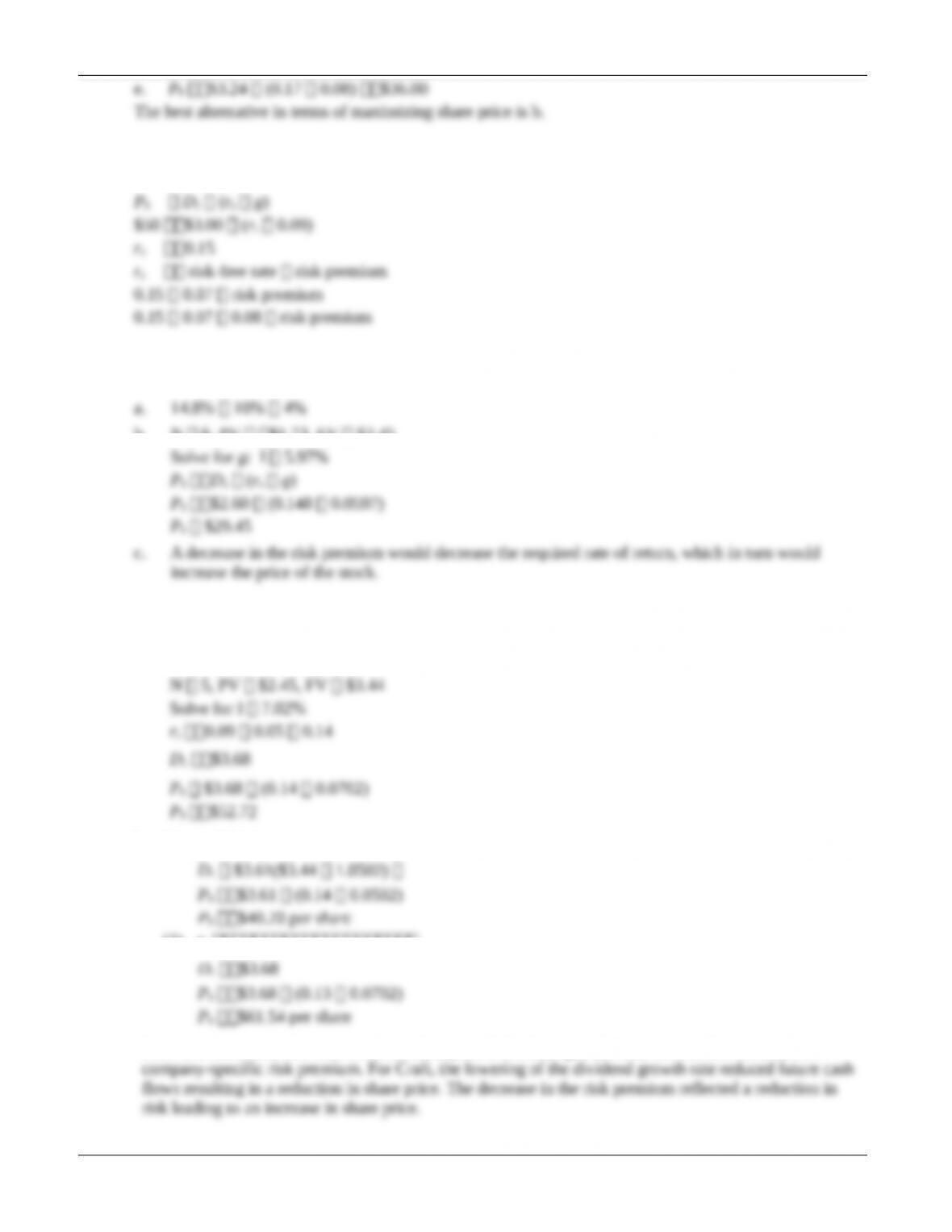
P7-19. Valuation with price/earnings multiples
LG 5; Basic
Firm EPS P/EStock Price
P7-20. Management action and stock value
LG 6; Intermediate
© 2015 Pearson Education, Inc.
128 Gitman/Zutter Principles of Managerial Finance, Brief, Seventh Edition
P7-21. Integrative—risk and valuation and CAPM formulas
LG 4, 6; Intermediate
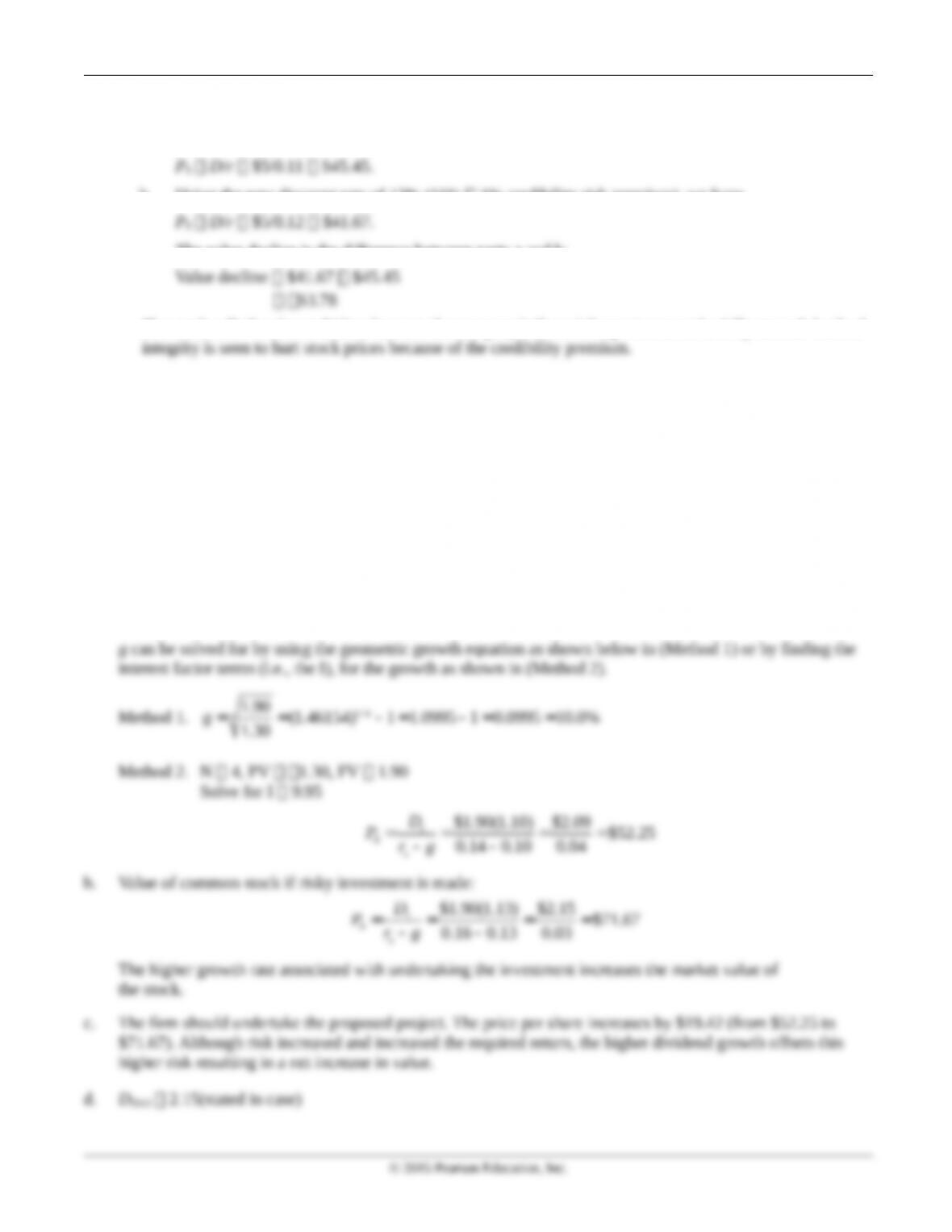
P7-22. Integrative—risk and valuation
LG 4, 6; Challenge
b. N 6, PV $1.73, FV $2.45
P7-23. Integrative—risk and valuation
LG 4, 6; Challenge
a. Estimate growth rate:
b. (1) rs 0.14
(2) rs
Price is a function of the current dividend, expected dividend growth rate, the risk-free rate, and the
© 2015 Pearson Education, Inc.
Chapter 7: Stock Valuation 129
P7-24. Ethics problem
LG 4; Intermediate
a. This is a zero-growth dividend valuation problem, so
b. Using the new discount rate of 12% (11% 1% credibility risk premium), we have
The value decline is the difference between parts a and b:
The stock sells for almost $4 less because the company’s financial reports cannot be fully trusted. Lack of
Case
Case studies are available on www.myfinancelab.com.
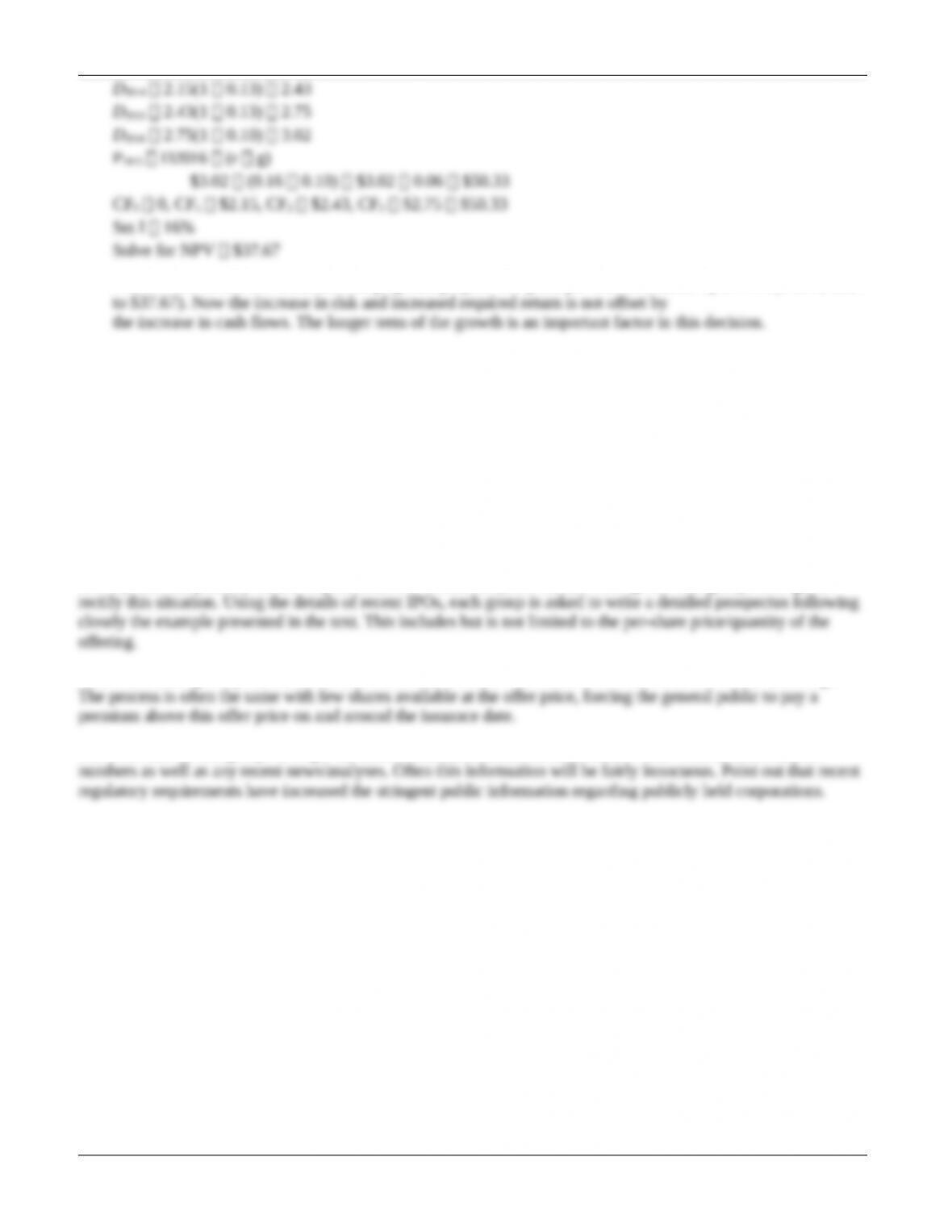
Assessing the Impact of Suarez Manufacturing’s Proposed Risky Investment on Its
Stock Value
This case demonstrates how a risky investment can affect a firm’s value. First, students must calculate the current
value of Suarez’s stock, rework the calculations assuming that the firm makes the risky investment, and then draw
some conclusions about the value of the firm in this situation. In addition to gaining experience in valuation of
stock, students will see the relationship between risk and valuation.
a. Current per-share value of common stock growth rate of dividends:
130 Gitman/Zutter Principles of Managerial Finance, Brief, Seventh Edition
No, the firm should not undertake the proposed project. The price per share decreases by $14.58 (from $52.25
Spreadsheet Exercise
The answer to Chapter 7’s Azure Corporation spreadsheet problem is located on the Instructor’s Resource Center
at www.pearsonhighered.com/irc under the Instructor’s Manual.
Group Exercise
Group exercises are available on www.myfinancelab.com.
This chapter’s exercise takes the groups back to the future. The semester began with the fictitious firms having
recently become publicly traded corporations. Out of necessity, few details were given. The groups now get to
Students should quickly realize the similarities of the various IPOs. Most are offered within the $10–$30 range.
The final task for the groups is to get the most recent information on their shadow firm. This includes market
© 2015 Pearson Education, Inc.