Chapter 7
Stock Valuation
Instructor’s Resources
Overview
This chapter continues on the valuation process introduced in Chapter 6 for bonds. Models for valuing preferred
and common stock are presented. For common stock, the zero growth, constant growth, and variable growth
models are examined. The relationship between stock valuation and efficient markets is presented. The role of
venture capitalists and investment bankers is also discussed. The free cash flow model is explained and compared
with the dividend discount models. Other approaches to common stock valuation and their shortcomings are
explained. The chapter ends with a discussion of the interrelationship between financial decisions, expected return,
risk, and a firm’s value. Stock valuation from the perspective of one’s professional life is contrasted with stock
valuation from a personal perspective.
Answers to Review Questions
1.Equity capital is permanent capital representing ownership, while debt capital represents a loan that must be
repaid at some future date. The holders of equity capital receive a claim on the income and assets of the firm
that is secondary to the claims of the firm’s creditors. Suppliers of debt must receive all interest owed prior to
2.Common stockholders are the true owners of the firm because they invest in the firm only upon the expectation
of future returns. They are not guaranteed any return, but merely get what is left over after all the other claims
3.Rights offerings protect against dilution of ownership by allowing existing stockholders to purchase additional
shares of any new stock issues. Without this protection current shareholders may have their voting power
4.Authorized shares are stated in a company’s corporate charter that specifies the maximum number of shares
When authorized shares are sold to the public and are in the hands of the public, they are called
© 2015 Pearson Education, Inc.
2 Gitman/Zutter Principles of Managerial Finance, Brief, Seventh Edition
When a firm purchases back its own shares from the public, they are classified as treasury stock. Treasury
Issued shares are the shares of common stock that have been put into circulation. Issued shares include
5.Issuing stock outside of their home markets can benefit corporations by broadening the investor base and also
allowing them to become better integrated into the local business scene. A local stock listing both increases
American depository receipts (ADRs) represent ownership of shares of a foreign company’s stock held on
deposit by the U.S. bank in the company’s home country. ADRs are issued in dollars by an American bank to
6.Preferred stockholders have a fixed claim on a firm’s income that takes precedence over the claim of common
stockholders.
7.Cumulative preferred stock gives the holder the right to receive any dividends in arrears prior to the payment of
dividends to common stockholders.
The call feature in a preferred stock issue allows the issuer to retire outstanding preferred stock within a
8.Venture capitalists (VC) are typically business entities that are organized for the purpose of investing in
attractive growth companies. Angel capitalists are generally wealthy individuals who provide private
9.Institutional venture capitalists are most commonly organized in one of four ways.
Small business investment companies (SBICs) are corporations chartered by the federal government.
VC investments are made under a legal contract that clearly allocates responsibilities and ownership interest
10. The general steps that a private firm must go through to go public via an IPO are listed below.
The firm must obtain the approval of its current shareholders.
© 2015 Pearson Education, Inc.
Chapter 3: Financial Statements and Ratio Analysis 3
11.The investment banker’s (IB) main activity is to underwrite the issue. In addition to underwriting, the IB
provides the issuer with advice about pricing and other important aspects of the issue.
12. The efficient market hypothesis says that in an efficient market, investors would buy an asset if the expected
13. According to the efficient market hypothesis:
b. Securities prices fully reflect all public information available and will react quickly to new
information; and
14. a. The zero growth model of common stock valuation assumes a constant, nongrowing dividend stream. The
4 Gitman/Zutter Principles of Managerial Finance, Brief, Seventh Edition
16. a. Book value is the value of the stock in the event all assets are liquidated for their book value and the
proceeds remaining after paying all liabilities are divided among the common stockholders.
Both the book value and liquidation value approaches ignore the earning power of a firm’s assets and lack a
relationship to the firm’s value in the marketplace. The price/earnings multiples approach is considered the
17. A decision or action by the financial manager can have an effect on the risk and expected return of the stock,
18. CAPM: rs RF [bj (rm RF)] and bj 1.00:
Suggested Answer to Focus on Practice Box: Understanding Human
Behavior Helps Us Understand Investor Behavior
Theories of behavioral finance can apply to other areas of human behavior in addition to investing. Think of
a situation in which you may have demonstrated one of these behaviors. Share with a classmate.
Student answers will vary. Examples:
Answers to Warm-Up Exercises
E7-1. Using debt ratio to calculate a firm’s total liabilities
Answer:
Debt ratio total liabilities total assets= ¸
Total liabilities debt ratio total assets
0.75 $5,200,000 $3,900,000
= ´
= ´ =
© 2015 Pearson Education, Inc.
Chapter 3: Financial Statements and Ratio Analysis 5
E7-2. Determining net proceeds from the sale of stock
Answer:
Net proceeds (1,000,000 $20 0.95) (250,000 $20 0.90)
$19,000,000 $4,500,000 $23,500,000
= ´ ´ + ´ ´
= + =
E7-3. Preferred and common stock dividends
Answer: Common stock dividend (Cash available Preferred dividends) Number
of common shares
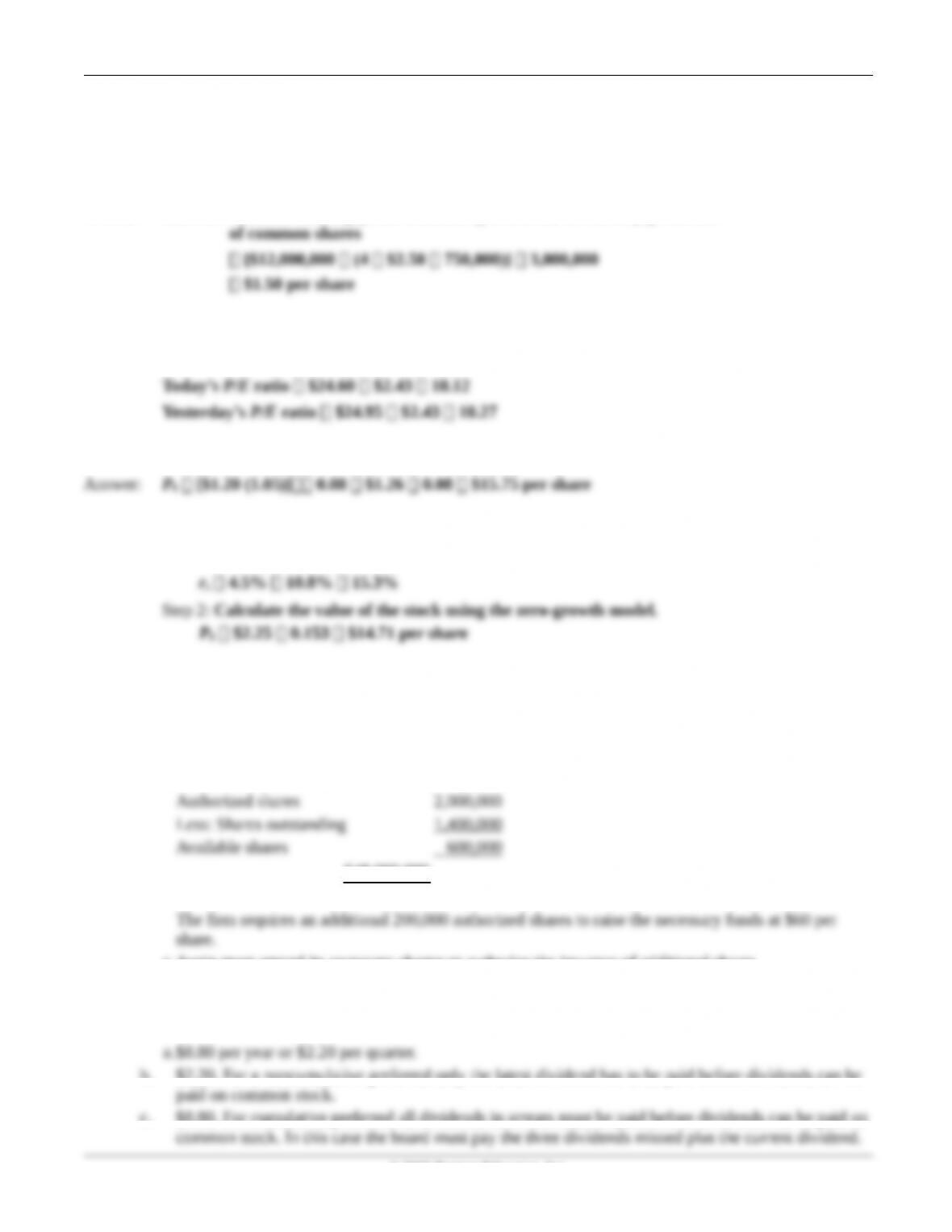
[$12,000,000 (4 $2.50 750,000)] 3,000,000
$1.50 per share
E7-4. Price/earning ratios
Answer: Earnings per share (EPS) $11,200,000 4,600,000 $2.43 per share
E7-5. Using the zero-growth model to value stock
E7-6. Capital asset pricing model
Answer: Step 1: Calculate the required rate of return.
Solutions to Problems
P7-1. Authorized and available shares
LG 2; Basic
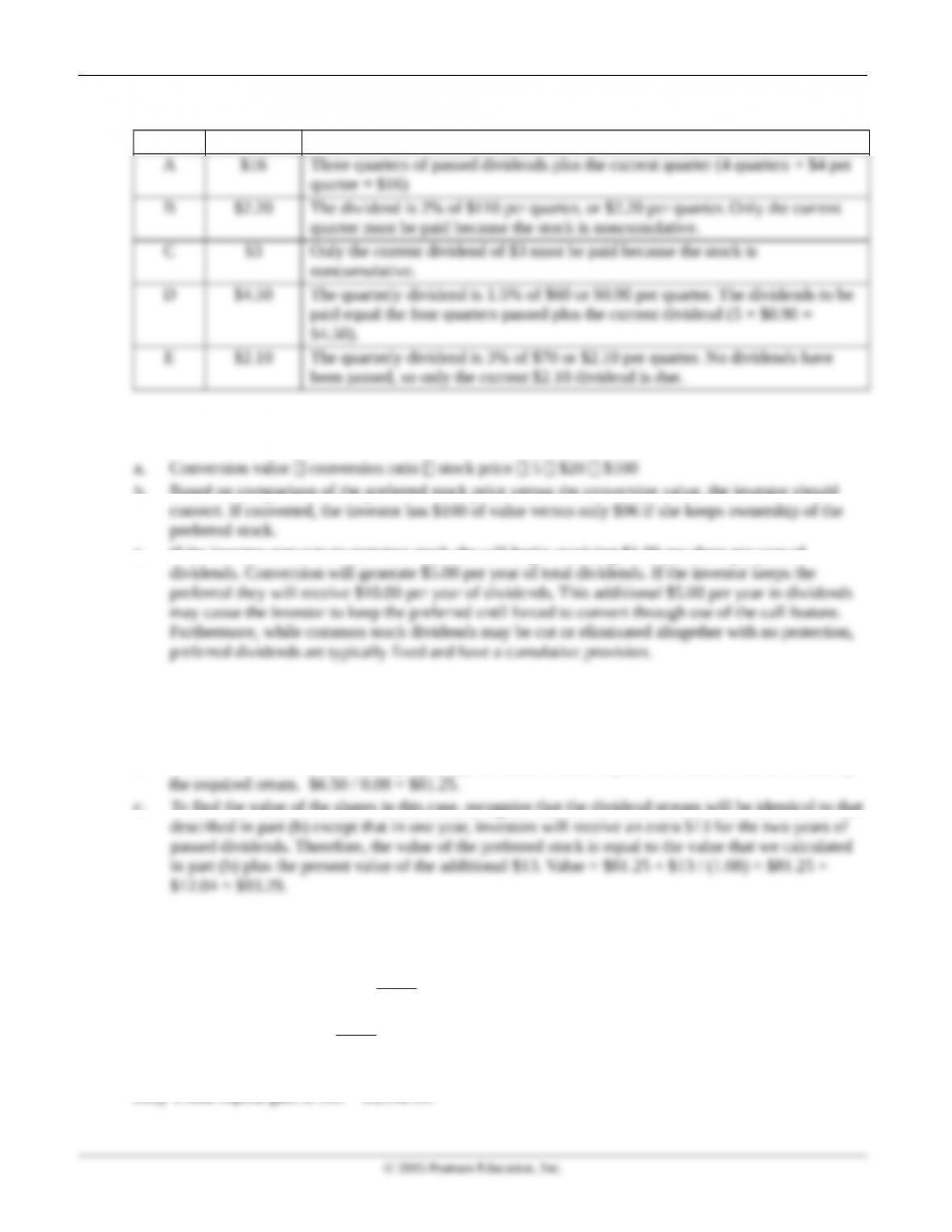
a.Maximum shares available for sale
b.
$48,000,000
Total shares needed 800,000 shares
$60
= =
c.Aspin must amend its corporate charter to authorize the issuance of additional shares.
P7-2. Preferred dividends
LG 2; Intermediate
b. $2.20. For a noncumulative preferred only the latest dividend has to be paid before dividends can be
c. $8.80. For cumulative preferred all dividends in arrears must be paid before dividends can be paid on
© 2015 Pearson Education, Inc.
6 Gitman/Zutter Principles of Managerial Finance, Brief, Seventh Edition
P7-3. Preferred dividends
LG 2; Intermediate
Case Answer Explanation
P7-4. Convertible preferred stock
LG 2; Challenge
b. Based on comparison of the preferred stock price versus the conversion value, the investor should
c. If the investor converts to common stock she will begin receiving $1.00 per share per year of
P7-5. Preferred stock valuation
LG 4; Basic
a.The annual dividend is 10% × $65 or $6.50
b. Because the dividend stream is a perpetuity, the value of stock is just the annual dividend divided by
c. To find the value of the shares in this case, recognize that the dividend stream will be identical to that
P7-6. Personal finance: common stock value—zero growth
LG 4; Intermediate
$5.00
Value of stock when purchased $31.25
0.16
$5.00
Value of stock when sold $41.67
0.12
Sally’s capital gain is $10.42 ($41.67 $31.25) per share.
Sally’s total capital gain is 100 $1,042.00.
= =
= =
–
´
Chapter 3: Financial Statements and Ratio Analysis 7
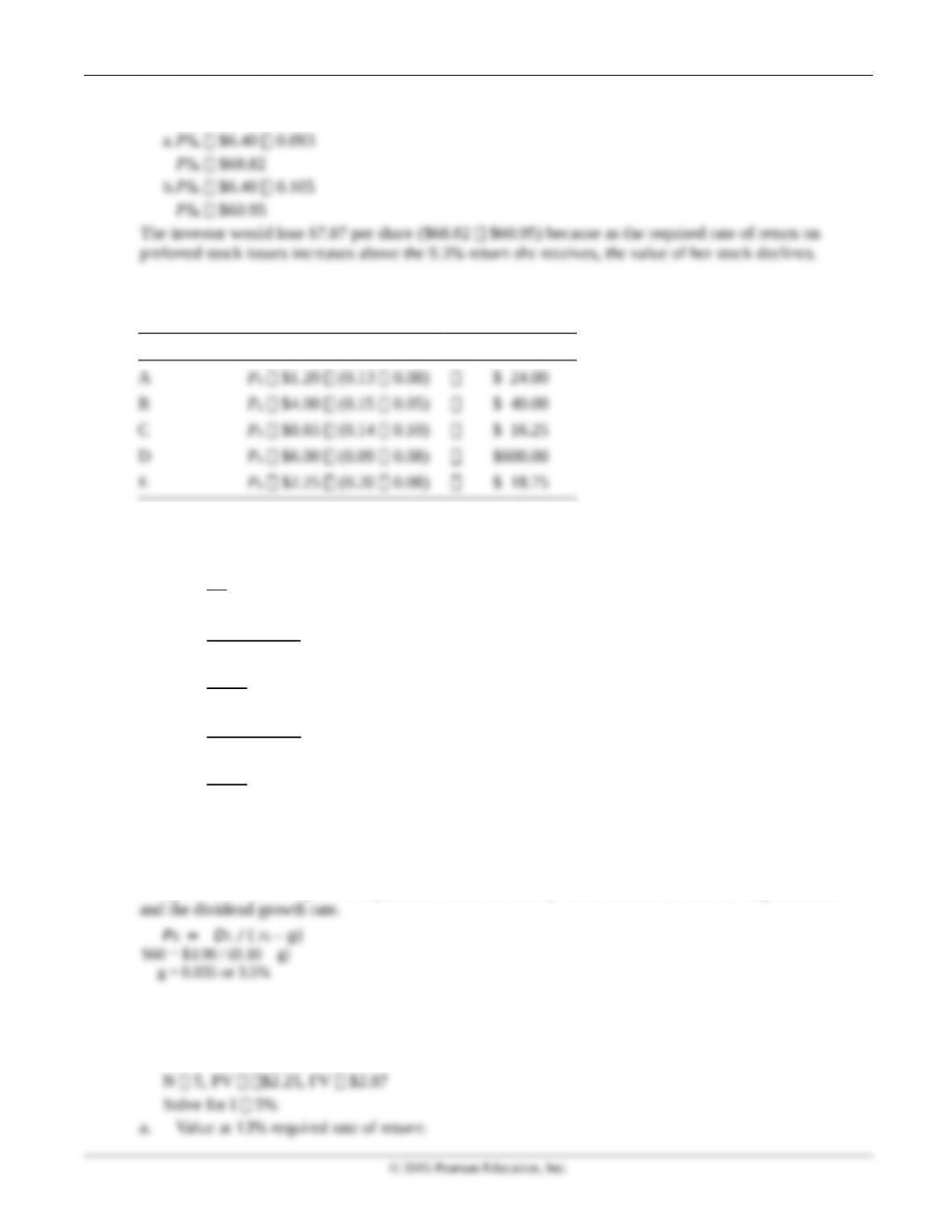
P7-7. Preferred stock valuation: PS0 Dp rp
LG 4; Intermediate
P7-8. Common stock value—constant growth: P0 D1 (rs g)
LG 4; Basic
Firm P0 D1 (rs g) Share Price
P7-9. Common stock value—constant growth
LG 4; Intermediate
a.
1
0
$1.20 (1.05) 0.05
$28
$1.26 0.05 0.045 0.05 0.095 9.5%
$28
s
s
s
D
r g
P
r
r
= +
´
= +
= + = + = =
b.
$1.20 (1.10) 0.10
$28
$1.32 0.10 0.047 0.10 0.147 14.7%
$28
s
s
r
r
´
= +
= + = + = =
P7-10. Common stock value—constant growth:
LG 4; Intermediate
The price of the stock equals next year’s dividend divided by the difference between the required return
and the dividend growth rate.
P0 = D1 / ( rs – g)
$60 = $3.90 / (0.10 – g)
g = 0.035 or 3.5%
P7-11. Personal finance: Common stock value—constant growth: P0 D1 (rs g)
LG 4; Intermediate
Computation of growth rate:
8 Gitman/Zutter Principles of Managerial Finance, Brief, Seventh Edition
0
$3.02 $37.75
0.13 0.05
P= =
–
b. Value at 10% required rate of return:
0
$3.02 $60.40
0.10 0.05
P= =
–
P7-12. Common stock value—variable growth:
LG 4; Challenge
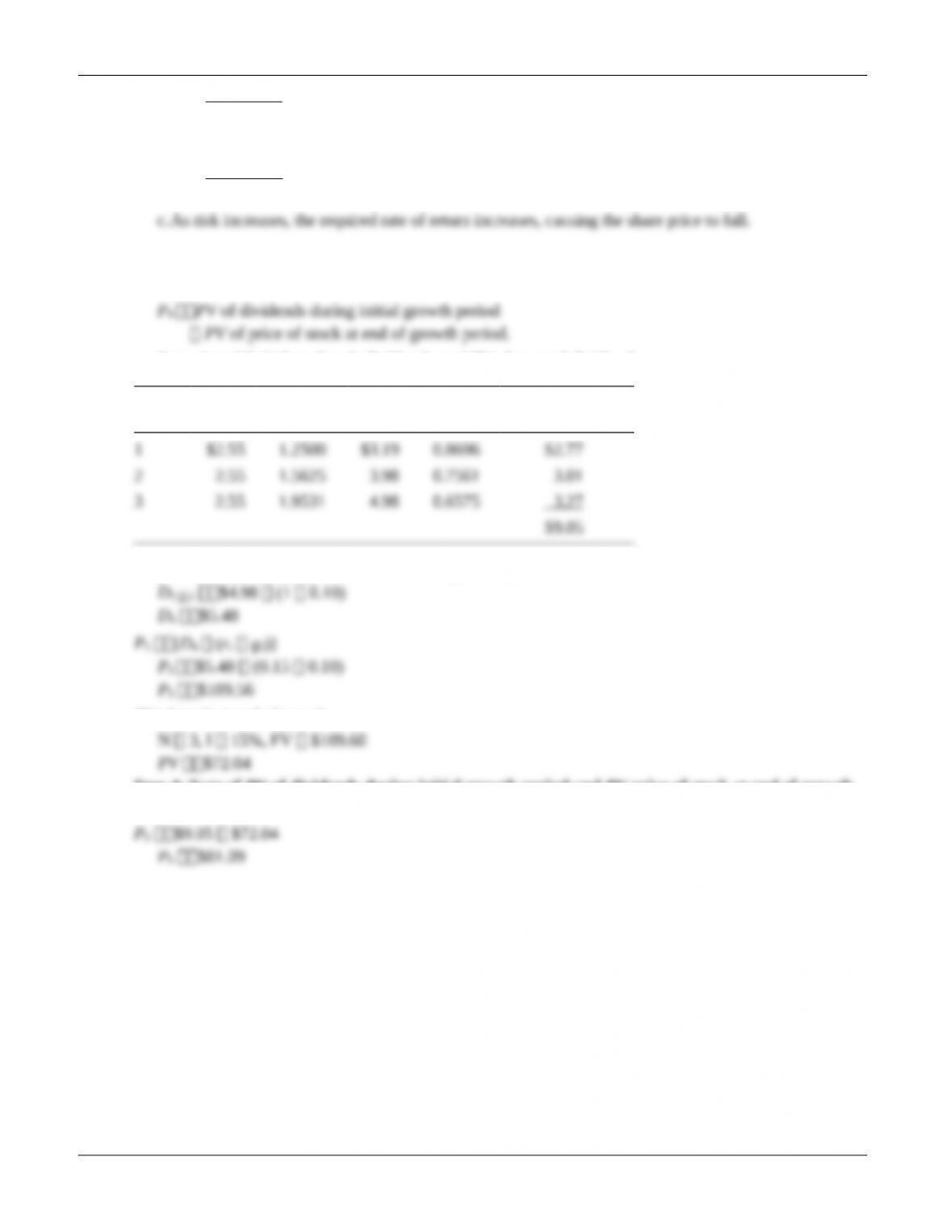
Steps 1 and 2: Value of cash dividends and PV of annual dividends
t D01.25t Dt1/(1.15)t
PV
of Dividends
Step 3: PV of price of stock at end of initial growth period
PV of stock at end of year 3
Step 4: Sum of PV of dividends during initial growth period and PV price of stock at end of growth
period
© 2015 Pearson Education, Inc.