P6-8. Risk-free rate and risk premiums
LG 1; Basic
a. Risk-free rate: RF r* IP
Security r*IP RF
c. Nominal rate: r r* IP RP
Security r*IP RP r
P6-9. Risk premiums
LG 1; Intermediate
a. RFt r* IPt
b. Risk premium:
c. ri r* IP RP or r1 rF risk premium
Security A has a higher risk-free rate of return than Security B due to expectations of higher near-term
P6-10. Bond interest payments before and after taxes
LG 2; Intermediate
c. Total before-tax interest $175,000
© 2015 Pearson Education, Inc.
2 Gitman/Zutter Principles of Managerial Finance, Brief, Seventh Edition
P6-11. Bond prices and yields
LG 4; Basic
P6-12. Personal finance: Valuation fundamentals
LG 4; Basic
a. Cash flows: CF15$1,200
b.
3 51 2 4
01 2 3 4 5
(1 ) (1 ) (1 ) (1 ) (1 )
CF CF
CF CF CF
Vr r r r r
= + + + +
+ + + + +
01 2 3 4 5
$1,200 $1,200 $1,200 $1,200 $6,200
(1 0.06) (1 0.06) (1 0.06) (1 0.06) (1 0.06)
V= + + + +
+ + + + +
0$8,791V=
Using Calculator:
N 5, I 6, PMT $1,200, FV $5,000
P6-13. Valuation of assets
LG 4; Basic
Present Value of
Asset End of Year Amount Cash Flows
C 1 0 N 5, I 16 $16,663.96
D 1–5 $ 1,500 N 6, I 12, $9,713.53
E 1 $ 2,000 Use Cash Flow $14,115.27
© 2015 Pearson Education, Inc.
Chapter 6: Interest Rates and Bond Valuation 3
Worksheet
P6-14. Personal finance: Asset valuation and risk
LG 4; Intermediate
a.
N PMT
@ 10%
Low Risk
@ 15%
Average Risk
@ 22%
High Risk
b. The maximum price Laura should pay is $13,030.92. Unable to assess the risk, Laura would use the
c. By increasing the risk of receiving cash flow from an asset, the required rate of return increases,
P6-15. Basic bond valuation
LG 5; Intermediate
a. I 10%, N 16, PMT $120, FV $1,000
b. Because Complex Systems’ bonds were issued, there may have been a shift in the supply-demand
c. I 12%, N 16, PMT $120, FV $1,000
When the required return is equal to the coupon rate, the bond value is equal to the par value. In
P6-16. Bond valuation—annual interest
LG 5; Basic
Bond Calculator Inputs Calculator Solution
$1,000
© 2015 Pearson Education, Inc.
4 Gitman/Zutter Principles of Managerial Finance, Brief, Seventh Edition
P6-17. Bond value and changing required returns
LG 5; Intermediate
a.
Bond Calculator Inputs Calculator Solution
b.
c. When the required return is less than the coupon rate, the market value is greater than the par value,
d. The required return on the bond is likely to differ from the coupon interest rate because either
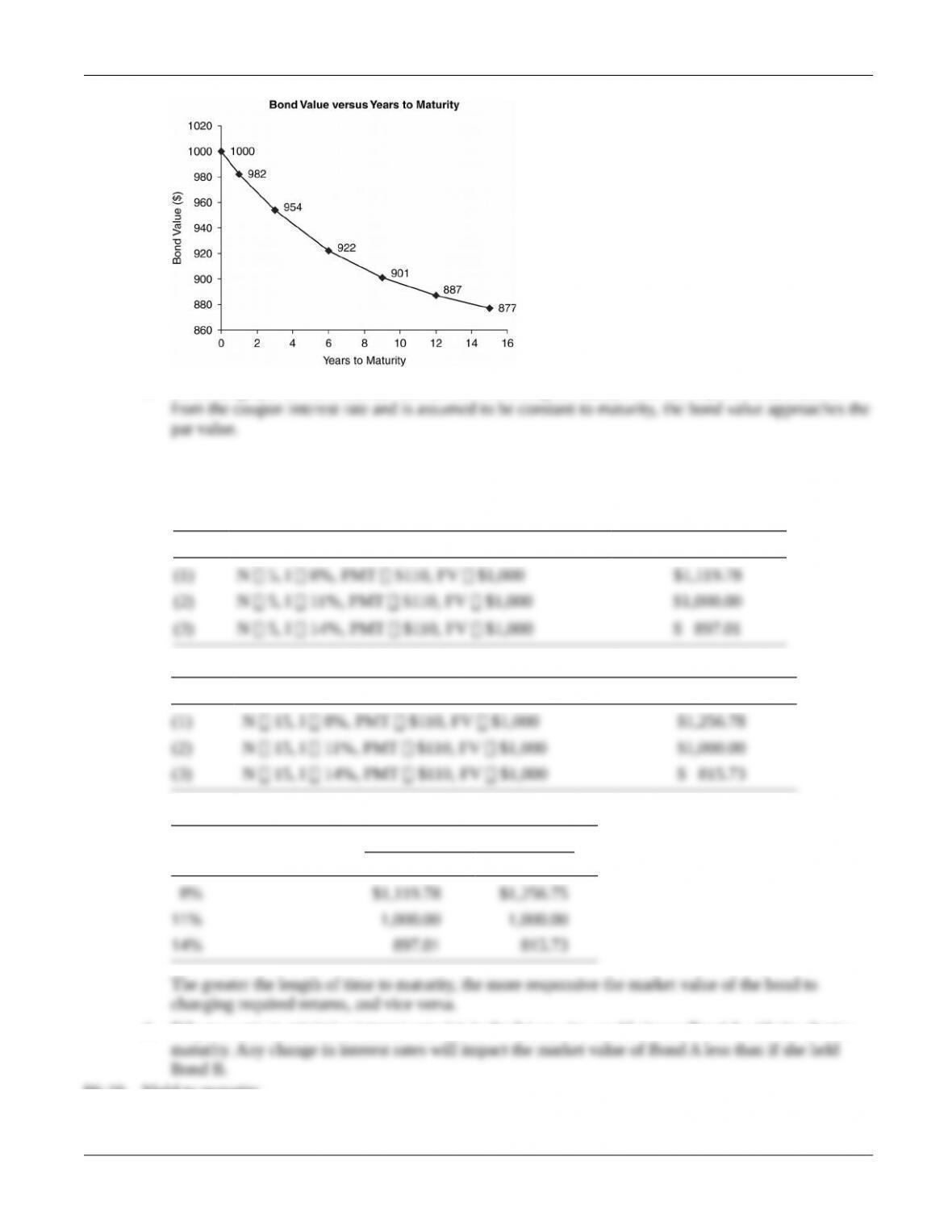
P6-18. Bond value and time—constant required returns
LG 5; Intermediate
a.
Bond Calculator Inputs Calculator Solution
© 2015 Pearson Education, Inc.
Chapter 6: Interest Rates and Bond Valuation 5
b.
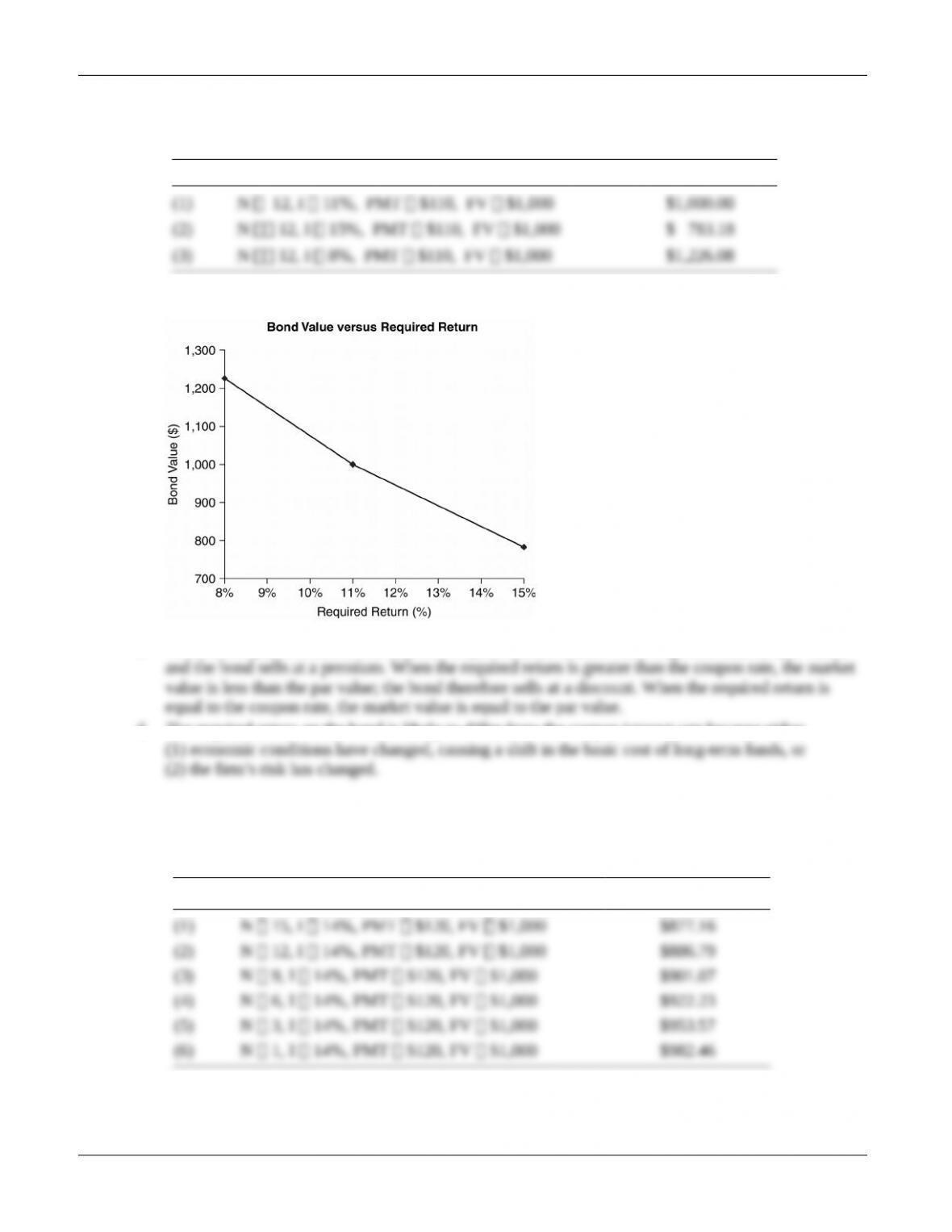
c. From the graph we can conclude that all else remaining the same, when the required return differs
P6-19. Personal finance: Bond value and time—changing required returns
LG 5; Challenge
a.
Bond Calculator Inputs Calculator Solution
b.
Bond Table Values Calculator Solution
c.
Value
Required Return Bond A Bond B
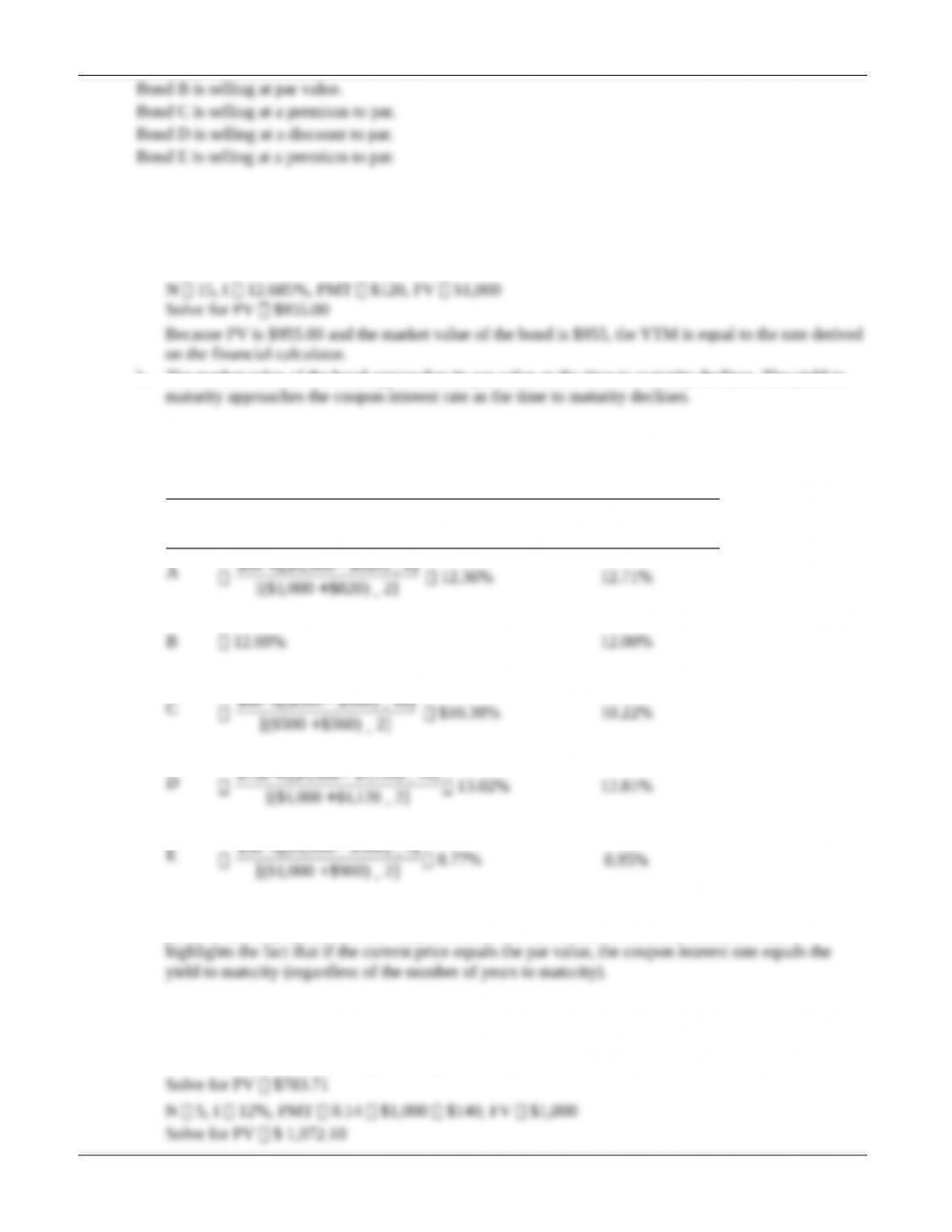
d. If Lynn wants to minimize interest rate risk in the future, she would choose Bond A with the shorter
P6-20. Yield to maturity
LG 6; Basic
Bond A is selling at a discount to par.
© 2015 Pearson Education, Inc.
6 Gitman/Zutter Principles of Managerial Finance, Brief, Seventh Edition
P6-21. Yield to maturity
LG 6; Intermediate
a. Using a financial calculator, the YTM is 12.685%. The correctness of this number is proven by putting
the YTM in the bond valuation model. This proof is as follows:
b. The market value of the bond approaches its par value as the time to maturity declines. The yield to
P6-22. LG 6: Yield to maturity
LG 6; Intermediate
a.
Calculator
Bond Approximate YTM Solution
A
$90 [($1,000 $820) 8]
+ – ¸
C
$60 [($500 $560) 12]
[($500 $560) 2]
+ – ¸
+ ¸
$10.38% 10.22%
D
$150 [($1,000 $1,120) 10]
[($1,000 $1,120 2]
+ – ¸
+ ¸
13.02% 12.81%
E
$50 [($1,000 $900) 3]
[($1,000 $900) 2]
+ – ¸
+ ¸
8.77% 8.95%
b. The market value of the bond approaches its par value as the time to maturity declines. The
yield-to-maturity approaches the coupon interest rate as the time to maturity declines. Case B
P6-23. Personal finance: Bond valuation and yield to maturity
LG 2, 5, 6; Challenge
a. N 5, I 12%, PMT 0.06 $1,000 $60; FV $1,000
© 2015 Pearson Education, Inc.
Chapter 6: Interest Rates and Bond Valuation 7
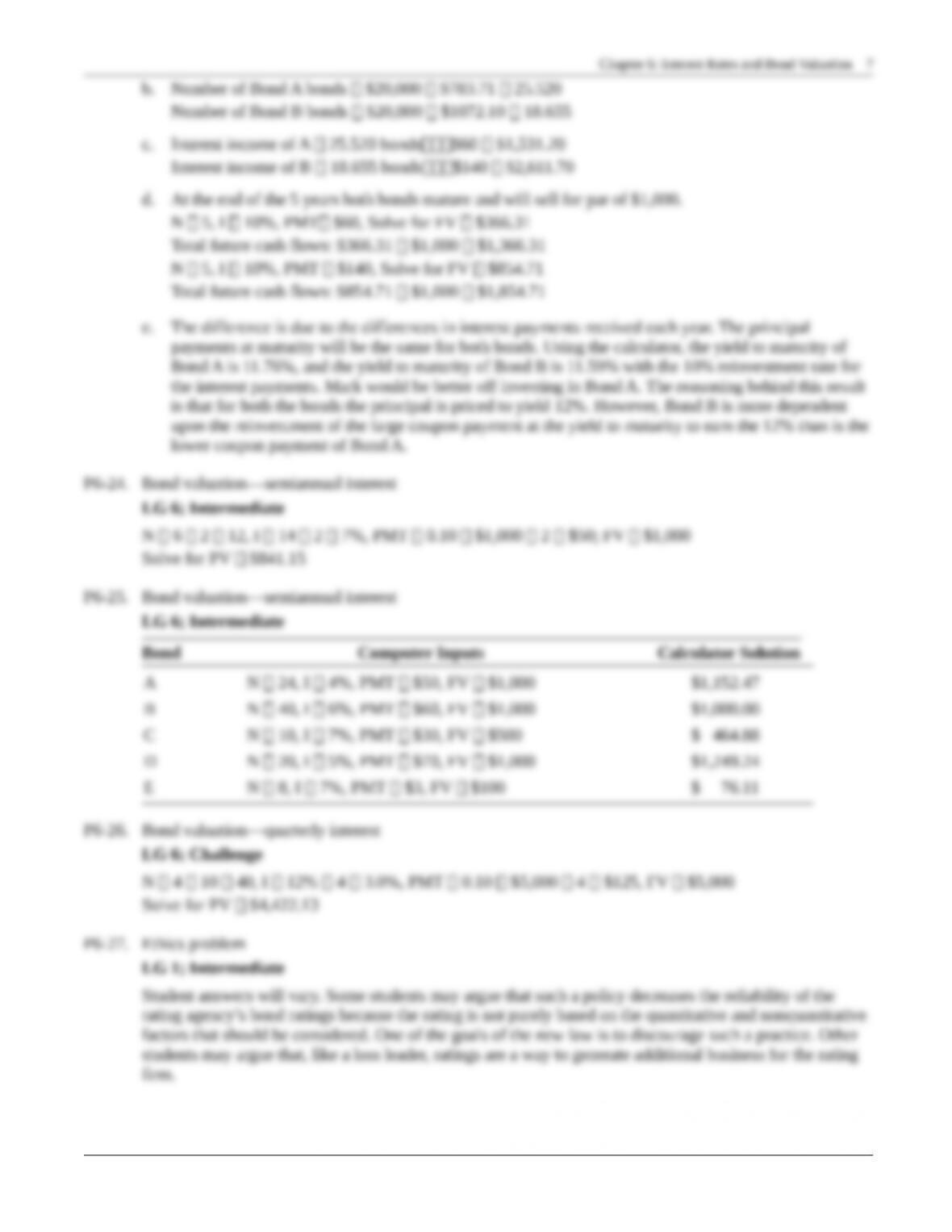
b. Number of Bond A bonds $20,000 $783.71 25.520
c. Interest income of A 25.520 bonds$60 $1,531.20
d. At the end of the 5 years both bonds mature and will sell for par of $1,000.
e. The difference is due to the differences in interest payments received each year. The principal
payments at maturity will be the same for both bonds. Using the calculator, the yield to maturity of
P6-24. Bond valuation—semiannual interest
LG 6; Intermediate
P6-25. Bond valuation—semiannual interest
LG 6; Intermediate
Bond Computer Inputs Calculator Solution
P6-26. Bond valuation—quarterly interest
LG 6; Challenge
P6-27. Ethics problem
LG 1; Intermediate
Student answers will vary. Some students may argue that such a policy decreases the reliability of the
Case
© 2015 Pearson Education, Inc.
8 Gitman/Zutter Principles of Managerial Finance, Brief, Seventh Edition
Case studies are available on www.myfinancelab.com.
Evaluating Annie Hegg’s Proposed Investment in Atilier Industries Bonds
This case demonstrates how a risky investment can affect a firm’s value. First, students must calculate
the current value of Atilier’s bonds, rework the calculations assuming that the firm makes the risky investment, and
then draw some conclusions about the value of the firm in this situation. In addition to gaining experience in
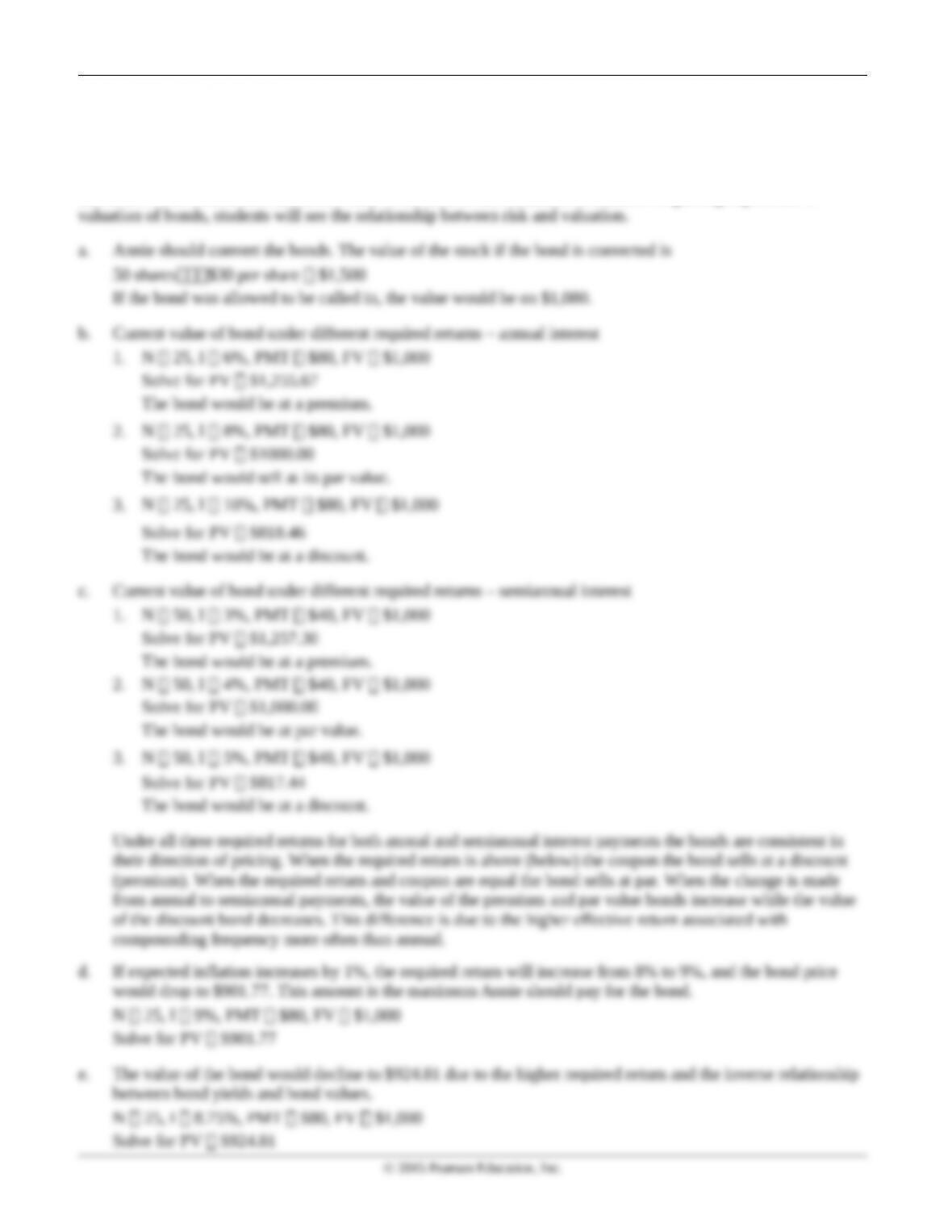
b. Current value of bond under different required returns – annual interest
1. N 25, I 6%, PMT $80, FV $1,000
2. N 25, I 8%, PMT $80, FV $1,000
3. N 25, I 10%, PMT $80, FV $1,000
c. Current value of bond under different required returns – semiannual interest
1. N 50, I 3%, PMT $40, FV $1,000
2. N 50, I 4%, PMT $40, FV $1,000
3. N 50, I 5%, PMT $40, FV $1,000
Under all three required returns for both annual and semiannual interest payments the bonds are consistent in
their direction of pricing. When the required return is above (below) the coupon the bond sells at a discount
d. If expected inflation increases by 1%, the required return will increase from 8% to 9%, and the bond price
would drop to $901.77. This amount is the maximum Annie should pay for the bond.
e. The value of the bond would decline to $924.81 due to the higher required return and the inverse relationship
between bond yields and bond values.
© 2015 Pearson Education, Inc.
Chapter 6: Interest Rates and Bond Valuation 9
f. The bond would increase in value and a gain of $110.61 would be earned by Annie.
g. The bond would increase in value and a gain of $91.08 would be earned by Annie.
Bond value at 7% and 15 years to maturity.
h. Antilier Industries provides a yield of 8% ($80) and is priced at $983.80 (0.98380 1,000). Hence,
i. Annie should probably not invest in the Atilier bond. There are several reasons for this conclusion.
Spreadsheet Exercise
The answer to Chapter 6’s CSM Corporation spreadsheet problem is located on the Instructor’s Resource Center at
www.pearsonhighered.com/irc under the Instructor’s Manual.
Group Exercise
Group exercises are available on www.myfinancelab.com.
This chapter is concerned with credit ratings. Each group is asked to use current information from their shadow
firm to flesh out the details for their fictitious firm. The first lesson students will learn is the lack of transparency in
The steps for the assignment are very straightforward. Each group is asked to retrieve the interest rate of a recent
The final step for the group is to address a potential capital investment. The interest rate will be derived from the
© 2015 Pearson Education, Inc.