
Part 3
Valuation of Securities
Chapters in This Part
Chapter 6 Interest Rates and Bond Valuation
Chapter 7 Stock Valuation
Chapter 6
Interest Rates and Bond Valuation
Instructor’s Resources
Overview
This chapter begins with a thorough discussion of interest rates, yield curves, and their relationship to required
returns. Features of the major types of bond issues are presented along with their legal issues, risk characteristics,
and indenture convents. The chapter then introduces students to the important concept of valuation and
demonstrates the impact of cash flows, timing, and risk on value. It explains models for valuing bonds and the
calculation of yield-to-maturity using either an approximate yield formula or calculator. Students learn how
interest rates may affect their ability to borrow and expand business operations or assets under personal control.
Answers to Review Questions
1.The real rate of interest is the rate that creates an equilibrium between the supply of savings and demand for
investment funds. The nominal rate of interest is the actual rate of interest charged by the supplier of funds
and paid by the demander. The nominal rate of interest differs from the real rate of interest due to two factors:
2.The term structure of interest rates is the relationship of the rate of return to the time to maturity for any class of
3.For a given class of securities, the slope of the curve reflects an expectation about the movement of interest
rates over time. The most commonly used class of securities is U.S. Treasury securities.
© 2015 Pearson Education, Inc.

2 Gitman/Zutter Principles of Managerial Finance, Brief, Seventh Edition
4. a. According to the expectations theory, the yield curve reflects investor expectations about future interest
b. The liquidity preference theory is an explanation for the upward-sloping yield curve. This theory states
c. The market segmentation theory is another theory that can explain any of the three curve shapes. Because
the market for loans can be segmented based on maturity, sources of supply and demand for loans within
5.In the Fisher equation, r r* IP RP, the risk premium, RP, consists of the following issuer– and
issue-related components:
Default risk: The possibility that the issuer will not pay the contractual interest or principal as scheduled.
6.Most corporate bonds are issued in denominations of $1,000 with maturities of 10 to 30 years. The stated
interest rate on a bond represents the percentage of the bond’s par value that will be paid out annually,
7.Long-term lenders include restrictive covenants in loan agreements in order to place certain operating and/or
financial constraints on the borrower. These constraints are intended to assure the lender that the borrowing
firm will maintain a specified financial condition and managerial structure during the term of the loan.
© 2015 Pearson Education, Inc.

Chapter 3: Financial Statements and Ratio Analysis 3
Violation of any of the standard or restrictive loan provisions gives the lender the right to demand immediate
8.Short-term borrowing is normally less expensive than long-term borrowing due to the greater uncertainty
9.If a bond has a conversion feature, the bondholders have the option of converting the bond into a certain
number of shares of stock within a certain period of time. A call feature gives the issuer the opportunity to
10. Current yields are calculated by dividing the annual interest payment by the current price. Bonds
are quoted in percentage of par terms, to the thousandths place. Hence, corporate bond prices are effectively
11.Eurobonds are bonds issued by an international borrower and sold to investors in countries with currencies
other than that in which the bond is denominated. For example, a dollar–denominated Eurobond issued by an
12. A financial manager must understand the valuation process in order to judge the value of benefits received
13. Three key inputs to the valuation process are:
c. Required return—the interest rate used to discount the future cash flows to a PV. The selection of the
15. The value of any asset is the PV of future cash flows expected from the asset over the relevant time period.
1 2
01 2
(1 ) (1 ) (1 )
n
n
CF
CF CF
Vr r r
= + +
+ + +
L
where:
© 2015 Pearson Education, Inc.

4 Gitman/Zutter Principles of Managerial Finance, Brief, Seventh Edition
16. The basic bond valuation equation for a bond that pays annual interest is:
0
1
1 1
(1 ) (1 )
n
t n
d d
t
V I M
r r
=
é ù é ù
= ´ + ´
ê ú ê ú
+ +
ë û
ë û
å
where:
V0 value of a bond that pays annual interest
To find the value of bonds paying interest semiannually, the basic bond valuation equation is adjusted as follows to
account for the more frequent payment of interest:
17. A bond sells at a discount when the required return exceeds the coupon rate. A bond sells at a premium when
the required return is less than the coupon rate. A bond sells at par value when the required return equals the
18. If the required return on a bond is constant until maturity and different from the coupon interest rate, the
19. To protect against the impact of rising interest rates, a risk-averse investor would prefer bonds with short
20. The yield-to-maturity (YTM) on a bond is the rate investors earn if they buy the bond at a specific price and
hold it until maturity. The YTM can be found precisely by using a hand-held financial calculator and using the
time value functions. Enter the B0 as the PV, and the I as the annual payment, and the N as the number of
Suggested Answer to Focus on Ethics Box:
Can We Trust the Bond Raters?
© 2015 Pearson Education, Inc.
Chapter 3: Financial Statements and Ratio Analysis 5
What ethical issues may arise because the companies that issue bonds pay the rating agencies to rate their
bonds?
The rating agencies have an incentive to keep their customers (i.e., the issuers) happy in order to secure future
Answers to Warm-Up Exercises
E6-1. Finding the real rate of interest
Answer: r* RF IP
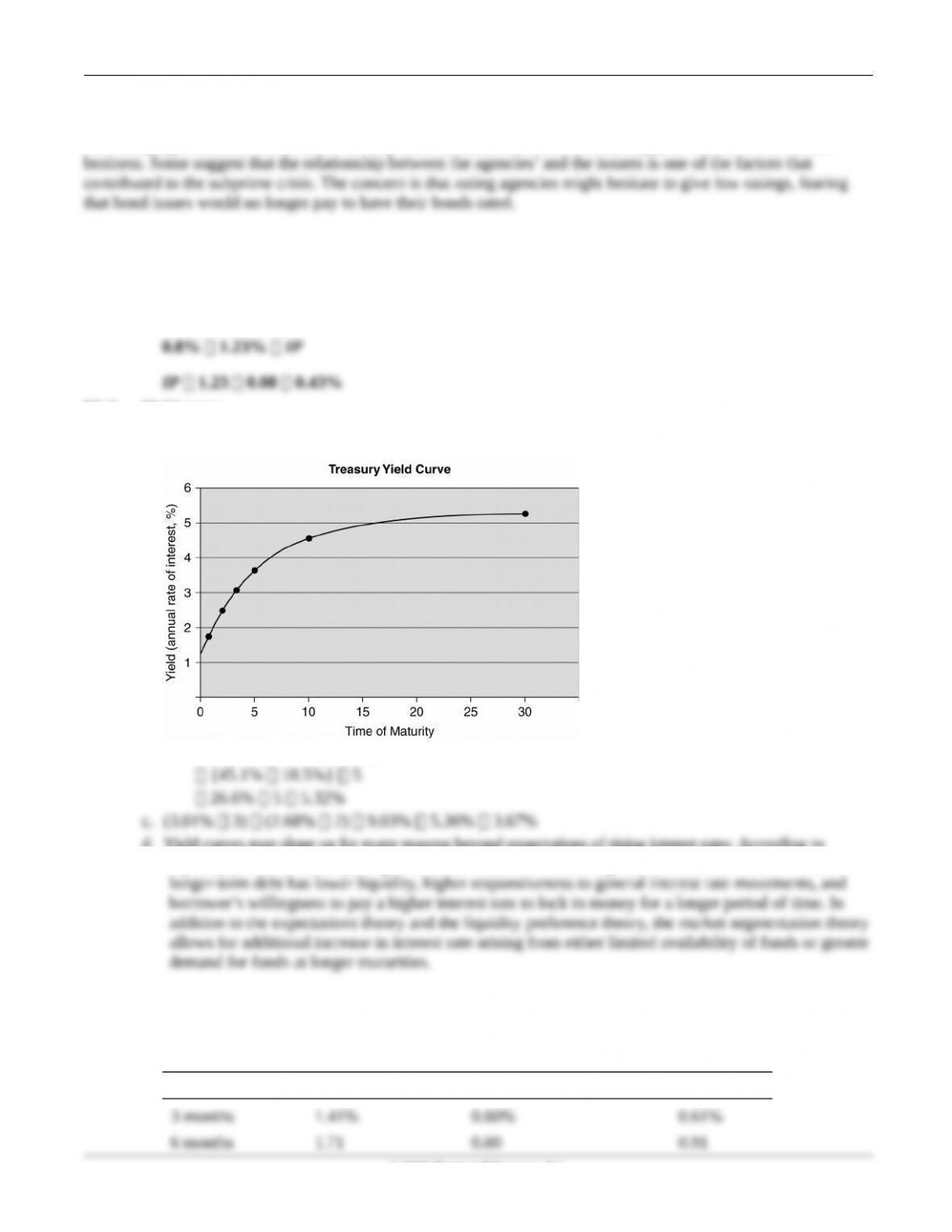
E6-2. Yield curve
a.
b. {(4.51% 10) (3.7% 5)} 5
d. Yield curves may slope up for many reasons beyond expectations of rising interest rates. According to
liquidity preference theory, long-term interest rates tend to be higher than short-term rates because
E6-3. Calculating inflation expectation
Answer: The inflation expectation for a specific maturity is the difference between the yield and the real
interest rate at that maturity.
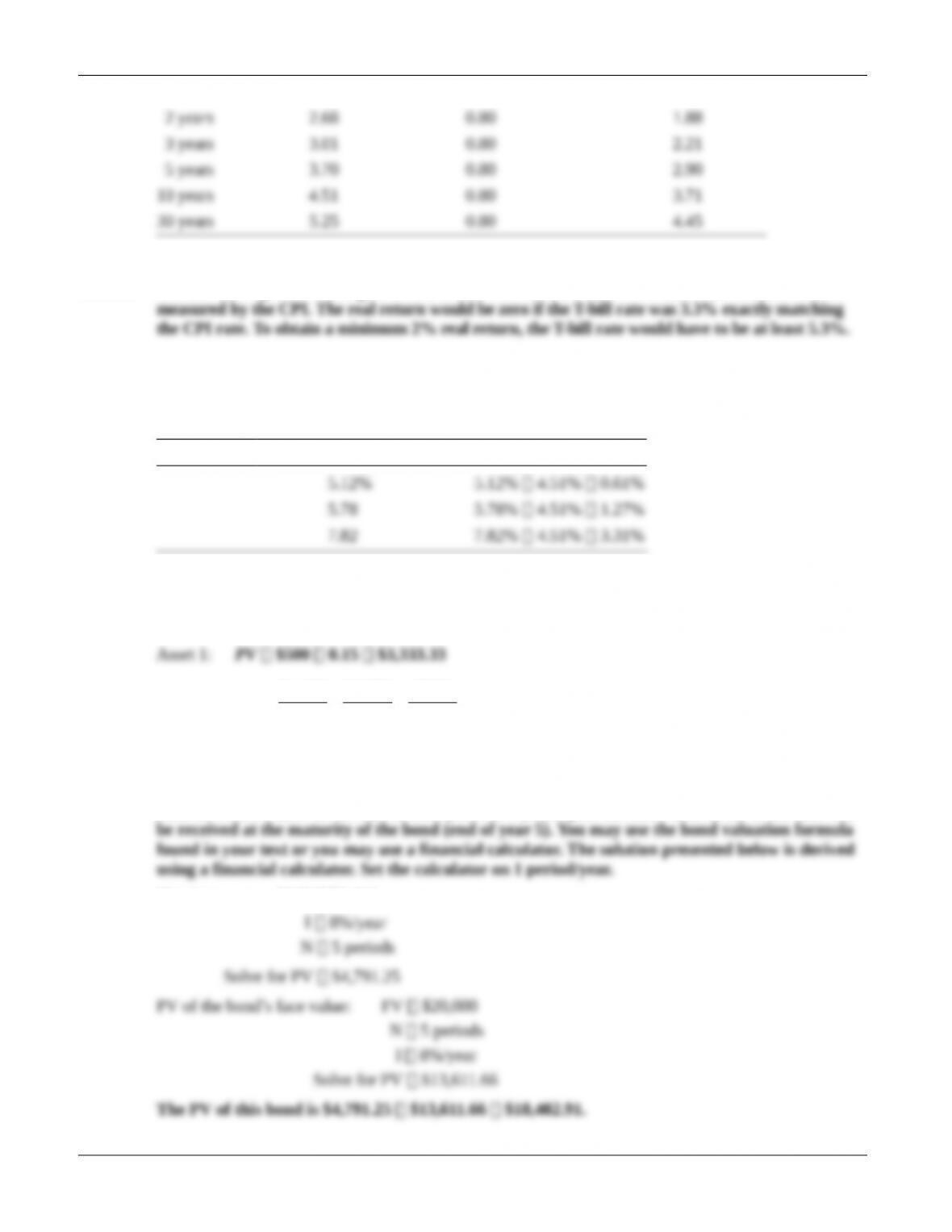
Maturity Yield Real Rate of Interest Inflation Expectation
© 2015 Pearson Education, Inc.
6 Gitman/Zutter Principles of Managerial Finance, Brief, Seventh Edition
E6-4. Real returns
Answer: A T-bill can experience a negative real return if its interest rate is less than the inflation rate as
E6-5. Calculating risk premium
Answer: We calculate the risk premium of other securities by subtracting the risk-free rate, 4.51%, from
each nominal interest rate.
Nominal interest rate Risk premium
E6-6. The basic valuation model
Answer: Find the PV of the cash flow stream for each asset by discounting the expected cash flows using
the respective required return.
Asset 2:
2 3
$1,200 $1,500 $850 $2,969.20
1.10 (1.10) (1.10)
PV =++=
E6-7. Calculating the PV of a bond when the required return exceeds the coupon rate
Answer: The PV of a bond is the PV of its future cash flows. In the case of the 5-year bond, the expected
cash flows are $1,200 at the end of each year for 5 years, plus the face value of the bond that will
PV of interest: PMT 1,200
© 2015 Pearson Education, Inc.

Chapter 3: Financial Statements and Ratio Analysis 7
E6-8. Bond valuations using required rates of return
Answer: a. Student answers will vary but any required rate of return above the coupon rate will cause
Solutions to Problems
P6-1. Interest rate fundamentals: The real rate of return
LG1; Basic
P6-2. Real rate of interest
LG 1; Intermediate
a.
b. The real rate of interest creates an equilibrium between the supply of savings and the demand for
c. See graph.
d. A change in the tax law causes an upward shift in the demand curve, causing the equilibrium point
P6-3. Personal finance: Real and nominal rates of interest
LG 1; Intermediate
d. The number of polo shirts in one year $109 $26.25 4.1524. He can buy 3.8% more shirts
e. The real rate of return is 9% 5% 4%. The change in the number of shirts that can be purchased is
© 2015 Pearson Education, Inc.
8 Gitman/Zutter Principles of Managerial Finance, Brief, Seventh Edition
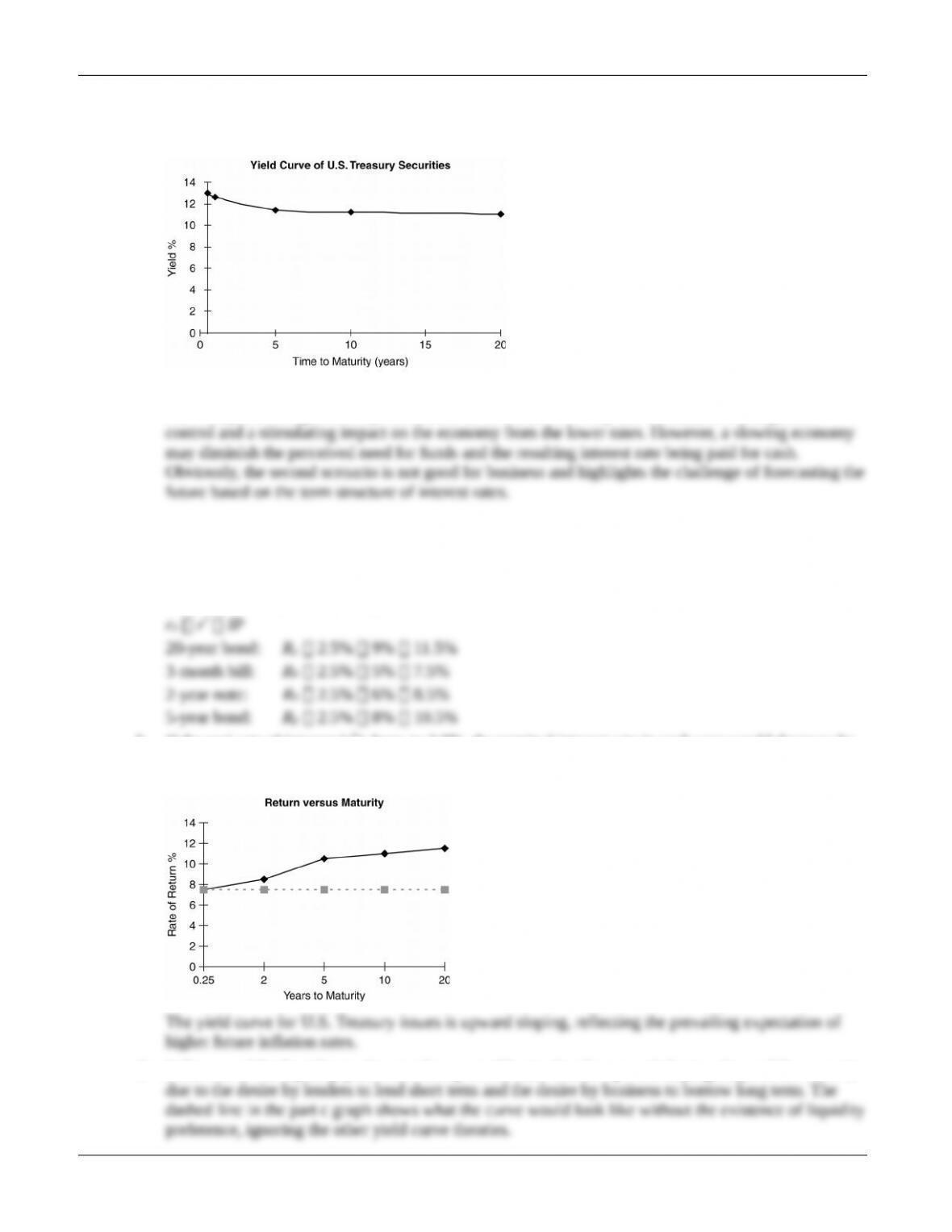
P6-4. Yield curve
LG 1; Intermediate
a.
b. The yield curve is slightly downward sloping, reflecting lower expected future rates of interest. The
curve may reflect a general expectation for an economic recovery due to inflation coming under
P6-5. Nominal interest rates and yield curves
LG 1; Challenge
a. rl r* IP RP1
For U.S. Treasury issues, RP 0
b. If the real rate of interest (r*) drops to 2.0%, the nominal interest rate in each case would decrease by
0.5% point.
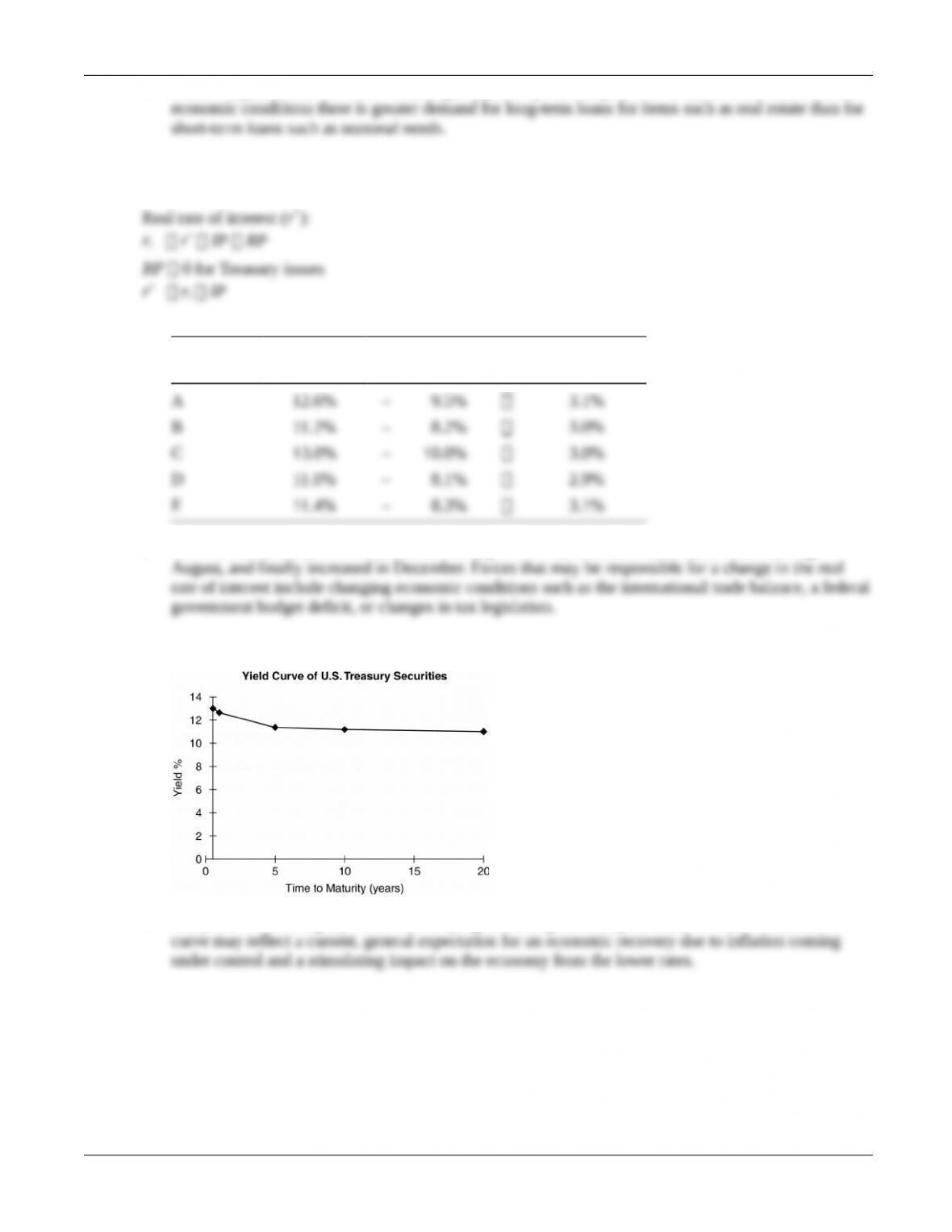
c.
d. Followers of the liquidity preference theory would state that the upward-sloping shape of the curve is
© 2015 Pearson Education, Inc.
Chapter 3: Financial Statements and Ratio Analysis 9
e. Market segmentation theorists would argue that the upward slope is due to the fact that under current
P6-6. Nominal and real rates and yield curves
LG 1; Challenge
a.
Security
Nominal
Rate (rj) – IP
Real Rate of
Interest (r*)
b. The real rate of interest decreased from January to March, remained stable from March through
c.
d. The yield curve is slightly downward sloping, reflecting lower expected future rates of interest. The
© 2015 Pearson Education, Inc.
10 Gitman/Zutter Principles of Managerial Finance, Brief, Seventh Edition
P6-7. Term structure of interest rates
LG 1; Intermediate
a.
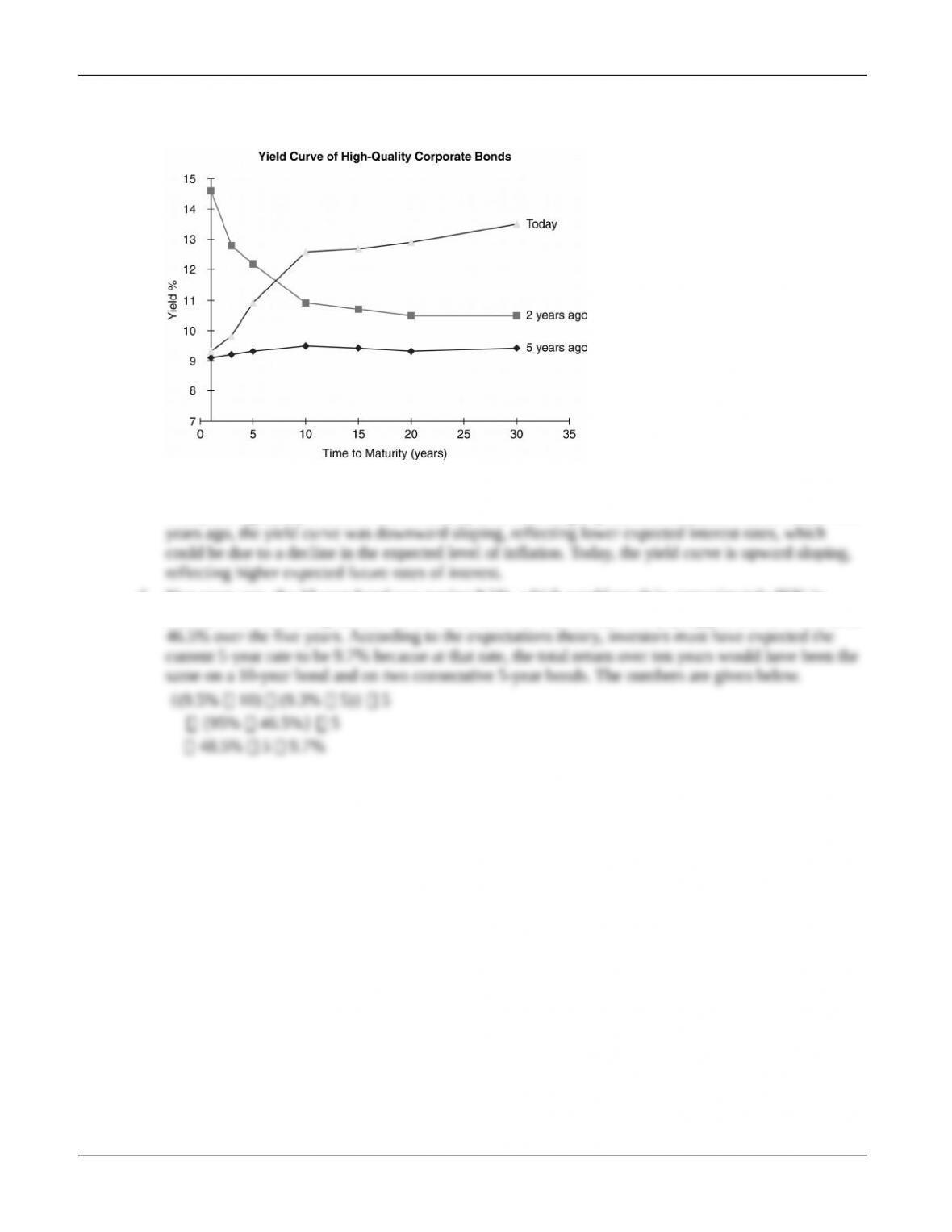
b. and c.
Five years ago, the yield curve was relatively flat, reflecting expectations of stable interest rates. Two
d. Five years ago, the 10-year bond was paying 9.5%, which would result in approximately 95% in
interest over the coming decade. At the same time, the 5-year bond was paying just 9.3%, or a total of
© 2015 Pearson Education, Inc.