
Chapter 5
Time Value of Money
Instructor’s Resources
Overview
This chapter introduces an important financial concept: the time value
of money. The present value and future of a sum, as well as the present and future values of an annuity, are
explained. Special applications of the concepts include intra-year compounding, mixed cash flow streams, mixed
cash flows with an embedded annuity, perpetuities, deposits to accumulate a future sum, and loan amortization.
Numerous business and personal financial applications are used as examples. The chapter drives home the need to
understand time value of money at the professional level because funding for new assets and programs must be
justified using these techniques. Decisions in a student’s personal life should also be acceptable on the basis of
applying time-value-of-money techniques to anticipated cash flows.
Answers to Review Questions
1.Future value (FV), the value of a present amount at a future date, is calculated by applying compound interest
over a specific time period. Present value (PV) represents the dollar value today of a future amount, or the
2.A single amount cash flow refers to an individual standalone value occurring at one point in time. An annuity
consists of an unbroken series of cash flows of equal dollar amount occurring over more than one period. A
3.Compounding of interest occurs when an amount is deposited into a savings account and the interest paid after
FVn PV(1 r)n
4.A decrease in the interest rate lowers the future amount of a deposit for a given holding period because the
deposit earns less at the lower rate. An increase in the holding period for a given interest rate would increase
5.Present value is the current dollar value of a future amount. It indicates how much money today would be
© 2015 Pearson Education, Inc.
2 Gitman/Zutter Principles of Managerial Finance, Brief, Seventh Edition
PV FVn (1 r)n
6.An increasing required rate of return would reduce the present value of a future amount because future dollars
7.Present value calculations are the exact inverse of compound interest calculations. Using compound interest,
10. An ordinary annuity is one for which payments occur at the end of each period. An annuity due is one for
11.The most efficient ways to calculate present value of an ordinary annuity are using an algebraic equation, a
18. The future value of a mixed stream of cash flows is calculated by multiplying each year’s cash flow by
20. As interest is compounded more frequently than once a year, both (a) the future value for a given holding
21. Continuous compounding assumes interest will be compounded an infinite number of times per year, at
© 2015 Pearson Education, Inc.
Chapter 3: Financial Statements and Ratio Analysis 3
22.The nominal annual rate is the contractual rate that is quoted to the borrower by the lender. The effective annual
APR is the annual percentage rate and is required by “truth-in-lending laws” to be disclosed to consumers. This
rate is calculated by multiplying the periodic rate by the number of periods in one year. The periodic rate is
26. The size of the equal annual end-of-year deposits needed to accumulate a given amount over a certain time
27. Amortizing a loan into equal annual payments involves finding the future payments whose present value at
the loan interest rate just equals the amount of the initial principal borrowed. Amortizing a loan involves
28. The best way to determine an unknown number of periods is through the use of a calculator or spreadsheet. In
both instances, you enter the cash flows and interest rate and then compute the number of periods needed to
Suggested Answer to Focus on Practice Box: New Century Brings
Trouble for Subprime Mortgages
As a reaction to problems in the subprime area, lenders tightened lending standards. What effect will this
have on the housing market?
The tightening of lending standards following the subprime fiasco further depressed home prices, which in 2007
were already undergoing their steepest, widest decline in history. As the housing-market slump persists, companies
© 2015 Pearson Education, Inc.
4 Gitman/Zutter Principles of Managerial Finance, Brief, Seventh Edition
Answers to Warm-Up Exercises
E5-1. Future value of a lump-sum investment
E5-2. Finding the future value
Answer: Because the interest is compounded monthly, the number of periods is 4 12 48 and the
monthly interest rate is 1/12th of the annual rate.
Note: Not all financial calculators work in the same manner. Some require the user to use the
CPT (Compute) button. Others require the user to calculate the monthly interest rate and input
If using a spreadsheet, the solution is:
Column A Column B
E5-3. Comparing a lump sum with an annuity
Answer: This problem can be solved in either of two ways. Both alternatives can be compared as lump
© 2015 Pearson Education, Inc.
Chapter 3: Financial Statements and Ratio Analysis 5
Method 1: Perform a lump sum comparison. Compare $1.3 million now with the present value of
the 25 payments of $100,000 per year. In this comparison, the present value of the $100,000
Method 2: Compare two annuities. Because the $100,000 per year is already an annuity, all that
remains is to convert the $1.3 million into a 25-year annuity.
E5-4. Comparing the present value of two alternatives
Answer: To solve this problem you must first find the present value of the expected savings over the 5-year
life of the software.
Year Savings Estimate
Present Value
of Savings
Because the $136,402 present value of the savings exceeds the $130,000 cost of the software, the
© 2015 Pearson Education, Inc.
6 Gitman/Zutter Principles of Managerial Finance, Brief, Seventh Edition
E5-5. Compounding more frequently than annually
Answer: Partners’ Savings Bank:
1
2
1
2
1
1
$12,000 (1 0.03/2)
$12,000 (1 0.03/2) $12,000 1.030225 $12,362.70
m n
r
FV PV m
FV
FV
´
æ ö
= ´ +
ç ÷
è ø
= ´ +
= ´ + = ´ =
Selwyn’s:
rxn 0.0275 1
1
FV PV (e ) $12,000 (2.7183 )
$12,000 1.027882 $12,334.58
´
= ´ = ´
= ´ =
Joseph should choose the 3% rate with semiannual compounding.
E5-6. Determining deposits needed to accumulate a future sum
Answer: The financial calculator input is as follows:
Solutions to Problems
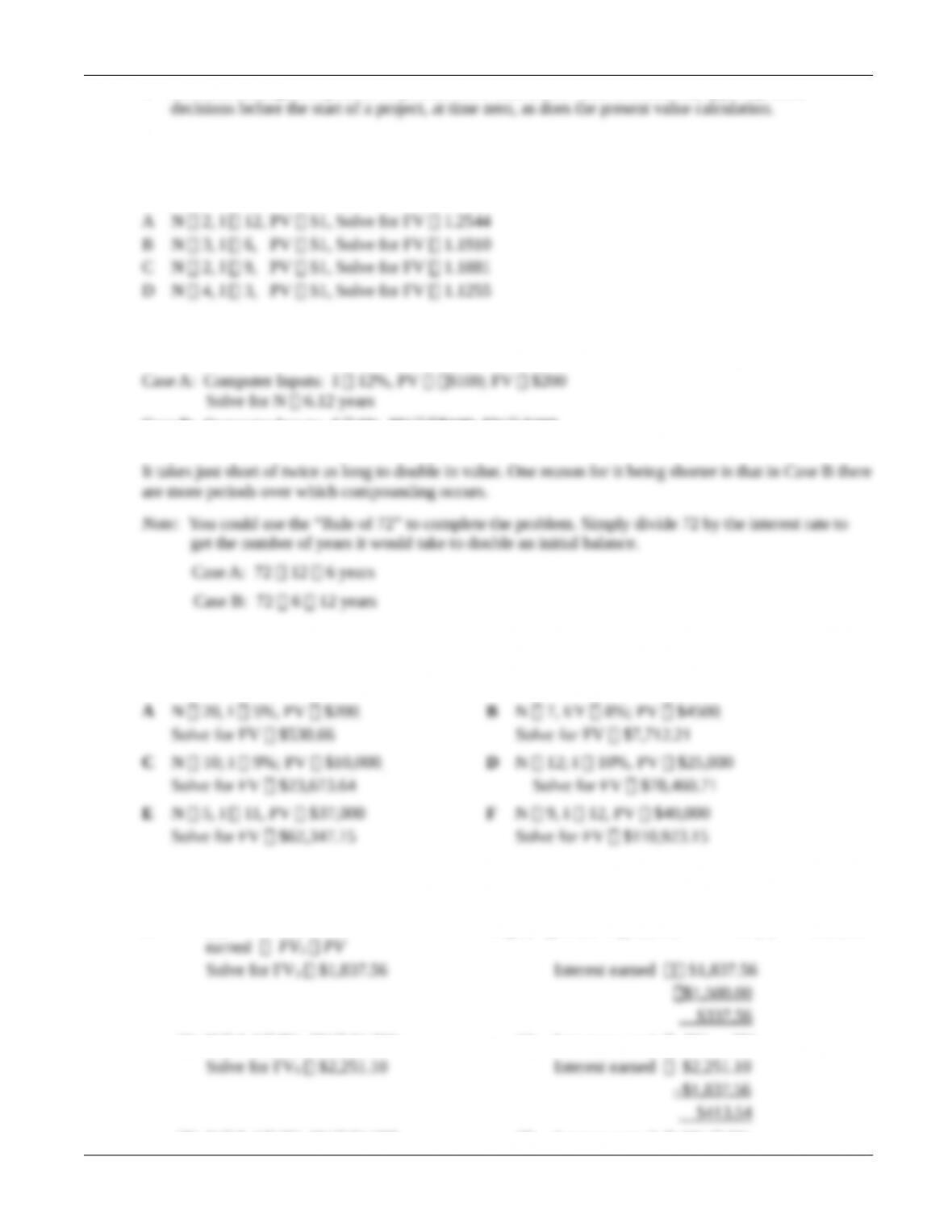
P5-1. Using a time line
LG 1; Basic
a, b, and c
© 2015 Pearson Education, Inc.
Chapter 3: Financial Statements and Ratio Analysis 7
d. Financial managers rely more on present value than future value because they typically make
P5-2. Future value calculation
LG 2; Basic
Case
P5-3. Time to double
LG 1; Basic
Case B: Computer Inputs: I 6%, PV $100; FV $200
N 11.90 years
P5-4. Future values
LG 2; Intermediate
Case Case
P5-5. Personal finance: Time value
LG 2; Intermediate
a. (1) N 3, I 7%, PV $1,500 b. (1) Interest
(2) N 6, I 7%, PV $1,500 (2) Interest earned FV6 – FV3
(3) N 9, I 7%, PV $1,500 (3) Interest earned FV9 FV6
© 2015 Pearson Education, Inc.
8 Gitman/Zutter Principles of Managerial Finance, Brief, Seventh Edition
c. The fact that the longer the investment period is, the larger the total amount of interest collected will
be, is not unexpected and is due to the greater length of time that the principal sum of $1,500 is
P5-6. Personal finance: Time value
LG 2; Challenge
a. (1) N 5, I 2%, PV $14,000 (2) N 5, I
b. The car will cost $1,576.01 more with a 4% inflation rate than an inflation rate of 2%. This increase is
c. Future value at end of first 2 years:
P5-7. Personal finance: Time value
LG 2; Challenge
Deposit Now: Deposit in 10 Years:
P5-8. Personal finance: Time value
LG 2; Challenge
P5-9. Personal finance: Single-payment loan repayment
LG 2; Intermediate
© 2015 Pearson Education, Inc.
Chapter 3: Financial Statements and Ratio Analysis 9
P5-10. Present value calculation:
1
PVIF (1 )n
i
=+
LG 2; Basic
Case
P5-11. Present values
LG 2; Basic
Case PV
P5-12. Present value concept
LG 2; Intermediate
a. N 6, I 12%, FV $6,000 b. N 6, I 12%, FV $6,000
c. N 6, I 12%, FV $6,000
d. The answer to all three parts is the same. In each case, the same question is being asked but in a
P5-13. Personal finance: Time Value
LG 2; Basic
a. N 3, I 7%, FV $500
© 2015 Pearson Education, Inc.