
Part 2
Financial Tools
Chapters in This Part
Chapter 3 Financial Statements and Ratio Analysis
Chapter 4 Cash Flow and Financial Planning
Chapter 5 Time Value of Money
Chapter 3
Financial Statements and Ratio Analysis
Instructor’s Resources
Overview
This chapter examines four key components of the stockholders’ report: the income statement, balance sheet,
statement of retained earnings, and the statement of cash flows. On the income statement and balance sheet, the
major accounts/balances are reviewed for the student. The rules for consolidating a company’s foreign and
domestic financial statements (FASB No. 52) are described. Following the financial statement coverage, the
chapter covers the evaluation of financial statements using the technique of ratio analysis. Ratio analysis is used by
prospective shareholders, creditors, and a firm’s own management to measure the firm’s operating and financial
health. Three types of comparative analysis are defined: cross-sectional analysis, time-series analysis, and
combined analysis. The ratios are divided into five basic categories: liquidity, activity, debt, profitability, and
market. Each ratio is defined and calculated using the financial statements of Bartlett Company. A brief
explanation of the implications of deviation from industry standard ratios is offered, with a complete (cross-sectional
and time-series) ratio analysis of Bartlett Company ending the chapter. The DuPont system of analysis is also
integrated into the example. The importance of understanding financial statements is highlighted through discussions
of how such knowledge will help a student be a more efficient business manager and more effectively make
personal financial decisions.
Answers to Review Questions
1. The role of the Financial Accounting Standards Board (FASB) and Public Company Accounting Oversight
Board (PCAOB) regulatory agencies in the financial reporting of businesses is highly significant. The
2 Gitman/Zutter • Principles of Managerial Finance, Fourteenth Edition
2. The purpose of each of the four major financial statements is as follows:
Income Statement—The purpose of the income statement is to provide a financial summary of a firm’s
Balance Sheet—The purpose of the balance sheet is to present a summary of the assets owned by a firm, its
Statement of Retained Earnings—This statement reconciles the net income earned during the year, and any
Statement of Cash Flows—This statement provides a summary of the cash inflows and the cash outflows
3. The notes to the financial statements are important because they provide detailed information not directly
4. Financial Accounting Standards Board Statement No. 52 describes the rules for consolidating a company’s
foreign and domestic financial statements. It requires U.S.-based companies to translate
5. Current and prospective shareholders place primary emphasis on a firm’s current and future level of risk and
return as measures of profitability, while creditors are more concerned with the short-term liquidity measures
6. Cross-sectional comparisons are made by comparing similar ratios for firms within the same industry, or to an
7. An analyst should devote primary attention to any significant deviations from the norm, whether above or
8. Comparing financial statements from different points in the year can result in inaccurate and misleading
9. The current ratio proves to be the better liquidity measure when all of a firm’s current assets are reasonably
10. Large businesses typically have established relationships with banks that can provide access to short-term
funds in the event that they have a need for liquidity. Whole Foods, the natural and organic grocery store,
11.Additional information is necessary to assess how well a firm collects receivables and meets payables. The
12. Financial leverage is the term used to describe the magnification of risk and return introduced through the
13. The debt ratio and the debt-equity ratio may be used to measure a firm’s degree of indebtedness. Coverage
15. Firms that have high gross profit margins and low net profit margins have high levels of expenses other than
16. The owners are probably most interested in the return on equity (ROE) because it indicates the rate of return
17. The price-earnings ratio (P/E) is the market price per share of common stock divided by the earnings per
share. It indicates the amount an investor is willing to pay for each dollar of earnings. It is used to assess the
18. Liquidity ratios measure how well a firm can meet its current (short-term) obligations when they come due.
19. The analyst may approach a complete ratio analysis on either a cross-sectional or time-series basis by
20. The DuPont system of analysis combines profitability (the net profit margin), asset efficiency (the total asset
4 Gitman/Zutter • Principles of Managerial Finance, Fourteenth Edition
Suggested Answer to Focus on Ethics Box: Taking Earnings Reports at
Face Value
Why might financial managers be tempted to manage earnings?
Financial managers’ incentive structures might tempt them to manage earnings. For many managers, compensation
Is it unethical for managers to manage earnings if they disclose their activities to investors?
Answers to Warm-Up Exercises
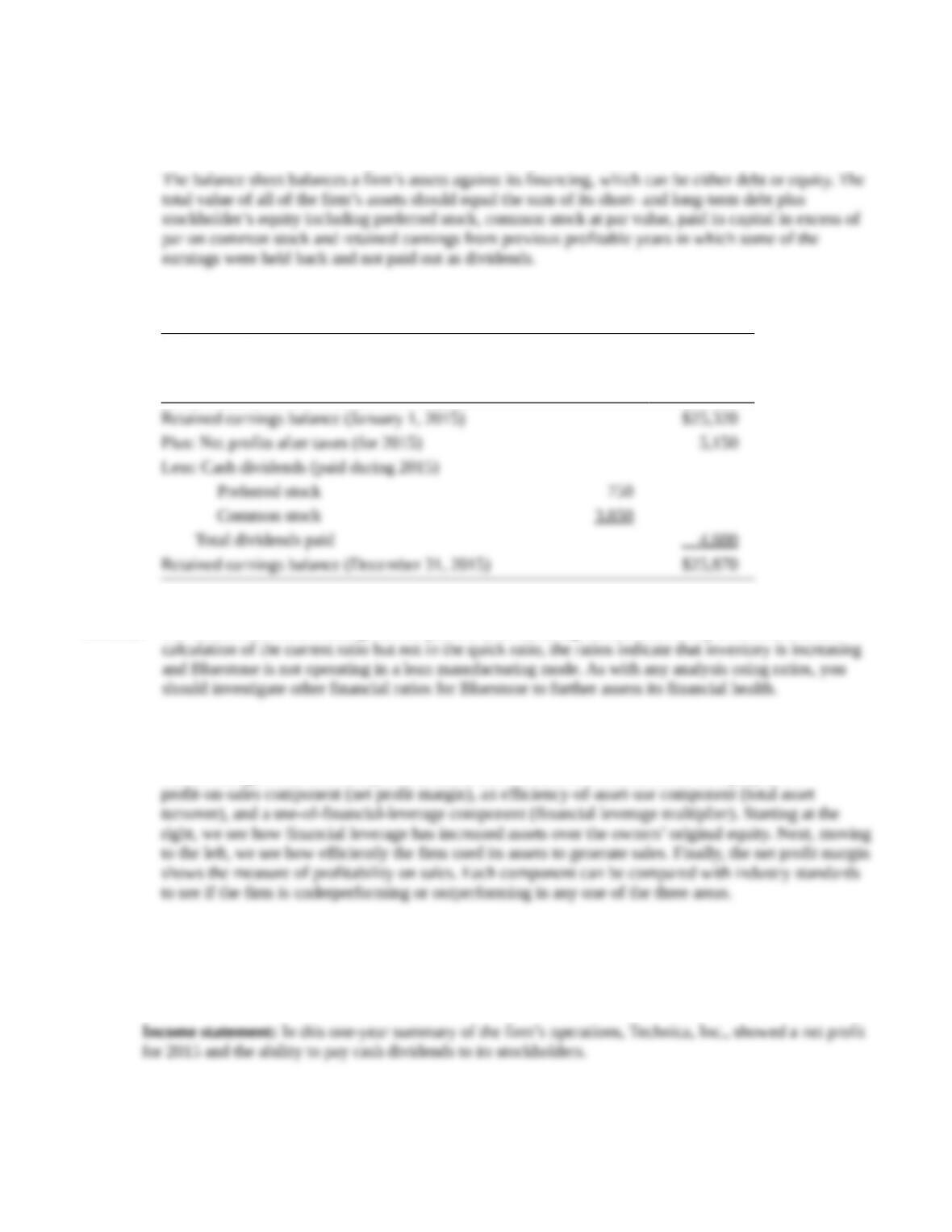
E3-1. Prepare an income statement.
Answer:
a.
Name of Company
Income Statement ($000,000)
c. Additions to retained earnings are the portion left after paying dividends, or $7,025,000.
E3-2. Income statement and balance sheet
Answer: In an income statement, the calculations begin with sales revenue and end with net profits after taxes. If
a company makes loss for a year, the final result will be a net loss after taxes.
E3-3. Statement of retained earnings
Answer:
Cooper Industries, Inc.
Statement of Retained Earnings ($000)
for the Year Ended December 31, 2015
E3-4. Current ratios and quick ratios
Answer: The current ratio is increasing but the quick ratio is declining. Because inventory is included in the
E3-5. The DuPont method of calculating ROE
Answer: ROE = 4.5% 0.72 1.43 = 4.63%
The advantage of the DuPont system is that it allows a firm to break its return on equity into a
Solutions to Problems
P3-1. Reviewing basic financial statements
LG 1; Basic
6 Gitman/Zutter • Principles of Managerial Finance, Fourteenth Edition
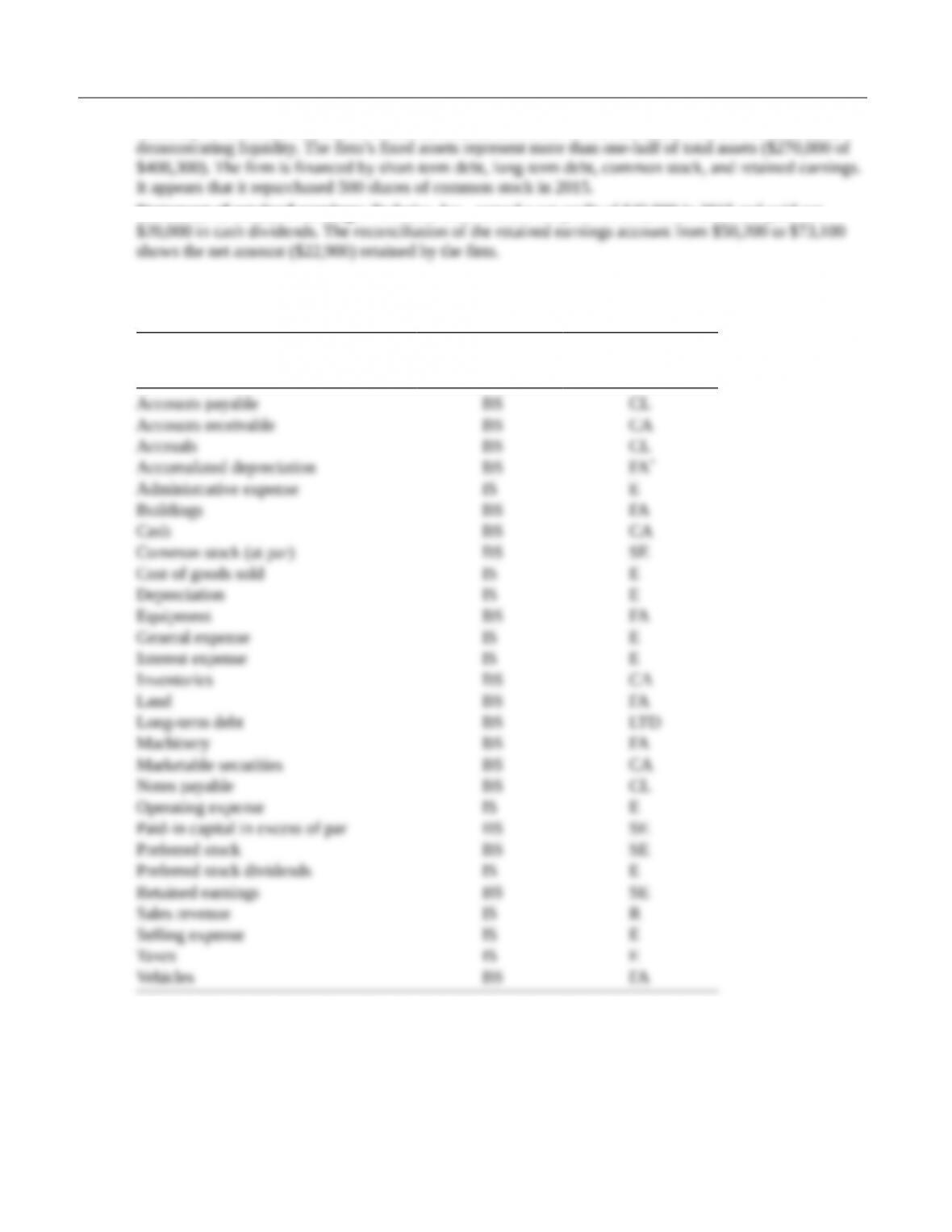
Balance sheet: The financial condition of Technica, Inc., at December 31, 2014 and 2015 is shown as a
summary of assets and liabilities. Technica, Inc., has an excess of current assets over current liabilities,
Statement of retained earnings: Technica, Inc., earned a net profit of $42,900 in 2015 and paid out
P3-2. Financial statement account identification
LG 1; Basic
(1) (2)
Account Name Statement Type of Account
* This is really not a fixed asset, but a charge against a fixed asset, better known as a contra-asset.
P3-3. Income statement preparation
LG 1; Intermediate
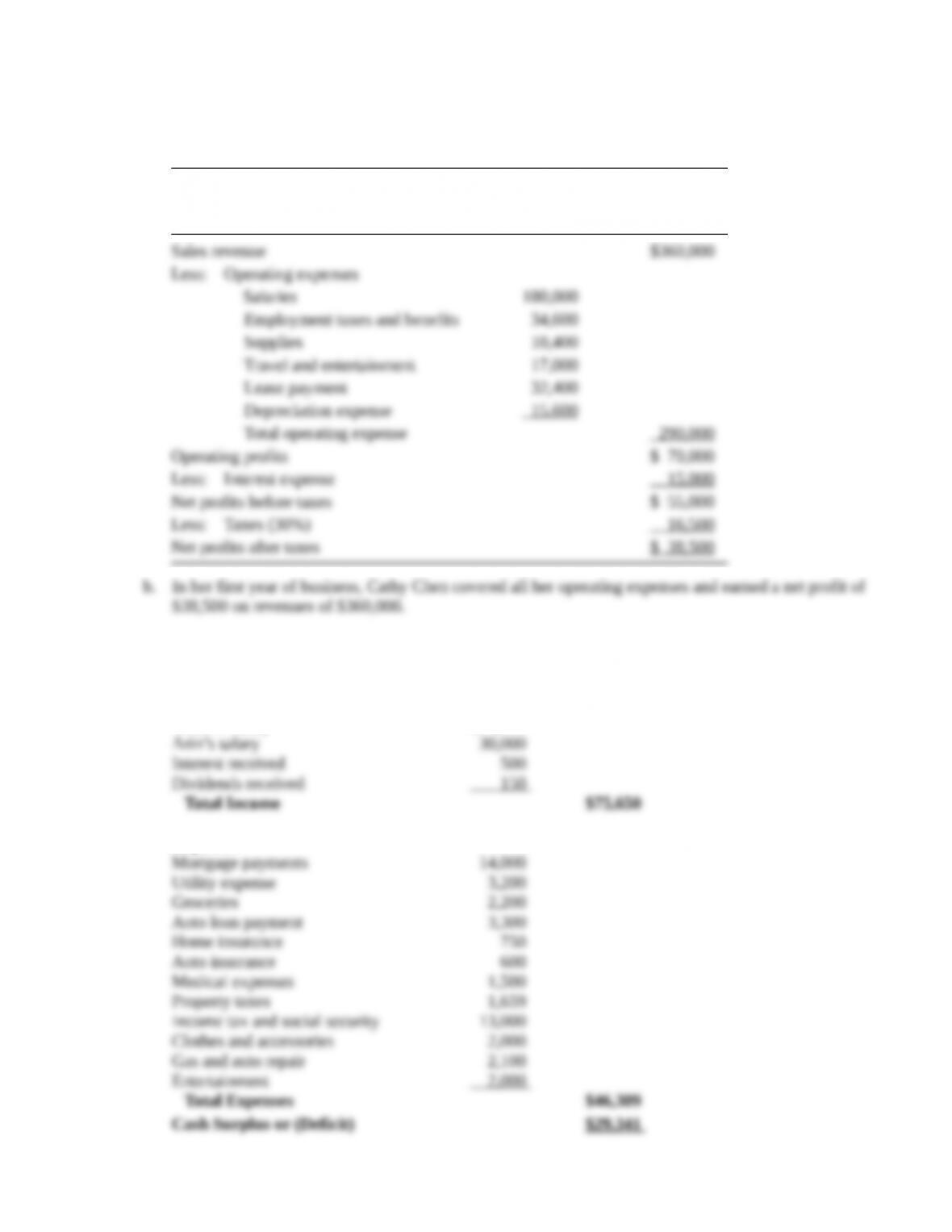
a.
Cathy Chen, CPA
Income Statement
for the Year Ended December 31, 2015
P3-4. Personal finance: Income statement preparation
LG 1; Intermediate
a.
Adam’s salary $45,000
Expenses

8 Gitman/Zutter • Principles of Managerial Finance, Fourteenth Edition
b. Because income exceeds expenses, the Adams have a cash surplus.
c. The cash surplus can be used for a variety of purposes. In the short term, they may replace their car,
buy better furniture, or more quickly pay off their home. Alternatively, they may purchase stocks and