
Chapter 2: The Financial Market Environment 13
Chapter 2
The Financial Market Environment
Instructor’s Resources
Overview
Money and capital markets and their major components are introduced in this chapter. Firms need to raise capital in
order to survive. Financial institutions give firms access to the money they need to grow. However, greed can drive
financial managers and institutions to commit actions that get them into trouble and even force bankruptcy. These
bankruptcies result in limited capital flows to firms and both they and the whole economy can suffer. Therefore,
financial institutions and markets should be well regulated. The final section covers a discussion of the impact of
taxation on the firm’s financial activities.
Answers to Review Questions
1. The key participants in financial transactions are individuals, businesses, and governments. These parties
participate both as suppliers and demanders of funds. Individuals are the net suppliers, which means that they
Financial institutions include commercial banks and investment banks. The former assists both individuals and
companies with their banking needs, while the latter concentrates efforts in the area of assisting corporations
2. Financial markets provide a forum in which suppliers of funds and demanders of loans and investments can
transact business directly.
Secondary market refers to the trading of securities among investors subsequent to the primary market
Financial institutions and financial markets are not independent of each other. It is quite common to find
© 2015 Pearson Education, Inc.
14 Gitman/Zutter Principles of Managerial Finance, Brief, Seventh Edition
3. The money market is created by a financial relationship between the suppliers and demanders of short-term
4. The capital market is a financial relationship created by a number of institutions and arrangements that allows
5. The broker market consists of national and regional securities exchanges. These organizations provide a
location, such as the New York Stock Exchange, to bring together the buyers and sellers of debt and equity.
In contrast, dealer markets are electronic markets for the buyers and sellers of securities not listed on the
6. In addition to the U.S. capital markets, corporations can raise debt and equity funds in capital markets located
in other countries. The Eurobond market is the oldest and largest international debt market. Corporate and
7. An efficient market will allocate funds to their most productive uses due to competition among
wealth-maximizing investors. Prices are assumed to be a function of information about the firm and economy.
An alternate view of market pricing is put forth by advocates of behavioral finance. This explanation of market
8. Securitization is the process of pooling mortgages and then selling claims against that pool in the secondary
9. Mortgage-backed securities represent claims on the cash flows generated by a pool of mortgages. As the
10. When a homeowner borrows money to buy a home, he borrows a fixed amount of money. As housing prices
11.As home prices decline, the value of homes may be less than the amount owed to the bank. Hence many
borrowers will simply walk away from their homes and let lenders repossess them. There will be an added
supply of housing. If multiple homes in the area are facing foreclosure, the value of remaining homes will
© 2015 Pearson Education, Inc.
Chapter 2: The Financial Market Environment 15
12. A crisis in the financial sector generally has a spillover effect on the other sectors of the economy. This can be
better understood by understanding the 2008 financial crisis. As mortgage-backed security delinquency rates
rose, the value of still solvent mortgage-backed securities fell. This fall led to the questions about the
13. Due to their enormous impact, governments typically regulate financial institutions more than most economic
14. The Securities Act of 1933 was designed to regulate activity in the primary market, ensuring that sellers of
15. The ordinary income of a corporation is income earned through the sale of a firm’s goods or services. Taxes
on corporate ordinary income have two components: a fixed amount on the base figure for its income bracket
16. Dividends received from another corporation, in which the shareholding firm’s position is less than one-fifth
17. The tax deductibility of corporate expenses reduces their actual after–tax cost. Corporate interest is a
Suggested Answer to Focus on Practice Box: Berkshire Hathaway: Can
Buffet Be Replaced?
The share price of BRKA has never been split. Why might the company refuse to split its shares to make
them more affordable to average investors?
The primary reason that Berkshire Hathaway does not split the price of its common stock is because Warren
Buffett’s philosophy is that a stock split is financially meaningless and only serves as a way to lower the stock
© 2015 Pearson Education, Inc.
16 Gitman/Zutter Principles of Managerial Finance, Brief, Seventh Edition
Answers to Warm-Up Exercises
E2-1. Suppliers and demanders of funds
Answer: Individuals as a whole spend less than they earn. The excess is invested, making it available for
businesses. If individuals consume more, fewer dollars will be available for investment. This would
E2-2 Raising funds
Answer: Financial institutions, such as investment banks, provide expertise in the acquisition of funds.
Investment banking institutions are able to use the expertise developed through the acquisition of funds
E2-3 Money market vs. capital market
Answer: Money markets are short-term markets, so firms using these would be in need of funds for less than a
year. Perhaps the business needs to increase inventory for a season, such as RV dealerships building
E2-4 Mortgage-backed securities
Answer: Questions you would ask include
h. Will borrowers soon be experiencing an interest rate increase because they took out a mortgage
E2-5 Biggest benefit of government regulation
Answer: While the type and level of government regulation will always be debatable, the idea that we need and,
in fact, benefit from some level of government regulation of financial institutions and markets is quite
E2-6. Dividends received exclusion
© 2015 Pearson Education, Inc.

Chapter 2: The Financial Market Environment 17
Answer: While 100% of corporate interest income is taxed at ordinary tax rates, only 30% of corporate dividend
Solutions to Problems
P2-1. Corporate taxes
LG 6; Basic
a. Firm’s tax liability on $92,500 (from Table 2.1):
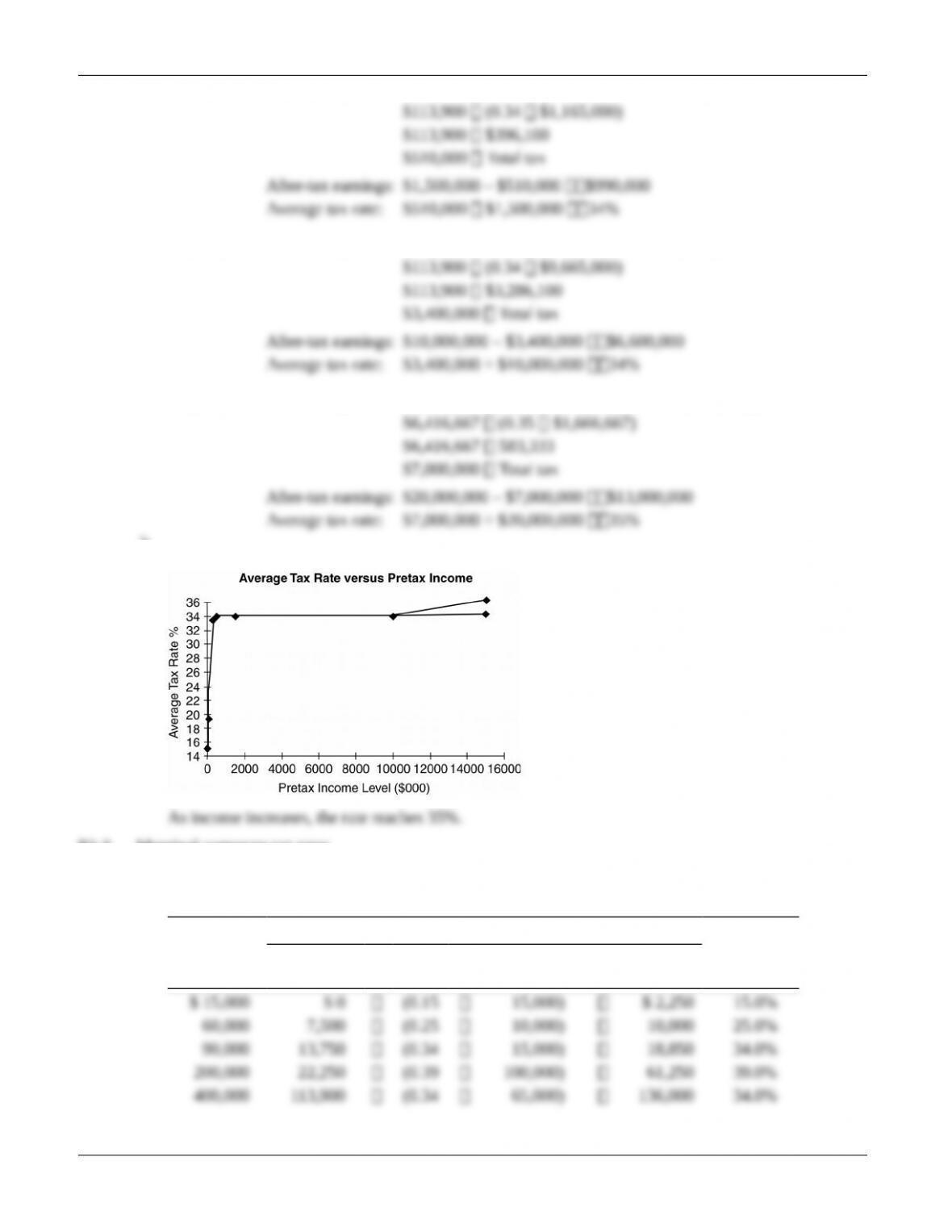
P2-2. Average corporate tax rates
LG 6; Basic
a. Tax calculations using Table 2.1:
$300,000: Tax liability: $22,250 + [0.39 ($300,000 – $100,000)]
$500,000: Tax liability: $113,900 [0.34 ($500,000 – $335,000)]
© 2015 Pearson Education, Inc.
18 Gitman/Zutter Principles of Managerial Finance, Brief, Seventh Edition
$1,500,000: Tax liability: $113,900 [0.34 ($1,500,000 – $335,000)]
$10,000,000: Tax liability: $113,900 + [0.34 ($10,000,000 – $335,000)]
$20,000,000: Tax liability: $6,416,667 [0.35 ($20,000,000 – $18,333,333)]
b.
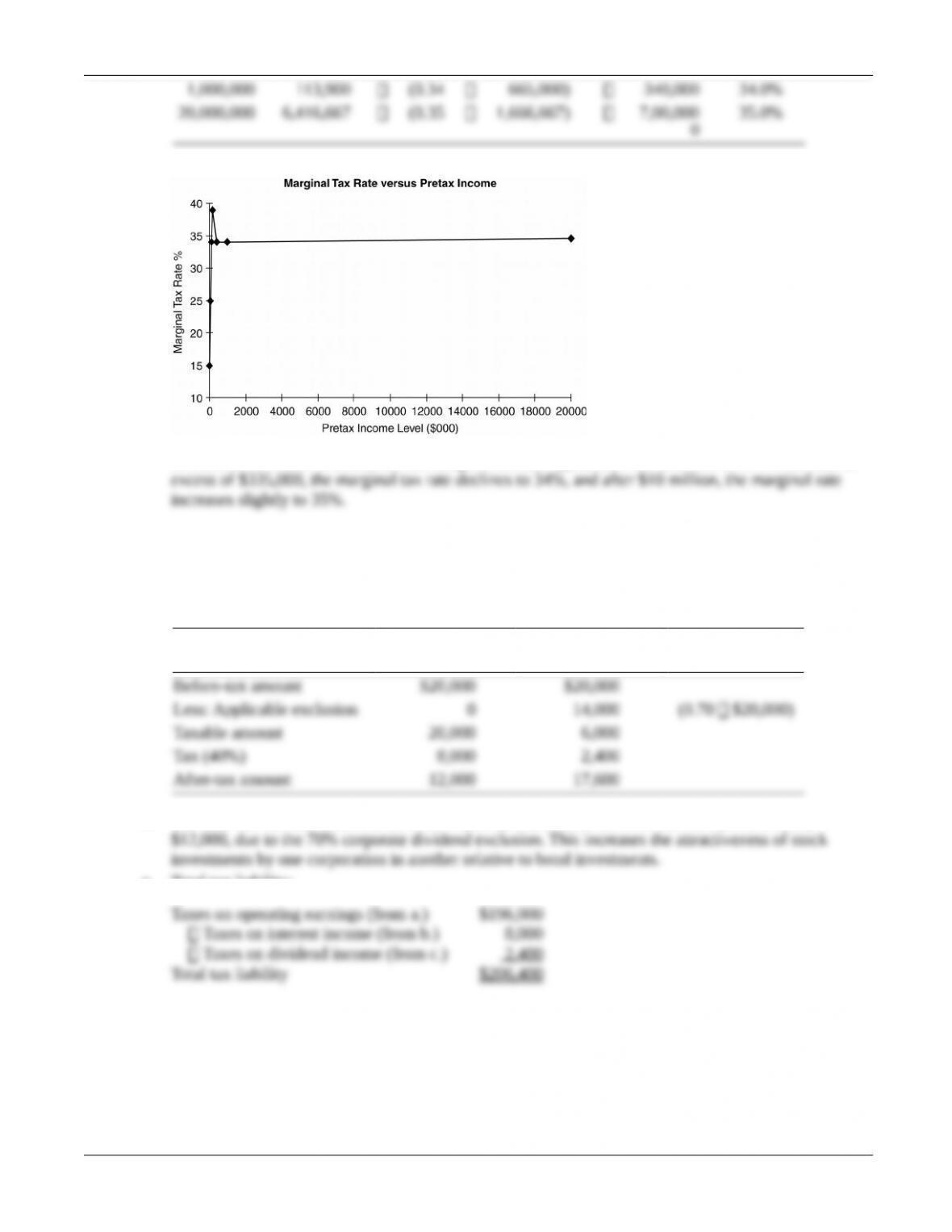
P2-3. Marginal corporate tax rates
LG 6; Basic
a.
Tax Calculation
Pre-Tax
Income Base Tax %
Amount
Over Base
Total
Tax
Marginal
Rate
© 2015 Pearson Education, Inc.
Chapter 2: The Financial Market Environment 19
0
b.
As income increases to $335,000, the marginal tax rate approaches and peaks at 39%. For income in
P2-4. Interest vs. dividend income
LG 6; Intermediate
a. Tax on operating earnings: $490,000 0.40 tax rate $196,000
b. and c.
(b)
Interest Income
(c)
Dividend Income
d. The after–tax amount of dividends received, $17,600, exceeds the after–tax amount of interest,
e. Total tax liability:
© 2015 Pearson Education, Inc.
20 Gitman/Zutter Principles of Managerial Finance, Brief, Seventh Edition
P2-5. Interest vs. dividend expense
LG 6; Intermediate
a. EBIT $50,000
b. EBIT $50,000
P2-6. Capital gains taxes
LG 6; Basic
a. Capital gain:
b. Tax on sale of asset:
P2-7. Capital gains taxes
LG 6; Basic
a. and b.
Asset
Sale Price
(1)
Purchase Price
(2)
Capital Gain
(1) – (2)
(3)
Tax
(3) 0.40
(4)
P2-8. Ethics problem
LG 5; Intermediate
The primary ethical issue is whether the insider is basing his buy or sale of company shares on internal
information. If he is basing his decisions on information not available to the general public, he would be
Case
© 2015 Pearson Education, Inc.

Chapter 2: The Financial Market Environment 21
Case studies are available on www.myfinancelab.com.
The Pros and Cons of Being Publicly Listed
a. Being a publicly listed company provides access to the money the company needs to grow. Shareholders also
b. There are many disadvantages to going public. One, there is no guarantee that shareholders will want to
c. Not enough information is provided to determine whether Robo-Tech meets the listing requirements to be on
d. Capital market efficiency is important for many reasons. If the market is efficient, prices are an unbiased estimate
Spreadsheet Exercise
The answer to Chapter 2’s Monsanto spreadsheet problem is located on the Instructor’s Resource Center at
www.pearsonhighered.com/irc under the Instructor’s Manual.
Group Exercise
There is no group exercise for Chapter 2.
© 2015 Pearson Education, Inc.