Chapter 15
Current Liabilities Management
Instructor’s Resources
Overview
This chapter introduces the fundamentals and describes the interrelationship of net working capital, profitability, and risk in
managing the firm’s current liability accounts. The management of current liabilities requires choosing appropriate levels of
financing and involves tradeoffs between risk and profitability. This chapter also reviews sources of secured and unsecured
short-term financing, including the role of international loans. Spontaneous sources, such as accounts payable and accruals, are
differentiated from negotiated bank sources, such as lines of credit. The cash discount offered on accounts payable and the
cost of forgoing such discounts are described. Secured sources include bank and commercial finance company loans, backed
by collaterals such as inventory or accounts receivable. Whether borrowing funds as a manager or for their own personal use,
effective management of current liabilities is essential, making Chapter 15 relevant at the professional and personal levels.
Answers to Review Questions
1.The two major sources of spontaneous short-term financing (financing that arises from the normal operating cycle) are
accounts payable and accruals. Both of these sources are spontaneous because their levels increase and decrease directly
2.There is no coststated or unstatedassociated with taking a cash discount; there is a cost of giving up a cash discount. By
giving up a cash discount, the purchaser pays the full price for merchandise but can make the payment later. The unstated
cost of giving up a cash discount is the implied rate of interest paid to delay payments. This rate can be used to make
4.The prime rate of interest, which is the lowest rate charged on business loans to the best business borrowers, is usually
5.The effective interest rate is the actual rate of interest paid for the period. The calculation of this rate depends on whether
© 2015 Pearson Education, Inc.
2 Gitman/Zutter Principles of Managerial Finance, Brief, Seventh Edition
Interest
Amount borrowed
6.A single-payment note is an unsecured loan from a commercial bank. It usually has a short maturity30 to 90 daysand the
interest rate is normally tied in some way to the prime rate of interest. The interest rate on these notes may be fixed or
Chapter 3: Financial Statements and Ratio Analysis 3
12. The interest rate charged on secured short-term loans is typically higher than the interest rate on unsecured short-term
loans. Typically, companies that require secured loans may not qualify for unsecured debt, and they are perceived as
13. a. A pledge of accounts receivable is the use of a firm’s receivables to secure a short-term loan. The lender evaluates
the quality of the accounts receivable, selects acceptable accounts, and files a lien on the collateral. After the
b. Factoring accounts receivable is the outright sale to the factor or other financial institution. The factor sets the
conditions of the sale in a factoring agreement. Normally factoring is done on a nonrecourse basis (the factor
14. a. Floating inventory liens are made by lenders and secured by a claim on general inventory consisting of a diversified
and low-cost group of merchandise. Generally less than 50% of the book value of the average inventory is advanced.
The interest charge on a floating lien is typically 3% to 5% above the prime rate.
b. Trust receipt inventory loans are often made by manufacturers’ financing subsidiaries to their customers. Under
c. A warehouse receipt loan is an arrangement whereby the lender receives control of the pledged collateral. The
Suggested Answer to Focus on Ethics Box: Accruals Management
Why might financial managers still be tempted to manage earnings when a clawback is legitimate possibility?
If financial managers are unlikely to get caught and punished, the expected (positive) payoff from their actions might tempt
them to manage earnings. Financial managers also might engage in earnings management, if the superior performance it
allows them to report leads to positive career outcomes (e.g., promotions, advancement). In such a case, the possibility of a
clawback might be viewed as a small price to pay when the manager leverages their actions into a higher paying, more
prestigious position.
Answers to Warm-Up Exercises
E15-1. Cash discount and the simplified formula
Answer: Payment required if taking the cash discount $25,000 0.97 $24,250
© 2015 Pearson Education, Inc.
4 Gitman/Zutter Principles of Managerial Finance, Brief, Seventh Edition
Cost of giving up the cash discount 3% (365 15) 73%
E15-2. Managing accruals
E15-3. Effective annual interest rate
Answer: Discount loan
E15-4. Effective annual interest rate
E15-5. Commercial paper interest rate
Solutions to Problems
P15-1. Payment dates
LG 1; Basic
a. December 25
P15-2. Cost of giving up cash discount
LG 1; Basic
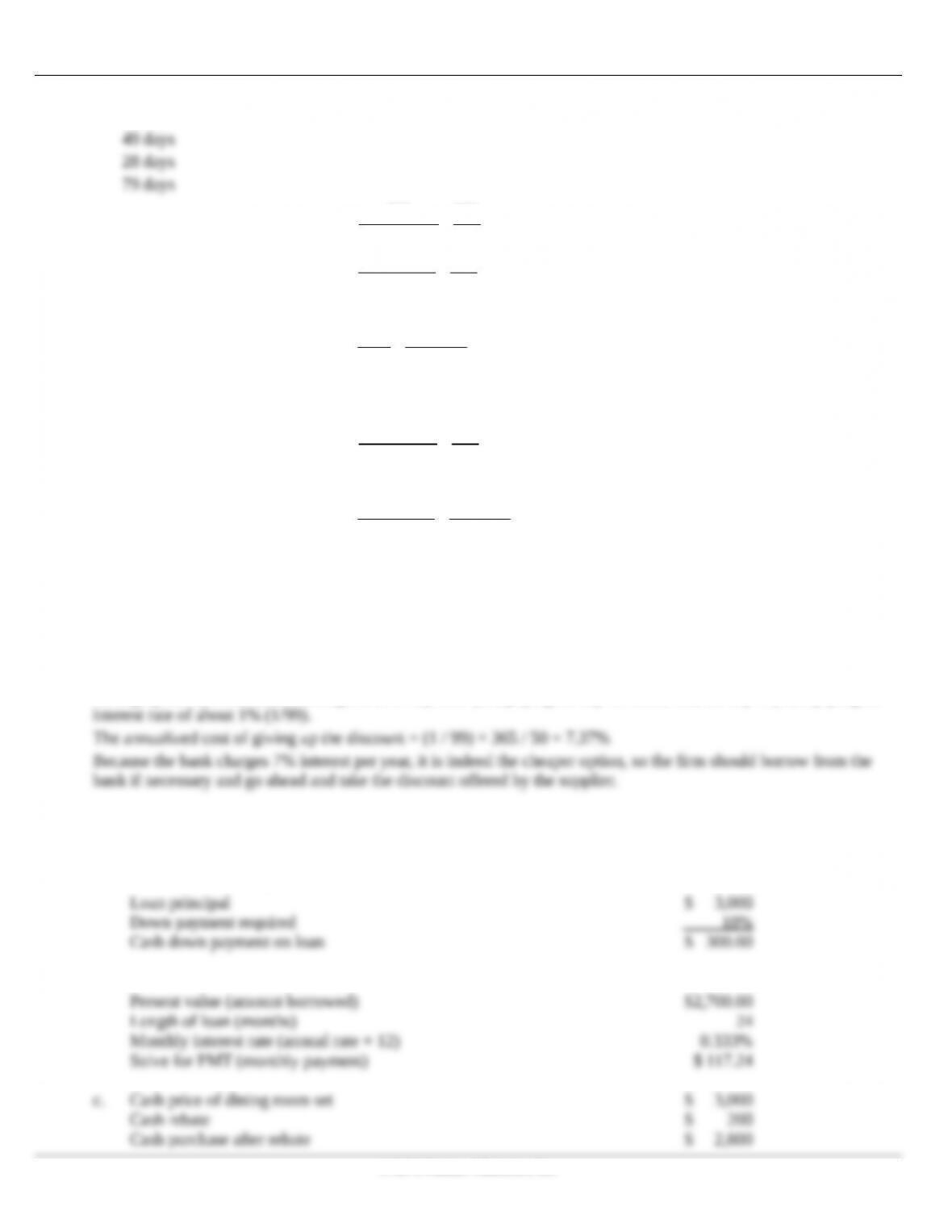
a. (0.02 0.98) (365 20) 37.24%
P15-3. Credit terms
LG 1; Basic
© 2015 Pearson Education, Inc.
Chapter 3: Financial Statements and Ratio Analysis 5
1/10 net 60 EOM
b. 45 days
c.
CD 365
Cost of giving up cash discount 100% CD N
= ´
–
1% 365
Cost of giving up cash discount 100% 1% 30
Cost of giving up cash discount 0.0101 12.17 0.1229 12.29%
= ´
–
= ´ = =
2% 365
Cost of giving up cash discount 98% (49 10)
Cost of giving up cash discount 0.0204 9.359 0.1909 19.09%
= ´ –
= ´ = =
Cost of giving up cash discount = [0.02 / (0.1 – 0.02)] = 0.0204 × 17.38 = 0.3545 = 35.46%
2% 365
Cost of giving up cash discount
100% 2% 21
= ´
–
Cost of giving up discount 20.204 17.38 0.3546 35.46%= ´ = =
1% 365
Cost of giving up cash discount 100% 1% (79 10)
Cost of giving up cash discount 0.0101 5.2899 0.0534 5.34%
= ´
– –
= ´ = =
d. For the first three purchases the firm would be better off to borrow the funds and take the discount. The annual
cost of not taking the discount is less than the firm’s 8% cost of capital in the last case.
P15-4. Cash discount versus loan
LG 1; Basic
Giving up the discount means taking out a 50-day loan (i.e., paying on day 65 rather than on day 15) and paying an
P15-5. Personal finance: Borrow or pay cash for an asset
LG 2; Intermediate
a. Calculate the down payment on the loan
b. Calculate the monthly payment on the loan
© 2015 Pearson Education, Inc.
6 Gitman/Zutter Principles of Managerial Finance, Brief, Seventh Edition
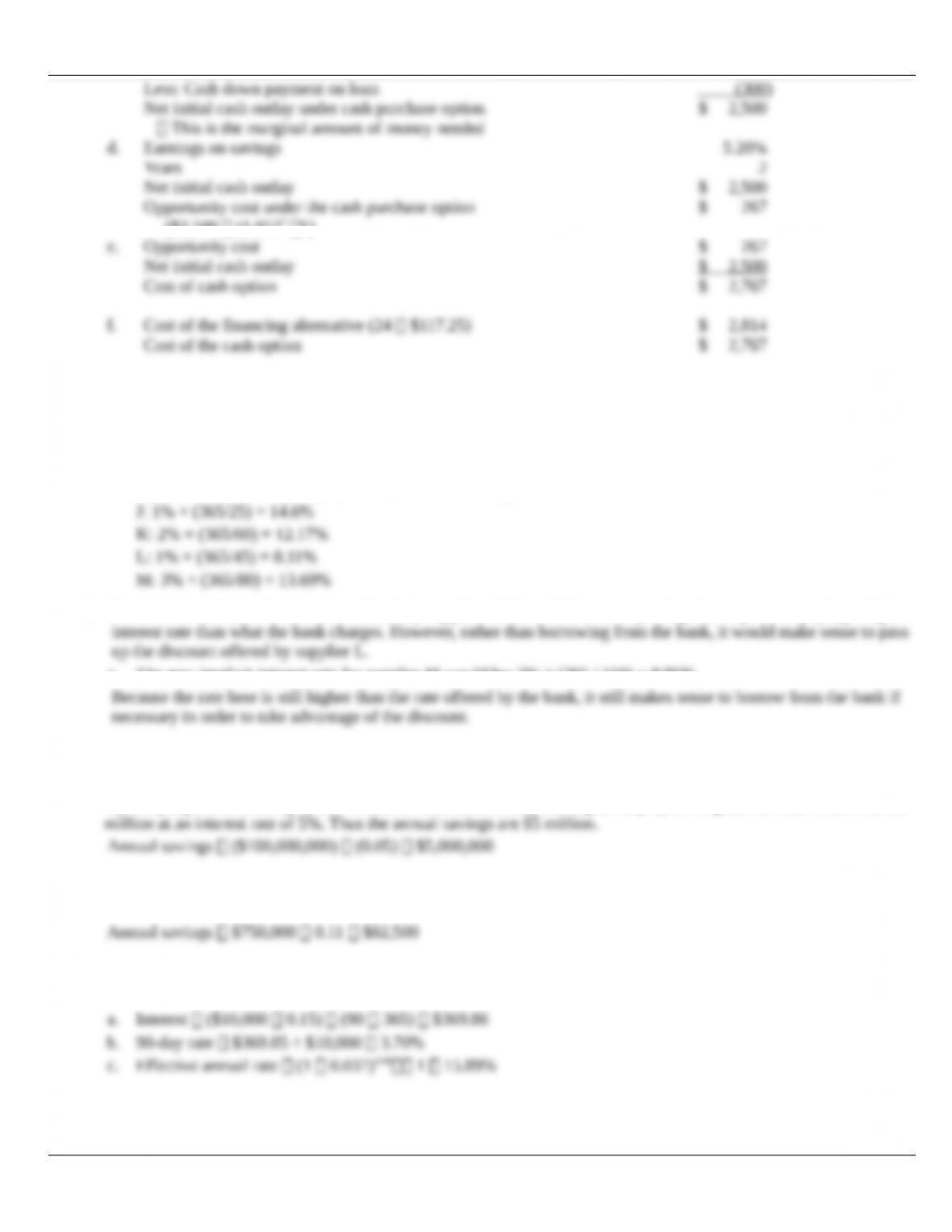
($2,500 (1.0522 1)
Because it is less expensive, Bob and Carol should pay cash for the furniture. The lower cost of
the cash alternative is largely the result of the $300 cash rebate.
P15-6. Cash discount decisions
LG 1, 2; Intermediate
a. Approximate cost of giving up discount from each supplier:
b. The firm should take the discounts offered by suppliers J, K, and M because passing those up means paying a higher
c. The new implicit interest rate for supplier M would be: 3% × (365 / 110) = 9.95%
P15-7. Changing payment cycle
LG 2; Basic
By delaying check clearing by one week, the firm is essentially forcing its employees to grant the firm a loan of $100
P15-8. Spontaneous sources of funds, accruals
LG 2; Intermediate
P15-9. Cost of bank loan
LG 3; Intermediate
© 2015 Pearson Education, Inc.