P14-5. EOQ analysis
LG 3: Intermediate
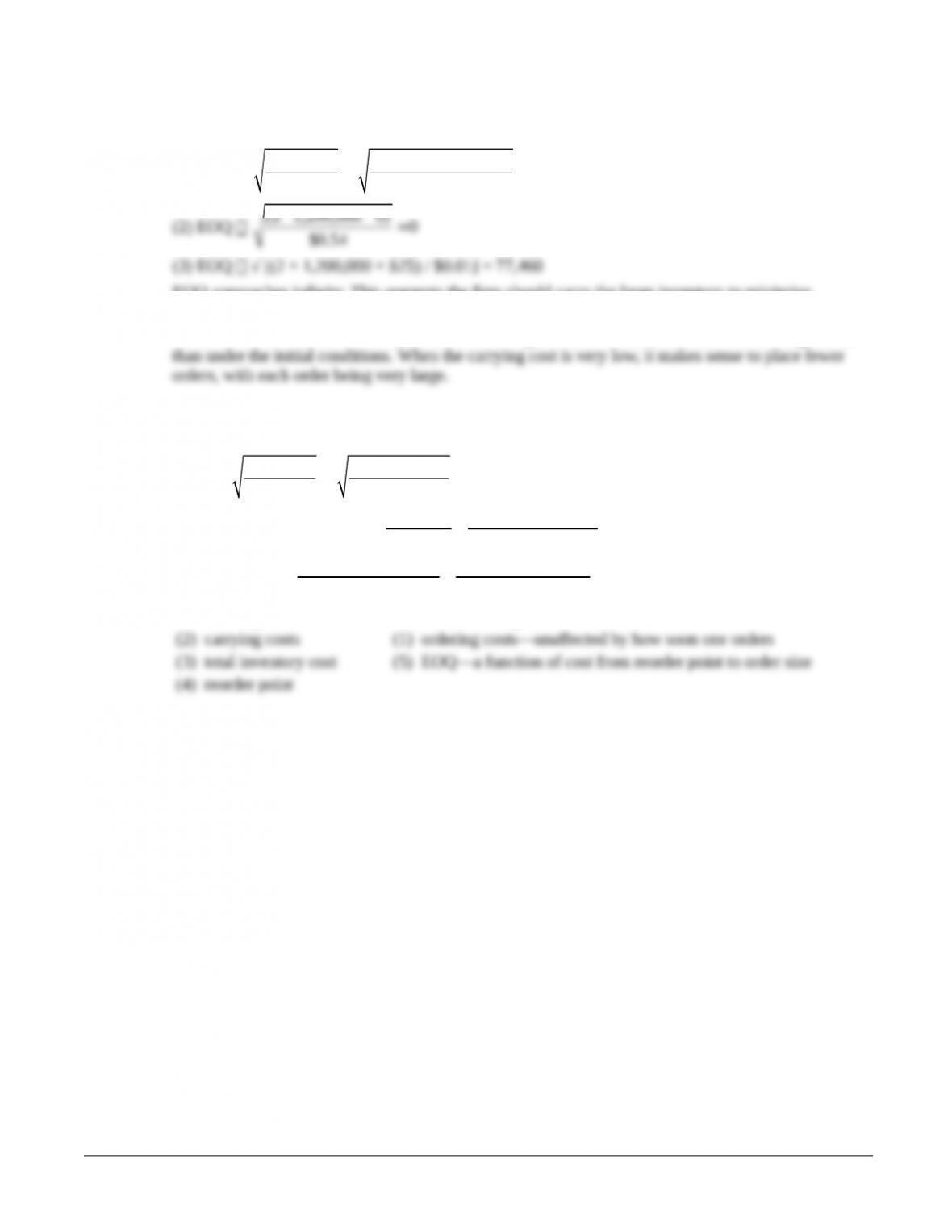
a. (1) EOQ
(2 ) (2 1,200,000 $25)
= = 10,541
$0.54
S O
C
´ ´ ´ ´
(2 1,200,000 0) 0
$0.54
´ ´ =
(3) EOQ √ [(2 × 1,200,000 × $25) / $0.01] = 77,460
EOQ approaches infinity. This suggests the firm should carry the large inventory to minimize
ordering costs.
b. When the fixed order cost is zero, it makes sense to place more orders, with each order being smaller
P14-6. EOQ, reorder point, and safety stock
LG 3; Intermediate
a. EOQ
(2 O) (2 800 $50)
= = 200 units
C 2
S´ ´ ´ ´
b. Average level of inventory
200 units 800 units 10 days
2 365
´
+
121.92 units
c. Reorder point
(800 units 10 days) (800 units 5 days) 32.88 units
365 days 365 days
´ ´
+ =
d. Change Do Not Change
(2) carrying costs (1) ordering costs—unaffected by how soon one orders
(3) total inventory cost (5) EOQ—a function of cost from reorder point to order size
(4) reorder point
© 2015 Pearson Education, Inc.
2 Gitman/Zutter Principles of Managerial Finance, Brief, Seventh Edition
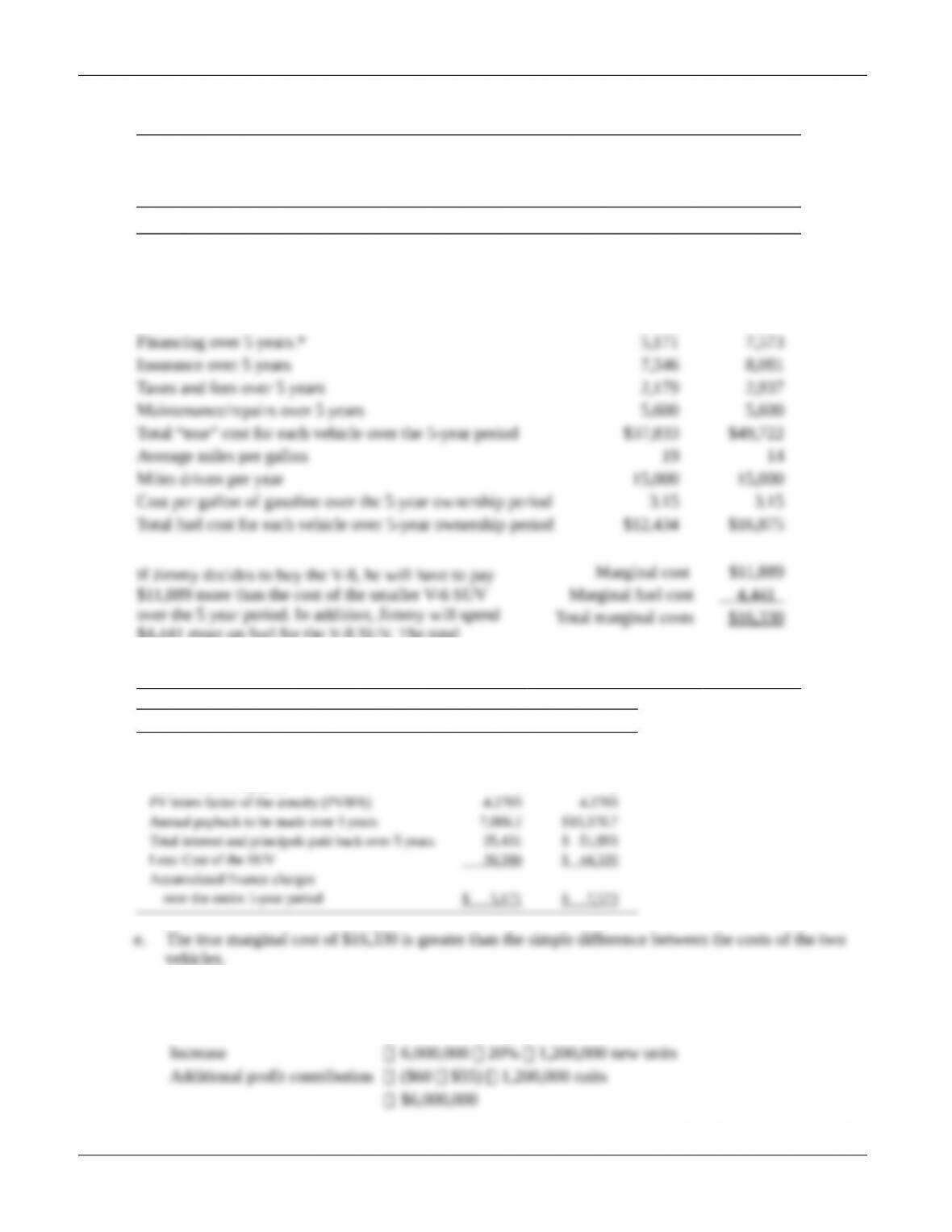
P14-7. Personal finance: Marginal costs
LG 3; Challenge
Jimmy Johnson
Marginal Cost Analysis
Purchase of V-8 SUV vs. V-6 SUV
V-6 V-8
MSRP
Engine (liters)
Ownership period in years
Depreciation over 5 years
$30,260
3.7
5
17,337
44,320
5.7
5
25,531
$4,441 more on fuel for the V–8 SUV. The total
marginal costs over the 5-year period, associated with
purchasing the V–8 over the V-6, are $16,330.
* Accumulated Finance Charges V–6 V–8
Cost of SUV
Assumed annual discount rate
Term of the loan (years)
$30,260.00
5.50%
5
$ 44,320
5.5%
5
vehicles.
P14-8. Accounts receivable changes without bad debts
LG 4; Intermediate
a. Current units $360,000,000 $60 6,000,000 units
© 2015 Pearson Education, Inc.
Chapter 14: Working Capital and Current Assets Management 3
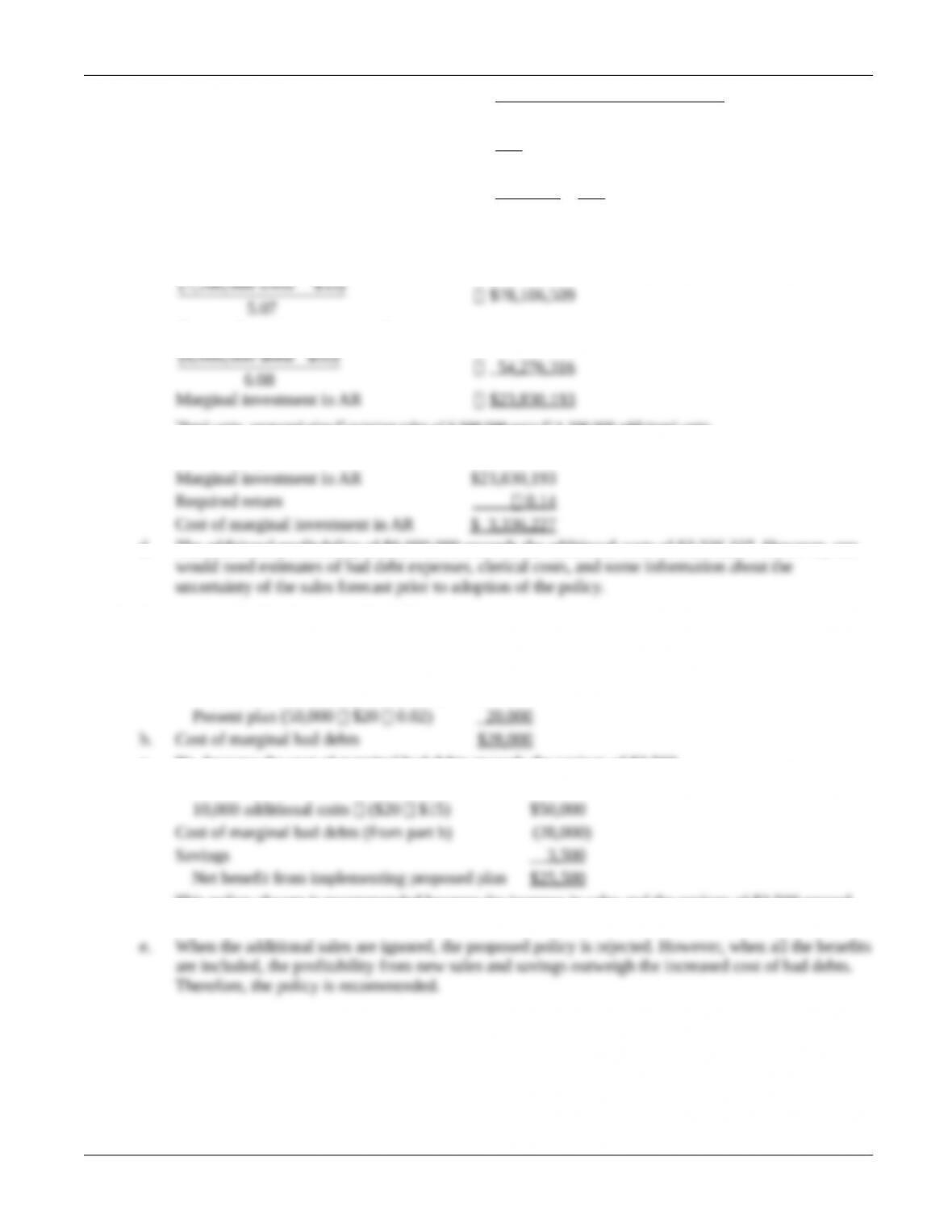
b. Average investment in accounts receivable
total variable cost of annual sales
turnover of A/R
Turnover, present plan
365 6.08
60 =
Turnover, proposed plan
365 365 5.07
(60 1.2) 72
= =
´
Marginal investment in AR:
Average investment, proposed plan:
*
(7,200,000 units $55)
5.07
´
Average investment, present plan:
(6,000,000 units $55)
´
*Total units, proposed plan existing sales of 6,000,000 units 1,200,000 additional units.
c. Cost of marginal investment in accounts receivable:
d. The additional profitability of $6,000,000 exceeds the additional costs of $3,336,227. However, one
P14-9. Accounts receivable changes and bad debts
LG 4; Challenge
a. Bad debts
Proposed plan (60,000 $20 0.04) $48,000
c. No, because the cost of marginal bad debts exceeds the savings of $3,500.
d. Additional profit contribution from sales:
This policy change is recommended because the increase in sales and the savings of $3,500 exceed
the increased bad debt expense.
P14-10. Relaxation of credit standards
LG 4; Challenge
Additional profit contribution from sales 1,000 additional units ($40 $31) $9,000
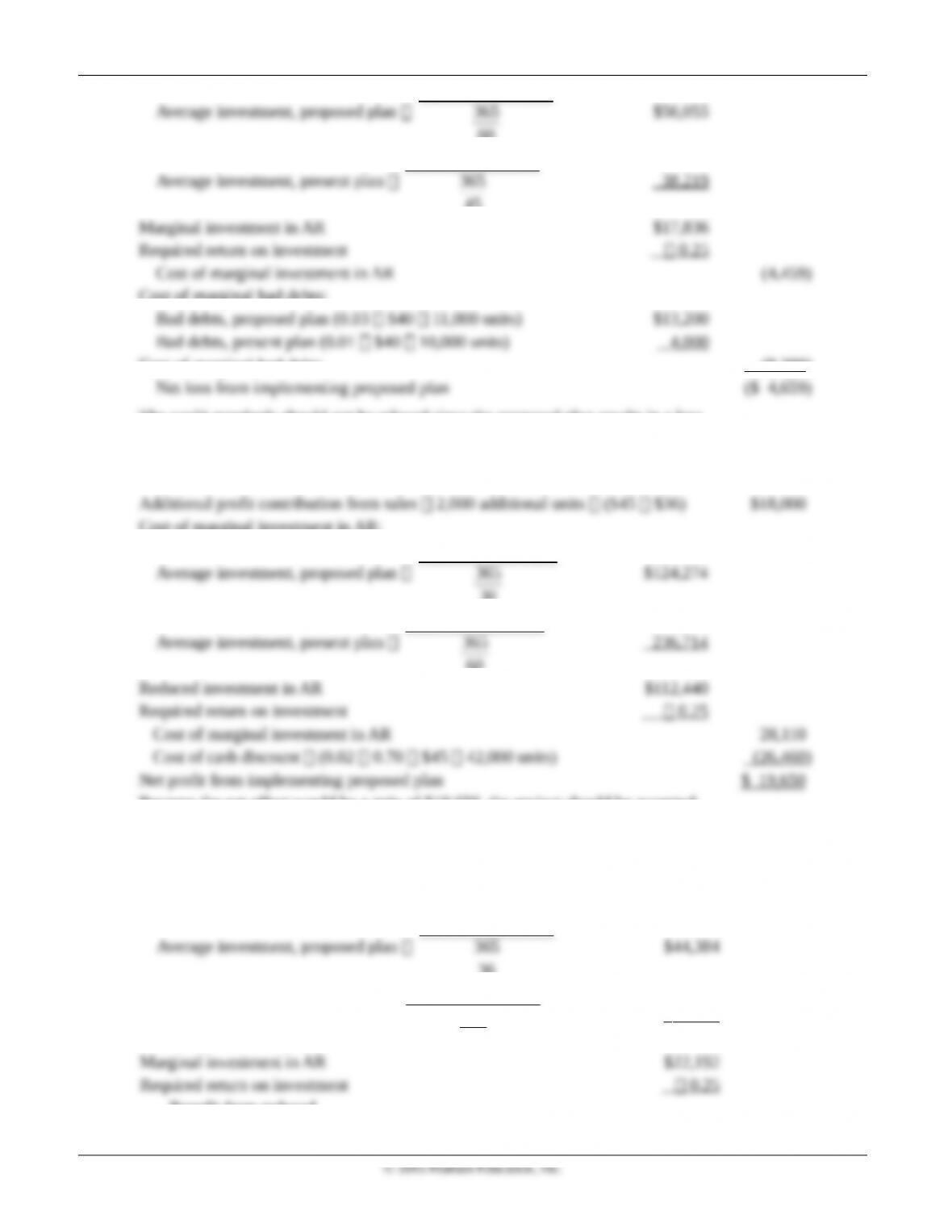
Cost of marginal investment in AR:
© 2015 Pearson Education, Inc.
4 Gitman/Zutter Principles of Managerial Finance, Brief, Seventh Edition
11,000 units $31
60
´
10,000 units $31
´
Cost of marginal bad debts:
Cost of marginal bad debts (9,200)
The credit standards should not be relaxed since the proposed plan results in a loss.
P14-11. Initiating a cash discount
LG 5; Challenge
Cost of marginal investment in AR:
42,000 units $36
30
´
40,000 units $36
´
Because the net effect would be a gain of $19,650, the project should be accepted.
P14-12. Shortening the credit period
LG 5; Challenge
Reduction in profit contribution from sales 2,000 units ($56 $45) ($22,000)
Cost of marginal investment in AR:
10,000 units $45
36
´
Average investment, present plan
12,000 units $45
365
45
´
66,576
Benefit from reduced
© 2015 Pearson Education, Inc.
Chapter 14: Working Capital and Current Assets Management 5
Marginal investment in AR $ 5,548
Cost of marginal bad debts:
This proposal is not recommended.
P14-13. Lengthening the credit period
LG 5; Challenge
Preliminary calculations:
Contribution margin
($450,000 $345,000) 0.2333
$450,000
–=
3
a. Additional profit contribution from sales:
b. Cost of marginal investment in AR:
$510,000 0.767
60
´
Average investment, present plan
$450,000 0.767
365
30
´
28,368
Marginal investment in AR ($35,934)
Required return on investment 0.20
Cost of marginal investment in AR ($ 7,187)
c. Cost of marginal bad debts:
Bad debts, proposed plan (0.015 $510,000) $7,650
Bad debts, present plan (0.01 $450,000) 4,500
Cost of marginal bad debts (3,150)
d. Net benefit from implementing proposed plan $3,663
The net benefit of lengthening the credit period is a surplus of $3,663; therefore the proposal is
recommended.
P14-14. Float
LG 6; Basic
P14-15. Lockbox system
LG 6; Basic
© 2015 Pearson Education, Inc.
6 Gitman/Zutter Principles of Managerial Finance, Brief, Seventh Edition
($8,877/day) 3 days $26,631
P14-16. Zero-balance account
LG 6; Basic
Current average balance in disbursement account $420,000
Opportunity cost (12%) 0.12
Current opportunity cost $ 50,400
Zero-balance account
The opportunity cost of the zero-balance account proposal ($48,000) is less than the current account
opportunity cost ($50,400). Therefore, accept the zero-balance proposal.
P14-17. Personal finance: Management of cash balance
LG 6; Intermediate
a. Alexis should transfer her current savings account balances into a liquid
marketable security
b. Current savings balance
$15,000
c. Alexis should transfer monthly the $500 from her checking account to the liquid
marketable security
Monthly transfer
$500.00
d. Rather than paying bills so quickly, Alexis should pay bills on their
due dates
Average monthly bills
$ 2,000
Summary
© 2015 Pearson Education, Inc.
Chapter 14: Working Capital and Current Assets Management 7
Increase in Alexis’s annual earnings $454.36
P14-18. Ethics problem
LG 6; Intermediate
Management should point out that what it is doing shows integrity, as it is honest, just, and fair. The ethics
reasoning portrayed in the Focus on Ethics box could be used.
Case
Case studies are available on www.myfinancelab.com.
Assessing Roche Publishing Company’s Cash Management Efficiency
Chapter 14’s case involves the evaluation of a furniture manufacturer’s cash management by its treasurer. The student
must calculate the OC, CCC, and resources needed and compare them to industry standards. The cost of the firm’s
Change in sales volume:
Total contribution margin of annual sales:
Under proposed plan ($15,000,000 0.20) $ 3,000,000
Investment in accounts receivable:
Turnover of accounts receivable:
Average investment in accounts receivable:
Cost of marginal investment in accounts receivable:
Average investment under proposed plan $1,380,898
Cost of marginal bad debts:
Bad debt would remain unchanged as specified in the case.
Net profits from implementation of new plan:
Additional profit contribution from sales:
© 2015 Pearson Education, Inc.
8 Gitman/Zutter Principles of Managerial Finance, Brief, Seventh Edition
Marginal investment in AR $428,313
Spreadsheet Exercise
The answer to Chapter 14’s Eboy Corporation accounts receivable management spreadsheet problem is located on
the Instructor’s Resource Center at www.pearsonhighered.com/irc under the Instructor’s Manual.
Group Exercise
Group exercises are available on www.myfinancelab.com.
The focus of financial management evolves from long-term investment decisions to short-term cash management
in this chapter. This assignment will require the groups to establish proper controls to better manage its current
assets and liabilities. This process begins with the development of the fictitious firm’s operating cycle. This is
based on its AAI and ACP.
© 2015 Pearson Education, Inc.