
Part 7
Short-Term Financial Decisions
Chapters in This Part
Chapter 14 Working Capital and Current Assets Management
Chapter 15 Current Liabilities Management
Chapter 14
Working Capital and Current Assets Management
Instructor’s Resources
Overview
This chapter introduces the fundamentals and describes the interrelationship of net working capital, profitability, and risk in
managing a firm’s current asset accounts. The chapter then focuses on the management of three major current asset
accountscash, accounts receivable, and inventory. Also discussed are general inventory management policies, international
inventory management, and several specific inventory management techniques: ABC, economic order quantity (EOQ), reorder
point, materials requirement planning (MRP), and just-in-time (JIT). The key aspects of accounts receivable management are
discussed: credit policy, credit terms, and collection policy. The chapter also discusses the additional risk factors involved in
managing international accounts receivable. Examples demonstrate the effect of changes in credit policy. Also discussed are
the impacts of changes in cash discounts. The chapter describes how managers and individuals often have to make choices
that involve tradeoffs between quantity and price.
Answers to Review Questions
1.Working capital management, the management of a firm’s current assets and liabilities, is one of the most important
functions of a financial manager. Managing these accounts wisely results in a balance between profitability and risk that
The basic definition of net working capital is the difference between current assets and current liabilities. An alternative definition
© 2015 Pearson Education, Inc.
2 Gitman/Zutter Principles of Managerial Finance, Brief, Seventh Edition
2.The more predictable a firm’s cash inflows, the lower the level of net working capital with which it can safely operate. This
3.If a firm increases the ratio of current assets-to-total assets, it will have a larger proportion of current assets. Because
The higher the ratio of current liabilities to total assets, the more current liabilities in relation to long-term funds held by the
4.A firm’s operating cycle is the period when a firm has its money tied up in inventory and accounts receivable until cash is
collected from the sale of the finished product. It is calculated by adding the average age of inventory (AAI) to the
5.If a firm does not face a seasonal cycle, then it will face only a permanent funding requirement. With seasonal needs the
6.An aggressive strategy finances a firm’s seasonal needs, and possibly some of its permanent needs, with short-term funds,
8.Financial managers will tend to keep inventory levels low to reduce financing costs. Marketing managers want large
© 2015 Pearson Education, Inc.
Chapter 3: Financial Statements and Ratio Analysis 3
Inventory is an investment because managers must purchase the raw materials and make expenditures for the production of
9.The ABC system divides inventory into three categories of descending importance based on certain criteria established by a
firm, such as total dollar investment and cost per item. Control of the A items is the most sophisticated due to the high
investment involved, while B and C items would be subject to less strict controls.
The EOQ looks at all of the various costs of inventory and determines what order size minimizes total inventory cost. The
model analyzes the trade-off between order costs and carrying costs and determines the order quantity that minimizes the
total inventory cost.
10. The need to ship materials and products to foreign countries creates challenges for international inventory managers.
11.A firm uses a credit selection process to determine if credit should be extended to a customer and if so, how much. The
credit manager may use the five Cs of credit to focus the analysis of a customer’s creditworthiness:
12. Credit scoring is the ranking of an applicant’s overall credit strength. It is derived as a weighted average of scores on key
© 2015 Pearson Education, Inc.
4 Gitman/Zutter Principles of Managerial Finance, Brief, Seventh Edition
14. The risks of international credit management include exposure to foreign exchange rate fluctuations and delays in
15. A firm’s credit terms conform to those of its industry for competitive reasons. If its terms are less restrictive than its
ACP is used to determine the average number of days that it takes to collect accounts receivable. The collection period
17. Float refers to funds that have been dispatched by a payer but are not in a form that can be spent by the payee. The three
components of float are mail float, processing float, and clearing float.
19. The three main advantages of cash concentration are as follows:
21. To be marketable, a security must have both a ready market and safety of principal. The market should have breadth (a
Suggested Answer to Focus on Practice Box: RFID: The Wave of the Future?
What problem might occur with the full implementation of radio frequency identification (RFID) technology in retail
industries? Specifically, consider the amount of data that might be collected.
One potential problem with RFID technology is what to do with all of the data. If you track a truck through in-cab telemetrics,
you have one lump of data. If you track each roll-cage within that truck, you have 40. If you track each tote, that is perhaps a
© 2015 Pearson Education, Inc.
Chapter 3: Financial Statements and Ratio Analysis 5
Answers to Warm-Up Exercises
E14-1. Operating Cycle
Answer:
Operating cycle = Average age of inventory + Average collection period
E14-2. Maximum and minimum seasonal funding requirements
Answer:
–Funding requirement = cash + inventory + accounts receivable accounts payable
Maximum funding requirement $35,000 $125,000 $70,000 $65,000 $165,000
Minimum funding requirement $10,000 $55,000 $40,000 $35,000 $70,000
= + + – =
= + + – =
E14-3. EOQ and reorder point
Answer: S 50,000
E14-4. Evaluation of change in credit standards
Answer: Step 1: Calculate profit contribution from additional sales
Additional profit contribution 50,000 units ($30 $20) $500,000
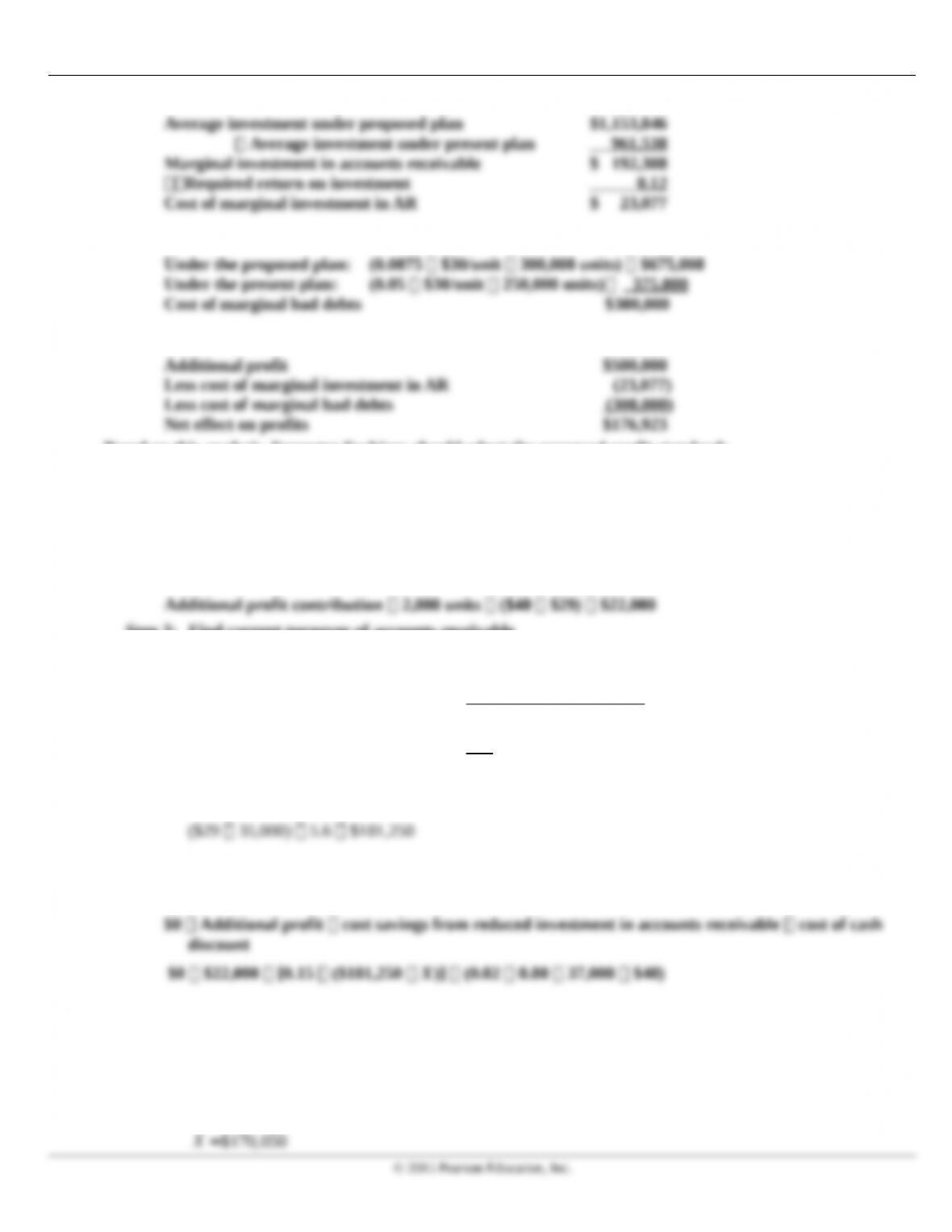
Step 2: Calculate cost of marginal investment in accounts receivable
(a) Find turnover of accounts receivable
(b) Find total variable cost of annual sales
(c) Find average investment in accounts receivable
© 2015 Pearson Education, Inc.
6 Gitman/Zutter Principles of Managerial Finance, Brief, Seventh Edition
Cost of marginal investment in accounts receivable:
Step 3: Calculate the cost of marginal bad debts
Step 4: Determine effect on profits
Based on this analysis, Forrester Fashions should adopt the proposed credit standards.
E14-5. Cash discount plan
Answer: The minimum average collection period after the discount is introduced can be determined when the net
profit from the initiation of the new plan is $0.
Step 1: Calculate profit contribution from additional sales
Step 2: Find current turnover of accounts receivable
Average investment presently (without discount)
365
Turnover of AR Average collection period
365
Under present plan 5.6
65
=
= =
Step 3: Determine the average investment presently in AR
Step 4: Let X equal the average investment in accounts receivable after the discount is introduced. Use the
equation below to balance the costs and benefits of introducing the discount policy.
Step 5: Solve for the average investment in AR, after the discount is introduced, which will balance the
equation in Step 4.
$0 $22,000 [0.15 ($181,250 )] (0.02 0.80 37,000 $40)
$0 $22,000 ($27,187.50 0.15 ) $23,680
0.15 $22,000 $27,187.50 $23,680 $25,507.50
X
X
X
= + ´ – – ´ ´ ´
= + – –
= + – =
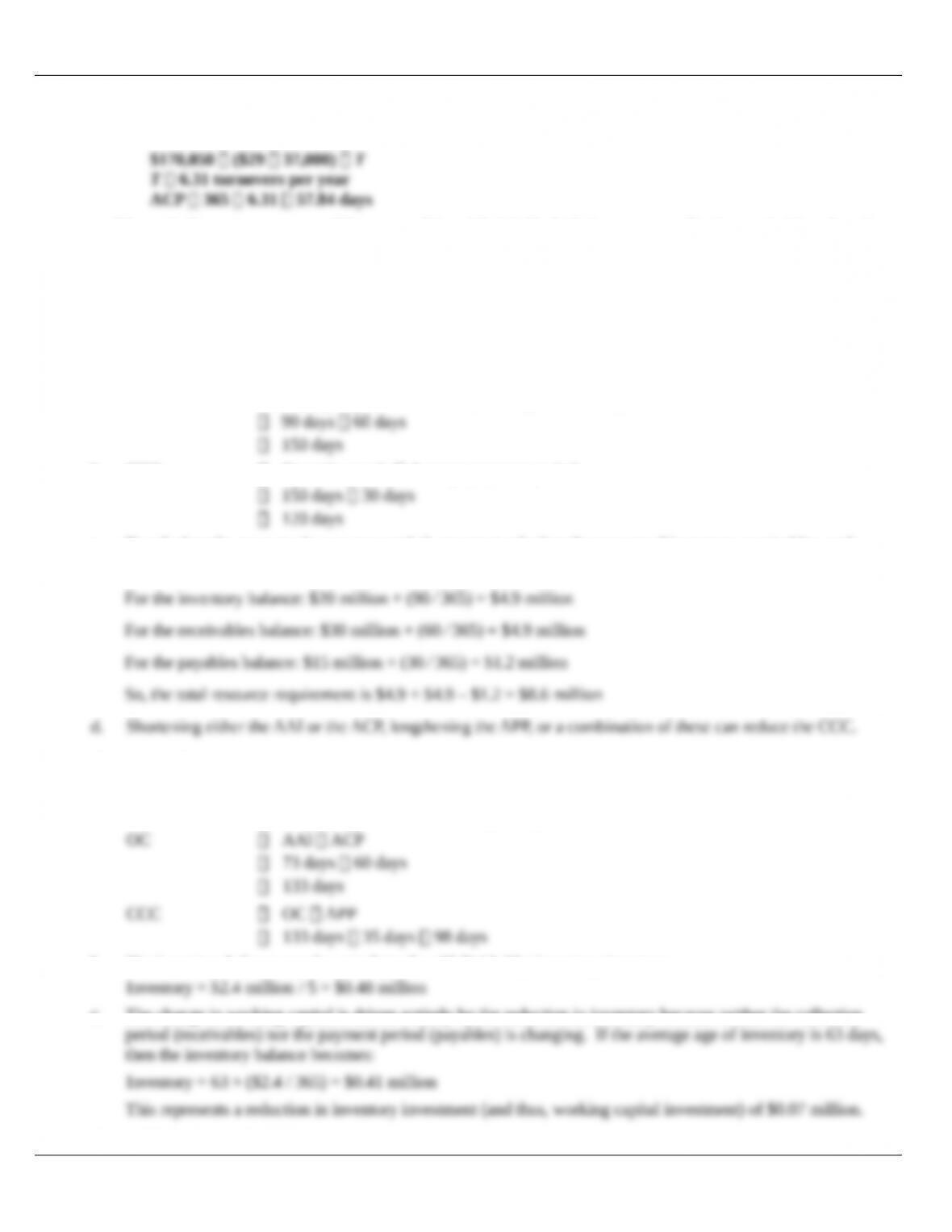
The cash discount program will be acceptable to Klein’s Tools if the average collection period is reduced to
at least 57.84 days from the current 65 days.
Solutions to Problems
P14-1. CCC
LG 2; Basic
a.OC Average age of inventories Average collection period
b. CCC Operating cycle Average payment period
c. To calculate the amount of resources needed, you must calculate the amount of inventory, receivables, and
accounts payable.
P14-2. Changing CCC
LG 2; Intermediate
a.AAI 365 days 5 times inventory 73 days
b. The inventory balance equals cost of goods sold divided by inventory turnover:
c. The change in working capital is driven entirely by the reduction in inventory because neither the collection
P14-3. Multiple changes in CCC
© 2015 Pearson Education, Inc.
8 Gitman/Zutter Principles of Managerial Finance, Brief, Seventh Edition
LG 2; Intermediate
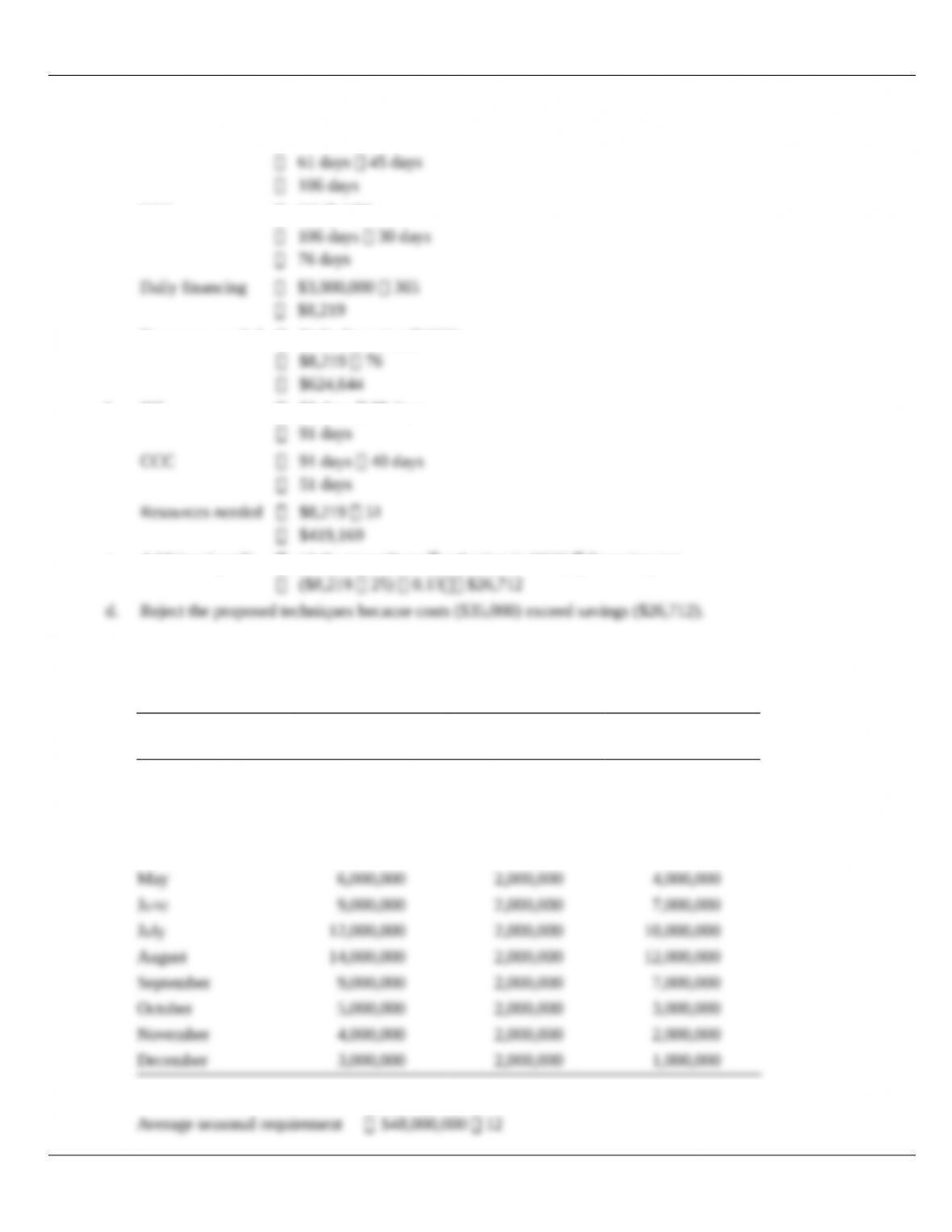
a. AAI 365 6 times inventory 61 days
OC AAI ACP
CCC OC APP
Resources needed Daily financing CCC
b. OC 56 days 35 days
c. Additional profit (daily expenditure reduction in CCC) financing rate
P14-4. Aggressive versus conservative seasonal funding strategy
LG 2; Intermediate
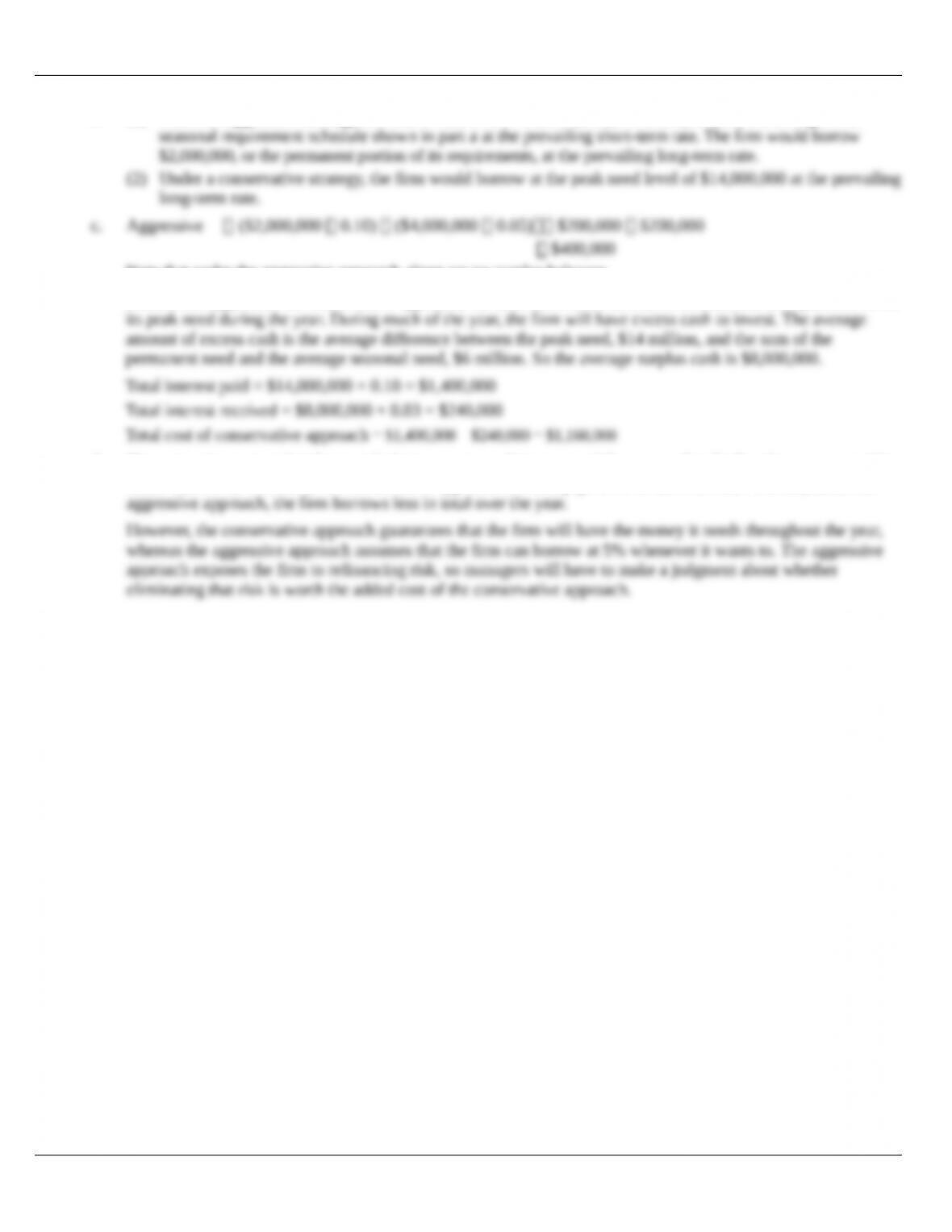
a.
Month
Total Funds
Requirements
Permanent
Requirements
Seasonal
Requirements
January $2,000,000 $2,000,000 $ 0
February 2,000,000 2,000,000 0
March 2,000,000 2,000,000 0
April 4,000,000 2,000,000 2,000,000
Average permanent requirement $2,000,000
© 2015 Pearson Education, Inc.
Chapter 3: Financial Statements and Ratio Analysis 9
$4,000,000
b. (1) Under an aggressive strategy, the firm would borrow from $1,000,000 to $12,000,000 according to the
Note that under the aggressive approach, there are no surplus balances.
ConservativeUnder the conservative approach, the firm borrows $14,000,000 because that is required to cover
d. The aggressive approach is less costly for two reasons. First, some of the money that the firm borrows costs 5%
rather than 10%, whereas in the conservative approach the firm pays 10% on all of its debt. Second, under the
© 2015 Pearson Education, Inc.